Georgia State University Georgia State University
ScholarWorks @ Georgia State University
ScholarWorks @ Georgia State University
History Theses Department of History
Spring 5-11-2013
A Reassessment of Deindustrialization and the Case of Atlantic
A Reassessment of Deindustrialization and the Case of Atlantic
Steel
Steel
Timothy T. Lawrence
Georgia State University
Follow this and additional works at: https://scholarworks.gsu.edu/history_theses
Recommended Citation Recommended Citation
Lawrence, Timothy T., "A Reassessment of Deindustrialization and the Case of Atlantic Steel." Thesis, Georgia State University, 2013.
https://scholarworks.gsu.edu/history_theses/69
This Thesis is brought to you for free and open access by the Department of History at ScholarWorks @ Georgia State University. It has been accepted for inclusion in History Theses by an authorized administrator of
A REASSESSMENT OF DEINDUSTRIALIZATION AND THE CASE OF ATLANTIC STEEL
by
TIMOTHY LAWRENCE
Under the Direction of Dr. Jared Poley and Dr. Marni Davis
ABSTRACT
This thesis seeks to understand the causal factors of deindustrialization in the steel industry
during the late twentieth century and uses the former Atlantic Steel Company mill in Atlanta,
Georgia as a case study. Using company records and secondary sources from a variety of social
science disciplines, I explore the roles of neoliberalism, government foreign and domestic
policies, and the world economic crisis of 1973 to reassess contemporary understanding of the
concept of deindustrialization.
A REASSESSMENT OF DEINDUSTRIALIZATION AND THE CASE OF ATLANTIC STEEL
by
TIMOTHY LAWRENCE
A Thesis Submitted in Partial Fulfillment of the Requirements for the Degree of
Master of Arts
in the College of Arts and Sciences
Georgia State University
Copyright By Timothy Lawrence
A REASSESSMENT OF DEINDUSTRIALIZATION AND THE CASE OF ATLANTIC STEEL
by
TIMOTHY LAWRENCE
Committee Co-chair: Jared Poley
Committee Co-chair: Marni Davis
Electronic Version Approved:
Office of Graduate Studies
College of Arts and Sciences
Georgia State University
DEDICATION
ACKNOWLEDGEMENTS
I owe a debt of gratitude to many people who have encouraged, advised, and generally made
positive contributions to this thesis, and to my educational endeavors in the larger sense. I
would like to thank Dr. Joe Perry for encouraging me to switch my thesis topic to a study of
deindustrialization, and challenging me to answer the “so what” question. Dr. Marni Davis gave
me honest advice at a time when I needed it most, and showed me what great pedagogy looks
like. I have had many enlightening and enjoyable conversations with Dr. Charles Steffen, and
I’m grateful that he allowed me to have input into the classes in which I was his TA. Dr. Jared
Poley went above and beyond what anyone could expect from an advisor, and I received more
help and knowledge from him than I can express here. Three of my fellow graduate students,
Mindy Clegg, Sara Patenaude-Schuster, and Dylan Ruediger made my experience intellectually
richer, and their presence is an example of the positive present and future of scholarship at
Georgia State. I am indebted to two old friends, Jason Deck and Joe Winograd for encouraging
me to pursue my academic life, and challenging many of my ill-conceived notions. Lastly, and
most importantly, I would like to thank my wife Judy, who made this thesis possible through
TABLE OF CONTENTS
ACKNOWLEDGEMENTS ... v
TABLE OF CONTENTS ... vi
LIST OF TABLES ... vii
INTRODUCTION ... 1
CHAPTER 1. A SYSTEMATIC DISINVESTMENT ... 7
What is Deindustrialization? ... 7
Many Shades of Causation ... 11
CHAPTER 2. A CLOSER LOOK ... 30
The Crisis of 1973-1975 ... 30
The Spread of Neoliberalism ... 34
The Reality of the World Steel Market ... 41
Government Policy ... 44
Atlantic Steel to Atlantic Station ... 49
CONCLUSION ... 53
LIST OF TABLES
Table 1. Evolution of the Steel Industry, 1960-2000 29
Table 2. Global Growth Rates, Annually and by Decade, 1960-2003 36
INTRODUCTION
The Atlanta Steel Hoop Company was incorporated in 1901 on a large plot of land near
downtown Atlanta, Georgia. The company was initially started to manufacture wire for cotton
bales and steel hoops for the naval stores industry, mainly for turpentine barrels. Unlike its closest
competitors to the west in Birmingham, Alabama – which were founded and funded by steel
magnates from Pittsburgh, Pennsylvania – the Atlanta Steel Hoop Company was started by locals to
supply the local demand for steel products. From the outset it was a corporation, capitalized with
fifty-thousand dollars divided into five-hundred shares and sold at one-hundred dollars apiece.1
The company, not having a furnace yet, originally purchased billets2 from Carnegie Steel Company
of Pittsburg and Tennessee Coal, Iron and Railroad of Birmingham. Within a few short years
Atlantic Steel (the name was changed within the first decade) employed over 120 men, and had
sales in Georgia, Alabama, and South Carolina. In 1905, the company invested five-hundred
thousand dollars on an open-hearth furnace and a blooming mill. This capital investment allowed
for greater product range, and drastically reduced costs by eliminating the need to purchase billets
from outside sources. The company continued to expand and diversify in the first part of the
twentieth century. Atlantic Steel developed a strong presence in the agricultural, merchant, and
commercial construction steel markets in the southeast.3 The firm contracted with the U.S.
1
Charles F. Stone, The Story of Dixisteel: The First Fifty Years, 1901-1951 (Atlanta: Atlantic Steel Company Publication, 1951), 53.
2
A billet is a piece of semifinished iron or steel that is nearly square and is longer than a bloom. Bars and pipe are made from billets. A bloom is a semifinished product, large and mostly square in cross section. Blooms are shaped into girders, beams and other structural shapes.
3
2
government during WWI, WWII, and the Korean War to supply steel for armaments and other
projects. The company also supported the war efforts by leading War Bond drives and sponsoring
patriotic parades. Over the 1950s and 1960s the company was fairly stable, both in terms of
management, and growth. By the mid-1960s, the company had over three thousand employees
and regularly operated three shifts per day. The plant production workers formed a local union of
the United Steel Workers of America (USW) in the earlier twentieth century, and by the 1960s,
workers enjoyed decent wages and benefits, though there were occasional strikes and work
stoppages.
At first glance, the history of a steel mill in Atlanta might seem a strange choice for a focus
on industrialization/deindustrialization, but the Atlanta mill–by well-timed adoption of technology
in the late 1950s–was representative of the future of the industry in a couple of important ways.
First–unlike the steel town Birmingham, Alabama–Atlanta is not situated in close proximity to most
of the natural resources needed for integrated steel production. Iron ore, coal, limestone, and
abundant fresh water are all keys to producing steel in open-hearth and basic oxygen furnaces. The
original open-hearth furnace served the company well for many years, but in a move to become
more competitive, installed a state-of-the-art electric arc furnace in the late 1950s. The electric arc
furnace required only a good supply of cheap electricity and scrap iron; Atlanta had both. Being
located at a major railroad hub, Atlantic Steel had access to railroad lines with which to quickly
transport scrap from all areas in the region or nation, and Georgia Power had an extensive network
of hydroelectric and coal-fired plants able to supply Atlantic Steel with reliable and cheap
3
electricity. Atlantic Steel was an early adaptor to the electric furnace (minimill) method of steel
production and it created a niche market based on flexibility and access to their regional market.
After Atlantic Steel modernized with the new electric arc furnace in 1956, they expanded
into the prefabricated building market, which complimented their other product lines. The
company grew, modernized, and managed to survive the Great Depression of the 1930s and
financial crises of the 1950s, 1960s, and 1970s. The company built a second plant in Cartersville,
Georgia in the mid-1970s with cutting edge technology and an expanding market presence. Then
the company was acquired by a Canadian firm in the late 1970s and was part of two more
corporate consolidations before the Atlanta plant ceased operations. This thesis addresses the
question of why Atlantic Steel closed, and it probes the question of whether or not the shuttering
of Atlantic Steel is a moment in the historical development of deindustrialization. We will consider
how Atlantic Steel fit into the global steel market, and how that market changed over the course of
the late twentieth century. At its heart, the thesis seeks to use the study of Atlantic Steel to
examine the historical evolution of capitalism in the developing world in the late twentieth century.
The process of deindustrialization became a focus of academic study during the early 1980s
and began in earnest with the publication of Barry Bluestone and Bennett Harrison’s The
Deindustrialization of America. Bluestone and Harrison define deindustrialization as “a widespread,
systematic disinvestment in the nation’s basic productive capacity.”4Their influential book
challenged the hypothesis of “creative destruction” popularized by Joseph Schumpeter which
maintains that capitalism inherently destroys certain modes of production, and that this is
4
4
ultimately beneficial because they will be replaced by new, innovative and more productive
alternatives. Bluestone and Bennett argue that large proportions of workers who lose their jobs
due to plant closings remain unemployed for years, and many never find comparable jobs again.5
This thesis will analyze the work of Bluestone and Bennett thirty years later to see if their
arguments are valid today, and to see if what happened with Atlantic Steel should be considered
deindustrialization.
Using Atlantic Steel as a case study, this thesis will apply the theoretical models of social
theorist David Harvey to the globalization of the steel industry and in the process put his work into
conversation with deindustrialization theory. The story of Atlantic Steel (and its transformations
after 1950) provides cogent evidence of the validity of Harvey’s arguments, namely that there was
a sea change in the ways in which large business entities sought capital accumulation. The tipping
point for that change occurred as a result of the global financial crisis of 1973-1975. Prior to the ’73
crisis, the vast majority of firms in the democratic industrialized world (the US, Western Europe,
Japan, etc.) sought capital accumulation through production and market dominance for their
products. This system was exemplified by the Fordist model, and it was particularly prevalent in
North America. But Harvey shows that after the shift in 1973, accumulation became synonymous
with specialty niche markets, decentralized conglomerates which dispersed production globally,
and a large-scale decrease in government intervention marked by privatization schemes and
deregulation.6 In addition, businesses increasingly turned toward nonproductive methods of capital
5
Ibid, 10.
6
5
accumulation such as mergers and acquisitions. All of these factors were present in the case of
Atlantic Steel.
Research for this paper relies heavily on the Atlantic Steel Company archives which are
housed at the Kenan Research Center of the Atlanta History Center; the United Steelworkers of
America, District 35 papers; and the Voices of Labor Oral History Project which are both located in
the Southern Labor Archives of Georgia State University.
In addition, I have located many secondary sources concerning the steel industry,
globalization, and deindustrialization. Two sources of particular usefulness are an Atlantic Steel
Company history written by a member of their board of directors which is very
management-centric; and a PhD dissertation that analyzed Atlantic Steel’s business practices and provides a
great deal of company data and economic analysis. In addition I have located a few oral histories of
former plant workers and union officials which provide a social angle to this thesis as well.
There are many ways in which to analyze the Atlantic Steel Company, but no one theory fits
or describes the company’s story adequately. Instead of forcing a square peg through a round hole,
so to speak, I will introduce the theorists whose work can benefit an analysis of ASC, but I won’t
force ASC’s story to conform to a specific theoretical framework. Bluestone and Harrison’s theory
of deindustrialization tells some of the story, as do David Harvey and Judith Stein with flexible
accumulation. Rowthorn and Ramaswamy provide some convincing economic arguments that can
shed some light on the ASC story as well, but no one theory fully explains why Atlantic Steel no
longer exists.
In this thesis I will argue that there were three important factors which enabled the process
6
growing affluence, the spread of neoliberal ideology, and the crisis of 1973-75. This thesis will
explore the role of these factors in the process of deindustrialization in the U.S. and specifically
CHAPTER 1. A SYSTEMATIC DISINVESTMENT
What is Deindustrialization?
The public perception of deindustrialization seems to be fairly clear; manufacturing
plants close permanently, leaving workers and municipalities struggling with high
unemployment and a diminished tax base. But social scientists and other academics do not
agree on the causes or implications of deindustrialization. In this chapter I seek to describe
some of the arguments explaining the phenomenon, to get a picture of the process in one
specific location, Atlanta, Georgia. There are three important questions that must be answered
in order to look at the long-term consequences of the loss of Atlantic Steel. What is
deindustrialization? What causes deindustrialization? And finally, is what happened at the
Atlantic Steel Company representative of deindustrialization?
Deindustrialization generally conjures up images of shuttered factories and long lines of
people signing up for unemployment benefits. The term is synonymous with places like
Youngstown (Ohio), Flint (Michigan) and Leeds in the U.K. Scholars Bluestone and Harrison
define deindustrialization as a “widespread, systematic disinvestment in the nation’s basic
productive capacity.”1
Atlantic Steel’s historical development after WWII indicates the ways deindustrialization
unfolded in the southeastern United States. From 1969 onward Atlantic Steel began to reduce
the size of its production workforce, but overall output generally increased due to gains in
productivity. This phenomenon was fairly consistent across the manufacturing sector from
1
8
1970-1990 where adaptation of new technologies and workflow planning caused huge gains in
productivity. The company made capital investments in new technologies, but those
investments were tempered by tax regulations, particularly equipment depreciation schedules.
Yet Atlantic Steel did not divest in itself in the way that Bluestone and Harrison describe
the manufacturing sector doing. In 1970 the company decided that it would relocate its mill in
Atlanta in order to build a more modern facility. Company management soon decided upon
relocating about forty-five miles to the northwest in Cartersville, Georgia. Unlike many steel
mill expansions in Europe, the Cartersville plant was not located to stimulate a depressed labor
market; it stayed close to its core market, and drew from the same labor pool as the original
plant.
The move from Atlanta to Cartersville did not generate huge cost savings for Atlantic
Steel, at least in the short run. Company documents related to long-range planning assumed
that the costs of operation for the Cartersville plant were roughly the same as for Atlanta.2
Costs of rail shipping of scrap were slightly higher, but ad valorem and sewer taxes were much
less in Cartersville. The company did not cite direct cost savings as a major factor in its decision
to relocate, but instead felt that “The best gain in moving will be the opportunity to cut direct
operating cost by rebuilding facilities with lower manpower requirements and improved
material handling opportunities.”3 Atlantic Steel was not specifically seeking to escape union
contracts or find substitute workers at a far lower pay scale, they were looking to modernize
and seek cost savings through gains in productivity. This was not downsizing in the short run,
but it contributed to what David Harvey refers to as “technology induced unemployment” in
2
Atlantic Steel Company records, Boxes 38/2,43/4-5
3
9
the long term.4 In essence, increased productivity means making more with fewer people, and
that is exactly what the U.S. manufacturing sector did over the course of the twentieth century.
While some firms in the manufacturing sector found huge cost savings in plant relocations
during the 1970s, this was not the case with U.S. steel mills, specifically Atlantic Steel.
Although Atlantic Steel was a much smaller operation than many of its competitors,
because it was a minimill it had its advantages too. Flexibility in the steel industry can override
the benefits of economy of scale, especially when the cost difference of building a large
integrated mill vs. a smaller minimill is considered. To demonstrate the advantages of a minimill
Howell, et al. show that in 1988, “a 500,000 TPY [tons per year] minimill shipping 450,000 TPY
of merchant bar is estimated to cost $284 million, or $631 per ton of shipment capacity. In
contrast, a 6 million TPY steel plant shipping 5 million TPY of typical integrated mill products…is
estimated to cost $7.33 billion, or $1,465 per ton of shipment capacity.”5 Cost savings tend to
be linked more to the level of operating capacity the facility is running at, more so than the
overall economy of scale.
Employment rates in U.S. manufacturing, specifically in the steel industry, plummeted in
the latter half of the twentieth century. According to the Bureau of Economic Analysis, U.S.
manufacturing in the broad Durable Goods sector has shown steady declines. In 1945,
15,360,000 workers produced durable goods; by 1980 the number had dropped to 12,237,000,
and by 2011 had fallen to 7,309,000. The U.S. was not alone in the loss of manufacturing jobs.
In Britain, according to Dambisa Moyo, “between 1979 and 2006, the numbers employed in the
4
David Harvey, The Enigma of Capital (New York: Oxford University Press, 2010), 96.
5
10
manufacturing industry fell 50 per cent from 7 million, to just under 3.4 million.”6 In the U.S.,
the steel industry saw an even greater decline than the larger manufacturing sector.
Employment in the Primary Metal Industries7 in 1945 was 2,079,000 workers; that number fell
to 1,137,000 in 1980, and 380,000 by 2011.8 Considering the population growth rate during this
period, this is a precipitous decline in employment, yet productivity gains allowed for robust
output.
The economists Allen Collard-Wexler and Jan De Loecker show that while the U.S. steel
industry shed about 75 percent of its workers, output per worker grew by a factor of five, or a
total of about 38 percent in the period 1962-2005.9 Furthermore, U.S. steel plants generated
over 100 billion dollars’ worth of product in 2007, which make this sector one of the fastest
growing sectors of manufacturing. This strange combination of huge job losses and massive
productivity gains allows us to see a different side of deindustrialization.
Job losses in the steel industry were not evenly spread across the industry, either
geographically or technologically. Steel mill closings in the 1980s were primarily concentrated in
the integrated sector.10 Integrated steel production requires more steps, each requiring more
manpower, than minimills. The integrated sector in the U.S. generally upgraded their
technology in the 1950s and 1960s, and they missed a wave of new technological development
in the late 1960s and early 1970s. This left U.S. producers with outdated equipment by the late
1970s and early 1980s, and high inflation rates at the time made it difficult to retool. This put
6 Dambisa Moyo,
How the West Was Lost (New York: Farrar, Straus, and Giroux, 2011), 85.
7
This designation includes the aluminum industry, which is a totally separate sector from steel.
8
Bureau of Economic Analysis website. www.bea.gov accessed 10/20/2012.
9
Allen Collard-Wexler and Jan De Loecker, “Reallocation and Technology: Evidence from the U.S. Steel Industry,” www.princeton.edu/ceps/workingpapers/230deloecker.pdf
10
11
U.S producers at a disadvantage to their Western European and Japanese competitors who had
upgraded at a more advantageous time. All of this contributed to plant closings in the U.S.
integrated sector.
Atlantic Steel did not relocate its mill outside of the country or even the region, so
off-shoring was not an issue. Atlantic Steel’s second mill in Cartersville, Georgia was initially
represented by the same Steelworkers Local Union and contract as the Atlanta mill, so this is
not a case of a runaway shop or a blatant union busting initiative. Instead, Atlantic Steel fell
victim to successive waves of corporate buyouts by ever-larger international conglomerates.
The company became a node of production within an enormous economy of scale; an outpost
of supply for a centralized, yet globally dispersed, corporate giant. The remaining vestige of the
former Atlantic Steel Company is the lone Cartersville mill, now a subsidiary of the Brazilian firm
Gerdau, “the leading supplier of long steel in the Americas.”11
Many Shades of Causation
There are many theorists who consider deindustrialization necessary, if not good, for
the capitalist system. Collard-Wexler and De Loecker do not use the term deindustrialization,
but their work is also not concerned with job loss or plant closures, they use the term
“reallocation”. Other social scientists and business people use the benign term “restructuring”
when discussing crisis-induced changes in the market. These phrases harken back to Joseph
Schumpeter’s concept of creative destruction, which advocated transferring capital investment
from industries with shrinking or flat growth rates, and investing in new, innovative ones.
Schumpeter wrote that:
11
12
The opening of new markets, foreign or domestic, and the organizational development from the craft shop and factory to such concerns as U.S. Steel illustrate the same process of industrial mutation … that incessantly revolutionizes the economic structure
from within, incessantly destroying the old one, incessantly creating a new one. This process of Creative Destruction is the essential fact about capitalism.12
When one looks at Atlantic Steel, the destructive element of capitalism can be seen as a loss of
control, more specifically ownership. There are no domestically owned steel mills in Georgia
currently. I will address the idea of the creative aspect of capitalism in chapter two.
Other economists such as Robert Rowthorn and Ramana Ramaswamy explicitly use the
term deindustrialization, but find it a necessary part of capitalism much like Schumpeter. In fact
there seems to be no academic argument rejecting the existence of deindustrialization, rather
there are opposing arguments about its causation and necessity.
In The Deindustrialization of America, Barry Bluestone and Bennett Harrison found that
changes in corporate strategy led to large conglomerates acquiring firms, reallocating profits,
and then refusing to reinvest capital back into the infrastructure of its old-style divisions such as
steel production. They shifted capital away from, often profitable, production and into new
sectors such as finance and further acquisition where greater short term profits could be had.
Bluestone and Harrison state that:
Deindustrialization is the outcome of a worldwide crisis in the economic system. The very successes of the long postwar expansion generated conditions that ultimately turned the normal, and often healthy, disinvestment process into a torrent of capital flight and wholesale deindustrialization. During the boom years, U.S. economic
expansion abroad generated enormous short-run profits, but in the course of doing this it helped to establish excess (unused) productive capacity in one basic industry after another. Through their multinational subsidiaries and the profitable sale of patents and licenses to foreign enterprises, the leading American firms even helped to generate their own future competition. In the 1970s this competition came back to haunt them in
12
13
virtually every major industry: steel, automobiles, shipbuilding, and electronics, to name a few.13
Bluestone and Harrison’s groundbreaking study was first published in 1982, right at the height
of U.S. plant closings, and during a period of high unemployment. This was also a point of crisis
at Atlantic Steel when company management were seeking to eliminate benefits and reduce
wages. Hindsight reveals that while plant closings did put a large proportion of steelworkers out
of work, the extremely low levels of unemployment a decade later suggests that many of those
laid off as a result of deindustrialization found other jobs. Whether those new jobs provided
comparable wages and benefits is another question altogether. In terms of the physical space in
which Atlantic Steel operated, the jobs that currently exist are mostly low-wage retail sales for
corporations like H&M clothing and Publix supermarkets.
In a more contemporary analysis sociologist Christopher Kollmeyer identifies three
primary explanations for deindustrialization within the social science literature: unbalanced
productivity growth, growing affluence of consumers, and economic globalization. While
Kollmeyer does not find that these three explanations are mutually exclusive, he does find that
they are weighted differently. In fact, Kollmeyer states that previous studies of
deindustrialization causation are inaccurate because they fail to analyze all three hypotheses
together. It is useful to consider Kollmeyer’s argument in regards to Atlantic Steel.
Many scholars have made the argument that unbalanced productivity growth has
caused deindustrialization.14 The basic premise of this argument is that the manufacturing
13
Bluestone and Harrison, 15.
14
14
sector has experienced far greater gains in productivity than most other sectors of the
economy, which can be measured as a yearly increase in the output of goods or services for
each worker. Because highly productive companies can produce the same or greater output
with their existing workforce (as Atlantic Steel did), Kollmeyer writes that the macroeconomic
ramifications of this are “that if one sector consistently outpaces other sectors in productivity
growth, and if the pattern of demand among these sectors remains constant, then employment
growth should contract in the dynamic sector, where demand for labor is shrinking, and expand
in the less-dynamic sector, where the demand for labor remains robust.”15 But Kollmeyer cites
statistical studies from the 2000s that refute this claim and instead show that increasing
productivity actually increases jobs in the manufacturing sector by driving down prices through
international competition, whereby these lower prices create greater demand from
consumers.16 One problem with applying this argument to steel production is that steel prices
are inelastic. Howell et al. illustrate that steel is a component of a durable good–sometimes
called an intermediate good–but that lowering the price of steel does not in itself lower the
cost of the final durable good. In other words, lowering the price of steel does not increase the
demand for steel.17 That being said, some intermediate goods have more influence on final
price than others. For instance, steel prices would likely have a greater impact on a municipality
planning infrastructure upgrades than on the manufacture of microwave ovens. Since Atlantic
Steel’s main market was the construction industry, Kollmeyer’s correlation seems applicable to
the historical evidence provided by the case of Atlantic Steel.
15
Kollmeyer, 1647.
16
Kollmeyer, 1648.
17
15
Another popular explanation for deindustrialization is growing affluence among
consumers. This means that as the relative affluence of a society increases, there is a shift in
spending away from manufactured products and toward services. This is sometimes referred to
as Engel’s Law. To illustrate this point hypothetically we can look at tools. In a less affluent
society, individuals might be obligated to provide all the maintenance on their own homes and
vehicles, thus necessitating tool purchases. In a more affluent society there is a tendency to pay
other people to perform those same maintenance services, and thus less of a demand for those
tools, as one tool might service many clients. As metro Atlanta became more affluent, there
was a decrease in agricultural land use in the outer areas (which were suburbanized), and this
led to a reduction in Atlantic Steel’s sales in its agricultural products. Atlantic Steel’s sales in the
residential and commercial construction sector increased along with the growth of Atlanta’s
suburbs. Additionally, the greater the affluence in a particular society, the less likely workers
are going to want to perform jobs which have the stigma of being reserved for the lower class.
A recent New York Times article found that this is a growing problem in China were affluence
has increased dramatically in recent years.18
The final common explanation for deindustrialization is economic globalization. This is
the most popular explanation among social scientists since the 1980s, and it is the basis of
Bluestone and Harrison’s argument. In this hypothesis, the “classic international division of
labor” is reversed. In the classic model, economically advanced countries manufactured
products from raw materials obtained from less advanced countries and then sold the finished
18
16
product back to them. According to globalization theory, sometime in the 1960s this pattern
morphed into a “new international division of labor,” where multinational corporations
relocated their means of production in order to take advantage of low wage scales in less
economically advanced regions (the South). These relocated facilities moved to low-income
areas in the U.S., particularly the south and the west or overseas to the “global south.” The
term “global south” was coined in 1980 by Willy Brandt, former chancellor of West Germany.
The term is a reference to the huge economic disparity that exists between countries in the
northern and southern hemispheres. The southern hemisphere contains a large percentage of
the world’s population, yet it is the countries of the global north that dominate most aspects of
the world economic system. Though there are outliers such as China and Brazil, the disparity
remains in the early twenty-first century.19 The shift of production to the global south was
aided by the technology of the information revolution, which made it possible to compress
geographical space and time. Companies sought to
enhance their organizational “flexibility” by dispersing their business operations across a worldwide network of smaller and ever-changing business units, each of which performs a specific task within a much larger chain of business activities … outsourcing certain non-essential business functions to third-party service providers, which assume these duties on a contractual basis.20
Globalization therefore siphoned off low-skilled manufacturing jobs from the technologically
and economically advanced countries (the global North) and rapidly industrialized some areas
of the global South. The shift of production to the global south was not done without help from
the industrialized north, Howell et al. show that:
19
For more on Brandt’s concept, see: http://www.stwr.org/special-features/the-brandt-report.html
20
17
In the mid and late 1970s, as the steel recession unfolded, substantial new steelmaking capacity began to become operational in the developing countries. These expansion projects were facilitated by Western world suppliers who sought to offset stagnant steel sales at home by providing state-of-the-art steelmaking equipment and technical
assistance to developing nations. The projects, which generally could not attract
indigenous private capital, were financed through a combination of developing country government subsidies and loans, concessional export financing by export-import banks in the industrialized countries, international development institutions like the Inter-American Development Bank and the World Bank, and perhaps most importantly, private banks in the industrialized nations eager to recycle petrodollars. Loans to developing country steel projects, backed by the guarantees of the local government, were so attractive to foreign banks that credit was made available on a virtually unlimited basis. Between 1974 and 1986, gross steelmaking capacity in the developing Western world grew from 54 to 122 million metric tons, but at the same time, countries like Mexico, Brazil and Argentina incurred a huge burden of foreign debt.21
While the globalization of the developing world is commonly held as leading causes of
deindustrialization, Kollmeyer found that this was not the most important factor in
deindustrialization.
Using regression analysis modeling to simultaneously study all three causal factors with
numbers provided by eighteen Organization of Economic Cooperation and Development
(OECD) countries, Kollmeyer determined that while all three factors have impacted
deindustrialization, the most significant impact came from rising affluence in Northern
countries.22 Furthermore, he finds that:
With or without globalization, the OECD countries were going to experience a considerable move toward postindustrialization during the last decades of the 20th century… more than half of the deindustrialization occurring in these countries is associated with levels of national affluence and unbalanced productivity growth that would have prevailed in the absence of globalization.23
Of course this does not eliminate globalization as a cause of deindustrialization entirely, but it
does suggest that steel industry jobs were reduced more as a result of productivity and growing
21
Steel and the State, 5.
22
Kollmeyer, 1667.
23
18
affluence than of offshoring, which is solidified by the fact that there are still a considerable
number of steel mills currently operating in the U.S. In fact, Atlantic Steel is a good example of
Kollmeyer’s argument because the mill did not relocate to the global South, but was purchased
by a foreign firm. American capitalists looked to other areas in which they could invest their
surplus capital, perhaps because they understood that growing affluence would continue to
erode domestic demand for steel. It is also important to note that Kollmeyer uses the terms
postindustrialization and deindustrialization interchangeably, whereas I do not.
Postindustrialization implies an end to manufacturing that has not yet come, and
deindustrialization suggests the decline of jobs and spaces dedicated to manufacturing. Though
Atlanta’s economy became increasingly diverse it did not lose industrial production altogether.
Kollmeyer made one more observation that is important to a study of the steel industry,
and that is the hidden side of outsourced job loss. For instance, as companies increase
productivity, there is a tendency to outsource non-core plant operations to third party
subcontractors. These could include anything from cleaning of the plant to product engineering,
among other things. Prior to deindustrialization, plant employees carried out most of these
functions, and therefore those jobs would be counted along with the rest of the production
jobs of a manufacturing company. Where these jobs have been subcontracted they would no
longer appear as steel manufacturing jobs, but as service sector jobs. If Atlantic Steel had a
production workforce of nearly 3000 in 1965, but only 550 during the mid-1990s, it is clear that
much of the difference may be attributed to subcontracting.
While sociologists like Kollmeyer provide tangible evidence as to the causes of
19
the role of U.S. government public policy, both foreign and domestic, in the workings of the
steel industry. Stein writes, “Because the steel industry was judged to be fundamental,
affecting the whole economy, the government often used the industry as a lever to effect
changes in the macro economy.”24 Stein shows that the government manipulated such factors
as capacity, prices, wages, industrial structure, and employment practices in order to meet the
goals of domestic policy. Government economists felt that maintaining a steady supply of
inexpensive steel was necessary to hold down rising inflation. But government foreign policies
had both directly and indirectly supported the growth of foreign steel industries, particularly in
Japan. Company documents citing the dangers of foreign competition date to the 1950s, and
articles in the company newsletter The Ladle discussing the dangers foreign steel posed were a
constant.
The government also encouraged foreign steel imports into the U.S. both to support
the economic stability of allies, and to maintain the steady supply of cheap steel in the U.S.
Stein effectively demonstrates that there was a disconnection between Cold War foreign policy
goals and federal economic planning which impacted the oil and steel industries. She states
that “At the outset of the Cold War, reconstructing or creating steel industries abroad was a
keystone of U.S. strategic policy, and encouraging steel imports became a tool for maintaining
vital alliances.” 25 These measures hurt the profitability of U.S. manufacturers, which in turn,
reduced their capital outlays for new equipment. This negative feedback loop had the far
reaching effect of lowering the overall capacity of U.S. steel output, thus making the U.S. more
24
Judith Stein, Running Steel, Running America (Chapel Hill: University of North Carolina Press, 1998), 3.
25
20
dependent upon foreign imports, and leaving it with aging productive technology. All of these
factors contributed to deindustrialization in the U.S.
It should be noted that while the U.S. was deindustrializing, other nations were
industrializing. This term is necessarily a regionally-determined one. Steel production has
always seen growth somewhere in the world, even in the worst economic downturns. The
growth of nation states or conceptions of national belonging grew alongside industrialization in
the nineteenth and twentieth centuries. Likewise, deindustrialization is a product of the nation
state, and dependent upon constructs of collective experience. Therefore, the whole concept of
deindustrialization is bound to conceptions of nationalism. Only by looking at the steel industry
as a collection of discrete autonomous producers operating within proscribed borders can we
see deindustrialization as it is generally understood. The problem with looking at the global
steel industry in nationalistic terms is that the industry has not been confined by the
boundaries of the various nations. The U.S. steel industry had become fully engaged in the
world capitalist system, perhaps to a greater extent than any other nation. Since the 1970s
there has been a steady advance toward consolidation in the steel industry, and this has led to
ever larger and more diversified conglomerates. Atlantic Steel was absorbed into a
multinational corporation in 1979. These conglomerates are increasingly global in scale. The
world’s largest steel producer, ArcelorMittal, has operations in more than sixty counties.26
Deindustrialization as a national concept, or at least the conventional wisdom
associated with the process, does not hold up in a global context. Deindustrialization might be
better labeled industrial migration or industrial evolution because there continues to be growth
26
21
within the industry, particularly in China. But growth in the steel industry has been generally far
out of proportion to domestic needs. Growth projections and expansion schemes have
sometimes been tied to purely domestic factors, but this has not been the norm since the
1970s. Industry that modernized in one nation thirty years ago may only now have reached full
taxable depreciation on their equipment, and may soon be revamping. In some cases,
manufacturing depletes natural resources in one area and it becomes financially prudent to
relocate in closer proximity to more abundant resources, as happened with the production of
wooden ships in the 18th century, moving considerable production from Europe to the U.S. In
the integrated sector supplies of ore dictate this. In other cases a declining birthrate among
workers limits the renewal of a cheap labor force. This, in turn, diminishes the market for said
products in that particular region, further lowering its geographical importance.
While individual nation states do have an impact upon the steel industry, particularly
when the state is a direct patron of the industry through trade protections or direct
investments, such as with China and Brazil, understanding deindustrialization comprehensively
requires a more global perspective. For this, David Harvey’s critique of capitalism is very useful.
The geographer David Harvey has written many analyses of capitalism that are helpful
to understand the process of globalization. Harvey is particularly insightful in his explanation of
the political shift from the social democratic (the Keynesian model) towards the neoliberal
(monetarist model) and its emphasis on the market solving social problems. Harvey shows that
the political turn toward neoliberal ideology occurred during the 1970s, and has dominated the
discourse in the U.S. and Britain since. The timing of this neoliberal turn had important
22
free trade. This policy argument is very similar to Stein’s, but he also goes more to the root
causes of the ideology behind political policies. Harvey points to contradictions and structural
problems inherent within capitalism, such as the constant tendency toward monopoly coupled
with the need for competition. The steel industry has seen a steady march toward monopoly,
with fewer and fewer large players dominating the market since the neoliberal turn in the
1970s. This is especially true in the U.S. market, where the zealous application of free market
ideology has been implemented. Like Bluestone and Harrison, Harvey addresses the concept of
creative destruction, and he writes, “The Schumpeterians have all along gloried in capitalism’s
endless creativity while treating the destructiveness as mostly a matter of the normal costs of
doing business.”27 It should be noted that Harvey does not completely disagree with
Schumpeter in regards to capitalism’s nearly limitless creativity.28
One of the problems of capitalism that Harvey discusses that is applicable to
deindustrialization is the problem of surplus capital. Surplus capital must be constantly
reinvested, but an ever-decreasing amount of that capital has been reinvested in production
because global competition has lowered the profit margins.29 Instead, many manufacturers
looked for non-productive means of capital accumulation, what Harvey refers to as flexible
accumulation. For example General Motors turned to financing, not just for their cars, but
home mortgages as well. In 1986, U.S. Steel Corporation changed its name to USX after
27
David Harvey, The Enigma of Capital (New York: Oxford University Press, 2010), 46.
28
Harvey comes to a different conclusion than Marx and many contemporary Marxists in that he feels that
capitalism might be able to overcome its flaws and contradictions because of its adaptability. But Marx argued that capitalism was doomed due to the Law of the Tendency of the Rate of Profit to Fall, which he enumerated in
Capital vol. III.
29
23
diversifying into the insurance business, and when the chairman of the board was asked what
the X stood for he replied it “stands for money.”30
Another form of flexible accumulation is acquisition. Acquisition and merger were the
dominant forms of growth in the steel industry since the 1970s. Rather than using surplus
capital to build new mills, larger conglomerates bought existing ones. The Canadian firm Ivaco,
which was rapidly expanding into the U.S. market by acquiring mills, bought out Atlantic Steel in
1979. The United Steelworkers Union, which represented Atlantic Steel employees, voiced
concern to the Justice Department that Ivaco was developing a monopoly on the drawn wire
market. The Justice department looked into the possible monopoly not because there was a
problem with Ivaco controlling the wire market, but because they felt there could be a problem
with the supply a raw material for other products like nails, but the neoliberal deregulation
drive was well under way and no action was taken.31 Eventually, surplus capital would no longer
be invested to produce steel at the Atlanta mill at all. The property would be converted to a
space built expressly for flexible accumulation where the profit margins could be far greater.
Most literature on deindustrialization focuses on the massive plant closings of the 1970s
and 1980s, and while Harvey and company raise some valid points as to why it begins in earnest
at that point, other scholars maintain that the process started much earlier, or has been a
perpetual companion of industrial production in the first place. While not expressly focused on
deindustrialization, Giovanni Arrighi showed a cyclical pattern to capitalism with nation states
arising to dominance and then entering a period of decline in roughly one hundred year
30
Harvey, A Brief History of Neoliberalism, 32.
31
24
cycles.32 Arrighi demonstrated this with the nation states of Venice, Holland, England, and the
United States. Interestingly, the U.S. domestic steel industry and Atlantic Steel dominated their
markets for roughly one hundred years as well.
Jefferson Cowie and Joseph Heathcott show that New England’s textile industry went
into serious decline in the 1910s, and that subsequent large-scale plant closings also occurred
during the Great Depression and immediate post-war period. In Cowie’s Capital Moves, he goes
on to show that the Radio Corporation of America (RCA) had initiated a strategy of globalization
as early as the 1930s. All of this suggests that the process of deindustrialization is nothing new. I
would argue that since the U.S. experienced considerable expansions in manufacturing
facilities, and jobs in the 1920s, and again in the post-war period, that this is a moot point. The
Atlantic Steel Company experienced most of its growth during the 1950s and 1960s, and
experienced most of its job losses during the 1970s and 1980s. This timeline coincides with
most of the literature on deindustrialization, so while I have found value in Cowie’s work, the
events of the 1970s remain integral to this study. Let us now return to our previous theoretical
frameworks to see how they line up with Atlantic Steel’s history.
To consider whether the case of Atlantic Steel exemplifies deindustrialization the
company’s ownership must be considered. Prior to the Ivaco buyout in 1979, ASC’s business
model was based on classic accumulation by production. The company built a brand new,
state-of-the-art production facility at a cost of over $36 million dollars.33 Many of the corporate
buyouts and mergers that were occurring in the industry were leveraged, meaning that the
32
Giovanni Arrighi, The Long Twentieth Century: Money, Power and the Origins of our Times (New York: Verso, 2010), 5-11.
33
25
buyer uses the projected value of the firm it is purchasing in order finance the acquisition. This
can mean that the actual capital outlay needed for a buyout could be substantially less than
building a new facility. ASC’s huge capital outlay reveals that it was committed to its traditional
production structure in its existing region, and was not overly burdened by its existing contract
with the United Steelworkers Union. This indicates that the company was not seeking to
globalize operations, though they seem to have had the access to capital to do so. They were
continuing to invest in production, so it does not seem that they were divesting or reallocating;
yet there is one specific instance where they may have been looking beyond traditional
production.
In 1970, right after ASC corporate officers committed to building the new plant in
Cartersville, the company commissioned land use studies for their existing property in midtown
Atlanta. Internal company documents relating to these studies suggest that the company was
not looking to merely sell the land, but to develop it themselves into something else. The 1970
Annual Report stated, “For the past year, a group of consulting firms–Hammer, Green, Siler
Associates; Barton-Aschman; and Toombs, Amisano and Wells–have been developing a
comprehensive Land Plan for the Company… A master Land Plan is evolving which, over a
period of time, has the possibility of resulting in one of the most advanced conceptual
developments in urban multi-purpose commercial and residential use in the country.”34 ASC
management considered options such as a technology park, residential housing, and mixed-use
business development.35 It is unclear if management favored one particular plan, and the
34
Atlantic Steel Company records, Box 1 /4.
35
26
concept was soon shelved after a downturn in the economy altered the Cartersville transition
plan.
After the Ivaco buyout in 1979, there is much clearer evidence that the company
engaged in strategies that led to the process of deindustrialization. Ivaco was a firm originating
out of Quebec, Canada that was rapidly expanding into the U.S. market through a string of
acquisitions that had a strong presence in the drawn wire market. In the late 1970s, Ivaco did
not build any new facilities, but expanded purely by acquisition. This demonstrates a desire to
move to a more flexible organizational model that can disperse production across a wider
collection of facilities, which Bluestone and Harrison suggest is a hallmark of globalization.
Furthermore, within three years of the buyout, Ivaco sent out a memo to the Atlanta and
Cartersville employees seeking large wage and benefit concessions in direct violation of their
collectively bargained contract. The firm’s new managers were not content with mere
productivity gains; they sought lower wages as well. Ivaco eventually sold the Cartersville plant,
but retained the Atlanta mill property because of its immense value as real estate. In 1998 the
Atlanta property was sold to developers who transformed it into the nation’s largest brownfield
renovation project; the live, work, shop complex called Atlantic Station. Ivaco management saw
the midtown property as a valuable non-production means of capital accumulation, like Atlantic
Steel’s former management did, yet did not develop the property themselves.
Georgia was a small niche market, yet a profitable one. Between 1975 and 1998 there
27
had some major sales in New York and the Caribbean, its core market was in the southeast.36
One reason the Atlanta area is an isolated market is its distance from an ocean port or
navigable waterway. In the 1990s, new technologies were developed for electric arc furnaces,
which would allow these mills to compete in the market dominated by the integrated
producers. Minimills began using “alternative irons” such as directly reduced iron (DRI), which
improved the quality of sheet and plate products. Additives like DRI are generally imported
from foreign producers like Brazil, thus necessitating access to a port facility. The added cost of
rail transport to Atlanta may have kept Atlantic Steel and its later incarnations from competing
in the plate and sheet sectors, but it may also have made it less desirable to locate a directly
competing mill close by. Either way the Atlanta market remained relatively isolated when
compared to the Midwest.37
It is difficult to determine the extent of deindustrialization of the steel industry in
Georgia specifically with so few examples, but after 1979, both the Atlanta and Cartersville
plants were owned by foreign conglomerates, and after 1998, only the Cartersville plant was
still in existence. In 2001 the Cartersville plant became part of an even larger conglomerate,
Gerdau, currently the fourteenth largest steel producer in the world.38 Additionally, the
Cartersville plant is no longer unionized. In essence by 1979 Atlantic Steel had become an
example of globalization. But, as Kollmeyer showed, globalization is not the most significant
factor in deindustrialization.
36
Giarratani, Gruver, and Jackson indicate that minimills like ASCo “natural market radius” of around three hundred miles from the plants. Beyond this transportation costs begin to limit competitiveness.
37
Frank Giarratani, Gene Gruver, and Randall Jackson, “Plant Location and the Advent of Slab Casting by U.S. Steel Minimills: An Observation-Based Analysis,” Economic Geography 82 (2006): 408-410.
38
28
Kollmeyer maintains that affluence is the heaviest weighted factor in deindustrialization,
and there are several indications that the metro Atlanta area experienced a pronounced
increase in affluence in the latter half of the twentieth century. Economists generally use Gross
Domestic Product (GDP) per capita to determine affluence in a nation; the formula is: affluence
= GDP divided by total population. According to the Bureau of Economic Analysis, per capita
real GDP in metropolitan Atlanta increased steadily over the preceding twelve-year period of
2000-2012.39 If this statistic is consistent over the period 1965-1995—as it is nationally—then it
is fairly certain that the Atlanta metropolitan area experienced increasing levels of affluence,
which Kollmeyer has linked causally to deindustrialization.
Deindustrialization is a complicated process. It is more than lost jobs and plant closings;
it represents a shift in the ideology and practice of capitalism. Though the creative aspect of
Schumpeter’s argument remains to be seen, it is clear that the destructive part is real. Jobs
were lost, mills closed or swallowed up by globalization, and capital was reinvested elsewhere.
What is more difficult to determine is if these factors represent a disinvestment in the
productive capacity in regards to the greater Atlanta area. Overall, the data shows that all of
the contributing factors to deindustrialization were present in the context of Atlantic Steel. In
the following chapters I will utilize a cross section of social science literature to determine some
of the less empirical aspects of deindustrialization, and analyze the extent of the damage this
process may have caused, and possibly will continue to cause in the future.
39
29
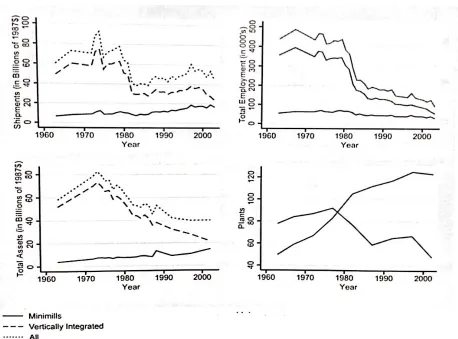
Table 1. Evolution of the Steel Industry.
CHAPTER 2. A CLOSER LOOK
The Crisis of 1973-1975
In October of 1973, the Yom Kippur War erupted after Egypt and Syria attacked Israel.
This attack was retaliation for the 1967 Six-Day War, in which Egypt and Syria had both lost
territory. Israel was victorious in the Yom Kippur War, but the country had received material
support from the United States. The U.S. support of Israel angered Arab nations who quickly
organized under the Organization of Petroleum Exporting Countries (OPEC). The resulting oil
embargo drove prices to record levels within a short period. The embargo exacerbated the
existing economic malaise in the U.S., which was already facing high inflation and low growth
(stagflation). Petroleum shortages were rampant around the U.S. and the ubiquitous photos of
long lines of cars streaming from gas stations have become a cornerstone of the cultural
memory of the era. The Yom Kippur War was not, by itself, the source of the 1973-1975 Crisis,
but it proved to be the tipping point.
In January of 1973 the U.S. stock market crashed and caused the worst losses since the
1930s. This crash was a result of destabilized currency markets brought on by the demise of the
Bretton Woods System. Bretton Woods was a system of static exchange rates that were tied to
the U.S. dollar’s convertibility to gold at a set rate.1 It was Richard Nixon who made the decision
to take the U.S. off of the gold standard, and the resulting chaos in the currency markets was
dubbed the “Nixon Shock.” The change in currency structure allowed the newly liberalizing
China a way in which to enter the world steel market, and the country successfully pegged its
1
31
currency to the U.S. dollar in order to build its unprecedentedly successful trade advantage with
the world’s largest economy. In 1972, Nixon had set out to normalize relations with China, and
was the first U.S. president to visit the country. Nixon’s strategy with China was an example of
Cold War foreign policy that was aimed to force the hand of the Soviets, in this case isolating
them further from their already tense relationship with China in order to encourage the
evolving Strategic Arms Limitations Talks. Nixon’s opening relations with China is yet another
example of foreign policy harming domestic production in that the resulting trade imbalance
has always worked in China’s favor. Though the Chinese did not become major players in the
world steel market until the 1990s, the events surrounding the 1973 crisis helped to pave the
way for future success.
1973 also marked the beginning of the end of U.S. engagement in the Vietnam War. As a
military supplier of steel, Atlantic Steel must have been impacted to a certain degree by the
drawdown of forces and the resulting reduced military spending as it was after the Second
World War, but this is difficult to prove with the existing company records.
The early 1970s company records and oral history of a company employee show that
there was a considerable amount of social conflict that occurred at the Atlanta plant. Former
employee Charlie Orrock revealed that there were company and union initiatives to increase
the number of women and African Americans working in production jobs. Orrock says that this
resulted in considerable conflict with older white workers, particularly since the company had
been in a virtual hiring freeze since the late 1960s.2 During the late 1960s and 1970s racial
division among white and black workers tested union solidarity. Judith Stein’s work is
2
32
particularly focused upon the ways in which racial tensions played out within the ranks of the
steel industry. It is clear that racial prejudice did have an adverse effect upon union cohesion at
a time when unionized steel workers were under attack. There were many examples of wildcat
strikes (strikes that started without the approval of union leadership) that occurred because
African American union members felt that they were not being represented by union leadership
or adequately promoted within the union. Atlanta experienced several such wildcat strikes
during the 1970s, such as at the Mead plant, Atlanta sanitation workers, and Nabisco plant.
Atlantic Steel did not experience a wildcat strike—the last strike had the full support of the
steelworkers union and occurred in 1969—but the Atlantic Steel local experienced racial strife.
Orrock stated that union meetings were divided with whites and blacks sitting on opposite sides
of the union hall.3 While racism is not a primary factor in deindustrialization, it needs to be
considered as something that weakened the labor movement at a critical juncture in its waning
influence.
The events that started in 1973 did not have an obvious immediate impact upon Atlantic
Steel and the company was able to downplay the economic crisis in their annual shareholders
reports for a couple of years. Despite fairly rosy outlooks in ’72, ’73, and ’74, the annual
shareholders report for 1975 stated that:
The year 1975 was a disappointing one for Atlantic Steel Company in many respects, yet some accomplishments were especially noteworthy, and we enter our 75th Anniversary Year with confidence and enthusiasm. Most disappointing were sales and profits, particularly when compared with the previous year’s all-time highs. This, of course, was the result of the faltering economy and perhaps the worst depression in the steel industry since the 1930s.”4
3
Charles Orrock interview, Voices of Labor Oral History Interview Project, 13-14.
4
33
Despite the optimism, 1975 and 1976 were very bad years for the company, which lowered its
value, and ultimately made it vulnerable for corporate takeover. The faltering economy had a
pronounced effect upon the construction industry in the Atlanta area, particularly the
residential sector. The massive growth in Atlanta’s suburbs came to a halt as financing dried up
and high gas prices made commuting a dubious choice for those seeking to leave the city.
Because of the company’s focus on the residential and light commercial markets the downturn
in construction severely hampered company sales.
The Crisis of 1973 had a profound impact upon the steel industry. 1973 marked the end
of what some historians have dubbed the “golden years “of American economic progress.
Howell, et al. indicates that this was the year where growth shifted from the industrialized
nations of Europe and the U.S. to the developing nations because “the changes in patterns of
world steel production can be partially related to changes in consumption and trade patterns.
Consumption in the United States, the EC and Japan peaked in 1973 and reached a peak in the
following year for the other western economies. Consumption has not yet [1988] peaked in the
developing nations.”5 For Atlantic Steel the peak seems to have come in 1974.
5
34
The Spread of Neoliberalism
In a speech given at the 1976 Georgia College Luncheon, Robert J. Buckley, president
and CEO of the steel company Allegheny Ludlum Industries speculated that a new economic
ideology was forming. He stated that:
To one who observes and reflects upon economic developments and the political and intellectual trends which accompany them, the first signs of a completely new departure in patterns of thought and action are becoming dimly visible. Something fundamental is happening. We may be in the very earliest stages of a revolution in economic thinking, and in the style of government economic action, which will be comparable in
importance to the Keynesian revolution. Keynes is ready to be dethroned–as soon as a possible successor can be found.6
Buckley may not have known exactly what changes were on the horizon, but he and other
corporate leaders must have sensed that any viable alternative to Keynesian economic thought
originating in the business community would be enthusiastically supported by those in
positions of power. Buckley correctly forecasted the neoliberal turn, which was in the process
of transforming political, economic, and social ideology in the United States and other
industrialized nations. Just two years later, Jimmy Carter appointed Paul Volcker to head the
Federal Reserve, and within a few short months Volcker would start a dramatic shift in U.S.
monetary policy.7
This neoliberal turn represented a shift from New Deal liberalism, which emphasized
maximum employment through Keynesian economic schemes, to a faith in market based
solutions epitomized by the policies of Ronald Reagan and Margaret Thatcher. Reagan and
Thatcher are both associated with supply-side economics, although Thatcher may have been
6
Robert J. Buckley, “The Power of Positive (Economic) Thinking,” from a speech at the Capital City Club, Atlanta, GA. 21 January 1976. Atlantic Steel Company records, box 50/1
7
35
more of a monetarist like Volker. Economists such as Robert Mundell, Arthur Laffer, and Victor
Canto championed supply-side economics, and they asserted that by lowering marginal taxes
and capital gains rates and freeing private industry from restrictive regulations, new investment
would increase supply which would, in turn, increase aggregate demand. Supply-side
economics are a clear example of a neoliberal economic policy. Harvey writes that:
Neoliberalism is in the first instance a theory of political economic practices that proposes that human well-being can best be advanced by liberating individual
entrepreneurial freedoms and skills within an institutional framework characterized by strong private property rights, free markets, and free trade. The role of the state is to create and preserve an institutional framework appropriate to such practices.8
But Harvey goes on to point out that, in practice, restoring or maintaining elite power often
trumps ideology, and that the history of neoliberalism is not as static and ideologically pure as
its supporters might suggest. In the case of Reagan, supply-side theory was unevenly applied,
while marginal and capital gains taxes were lowered, payroll taxes actually increased and deficit
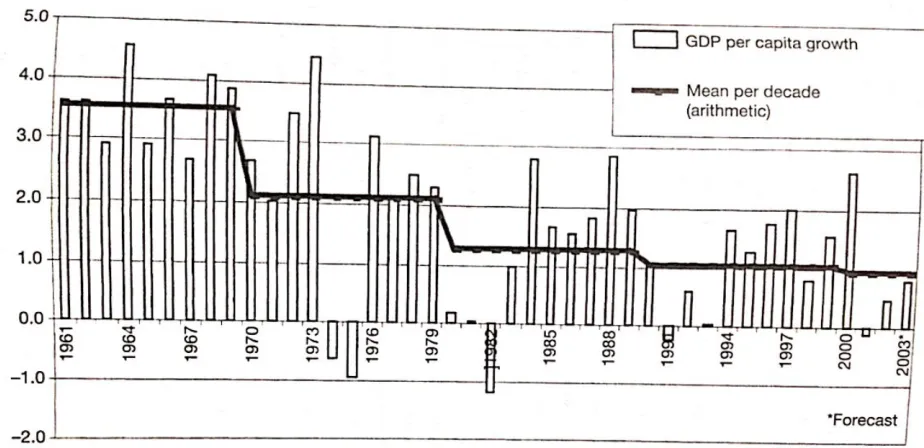
spending skyrocketed. Neoliberal policies seem to have helped to reduce high levels of
inflation, but have not created growth; see table 2. But how did neoliberal thought come to
dominate modern discourse in the 1970s and 1980s?
8
36
Table 2. Global Growth Rates, annually and by decade, 1961-2003.
Source: Harvey, A Brief History of Neoliberalism, 155.
There are several explanations for the rise of neoliberal thought. The Atlantic Steel
records are filled with documents produced by the U.S. Chamber of Commerce.9 The Chamber
of Commerce (COC) was a prolific producer of tracts espousing neoliberal ideology, though not
often using that term. The Robert Buckley speech cited earlier was sponsored by the Atlanta
Chapter of the COC, and was aimed at influencing students and academics. The upper-level
management of Atlantic Steel was heavily involved with the COC, supporting the organization
financially and through calls for political action. There are numerous examples of
correspondence between company officials and Georgia politicians concerning bills that the
COC was resisting or promoting. There are several pieces of correspondence between Atlantic
9