https://doi.org/10.5194/hess-23-2077-2019 © Author(s) 2019. This work is distributed under the Creative Commons Attribution 4.0 License.
Does the Normalized Difference Vegetation Index
explain spatial and temporal variability in sap
velocity in temperate forest ecosystems?
Anne J. Hoek van Dijke1,2,3, Kaniska Mallick1, Adriaan J. Teuling2, Martin Schlerf1, Miriam Machwitz1, Sibylle K. Hassler4, Theresa Blume5, and Martin Herold3
1Environmental Sensing and Modelling, Environmental Research and Innovation Department, Luxembourg Institute of Science and Technology (LIST), Belvaux, Luxembourg
2Hydrology and Quantitative Water Management Group, Wageningen University & Research, Wageningen, the Netherlands 3Laboratory of Geo-Information Science and Remote Sensing, Wageningen University & Research,
Wageningen, the Netherlands
4Institute of Water and River Basin Management, Karlsruhe Institute of Technology (KIT), Karlsruhe, Germany 5Hydrology Section, GFZ German Research Centre for Geosciences, Potsdam, Germany
Correspondence:Anne J. Hoek van Dijke ([email protected]) Received: 28 November 2018 – Discussion started: 14 December 2018 Revised: 29 March 2019 – Accepted: 3 April 2019 – Published: 25 April 2019
Abstract. Understanding the link between vegetation char-acteristics and tree transpiration is a critical need to facil-itate satellite-based transpiration estimation. Many studies use the Normalized Difference Vegetation Index (NDVI), a proxy for tree biophysical characteristics, to estimate evapo-transpiration. In this study, we investigated the link between sap velocity and 30 m resolution Landsat-derived NDVI for 20 days during 2 contrasting precipitation years in a tem-perate deciduous forest catchment. Sap velocity was mea-sured in the Attert catchment in Luxembourg in 25 plots of 20×20 m covering three geologies with sensors installed in two to four trees per plot. The results show that, spatially, sap velocity and NDVI were significantly positively corre-lated in April, i.e. NDVI successfully captured the pattern of sap velocity during the phase of green-up. After green-up, a significant negative correlation was found during half of the studied days. During a dry period, sap velocity was un-correlated with NDVI but influenced by geology and aspect. In summary, in our study area, the correlation between sap velocity and NDVI was not constant, but varied with phenol-ogy and water availability. The same behaviour was found for the Enhanced Vegetation Index (EVI). This suggests that methods using NDVI or EVI to predict small-scale variabil-ity in (evapo)transpiration should be carefully applied, and
that NDVI and EVI cannot be used to scale sap velocity to stand-level transpiration in temperate forest ecosystems.
1 Introduction
Evapotranspiration (ET) is estimated globally as 60 % of the total precipitation (Oki and Kanae, 2006) and 80 % of to-tal surface net radiation (Wild et al., 2013). This makes ET the second largest component of the water and energy bal-ance. Changes in ET due to climate or land-use change have a major influence on the catchment water balance. Deforesta-tion for example reduces ET (de Oliveira et al., 2018), lead-ing to lower precipitation (Bagley et al., 2014) and higher streamflow (Dos Santos et al., 2018). Teuling et al. (2009) showed that changes in incoming radiation and water avail-ability impact regional ET and runoff. In order to predict these changes, a comprehensive understanding of “what con-trols ET” is an important look forward.
interactions between climate (Awada et al., 2013; e.g. Hasler and Avissar, 2007), soil moisture content (Mitchell et al., 2012), topographic variables such as slope position and as-pect (Mitchell et al., 2012), and vegetation characteristics (Williams et al., 2012). With respect to the vegetation bio-physical characteristics, it has been shown that tree transpi-ration differs with leaf area index (LAI) (Wang et al., 2014; Granier et al., 2000), tree height (Ford et al., 2011; War-ing and Landsberg, 2011), tree diameter (Jung et al., 2011; Chiu et al., 2016), tree age (Baret et al., 2018), and pheno-logical stage (Sobrado, 1994). With the advancements of re-mote sensing and free data availability, there have been many efforts to link (E)T to satellite-derived vegetation indices (Carter and Liang, 2018). For example, studying large wa-tersheds, Nagler et al. (2005) found a positive correlation between the Enhanced Vegetation Index (EVI) and Normal-ized Difference Vegetation Index (NDVI) and ET in a ripar-ian area, and Szilagyi (2000) found a positive correlation be-tween NDVI and ET in a mixed forest. Using the NDVI as a measure of vegetation biophysical properties has two ma-jor drawbacks: the saturation of NDVI at high biomass and the sensitivity to soil reflectance (Huete, 1988). Despite these drawbacks, NDVI is the most commonly used index for veg-etation monitoring (Glenn et al., 2010).
The link between NDVI and transpiration or evapotran-spiration (E(T )) is used in different ways to either esti-mate (E)T or to scale in situ water flux measurements to the landscape level. Five different ways are described be-low. First, the NDVI is used to calculate the fractional veg-etation cover to estimate (E)T in forests or mixed land-use types (Boegh et al., 2009; Maselli et al., 2014; Zhang et al., 2009; Chiesi et al., 2013). Second, NDVI is used to derive a spatio-temporal crop coefficient (the Kc-NDVI method) for grassland and agricultural fields (e.g. Mutiibwa and Irmak, 2013; Kamble et al., 2013; Reyes-González et al., 2018) or natural or mixed ecosystems (Maselli et al., 2014; Hunink et al., 2017). TheKc-NDVI method neglects the soil-moisture-driven controls onE(T ), and this is one of the main drawbacks of using this method in natural vegeta-tion (Glenn et al., 2010). An addivegeta-tional water-stress term can be used with the Kc-NDVI equation to model dry ecosys-tem ET or water-stressed conditions (Maselli et al., 2014; Park et al., 2017). Third, surface energy balance models use NDVI to parameterize aerodynamic roughness length and displacement height (Su, 2002), and models based on the Penman–Monteith equation use NDVI to parameterize sur-face conductance (Zhang et al., 2009). Fourth, the sursur-face temperature-NDVI (Ts-VI) “triangle” method is used to de-rive a soil moisture stress scalar to constrain ET. If pixels from different surface conditions are plotted in a Ts-NDVI scatterplot, they form a triangle pattern. The evaporative frac-tion and the Priestley–Taylor coefficient – the ratio potential evaporation over equilibrium evaporation – can be parame-terized from that triangle, and are consequently used to cal-culate ET (Zhu et al., 2017; Jiang and Islam, 2001; Mallick
et al., 2009). Fifth, NDVI is used, e.g. as a proxy for stom-atal conductance or absorbed photosynthetically active radi-ation, to scale in situ measured ET to larger regions (Kim et al., 2006; Rahman et al., 2001). Thus, in many different ap-proaches, NDVI plays a key role in estimating transpiration. The above-mentioned studies often derive the NDVI from MODIS or AVHRR data which have a spatial resolution of 250 m and 1 km (except for Reyes-González et al., 2018; Kim et al., 2006; Rahman et al., 2001; Su, 2002, who used airborne data or high-resolution satellite data; Landsat or IKONOS). The NDVI is often compared with ET derived from different flux towers with a footprint length of 100 to 1000 m (Kim et al., 2006), or a water balance model. There-fore, these studies encompass large spatial areas, with a larger variation in vegetation cover and sometimes multiple land-use types. Despite the availability of high spatial reso-lution satellite products increasing rapidly (e.g. Sentinel se-ries), there is a lack of studies that investigate the link be-tween satellite-derived NDVI and the water balance on the scale of forest patches or smaller. At the same time, there is a trend towards hyper-resolution land surface modelling and monitoring (Bierkens et al., 2015), where for example 30 m Landsat-derived NDVI data are used as a proxy for land cover in a continental land-surface model (Chaney et al., 2016). For many processes or parameters it is, however, unknown whether they can be applied at such high resolu-tions. Therefore, in this study we aim to understand whether the relation between NDVI and transpiration is also valid on the scale of forest patches by using 30 m resolution NDVI data.
Investigating the link between transpiration and NDVI re-quires high-resolution satellite data as well as a dense net-work of in situ transpiration observations. In the Attert catch-ment, a dense network of sensor clusters with – among oth-ers – sap velocity sensors allows for a detailed study of the link between tree transpiration and NDVI. For this catchment Hassler et al. (2018) showed that variability in sap velocity is mainly controlled by tree characteristics, such as tree diam-eter and tree height and site characteristics, such as geology and aspect. The aim of our study is to investigate the link between transpiration and NDVI using measurements of sap velocity combined with 30 m resolution NDVI data. Hassler et al. (2018) showed that small-scale variability in sap veloc-ity was related to tree structural characteristics, and therefore we expect sap velocity and NDVI to be correlated. We hy-pothesize this correlation to be positive, because we expect that forest stands with a higher leaf biomass (higher NDVI) will have a larger sap velocity.
Figure 1.The geology of the Attert catchment and its location in Luxembourg. Sandstone in the catchment is a combination of Buntsandstein sandstone in the north and Lower Jurassic sandstone in the south. Also shown are the main streams, sensor clusters, meteorological stations Roodt and Useldange, and the location of the CAOS sensor cluster where wind speed and relative humidity measurements were taken from.
2 Material and methods 2.1 Site description
The study was carried out in the Attert catchment in mid-western Luxembourg. This area was chosen because of its small-scale diversity in geology and soil hydrological con-ditions. The 288 km2 sized catchment lies on the border of the Ardennes Massif and the Paris Basin. The three distinct geologies in the catchment are schists, sandstone, and marls (Fig. 1). Soils vary between sand and silty clay loam (Müller et al., 2014). The land use is characterized by coniferous and deciduous forest on the hillslopes in the sandstone area, and grassland or agriculture in the valleys in the marl area and on the plateaus in the schist area. The elevation of the stud-ied sensor clusters ranges from 217 to 473 m a.s.l. (above sea level). The average monthly temperature ranges from 0◦C (January) to 18◦C (July), the average yearly precipitation is 850 mm, and the mean annual evapotranspiration is 570 mm (Müller et al., 2014).
Within the CAOS research unit, a monitoring network was set up in the Attert catchment including 29 sensor clusters in a forest (of which 25 are used in this study) in order to provide a new framework for hydrological models for catch-ments at the lower meso-scale (Zehe et al., 2014). A sen-sor cluster covers 20×20 m, and in each sensor cluster, soil moisture content (θ), meteorological characteristics, and sap velocity were measured. More information about these mea-surements can be found in Renner et al. (2016) and Hassler et al. (2018).
Soil moisture content was measured in three soil profiles in each cluster site using Decagon 5TE sensors at three depths (10, 30, and 50 cm). For this study, the average θ at 30 cm depth was calculated for the catchment. Wind speed and rela-tive humidity were measured above grass at a weather station
Table 1.Meteorological characteristics and their unit.
Variable Symbol Unit
Evapotranspiration ET mm d−1
Potential evaporation Ep mm d−1 Vapour pressure deficit D kPa Daily total global radiation Rg W m−2 Soil moisture content θ m3m−3 Daily average temperature Ta ◦C
from the CAOS research unit (Fig. 1). Mean daily air tem-perature (Ta) was available from the Roodt weather station, and global radiation (Rg) was available from the Useldange weather station. Daily potential evaporation (Ep) was cal-culated for the catchment using the FAO Penman–Monteith equation (Allen et al., 1998). Table 1 lists the used symbols and their unit.
2.2 Meteorological conditions
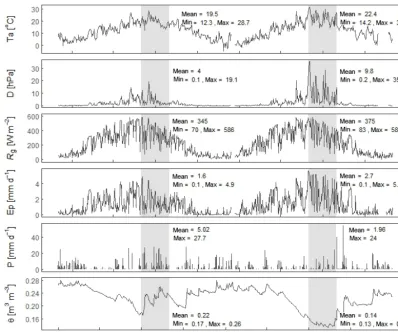
[image:3.612.331.524.322.414.2]cumu-Figure 2.Meteorological conditions in 2014 and 2015. Daily average temperature (Ta), vapour pressure deficit (D), global radiation (Rg), potential evaporation (Ep), precipitation (P), and soil moisture content (θ). The min, mean, and max values are calculated for July and August in both years, indicated by the grey box.
Figure 3.Cumulative precipitation surplus (P−Ep) from April to October for 2014 (solid line) and 2015 (dashed line). The difference in precipitation surplus between the 2 years was largest at the end of August, as indicated by the arrow.
lative precipitation deficit of 113 mm at the end of August (Fig. 3). Consequently, θ was low in the summer of 2015 (Fig. 2).
2.3 Data
2.3.1 Sap velocity
Sap velocity is used as a measure of tree transpiration (e.g. Smith and Allen, 1996). In summary, in this method, heat is applied to the water in the xylem of the tree trunk, and this heat is carried upwards with the water. Temperature sen-sors monitor the time it takes before the heat pulse reaches the sensor. This time is related to the velocity of the water in the xylem. More information about sap velocity measure-ments can be found in e.g. Smith and Allen (1996).
[image:4.612.66.268.460.635.2]be-Table 2.Sensor cluster characteristics.
Geology No. of sensor clusters No. of studied No. of beech/ Elevation No. of stems per mean
trees oak/ (min–max) cluster cluster
other (min–max) DBH (min–max)
Sandstone 9 29 21/7/1 217–284 9–54 2–44
Marl 5 13 2/8/3 283–351 16–34 5–17
Schist 11 31 23/5/3 428–473 20–346 4–37
tulusL.), maple (Acer pseudoplatanusL.), and alder (Alnus glutinosa(L.) Gaertn.). Table 2 shows the presence of the dif-ferent species in this study. Sap velocity was measured at the north-facing side of the stems using sap flow sensors man-ufactured by East 30 Sensors in Washington, US. From the measured temperatures, sap velocities were calculated based on the equation of Campbell et al. (1991), which is recom-mended by the manufacturer. Afterwards, a wounding cor-rection was performed following Burgess et al. (2001). Sap velocity differs with horizontal depth in a tree, and this ra-dial variability is one of the main sources of uncertainty in sap velocity measurements (Hernandez-Santana et al., 2015). To account for the radial velocity profile, the sensors mea-sure at three depths: 5, 18, and 30 mm. Following Hassler et al. (2018), for each tree, the sensor with the highest mean daily sap velocity was selected. Trees with less than 80 % available data from June to August, or with a prolonged pe-riod of negative sap velocity, were excluded from the anal-ysis. This resulted in a data set with 73 trees at 25 sensor clusters (Table 2). For each cluster, the mean daily sap veloc-ity (from 08:00 to 20:00 LT – local time) was calculated. To match the spatial scale of the sap velocity data to the NDVI data with a 30 m resolution, mean daily sap velocity was cal-culated for each cluster.
Sap velocity measurements can be scaled up to whole tree transpiration from the total sapwood area for each tree (Smith and Allen, 1996), but these data were not available within our study area. Alternatively, a species- and site-specific al-lometric equation between tree diameter at breast height and sapwood area can be used to calculate tree total sap flow, but this conversion introduces uncertainties (Gebauer et al., 2012; Ford et al., 2004). Therefore, we used sap velocity di-rectly in our study.
2.3.2 NDVI and EVI
The vegetation indices were calculated from Landsat-7 (ETM+ sensor) and Landsat-8 (OLI sensor) surface re-flectance data obtained from EarthExplorer of the US Ge-ological Survey. Both sensors acquire images with a spa-tial resolution of 30 m and, combined, they have a temporal resolution of 8 days. The overpass time of the satellites is 10:27 GMT. Clouds and cloud shadows were removed from the images using the cloud quality information delivered with the data product, and this automatic procedure was followed
by a visual check to remove cloudy pixels. After the cloud removal, surface reflectance values were extracted for each cluster centre using bilinear interpolation, where the four closest raster cells are interpolated. Images were removed when surface reflectance information was available for less than five clusters or for only one geology type. This resulted in a total availability of 20 Landsat images, 11 for the grow-ing season of 2014 and 9 for the growgrow-ing season of 2015. NDVI and EVI were calculated as follows:
NDVI=ρNIR−ρRed ρNIR+ρRed
(1) EVI= (ρNIR−ρRed)
ρNIR+6·ρRed−7.5·ρBlue+1
·2.5 (2)
whereρis the surface reflectance in the near-infrared (NIR), red, and blue parts of the electromagnetic spectrum.
2.3.3 Tree and sensor cluster characteristics
To study the effect of static vegetation and environmental characteristics on sap velocity and NDVI, correlations with tree and environmental characteristics were calculated. In-formation on semi-static tree and cluster site characteristics is available from Hassler et al. (2018). For every cluster, the total number of stems was counted, and the DBH was mea-sured for each tree with a circumference of more than 4 cm (Table 2). The tree height was estimated for every tree where sap velocity was measured, and for each cluster site, aspect was noted. Elevation and geology are derived from a digital elevation model and a geological map.
3 Results
3.1 Temporal and spatial variability in sap velocity and NDVI
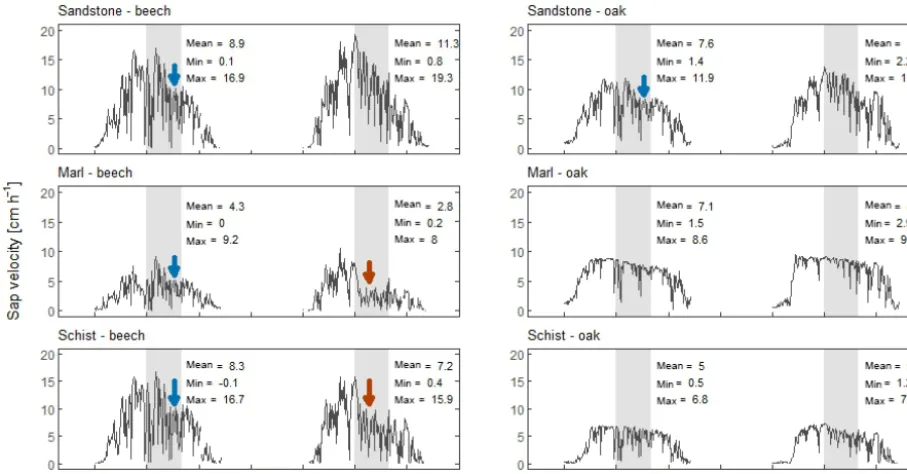
[image:5.612.67.526.85.161.2]Figure 4.Mean daily sap velocity for beech and oak trees in the three different geologies. The drop in sap velocity in August 2014 (blue arrow) is related to a lower incoming radiation, while the drop in August 2015 (red arrow) is not related to a lower incoming radiation, but falls into a period of below-average precipitation and low soil moisture content. The min, mean, and max values are calculated for July and August in both years, indicated by the grey box.
period with little rainfall, sap velocity was low for part of the trees located in the marl and schist area. The reduced sap ve-locity in 2015 did not correlate with a lowRg. Redundancy analysis showed that in 2014, 78 % of the variability in daily sap velocity was explained byRgandTa. In 2015,Rg,Ta, andθ together explained 65 % of the variability in sap daily velocity.
The phenological cycle is clearly visible in the temporal dynamics of NDVI with a rapid green-up in April (Fig. 5). In April, the mean Landsat-derived NDVI over the clusters was 0.62 (±0.05), as compared to 0.82 (±0.05) during the fully developed stage of the vegetation. On 12 August 2015, the NDVI of all clusters was low, which did not appear in the MODIS NDVI product. These pixels were not removed by the cloud removal procedure, but haze is visible in the image, which possibly influenced the cluster pixels. Unfortunately no other cloudless images were available for the second half of July and August in 2015, the driest months of the summer. 3.2 Correlation between sap velocity and NDVI Analysing all sensor clusters together for all 20 days, a mod-erate positive correlation was found between sap velocity and NDVI (p <0.001, Pearson’sr=0.47) (Fig. 6a). Con-sidering temporal correlation, both sap velocity and NDVI had low values at the start and end of the growing season and high values in summer. This means that sap velocity and NDVI were positively correlated for 22 of the 25 clus-ters (p <0.05) (Fig. 6b–e). Considering the months May to
Figure 5.Observed NDVI dynamics during the growing seasons of 2014 and 2015. The grey line and dots represent the mean NDVI over the forested clusters derived from the MOD13Q1 product of MODIS. It provides a better overview of the seasonal course. The 20 boxplots (in black) show the variability in Landsat-derived NDVI over the studied clusters for each studied day.
September only, when the canopy was in full leaf, there was no (significant) correlation between sap velocity and NDVI for 22 of the 25 clusters.
[image:6.612.308.548.378.473.2]Figure 6.Temporal correlation between sap velocity and NDVI for all 20 studied days in 2014 and 2015.(a)For all sensor clusters together, sap velocity and NDVI were positively correlated (p <0.001,R2adj=0.22).(b–e)The correlation for four different clusters in different geologies. For each shown cluster, the correlation is significant (p <0.05). For 1 of the 25 clusters, the correlation is not significant, and for 2 clusters the correlation is significant only atp <0.1. The dashed line represents the 95 % confidence interval.
Figure 7.Relationship between sap velocity and NDVI for 6 days. Each dot represents one sensor cluster in the sandstone, schist, and marl area. The dashed line represents the 95 % confidence interval.(a, d)April 2014 and 2015, during the period of green-up. At the(b)start and
[image:7.612.100.498.363.624.2]below average. For 5 of the studied days during the grow-ing season of 2014 and early June and September 2015, sap velocity and NDVI were negatively correlated. For 5 days in 2014 and 6 days in 2015, sap velocity and NDVI were uncorrelated.
3.3 Correlation between sap velocity and NDVI in relation to soil moisture content (θ)
Figure 8a shows the dynamic changes in the correlation co-efficient between sap velocity and NDVI. In both years, the correlation coefficient was positive at the beginning of the growing season (April) and negative or close to zero during the rest of the year. In the year 2014, no trend was visible in the variability of the correlation coefficient. In 2015, the cor-relation coefficient was initially positive and became nega-tive in May. As the growing season progressed andθdropped (to a minimum ofθ=0.13 m3m−3in mid-August), the cor-relation became weaker and insignificant. At the end of September, when θ increased following high precipitation, the correlation between sap velocity and NDVI was again negative. Studying all days together, sap velocity and NDVI were positively correlated during the period of highestθ(in April, θ >0.22 m3m−3) (Fig. 8b). Contrastingly, at highθ during September 2015 (θ >0.20 m3m−3), sap velocity and NDVI were negatively correlated. The correlation coefficient was close to zero whenθwas lowest. At intermediateθ, the correlation coefficient was mostly negative.
3.4 Effect of static vegetation and environmental characteristics on sap velocity and NDVI
The effects of static vegetation and environmental character-istics on sap velocity and NDVI were calculated. This was also done to check whether dependency on one of these char-acteristics could explain the negative correlation between sap velocity and NDVI. Assessing individual trees, sap velocity was related to tree DBH and tree height, but at cluster level, sap velocity was not or moderately dependent on these char-acteristics (Table 3). The number of stems and mean tree DBH per sensor cluster did not correlate with sap veloc-ity. For some days, sap velocity was higher in clusters with higher trees. For most studied days, sap velocity for beech trees was higher than for oak trees, but this difference was usually not significant. Altitude and sap velocity were nega-tively correlated in April for both years. Geology and aspect explained part of the variability in sap velocity, especially during summer 2015, when sandstone clusters had a higher sap velocity than schist and marl clusters, and north-facing slopes had a higher sap velocity than south-facing slopes. The different cluster characteristics were not independent and, therefore, a relation between two variables could also have been the result of a causal relation with another vari-able.
Cluster-averaged tree characteristics were usually not re-lated to NDVI, and their direction of influence was not sistent. Also, the change in NDVI with altitude was not con-sistent over the year, but in April of both years, the corre-lation was negative. In both years, schist clusters had the lowest NDVI in April (p <0.1 in 2014). From June till Au-gust 2015, sandstone clusters had the highest NDVI, except for 9 and 25 June. Variability in species and aspect were cor-related with variability in NDVI only for a few days.
4 Discussion
4.1 Sap velocity and scaling to tree transpiration In the present study, mean sap velocity was calculated for the two to four trees in each sensor cluster. This is only a small selection of the total number of trees per cluster, which varied from 9 to 346, with a median of 34 trees per cluster. The trees selected for sap velocity measurements are roughly represen-tative of the cluster with respect to species and DBH. But ve-locity of the sap depends on tree DBH, height, species, and tree age (Gebauer et al., 2012; Ryan et al., 2006), and there-fore, making a true representative selection remains chal-lenging.
We looked for a relationship between tree sap velocity and a canopy trait, NDVI. Please note that two scaling steps are required to scale sap velocity up to the canopy level: a first step to scale from sap velocity to whole tree transpiration and a second step from tree to stand transpiration. In this study, measurements of sap velocity were preferred over whole tree or stand transpiration, because scaling introduces uncertain-ties, especially when sapwood area is not known (Gebauer et al., 2012; Ford et al., 2004). An empirical scaling for-mula can be used to calculate whole tree transpiration from (1) sap flow, (2) tree DBH, and (3) a species- and site-specific parameter. On an individual tree level, trees with a larger DBH had a higher sap velocity, which is also known from other studies (Jung et al., 2011). Calculating whole tree tran-spiration from sap velocity would have thus increased the mutual differences among clusters, but usually would have not changed the order of values and direction of correlation with NDVI. The species-specific parameter in the scaling for-mula would have increased the differences in transpiration between beech and oak trees. This is because beech trees in this study had, on average, a larger sap velocity and, despite the lower DBH, a higher average sapwood area.
4.2 Temporal and spatial variability in sap velocity and NDVI
Figure 8.Relationship between sap velocity and NDVI and observed soil moisture content (θ).(a)The average soil moisture content at 30 cm depth over the sensor clusters. The colours indicate the spatial correlation coefficient (Pearson’sr) between sap velocity and NDVI for the 20 studied days. Symbols indicate whether the correlation is significant atp <0.05 (∗) or atp <0.1 (+).(b)The soil moisture content and Pearson’s correlation coefficient for the 20 studied days. Black dots indicate thatp <0.1.
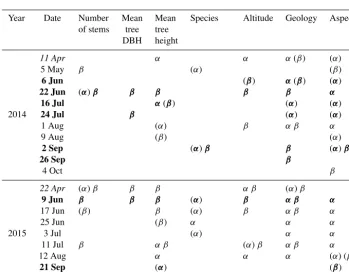
Table 3.Seven (semi-)static sensor cluster characteristics and whether they are significantly correlated (p <0.05) with spatial variability in mean sap velocity (α) and NDVI (β). Parentheses indicate a significance level ofp <0.1. The results are based on Pearson’s correlation for numerical data and one-way ANOVA for species, geology, and aspect. The mean sensor cluster DBH is the mean DBH of all trees in the sensor cluster, while the mean tree height is the mean of the sap velocity trees only. Species classes are beech, oak, or a mixture. The number of stems, DBH, and tree height are not independent. Mean tree height, aspect, and altitude are related to geology. Italic indicates that the correlation between sap velocity and NDVI was positive for this day, while bold indicates a negative correlation.
Year Date Number Mean Mean Species Altitude Geology Aspect
of stems tree tree DBH height
2014
11 Apr α α α(β) (α)
5 May β (α) (β)
6 Jun (β) α(β) (α)
22 Jun (α)β β β β β α
16 Jul α(β) (α) (α)
24 Jul β (α) (α)
1 Aug (α) β α β α
9 Aug (β) (α)
2 Sep (α)β β (α)β
26 Sep β
4 Oct β
2015
22 Apr (α)β β β α β (α)β
9 Jun β β β (α) β α β α
17 Jun (β) β (α) β α β α
25 Jun (β) α α α
3 Jul (α) α α
11 Jul β α β (α)β α β α
12 Aug α α α (α) (β)
21 Sep (α) (β)
29 Sep (α) (α)
beech and oak trees in the sandstone area compared to 2014. For the beech trees in the marl and schist area however, mean sap velocity was lower in summer 2015. This drop in sap ve-locity in 2015 could not be attributed to a reduction in atmo-spheric demand or available energy (Fig. 9), and was likely the result of stomatal closure in response to water stress. No drought-related reduction was observed in NDVI, and also no lagged effect. This indicates that trees were conservative with water and closed their stomata to prevent transpirational
water loss. Under the relatively mild stress during the sum-mer of 2015 no change in tree canopy structure (leaf area in-dex, leaf angle distribution) and thus no change in structural indices like NDVI can be expected as structural vegetation changes become visible only after a prolonged dry period (Eklundh, 1998).
[image:9.612.124.473.314.587.2]vari-Figure 9.Relationship between sap velocity and meteorological conditions for spring and summer 2014 and 2015 for a beech tree in the schist area. The relationship between mean daily sap velocity and(a)global radiation (Rg),(b)vapour pressure deficit (D), and(c)soil moisture content (θ). The regression line is shown in the plot. In summer 2015, sap velocity is low, despite highRgandD.
ability in sap velocity. Interestingly, our study showed that cluster mean tree characteristics did not explain variability in cluster mean sap velocity during most of the growing season (Table 3). This is likely because of the smaller variability in sap velocity and tree characteristics on the cluster level as compared to individual trees.
Part of the trees showed a water-stress-induced drop in sap velocity in 2015. The statistical analysis revealed that dur-ing this period, geology and aspect significantly explained part of this spatial variability in sap velocity (Table 3). The higher sap velocity on north-facing slopes could indicate the effect of a higher water availability compared to south-facing slopes. In the sandstone area, trees maintained high sap ve-locity during the dry period, but sap veve-locity was reduced in the schist and marl area. Also, this effect of geology is likely related to water availability. Pfister et al. (2017) and Wrede et al. (2015) showed that in the Attert catchment, sandstone has a high storage capacity, because of the deep permeable soils, while the storage capacity is low in the marl and schist area. Furthermore, trees in the sandstone area were on av-erage taller and had a larger DBH. These trees might have been able to access water from deeper layers because of a more developed root system.
4.3 Correlation between sap velocity and NDVI Temporally, sap velocity and NDVI were positively corre-lated, because both follow a similar seasonal cycle with lower values in April and October than in summer. Considering only the full leaf period (May–September), sap velocity and NDVI were not correlated. Variability in sap velocity during the full leaf period was to a large extent explained by daily variations inRgandTa, and these meteorological controls of transpiration are not reflected in the NDVI. Nor is the NDVI affected by daily variations inRgandTa.
Considering spatial correlation, three different patterns were found: positive, negative, and no correlation. The
differ-ent patterns are discussed below. During April in both years, sap velocity and NDVI were positively correlated. This was before complete leaf-out and the spatial variability in NDVI was high. In April, elevation of the clusters significantly ex-plained part of the variability in both sap velocity – Pearson’s r= −0.56 (2014) and−0.45 (2015) – and NDVI – Pearson’s r= −0.78 (2015). Onset of greenness varies with elevation and associated temperature differences (Elmore et al., 2012; Kang et al., 2003), and at the moment of image acquisition, the clusters were in different stages of phenological develop-ment. This was reflected in both NDVI and sap velocity, and likely explains the positive correlation between them.
[image:10.612.98.500.67.215.2]not per se transpiration (as explained in Sect. 4.1), but a con-version of sap velocity to tree transpiration is not expected to influence the sign of the correlation. Lastly, a correlation with static tree and site characteristics was investigated, but this was also not found to explain the negative correlation.
On half of the studied days, no correlation was found be-tween sap velocity and NDVI, which could be due to noise in the data caused by the saturation of the NDVI signal. Ab-sence of a correlation could also indicate that optical vege-tation characteristics are uncoupled from ET, i.e. that no sig-nificant control of stomata and vegetation structure on ET was apparent in the Attert catchment. The temporal change in Pearson’srduring the growing season of 2015 – a negative correlation during the beginning (June) and end (September) of the growing season, but no correlation during the drier pe-riod – points to an effect of short-term water stress, which is discussed in Sect. 4.4.
4.4 Comparing the dry and wet growing seasons Summer 2015 experienced below-average precipitation, but was not exceptionally dry. Nevertheless, sap velocity dropped during this dry period. In 2014, when ample soil water was available, temporal variability in sap velocity was strongly coupled with Rg,D, and Ta. During the period of low soil moisture content in 2015 sap velocity was, next to Rg, D, andTa, also coupled with soil moisture content. The water stress occurred only for a short time period, and therefore no change in NDVI was apparent. Given that the spatial pattern in sap velocity changed from the wet to dry periods, while NDVI did not change, the correlation between sap velocity and NDVI was different in the two summer sea-sons. During the wet summer of 2014, we found a weak to moderate negative correlation, and during the dry summer of 2015, sap velocity and NDVI were uncorrelated. During the dry summer of 2015, water availability (through geology and aspect) likely explained spatial variability in sap veloc-ity, and this soil moisture control of ET was not reflected in NDVI.
4.5 Using NDVI to estimate evapotranspiration
We hypothesized finding a positive correlation between sap velocity and NDVI, but spatially, this was the case only in April. This means that NDVI successfully captured the pat-tern of sap velocity during the phase of green-up when wa-ter was not limited. Afwa-ter green-up, the positive correlation changed into a negative correlation or no correlation. The in-consistent correlation between sap velocity and NDVI would also translate into an inconsistent correlation between tran-spiration and NDVI, after applying a scaling equation. Var-ious methods however use NDVI to estimate(E)T, among others, in evergreen, boreal, and deciduous forests, and as-sume the two to be positively correlated (Glenn et al., 2010, provide a review). Of these methods, theKc-NDVI method
is used most frequently, and it is shown that including NDVI as a spatio-temporal crop coefficient improves(E)T predic-tion compared to the convenpredic-tional use of a crop coefficient in forests (Maselli et al., 2014; Hunink et al., 2017). Other studies however found a weak correlation between NDVI and flux tower transpiration and reported that EVI provides better results in salt cedar and cottonwood dominated stands (Na-gler et al., 2005) and boreal forest (Rahman et al., 2001), because the EVI does not saturate as quickly at high LAI (Huete et al., 2002). Therefore we also explored the correla-tion between sap velocity and the EVI. The results, although in absolute terms different and “less significant”, tell a simi-lar story to NDVI – a positive correlation in April, a negative but not always significant correlation during the rest of the year, and no correlation during the dry summer of 2015.
Compared to our study, earlier studies that found a posi-tive correlation between(E)T and NDVI encompassed large spatial areas and sometimes multiple land-use types. This raises the question whether the link between(E)T and NDVI holds on a small spatial scale. Methods that use NDVI to esti-mate ET, including land-surface models, should be carefully applied when studying small-scale variability in ET.
NDVI lags behind sap velocity in relation to drought and cannot be used to predict transpiration under dry conditions. A water-stress factor has been introduced by several studies to overcome this problem, but this stress factor is not always spatially explicit (e.g. Maselli et al., 2014). Our study showed that, in the studied catchment, a spatially explicit stress factor is required for accurate transpiration prediction under drying conditions, because neither NDVI nor meteorological condi-tions capture the spatial variability in ET controlled by geo-logically induced differences in water availability.
4.6 Using NDVI to scale transpiration
The scaling of water flux measurements across scales is a main challenge in ecohydrology (Asbjornsen et al., 2011; Hatton and Wu, 1995). Scaling in situ measurements over a larger area, for example flux tower or sap velocity measure-ments, is traditionally done by scaling over in situ measured biometric parameters such as DBH, basal area, or sapwood area ( ˇCermák et al., 2004). Obtaining these characteristics from satellite images is less resource demanding, can be ap-plied over larger areas, and provides the opportunity to study both spatial and temporal patterns simultaneously. Satellite-derived scaling parameters have another advantage over the conventional ones: (semi-)static characteristics are unreliable under the changing conditions that we face for the future, with among others more intense droughts (Cleverly et al., 2016; IPCC, 2012).
possibil-ities using remote data to characterize vegetation and(E)T. Reyes-Acosta and Lubczynski (2013) for example used high-resolution images to identify single trees to scale sap flow data to the stand level. Future research could focus on where and under which conditions tree characteristics control or de-scribe(E)T and whether this relation holds when scaling up to remote-sensing-derived data on different scales.
5 Conclusions
The aim of this study was to investigate the link between sap velocity and satellite-derived NDVI in a temperate forest catchment. We focussed on small-scale variability, in both space and time. A positive correlation between sap veloc-ity and NDVI was expected. Data analysis for 2 consecutive years led us to the following conclusions.
a. Temporally, a correlation between sap velocity and NDVI was only found when the entire growing sea-son was considered. Spatially, a positive correlation was found in April, when spatial variability in sap velocity and NDVI was large and reflected an altitude-dependent difference in green-up. This means that NDVI did cap-ture the spatial pattern in leaf-out which also affected sap velocity. During the rest of the growing season, a negative correlation was found between sap velocity and NDVI. This negative correlation was significant during half of the studied days. The likely saturation of the NDVI signal in combination with the small spatial vari-ability in NDVI could explain the absence of a positive correlation, but does not explain this negative correla-tion.
b. In 2015, during the dry summer period, the spatial cor-relation between sap velocity and NDVI changed. Vari-ability in sap velocity could not be captured by NDVI. Instead, sap velocity was controlled by geology and as-pect, likely through their effect on water availability. This shows that a stress factor, used to estimate tran-spiration during dry periods, cannot always be based on meteorology only, but should include information that reflects the water availability.
c. The time-variable and inconsistent spatial correlation between sap velocity and NDVI would also translate into an inconsistent correlation between transpiration and NDVI. From this we conclude that NDVI alone can-not describe small-scale temporal and spatial variabil-ity in sap velocvariabil-ity and transpiration in a temperate for-est ecosystem. Only for temporal scales that cover the whole phenological cycle was NDVI a significant pre-dictor of transpiration processes. The EVI, which is less sensitive to saturation effects, was also unsuitable as a predictor of transpiration under the studied conditions. Therefore, we suggest that the use of vegetation indices
to predict transpiration should be limited to ecosystems and scales where the correlation was confirmed.
Data availability. The satellite images are available from https://earthexplorer.usgs.gov/ (last access: April 2019). The used measurements of air temperature and global radiation are avail-able from https://www.agrimeteo.lu/Internet/AM/inetcntrLUX. nsf/cuhome.xsp?src=L941ES4AB8&p1=K1M7X321X6&p3= 343GO6H65M&p4=6B0G8RP4G8 (last access: April 2019). Other meteorological data, soil moisture data, and sap velocity data are available upon request from the corresponding author.
Author contributions. KM, MM, MS and AJT initialized the study. SKH and TB provided the sap flow and meteorological data. AJHvD performed the data analysis in consultation with KM, MS, and AJT and wrote the paper. All the authors contributed to inter-preting results, discussing findings and improving the paper through joint editing.
Competing interests. The authors declare that they have no conflict of interest.
Special issue statement. This article is part of the special issue “Linking landscape organisation and hydrological functioning: from hypotheses and observations to concepts, models and under-standing (HESS/ESSD inter-journal SI)”. It is not associated with a conference.
Acknowledgements. This work was supported by the Luxembourg National Research Fund (FNR) (PRIDE15/10623093/HYDRO-CSI). We acknowledge the DFG for funding CAOS research unit FOR 1598 and Britta Kattenstroth and Tobias Vetter for the maintenance of the sensor network. Partial support for Kaniska Mallick and Martin Schlerf also came through the Hi-WET consortium sponsored by BELSPO – FNR (STEREOIII: INTER/STEREOIII/13/03/HiWET; contract no. SR/00/301) and FNR-DFG (CAOS-2; INTER/DFG/14/02).
References
Allen, R. G., Pereira, L. S., Raes, D., and Smith, M.: Crop evapo-transpiration: guidelines for computing crop water requirements, FAO irrigation and drainage paper 0254-5284, series 56, Food and Agriculture Organization of the United Nations, Rome, 300 pp., 1998.
Asbjornsen, H., Goldsmith, G. R., Alvarado-Barrientos, M. S., Rebel, K., Van Osch, F. P., Rietkerk, M., Chen, J., Gotsch, S., Tobon, C., Geissert, D. R., Gomez-Tagle, A., Vache, K., and Dawson, T. E.: Ecohydrological advances and applications in plant-water relations research: a review, J. Plant Ecol., 4, 3–22, https://doi.org/10.1093/jpe/rtr005, 2011.
Awada, T., El-Hage, R., Geha, M., Wedin, D. A., Huddle, J. A., Zhou, X., Msanne, J., Sudmeyer, R. A., Martin, D. L., and Bran-dle, J. R.: Intra-annual variability and environmental controls over transpiration in a 58-year-old even-aged stand of invasive woody Juniperus virginiana L. in the Nebraska Sandhills, USA, Ecohydrology, 6, 731–740, https://doi.org/10.1002/eco.1294, 2013.
Bagley, J. E., Desai, A. R., Harding, K. J., Snyder, P. K., and Foley, J. A.: Drought and Deforestation: Has Land Cover Change Influ-enced Recent Precipitation Extremes in the Amazon?, J. Climate, 27, 345–361, https://doi.org/10.1175/jcli-d-12-00369.1, 2014. Baret, M., Pepin, S., and Pothier, D.: Hydraulic limitations in
domi-nant trees as a contributing mechanism to the age-related growth decline of boreal forest stands, Forest Ecol. Manage., 427, 135– 142, https://doi.org/10.1016/j.foreco.2018.05.043, 2018. Bierkens, M. F. P., Bell, V. A., Burek, P., Chaney, N., Condon,
L. E., David, C. H., Roo, A., Döll, P., Drost, N., Famigli-etti, J. S., Flörke, M., Gochis, D. J., Houser, P., Hut, R., Ke-une, J., Kollet, S., Maxwell, R. M., Reager, J. T., Samaniego, L., Sudicky, E., Sutanudjaja, E. H., Giesen, N., Winsemius, H., and Wood, E. F.: Hyper-resolution global hydrological modelling: what is next?, Hydrol. Process., 29, 310–320, https://doi.org/10.1002/hyp.10391, 2015.
Boegh, E., Poulsen, R. N., Butts, M., Abrahamsen, P., Dellwik, E., Hansen, S., Hasager, C. B., Ibrom, A., Loerup, J. K., Pilegaard, K., and Soegaard, H.: Remote sensing based evapotranspiration and runoff modeling of agricultural, forest and urban flux sites in Denmark: From field to macro-scale, J. Hydrol., 377, 300–316, https://doi.org/10.1016/j.jhydrol.2009.08.029, 2009.
Burgess, S. S. O., Adams, M. A., Turner, N. C., Beverly, C. R., Ong, C. K., Khan, A. A., and Bleby, T. M.: An im-proved heat pulse method to measure low and reverse rates of sap flow in woody plants, Tree Physiol., 21, 589–598, https://doi.org/10.1093/treephys/21.9.589, 2001.
Campbell, G. S., Calissendorff, C., and Williams, J. H.: Probe for Measuring Soil Specific Heat Using A Heat-Pulse Method, Soil Sci. Soc. Am. J., 55, 291–293, https://doi.org/10.2136/sssaj1991.03615995005500010052x, 1991.
Carter, C. and Liang, S.: Comprehensive evaluation of em-pirical algorithms for estimating land surface evapo-transpiration, Agr. Forest Meteorol., 256–257, 334–345, https://doi.org/10.1016/j.agrformet.2018.03.027, 2018.
ˇ
Cermák, J., Kuˇcera, J., and Nadezhdina, N.: Sap flow measurements with some thermodynamic methods, flow integration within trees and scaling up from sample trees to entire forest stands, Trees, 18, 529–546, https://doi.org/10.1007/s00468-004-0339-6, 2004.
Chaney, N. W., Metcalfe, P., and Wood, E. F.: HydroBlocks: a field-scale resolving land surface model for application over continental extents, Hydrol. Process., 30, 3543–3559, https://doi.org/10.1002/hyp.10891, 2016.
Chiesi, M., Rapi, B., Battista, P., Fibbi, L., Gozzini, B., Magno, R., Raschi, A., and Maselli, F.: Combination of ground and satellite data for the operational estimation of daily evapotranspiration, Eur. J. Remote Sens., 46, 675–688, https://doi.org/10.5721/EuJRS20134639, 2013.
Chiu, C.-W., Komatsu, H., Katayama, A., and Otsuki, K.: Scaling-up from tree to stand transpiration for a warm-temperate multi-specific broadleaved forest with a wide variation in stem diame-ter, J. Forest Res., 21, 161–169, https://doi.org/10.1007/s10310-016-0532-7, 2016.
Cleverly, J., Eamus, D., Restrepo oupe, N., Chen, C., Maes, W., Li, L., Faux, R., Santini, N. S., Rumman, R., Yu, Q., and Huete, A.: Soil moisture controls on phenology and productivity in a semi-arid critical zone, Sci. Total Environ., 568, 1227–1237, https://doi.org/10.1016/j.scitotenv.2016.05.142, 2016.
Davi, H., Soudani, K., Deckx, T., Dufrene, E., Le Dan-tec, V., and FranÇois, C.: Estimation of forest leaf area index from SPOT imagery using NDVI distribution over forest stands, Int. J. Remote Sens., 27, 885–902, https://doi.org/10.1080/01431160500227896, 2006.
de Oliveira, J. V., Ferreira, D. B. D. S., Sahoo, P. K., Sodré, G. R. C., de Souza, E. B., and Queiroz, J. C. B.: Differences in precipita-tion and evapotranspiraprecipita-tion between forested and deforested ar-eas in the Amazon rainforest using remote sensing data, Environ. Earth Sci., 77, 239, https://doi.org/10.1007/s12665-018-7411-9, 2018.
Dos Santos, V., Laurent, F., Abe, C., and Messner, F.: Hydrologic Response to Land Use Change in a Large Basin in Eastern Ama-zon, Water, 10, 429, https://doi.org/10.3390/w10040429, 2018. Eklundh, L.: Estimating relations between AVHRR NDVI
and rainfall in East Africa at 10-day and monthly time scales, Int. J. Remote Sens., 19, 563–568, https://doi.org/10.1080/014311698216198, 1998.
Elmore, A. J., Guinn, S. M., Minsley, B. J., and Richardson, A. D.: Landscape controls on the timing of spring, autumn, and grow-ing season length in mid-Atlantic forests, Global Change Biol., 18, 656–674, https://doi.org/10.1111/j.1365-2486.2011.02521.x, 2012.
Ford, C. R., McGuire, M. A., Mitchell, R. J., and Teskey, R. O.: Assessing variation in the radial profile of sap flux density in pinus species and its effect on daily water use, Tree Physiol., 24, 241–249, https://doi.org/10.1093/treephys/24.3.241, 2004. Ford, C. R., Hubbard, R. M., and Vose, J. M.:
Quantify-ing structural and physiological controls on variation in canopy transpiration among planted pine and hardwood species in the southern Appalachians, Ecohydrology, 4, 183–195, https://doi.org/10.1002/eco.136, 2011.
Gamon, J. A., Field, C. B., Goulden, M. L., Griffin, K. L., Hart-ley, A. E., Joel, G., Peñuelas, J., and Valentini, R.: Rela-tionships between NDVI, canopy structure, and photosynthe-sis in three Californian vegetation types, Ecol. Appl., 5, 28–41, https://doi.org/10.2307/1942049, 1995.
abundance of European beech, J. Hydrol., 442–443, 2–14, https://doi.org/10.1016/j.jhydrol.2012.03.009, 2012.
Glenn, E. P., Nagler, P. L., and Huete, A. R.: Vegetation Index Methods for Estimating Evapotranspiration by Remote Sensing, Surv. Geophys., 31, 531–555, https://doi.org/10.1007/s10712-010-9102-2, 2010.
Granier, A., Loustau, D., and Bréda, N.: A generic model of for-est canopy conductance dependent on climate, soil water avail-ability and leaf area index, Ann. Forest Sci., 57, 755–765, https://doi.org/10.1051/forest:2000158, 2000.
Hasler, N. and Avissar, R.: What controls evapotranspira-tion in the Amazon Basin?, J. Hydrometeorol., 8, 380–395, https://doi.org/10.1175/JHM587.1, 2007.
Hassler, S. K., Weiler, M., and Blume, T.: Tree-, stand- and site-specific controls on landscape-scale patterns of transpiration, Hy-drol. Earth Syst. Sci., 22, 13–30, https://doi.org/10.5194/hess-22-13-2018, 2018.
Hatton, T. J. and Wu, H. I.: Scaling theory to extrapolate individual tree water use to stand water use, Hydrol. Process., 9, 527–540, https://doi.org/10.1002/hyp.3360090505, 1995.
Hernandez-Santana, V., Hernandez-Hernandez, A., Vadeboncoeur, M. A., and Asbjornsen, H.: Scaling from single-point sap ve-locity measurements to stand transpiration in a multispecies deciduous forest: uncertainty sources, stand structure effect, and future scenarios, Can. J. Forest Res., 45, 1489–1497, https://doi.org/10.1139/cjfr-2015-0009, 2015.
Huete, A., Didan, K., Miura, T., Rodriguez, E. P., Gao, X., and Fer-reira, L. G.: Overview of the radiometric and biophysical perfor-mance of the MODIS vegetation indices, Remote Sens. Environ., 83, 195–213, https://doi.org/10.1016/S0034-4257(02)00096-2, 2002.
Huete, A. R.: A soil-adjusted vegetation index (SAVI), Re-mote Sens. Environ., 25, 295–309, https://doi.org/10.1016/0034-4257(88)90106-X, 1988.
Hunink, J. E., Eekhout, J. P. C., de Vente, J., Contr-eras, S., Droogers, P., and Baille, A.: Hydrological mod-elling using satellite-based crop coefficients: a comparison of methods at the basin scale, Remote Sens., 9, 174–189, https://doi.org/10.3390/rs9020174, 2017.
IPCC: Summary for Policymakers, in: Managing the Risks of Ex-treme Events and Disasters to Advance Climate Change Adapta-tion, A Special Report of Working Groups I and II of the Inter-governmental Panel on Climate Change, edited by: Field, C. B., Barros, V., Stocker, T. F., Qin, D., Dokken, D. J., Ebi, K. L., Mas-trandrea, M. D., Mach, K. J., Plattner, G.-K., Allen, S. K., Tignor, M., and Midgley, P. M., Cambridge University Press, Cambridge, UK, and New York, NY, USA, 2012.
Jiang, L. and Islam, S.: Estimation of surface evaporation map over Southern Great Plains using remote sensing data, Water Resour. Res., 37, 329–340, https://doi.org/10.1029/2000WR900255, 2001.
Jung, E. Y., Otieno, D., Lee, B., Lim, J. H., Kang, S. K., Schmidt, M. W. T., and Tenhunen, J.: Up-scaling to stand transpira-tion of an Asian temperate mixed-deciduous forest from sin-gle tree sapflow measurements, Plant Ecol., 212, 383–395, https://doi.org/10.1007/s11258-010-9829-3, 2011.
Kamble, B., Kilic, A., and Hubbard, K.: Estimating crop coef-ficients using remote sensing-based vegetation index, Remote Sens., 5, 1588–1602, https://doi.org/10.3390/rs5041588, 2013.
Kang, S., Running, S. W., Lim, J.-H., Zhao, M., Park, C.-R., and Loehman, R.: A regional phenology model for detecting onset of greenness in temperate mixed forests, Korea: an application of MODIS leaf area index, Remote Sens. Environ., 86, 232–242, https://doi.org/10.1016/S0034-4257(03)00103-2, 2003. Kim, J., Guo, Q., Baldocchi, D. D., Leclerc, M. Y., Xu, L.,
and Schmid, H. P.: Upscaling fluxes from tower to landscape: Overlaying flux footprints on high-resolution (IKONOS) im-ages of vegetation cover, Agr. Forest Meteorol., 136, 132–146, https://doi.org/10.1016/j.agrformet.2004.11.015, 2006.
Mallick, K., Bhattacharya, B. K., Rao, V. U. M., Reddy, D. R., Banerjee, S., Venkatesh, H., Pandey, V., Kar, G., Mukherjee, J., Vyas, S. P., Gadgil, A. S., and Patel, N. K.: Latent heat flux estimation in clear sky days over Indian agroecosystems using noontime satellite re-mote sensing data, Agr. Forest Meteorol., 149, 1646–1665, https://doi.org/10.1016/j.agrformet.2009.05.006, 2009.
Maselli, F., Papale, D., Chiesi, M., Matteucci, G., Angeli, L., Raschi, A., and Seufert, G.: Operational monitoring of daily evapotranspiration by the combination of MODIS NDVI and ground meteorological data: Application and evalua-tion in Central Italy, Remote Sens. Environ., 152, 279–290, https://doi.org/10.1016/j.rse.2014.06.021, 2014.
Mitchell, P. J., Benyon, R. G., and Lane, P. N. J.: Responses of evapotranspiration at different topographic positions and catch-ment water balance following a pronounced drought in a mixed species eucalypt forest, Australia, J. Hydrol., 440–441, 62–74, https://doi.org/10.1016/j.jhydrol.2012.03.026, 2012.
Müller, B., Bernhardt, M., and Schulz, K.: Identification of catchment functional units by time series of thermal remote sensing images, Hydrol. Earth Syst. Sci., 18, 5345–5329, https://doi.org/10.5194/hess-18-5345-2014, 2014.
Mutiibwa, D. and Irmak, S.: AVHRR-NDVI-based crop coefficients for analyzing long-term trends in evapotranspiration in relation to changing climate in the U.S. High Plains, Water Resour. Res., 49, 231–244, https://doi.org/10.1029/2012wr012591, 2013. Nagler, P. L., Cleverly, J., Glenn, E., Lampkin, D., Huete, A., and
Wan, Z.: Predicting riparian evapotranspiration from MODIS vegetation indices and meteorological data, Remote Sens. Envi-ron., 94, 17–30, https://doi.org/10.1016/j.rse.2004.08.009, 2005. Oki, T. and Kanae, S.: Global hydrological cycles and world water resources, Science, 313, 1068–1072, https://doi.org/10.1126/science.1128845, 2006.
Park, J., Baik, J., and Choi, M.: Satellite-based crop coeffi-cient and evapotranspiration using surface soil moisture and vegetation indices in Northeast Asia, Catena, 156, 305–314, https://doi.org/10.1016/j.catena.2017.04.013, 2017.
Pfister, L., Martínez-Carreras, N., Hissler, C., Klaus, J., Carrer, G. E., Stewart, M. K., and McDonnell, J. J.: Bedrock geology con-trols on catchment storage, mixing, and release: A comparative analysis of 16 nested catchments, Hydrol. Process., 31, 1828– 1845, https://doi.org/10.1002/hyp.11134, 2017.
Rahman, A. F., Gamon, J. A., Fuentes, D. A., Roberts, D. A., and Prentiss, D.: Modeling spatially distributed ecosys-tem flux of boreal forest using hyperspectral indices from AVIRIS imagery, J. Geophys. Res.-Atmos., 106, 33579–33591, https://doi.org/10.1029/2001JD900157, 2001.
con-trols of transpiration along a hillslope transect inferred from eco-hydrological measurements and thermodynamic limits, Hydrol. Earth Syst. Sci., 20, 2063–2083, https://doi.org/10.5194/hess-20-2063-2016, 2016.
Reyes-Acosta, J. L. and Lubczynski, M. W.: Mapping dry-season tree transpiration of an oak woodland at the catchment scale, using object-attributes derived from satellite imagery and sap flow measurements, Agr. Forest Meteorol., 174–175, 184–201, https://doi.org/10.1016/j.agrformet.2013.02.012, 2013.
Reyes-González, A., Kjaersgaard, J., Trooien, T., Hay, C., and Ahi-ablame, L.: Estimation of crop evapotranspiration using satellite remote sensing-based vegetation index, Adv. Meteorol., 2018, 1– 12, https://doi.org/10.1155/2018/4525021, 2018.
Ryan, M. G., Phillips, N., and Bond, B. J.: The hydraulic lim-itation hypothesis revisited, Plant Cell Environ., 29, 367–381, https://doi.org/10.1111/j.1365-3040.2005.01478.x, 2006. Smith, D. M. and Allen, S. J.: Measurement of sap
flow in plant stems, J. Exp. Bot., 47, 1833–1844, https://doi.org/10.1093/jxb/47.12.1833, 1996.
Sobrado, M. A.: Leaf age effects on photosynthetic rate, tran-spiration rate and nitrogen content in a tropical dry for-est, Physiol. Plant., 90, 210–215, https://doi.org/10.1111/j.1399-3054.1994.tb02213.x, 1994.
Su, Z.: The Surface Energy Balance System (SEBS) for estima-tion of turbulent heat fluxes, Hydrol. Earth Syst. Sci., 6, 85–99, https://doi.org/10.5194/hess-6-85-2002, 2002.
Sun, L. and Schulz, K.: Spatio-Temporal LAI Modelling by Inte-grating Climate and MODIS LAI Data in a Mesoscale Catch-ment, Remote Sens., 9, 144, https://doi.org/10.3390/rs9020144, 2017.
Szilagyi, J.: Can a vegetation index derived from remote sensing be indicative of areal transpiration?, Ecol. Model., 127, 65–79, https://doi.org/10.1016/S0304-3800(99)00200-8, 2000. Teuling, A. J., Hirschi, M., Ohmura, A., Wild, M., Reichstein, M.,
Ciais, P., Buchmann, N., Ammann, C., Montagnani, L., Richard-son, A. D., Wohlfahrt, G., and Seneviratne, S. I.: A regional perspective on trends in continental evaporation, Geophys. Res. Lett., 36, L02404, https://doi.org/10.1029/2008GL036584, 2009. Wang, L., Good, S. P., and Caylor, K.: Global synthesis of vege-tation control on evapotranspiration partitioning, Geophys. Res. Lett., 41, 6753–6757, https://doi.org/10.1002/2014GL061439, 2014.
Wang, Q., Adiku, S., Tenhunen, J., and Granier, A.: On the relationship of NDVI with leaf area index in a de-ciduous forest site, Remote Sens. Environ., 94, 244–255, https://doi.org/10.1016/j.rse.2004.10.006, 2005.
Waring, R. H. and Landsberg, J. J.: Generalizing plant-water relations to landscapes, J. Plant Ecol., 4, 101–113, https://doi.org/10.1093/jpe/rtq041, 2011.
Wei, Z., Yoshimura, K., Wang, L., Miralles, D. G., Jasechko, S., and Lee, X.: Revisiting the contribution of transpiration to global ter-restrial evapotranspiration, Geophys. Res. Lett., 44, 2792–2801, https://doi.org/10.1002/2016GL072235, 2017.
Wild, M., Folini, D., Schär, C., Loeb, N., Dutton, E. G., and König-Langlo, G.: The global energy balance from a surface perspective, Clim. Dynam., 40, 3107–3134, https://doi.org/10.1007/s00382-012-1569-8, 2013.
Williams, C. A., Reichstein, M., Buchmann, N., Baldocchi, D., Beer, C., Schwalm, C., Wohlfahrt, G., Hasler, N., Bernhofer, C., Foken, T., Papale, D., Schymanski, S., and Schaefer, K.: Climate and vegetation controls on the surface water bal-ance: Synthesis of evapotranspiration measured across a global network of flux towers, Water Resour. Res., 48, W06523, https://doi.org/10.1029/2011WR011586, 2012.
Wrede, S., Fenicia, F., Martínez-Carreras, N., Juilleret, J., Hissler, C., Krein, A., Savenije, H. H. G., Uhlenbrook, S., Kavetski, D., and Pfister, L.: Towards more systematic per-ceptual model development: a case study using 3 Lux-embourgish catchments, Hydrol. Process., 29, 2731–2750, https://doi.org/10.1002/hyp.10393, 2015.
Zehe, E., Ehret, U., Pfister, L., Blume, T., Schröder, B., Westhoff, M., Jackisch, C., Schymanski, S. J., Weiler, M., Schulz, K., All-roggen, N., Tronicke, J., van Schaik, L., Dietrich, P., Scherer, U., Eccard, J., Wulfmeyer, V., and Kleidon, A.: HESS Opinions: From response units to functional units: a thermodynamic rein-terpretation of the HRU concept to link spatial organization and functioning of intermediate scale catchments, Hydrol. Earth Syst. Sci., 18, 4635–4655, https://doi.org/10.5194/hess-18-4635-2014, 2014.
Zhang, K., Kimball, J. S., Mu, Q., Jones, L. A., Goetz, S. J., and Running, S. W.: Satellite based analysis of north-ern ET trends and associated changes in the regional wa-ter balance from 1983 to 2005, J. Hydrol., 379, 92–110, https://doi.org/10.1016/j.jhydrol.2009.09.047, 2009.