Economics Dissertations Department of Economics
Fall 12-15-2010
The Effects of Rent Assignment on Long-Lived
Public Goods in Exhaustible Resource Economies
Musharraf R. Cyan
Georgia State University
Follow this and additional works at:https://scholarworks.gsu.edu/econ_diss
This Dissertation is brought to you for free and open access by the Department of Economics at ScholarWorks @ Georgia State University. It has been accepted for inclusion in Economics Dissertations by an authorized administrator of ScholarWorks @ Georgia State University. For more information, please [email protected].
Recommended Citation
Cyan, Musharraf R., "The Effects of Rent Assignment on Long-Lived Public Goods in Exhaustible Resource Economies." Dissertation, Georgia State University, 2010.
The effects of rent assignment on
long-lived public goods in exhaustible
resource economies
By
Musharraf Rasool Cyan
A Dissertation Submitted in Partial Fulfillment
of the Requirements for the Degree
of
Doctor of Philosophy
in the
Andrew Young School of Policy Studies
of
Georgia State University
Copyright by Musharraf Rasool Cyan
PERMISSION TO BORROW
In presenting this dissertation as a partial fulfillment of the requirements for an advanced degree from Georgia State University, I agree that the Library of the University shall make it available for inspection and circulation in accordance with its regulations governing materials of this type. I agree that permission to quote from, to copy from, or to publish this dissertation may be
granted by the author or, in his or her absence, the professor under whose direction it was written or, in his or her absence, by the Dean of the Andrew Young School of Policy Studies. Such quoting, copying, or publishing must be solely for scholarly purposes and must not involve potential financial gain. It is understood that any copying from or publication of this dissertation which involves potential gain will not be allowed without written permission of the author.
NOTICE TO BORROWERS
All dissertations deposited in the Georgia State University Library must be used only in accordance with the stipulations prescribed by the author in the preceding statement.
The author of this dissertation is: Musharraf Rasool Cyan
Cyan Farms, Mera Begwal Islamabad, Pakistan
The director of this dissertation is: Roy Bahl
Regents Professor of Economics
Andrew Young School of Policy Studies 14 Marietta Street
Atlanta, GA 30303
Users of this dissertation not regularly enrolled as students at Georgia State University are required to attest acceptance of the preceding stipulations by signing below. Libraries borrowing this dissertation for the use of their patrons are required to see that each user records here the information requested.
Type of use
ACCEPTANCE
This dissertation was prepared under the direction of the candidate‘s Dissertation Committee. It has been approved and accepted by all members of that committee, and it has been accepted in partial fulfillment of the requirements for the degree of Doctor of Philosophy in Economics in the Andrew Young School of Policy Studies of Georgia State University.
Dissertation Chair: Roy Bahl
Committee: Jorge Martinez-Vazquez Sally Wallace
Yongsheng Xu Geeta Sethi
Electronic Version Approved: Mary Beth Walker, Dean
Andrew Young School of Policy Studies Georgia State University
Acknowledgements
My gratitude to my mother and father, Ismat Naheed and Iftikhar Ahmad Cyan, for supporting me in my endeavor to pursue doctoral studies in the United States; both have always readily encouraged me in pursuing academic qualifications and never uttered a word of doubt about my professional goals. I am thankful for their example of hard work in life, their unwavering faith in me, and for teaching me what is valuable in life. My wife Nida and sons, Mikal and Nural, have endured the most immediate consequences of inconvenience as I worked on my research. Nida encouraged me all along and provided me her unfaltering support. I could not have completed my dissertation without her support and patience.
I wish to express my deep sense of gratitude to my dissertation chair, Professor Roy Bahl. His kindness, encouragement, critical assessment of my work and keeping me to a timeline helped me enormously. I have benefited from his patient reviews of my chapters and always pointing out the next target for improvement. I am sincerely grateful to Professor Jorge Martinez-Vazquez, for making me a part of the International Center for Public Policy (International
Studies Program). I benefited from greatly his comments and the ICP2 experience of work in the
Contents
Abstract ... i
Chapter 1 Introduction ... 1
Research question and contribution to the literature ... 1
Resource rent and resource rent taxes ... 3
Assignment of resource rent tax and revenue sharing... 9
Main arguments in favor of central assignment of rent taxes and revenue shares ... 10
Resource rent and concern for long run productivity ... 12
The following chapters ... 17
Chapter 2 A Theoretical Model for Exhaustible Resource Rent Assignment ... 21
Introduction ... 21
Role of Long-lived Public Goods in Development ... 26
Federations with Asymmetric Resource Endowments... 33
A Model for Exhaustible Resource Rent Assignment ... 40
Additional Cases Of Rent Assignment ... 51
Conclusion ... 63
Chapter 3 The Effects of Rent Share Changes on Public Investment in the Regions of Russia . 66 Introduction ... 66
Empirical models... 70
Multiple treatments and groups of regions ... 70
Specification ... 72
Control variables... 77
Data description... 82
Descriptive statistics ... 87
Summary statistics ... 87
Normalized differences in means of treated and control observations ... 88
Key variables ... 90
Correlation matrix... 93
Multiple treatment models ... 95
Annualized effects models... 105
Seemingly unrelated equations estimation with multiple treatments ... 108
Conclusion ... 113
Chapter 4 Resource rent sharing reconsidered in the context of regional identity ... 118
Introduction ... 118
Resource rent issues in a federation ... 124
The ownership question and political stability ... 128
Revenue sharing in federal countries—some examples ... 132
The case of Russia‘s regions ... 137
Conclusion ... 142
Chapter 5 General Conclusions ... 146
Appendix A.1 Application of the Kolm Triangle Technique to Rent Assignment ... 193
Appendix B.1 Proofs ... 198
Appendix B.2 Choosing federal share of rent with political stability ... 217
Appendix C.1 Description of Variables in the Data ... 219
Appendix C.2 Determinants of investment in long-lived public goods in Regions of Russia . 223 Appendix C.3 Average Treatment Effects: Matching & Propensity Score Estimation ... 235
Identification of treatment effects ... 235
I. Average Treatment Effects on Gross Investment in Fixed Public Capital ... 242
II. Propensity Score Matching Method ... 244
LIST OF TABLES Tables
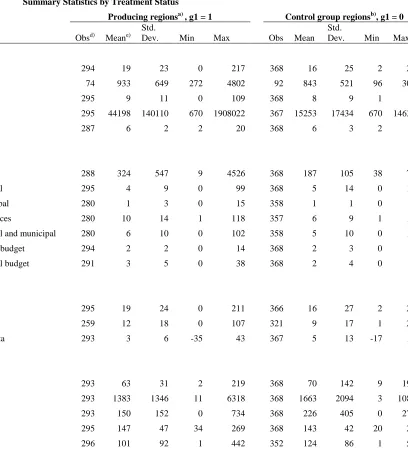
1. Summary Statistics by Treatment ………..….…155
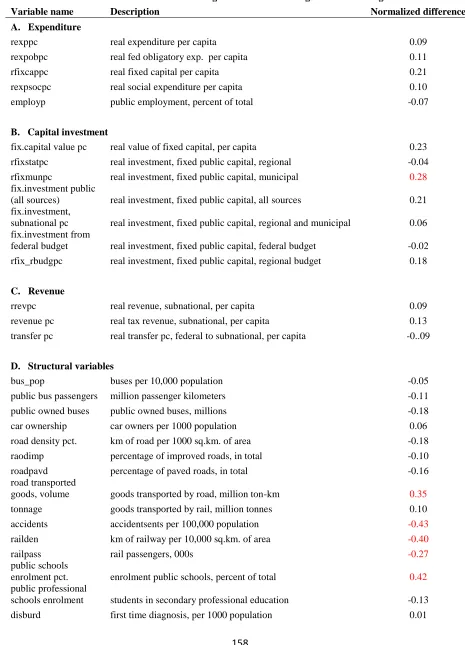
2. Normalized Difference in Averages between Producing and Control Regions …...…..158
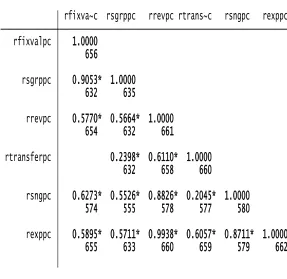
3. Correlation Matrix 1 ………..…….160
4. Correlation Matrix 2 ……….….…….161
5. The effect of change in rent revenue shares on investment in fixed public capital in
regions of Russia –a difference-in-differences estimation (multiple treatment model)..162
6. The effect of change in rent revenue shares on investment in fixed public capital in
regions of Russia –a difference-in-differences estimation (multiple treatment model)..164
7. The effect of change in rent revenue shares on new acquisition of fixed public capital in
regions of Russia –a difference-in-differences estimation (multiple treatment model)..166
8. The effect of change in rent revenue shares on new acquisition of fixed public capital in
regions of Russia –a difference-in-differences estimation (multiple treatment model)..168
9. The effect of change in rent revenue shares on investment in fixed public capital in
regions of Russia –a difference-in-differences estimation (annualized treatment effect model) ……….170
10.The effect of change in rent revenue shares on new acquisition of fixed public capital in
regions of Russia –a difference-in-differences estimation (annualized treatment effect model)……….…….172
11.The effect of change in rent revenue shares on investment in fixed public capital and total
public expenditure in regions of Russia –a difference-in-differences estimation (multiple treatment model using seemingly unrelated equations) ……….……….174
12.The effect of change in rent revenue shares on new acquisition of fixed public capital and
total public expenditure in regions of Russia –a difference-in-differences estimation (multiple treatment model using seemingly unrelated equations) ……….…….176
13.Settlement of Exhaustible Resource Ownership in Federal Countries ………….……..178
14.Importance of Oil to GDP in federal countries ……….……..179
15.Rent as a percent of total revenues and federal-regional shares ……….180
16.Type of Taxes Levied to Collect Economic Rent in Federal Countries ……….181
17.The effect of rent tax share on investment in fixed public capital on regions of Russia
(DDD estimation) ………....182 18.The effect of rent tax share on acquisition of fixed public capital in regions of Russia
(DDD estimation) ………184
19.The effect of rent tax share on investment in fixed public capital and recurrent
expenditures in regions of Russia (DDD estimation) ……….186
20.The effect of rent tax share on investment in fixed public capital and recurrent
List of Figures
Figures
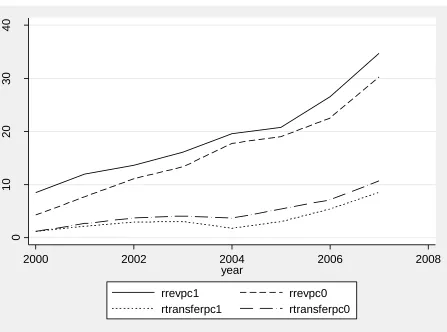
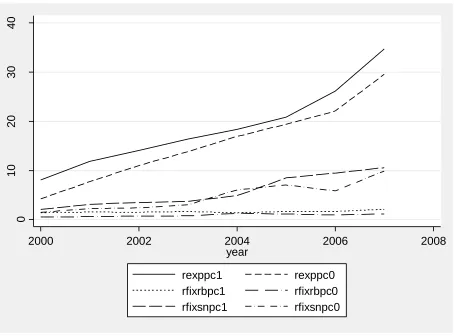
1. Changes in unconditional mean values of key variables 1………153
Abstract
Exhaustible resource rents are an important taxable base in many countries, with revenue sharing often part of the scheme. In some cases large shares are retained for the central government. Generally, the discussions of exhaustible resource taxation consider assignment of resource rent tax base and revenue sharing from the limited perspectives of efficiency and stability. Tax assignment and sharing arrangements are assumed to have a neutral effect on investment of resource rents in long-lived public goods. We attempt to demonstrate that this may not be the case, specifically looking at the question of whether rent assignment is neutral to effects on investment of rents in long-lived public goods, a normative policy objective, and under what conditions it occurs. We test the theoretical propositions with data from the Russian Federation to derive empirical results. The results from the Russian Federation point toward an important dimension of rent tax assignment in a federation. They results show that ceteris paribus, higher share of rent for the federation may lead to lower investment in long-lived public goods and may be constrained by stability. Another argument has been made for reconsidering rent tax
assignment using assertive ethnic identity as a manifestation strong ownership claims.
Chapter 1 Introduction
Research question and contribution to the literature
Exhaustible resource rents are an important taxable base in many countries, with revenue
sharing often part of the scheme. In some cases large shares are retained for the central
government. Generally, the discussions of exhaustible resource taxation consider assignment of
resource rent tax base and revenue sharing from the limited perspectives of efficiency and
stability. Tax assignment and sharing arrangements are assumed to have a neutral effect on
investment of resource rents in long-lived public goods.1 In the discussion we are presenting in
the following chapters, we attempt to demonstrate that this may not be the case. This research
specifically looks at the question of whether rent assignment is neutral to effects on investment
of rents in long-lived public goods, a normative policy objective, and under what conditions it
occurs. We test the theoretical propositions with data from the Russian Federation to derive
empirical results.
This research adds to the literature of exhaustible resource rent assignment by
demonstrating that assignment and revenue sharing arrangements may not be neutral with respect
to investment of exhaustible resource rent in long-lived public goods. It presents a case for
1 Most discussions do not mention if there would be any effects of assignment of rent taxation on investment choices
of exhaustible resource rents. For example some of the important discussions of rent taxation make this common omission: Dasgupta, Heal and Stiglitz (1981) show taxation affects inter-temporal allocation of exhaustible resource through effects on the pace of extraction; McLure and Mieszkowski (1983), present different issues concerning efficiency, equity and allocation of rents, treating them only as revenues in the general pool without connecting them with assignment of rent taxation; this particular treatment is the main discussion in Boadway and Flatters (1983) in the same volume and remains the standard approach; McKenzie (2006) is a discussion of arguments for
enhancing the scope of rent assignment discussions and bringing in rent investment
considerations into revenue sharing decisions. In this sense, it adds the allocation dimension to
the earlier assignment question that generally concerns itself with distribution and stability
concerns. A theoretical model developed in Chapter 2 shows that under commonly faced policy
choices, rent assignment (and revenue sharing) affect(s) investment of exhaustible resource rent
in long-lived public goods. The following two chapters, using data on the Regions of Russia
provide some validation to the theoretical propositions. We show that assignment of rent taxes or
changes in rent shares may have effects on investment in long-lived public goods—a finding that
has importance for development policy.
For good economic reasons, exhaustible resource rents serve as a tax base for efficient
taxation.2 Resource rent revenues lead to different expenditure choices regarding current and
capital spending. For both tax and expenditure efficiency, a framework will be required that links
both the revenue and expenditure sides of policy choices. Within this framework, rent tax
assignment and revenue sharing will be considered and different options may be linked to certain
expenditure choices. In the following chapters, a case is laid out in a federal setting where
assignment of tax on exhaustible resource rents and revenue sharing are made in such a
framework, and under certain circumstances, have effects on investment choices. A majority of
discussions about resource rent taxation have concerned themselves with macroeconomic
stabilization and redistribution objectives.3 This discussion attempts to add to the literature on the
subject by focusing on the allocation effects of rent taxation as it distills the effects of assignment
and sharing arrangements on public investment. In this sense, the discussion builds a case for the
2
These reasons, for example, are laid out in McKenzie (2006).
3 Musgrave‘s trilogy of government functions is a used as a baseline consideration for tax assignment also. See for
pursuit of development policy4 through an analysis of assignment of exhaustible resource rent
tax and revenue sharing.
In this introductory chapter, we have dealt with a description of key basic assumptions
and concepts that are used later on. At the same time we have attempted to provide definitional
clarity for some terms. More specifically, the concept of rent is recounted along with various
types of resource rent taxes. The assignment question and its various arguments are briefly
discussed. Then the importance of investment of exhaustible resource rents is highlighted before
priming the discussion for the theoretical and empirical considerations.
Resource rent and resource rent taxes
Exhaustible resource rent is an important fiscal item in many federations. Rent collection
and sharing therefore commonly crop up as important issues in intergovernmental relations.
Argentina, Australia, Brazil, Canada, India, Iraq, Mexico, Nigeria, Pakistan, Russia, United Arab
Emirates, United States and Venezuela are among the major federations of the world. All of
them produce oil, gas and other minerals in quantities that are significant quantities. For
example, oil extraction is an important sector in the gross domestic product in a number of
federations.5 Reserves are endowed in some regions only. As a result, rent tax collection and
revenue sharing are important considerations for the national or subnational fiscal policy.
Among the federations, Iraq has a major dependence on oil production as it contributes
54 percent of GDP. Nigeria, another major federation, gets nearly 40 percent of GDP from oil. In
the United Arab Emirates, the contribution of oil to GDP is greater than 20 percent of GDP. In
4 For a detailed discussion of this concept, see Bahl (1999). 5
case of Venezuela, oil accounts for 20 percent of GDP closely followed by the Russian
Federation with around 17 percent of contribution to GDP coming from the oil sector. For
Mexico, another important federation, the contribution to GDP from oil and gas is around 5
percent.6 A more precise measure of the significance of the petroleum sector to government is
the share of rent tax revenue as a percentage of total revenue. Again, in a number of federal
countries7 oil and gas rent tax revenues appear as important items in the tally for total revenue. In
Australia, at 2.9 percent of total government revenue, it is noticeable. In Pakistan, at 8.4 percent
of total tax revenue, it is significant enough to create long drawn out political conflict between
producing provinces and federal government. In the United Arab Emirates, with nearly 75
percent of total revenue, petroleum becomes the mainstay of the fiscal regime. To a lesser
degree, in Venezuela with half of government revenue coming from this sector, it again becomes
the main source of revenue. In the largest federation, Russia, it accounts for 36.7 percent of total
revenue signifying that rent taxes make a major contribution to government operations.
Before entering upon the discussion of neutrality or otherwise of assignment of rent tax
and revenue sharing arrangements, it is important to clarify a few connected concepts. The two
foremost issues are what a resource rent is and what taxes could be classified as resource rent
taxes. Exhaustible resource rent is defined as the sum of sales revenue and extraction costs,
computed over a unit of the extracted resource (Dasgupta & Heal, 1979). It can be understood as
partly a Ricardian rent and partly a Hotelling rent.8 Whereas the first component of this rent is a
6 Calculated from Government of Mexico‘s Sistema de Cuentas Nacionales de México. Cuentas de bienes y
servicios 2005-2009. Año base 2003. Primera version, Table 51,page 117.
7
The percentages are based on the sources listed under Table 4.3 in Chapter 4.
8 The term is due to the seminal work on exhaustible resources by Hotelling (1931). The efficient extraction path is
fairly well established concept,9 Hotelling rent is a term used to refer to the fact that extraction of
a finite stock is only rational if the value of extracted amount is higher than the net present value
of the same amount if left unextracted.10 Resource rents taxes attempt to reach this base and
siphon it away for the general use of the society.
If economic rent can be computed for a unit of extracted resource, for the purposes of
taxation this represents a base upon which an efficient tax could be levied. Since the rent is an
economic profit, it accrues due to scarcity of the resource. Rent signifies the willingness of the
production process to pay for the use of the extracted resource. The resource is used up in the
process and is lost forever. Rent is the one-time value paid for this single use to the owner. A tax
rate that equals the amount of rent remains efficient.11 A resource rent tax levied at an efficient
level will have no influence on investment, types of investment, labor-capital ratio, choice of
technology, pace of extraction, mine closure and final disposition of extracted stocks.12 In
practice, neither the price of extracted resource nor the costs remain stable over time. When
combined with the complexity of mining operations spread over several mines, each with
differential costs, it means that rents may vary between mines and over time. The conceptual
clarity of rents is not equally replicable in its practical calculations.
Although not central to the analysis presented in the following chapters, reiteration of the
tax efficiency and whether it would be affected by the assignment decision is important as a
benchmark of reference. Assuming that there is no information asymmetry, government can
design and collect an efficient resource rent tax. It is not necessary that a single instrument
9 Economic rent is typically defined as the excess proceeds in a production process given to a factor, above the
amount required to draw the factor into the process or to sustain the use of the factor (Shepherd, 1970).
10Otto et al. (2006) present a discussion of economic rent accruing to mineral extraction.
11 Theoretical discussions of neutrality and some design issues of resource rent tax are represented in Garnaut and
Ross (1979) and Fraser (1993).
should be employed to siphon away rents. Different levels of government can share the base. As
long as the multiple instruments collect all the economic rent that is there and there are no
administrative costs associated with multiplicity of instruments, taxation will remain efficient.
For the most part in my discussion, we maintain these assumptions that resource rent taxes being
modeled in the analytical framework are efficient.13 The same assumption extends to the case of
multiple tax instruments, all delving into the same base. Later in the analysis, for the sake of
expositional simplicity a single tax is employed in the model.
In practice, a number of taxes are used to tax exhaustible resource rents. A World Bank
study enumerates these taxes under two categories (Otto et al., 2006). The first category
comprises the in rem taxes and includes unit based royalty, ad valorem royalty, sales and excise
tax, property tax, export duty, withholding on remitted loan interest, withholding on imported
services, value added tax, registration fee, rent or usage fee and stamp duty.14 The second
category is made up by in personam taxes. Corporate income tax, capital gains tax (levied only
in developing countries), additional profits tax (rarely used), net profits royalty or net value
royalty and withholding on remitted profits or dividends. The in rem taxes do not clearly aim for
the economic rents accruing to extracted resources. Only where tax systems lack adequate
capacity, unit based or ad valorem royalty could be arguably a crude means of siphoning parts of
rent to the government.15 On the other hand, in personam taxes are levied on profits and they are
adequate to siphon away economic rents. Corporate income tax, levied at a higher than normal
rate, siphons away economic profits from mining operations to the government. In general
royalty is paid regardless of the profits of the operation. In some cases, a mineral tax may be
13In practice, if an operational measure cannot be found, the tax may not be efficient.
named differently but in essence it is a net profits royalty.16 These are two examples of pure rent
taxes. Disregarding the complexity of computing rent or pure economic profits for mining
operations that may be spread over several jurisdictions or countries, corporate income tax is
used to tax rents. If the rate is the same across all sectors, then it does not become a rent tax. But
in countries where the tax code legislates special (often higher) tax rates for the mineral sector, it
becomes partly a rent tax. For example, in Malaysia and Venezuela the corporate income tax for
the oil sector is higher than other sectors. Other commonly used instruments are license fees
(Brazil), bonus bids (Canada) and export levies (Argentina, the Russian Federation). Local
governments may levy a special rate property tax. The special component of the rate allows them
to retrieve some of the rent whereas the general component of the rate is designed as the normal
property tax payment for use of local services, following the benefits principle.
Without going into further details of tax instruments and their relative merits, we want to
focus on the effects of base assignment and revenue sharing arrangements on investment in
long-lived public goods—the topic of my analytic endeavor. Therefore, for the remaining discussion,
we abstract from reference to individual tax instruments unless specifically required. Instead we
use the term resource rent tax which embodies the taxes levied to siphon away economic rents
accruing to extraction of exhaustible resources. This term is also useful as it captures an essential
feature of exhaustible resources namely, the finite stocks and one time rents that can accrue to
producing jurisdictions. Before leaving the discussion of individual tax instruments, we present a
short aside on royalties to clarify the extent to which they could be counted under a resource rent
tax.
Royalties are a common tax instrument levied in most countries with significant mining
operations. It is a tax specific to natural resources. Two aspects of natural resource royalty can be
brought up to clarify the nature of this levy. The first one relates to the nature of the levy. It is
defined as a payment for resource ownership. In this sense royalty has a legal status not
necessarily very significant for fiscal policy.17 It can be charged only by the owners and payment
recognizes resource ownership. Royalty is paid in lieu of transfer of property rights of the
mineral from the endowment owner to the firm carrying out the mining operation. The second
aspect of royalty is not equally clear. It is levied on the base, the resource rent, but in some cases
without specifically claiming the levy to be a resource rent tax.18 The general practice of setting
royalty rates is also a manifestation of this approach. In many cases, an arbitrary rate is set which
remains fixed over long periods of time.19 The rate is sufficiently low to keep it below the upper
bound of rent assessment. Resource rents vary with production methods, commodity prices and
cost of mining. Royalty collects a known fraction of the value of production without the
necessity of calculating resource rents for individual mining operations.20 Beyond this feature of
royalty it is but another instrument for collection of part of the resource rents.21 In some cases, no
explicit royalty is collected but another tax assumes the same role. A good example of this kind
of tax is the Mineral Extraction Tax in the Russian Federation. It is levied at a uniform rate
across all mines with varying exemptions and depreciation allowances.
17 Sometimes a distinction for royalty has been made as an interest free of production expense; see for example
Maxwell (1954, 1995) with reference to the United States. A recent account of mineral royalties with international cases has been provided in Otto et al. (2006).
18Otto et al. (2006), p.50, provide a detailed definition of royalty as ‗[a] royalty is any tax that exhibits one or more
of the following attributes: the law creating the tax calls that tax a royalty; the intent of the tax is to make a payment to the owner of the mineral as compensation for transferring to the taxpayer the ownership of the mineral or the right to sell that mineral; the intent of the tax is to charge the producer of the mineral for the right to mine the mineral produced; the tax is special to mines and is not imposed on other industries.‘
19 South Africa has recently introduced a variable royalty regime, changeable with commodity prices that will be
levied on the base of sales revenue (Cawood, 2010).
20
This would be true for unit based and ad valorem type royalties only if they are the only instruments collecting a notional value of rent which is not clearly defined.
21
Assignment of resource rent tax and revenue sharing
The general question of assignment of rent tax base and revenue sharing is relevant under
any tax assignment scheme.22 The clearest case of assignment of resource rents would be through
assignment of resource rent as a tax base to a certain level of government. In other cases, it could
take place through a sharing of the tax base, where different levels of government levy their own
taxes. Revenue sharing on derivation basis may also be part of the assignment scheme. Assuming
that resource rent taxes are levied at an efficient level and the same shares apply, base and
revenue sharing may achieve the same outcomes for the producing regions because both schemes
will result in the same amount of revenue with the producing regions. In practice, the shares of
exhaustible resource rent provided under revenue sharing, belonging to producing regions and
the rest of the country, may or may not be the same as base sharing. Tax assignment may give a
higher share to the centre but impose a derivation based high share in revenues for the producing
regions. On the other hand, if the country has not legislated revenue sharing arrangements, shares
in the base will determine the revenue shares of different levels of government. In this case, the
rent assignment will take place through base sharing. If there is efficient central taxation, the
only efficiency important at the subnational level is on the expenditure side. Therefore, the
discussion in the following chapters posits the rent tax assignment question allowing for different
types of tax and revenue sharing arrangements to operate under it. For the purposes of the
following chapters, ‗rent assignment‘ means the final shares of producing regions against the rest
of the country, derived from base sharing and/or revenue sharing arrangements.
Main arguments in favor of central assignment of rent taxes
and revenue shares
The non-neutrality of rent assignment, if authenticated, implicitly raises a question about
the balance of arguments in favor of centralization. Therefore, it will be useful to briefly recount
these arguments here. Efficiency of rent collection arrangements is an important consideration in
tax policy. It allows governments to avoid creating deleterious effects of taxation on investment
decisions, pace of extraction, type of methods used to extract resources, processing choices and
final usage. Rent tax assignment choices are considered under the efficiency framework. A
considerable quantum of research has been devoted to elaborating conditions under which tax
efficiency operates.23 This literature deals with the difficulties of computing rent and variations
in rent amounts over time.24 International commodity prices are known to fluctuate. At the same
time, production processes undergo technological changes, in turn affecting production costs. All
this makes computing rents complex requiring high levels of capacity at various levels of
government. Generally, it is assumed, sometimes with weak justifications, that central levels of
government have higher capacity. This argument alone sways the assignment question, when it
comes to exhaustible resource rents, in favor of centralization although even here we may get
inefficient taxes. The need to employ efficient taxation in this way leads to arguments for
centralization of rent taxes.
23For example, see Boadway and Flatters (1993), Daniel, Keen and McPherson (2010).
24
Without necessarily deprecating the merits of these arguments, it is easy to say that such
argumentation could only justify administrative centralization, without overshadowing the
domain of revenue sharing. The producing regions could still receive derivation based shares
from centrally administered resource rent taxes. Even if there are incontrovertible arguments in
favor of centrally administered resource rent taxes, they by no means can preclude subnational
sharing of revenues. The discussion in the following chapters therefore eschews these arguments
entirely and focuses on the effects of rent assignment on a less studied area, namely public
investment of resource rents.
Another set of three issues commonly raised in connection with rent taxation pertains to
the potential effects of rent revenue on the economy. First issue is the injection of revenues
derived from resource rents gathered in the producing regions that lower the tax price of public
services provided in their jurisdictions. The tax price change induces labor migration due to
differences in net fiscal benefits between producing and non-producing regions. It is argued that
this is an inefficient outcome. To prevent such labor migration, exhaustible resource rents should
be spread over a country as much as possible, it is argued. This argument seemingly combines
allocation and distribution choices. Another related issue works at all levels of government.
Resource rents may cause exchange rate effects and crowding out of other sectors in the
economy. Macroeconomic effects may require stabilization, which lies in the functional purview
of the central government. Thirdly, fluctuations in commodity prices create unpredictability in
rent revenues.25 Rent based revenues are pro-cyclical exposing subnational governments to fiscal
pressures during economic downturns. Subnational governments, when they have a legally
25 Boadway and Keen (2010), Figure 2.1, have documented fluctuations in real prices of crude oil, copper and
constrained access to credit markets, have a lower capacity than central governments to absorb
the effects of revenue fluctuations (Norregaard, 1997).
All three issues, it is argued, point toward centralization of rent. These arguments are
stronger than the efficiency considerations because their effects go beyond tax administration. In
addition to assignment of rent taxes to the center, on the basis of these arguments, producing
regions can be deprived of high shares in revenue also. While recognizing these arguments, it
suffices to say here that none of them makes a water tight case for complete centralization of
exhaustible resource rents. Arrangements at subnational levels, such as savings funds,
endowment facilities or fiscal rules, may provide answers that are possible at the central level.26
The following chapters do not attempt to address these options in order to focus on a relatively
less studied issue in rent assignment, namely the effects of rent assignment on public investment.
Resource rent and concern for long run productivity
Exhaustible natural resources present some unique issues for policy formulation. They
are further rendered interesting when viewed in a federal context. Theory argues for a wider
sharing of rents in a society (Dasgupta & Heal, 1979; McKenzie, 2006), but it does not clearly
spell out whether this sharing should be at the regional level or at the national level. The
ownership question assumes significance when it comes to sharing of resource rents. This is
partly due to the nature of the resource rents. Exhaustible resources are irreplaceable engendering
strong ownership claims. They cannot be regenerated in timescales relevant to human planning
cycles. With an exhaustible resource, ‗the intertemporal sum of the services provided by a given
stock of the resource is finite‘ (Dasgupta, 1984, p. 153). Exhaustible natural resources are
generally endowed unequally to certain regions.27 Many times their ownership is claimed by the
society as a whole. Economic theory presents arguments in favor of this treatment arguing that
since exhaustible resources generate rents and the tax cannot be shifted,28 their community
ownership is more efficient over individual ownership. The efficiency argument is based on the
distortionary effects of rent on economic agents. It will be inefficient to leave these rents to be
exploited by private individuals. Taxation of rents to the point of their exhaustion and then
utilization of revenue for the general community weal is a practical mechanism for community
ownership.
This provides a measure of equity within society, at the same time ensuring that
economic distortion is minimized. However, what is not clear is what constitutes a community
for the purposes of sharing of resources. In practice this question is not clearly answered.
Community could arbitrarily comprise individuals living within the geographic confines of
country or a subnational region. It could be all individuals of such a set currently alive or also
include any number of future generations. A cursory observation of the way nations are carved
up shows that communities for the purpose of sharing of exhaustible resource rents varies very
much in size, nature, constitution and timeliness. Economic theory for the purposes of rent
assignment does not attempt to create another definition but takes politically constituted
communities as given.
Rent assignment discussions therefore do not address community ownership of rents and
its effects on expenditure choices. Even if efficient taxation is employed and macroeconomic
instability is addressed through fiscal rules, expenditure choices for accumulating resource rents
are important to development and growth in the economy. As discussed below, unlike other
27 The same may hold for renewable natural resources.
28
forms of taxation, rent tax combined with appropriate expenditure choices, can be an instrument
for development and long term sustainability of productivity. Implicitly, rent assignment based
on the arguments recounted above, assumes that expenditure preferences are the same across
jurisdictions in a country. More specifically, it assumes that producing regions and communities
asserting ownership to exhaustible resource endowments have the same rent investment
preferences as other communities in a nation. These assumptions are not plausible. The
discussion in the following chapters addresses this discrepancy in the rent assignment question. It
connects rent assignment with expenditure choices, employing a policy framework, and allows
for differences in preferences for rent investment among regions.
An argument for linking rent assignment to expenditure choices is made from the
perspective of development and growth. Finite resources extracted from endowments are used as
inputs in the current production processes. They sustain current levels of consumption. Resource
rent is collected by government and can be invested or consumed. Once the stocks decline or are
exhausted, the productivity of the economy will be adversely affected. Decline of stocks can
mean declining levels of consumption and welfare in this situation. If rent is consumed, the
productivity and consumption level become low as stocks approach zero. However, if rent is
invested in producible capital, it will sustain current levels of production.29 This policy choice is
referred to as the Hartwick Rule (Hartwick, 1977). More specifically, all the rent from
exhaustible resource should be invested in producible capital to preserve current levels of
productivity and consumption. This principle is the normative outcome for policy choices in
most of the following discussion.
29 This is different from other taxes as the base for such taxes is not exhaustible. Taxes may distort economic
A related concept, genuine savings or genuine growth, attempts to take exhaustible
resource decline and environmental damages into consideration. In this discussion, the issue of
rent assignment is being analyzed assuming that the notions of the Hartwick Rule and genuine
national savings indicate an interest in seeking optimal rent investment namely a level of
investment that sustains productivity of the economy. Exhaustible natural resources are an
endowment but by their nature the stocks deplete regularly with extraction. This means that their
extraction is carried on over a finite period of time. Extraction does two things: it makes an input
available to the production of goods and services within the economy and it also deprives future
generations of an input in the production process. It also reduces the opportunity to collect rents
in the future. If the rent is consumed by the current generation, it enhances their welfare
measured in consumption terms, but it potentially reduces the welfare of the future generations.
The Hartwick Rule is a theoretical concept which describes that under certain conditions
intergenerational equity can be guaranteed even when exhaustible natural resources are
extracted. These conditions include constant returns to scale production, stable population and no
technological progress. It states that if rents from exhaustible natural resources are invested in
long term replaceable capital, then there is no change in the intergenerational welfare (Hartwick
1977). According to the Hartwick Rule
∆ k = - y(t)
Where ∆ k is the change in capital in time t and y(t) is the amount of resource extracted in
the same time period. The rule means that the all the resource rent should be invested in
producing new physical capital. If this condition is met then consumption remains unchanged
The intergenerational distribution of benefits within the federal arrangement of
government is complex. Relying on the Hartwick Rule, we would argue that the
intergenerational assignment of benefits is a function of extraction rate, distribution of ownership
and the type of investments or consumption generated by the rental income. Exhaustible natural
resource is available, by definition, in some time periods only. Its availability to production
immediately creates an intergenerational equity question. If it is available to individuals living in
the prior time period only, then it is their endowment and has a wealth and income effect during
it. The consumption level of the individuals in the prior time period will be significantly
improved, depending upon the size of the endowment and cost of extraction. Going by a
utilitarian perspective, the intergenerational equity question is not significant. In the later time
period, when the resource has been exhausted, individuals will not have any endowment to rely
on. There should be a negative of the income and wealth effects in operation, reducing their
consumption levels. As long the sum of generational welfare has increased, which generation
benefited the most is unimportant. But applying Rawls principle, if we assume that no individual
before the start of time knows if he will belong to the prior generation or the later one, then he
will only choose an intertemporal distribution of the endowment such that his consumption stays
the same in either time period. To achieve a no envy result, some distribution principle is
required.
Hartwick (1977) suggests that this can be achieved if the royalty from the exhaustible
natural resource is invested in reproducible capital. In the first time period when the resource is
extracted all the rents should be invested in production of reproducible capital which leads to a
higher level of consumption for the individuals in that time period. In the second time period,
second generation and ensures that their consumption level, measured in present value terms,
does not change below that of individuals in the preceding time period. The same principle has
been endorsed by Solow (1986) when he suggests that as a rule, efficiency and equity both can
be achieved if the rents from exhaustible natural resources are invested in capital formation. A
nice implication of the Hartwick Rule and Solow‘s discussion is that equity does not need to be
considered separately. As long as efficiency is achieved and the Hartwick Rules is followed,
equity follows. In other words, an exhaustible resource is also part of the capital available for
production. As long the capital available for all time periods is the same, given no increase in
population or change in technology, it does not matter whether a natural resource or reproducible
capital forms the stock of capital in a certain time period.
Intergenerational equity is a one way concept, where the earlier generation can take
actions to improve the later generation‘s welfare. But the other way round is not possible due to
one way flow of actions (Rawls, 1971). There are various views of maximizing intergenerational
equity, ranging from the utilitarian to the Rawlsian. The Rawlsian max-min social welfare
function would ensure that the welfare of the poorest generation is maximized (Solow, 1974).
There are apparent problems with both the views. But Hartwick Rule by comparison offers a
simpler criterion. An simple analysis of rent sharing and welfare consequences is presented in
Appendix A.1.
The following chapters
In the following three chapters, this simple framework is expanded to take into account
differences in preferences, tax base endowments and sharing of exhaustible resource tax base.
development and growth. This is later used as a policy device to set up the theoretical model for
rent tax assignment in a federal country. The theoretical model presents a general case in a
two-region federation where two-regions vary in tax base endowments and preferences for long-lived
public goods. After the discussion of the general case, additional cases are presented to discuss
intergovernmental grants, differences in tax base endowments (general measures of regional
wealth) and other subnational taxes. The results yield hypotheses that can be empirically tested.
The government while allocating fiscal resources makes a fundamental choice, how much to
allocate to investment in public capital out of the total expenditure. The ratio between investment
and total expenditure is kept a certain level as governments seek to provide higher current
expenditures to their populations. The increase in long-lived public goods is another objective
that the governments pursue while attempting to keep current expenditures at a certain desirable
level. The theoretical model attempts to explain the effect of reduction in subnational share of
resource rents in this context. After presenting the model we then use six cases to characterize
different situations in the world federations.
In Chapter 3 an empirical model is developed to test the implications of the theoretical
model. The hypothesis in Chapter 2 predicts that an increase in the federal share of rent at the
expense of producing regions leads to a decline in investment in long-lived public goods. Such a
policy change namely an increase in federal share of rent, has been mapped in the Russian
Federation from 2002 to 2007. This experience offers a quasi natural experiment for empirical
evaluation of the effects of the policy change on investment in long-lived public goods. A panel
data of regions of Russia from 2000 to 2008 is used to test the theoretical results from the first
paper. The summary statistics presented are normalized to assess application of program
maintained on the model. Before testing for the effect of changes in resource rent revenue shares
of regions, we have identified some determinants of new investment in fixed public capital in the
regions of Russia. The variables that have a significant effect on new investment in fixed public
capital in the regions of Russia are used as controls for the subsequent estimations. Using
program evaluation methods, we employ two types of difference-in-differences estimators to
study the effect of changes in the regional share of rent revenue on new investment in fixed
public capital. The first set of estimators estimates the effect on new investment in fixed public
capital separately for each post treatment year. The second type of estimator estimates the effect
on new investment in fixed public capital for all the entire post treatment time period. The
robustness of the results from the difference-in-differences estimators are then checked using two
additional methods. First we estimate the effects using bias corrected matching estimator. The
results corroborate the general findings obtained from the difference-in-differences estimation.
Then, we use a propensity score matching to test the validity of the estimated effects. Again we
find that the results are generally the same as obtained from difference-in-differences estimation.
Chapter 4 offers some world examples of rent assignment and provides evidence that
identity based ownership of resource rents may not be neutral to rent assignment. There we
provide a brief review of the resource rent tax assignment in the major federations. The
variations in the treatment are discussed. We also provide examples on rent tax instruments
employed in these countries at different levels and conclude that resource rent tax assignment
should not be left to the general assignment problem but should be given a special consideration.
Using data from the Russian Federation we use a difference-in-difference-in-differences
estimator to find out the differential effects of increases in the federal share of resource rent at
producing republics. The results show that the new investment in public capital in the republics
with claims to ethnic identity declines more than it does in the other producing regions. Using
the percentage of ethnic Russian population in the total population we find that a higher
percentage of ethnic Russians in the population increases the investment in new fixed public
capital. The conclusion makes a case for enhancing the scope of issues that should be considered
for rent assignment.
Chapter 5 is a brief narration of the most important results obtained and it concludes the
discussion. It argues for widening the scope of rent assignment discussions and recounts some of
Chapter 2 A Theoretical Model for Exhaustible Resource Rent Assignment
Introduction
In this chapter we are presenting a model to analyze the effects of assignment of rent tax
levied on an exhaustible resource and revenue sharing on investment in long-lived public goods.
It is predicated on the main argument that rent tax assignment and rent revenue sharing are not
neutral in terms of effects on investment in long-lived public goods. Producing regions may
differ from non-producing jurisdictions in their preference for public infrastructure and other
long-lived public goods. Such differences, if present among the two types of regions, render rent
assignment non-neutral to rent allocation. In general such differences are not studied. The model
that is laid out later in this chapter attempts to take differences in preferences into account and
maps them out on rent allocation. The rent assignment is characterized by a change in the shares
between federal and subnational governments. Tax base and revenue sharing are assumed to be
equivalent to simplify the model. The theoretical discussion presents first a general case,
modeling a federation with differential tax base endowments. Then it sets out variations on the
general model by bringing in the role of intergovernmental transfers and differences in regional
level preferences for long-lived public goods. The differences in preferences are allowed but not
necessarily invoked as assumptions. They become relevant to some results.
The assignment of rent tax in multi-tiered government has not been discussed from this
perspective. In order to focus on the effects of assignment on investment in public goods, we
and expenditure allocation. To lay out this approach the following narrative alludes to several
issues that are germane to the discussion, focusing on a normative connection between
exhaustible resource rent and investment in long-lived public goods, efficiency and equity as
relates to use of exhaustible resources and the world federations endowed with asymmetric
exhaustible resource endowments. These allusions at the outset allow me to characterize the
model with its attendant arguments.
Rent tax in general is an instrument for siphoning away economic rents from exhaustible
resource extraction to the general benefit of the economy, endorsed in theory for the efficiency
gains it provides to the society.30 As long as the tax instrument scoops up all of it, neither leaving
any economic rent in the hands of mineral extracting private companies nor expropriating more
than can be counted as the actual rent, it is efficient, providing a rare tool to policy makers.
Discussions aiming to hone tax instruments that meet this surgical precision have been recorded
from the points of view of feasibility of administration.31 Some other concerns are computation
of profits with fluctuating commodity prices (Bahl & Bird, 2008). We do not pursue these
discussions any further here, assuming that design and implementation of such taxation is
feasible.32 Instead we are focusing on the outcomes of rent taxation in a federal setting.33 In
doing so we are attempting to answer a question, as laid out above, that is important both from
efficiency and equity perspectives: even if a rent tax is efficiently levied and administered, the
30 Boadway and Flatters (1993) reiterate the generally held views that resource rent taxes are non-distortionary and
allow a distribution of rents over all members of a society; Dasgupta, Heal and Stiglitz (1980) present a discussion of tax instruments with reference to their effects on depletion rates; Bergstrom (1982) argued that an excise tax on oil rents can efficiently capture rents. Similarly, Otto (2000) reiterates the theoretical certitude and in addition provides a description of rent tax instruments in developing countries.
31
Land (1995) gives a detailed treatment of progressive profit taxation of mineral resources. A discussion of tax instruments and their assignment in federal settings is presented in McKenzie (2006). Table 9.1 shows, using examples from 23 countries, that various types of taxes have been assigned among three tiers of government.
32
For a discussion of mining tax decentralization in a multi-tiered government, see Otto (2001).
33 I do not distinguish between royalties and natural resource taxes in my characterization of rent tax as essentially
level of assignment in a federation has an effect on outcomes, and in turn an effect on efficiency
(and equity, as laid out in the Hartwick rule). This examination broadens the scope of efficiency
to include expenditure outcomes in addition to the traditional concern with tax efficiency,
balancing the focus with regard to the use of rent tax revenue. If efficiency is achieved in this
enlarged scope, it ensures equity by sustaining the level of productivity inter-temporally. The
question is examined by positing the assignment of rent tax and expenditure questions in a
general multi-tiered government framework. The implicit argument is that it is not only taxation
alone but expenditures also that determine the efficient (and equitable) outcomes. Unless
discussed together, efficiency is at best a partial achievement. This integrated approach of rent
tax and capital expenditures adduces a wider scope of efficiency.
The chapter is structured as five sections. Two important building blocks are crafted in
the first two sections before the model is discussed. The place of public infrastructure, a type of
long-lived public good, in development is the first one. Following a narration of this notion we
present a brief description of an important exhaustible resource, petroleum, in federations and in
particular the type of revenue and base sharing arrangements that are used. Hence, Section 1
recounts the importance of long-lived public goods and explores their connection with rent
taxation from a normative policy perspective. The inclusion of this description is necessary to
concretize the notion of efficiency of outcomes. The section sets the stage for the following
theoretical framework. It also introduces the enlarged scope of efficiency for policy
consideration. The discussion culminates by introducing the tradeoff in expenditure choices
between long-lived and consumable public goods in development. Section 2 takes a slight but
relevant detour to briefly visit world cases of federations and large countries where the
some basic parameters of rent tax assignment in federal countries to make use of them in setting
out problems discussed under the theoretical model. The types of tax and base sharing in 10
federations, inter alia, are presented. Here my position is that the sheer size of mineral extraction
and related revenues, even whilst ignoring the political issues, dictates a relevance of tax and
expenditure assignments that could only be ignored at the peril of loss of efficiency. Various
types of instruments used for rent tax collection and sharing ratios are summarized.
Section 3 presents a theoretical model for exhaustible rent assignment in a federation and
constitutes the core of this discussion. The model builds a general case where long-lived public
goods are pursued as the first objective of development. This pursuit is arguably made under the
Hartwhick rule, genuine savings approach or simply infrastructure for growth approach. The
provision of consumable public goods, competing for fiscal resources, form the second objective
of development policy. In the general case, federal taxation on the general tax base and the
natural resource rent operate as distinct policy variables. We allow for a differential social
valuation of the two types of public goods across subnational jurisdictions, allowing policy
choices which can emphasize one over the other. The choices are made in the subnational
domain. The general case presents a model for investments in the stock of long-lived goods in a
federation with subnational governments operating under the tutelage of the center. This case
applies to most established federations as well as large unitary countries under certain
assumptions. The model is, however, sufficiently flexible to analyze the effects of some other
policy variables.
Section 4 contains a discussion of relaxing some of the strict assumptions of the general
case. We allow for additional scenarios to be depicted through variations in the model. First of
insights into the impact of federal rent taxation on the development of long-lived public goods.
The case allows for direct investment in long-lived public goods through a straightforward
budgetary allocation, in the shape of vertical programs or establishing a savings fund.
Developing the model further, we bring in the role of explicit transfers. The general case has
implicit transfers built in the model. Equalization transfers in the model show that the results will
vary with additional parameters when considered. In another iteration of the model, the regional
fiscal resource is shown as a function of the subnational tax policy and administration. Whether
changes in subnational taxation, given the federal taxes on general tax base and natural resource
rent, would affect increase in long-lived public goods or not. The discussion of each case is
validated by reference to cases from the federations around the world. Finally, in many cases,
resource rich regions are poor and under-populated compared with the rest of the country. The
question of whether these facts change the results of the earlier analysis or not, is also modeled.
For the purposes of this analysis we bring in changes in distribution of the fiscal resource, which
is a proxy for regions‘ wealth.
Section 5 concludes the discussion of the theoretical model. The contribution of the
model to the assignment question in federations is highlighted. The policy preference for
long-lived public goods (or lack thereof) varies across regions. Where there is a higher preference for
sustainable improvements in welfare, as would be expected in regions with high resource
ownership, resource rent tax (or revenue) assignment is not neutral to new investments in
long-lived public goods. The expectation for higher preference in regions endowed with exhaustible
resources is based on its connection with ownership. But there may be cases where such
Role of Long-lived Public Goods in Development
Exhaustible resources are often key inputs in production processes sustaining the current
level of social welfare in a country. For example, production processes with presently available
technology are dependent on exhaustible resources, in turn generating a similar dependence of
household consumption on them.34 At the same time, allocation of rent to production of
consumable goods or new investment in long-lived goods is a choice that partially determines the
stock of capital over time. If rents together with the exhaustible resource are consumed, then the
outcome ceteris paribus, leads to lower productivity and consumption over time. If however,
long-lived public goods are generated in addition to consumption, productivity is sustainable
inter-temporally. If public infrastructure is one of the expenditures choices for accumulating rent
revenue, it is pertinent to see if it is relevance and importance to development.
Public good provision is central to pursuit of development. Governments pursue
development through taxation, expenditure and regulation, but largely through public
expenditure.35 As a result of this expenditure various types of public goods are provided. These
public goods in various ways have a positive effect on human welfare (Anand & Ravillion,
1993)36 and most public goods are known to have a positive income elasticity of demand.37
Commonly recognized public goods like childhood vaccination, public health, urban planning,
34 The production processes use both exhaustible and renewable resources as inputs. Here, and later in this section,
only one type of resources is specifically mentioned because of the focus of this paper on exhaustible resource rents.
35 This assertion is made to focus on public expenditure made out of rent tax revenue but is by no means
unsupported by evidence. Taxation, despite its redistributive effect is best treated as a revenue raising measure. The effects of taxation on economic development have been discussed as incentives to development (Wasylenko, 1999 provides a survey of literature on taxation and economic development); regulation has its effects on welfare but is limited in scope.
36
As an indirect effect, Cellini, Ferreira and Rothstein (2010) set out empirical evidence showing there is increase in housing values as a result of school investments; Brandts and Rivas (2009) present experimental evidence
demonstrating that institutional environment with a higher punishment possibilities results in higher well being controlling for income and other relevant variables; Sandler and Arce (2007) note the emphasis on public goods as means to development in international financial assistance to developing countries.
37 For example Hewitt (2007) presents empirical estimates of national public goods where the demand for such
education and road have well recognized effects for social welfare and a higher level of
consumption of public goods in some ways indicates that they are synonymous with
development. Not only that but centralized versus decentralized mandates of providing public
goods in multi-tiered government have an effect on public investment expenditures.38 However,
both development and public goods are understood very differently by individuals and
development has been recognized as a set of choices that emerges out of a number of variables
including but not limited to economic growth.39 The definitional spread results in changing
relative emphasis on the type of public goods but a large fraction of public expenditure in
long-lived public goods is never absent from government decisions. In fact, large scale investments in
long-lived public goods have been the hallmark of many government policies.40
Discerning government policy distinguishes between types of public goods. When
government chooses levels of public goods and the type of public goods that are to be provided,
there exists a basic tradeoff between consumable public goods and new investment in long-lived
public goods.41 Repair and maintenance expenditures would also be a complementary part of the
choice. Public expenditure directed toward provision of security, system of courts, air traffic
control, regulation and monetary policy are consumed in the present. Benefits are enjoyed in the
current time period. In contrast to this type of expenditure new capital investment in buildings,
38
Kochar, Singh, and Singh (2009) using data from Indian Punjab show that central mandates overlaying decentralized public good provision mandates have a positive effect on creating intra-village equality in public expenditure. Using data from 2400 Chinese villages Luo, Zhang, Huang and Rozelle (2007) present evidence for the effect of direct village head election on increased investment in public goods.
39
A number of insightful discussions have been carried out to expand the scope of development. The classical version of development as synonymous with economic growth was replaced by the UNDP‘s adoption of Human Development Index as a measure of development, thus enhancing the scope of the term. For instance Pope (2009) uses measures of morbidity and mortality in addition to income; Collier (2009) discussed security and accountability as public goods for development;
40 For discussions of importance given to development of public infrastructure as a cardinal component of state‘s
development policy see for China (Bai & Qian, 2009), India (Lall, 2007; Banarjee & Somanathan, 2007; Patel and Bhattacharya, 2009), Spain (Salinas-Jiménez, 2004), Canada (Harchaoui, Tarkhani & Warren, 2004), Singapore (Phang, 2002), and United States (Cain, 1997).
41 Adam and Bevan (2006) argue that public infrastructure has a positive effect on the non-tradable production by