Open Access
Research article
Use of complementary alternative medicine for low back pain
consulting in general practice: a cohort study
Jean-François Chenot*
1, Annette Becker
1,2, Corinna Leonhardt
3,
Stefan Keller
3,4, Norbert Donner-Banzhoff
2, Erika Baum
2, Michael Pfingsten
5,
Jan Hildebrandt
5, Heinz-Dieter Basler
3and Michael M Kochen
1Address: 1Dpt. of General Practice, University of Göttingen, Humboldtallee 38, 37073 Göttingen, Germany, 2Dpt. of General Practice, Preventive
and Rehabilitation Medicine, University of Marburg, Robert-Koch-Str. 5, 35033 Marburg, Germany, 3Institute for Medical Psychology, University
of Marburg, Bunsenstr. 3, 35037 Marburg, Germany, 4Dpt. of Public Health Sciences, University of Hawaii at Manoa, 1960 East-West Rd.,
Honolulu, HI 96822, USA and 5Dpt. of Anaesthesiology, Pain Clinic, University of Göttingen, Robert-Koch-Str. 40, 37075 Göttingen, Germany
Email: Jean-François Chenot* - [email protected]; Annette Becker - [email protected];
Corinna Leonhardt - [email protected]; Stefan Keller - [email protected]; Norbert Donner-Banzhoff - [email protected]; Erika Baum - [email protected]; Michael Pfingsten - [email protected];
Jan Hildebrandt - [email protected]; Heinz-Dieter Basler - [email protected]; Michael M Kochen - [email protected]
* Corresponding author
Abstract
Background: Although back pain is considered one of the most frequent reasons why patients seek complementary and alternative medical (CAM) therapies little is known on the extent patients are actually using CAM for back pain.
Methods: This is a post hoc analysis of a longitudinal prospective cohort study embedded in a RCT. General practitioners (GPs) recruited consecutively adult patients presenting with LBP. Data on physical function, on subjective mood, and on utilization of health services was collected at the first consultation and at follow-up telephone interviews for a period of twelve months
Results: A total of 691 (51%) respectively 928 (69%) out of 1,342 patients received one form of CAM depending on the definition. Local heat, massage, and spinal manipulation were the forms of CAM most commonly offered. Using CAM was associated with specialist care, chronic LBP and treatment in a rehabilitation facility. Receiving spinal manipulation, acupuncture or TENS was associated with consulting a GP providing these services. Apart from chronicity disease related factors like functional capacity or pain only showed weak or no association with receiving CAM.
Conclusion: The frequent use of CAM for LBP demonstrates that CAM is popular in patients and doctors alike. The observed association with a treatment in a rehabilitation facility or with specialist consultations rather reflects professional preferences of the physicians than a clear medical indication. The observed dependence on providers and provider related services, as well as a significant proportion receiving CAM that did not meet the so far established selection criteria suggests some arbitrary use of CAM.
Published: 18 December 2007
BMC Complementary and Alternative Medicine 2007, 7:42 doi:10.1186/1472-6882-7-42
Received: 23 April 2007 Accepted: 18 December 2007
This article is available from: http://www.biomedcentral.com/1472-6882/7/42
© 2007 Chenot et al; licensee BioMed Central Ltd.
Background
Low back pain (LBP) is a major health problem in indus-trialized countries with significant economic impact [1]. Although it is one of the most common conditions for which adults seek medical attention, there are still few therapeutic interventions with proven clinical benefit [2]. Patients suffering from LBP are frequently dissatisfied with conventional treatment options and turn to comple-mentary and alternative medicine (CAM) [3]. In a tele-phone survey in the United States 54% of the sample reporting back or neck pain had used one form of CAM compared to 34% who consulted a conventional health care provider [4]. In a Canadian survey 39% of patients with chronic LBP reported use of CAM [5].
CAM is also popular in Germany and 73% of German individuals above 16 years have at least used one form of CAM [6]. According to a widespread definition the term CAM is defined as a group of therapeutic and diagnostic disciplines that usually exist outside the institutions where conventional health care is taught and provided [7]. In Germany, parts of CAM are integrated in conven-tional medical care. Physicians can qualify and get formal accreditation in different specialties relating to CAM, gen-erally offered in addition to a medical speciality. In 2005, the National Association of Statutory Health Insurance Physicians in Germany reported that 9214 (7.8%) physi-cians in the ambulatory care sector were accredited in spi-nal manipulation therapy (SMT), 7544 (6.3%) in naturopathic medicine and 2678 (2.3%) in homeopathy [8]. It is estimated that over 20,000 physicians had train-ing in acupuncture [9]. Additionally, many physicians provide CAM without specific training or formal accredi-tation [10]. Other health care professionals such as naturopathic healers ["Heilpraktiker"] also offer CAM, but are not very popular for LBP [11]. In Germany, unlike in other countries with non-medical chiropractors, prac-tice of manual therapy including manipulation as well as ordering X-rays or running an imaging facility is restricted to physicians. Access to massage usually requires a referral from a licensed physician. While some CAM services, e.g. SMT or acupuncture is offered within special programs, are covered by the statuary health insurance other CAM services are not.
The purpose of this study was to estimate the extent of CAM use for LBP in Germany and to obtain information about the most commonly used CAM methods. Addition-ally, we explore which disease-related, socio-demographic and healthcare-related factors are associated with CAM use for LBP.
Methods
Study design
This is a post hoc analysis of a longitudinal prospective cohort study embedded within a three armed randomized controlled trial (RCT) with an educational intervention in a primary care setting [12]. The present cohort encom-passes all patients enrolled in that trial. The primary goal of the RCT was to asses the impact of guideline-oriented treatment on functional capacity in patients with LBP. A predefined secondary goal of the study was to explore the variation of health care services for LBP. The study was conducted in two centers (Marburg, Göttingen). Ethical approval was obtained from both study sites.
General practitioners
We contacted 818 general practices in the geographical area of both study centers. Addresses were obtained from local health authorities. From 118 practices who agreed to participate, 2 dropped out after randomization. The GPs were on average 12.7 years in practice (SD ± 6.9), 48 years old (SD ± 6) (national average 50.4 years) and 42% of them were female (national average 36%). A total of 68 (59%) practices were run by a single GP. The basic demo-graphic data of our sample is not meaningfully different from the national average [13]. Of the 116 participating practices, 3 (2%) were accredited in homeopathy, 5 (4%) in SMT, 16 (14%) in naturopathic medicine, and 25 (21%) in acupuncture. Additionally, 22 (19%) practices offer transcutaneous electric nerve stimulation (TENS) and 46 (40%) at least one form of electrotherapy.
Patients
During the recruitment period practice nurses asked every patient with LBP to participate in the study. All patients were registered to allow an estimation of the number of screened patients. Inclusion criteria were (1) consulting for LBP, (2) age above 18, (3) ability to read and under-stand German, and (4) written consent.
Instruments and data collection
LBP. Study nurses were trained in conducting standard-ized interviews and were able to describe each method in more detail if necessary. We also report some interven-tions which are not considered as CAM but usually are not recommended as first line therapies by back pain guide-lines or are used as household remedies.
The Hanover Functional Ability Questionnaire (HFAQ) was used for the assessment of functional capacity [14]. The HFAQ is a frequently used instrument for the assess-ment of back pain disability and a scale with good psycho-metric properties that are comparable to the Roland & Morris Scale [15]. We preferred the HFAQ because it only consists of 12 items without a loss of psychometric quality compared to the Roland & Morris Scale which is advanta-geous in telephone interviews. The scale ranges from 0 (extreme functional limitation) to 100 (no functional limitation); scores below 70 are considered to represent a significant impairment.
To classify the natural history of LBP, we used a modifica-tion of the von Korff procedure as follows [16]:
▪ Acute LBP: single episode of LBP of less than 90 days duration
▪ Recurrent LBP: multiple episodes LBP of less then 90 days duration within the last 12 months
▪ Chronic LBP: more than 90 consecutive days of LBP within the last 12 months.
To estimate the proportion of patients with radicular symptoms, we relied on the patients' reported level of pain radiation into the leg, which we considered as an indicator of possible nerve root irritation. Given the absence of reliable methods, this is a frequently used and pragmatic approach for assessing radicular pain in large cohorts [17].
For the assessment of depression, we applied the German version of the Center for Epidemiologic Studies –
Depres-sion Scale (CES-D) [18]. Scores above 23 are considered as possible indicator of a clinically relevant depression [19].
Consultation of orthopedic surgeons, general surgeons and neurologists was summarized as "specialist consulta-tion".
2.5. Statistical analysis
We performed logistic regression analyses modeled towards receiving a specific health care service with all socio-demographic and disease-related and healthcare-related factors in Table 1. This procedure provides odds ratios and 95% confidence intervals. Continuous data on depression, pain as measured on a numeric rating scale (NRS) ranging from 0 to 10 and functional capacity were dichotomised. For depression (CESD), we used a cut-off score of >23, for pain levels above 5 and for functional capacity (HFAQ) a cut-off score of >70. All p-values are two-sided and the significance level was 5%.
For acupuncture, SMT, TENS and electrotherapy we added a term in the regression model if such service were pro-vided by the GP.
With a selection procedure (score option) we selected the best model retaining the three most significant predictors.
Table 1: Sociodemographic and clinical data.
Sociodemographic data n = 1342 n (%)
Age groups
< 40 years 348 (35%)
40–60 years 592 (49%)
> 60 years 263 (22%)
Gender female 778 (58%)
School education
< 10 years 2859 (21%)
10 years 551 (41%)
> 10 years 506 (38%)
Employment status
Working full or part-time 765 (57%)
Housekeeping 203 (15%)
Retired 254 (19%)
Unemployed 120 (9%)
Severity of pain > 5 at baseline (scale 1–10) 555 (41%) Chronicity
Acute LBP 257 (19%)
Recurrent LBP 536 (40%)
Chronic LBP 550 (41%)
Radiation of pain below the knee* 259 (19%) (CESD) depression-score > 23 at baseline (n = 1129) 189 (18%) Suspicion of red flags at baseline 118 (9%) Functional capacity < 70 at baseline 633 (47%)
Applied for disability pension 97 (7%)
Consulted a specialist within 12 months for LBP 623 (49%)
Rehabilitation 136 (10%)
Data collection over 12 months period
Figure 1
Data collection over 12 months period.
4 weeks 6 months 12 months baseline
Goodness of fit was tested with the Hosmer-Lemeshow-test and the loglikelihood ratio-Hosmer-Lemeshow-test. We report only mod-els in which the null hypothesis of goodness of fit was not rejected [20]. The software package SAS 9.1 was used for analysis.
Results
Patients
Over a period of three months the 116 participating prac-tices invited approximately 3,400 patients with LBP to participate in the study. They recruited on average 11.6 (SD ± 5.8) patients; a total of 1,342 of 1,588 patients who agreed to participate were finally included. Patients' flow and reasons for exclusion are listed in Figure 2. During the follow-up period 127 (9.4%) dropped out and 1,218 patients were followed up for one year. Patient character-istics are given in Table 1.
Utilization of CAM and some other services
In the narrowest to the broadest definitions of CAM serv-ice, one half to two thirds of all patients received at least one form of CAM during the one-year follow-up. Using a wide definition including all therapies listed in Tables 2 and 3, a total of 928 patients (69%) received at least one form of CAM. With a narrow definition (acupuncture, SMT and massage), 691 patients (51%) received CAM.
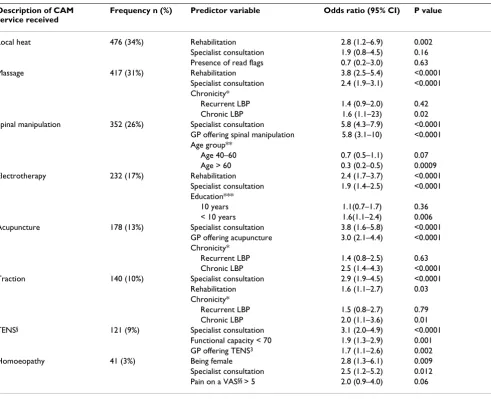
In Table 2 the number of patients who received a specific form of CAM and the predictors for receiving this form of CAM are presented. The most popular forms of CAM were local heat, massage and spinal manipulation. The
predic-tors for receiving at least one form of CAM varied, but the consultation of a specialist and a stay in a rehabilitation facility was consistently associated with the use of CAM.
Therapies which were used by less than 40 patients are given in Table 3.
Discussion
Summary of main findings
Our study confirms that a large proportion of patients with back pain is at least using one form of CAM, mostly in the form of local heat, massage and spinal manipula-tion [4,5]. Using CAM was associated with specialist care, chronic LBP and staying in a rehabilitation facility. Receiv-ing spinal manipulation, acupuncture or TENS were asso-ciated with consulting a GP who provides these services. Apart from chronicity, disease-related factors like func-tional capacity or pain only showed weak or no associa-tion with receiving CAM.
Meaning of the results
Predictors for the use of CAM and related treatment modalities
Unlike multiple other studies we did not observe the con-sistently reported association of CAM with younger age, higher educational status and higher income [4,5,21,22]. The lack of association with higher income and higher education might reflect the integration of large parts of CAM like manual therapy, massage and acupuncture into conventional care in Germany, thus requiring no or only small co-payments for CAM services.
We are analysing associated factors for each treatment modality separately instead of treating CAM as a summary variable, which might also partly explain the observed dif-ference.
The consistently observed association between staying in a rehabilitation facility and specialist consultation is an indicator of patients with higher health care demands. This is also reflected by the frequently observed associa-tion with chronic LBP, although this was a weaker predic-tor. But it also reflects traditional treatment strategies and professional preferences. Mood disorders were found to be associated with use CAM by others, but in our sample a positive depression score (CESD) was unrelated [5,21,23]. We did not collect data on comorbid condi-tions which were also found to be associated with CAM use by others [5,21,23].
Local heat and cold
Application of local heat was very popular while only few patients applied cold ant the only significant predictor was stay in rehabilitation. While there is still insufficient evidence regarding the effects of the application of cold for LBP, there is moderate evidence that heat wrap therapy
Patient flow
Figure 2
Patient flow.
1,588 patients recruited ≈3,400 assessed for eligibility
1,342 patients baseline data & 4 week follow-up
246 patients excluded - no pain at inclusion n = 192 - missing consent n = 19 - no follow up data = 33 - others = 2
1,299 patients follow-up 6 months
1,216 patients follow-up 12 months
44 patients (4) loss to follow-up
83 patients (5) loss to follow-up ≈1,800 patients refused
reduces pain and disability for patients with back pain that lasts for less than three months. The relief is relatively small and has only been shown to occur for a short time [24]. Heat wraps are traditionally part of the treatment offered in rehabilitation facilities for patients with chronic LBP, which seems contradictory. But heat wraps are only part of a multimodal approach used to mobilize patients. Less than one third of patients using local heat stayed in rehabilitation. There are several ways to apply heat and we do not know which form was used and if appliance of heat was recommended by health care providers. Appli-ance of heat is a widespread house hold remedy and some might have used self-applied heat pads that are available over the counter.
Table 2: Predictors for the use of complementary alternative medicine and some other services for low back pain.
Description of CAM service received
Frequency n (%) Predictor variable Odds ratio (95% CI) P value
Local heat 476 (34%) Rehabilitation 2.8 (1.2–6.9) 0.002
Specialist consultation 1.9 (0.8–4.5) 0.16 Presence of read flags 0.7 (0.2–3.0) 0.63
Massage 417 (31%) Rehabilitation 3.8 (2.5–5.4) <0.0001
Specialist consultation 2.4 (1.9–3.1) <0.0001 Chronicity*
Recurrent LBP 1.4 (0.9–2.0) 0.42
Chronic LBP 1.6 (1.1–23) 0.02
Spinal manipulation 352 (26%) Specialist consultation 5.8 (4.3–7.9) <0.0001 GP offering spinal manipulation 5.8 (3.1–10) <0.0001 Age group**
Age 40–60 0.7 (0.5–1.1) 0.07
Age > 60 0.3 (0.2–0.5) 0.0009
Electrotherapy 232 (17%) Rehabilitation 2.4 (1.7–3.7) <0.0001
Specialist consultation 1.9 (1.4–2.5) <0.0001 Education***
10 years 1.1(0.7–1.7) 0.36
< 10 years 1.6(1.1–2.4) 0.006
Acupuncture 178 (13%) Specialist consultation 3.8 (1.6–5.8) <0.0001
GP offering acupuncture 3.0 (2.1–4.4) <0.0001 Chronicity*
Recurrent LBP 1.4 (0.8–2.5) 0.63
Chronic LBP 2.5 (1.4–4.3) <0.0001
Traction 140 (10%) Specialist consultation 2.9 (1.9–4.5) <0.0001
Rehabilitation 1.6 (1.1–2.7) 0.03
Chronicity*
Recurrent LBP 1.5 (0.8–2.7) 0.79
Chronic LBP 2.0 (1.1–3.6) 0.01
TENS§ 121 (9%) Specialist consultation 3.1 (2.0–4.9) <0.0001
Functional capacity < 70 1.9 (1.3–2.9) 0.001
GP offering TENS3 1.7 (1.1–2.6) 0.002
Homoeopathy 41 (3%) Being female 2.8 (1.3–6.1) 0.009
Specialist consultation 2.5 (1.2–5.2) 0.012 Pain on a VAS§§ > 5 2.0 (0.9–4.0) 0.06
* comparison acute LBP ** comparison age below 40 *** comparison > 10 years education
§ Transcutaneus electric nerve stimulation, §§ visual analog scale
Table 3: Complementary alternative medicine (CAM) used by less then 40 patients
CAM n (%)
Magnet-resonance therapy 28 (≈ 2%)
Underwater pressure massage 18 (< 2%)
Cold therapy 17 (< 2%)
Phytotherapy 8 (< 1%)
Naturopathic healer 22 (< 2%)
Non medical Chiropractor 16 (< 2%)
Osteopath 7 (< 1%)
[image:5.612.57.292.588.721.2]Massage
Receiving massage for LBP was the most used classical CAM. It is now considered effective for chronic LBP [25,26]. A recent European survey comparing the treat-ment for chronic pain found a high prevalence for the application of massage therapy in Germany [27]. Our findings confirm this study. Massage is traditionally part of the treatment offered in rehabilitation facilities. Since GPs have to manage a budget for physiotherapy and mas-sage therapy, the purpose of a referral of patients to a spe-cialist might be solely to avoid exceeding their own budget. Specialist might feel pressured to offer an addi-tional treatment going beyond the services already pro-vided by GPs. However, of all patients who received massage within the first four weeks, 13% had acute and 40% recurrent LBP, indicating some arbitrary prescrip-tions.
Spinal manipulation
Not surprisingly, consulting a GP with training in spinal manipulation, acupuncture or TENS was associated with receiving exactly that service. A total of 77% of ambula-tory orthopaedic surgeons in Germany have training in SMT, which explains the high amount of spinal manipu-lation in those cases [6]. Evidence is shifting towards effec-tiveness of manipulative therapy for acute LBP [25]. This is not reflected by current national and international guidelines based on a Cochrane Review [28]. Most patients receiving manipulative therapy had chronic (47%) or recurrent LBP (39%) and could be considered as inappropriate for manipulation. Older individuals were significantly less likely to receive spinal manipulation which seems reasonable since they are more likely to have contraindications for manipulations, like osteoporosis.
Acupuncture
Recent studies found acupuncture to be effective for chronic LBP [29,30]. However, 40% of patients receiving acupuncture hat acute or recurrent LBP. A more detailed report on the use of acupuncture in our sample has been published elsewhere [31]. Acupuncture was apart from provider related factors associated with chronic LBP. It was used as adjuvant therapy and did not result in decreased use of other health care services. A significant proportion (40%) of patients who received acupuncture did not meet the so far only known selection criterion, namely chonicity.
Electrotherapy and TENS
The available evidence supporting the use of TENS as iso-lated treatment modality is limited and conflicting [32]. The association with low functional capacity and special-ist consultation indicates that patients receiving TENS were highly affected by LBP.
The term electrotherapy summarizes different forms of electric muscle stimulation, excluding TENS. It is a tradi-tional adjunctive treatment in the management of LBP with proven short term effect on pain [33,34]. Electrother-apy is one of the few instances where a sociodemographic factor (low educational status) was associated. Unlike acupuncture, spinal manipulation and TENS, consulting a GP providing electrotherapy was not associated with receiving electrotherapy. This might reflect a low convic-tion of GPs that electrotherapy is effective. Patients with lower educational status might also have lower awareness of other forms CAM.
Other treatment modalities
Although nearly 10% of the patients, mostly with chronic LBP, received traction therapy there is no conclusive evi-dence that this treatment has any long term benefit [35].
It has been observed that women are more prone to receive various kinds of CAM [36], but with the exception of homeopathy we found no association between CAM prescription and gender. Only few patients with high level of pain on the NRS used homeopathy for LBP, which is consistent with the experts' opinion that homeopathy is not likely to be effective for LBP [37].
Only a minority of patients obtained treatment from non-physicians like osteopaths, natural healers and non-med-ical chiropractors. Unlike in other countries these services are not widespread available in Germany because regula-tions favour physicians to offer this treatments.
Strengths and limitations
chiropractors differ from patients seeking care from med-ical doctors alone [38].
Conclusion
The frequent use of CAM for LBP shows that CAM is pop-ular in patients and doctors alike. The consistently observed association between prescription of CAM and staying in a rehabilitation centre and specialist consulta-tions is indicating that CAM is mainly used for managing patients with higher and healthcare demands and chronic LBP. These factors are stronger predictors than any back pain related or sociodemographic item we collected as found in many other surveys. However, the observed dependence of CAM use on providers and provider-related services, as well as a significant proportion receiv-ing CAM that did not meet the so far established selection criteria suggest some arbitrary use of CAM.
Evidence for effectiveness of CAM is increasing; therefore the next step in research would be to identifying character-istics of patients with LBP which will most benefit from a specific form of CAM.
List of abbreviations
CAM: complementary alternative medicine, GP: general practitioner, LBP: low back pain, NRS: numeric rating scale, OR: odds ratio, SD: standard deviation; SMT: spinal manipulation therapy, TENS: transcutaneus electric nerve stimulation,
Competing interests
The author(s) declare that they have no competing inter-ests.
Authors' contributions
All authors contributed to study design. AB, EB, CL, JFC, MP, SK and NDB contributed to data collection. JFC, AB, SK and CL wrote the analysis plan, JFC, AB and CL ana-lysed data. JFC and MMK were the principal authors of the manuscript; JFC had full access to all data, and is the guar-antor. All authors contributed to manuscript drafting and revision and approved the final manuscript.
Acknowledgements
We wish to thank all participating patients and general practitioners who participated in the study. The study was funded by the German Ministry for Education and Research (BMBF) Grant Nr. 01EM0113.
References
1. Wadel G: The epidemiology of LBP. In The back pain revolution
Churchill Livingstone; 1999.
2. Deyo RA, Weinstein JN: Primary care: Low back pain. N Engl J Med 2001, 344:363-70.
3. Sherman KJ, Cherkin DC, Connelly MT, Erro J, Savetsky JB, Davis RB, Eisenberg DM: Complementary and alternative medical ther-apies for chronic low back pain: What treatments are patients willing to try? BMC Complement Altern Med4:9. 2004 Jul 19; doi:10.1186/1472-6882-4-9.
4. Wolsko PM, Eisenberg DM, Davis RB, Kessler R, Phillips RS: Pat-terns and perceptions of care for treatment of back and neck pain: results of a national survey. Spine 2003, 28:292-7. 5. Foltz V, St Pierre Y, Rozenberg S, Rossignol M, Bourgeois P, Joseph L,
Adam V, Penrod JR, Clarke AE, Fautrel B: Use of complementary and alternative therapies by patients with self-reported chronic back pain: a nationwide survey in Canada. Joint Bone Spine 2005, 72:571-7.
6. Gesundheitsberichterstattung des Bundes: Use of complementary alternative methods in medicine [German]. Heft 9 2002 [http://www.rki.de/nn_199850/DE/Content/GBE/Gesundheitsberich terstattung/GBEDownloadsT/
alternative__methoden,temeId=raw,property=publicationFile.pdf/ alternative_methoden.pdf]. Berlin; Germany, Robert Koch Institut 7. Zollman C, Vickers A: What is complementary medicine? BMJ
1999, 319:693-696.
8. National Association of Statutory Health Insurance Physicians (12/ 2006): 1999 [http://www.kbv.de]. [last access June 2007]
9. Molsberger A, Böwing G, Haake M, Meier U, Winkler J, Molsberger F: Acupuncture in diseases of the locomotor system. Status of research and clinical applications [German]. Orthopäde
2002, 31:536-543.
10. Haltenhof H, Hesse B, Buhler KE: Evaluation and utilization of complementary medical procedures – a survey of 793 physi-cians in general practice and the clinic. [German]. Gesund-heitswesen 1995, 57:192-195.
11. Maretzki TW, Seidler E: Biomedicine and naturopathic healing in West Germany. A historical and ethnomedical view of a stormy relationship. Cult Med Psychiatry 1985, 9(4):383-421. 12. Chenot JF, Becker A, Donner-Banzhoff N, Baum E, Hildebrandt J,
Pfingsten M, Leonhardt C, Luckmann J, Keller S, Basler HD, Keller S, Kochen MM: Process and results of the implementation of a guideline in primary care [German] [abstract]. Schmerz
2005:28.
13. Wetzel D, Himmel W, Heidenreich R, Hummers-Pradier E, Kochen MM, Rogausch A, Sigle J, Boeckmann H, Kuehnel S, Niebling W, Scheidt-Nave C: Participation in a quality of care study and consequences for generalizability of general practice research. Fam Pract 2005, 22:458-64.
14. Kohlmann T, Raspe H: The Hannover Functional Questionnaire in ambulatory diagnosis of functional disability caused by backache. [German]. Rehabilitation 1996, 35:1-8.
15. Roese I, Kohlmann T, Raspe H: Measuring functional capacity in backache patients in rehabilitation: a comparison of stand-ardized questionnaires. [German]. Rehabilitation 1996, 35:103-8.
16. Von Korff M: Studying the natural history of back pain. Spine
1994, 19(18 Suppl):2041S-2046S.
17. Luijsterburg PA, Verhagen AP, Ostelo RW, van den Hoogen HJ, Peul WC, Avezaat CJ, Koes BW: Conservative treatment in patients with an acute lumbosacral radicular syndrome: design of a randomised clinical trial. BMC Musculoskelet Disord 2004, 5:39. doi:10.1186/1471-2474-5-39.
18. Radloff LS: The CES-D scale: A self-report depression scale for research in the general population. Appl Psychol Measur 1977, 3:385-401.
19. Hautzinger M, Bailer M: General Depression-Scale: ADS [Ger-man]. Weinheim Beltz Test 1993.
20. Allison PD: Logistic regression using the SAS system – theory and application. SAS Institute, Inc., Cary, NC; 1999.
21. Eisenberg DM, Kessler RC, Foster C, Norlock FE, Calkins DR, Del-banco TL: Unconventional medicine in the United States. Prevalence, costs, and patterns of use. N Engl J Med 1993, 328:246-52.
22. MacLennan AH, Myers SP, Taylor AW: The continuing use of complementary and alternative medicine in South Australia: costs and beliefs in 2004. Med J Aust 2006, 184:27-31.
23. Coulter ID, Hurwitz EL, Adams AH, Genovese BJ, Hays R, Shekelle PG: Patients using chiropractors in North America: who are they, and why are they in chiropractic care? Spine 2002, 27:291-6.
Publish with BioMed Central and every scientist can read your work free of charge
"BioMed Central will be the most significant development for disseminating the results of biomedical researc h in our lifetime."
Sir Paul Nurse, Cancer Research UK
Your research papers will be:
available free of charge to the entire biomedical community
peer reviewed and published immediately upon acceptance
cited in PubMed and archived on PubMed Central
yours — you keep the copyright
Submit your manuscript here: BioMedcentral 25. van Tulder MW, Furlan AD, Gagnier JJ: Complementary and
alternative therapies for low back pain. Best Pract Res Clin Rheu-matol 2005, 19:639-54.
26. Furlan AD, Brosseau L, Imamura M, Irvin E: Massage for low back pain. Cochrane Database Syst Rev 2002:CD001929.
27. Breivk H, Collett B, Ventafridda V, Cohen R, Gallacher D: Survey of chronic pain in Europe: Prevalence, impact on daily life, and treatment. Eur J Pain 2006, 10:287-333.
28. Assendelft WJ, Morton SC, Yu EI, Suttorp MJ, Shekelle PG: Spinal manipulative therapy for low back pain. Cochrane Database Syst Rev 2004:CD000447.
29. Weidenhammer W, Linde K, Streng A, Hoppe A, Melchart D: Acu-puncture for chronic low back pain in routine care: a multi-center observational study. Clin J Pain 2007, 23:128-35. 30. Thomas KJ, MacPherson H, Thorpe L, Brazier J, Fitter M, Campbell
MJ, Roman M, Walters SJ, Nicholl J: Randomised controlled trial of a short course of traditional acupuncture compared with usual care for persistent non-specific low back pain. BMJ 2006, 333:623.
31. Chenot JF, Becker A, Leonhardt C, Keller S, Donner-Banzhoff N, Baum E, Pfingsten M, Hildebrandt J, Kochen MM, Basler HD: Deter-minants for receiving acupuncture for LBP and associated treatments: a prospective cohort study. BMC Health Serv Res
2006, 6:. doi:10.1186/1472-6963-6-149.
32. Khadilkar A, Milne S, Brosseau L, Robinson V, Saginur M, Shea B, Tug-well P, Wells G: Transcutaneous electrical nerve stimulation (TENS) for chronic low-back pain. Cochrane Database Syst Rev
2005:CD003008.
33. Ghoname EA, Craig WF, White PF, Ahmed HE, Hamza MA, Hender-son BN, Gajraj NM, Huber PJ, Gatchel RJ: Percutaneous electrical nerve stimulation for low back pain: a randomized crossover study. JAMA 1999, 281:818-23.
34. Hurley DA, Minder PM, McDonough SM, Walsh DM, Moore AP, Bax-ter DG: Interferential therapy electrode placement tech-nique in acute low back pain: a preliminary investigation.
Arch Phys Med Rehabil 2001, 82:485-93.
35. Clarke JA, van Tulder MW, Blomberg SE, de Vet HC, van der Heijden GJ, Bronfort G: Traction for low-back pain with or without sci-atica. Cochrane Database Syst Rev 2005:CD003010.
36. Jain N, Astin JA: Barriers to acceptance: an exploratory study of complementary/alternative medicine disuse. J Altern Com-plement Med 2001, 7:689-96.
37. Ernst E, Pittler MH: Experts' opinions on complementary/alter-native therapies for low back pain. J Manipulative Physiol Ther
1999, 22:87-90.
38. Côté P, Cassidy JD, Carroll L: The treatment of neck and low back pain: who seeks care? who goes where? Med Care 2001, 39:956-67.
Pre-publication history
The pre-publication history for this paper can be accessed here: