Hydrol. Earth Syst. Sci., 16, 2749–2757, 2012 www.hydrol-earth-syst-sci.net/16/2749/2012/ doi:10.5194/hess-16-2749-2012
© Author(s) 2012. CC Attribution 3.0 License.
Hydrology and
Earth System
Sciences
Water management simulation games and the construction of
knowledge
M. Rusca, J. Heun, and K. Schwartz
UNESCO-IHE Institute for Water Education, Department of Integrated Water Systems and Governance, P.O. Box 3015, 2601 DA Delft, The Netherlands
Correspondence to: K. Schwartz ([email protected])
Received: 20 February 2012 – Published in Hydrol. Earth Syst. Sci. Discuss.: 12 March 2012 Revised: 13 July 2012 – Accepted: 18 July 2012 – Published: 16 August 2012
“Knowledge will not come from teaching, but
from questioning. He will recover it for himself ”
(Plato, 1956:135).
Abstract. In recent years, simulations have become an im-portant part of teaching activities. The reasons behind the popularity of simulation games are twofold. On the one hand, emerging theories on how people learn have called for an experienced-based learning approach. On the other hand, the demand for water management professionals has changed. Three important developments are having considerable con-sequences for water management programmes, which edu-cate and train these professionals. These developments are the increasing emphasis on integration in water management, the characteristics and speed of reforms in the public sec-tor and the shifting state-society relations in many countries. In response to these developments, demand from the labour market is oriented toward water professionals who need to have both a specialist in-depth knowledge in their own field, as well as the ability to understand and interact with other disciplines and interests. In this context, skills in negotiat-ing, consensus building and working in teams are considered essential for all professionals. In this paper, we argue that simulation games have an important role to play in (actively) educating students and training the new generation of water professionals to respond to the above-mentioned challenges. At the same time, simulations are not a panacea for learn-ers and teachlearn-ers. Challenges of using simulation games in-clude the demands it places on the teacher. Setting up the simulation game, facilitating the delivery and ensuring that learning objectives are achieved require considerable knowl-edge and experience as well as considerable time-inputs of the teacher. Moreover, simulation games usually incorporate
a case-based learning model, which may neglect or underem-phasize theories and conceptualizations. For simulations to be effective, they have to be embedded in this larger theoret-ical and conceptual framework. Simulations, therefore, com-plement rather than substitute traditional teaching methods.
1 Introduction
the same time, the demands for graduates of water manage-ment programmes have changed over the past decades. Man-agement at the level of the river basin has become “a central tenet of mainstream water policies anchored in the overar-ching concept of Integrated Water Resources Management” (Molle, 2009). The labour market requires a more multi- and interdisciplinary professional, endowed with skills such as negotiations, team-building and consensus-building.
In this paper, we argue that simulation games have an im-portant role to play in this shift of teaching methods and the changing demands for water managers. We develop this argu-ment by first elaborating on the shift in teaching methods and the role that simulation games can play in this shift. The sec-ond part of the article presents an elaboration on the chang-ing demands placed on water managers (and as an exten-sion also on educational programmes in water management). These changing demands result from the above-mentioned emphasis on IWRM, the increasingly rapid reforms occur-ring in the public sector and the need for coordination as a result of changing governance systems that incorporate a multitude of (semi-) autonomous agencies and actors. The third section presents the Ravilla simulation game and dis-cusses the lessons learnt in implementing this game over the past decade.
2 From transferring to constructing knowledge
Historically, learning was associated with a transfer from a knowledgeable individual to a group of uneducated learners through books, lectures and articles. The traditional learning paradigm is effectively represented by Locke’s notion of
tab-ula rasa, or “blank slate”. The mind is seen as an empty
con-tainer to be filled, rather than a muscle to be trained through exercises and challenges (Wright et al., 1994). The impli-cations for teaching are many: everyone who “knows” can teach. The task of the teacher is to transfer knowledge to students who passively receive this knowledge. The relation-ship between teacher and student is rather impersonal and based on a clear hierarchy. The classroom is very much a competitive environment in which each student aims at out-performing classmates by reproducing as much of the trans-ferred knowledge as possible (Wright et al., 1994).
2.1 Early criticism to the concept of knowledge transfer
Although traditional education methods have remained largely predominant in higher education, criticism and ques-tions regarding our understanding of learning have long res-onated. The constructivist theory, which dates back to Pi-aget’s studies (1950 and later), was fundamental in raising these concerns and in fuelling the debate on learning methods for over half a decade. Constructivists argue that knowledge is constructed through the learners’ own activities, “[. . . ] building on what they already know”. Teaching is not a
mat-ter of transmitting but of [. . . ] building their knowledge in terms of what they already understand” (Biggs and Tang, 2007). The debate shifted to methods, media and tools to al-low learners to lead their own learning process. In 1969, Dale theorized that learners retain more information when they have to actively “do” something than when they passively hear or read something. As such, the amount of information retained by the learner is linked to the teaching methods used (Bales, 1996). In the 1990s, Dale’s learning theory regained popularity and was further developed by placing numerical scores on the effectiveness (in terms of how people learn) of different teaching methods. According to Bale (1996), of a traditional lecture, only 5 % of information provided is tained by the participant. Reading (10 % of information re-tained), audiovisual materials (20 % of information retained) and demonstrations (30 % of information retained) are seen as more effective. Even more knowledge is retained in group discussions (50 %). The underlying suggestion of these dif-ferent rates is that learning appears to be a fundamentally so-cial process and, as such, requires an act of participation on behalf of the learner (Henshel, 1999). The most “successful” learning experiences occur with practical exercises (75 %) and by having the student “teach” other students (80 %).
2.2 The construction of knowledge
M. Rusca et al.: Water management simulation games and the construction of knowledge 2751
Table 1. Paradigm shift in teaching and learning theories.
Traditional Paradigm New Paradigm
Philosophical foundation Locke’s Tabula rasa Socratic Method Acquisition of knowledge Transferred Exercised Responsibility for learning Teacher Student Teacher’s role Transfer Facilitator/coach
Student’s role Acquire Exercise
Relationship Impersonal Collaborative/social
Place Classroom Classroom and other settings
Time Classroom sessions Continuative process
Sources: (Oblinger, 2004; Niemi, 2002; Henschel, 1999; Ruben, 1999; Wright et al., 1994).
The emphasis on students’ active role in learning is re-flected by the emergence of a new pedagogical terminology. A variety of terms illustrate this new paradigm. Terms such as “authentic learning, self-directed learning, self-regulated learning, independent learning, autonomous learning, prob-lem solving and active learning [which] have the same pur-pose, even though they originate from somewhat different theoretical frameworks” (Niemi, 2002).
2.3 Activating students through simulation games
Simulations games can overcome some of the limitations as-sociated with more traditional learning (Ruben, 1999) and activate the learner. Simulation games as a teaching method have a long history (Greenblat, 1973). The core idea of a sim-ulation game is that a real-life situation, event or activity is imitated. Key characteristics and processes of that situation, event or activity are mimicked through the simulation game. In this mimicry, a trade-off usually exists between the degree to which the simulation is “real” or accurate and the effort required in playing this game (Lankford and Watson, 2007; Oblinger, 2004; Thomas and Milligan, 2004).
Figure 1 presents the generic structure of a simulation game for a complex (integrated) water resources manage-ment system. Players represent actors that take managemanage-ment actions according to their mandate. The impact of the actions is simulated in a system model, which provides a new state of affairs in the water management system. Actors evaluate the “new” state of affairs and on the basis of this evalua-tion take new management acevalua-tions for the next time period of simulation. Actions ideally represent the whole range of water management activities: investments, operational man-agement, incentives and advice, licenses, etc. Actions often depend upon, reinforce or counteract each other with respect to their impact on the water management system. Specific actions may require consent and cooperation from other ac-tors. The system model describes the natural, the infrastruc-tural and the economic system and generates performance indicators for the functioning of the actors and the water re-sources system. True to water rere-sources management, there is no optimum state of affairs that satisfies all.
This generic structure provides games the flexibility to pursue different learning objectives depending on how the simulation is organised and guided. Our experience indicates that learning objectives of simulation games generally fall into four classes. The first relates to how the (physical, in-stitutional, economic) system works and how the system can be influenced in different ways. The second relates to un-derstanding the position of other stakeholders by playing their role: what do others consider important; what condi-tions and constraints do they experience; what language do they use? The third learning objective relates to the interac-tion between interest groups or actors. And finally the struc-ture allows games to experience and test new organizational and institutional arrangements, which in real life can hardly ever be done.
Activation is intrinsic in a simulation game: “individuals assume roles, act out their characters, experience the inter-action and see the outcome” (Oblinger, 2004). Simulations allow for testing the knowledge acquired through a practi-cal use of the knowledge. Practice through “reinforcement, application, repetition, and often practice in a variety of settings” (Ruben, 1999) enforces the knowledge.
Figure 1: Typical structure of a water management system simulation game
Player (Institutions)Player
(Institutions)Player (Institution)
Management Action Management
Action
Management Action Management
Action
System Model
(Natural, Infrastructural,
Economic)
Performance IndicatorPerformance
Indicator
Performance IndicatorPerformance
Indicator
Evaluation
Fig. 1. Typical structure of a water management system simulation game.
3 Changing demands for water management graduates
The change in the teaching-learning process is not only the result of a pedagogic paradigm shift in the supply-side of higher education. The need or demand for new teaching ap-proaches also reflects changes in the demand side of higher education with respect to water management. Essentially, three important changes in governance arrangements and in the water sector have considerable consequences for water management programmes. These changes are the increasing emphasis on IWRM as the guiding paradigm according to which water resources should be managed, the characteris-tics of reforms in the public sector and the shifting state-society relations in many countries. These three factors are elaborated upon below.
3.1 From the hydrological mission to integrated water resources management
The emergence of Integrated Water Resources Management (IWRM) as a hegemonic paradigm in the water sector has been described and analyzed at length (Biswas, 2004; Conca, 2006; Molle, 2008, 2009; Mollinga, 2008). IWRM broadly incorporates three “systems”: the bio-physical system, the in-frastructural system and the organizational/institutional sys-tem. The underlying concept of IWRM is that it integrates these three systems. As such, IWRM implies an interdis-ciplinary approach to water resources management and re-quires the ability to negotiate, discuss and reach a cross-sectoral consensus (Hoeskstra, 2012; Seibert and Vis, 2012). In this context, extensive knowledge and expertise in one dis-cipline is not sufficient. For the educational sector, this im-plies a new approach to water management, “now recognized as a socio-economic, institutional, and ethical challenge as much as it is a biophysical and engineering challenge” (Kir-shen et al., 2004). The goal of water management programs thus becomes training students with different backgrounds into experts in their field, but who also have the ability to
understand and interact with other disciplines and interests (Kirshen et al., 2004).
3.2 The speed and space of change
Another important factor is the spatial-temporal scales at which changes are taking place in the public sector and in civil society. Globally the public sector has increasingly been subject to reforms. The pace and scope of these changes to state’s structures and dynamics have become much greater than previously experienced (Thynne, 2000). Not only do changes occur more rapidly, also the governance structures have become much more complex as a shift has taken place to “governance-beyond-the-state”. This shift concerns the “emergence, proliferation and active encouragement [...] of institutional arrangements of “governing”, which give a much greater role in policy-making, administration and im-plementation to private economic actors on the one hand and to parts of civil society in the other in self-managing what until recently was provided or organized by the national or local state” (Swyngedouw, 2005). This proliferation of agen-cies and actors involved in water management has greatly increased the need for coordination.
M. Rusca et al.: Water management simulation games and the construction of knowledge 2753
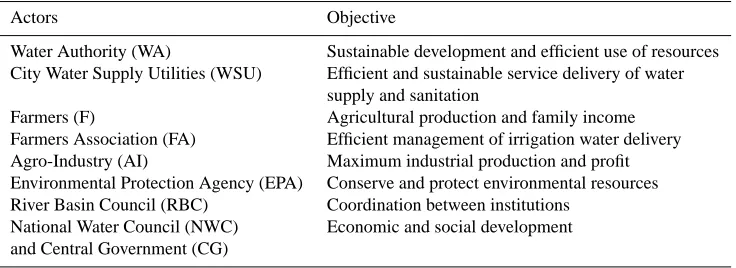
Table 2. Actors and their objectives in the Ravilla simulation game.
Actors Objective
Water Authority (WA) Sustainable development and efficient use of resources City Water Supply Utilities (WSU) Efficient and sustainable service delivery of water
supply and sanitation
Farmers (F) Agricultural production and family income Farmers Association (FA) Efficient management of irrigation water delivery Agro-Industry (AI) Maximum industrial production and profit Environmental Protection Agency (EPA) Conserve and protect environmental resources River Basin Council (RBC) Coordination between institutions
National Water Council (NWC) Economic and social development and Central Government (CG)
Note: depending on the chosen institutional arrangement, the setting of national policies and regulations may be with the CG/NWC or the RBC or be delegated to the WA as the custodian of the water resources.
3.3 Impact of the changes for higher education and the role of simulation games
The impact of these changes has been to place new demands on the knowledge, skills and competencies of graduates of water programmes. Professionals in the water sector are in-creasingly required to be a specialist in their own field or discipline, whilst also having a “basic knowledge of adja-cent and connecting fields” (Oskam, 2009). With the ver-tical leg of the letter “T” representing the in-depth knowl-edge of the main discipline and the horizontal leg of the “T” reflecting the basic knowledge of adjacent disciplines, this type of graduate has been referred to as the T-shaped grad-uate (Oskam, 2009). Besides the know-how, the “new” wa-ter manager also requires certain skills such as the ability in research, working in teams, “creative thinking, communica-tion, and cooperation” (Oskam, 2009). The goal, therefore, is for the students to acquire “competence – not just aware-ness” (Oblinger, 2004). These goals are challenging for tra-ditional universities, which are often organized according to particular disciplines.
In creating this T-shape professional, simulation games can play a powerful role. By mimicking real-life situations, events and processes, simulation games have the potential of reflecting the complexities witnessed in actual water man-agement. By having the participant play the role of an actor in the simulation game, he/she will experience what it is like to have to make decisions in such a complex environment. Moreover, the interdependency of actors in the simulation game will also highlight how decision-making at different spatial levels by certain actors has impacts at other spatial levels and on other actors.
4 The Ravilla simulation game
The Ravilla simulation game has evolved over a decade with inputs from different staff members of UNESCO-IHE and resource analysis. The main objective of the game is
to give participants hands-on experience with all important aspects of IWRM. Over time, it became an instrument that addresses all of the four learning objectives mentioned in Sect. 2.1: (i) understanding the system and its management, (ii) understanding the position of others, (iii) understanding the interaction between interest groups and (iv) experiencing different organizational and institutional settings. The rela-tive emphasis given to a particular learning objecrela-tive depends on how the game is organized.
4.1 Playing the Ravilla simulation game
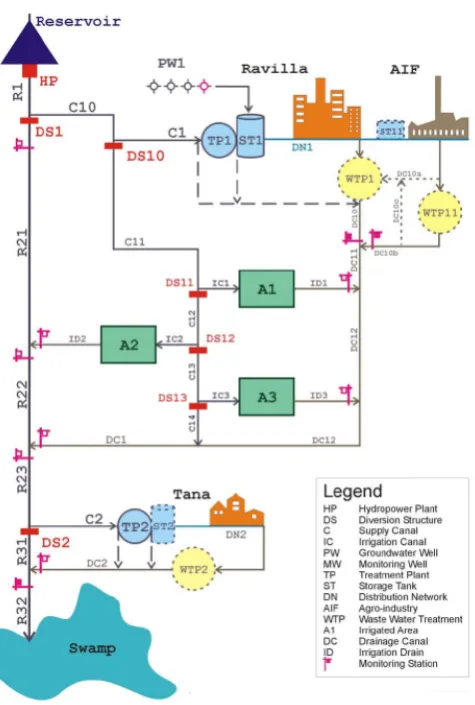
In the Ravilla simulation game, participants represent ac-tors in the fictive Ra Basin (Fig. 2). The acac-tors make de-cisions about operational water management, in which wa-ter allocation and distribution are simulated in time steps of three months. As the game progresses, players make de-cisions over a timespan of one year, covering a wet and a dry season. During the game, several consecutive years are played. Decisions concern the full array of water man-agement measures: demand and supply analysis, operation and maintenance, investments, reservoir releases and gate settings, groundwater use, water and wastewater treatment, cropping patterns and agricultural inputs, pricing and finan-cial management, standard setting, monitoring and informa-tion release. The system model generates performance indi-cators with respect to service delivery, economic production and income, water quantity and quality, water shortages and losses, and efficiency and effectiveness of system manage-ment. The actors and the objectives they pursue in the game are presented in Table 2.
Figure 2: Scheme of the Ra Basin
Fig. 2. Scheme of the Ra Basin.
decisions that affect water use, system performance or al-location in the basin. The combination of decisions deter-mines the demanded amount of water by the different ac-tors and the actual allocation of water for the different uses. This, in turn, impacts the degree to which the objectives of the actors are achieved. Given the fact that water resources are scarce within the Ra Basin, participants are stimulated to negotiate with each other regarding water demand, sys-tem operation and allocation with the aim of achieving their respective objectives.
The Ravilla game can be played using three different in-stitutional settings (Table 3). Each setting represents dif-ferent approaches to how the water sector is organized. The institutional settings vary according to the level of (de)centralization, private sector involvement, level of cost recovery, level of integration and legal framework. In each setting, the mandates of the organizations/actors are differ-ent. The idea of these multiple institutional arrangements is to highlight how reforms can affect the management of water resources and impact the different actors.
In 2012, the Ravilla game was further elaborated to incor-porate an option of a transboundary water sharing dimension.
This added dimension fortified the activity of negotiation be-tween actors by introducing international negotiations as part of the simulation game.
Playing the Ravilla simulation game essentially consists of 4 phases, which are repeated over the game’s duration. First of all, the players are to undertake a situational analysis on the basis of available data. The available data, like in real-life, are limited. These data are provided to all participants in a lecture. The second stage of the game sees the partic-ipants deliberate about measures to be undertaken. Prefer-ences for measures will be based on the situational analy-sis. This phase may be characterised by intensive interaction between the participants, depending upon how much the ac-tors wish to cooperate (or consult each other). The measures that are agreed upon are then fed into the model of the simu-lation game in the third stage. This produces new data, which the participants then have to analyze. This final phase of anal-ysis on the one hand seeks to understand how the selected measures have affected the situation (reflection). On the other hand, this analysis is to establish the “new” situation that forms the basis for the second round of decision-making. Our experience is that, in the course of consecutive rounds, the consultation and negotiation between actors increase as par-ticipants better understand the need for this interaction with other actors. By going through this process multiple times, the simulation game incorporates a trial and error process, which allows for participants to learn from earlier decisions, how their decisions link with decisions of other actors and the outcomes that this aggregation of decisions leads to.
At the conclusion of the simulation game, a debriefing session is held with the participants. During this session, participants present their experiences and observations on the performance of the water resources system and the wa-ter management process, and discuss the inwa-terlinkages be-tween the bio-physical, the infrastructural and the organiza-tional/institutional systems. The participants are asked to re-late their experience of the simulation game to theoretical approaches to integrated water resources management and to their own work experience. In addition, facilitators provide feedback to the participants regarding the negotiations, de-cisions and the resulting outputs. By having this reflection on the simulation game, the participants are able to eval-uate the negotiations and decisions they made. Moreover, this reflection deepens the understanding of integrated wa-ter management systems and processes and the relevance and irrelevance of different performance indicators.
4.2 Lessons learnt from the Ravilla simulation game
[image:6.595.51.289.58.411.2]M. Rusca et al.: Water management simulation games and the construction of knowledge 2755
Table 3. Characteristics of institutional arrangements represented in Ravilla simulation game.
Classification Setting 1 Setting 2 Setting 3
Level of decentralization Centralised Decentralised Partly decentralized Level of private sector involvement Public Private Mixed
Requirement of cost recovery Low High High
Integration and coordination No Partly Yes
Legal framework Poor Fair Strong
to assume the different roles in the simulation game and also allows the participant to be more creative and less con-strained by routinized decision-making. Also, when partici-pants come from the same real-life work environment, then the fictive case will help to diminish hierarchical relation-ships which may exist in the group.
Secondly, one of the most challenging aspects of a simula-tion game is to ensure a proper balance. This balance is two-fold. First, the game should, on the one hand, be sufficiently detailed, realistic and recognizable to give the participant the impression that the game is “real” or at least convincing. On the other hand, the game should be sufficiently simple and easy to limit the required time for understanding and play-ing it. Usually, between three and five days are needed to play the Ravilla simulation game properly (including stu-dents’ presentations and analysis of how decisions have lead to certain outcomes). What the game must also offer is a bal-ance between conflicts and contestation, whilst also allow-ing for decisions that produce “more favourable” outcomes. The participant should have the conviction that, by analyzing and understanding the decisions and the accompanying out-puts, they will be able to arrive at better-informed decision-making. Important in this respect is also that the outcomes of the model are credible, meaning that decisions lead to under-standable effects.
Thirdly, our experience is that the foundation of a success-ful simulation game is the face-to-face interaction of play-ers. Although the computer-based model plays an important role in translating decisions by the players to a new situation, the model should not become the focal point of the game. Ideally, the use of computers by participants should be lim-ited to a minimum. Rather, the simulation game works best when it adheres to paper-based decision-making and out-put mechanisms (through standardized forms). Use of the computer to run the model is limited to the main facilitator. Having the participant use a computer usually distracts the participant from face-to-face interaction and discussion with other participants. Moreover, it steers the game too much to a discussion on the model rather than to stimulate un-derstanding the bio-physical, infrastructural and institutional systems. In this sense, a water resources management sim-ulation game differs from decision support systems (DSS) or expert systems for water resources planning and manage-ment. These DSS almost always lack the essential elements of simulation games for understanding IWRM: the process of
decision-making and the interaction with other stakeholders. Moreover, these tools encompass only a distant rather than a real confrontation with trade-offs inherent to IWRM.
Fourthly, the feedback from participants is that they are able to identify with the actors they represent. Moreover, dur-ing the game participants truly become concerned about their roles. In addition, during the game they truly become con-cerned about their function. The reason is that Ravilla offers a good mix of operational management and policy develop-ment in which students have to live with decisions made in previous rounds, but also feel that they can influence the state of affairs in very realistic ways.
An important added value of the Ravilla simulation game, and one that we feel should apply to all simulation games, is that it is embedded in a broader conceptual framework. In the case of Ravilla, this broader framework is that of integrated water resources management. The game exposes the diffi-culties and challenges in pursuing integrated water manage-ment. The simulation game must thus be seen as a comple-ment to other educational activities in which this conceptual frame is presented and discussed in detail. Important in this respect is that simulation game must highlight salient fea-tures of that broader conceptual framework. In Ravilla, this is achieved through the inclusion of different sectors (envi-ronmental and civil society) and allowing for different in-stitutional arrangements, which illustrate how reforms may impact decision-making and different actors.
5 The potential and limitations of simulation games
In this article, we have argued that using simulation games can contribute to the learning experience of students in the field of water management. The potential of simulation games, however, is strongly dependent on the context in which it is implemented and is subject to limitations. This potential and limitations are elaborated upon below.
to integrate various disciplines by combining technical fields such as hydrology and water resources management (e.g. wa-ter allocation, dams, hydropower generation, irrigation sys-tems etc.) with socio-economic disciplines. The simulation allows for repetition (trial and error) and, as such, rein-forcement of knowledge acquisition. The game can also be adapted to new scenarios, reflecting the shifting emphasis within the water sector. Further, it allows a participant to ex-perience beyond one’s established reality, by offering a flex-ible systems that can be modified and adapted through fic-tive reform processes, development of policies, or the intro-duction of hydrological changes (e.g. droughts, floods, over abstraction of groundwater). Simulations bring participants to a table to negotiate and build consensus within the group and with other groups. Players will directly experience the different power status of the stakeholders, the control cer-tain stakeholders (unlike others) have over strategic resources and the informal influence of the stakeholder (personal rela-tions, networks, leadership etc.). Moreover, simulations stim-ulate interaction of participants by forcing players to work in a team and build consensus on certain measures/decisions within the simulation. At the same time, simulations also re-flect imbalances that participants will also experience in their daily professional life. Some participants will have stronger leadership skills, have more knowledge or ability to analyze a given situation or will be better negotiators. The outcome of the simulation will largely depend on these factors.
At the same time, the simulation game also has its limits. Simulation games may not be more efficient than other teaching methods. In fact, our experience is that simulations increase the demands placed on teachers rather than reduce them. The role of the teacher changes from transferring knowledge to that of facilitating knowledge construction. This requires considerable knowledge and experience. The teacher must analyze and interpret how the game is proceed-ing, steer and guide the game during its implementation, and finally assist the players in the reflections on their decisions and the game in general. Moreover, preparation time, participation in the simulation and in the analyses that (should) follow the exercise mean that the effort required on the part of the teacher is significant. If the simulation aims at promoting multidisciplinarity, facilitators need to develop themselves as a T-shaped lecturer, before being able to guide students in this process. The fact that simulation games usually require periodic updating to accurately reflect current trends in the water sector increases knowledge and time-requirements for implementing such educational tools. Moreover, the simulation game is ideally part of a larger blended learning activity. Finding the right balance between different learning activities (and the contributions they provide for constructing knowledge) is crucial. Before deciding on using a simulation game, these issues need to be carefully addressed.
Edited by: J. Seibert
References
Bales, E.: Corporate Universities versus Traditional Universities: Friends or Foes. Key Note Address at the Conference on Innova-tive Practices in Business Education, Orlando, FL, 4–7 Decem-ber, 1996.
Biggs, J. B. and Tang, C.: Teaching for quality learning at university, Open University Press/Mc Graw-Hill Education, 2007.
Biswas, A. K.: Integrated Water Resources Management: a Re-assessment, Water Int., 29, 248–256, 2004.
Boekaerts, M., Pintrich, P. R., and Zeidner, M. (Eds.): Self-regulation: Theory, research, and applications, Orlando, FL, Aca-demic Press, 2000.
Conca, K.: Governing water: contentious transnational politics and global institution building, MIT Press, Cambridge, 2006. Dale, E.: Audiovisual methods in teaching, 3rd Edn., The Dryden
Press, New York, 1969.
Gardner, H.: The Unschooled Mind, New York: Basic Books, 1991. Greenblat, C.: Teaching with simulation games: A review of claims
and evidence, Teach. Sociol., 1, 62–83, 1973.
Henschel, P.: The manager’s core work in the new economy, http: //www.newmango.com/01iftf/henschel.html (last access: 20 Jan-uary 2012), 1999.
Hoekstra, A. Y.: Computer-supported games and role plays in teach-ing water management, Hydrol. Earth Syst. Sci. Discuss., 9, 1859–1884, doi:10.5194/hessd-9-1859-2012, 2012.
Johnassen, D. H. and Rohrer-Murphy, L.: Activity theory as a framework for designing constructivist learning environment, Etr. & D.-Educ. Tech. Res., 47, 61–79, 1999.
Kirshen, P. H., Vogel, R. M., and Rogers, B. L.: Challenges in grad-uate education in integrated water resources management, J. Wa-ter. Res. Pl.-ASCE, Editorial, 185–186, 2004.
Kolb, A. D.: Experiential learning: Experience as the source of learning and development, Prentice Hall, Englewood Cliffs, NJ, 1984.
Lankford, B. A. and Watson, D.: Metaphor in natural resource gam-ing; insights from the River Basin Game, Simulat. Gaming, 38, 421–442, 2007.
Molle, F.: Nirvana concepts, narratives and policy models: Insights from the water sector, Water Alternatives, 1, 131–156, 2008. Molle, F.: River-basin planning and management: The social life of
a concept, Geoforum, 40, 484-494, 2009.
Mollinga, P.: Water, politics and development: Framing a political sociology of water resources management, Water Alternatives, 1, 7–23, 2008.
Niemi, H.: Active learning–a cultural change needed in teacher ed-ucation and schools, Teach. Teach. Educ., 18, 763–780, 2002. Oblinger, D.: The next generation of educational engagement,
Jour-nal of Interactive Media in Education, 8, 1–18, 2004.
Oskam, I. F.: T-shaped engineers for interdisciplinary innovation: An attractive perspective for young people as well as a must for innovative organisations, public lecture given in Amsterdam, 11 March, 2009.
Piaget, J.: The Psychology of Intelligence, Routledge, New York, 1950.
Plato: Meno, great dialogues of Plato, Mentor, New York, 28–69, 1956.
M. Rusca et al.: Water management simulation games and the construction of knowledge 2757
Seibert, J. and Vis, M. J. P.: Irrigania – a web-based game about sharing water resources, Hydrol. Earth Syst. Sci. Discuss., 9, 1961–1977, doi:10.5194/hessd-9-1961-2012, 2012.
Swyngedouw, E.: Governance innovation and the citizen: the Janus face of governance-beyond-the-state, Urban Stud., 42, 1991– 2006, 2005.
Thomas, R. C. and Milligan, C. D.: Putting teachers in the loop: Tools for creating and customising simulations, Journal of Inter-active Media in Education, 15, 1–22, 2004.
Thynne, I.: The state and governance: issues and challenges in per-spective, Int. Rev. Adm. Sci., 66, 227–240, 2000.