Available on line www.jocpr.com
Journal of Chemical and Pharmaceutical Research
__________________________________________________
ISSN No: 0975-7384 CODEN(USA): JCPRC5
J. Chem. Pharm. Res., 2011, 3(3):464-469
Rapid analytical method development and validation of Piroxicam
by RP-HPLC
Madhukar. A1*, V. Sudheer Kumar1, P. Anand1, CH. Samrat1, T. Hemlatha2 and Mohd. Tajuddin Baba1
1
St. Mary’s College of Pharmacy, St. Francis Street, Secunderabad, A. P., INDIA
2
Jawaharlal Nehru Technological University, Kakinada, A. P., INDIA
______________________________________________________________________________
ABSTRACT
This paper describes the analytical method suitable for validation of Piroxicam by reversed Phase High Performance liquid chromatography (HPLC) method. The method utilized RP-HPLC (Younglin with UV-detector) model and a column, 150mm ´ 4.6 mm, 5m (Symmetry, ODS- 3V, 150mm ´ 4.6mm, 5m). The mobile phases were comprised of Methanol and Water pH 3.2 (55:45v/v). Validation experiments were performed to demonstrate System suitability, precision, linearity and Range, Accuracy study, stability of analytical solution and robustness. The method was linear over the concentration range of 1-200 mg/ML-1. The method showed good recoveries (99.8 – 102.9%).
Keywords: RP-HPLC, Piroxicam, Analytical method, Quality control, validation.
______________________________________________________________________________
INTRODUCTION
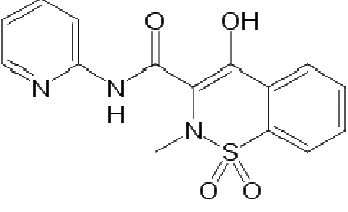
Piroxicam (PXM), (3E)-3-[hydroxy-(pyridine-2-yl amino) methylidene]-2-methyl-1, 1 dioxobenzo[e]thiazin-4-one (C15H13N3O4S). PXM is a class of drug called Nonsteroidal
A2, an aggregating agent, by the platelets. benzothiazine-3-carboxamide 1, 1
PXM is official in Indian Pharmacopoeia Pharmacopoeia [8] and United States Pharmacopeia
PXM is Oxicam derivative having analgesic and
analytical methods had reported in literature for estimation of combination with other drugs
the world ‘Validation’ means
20], and validation as per ICH guidelines
Apparatus
The analysis was performed by using the analytical balance G285 (Mettler Toledo), pH meter 744 (metrohm), the HPLC used is of
150mm ´ 4.6mm 5µ (Symmetry
1.2ml/min (Isocratic). The mobile phase consists of A & B with mixture of
Water pH (3.2) at different proportions A & B which are degassed in a sonicator for 10minutes the injection volume is 10m
Reagents and solutions
Pure sample of Piroxicam (USP) and other
HPLC and milli-Q grade. All other chemicals like Potassium Di
of AR grade. Optimized chromatographic conditions are listed in table no.1.
Standard preparation
Accurately weigh and transfer
diluent, sonicate to dissolve, make up to volume with diluent. Transfer into 10ml volumetric flask, dilute to the volume with mobile solution through the 0.45µ filter.
Accuracy
Accuracy for the PXM is determined by applying the method in placebo to which known amount of
A2, an aggregating agent, by the platelets. PXM,
4-Hydroxy-2-methyl-N-carboxamide 1, 1- dioxides is analgesic and anti-inflammatory agent is official in Indian Pharmacopoeia [6], British Pharmacopoeia
[image:2.595.211.385.171.277.2]and United States Pharmacopeia [9].
Fig. 1: Structure of Piroxicam
is Oxicam derivative having analgesic and anti-inflammatory action analytical methods had reported in literature for estimation of PXM combination with other drugs [13-18]. Pharmaceutical validations among these
the world ‘Validation’ means ‘Assessment’ of validity or action of providing effectiveness , and validation as per ICH guidelines [21].
EXPERIMENTAL SECTION
The analysis was performed by using the analytical balance G285 (Mettler Toledo), pH meter 744 (metrohm), the HPLC used is of Younglin with UV-detector. Column used in HPLC
µ (Symmetry, ODS-3V, 150mm ´4.6mm, 5 µ is suitable) with a flow rate ml/min (Isocratic). The mobile phase consists of A & B with mixture of
) at different proportions A & B which are degassed in a sonicator for minutes the injection volume is 10ml and the ultra violet detection was at 240nm.
Pure sample of Piroxicam (USP) and other ingredients such as Methanol and water used were Q grade. All other chemicals like Potassium Di-hydrogen phosphate used were
chromatographic conditions are listed in table no.1.
h and transfer 10mg of PXM into a 10ml of volumetric flask, add diluent, sonicate to dissolve, make up to volume with diluent. Transfer 1 m
volumetric flask, dilute to the volume with mobile phase and mix well filter.
is determined by applying the method in triplicate samples of mixture of placebo to which known amount of PXM standard is added at different levels (80%, 100% and -(pyridin-2yl)-2H-1, 2-inflammatory agent [1-5]. , British Pharmacopoeia [7], European
inflammatory action [10-12]. Various PXM individually and in . Pharmaceutical validations among these methods undergo providing effectiveness [19,
The analysis was performed by using the analytical balance G285 (Mettler Toledo), pH meter detector. Column used in HPLC is of is suitable) with a flow rate of ml/min (Isocratic). The mobile phase consists of A & B with mixture of Methanol and the ) at different proportions A & B which are degassed in a sonicator for about
and the ultra violet detection was at 240nm.
ingredients such as Methanol and water used were of hydrogen phosphate used were chromatographic conditions are listed in table no.1.
of volumetric flask, add about 10ml of ml of the above solution phase and mix well. Filter the
Madhukar. Aet al J. Chem. Pharm. Res., 2011, 3(3):464-469 ______________________________________________________________________________
120%). The sample were filtered through 0.45µ membrane filter and injected into the chromatographic system.
Precision
The precision of the analytical method was studied by analysis of multiple sampling of homogeneous sample. The precision expressed as %RSD. The %RSD was found to be 0.17% in the results of precision.
Linearity and Range
The Linearity of detector response is established by plotting a graph to concentration versus area of PXM standard and determining the correlation coefficient. A series of solution of PXM standard solution in the concentration ranging from about 1-200ppm levels of the target concentration (100µg/ml of PXM) were prepared and injected into the HPLC system.
RESULTS AND DISCUSSION
PXM standard having concentration 100µg/ml was scanned in UV- region between 200- 400 nm.
λmax of PXM was found to be at 240 nm. The PXM peak in the sample was identified by
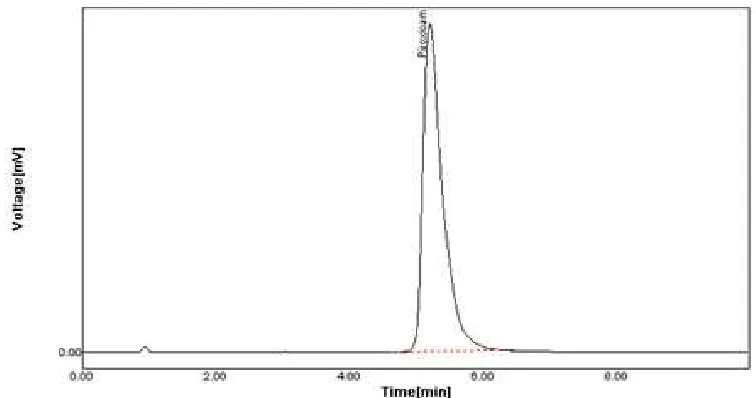
comparing with the PXM standard and the Retention time was found to be around 5.183 minutes. The estimation PXM was carried out by RP-HPLC using Mobile phase having a composition volumes of 55 volumes of Methanol and 45 volumes of Water (55:45 v/v). The ratio pH was found to be 3.2. Then finally filtered using 0.45µ nylon membrane filter and degassed in sonicator for 10minutes. The column used was C18 Symmetry ODS 3V (150mm x 4.6mm; 5µ
[image:3.595.179.419.605.712.2]particle size). Flow rate of Mobile phase was 1.2ml/min, theoretical plates – 6013.72, and tailing factor – 1.32.
Table – 1: Optimized chromatographic conditions
Parameter Optimized condition
Chromatograph HPLC (Younglin HPLC with UV-detector)
Column Symmetry-Extend C18 (150 × 4.6mm, packed with 5µm) is suitable
Mobile Phase* Water: Methanol (45:55) Flow rate 1.2ml/min
Detection UV at 240nm Injection volume 20µl
Temperature column Ambient
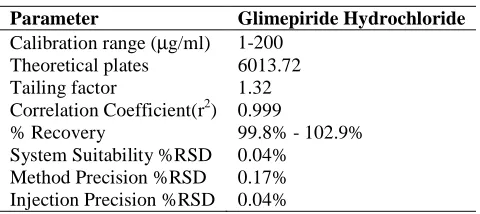
Table – 2: System suitability parameters Parameter Piroxicam
Parameter Glimepiride Hydrochloride
Calibration range (µg/ml) 1-200 Theoretical plates 6013.72 Tailing factor 1.32 Correlation Coefficient(r2) 0.999
% Recovery 99.8% - 102.9% System Suitability %RSD 0.04%
The System Suitability parameters show the results very satisfactory. The acceptance criteria of System Suitability is RSD should be not more than 2.0% and the method show System Suitability 0.04% which shows that the method is repeatable. The acceptance criteria of Method Repeatability is RSD should be not more than 2.0% and the method show Method Repeatability 0.17% which shows that the method is precise.
Fig. 2: Chromatogram of standard for Piroxicam
Fig. 3: Linearity of Piroxicam
The validation of developed method shows that the drug stability is well within the limits. The linearity of the detector response was found to be linear from 1-200µg/ml of target concentration for PXM standard with a correlation coefficient value is greater than 0.999. The correlation coefficient of (r2) = 0.999, which shows that the method is capable of producing good response
y = 28466x - 6857.8 R² = 0.9996
0.00 1000000.00 2000000.00 3000000.00 4000000.00 5000000.00 6000000.00
0.00 50.00 100.00 150.00 200.00 250.00
Madhukar. Aet al J. Chem. Pharm. Res., 2011, 3(3):464-469 ______________________________________________________________________________
in UV-detector. The Accuracy limit is the % recovery should be in the range of 99.8-102.9%. The validation of developed method shows that the accuracy is well within the limit, which shows that the method is capable of showing good accuracy.
Regression analysis of the calibration curve for PXM showed a linear relationship between the concentration and peak area with correlation coefficients higher than 0.999 in all the curves assayed.
CONCLUSION
HPLC is at present one of the most sophisticated tools of analysis. The estimation of PXM is done by RP-HPLC. The mobile phase consists of 55 volumes of Methanol and 45 volumes of Water (55:45). The ratio pH was found to be 3.2. Then finally filtered using 0.45µ nylon membrane filter and degassed in sonicator for 10 minutes). The detection is carried out using UV-detector set at 240nm. The solutions are chromatographer at the constant flow rate of 1.2ml/min. The Retention time for PXM was around 5.183minutes. Linearity range for PXM is 1-200µg/ml. The quantitative estimation was carried out on the tablet by RP-HPLC taking a concentration of 100µg/ml. the quantitative results obtained is subjected to the statistical validation. The values of RSD are less than 2.0% indicating the accuracy and precision of the method. The % recovery 99.8% to 102.9% for PXM.
The results obtained on the validation parameter met the requirements. It inferred that the method was found to be Simple, Specific, Precision, and Linearity, Proportional i.e. it follows Lambert-Beer’s law. The method was found to have a suitable application in routine laboratory analysis with a high degree of Accuracy and Precision.
REFERENCES
[1] The Merck Index- An Encyclopedia of Chemicals, Drugs and Biologicals, 13th ed, Merck, USA, 2001, 48, 7589.
[2] A.C. Moffat, and B. Widdop, Clarke’s Analysis of Drugs and Poisons, 3rd Edition, Pharma Press, 2004, 1391, 1463.
[3] Martindale. The Complete Drug Reference, 33rd Edition, Pharmaceutical Press, 751.
[4] Goodman and Gilman, The Pharmacological Basis of Therapeutics, 10th Edition, McGraw-Hill, New York, 2001, 357.
[5] Harry G. Brittain, Analytical Profiles of Drug Substances and Excipients, Academic Press, 14, 509, 551.
[6] Indian Pharmacopoeia, Government of India, Ministry of Health and Family Welfare, Delhi,
1996, 554.
[7] British Pharmacopoeia, Her Majesty’s Stationery Office, London, 2006, 1508.
[8] European Pharmacopoeia, 3rd Edition, Council of Europe, France, 1997, 55.
[9] United States Pharmacopeia / The National Formulary, (USP28/NF 23), United States Pharmacopeial Convention, Rockville, MD, 2005, 16, 1569.
[10]Florey K, Analytical Profile of Drug Substance, Academic Press, 2000, 3, 509-529.
[12]Barar FSK. Essentials of Pharmacotherapeutics, 3rd Edition, New Delhi, S Chand and Company Ltd, 2003, 128.
[13]Spectrophotometry in a continuous flow system, Eur. J. Pharm. Sci., 2002, 15, 179-183. [14]Puthli SP; Vavia PR, J. Pharm. Biomed. Anal., 2000, 22, 673-677.
[15]Bartsch H; Eiper A; Kopelent-Frank H, J. Pharm. Biomed. Anal., 1999, 20, 531-541. [16]Rozou S, Voulgari A; Antoniadou-Vyza E, Eur. J. Pharm. Sci., 2004, 21, 661-669.
[17]Nagaralli BS; Seetharamappa J; Melwanki MB, J. Pharm. Biomed. Anal., 2002, 31, 859- 864.
[18]Vijay Kumar. R; Madhukar. A et al., Der. Pharmacia. Lettre., 2010, 2(2), 217-222 [19]Sharma S.K., The Eastern Pharmacist, July 2001, 21-23.
[20]Chowdary K.P.K., Himabindu G., Eastern Pharmacist, May 1999, 39-41.
[21]Validation of analytical procedures / methodology, ICH harmonized triplicate guideline,