Journal of Chemical and Pharmaceutical Research
__________________________________________________
ISSN No: 0975-7384 CODEN(USA): JCPRC5
J. Chem. Pharm. Res., 2011, 3(3):18-24
Enzyme activity changes in Brassica juncea (L.) Czern.& Coss. in
response to Albugo candida Kuntz.(Pers.)
*Yogita Singh, D. V. Rao and Amla Batra
Biotechnology Laboratory, Lab No.-5, Department of Botany, University of Rajsthan, Jaipur
__________________________________________________________________________________
ABSTRACT
The quantitative analysis of Peroxidase, α-amylase, Invertase, IAA-oxidase, Ascorbic acid
oxidase activity were observed in healthy and diseased Brassica juncea leaves and inflorescence. Maximum Peroxidase activity observed in infected leaves and disease inflorescence as compared to healthy leaves and infected inflorescence. α- amylase was
maximum in healthy leaves and minimum in infected inflorescence. Maximum invertase activity was found in infected leaves of Brassica juncea and minimum in healthy leaves of Brassica juncea . IAA-oxidase activity was higher in infected leaves and inflorescence as compared to healthy leaves and inflorescence. The activity of Ascorbic acid oxidase decrease with the increase in infection in plants.
Key Words: Brassica juncea, Albugo candida, Peroxidase, α-amylase, Ascorbic acid oxidase.
__________________________________________________________________________________
INTRODUCTION
Brassica juncea (L.) Czern. & Coss. is an important oil seed belonging to family cruciferae. Brassica juncea is commonly known as ‘Indian Mustard’and is one of the most important oilseed
crops of northern India.Its cultivation is mostly confined to Uttar Pradesh, Rajasthan, Punjab, Haryana and some parts of Madhya Pradesh, West Bengal and Assam. In Rajasthan, cultivated area of mustard is 2.6 million hectares, producing about 2.2 million tones of grains (Directorate of Agriculture, Rajasthan, Jaipur). Oilseed brassicas are widely cultivated through the world as condiment and spices for improved flavour of human diet and as fodder for live stock feeding. However, the largest cultivation of this crop is for edible vegetable oil production.
Analysis of enzymes is an essential features of the biochemical organization of living things . A number of major biological problems such as evolution of population ,transformation , regulation in differential tissues are understand in the of the enzymes. In the present study existence of variability of enzymes in resistance and susceptible Brassica juncea against white rust caused by Albugo candida is assessed the result are reported here.
EXPERIMENTAL SECTION
On the basis of susceptibility and resistance to Albugo candida, white rust disease. For the quantitative estimation of enzymes different protocol were used .Healthy leaves and inflorescence and infected leaves and inflorescence were collected from Agriculture research station Durgapura, Jaipur.
Enzyme extraction:-
Fresh collected(1g) plant material were ground in 3ml chilled phosphet buffer (0.02M,ph6.0) in chilled pestle and morter.The extract was centrifuged at 10,000 rpm for 15 minutes in cooling centrifuged at 40C. The supernatant was mixed with the double amount of chilled acetone and incubated at 50C for half an hour for precipitation of the soluble proteins. It was recentrifuged at 3600rpm for 10 minutes at 40C. The supernatant was discarded, while residue was resuspended in 10ml of phosphate buffer (0.02M, ph 6.4) and enzyme source. Enzyme extracted was thus prepared was assayed for Peroxidase, Alpha amylase, Invertase IAA-oxidase and Ascorbic acid oxidase.
Enzymes were determined following method described Alpha amylase was determined by the given in [2]. Invertase was determined using [3]. Peroxidase was determined using [4]. IAA-oxidase was determined using [5]. Activity of Ascorbic acid IAA-oxidase was determined using method of [6]. The experiments were replicated and repeated thrice.
RESULTS AND DISCUSSION
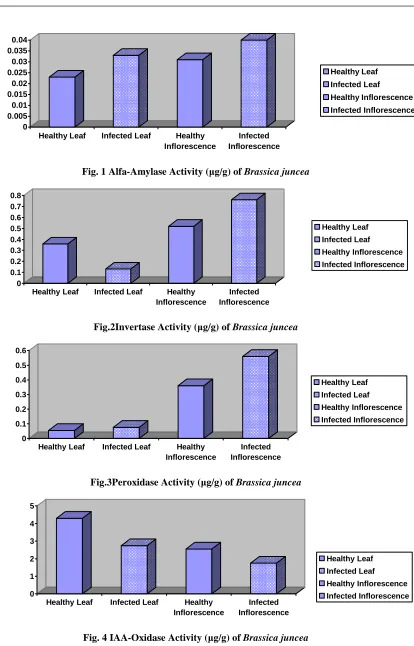
Enzyme activity changes of healthy and Albugo candida infected mustard plants revealed that in different parts as compared to healthy ones .α-amylase activity was higher in healthy Brassica
Fig:1 Healthy inflorescence of Fig:2 Infected inflorescence of Brassica juncea. Brassica juncea
Fig:3 Healthy leaves of Brassica juncea Fig:4 Infected leaves of Brassica juncea
Increased activity of the starch hydrolyzing enzyme (alpha amylase and Invertase) has been recorded in diseased tissues. The increased activity of these enzymes might be due their enhanced synthesis by the host to meet the the catabolic reactions in the enhanced state of host metabolism after infection [7].
Obviously high sugar levels were result of starch hydrolysis by the activation of alpha amylase in the disease tissue Activation of Invertase is quite possible in diseased tissue.
The phenol oxidizing enzymes have been correlated with disease resistance in many crop plants. The production of lignin is catalysed by Peroxidase. Peroxidase activity was higher in diseased infloerescence and diseased leaves compared to healthy leaves and inflorescence. Maximum Peroxidase activity was found to be infected leaves of Brassica juncea.
Presence of phenolics in high concentration in the plant cells gives them resistance to pathogens.After infection by pathogen plant cells synthesize phenol oxidizing enzymes that oxidize phenols to toxic quinones.Hence, the activity of these enzymes increases in infected cells. Higher activities of phenol oxidizing enzyme peroxidase in the rust and powdery mildew resistant lines of pea as compared to susceptible lines [8]. Increase in the activity of peroxidase after infection in different host-pathogen system [ 9,10,11 ]. The results obtained in present studies are in agreement with those of this worker.
Inhibition of IAA-oxidase due to accumulation scorpoletin was related with hyperauxiny in disease tissue recorded [13].Similarily, chlorogenic and caffeic acid were considered responsible for IAA-oxidase inhibition [14]. Inhibition of IAA-oxidase by increased caffeic acid and m-coumaric acid in spiked sandal was recorded [15].
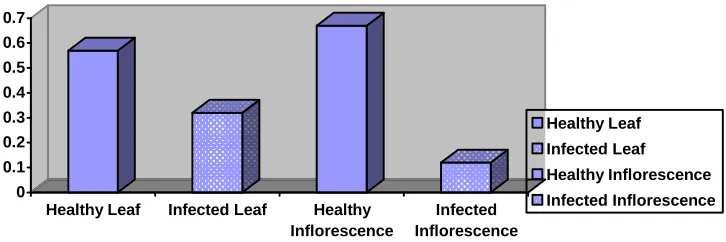
Infection due to Albugo candida in Brassica juncea var. varuna resulted in ascorbic acid metabolism. Ascorbic acid oxidase activity was highest in healthy inflorescence compared to diseased inflorescence. In leaves highest activity was found to be healthy leaves compared to infected leaves.
Increase in Ascorbic acid in diseased tissues was corresponding to the activity of Ascorbic acid oxidase [16,17].
That not only the suppressed activity of Ascorbic acid oxidase but also excessive synthesis through sugar precursors was responsible for accumulation of Ascorbic acid in diseased tissue catalyzation of Ascorbic acid synthesis by IAA has been reported [18]. Albugo candida pathogenasis may be attributed to the increased respiration rate, which may induce rapid oxidation of ascorbic acid. The decline may also be due to the production of the enzyme ascorbic acid oxidase, either by the pathogen itself or by the host-pathogen interactions[19]
Enzyme activity was found in the all plants . To function as a regulator of cell expension .IAA-oxidase affects cell elongation, probably, through its influence on cell wall extensibility. Since long ,peroxidase are known to be involved in growth regulation and different biochemical pathways have been proposed to examine the mechanism of action [20] .Plant cell wall plays a critical role in water uptake .A wide range of growth regulating agents ,including both hormones and environmental factors. These studies show that plant parts having enzymatic activity studies of some enzymes peroxidase, α-amylase, Invertase, IAA-oxidase, Ascorbic acid oxidase in Brassica juncea.
Table: Enzymatic activity from healthy and infected parts of Brassica juncea
S.No. Plant Parts
Alfa-Amylase
(µg/g)
Invertase (µg/g)
Peroxidase (µg/g)
IAA-Oxidase
(µg/g)
Ascorbic Acid Oxidase
(µg/g)
1. Healthy Leaf 0.023 0.36 0.055 4.30 0.57 2. Infected Leaf 0.033 0.13 0.076 2.75 0.32
3. Healthy
0 0.005 0.01 0.015 0.02 0.025 0.03 0.035 0.04
Healthy Leaf Infected Leaf Healthy Inflorescence Infected Inflorescence Healthy Leaf Infected Leaf Healthy Inflorescence Infected Inflorescence
Fig. 1 Alfa-Amylase Activity (µg/g) of Brassica juncea
0 0.1 0.2 0.3 0.4 0.5 0.6 0.7 0.8
[image:5.595.110.524.56.702.2]Healthy Leaf Infected Leaf Healthy Inflorescence Infected Inflorescence Healthy Leaf Infected Leaf Healthy Inflorescence Infected Inflorescence
Fig.2Invertase Activity (µg/g) of Brassica juncea
0 0.1 0.2 0.3 0.4 0.5 0.6
[image:5.595.117.409.88.209.2]Healthy Leaf Infected Leaf Healthy Inflorescence Infected Inflorescence Healthy Leaf Infected Leaf Healthy Inflorescence Infected Inflorescence
Fig.3Peroxidase Activity (µg/g) of Brassica juncea
0 1 2 3 4 5
Healthy Leaf Infected Leaf Healthy Inflorescence Infected Inflorescence Healthy Leaf Infected Leaf Healthy Inflorescence Infected Inflorescence
[image:5.595.120.397.244.360.2]CONCLUSION
Result obtained enzymatic activity was maximum in infected parts compared to healthy leaves and inflorescence. These results are suggestive of enzymes of commercial importance and may great interest in plant pharmaceuticals. Scientific information about the chemical composition of these plants and may be important both conceptually, to understand the physiological process of plant parts and technically by providing more information for agro industry.
REFERENCES
[1] D.K. Maheshwari, S.N. Chaturvedi, and B.S.Yadav, (1985). Indian Phytopath 38: pp.546-548.
[2] L. Shuster and R. Gifford,(1962) . Arch. Biochem Biophys. 96:pp. 534-545 [3] G.P.Harris and B.Jeffcoat (1974). Ann. Bot., 38 ,pp.77-83.
[4] P.George, (1953). J.Biol. Chem.pp.201:413.
[5] S.Mahadevan, (1964)In: Habbleth, W.(Ed.) seed production. Butterworth, London, pp.647- 660.
[6] A.Mahadevan,(1975). Methods in physiological plant physiology. Sivakami publication, Madras.pp.63-64.
[7] F. Nonaka, (1959). Sci. Bull. Fac. Agric. Kikyshu Uni.pp.17. 1-8. [8] M.S. Chander ,(1990). J Mycol Pl Pathol 18,pp.74-75.
[9] S.L. Sharma, S.V.Bhardwaj,S.K. Sugha and S.K. Sharma, (1982). J Mycol Pl Pathol 12,pp. 322-330.
[10]J. Gupta and J.L. Koul, (1988). J Mycol Pl Pathol 18 pp. 74-75.
[11]A.Ramanathan,P.Vidhyasekharan and R.Semiyappen (2000). Z-Pfla Krenkh pfla schutz. 107,pp.245-247.
[12]B.I.S.Shrivastva , M. Shaw and T.E. vanterpool, (1962).Can. J.Bot., 40,pp.53-59. [13]L.Squeira, L.(1969). Phytopathology 59,pp.473-478.
[14]M.P. Imbert, and L.A. Wilson.(1972). Phytochemistry 11, pp.2671-2676.
[15]K.Parthasarthi,, C.R.Rangaswamy, D.R.C.Babu and P.S.Rao. (1975). Indian Phytopath. 28, 352-356.
[16]S.D. Purohit, N.S. Shekhawat, H.C. Arya,(1983). Int. J. Tropical. Pl.Dis., 1,pp.107-110. [17]D.V. Rao DV (1989). Ph.D thesis . University of Rajasthan, Jaipur, India.
[18]J.J. Chinoy and K.K.Nanda,(1959). Intl.Bot. Congr. Abstracts.2,pp.69
[19]A.K.Ghosh, R.N.Tandon, S.N.Bhargva and M.P. Shrivastava MP. (1965).
[image:6.595.118.481.87.208.2]