The Context is the Message?! Learning about the
Israeli-Palestinian Conflict through Computerized
Simulations in Different National Contexts
Ronit Kampf
Communication Department and the Program in Research of Child and Youth Culture, Tel Aviv University, Israel
Copyright©2016 by authors, all rights reserved. Authors agree that this article remains permanently open access under the terms of the Creative Commons Attribution License 4.0 international License.
Abstract
Two cross-national experimental studies examined the effects of PeaceMaker and Global Conflicts on knowledge acquisition and attitude change regarding the Israeli-Palestinian conflict. PeaceMaker and Global Conflicts are role-playing computerized simulations of this conflict. 248 undergraduate students from Turkey, Israel, Palestine and the US participated in the two studies. They filled in questionnaires measuring knowledge and attitudes before and after playing the games. Results suggested stronger effects in knowledge acquisition and attitude change for secondary/third parties (i.e., Turks and Americans) compared to directly involved parties (i.e., Israeli-Jews and Palestinians). Yet effects in attitude change and perspective taking were limited for the Global Conflicts Game. The variation in the results obtained from different national contexts indicates the importance of context in learning from simulations, particularly important for the pedagogy and learning scholarship in the context of peacebuilding. The effect of context on learning from simulations should encourage scholars of experiential teaching and learning in conflictual contexts to direct their attention to exploring the contingencies of effectiveness for simulations, rather than adopting dichotomous research questions that ask whether simulations are useful or not. Yet the game characteristics may be crucial in determining whether the players gain the perspective of both sides or not.Keywords
Peace Education, Knowledge Acquisition, Computerized Simulations, Israeli-Palestinian Conflict, Attitude Change1. Introduction
Simulations and role-plays are commonly used in the teaching of conflict analysis and resolution. In traditional simulations, students act out a specific conflict or negotiation scenario delivered by the instructor. Role-play
instructions are often distributed to participants in written form beforehand and they are asked to stick to their confidential instructions [1, 2]. For the last decade, role-playing has been increasingly subject to criticism by researchers and instructors [3, 4] on several grounds. First, it is argued that role-playing in simulations elicits cultural stereotypes [5]. Second, simulations put students in artificial situations having no relevance to real life and lacking the complexity of a conflict setting [6, 7]. Role-plays isolate students from meaningful contexts to which they can personally relate [8]. Finally, role plays and simulations are criticized for having little or no transference of skills to real life settings [e.g., 4, 8, 9, 10].
Based on these criticisms, which called for assessing common sense assumptions about conflict and negotiation teaching, several scholars scrutinized simulation-based teaching in a more critical manner. Recently, the number of studies focusing on the effectiveness of simulations and role-plays has grown. Most of these studies examined the effectiveness of the use of simulations in teaching negotiation and mediation skills. In that, they provided valuable insight into how and under what conditions simulations are effective, even though some of the results contradict one another. For instance, research with ICONS and GlobalEd showed that simulations are more effective in knowledge acquisition in conflict resolution compared to traditional lectures and discussions mainly because simulations are successful in raising interest and motivation among students [11-13]. On the other hand, Druckman and Ebner [14] showed that role-plays motivate learning when students are passive, but otherwise they are not necessarily more effective than learning through lectures and case studies. In fact, simulations may activate learning better for simulation designers than for participants. In any case, simulations and games seem to be effective because they manage to raise student motivation and interest [e.g., 15, 16].
computer games - Global Conflicts (GC) and PeaceMaker (PM) - which simulate the Israeli-Palestinian situation. Specifically, it examines whether learning about this conflict is context-dependent by having students belonging to different national groups play the same conflict scenario. The two studies measure learning in two areas: 1) the extent of change in participants’ knowledge about the conflict; 2) whether the participant’s attitude towards the conflict changed or not (i.e. perspective taking ability). The studies show that national closeness to a specific conflict narrative makes a difference in learning outcomes, though game characteristics may also influence attitude change and perspective taking regarding the conflict.
Specifically, the studies differentiate between secondary/third parties to the conflict (i.e., Americans and Turks) and direct parties to the conflict (i.e., Israelis and Palestinians). Both Turkey and the US are involved in the conflict to help the Israeli and Palestinian disputing parties manage or resolve it. Given that the nationality of the group receiving the information may influence learning outcomes, the studies expect that (a) game effects with regard to attitude change and perspective taking will be stronger for secondary/third parties to the conflict than for direct parties, because Turkish and American participants may have less salient and weaker attitudes concerning the situation, as opposed to Palestinian and Jewish participants who have stronger and more salient attitudes. It is in line with research on attitude strength, which suggests that stronger attitudes are more resistant to change and lead to selective cognitive processing [17], and (b) game effects with regard to knowledge acquisition will be stronger for secondary/third parties than for direct parties, because the latter may have prior high levels of knowledge on the Israeli-Palestinian situation and so would not have much more to gain [18].
"I don’t know what an Israeli of my age thinks about the situation… This game opened my mind to see other viewpoints concerning the conflict.’’ (Palestinian participant)
"I have a definite attitude toward the “other side”….that`s interesting. I can`t say that my views have changed completely but this game has raised many questions…It is impossible to regard all Palestinians as one and the same, I suppose….once when I heard Arabs mentioned I became afraid, but now I remember the enjoyable game …I have a dilemma." (Israeli-Jewish participant)
1.1. Using Computer Games in Teaching about Conflicts
Teaching in the conflict analysis and resolution field relies heavily on simulations and games [1, 2, 4, 13, 14]. Despite their extensive use, the effectiveness, and especially the cultural relevance, of role plays and simulations have only recently been assessed in a systematic manner by
researchers in the conflict resolution field [1, 4, 9, 12, 14]. Use of simulations was criticized on several grounds such as eliciting cultural stereotypes [5] and being artificial and not having any relevance to real life [6, 7]. Some have argued that role-plays isolate students from a meaningful context to which they can relate [8]. Role plays and simulations have also been criticized for having little or no transference of skills to real life settings [8-10].
Several studies were undertaken to address these criticisms. For instance, Honeyman, Coben, and De Palo [6], Volkama [7] and Ebner and Efron [20] all introduced different types of real life stakes to the simulation environment that range from using current affairs from real life, through introducing monetary consequences, to adventure learning. However, the use of computer games was rarely explored in this sense as one of the potential teaching methods to overcome some of the criticisms listed above. In fact, we know from a study conducted by Wilkenfeld and his colleagues [13] that there are several benefits of using computerized simulations such as helping parties to privately organize their information, develop pre-negotiation strategies, evaluate and propose mid-negotiation offers, generate prescriptions, and most importantly aid negotiators in overcoming their cognitive limitations.
Thus, a significant advantage of technology and computer games in simulations could be to increase the real life complexity in the game as well as reducing randomness due to decision-making taking place in a more structured and controlled environment. Computer games can help introduce higher complexity into simulations, close to that of a real life situation. They can also structure the role-playing of students further and thus make the learning experience less dependent on student acting skills, as well as avoiding cultural stereotyping. Finally, since one of the most important aspects of using simulations is to increase motivation in the classroom, computer games certainly rank higher on that aspect as well, especially for young learners.
In recent years, specific computer games have been manufactured in order to teach students about different skills pertaining to conflicts (for a complete list see http://www.gamesforchange.org/game_categories/conflict/). PM and GC, games simulating the Israeli-Palestinian conflict and negotiations, are two such examples (explained in the next sections in more detail). Despite the prevalence of such sophisticated games simulating conflicts and negotiations, research on their effectiveness is still sparse.
of more and less salient conflicts. They found that the game was effective in teaching about the conflicts, showing that it is possible to use computer-based simulations as a peace education tool in order to teach young people a less stereotypical and less ethnocentric view of the situation.
In addition, we do not know much about the effectiveness of simulations in different national contexts and if different national groups relate to the same conflict in a similar way or not. Cuhadar & Kampf [18] conducted an experimental study on PM which they assessed the effectiveness of the game in terms of both knowledge acquisition (i.e. learning about the conflict) and attitude change (i.e. attitude towards the conflict and the other side), including students from different cultural and political backgrounds (Israeli-Jewish, Palestinian, American, and Turkish). They concluded that the game contributed not only to the gaining of knowledge about the narratives of both sides in the conflict, but also to attitude change, at least for those who were not direct parties to the conflict. While the direct parties’ attitudes remained the same, Turkish and American students shifted from a biased view towards a more balanced view on recent events that received extensive media coverage and public debate at the time of the study such as the Gaza Operation in 2008-2009.
However, several important questions remain unanswered in the abovementioned study. Since the study showed that the game had different learning outcomes for different national groups, does being a direct party to a conflict make any difference? How does group nationality affect learning and attitude change? Does learning change from one identity group to another? These are the questions examined in this study.
If the role play is especially connected to a real life conflict, as in the current study on GC and PM, the learning experience can be even more powerful as the students will be more attuned to the context [13]. In this respect, PM and GC are unique teaching tools, enabling a systematic study of learning outcomes in conflict resolution teaching. The games combine the advantages of role-play with more structure and allow the systematic tracking and assessment of student learning in a conflict setting. Moreover, both GC and PM are seen as an especially preferable method for generating new learning, empathy, and perspective taking [15, 16] because (a) games are both engaging and interactive in a way that is fun for the players [e.g., 18], and (b) play is naturally conducive to learning, focusing on learning by doing and learning by experiencing, which were found preferable as inter-group intervention methods [e.g., 22]. However, differing design models and pedagogical strategies of the two computerized simulations may make for distinguishable changes in their attitude change and perspective taking outcomes.
GC may be more effective than PM with regard to attitude change and perspective taking for three key considerations. First, GC may induce more immersion than PM and can therefore be assumed to be more enjoyable,
boosting players' engagement and motivation, as a result impacting their attitudes and behavior [23, 24]. Second, GC presents a more episodic framing to the conflict compared to PM, focusing on the hardships of both Israelis and Palestinians at a checkpoint in the Palestinian territories, an experience which may produce empathy and identification with both sides, eliciting a more balanced perspective regarding the situation [e.g., 25]. Finally, in GC as compared to PM, a player assumes the role of a more distant party to the conflict who is obliged to look at the situation from both perspectives and act according to norms of balance and objectivity (i.e., a Western reporter rather than the Israeli Prime Minister or the Palestinian President). Therefore, participants playing the former may find it easier to look at the conflict through the lenses of both sides (i.e., to gain an impartial perspective), while those playing the latter may be more likely to look at the situation through the lens of their own side (i.e., an ethnocentric perspective) [e.g., 26, 27].
However, research on attitude strength has suggested that people holding consistent and extreme attitudes are more likely to resist change through social influence, whereas people who hold weaker attitudes towards an attitude object more easily change their attitudes [17]. When attitudes are linked to self-defining values and reference groups, which is often the case in intractable conflicts like the Israeli-Palestinian situation, they are very much resistant to change. People often reject, reinterpret, or avoid information discrepant with their political identity [28-30]. In this sense, one can expect less change in attitudes for students who belong to groups that are direct parties to the conflict (i.e. Israeli-Jews and Palestinians).
Thus, the two studies suspect that PM and GC will have diverse effects on learning for different groups depending on their nationality and degree of emotional proximity to the conflict. In order to understand these effects, the studies use the two computerized simulations of the Israeli-Palestinian conflict in systematic experimental assessments with Israeli-Jewish, Palestinian, Turkish and American undergraduate students.
2. Research Hypotheses
H1: Stronger effects will be found in knowledge acquisition for secondary/third parties compared to directly involved parties.
H2: Stronger effects will be found in attitude change and perspective taking for secondary/third parties compared to directly involved parties.
3. Method
3.1. Participants
political science participated in the PM study, including 38 Turkish students from Bilkent University, 50 Israeli-Jewish students from Tel Aviv University, 30 American students from Wichita State University and 30 Palestinian students from Al-Quds University.
The four groups did not differ in terms of gender (X2 (3, 144) =.40, p=.58). The four groups differed in terms
of age: Israeli students were older (M = 25.12 SD =1.32) than American students (M = 22.7 SD =2.39), Turkish students (M = 21.42 SD =1.59) and Palestinian students (M = 21.1 SD =1.17), F(3, 144) =44.57, p < .0001. This difference is due to the fact that Israelis serve a period of three to four years in the army before studying at university.
A hundred and forty undergraduate students of political science and communication participated in the GC study, including 30 Turkish students from Bilkent University, 40 Israeli students of Jewish origin from Tel Aviv University, 40 American students from Wichita State University and 30 Palestinian students from Al-Quds University.
The four groups did not differ in terms of gender (X2 (3, 136) =.37, p=.76). The four groups differed in terms
of age: Israeli students of Jewish origin were older (M = 25.12 SD =1.32) than American students (M = 22.04 SD =4.45), Turkish students (M = 22.02 SD =1.94) and Palestinian students (M=21.17 SD =1.44), F(3, 136) =44.57, p < .0001.
3.2. Research Contexts
3.2.1. The PeaceMaker Game
PM is a computer game inspired by historical real-world events (http://www.peacemakergame.com/). A player can assume the role of the Israeli Prime Minister or of the Palestinian President and take various decisions with the aim of satisfying Israeli and Palestinian constituents. ImpactGames developed this game in 2007 with the help of advisors in Israel, Palestine and the US.
PM can be played in English, Hebrew, and Arabic. The player can select between calm, tense, or violent conflict levels, differing in the frequency of events that appear on the screen and are beyond her control. In order to deal with these events a player can select actions pertaining to three main categories: security, political and construction, each branching into a variety of sub-categories such as checkpoints and speeches.
Players accumulate points for both sides according to the actions taken in the game. The scores, calculated by a function within the game, are related to polls registering the level of satisfaction of different nations, of political groups within the country and around the world in response to the leader's actions. In order to resolve the conflict in the game, scores for both Israeli and Palestinian sides must reach 100 points each. If either score drops below -50, the player loses the game. Changes in the scores were determined by the developers, based on a series of tests carried out with international experts.
3.2.2. The Global Conflicts Game
GC is an award-winning educational game developed in 2010 by Serious Games Interactive in Denmark (https://school.seriousgames.net/en/). The game environment is based on real-life accounts reported to human rights organizations and news agencies by victims and witnesses, as well as various other sources.
The game consists of several different scenarios, each putting the player in a different context and requiring the deployment of different skills. We selected the one about the Israeli-Palestinian conflict, illustrating the tensions between the two sides in a checkpoint scenario. The player is represented by the avatar of a Western reporter who arrives in Jerusalem. Her task is to write for one of the following newspapers: Israeli, Palestinian, or Western. The player is expected to produce a news report geared to the audience of one of these newspapers based on the interviews she conducts with various characters at the checkpoint. At the end of the game, the player chooses some of the quotes she collected throughout the interviews, including them in her final news report on which she is evaluated. This evaluation indicates whether the report is placed in the front pages of the newspaper or in the back, whether the quotes reflect important pieces of information about the conflict, and whether these quotes are a good fit for the newspaper selected for the assignment.
The player is challenged to keep her work objective while gathering important information to be used in the news report. In the meantime, the player experiences the developments in the Israeli-Palestinian conflict and learns about the issues that are central to this conflict. The student has to form an opinion based upon her own actions and after meeting characters who represent different attitudes towards the conflict, despite the fact that she writes for a specific newspaper.
3.2.3. Control Group
The study also included a control group of participants who did not play the games in order to examine if the two game interventions actually work and that the results were not just suggesting diverse learning outcomes on different national groups.
A hundred and twenty undergraduate students of political science and communication were included in the control condition: 30 Israeli-Jewish students from Tel Aviv University (11 of whom were males), 30 Palestinian students from Al-Quds University (11 of whom were males), 30 Turkish students from Bilkent University (14 of whom were males) and 30 American students from Wichita State University (16 of whom were males). Insignificant differences were found in terms of age and gender between participants who played the games and those who did not play them.
aspects of digital natives (not related to the conflict). Finally, they again filled in a short questionnaire. The two questionnaires were identical in content and similar to those used in the game studies (besides questions deliberating participants' experience with the game).
3.3. Design and Procedure
The PM and GC studies were conducted as part of classes in political science and conflict resolution. The data on the PM game were collected in Spring 2013, and the data on the GC game were collected in Spring/Summer 2013. No major event happened during this period that could provide alternative explanation for the results.
The studies took up to three hours and included four parts. First, participants were introduced to the game and played a short demo. Second, they filled in a short questionnaire. Third, participants played either GC or PM. In the case of the PM game they played it twice, once in the role of the Israeli Prime Minister and once in the role of the Palestinian President, in random order. All participants played the PM game in Hebrew, Arabic or English at the calm conflict level (i.e., low frequency of inciting incidents), because the study examined their learning outcomes rather than game performance (focusing on how well they dealt with high frequencies of inciting incidents). In the case of the GC game, the participants were divided, with each playing a Western journalist representing either an Israeli or a Palestinian newspaper in the game. It should be noted that the GC game can be played in English and provides both Israeli and Palestinian perspectives to the conflict, no matter which role the player assumes. In contrast, the PM game provides either the Israeli or the Palestinian perspective according to the role played. Therefore, participants played both Israeli and Palestinian roles in the PM game in random order and the Israeli or Palestinian role in the GC game. Finally, after playing the game, the participants again filled in a short questionnaire. The questionnaire used before and after the game was almost identical in content with the exception of a few additional questions in the post-game questionnaire deliberating participants' experience with the game.
3.3. Instruments
In order to measure knowledge about the Israeli-Palestinian conflict, students were asked a battery of 24 open-ended and closed-ended knowledge questions on various political and historical aspects of the Israeli-Palestinian conflict varying in degrees of difficulty, such as: "Name the parties to the 1993 Oslo agreement"; "What is the Green line?"; "Who is covered in the Right of Return?"; and "What is the meaning of the Nakba Day?". The knowledge measure included questions relevant to both games and was used in previous studies which examined PM's effectiveness regarding knowledge acquisition among participants who are direct parties to the conflict (i.e., Israeli-Jews and Palestinians) and those who are
secondary/third parties (i.e., Turks and Americans) [18]. In order to measure knowledge acquisition, the number of correct answers in the two questionnaires was considered.
In order to assess attitudes and perspective taking in the conflict, the studies focused on long lasting historical issues in the conflict, examining the 'rightness' of each side regarding key issues including water, refugees, borders, settlements, Jerusalem, and security, using the following scale: 1. Palestinians are absolutely right, 2. Palestinians are somewhat right, 3. Both sides are equally right, 4. Israelis are somewhat right, and 5. Israelis are absolutely right. This measure has already been used in previous studies conducted with PM, which examined attitude change and perspective taking of participants who are direct parties to the Israeli-Palestinian conflict and those who are secondary/third parties to the conflict [18]. A factor analysis indicated that in the pre-game intervention the six key issues were loaded on one factor explaining 65.68% of variance. Similarly, a factor analysis indicated that in the post-game intervention the six key issues were loaded on one factor explaining 69.53% of variance. Therefore, the average of answers given on the six key issues was used as a measure of attitude change about key issues in the conflict before and after playing the game.
3.4. Statistical Procedures
A repeated-measures analysis of variance (ANOVA) was used, investigating the effect of game type (GC, PM or No Game) on the levels of knowledge and attitude values at two separate time points: pre- and post-game intervention. The important point with this study design is that the same participants are measured twice on the same dependent variable. Therefore, this test detects any overall differences between related means.
The analyses included both participants playing PM and GC and those who did not play the games, for three key considerations. First, the data on the GC game were collected a couple of months after the data collection for the PM game and for the control group, who did not play either game. No major event happened during this time that could provide an alternative explanation for the results. Second, the three groups (i.e., GC, PM, No Game) did not differ in any key characteristics that could provide an alternative explanation for the results. Finally, other statistical approaches such as meta-analysis also combine the results from multiple studies using different groups of participants measured at different times.
4. Results
4.1. Knowledge Acquisition about the Israeli-Palestinian Conflict
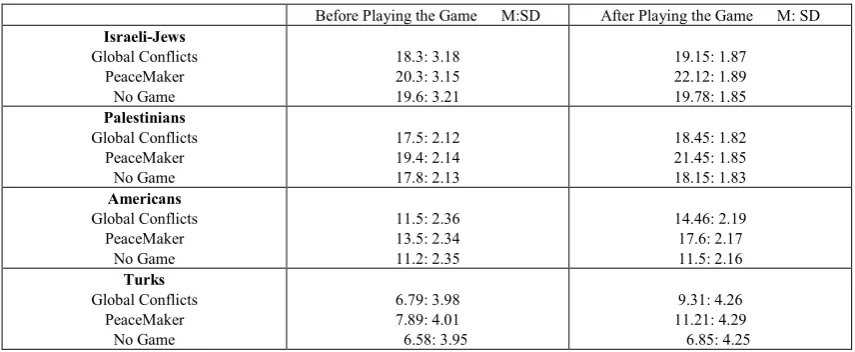
American, Turkish) and game type (PM, GC, No Game) as between-subjects factors and time (before or after playing the game) as a within-subjects factor. The interaction between game type, nationality and time was significant (F(6,401)=23.46, p<.0001, η2= .22).
Table 1 shows that American students answered more knowledge questions correctly after playing PM (M = 17.6, SD =2.17) than before playing it (M =13.5, SD = 2.34). Turkish students answered more knowledge questions correctly after playing PM (M =11.21, SD = 4.29) than before playing it (M =7.89, SD = 4.01). Israeli-Jewish students answered more questions correctly after playing PM (M = 22.12, SD =1.89) than before playing it (M =20.3 SD = 3.15). Palestinian students answered more questions correctly after playing PM (M = 21.45, SD =1.85) than before playing it (M =19.4, SD =2.14).
American students answered more knowledge questions correctly after playing GC (M = 14.46, SD =2.19) than before playing it (M =11.5, SD = 2.36). Turkish students answered more questions correctly after playing GC (M =9.31, SD = 4.26) than before playing it (M =6.79, SD=3.98). Israeli-Jewish students answered more questions correctly after playing GC (M = 19.15, SD =1.87) than before playing it (M =18.3 SD = 3.18). Palestinian students answered more questions correctly after playing GC (M = 18.45, SD =1.82) than before playing it (M =17.5, SD =2.12).
In sum, American and Turkish students acquired more knowledge about the conflict after playing the games than did Israeli-Jewish and Palestinian students who played them. Therefore, hypothesis 1 is confirmed.
Table 1 shows that during the same period no change was found in knowledge acquisition in the Israeli-Jewish control group (M=19.63 SD=3.21 M=19.78 SD=1.85), in the Palestinian control group (M=17.8 SD=2.13 M=18.15 SD=1.83), in the Turkish control group (M=6.58 SD=3.95 M=6.85 SD=4.25) and in the American control group (M=11.2 SD=2.35 M=11.5 SD=2.16).
4.2. Attitudes toward Key Issues in the Israeli-Palestinian conflict
In order to examine the effects of game type and nationality on attitudes toward key issues in the conflict, a three-way ANOVA was conducted with nationality and game type as between-subjects factors and time as a within-subjects factor. The interaction between game type, nationality and time was significant (F(6, 401)=21.56, p<.0001, η2= .18).
[image:6.595.91.519.554.730.2]Table 2 shows that Americans playing GC held a pro-Israeli view before playing the game and got closer to thinking after playing it that both Israelis and Palestinians are equally right regarding key issues in the conflict (M=3.92 SD=.65 M=2.72 SD=.66), while those playing PM did not change their attitude after playing the game and held a pro-Israeli view (M=3.51 SD=.79 M=3.39 SD=.75). Turks playing GC held a pro-Palestinian view before playing the game and after playing it got closer to thinking that both Israelis and Palestinians are equally right regarding key issues in the conflict (M=2.16 SD=.12 M=3.14 SD=.13), while those playing PM did not change their attitude after playing the game and held a pro-Palestinian view (M=2.42 SD=.63 M=2.51 SD=.65). Israelis playing GC held a pro-Israeli view before playing the game and after playing it got closer to thinking that both Israelis and Palestinians are equally right regarding key issues in the conflict (M=3.98 SD=.59 M=3.48 SD=.66), while those playing PM did not change their attitude after playing the game and held a pro-Israeli view (M=3.47 SD=.83 M=3.35 SD=.84). Palestinians playing GC held a pro-Palestinian view before playing the game, and after playing it got closer to thinking that both Israelis and Palestinians are equally right regarding key issues in the conflict (M=1.07 SD=.09 M=1.59 SD=.11), while those playing PM did not change their attitude after playing the game and held a pro-Palestinian view (M=2.03 SD=.31 M=2.21 SD=.36).
Table 1. Descriptive statistics of nationality and game type effects on knowledge acquisition
Before Playing the Game M:SD After Playing the Game M: SD
Israeli-Jews
Global Conflicts PeaceMaker
No Game
18.3: 3.18 20.3: 3.15 19.6: 3.21
19.15: 1.87 22.12: 1.89 19.78: 1.85
Palestinians
Global Conflicts PeaceMaker
No Game
17.5: 2.12 19.4: 2.14 17.8: 2.13
18.45: 1.82 21.45: 1.85 18.15: 1.83
Americans
Global Conflicts PeaceMaker
No Game
11.5: 2.36 13.5: 2.34 11.2: 2.35
14.46: 2.19 17.6: 2.17 11.5: 2.16
Turks
Global Conflicts PeaceMaker
No Game
6.79: 3.98 7.89: 4.01 6.58: 3.95
Table 2. Descriptive statistics of nationality and game type effects on attitudes toward key issues in the Israeli-Palestinian conflict Before Playing the Game
M:SD After Playing the Game M: SD
Israeli-Jews
Global Conflicts PeaceMaker
No Game
3.98: .59 3.47: .83
3.75: .75
3.48: .66 3.35: .84 3.97: .76
Palestinians
Global Conflicts PeaceMaker
No Game
1.07: .09 2.03: .31 1.56: .24
1.59: .11 2.21: .36 1.78: .27
Americans
Global Conflicts PeaceMaker
No Game
3.92: .65 3.51: .79 3.87: .75
2.72: .66 3.39: .75 3.75: .68
Turks
Global Conflicts PeaceMaker
No Game
2.16: .12 2.42: .63 2.25: .57
3.14: .13 2.51: .65 2.46: .54
In sum, stronger effects were found in attitude change and perspective taking for Turkish and American students playing the GC game compared to Israeli-Jewish and Palestinian playing it. However, no learning effects were obtained for participants playing the PM game, and they retained an ethnocentric perspective toward the conflict (i.e., looking at the situation through the lens of their own side). Therefore, hypothesis 2 is partially confirmed.
Table 2 shows that during the same period no significant change was found in attitudes regarding key issues in the conflict in the Israeli-Jewish control group (M=3.75 SD=.75 M=3.97 SD=.76), in the Palestinian control group (M=1.56 SD=.24 M=1.78 SD=.27), in the Turkish control group (M=2.25 SD=.57 M=2.46 SD=.54) and in the American control group (M=3.87 SD=.75 M=3.75 SD=.68).
5. Discussion and Conclusions
This study aims to assess the impact of two computer-based simulations on the teaching of peacebuilding and whether these effects change from one cultural context to another. By using the GC and PM games, which are simulations of the Israeli-Palestinian conflict, and using a cross-cultural experimental design, the studies assessed whether participants could increase their knowledge about the conflict and develop perspective taking, and whether these effects changed with being direct parties to the conflict as opposed to secondary/third parties.
Results suggested that American and Turkish participants acquired more knowledge about the conflict compared to Israeli-Jewish and Palestinian participants, but the latter two had prior high levels of knowledge of the Israeli-Palestinian situation and so did not have much more to gain (i.e., ceiling effect). In addition, all participants playing the GC game acquired a more impartial perspective toward long lasting historical issues in the conflict, but the effect was stronger for the secondary/third parties to the conflict. The
latter may have less salient and weaker attitudes concerning the situation as opposed to Israeli-Jewish and Palestinian participants who may have stronger and more salient attitudes ([17]. Finally, learning effects with regard to attitude change and perspective taking were not obtained for the PM game, and the participants playing this game retained stereotypic and ethnocentric attitudes toward the conflict.
This is most likely due to the different game characteristics which should be further explored in future research. First, as mentioned earlier GC may induce more immersion than PM and can therefore be assumed to be more enjoyable, boosting players' engagement and motivation, as a result impacting their attitudes and behavior [23, 24]. In addition, GC presents more episodic framing to the conflict compared to PM, focusing on the hardships of both Israelis and Palestinians at a checkpoint in the Palestinian territories, an experience which may produce empathy and identification with both sides, eliciting a more impartial perspective regarding the situation [e.g., 25]. Finally, in GC as compared to PM, a player assumes the role of a more distant party to the conflict committed to standards of objectivity and neutrality (i.e., a Western reporter rather than the Israeli Prime Minister or the Palestinian President), and therefore may be less prone towards the myside bias. Myside bias, also called confirmation bias, is the tendency to search for, interpret, favor, and recall information in a way that confirms one's beliefs while giving disproportionately less attention to information that contradicts it [e.g., 31]. As a result, participants playing GC may find it easier to look at the conflict through the lenses of both sides (i.e., to be exposed to contradicting information and gain a more balanced perspective) compared to those playing PM who may be more likely to look at the situation through the lens of their own side (i.e., an ethnocentric and stereotypic perspective) [e.g., 26, 27].
different learning outcomes of the two games with regard to attitude change. Israeli-Jewish and Palestinian students playing PM may have stronger attitudes about the conflict than those playing GC. This study was conducted shortly after the Gaza operation, an event which received extensive media attention and public debate. The data on Israeli-Jewish and Palestinian participants in the GCs study were collected after the data on Israeli-Jewish and Palestinian participants in the PM study. Therefore, the latter may have more salient attitudes about the conflict than the former, and research on attitude strength suggests that salient attitudes are more resistant to change and lead to selective cognitive processing [17]. Furthermore, when one’s attitude is linked to one’s ‘self’ concept or value system, the attitude is more resilient to change [e.g., 32]. In the future, it would be interesting to compare the short-term and long-term impact of game interventions on attitudes and behaviors, particularly since the number of studies on the long-term effects of peace workshops in protracted conflicts like the Israeli-Palestinian situation is extremely limited [e.g., 33, 34].
Finally, results indicated that participants who played the games acquired more knowledge about the conflict, while those who did not play them did not change their levels of knowledge about the conflict during the same period. In addition, unlike participants who did not play the games, participants playing them became more impartial toward the conflict (although this effect was not obtained in the case of PM). Therefore, this study has implications for the scholarship on pedagogy and teaching assessment in the context of peacebuilding. Considering the mixed results obtained so far with regard to the effectiveness of simulations [e.g., 4, 35], the comparison of learning outcomes between participants who played the games (i.e., experimental group) and those who did not play them (i.e., control group) suggests that the two games not only contributed to the improvement of conflict-specific knowledge but also improved perspective taking, albeit in a limited manner in the case of PM.
The abovementioned comparison of learning outcomes between the experimental group and the control group in this study indicates that computer games like GC facilitate the gaining by the participants of a conceptually complex view of the conflict as opposed to the simplistic and polarized view of the conflict often presented in collective narratives and mainstream socialization agents in a conflict environment [e.g., 36]. By achieving this, computer games can thus be a tool, as indicated by pedagogy and teaching scholars in the context of conflict resolution, for legitimating the other’s narrative in a way such that events are seen from both perspectives [37]. This is an important step towards increasing learning about the “out-group” and the conflict dynamics, as indicated by social and political psychologists working on inter-group conflict [37]; a necessary step towards attitude change and reducing inter-group tensions. This leads in the direction of liberating
the parties from the perception of “sole victimhood” in the conflict. The more they understand and appreciate the perspective of the other party in the conflict, the more likely that empathy will develop and that they abandon their “victim” mentality. This may also lead to “in-group reappraisal” where parties begin to critically assess their group’s contribution to the conflict dynamics. Computer games and their effects in this regard should be further explored in depth in future research.
Another implication for the pedagogy and learning scholarship in the context of peacebuilding is that the variation in the results obtained from different cultural contexts indicates the importance of context in learning from simulations. In addition to the different learning outcomes we observed in different cultural contexts, the PM and GC games have clearly shown that learning effects for direct parties to the conflict are different from those for secondary/third parties to the conflict. The effect of context on learning from simulations should perhaps encourage scholars of experiential teaching and learning in conflictual contexts to direct their attention to exploring the contingencies of effectiveness for simulations, rather than adopting dichotomous research questions that ask whether simulations are useful or not. In fact, very few assessments have involved cross-cultural experimental studies about the effectiveness and usefulness of technology as a pedagogical tool in teaching about conflicts and peacebuilding, particularly in the context of intractable conflicts like the Israeli-Palestinian situation, and this should be further explored in the future.
The results examining the effectiveness of GC and PM are promising in terms of showing that computer games can be used as part of peacebuilding training. The results indicate that the games are useful not only in teaching a more complex view of the conflict to the parties, particularly to those who are direct parties to the conflict, but also in engendering attitude change, especially in the form of taking a more balanced perspective and being able to look at the conflict through the lenses of both sides. However, it is also important to note the different results obtained for direct party participants compared to secondary/third party participants and for the two games. The game characteristics may be crucial in determining whether the players gain the perspective of both sides or not. Further research is required to understand how PM and GC achieve their learning effects, by singling out different dimensions of the two games in order to provide a more in-depth and comparative analysis of their impact.
Previous studies have already shown that Israeli-Jewish and Palestinian young people know almost nothing about what transpires on the other side of the Israeli-Palestinian divide, except for the limited and violent images constructed by the media and daily incidents [e.g., 36]. Moreover, since these young people have never actually experienced a state of peace, they may not regard it as having a significant value for which a price should be paid. Therefore, the opportunity for young Israeli-Jewish and Palestinian people to learn about and to perhaps understand the "other" party, even if through computerized simulations like GC and PM, is an issue of great importance in any process of reconciliation in the Middle East and an essential requirement for obtaining public support and legitimacy for any peace initiative.
REFERENCES
[1] Brown, S., Boyer, M., Mayall, H., Johnson, P., Meng, L., Butler, M., Reis, S. The GlobalEd Project: Gender differences in a problem-based learning environment of international negotiations. Instructional Science, Vol. 31, No.4-5, 255-276, 2003.
[2] Druckman, D. Negotiation and Mediation. In J. N. Druckman, D. P. Green, J. H. Kuklinski, & A. Lupia (Eds.), Cambridge Handbook of Experimental Political Science, Cambridge University Press, New York, 2011.
[3] Lewicki, R. J. Teaching Negotiation and Dispute Resolution in Colleges of Business: The State of the Practice. In M. Wheeler (Ed.), Teaching Negotiation: Ideas and Innovations, PON Books, Cambridge MA, 2000.
[4] Movius, H. The effectiveness of negotiation training. Negotiation Journal, Vol., No. 4, 509-531, 2008.
[5] Kersten, G. E., Koszegi, S., & Vetschera, R. The effects of culture in computer mediated negotiations: Experiments in 10 countries. Journal of Information Technology Theory Applied, Vol. 5, No.21, 1-28, 2003.
[6] Honeyman, C., Coben, J., & De Palo, G. Introduction: Negotiation teaching 2.0. Negotiation Journal, Vo. 25, No. 2, 141-146, 2009.
[7] Volkema, R. J. (2007). Negotiating for money: Adding a dose of reality to classroom negotiations. Negotiation Journal, Vol. 23, No. 4, 473-485, 2007.
[8] Alexander, N., & LeBaron, M. Death of the Role Play. In C. Honeyman, J. Coben, & G. DePalo (Eds.), Second Generation Negoation Teaching (Vol. 1), DRI Press, St. Paul MN, 2009. [9] Loewenstein, J., & Thompson, L. The challenge of learning.
Negotiation Journal, Vol. 16, No. 4, 399-408, 2000.
[10] Nadler, J., Thompson, L., & Boven, L. V. Learning negotiation skills: Four models of knowledge creation and transfer. Management Science, Vol. 49, No. 4, 529-540, 2003.
[11] Gehlbach, H., Brown, S. W., Ioannou, A., Boyer, M. A., Hudson, N., Niv-Solomon, A., Janik, L. Increasing interest in social studies: Social perspective taking and self-efficacy in stimulating simulations. Contemporary Educational Psychology, Vol. 33, No. 4, 894-914, 2008.
[12] Torney-Purta, J. Evaluating programs designed to teach international content and negotiation skills. International Negotiation, Vol. 3, No. 1, 77-97, 1998.
[13] Wilkenfeld, J., Young, K., Queen, D., & Assal, V. Mediating International Crises. Routledge, Oxford UK, 2005.
[14] Druckman, D., & Ebner, N. Onstage or behind the scenes? Relative learning benefits of simulation role-play and design. Simulation & Gaming, vol. 39, No. 4, 465-497, 2008. [15] Bogost, I. Persuasive Games. MIT Press, Cambridge MA,
2007.
[16] Gee, J. P. Learning and games. In Salen, K. (ed.), The Ecology of Games: Connecting Youth, Games, and Learning (pp. 21–40). MIT Press, Cambridge MA, 2008.
[17] Eagly, A., & Chaiken, S. Attitude Structure and Function. In T. D. Gilbert, S. T. Fiske, & G. Lindzey (Eds.), The Handbook of Social Psychology. McGraw-Hill, New York, 1998.
[18] Cuhadar, E., & Kampf, R. Learning about the Israeli-Palestinian conflict and negotiations through simulations: The case of PeaceMaker. International Studies Perspectives, Vol. 15, No. 4, 509-524, 2014.
[19] Crampton, A. & Manwaring, M. Reality and Artifice in Teaching Negotiation: The Variable Benefits of 'Keeping it Real' in Simulations, 2 (1), (e-newsletter), 2008.
[20] Ebner, N., & Efron, Y. Using tomorrow's headlines for today's training: Creating pseudo-reality in conflict resolution simulation games. Negotiation Journal, Vol. 21, No. 3, 377-394, 2005.
[21] Gonzalez, C., Saner, L. D., & Eisenberg-Zittrain, L. Learning to stand in the other’s shoes: A computer video game experience of the Israeli–Palestinian conflict. Social Science Computer Review, Vol. 31, No. 2, 236-243, 2013.
Computers in Human Behavior, Vol. 52, 541-549, 2015. [23] Fu, F.L., Su, R.S., & Yu, S.C. EGameFlow: A scale to
measure learners’ enjoyment of e-learning games. Computers & Education, Vol. 52, No. 1, 101–112, 2009.
[24] Kiili, K. Digital game-based learning: Towards an experiential game model. Internet and Higher Education, Vol. 8, No. 1, 13–24, 2005.
[25] Gross, K. Framing persuasive appeals: Episodic and thematic framing, emotional response, and policy opinion. Political Psychology, Vol. 29, No. 2, 169–192, 2008.
[26] Halperin, E., Porat, R., Tamir, M., & Gross, J.J. Can emotion regulation change political attitudes in intractable conflicts? From the laboratory to the field. Psychological Science, Vol. 24, No. 2, 106-111, 2013.
[27] Halperin, E., Pliskin, R., Saguy, T., Liebrman, V., & Gross, J.J. Emotional regulation and the cultivation of political tolerance: Searching for a new track for intervention. Journal of Conflict Resolution, Vol. 58, No. 6, 1100-1138, 2014. [28] Bartels, L. Beyond the running tally: partisan bias in political
perceptions. Political Behavior, Vol. 24, No. 2, 117-150, 2002.
[29] Klayman, J. Varieties of confirmation bias. Psychology of Learning and Motivation, Vol. 32, 385-418, 1995.
[30] Taber, C. & Lodge, M. Motivated skepticism in the
evaluation of political beliefs. American Journal of Political Science, Vol. 50, No. 3, 755-769, 2006.
[31] Stanovich, K.E., West, R.F., & Toplak, M.E. Myside bias, rational thinking, and Intelligence. Current Directions in Psychological Science, Vol. 22, No. 4, 259–264, 2013. [32] Pomerantz, E., Chaiken, S., & Tordesillas, R. Attitude
strength and resistance processes. Journal of Personality and Social Psychology, Vol. 69, No. 3, 408–419, 1995.
[33] Malhotra, D., & Liyanage, S. Long-term effects of peace workshops in protracted conflicts. Journal of Conflict Resolution, Vol. 49, No. 6, 908-924, 2005.
[34] Rosen, I., & Salomon, G. Durability of peace education effects in the shadow of conflict. Social Psychology Education, Vol. 14, 135-147, 2011.
[35] Matz, D., & Ebner, N. Using role play in online negotiation. In C. Honeyman, J. Cohen & G. DePalo (Eds), Venturing Beyond the Classroom, Vol. 2. DRI Press, St Paul MN, 2010.
[36] Wolfsfeld, G., Frosh, P., & Awabdy, M. Covering death in conflicts: Coverage of the Second Intifada on Israeli and Palestinian television. Journal of Peace Research, Vol. 45, 401-417, 2008.