Review Article
Sleep Spindles as Facilitators of Memory Formation
and Learning
Daniel Ulrich
Department of Physiology and Institute of Neuroscience, Trinity College Dublin, Dublin, Ireland
Correspondence should be addressed to Daniel Ulrich; [email protected]
Received 4 January 2016; Accepted 13 March 2016
Academic Editor: Igor Timofeev
Copyright © 2016 Daniel Ulrich. This is an open access article distributed under the Creative Commons Attribution License, which permits unrestricted use, distribution, and reproduction in any medium, provided the original work is properly cited.
Over the past decades important progress has been made in understanding the mechanisms of sleep spindle generation. At the same time a physiological role of sleep spindles is starting to be revealed. Behavioural studies in humans and animals have found significant correlations between the recall performance in different learning tasks and the amount of sleep spindles in the intervening sleep. Concomitant neurophysiological experiments showed a close relationship between sleep spindles and other sleep related EEG rhythms as well as a relationship between sleep spindles and synaptic plasticity. Together, there is growing evidence from several disciplines in neuroscience for a participation of sleep spindles in memory formation and learning.
1. Introduction
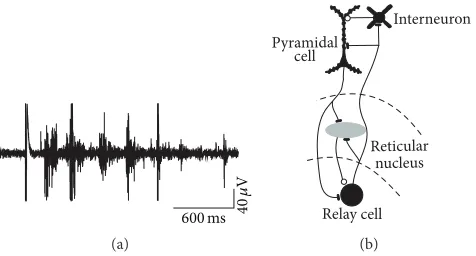
Sleep spindles are waxing and waning 7–14 Hz EEG rhythms that occur during various stages of non-REM sleep (Fig-ure 1(a)). They are generated in the thalamus through alternating excitation of relay cells and reticular neurons (Figure 1(b)). Spindles are propagated from thalamus to the cortex by thalamocortical axons and get synchronized via corticothalamic projections [1]. Spindles were originally thought to occur at sleep onset but were subsequently shown to be generated throughout sleep, particularly in association with slow oscillations. Although mechanistically not fully understood faster centroparietal spindles in humans are distinguishable from slower prefrontal spindles [1]. There is support from behavioural, physiological, and cellular studies for an active role of sleep in learning. According to two sep-arate conceptual frameworks, the two major sleep episodes, non-REM and REM sleep, contribute sequentially or in parallel to sleep-dependent memory formation. In the dual model, non-REM sleep predominantly facilitates declarative learning, that is, the memories for facts and events, while REM sleep affects mainly procedural learning [2]. Alterna-tively, in the sequential model all types of memories are shaped by the alternating occurrence of non-REM and REM sleep episodes [3]. In this review I discuss behavioural and neurophysiological data that support a role of sleep spindles
in memory formation summarizing recent findings over the past decade. For a more general discussion of the role of sleep in learning, the reader is referred to recent comprehensive review articles [4–8].
2. Sleep Spindles and Learning
40
𝜇
V
600ms
(a)
Pyramidal cell
Interneuron
Reticular nucleus
Relay cell
(b)
Figure 1: (a) Spindle discharges recorded in thalamus with extracellular electrodes. (b) Schematic diagram of the main cell types in thalamus and cortex participating in spindles. Thalamocortical relay cells excite inhibitory neurons of the adjacent reticular nucleus. Relay cells in turn are reexcited via postinhibitory rebound from reticular neurons. Thalamus and cortex are reciprocally connected by axons of relay cells and pyramidal neurons.
A comparable beneficial role of slow sleep spindles was seen in a word-pair learning task involving a daytime nap [12]. This latter finding largely excludes a major contribution of circadian rhythms that are known to influence sleep spindle activity and learning [13]. In addition, Schmidt et al. [12] showed that the role of slow spindles became significant only above a certain level of complexity of the task. It was subsequently shown that a linear correlation between spindle density and recall performance was not ubiquitous as it applied to verbal learning and visuospatial memory but not to a facial recognition test [14, 15]. Spindles occur during various stages of non-REM sleep and can be associated with slow oscillations during slow-wave sleep. In a visual learning task, Cox et al. found that the sleep spindles particularly occurring during slow-wave sleep are responsible for potentiating mem-ories [16]. However, in another study involving procedural motor learning, an increase in spindles was associated with stage 2 sleep, that is, light sleep [17]. It is thus possible that in humans different learning paradigms benefit from either type of spindles (slow or fast) during different phases of non-REM sleep.
A series of complementary studies investigated the role of sleep spindles in procedural learning in humans. Morin et al. [18] found increased spindle activity after a motor sequence learning tasks. A correlation between motor sequence learn-ing and spindle activity was also found durlearn-ing daytime naps, again rendering a significant contribution of circadian factors rather unlikely [19].
Neurological and psychiatric conditions like Alzheimer’s disease and schizophrenia are associated with decreased memory performance and reduced spindle activity during sleep [20]. Similarly, a decline in learning capabilities in the elderly correlates with diminished sleep spindle activity in prefrontal cortical areas [21]. These examples complement the studies in healthy subjects by demonstrating a relationship between spindles and memory also under conditions of decreased performance.
A comparable increase in sleep spindle density was found in laboratory rats trained in an odor-reward association task [22]. In addition, increased spindle density was also associated with retrieval of remote memories and memory
updates (reward extinction) indicating that an involvement of sleep spindles in learning is not confined to sleep episodes immediately after training [22]. In the same species, spindles particularly at the transition to REM sleep were shown to be involved in the consolidation of novel memories [23]. These studies show that spindles play a role in learning also in other species and that laboratory animals can be used to investigate the underlying mechanisms (see below).
[image:2.600.183.421.72.200.2]Supplementary evidence for a role of spindles in memory formation was recently provided by the finding that learning related changes in spindle activity occur preferentially in task-associated areas of the brain. Nishida and Walker showed increased spindle activity in the contralateral hemisphere after a unilateral finger tapping task [19]. Similarly, by using standardized low-resolution brain electromagnetic tomogra-phy, Tamaki et al. [30] found a localized increase in sleep spindles after visuomotor learning in brain areas that are known to be involved in the task. A regional increase in spin-dles was also observed in electrocorticographic recordings in patients who were trained on a brain-computer interface [31]. In addition, that study showed that the increased spindle activity was due to an increased gain in existing spindle networks rather than due to the formation of novel ones. A recent study used memory cueing to investigate the role of spindles in memory formation [32]. These authors paired a word-location task with particular odors. During subsequent sleep, topographically localized spindles could be evoked by the corresponding odorant.
Together, a variety of studies show comprehensive cor-relative data for a role of sleep spindles in declarative and procedural memory consolidation in humans and laboratory animals in task relevant brain areas. In addition, memory performance can be up- or downregulated by experimentally enhancing or decreasing spindle activity.
3. Mechanisms of Sleep Spindle
Associated Learning
Learning is thought to result from modifications of synaptic connections. In particular, long-term potentiation (LTP), a long-lasting enhancement of synaptic strength between excitatory neurons, has been widely investigated and is considered to be a key process in memory formation [33]. However, the inverse process of long-term synaptic depres-sion was also shown to contribute to learning [34]. In addition, similar plasticity processes have been shown to occur at inhibitory synaptic contacts and between excitatory and inhibitory neurons [35]. It is thus likely that learning involves modifications at different types of synapses involving strengthening and weakening of subsets of neural connec-tions. The two main paradigms regarding the role of sleep in learning are the synaptic downscaling and the systems consolidation hypotheses [4, 6]. According to the former, non-REM sleep leads to weakening of synaptic connections as part of a homeostatic process while in systems consolidation synapses are strengthened via replay of wake-related neural activity within and between different brain areas, in particular the hippocampus and neocortex [36, 37]. LTP is the most intensively studied form of synaptic plasticity and is known to proceed through different stages (early, late) eventually leading to long-lasting enhancement of synaptic transmission [38]. A key regulator of synaptic modifications is the sec-ondary messenger Ca2+ [39]. A combination of parameters like ion concentration and kinetics seem to determine the sign and size of changes in synaptic strength. In the following,
experimental evidence of the role of spindles in synaptic plasticity will be discussed.
Sejnowski and Destexhe [40] hypothesized that sleep spindles may contribute to learning by triggering calcium influx into pyramidal cells of neocortex that then induces the relevant plasticity processes. Indeed, spontaneous spindles in cats led to an increased responsiveness of neurons to synaptic stimuli [41] indicating that spindles enhance postsy-naptic responsiveness to sypostsy-naptic inputs. However, the spin-dle induced depolarizations may be restricted to dendritic compartments of neocortical pyramidal cells as concomitant spindle associated synaptic inhibition may prevent these depolarizations from reaching the soma and hence induce strong spike firing. This scenario would be in line with the relatively low firing frequency of pyramidal cells in neocortex during spindles that were observed with electrophysiological techniques in cats [42]. The model is further supported by experimental observations of dendritic Ca2+ influx during inhibition of the soma via GABA receptor activation [43] and the prevalence of inhibitory cell activity during spindles in naturally sleeping rats as seen with extracellular tetrode recordings [44].
5m
V
20
mV
250 ms (a)
Control Conditioned
Co
nt
ro
l
C
ondi
tio
ne
d
EPS
P (%)
100 150
50
0
20 ms 2 mV
10 20 30 40
Time (min) 100
200
EPS
P (%)
∗∗
(b)
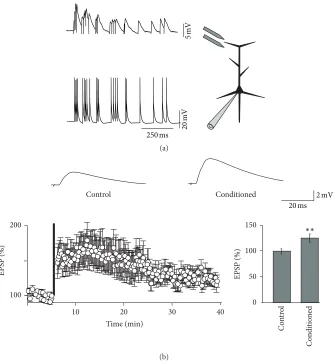
Figure 2: (a) Experimental approach for studying the role of spindles in synaptic plasticity. Spindle discharge patterns were used to trigger excitatory postsynaptic potentials (EPSPs) in pyramidal neurons. The same spindle trains were used to elicit action potentials in the soma. (b) Sample traces and EPSP time course before and after spindle conditioning. Concurrent pre- and postsynaptic spindles lead to statistically significant long-term synaptic potentiation (∗∗).
Various mechanisms have been postulated to account for strengthening or weakening of synaptic connections. In particular long-term potentiation at excitatory synapses was shown to be associated with the growth of synaptic spines [54]. Interestingly in a recent report, Yang et al. [55] showed a non-REM sleep-dependent increase in dendritic spines asso-ciated with increased performance in a motor learning task in mice. This finding is all the more remarkable as the overall spine number was previously shown to decrease during sleep [56]. It is thus conceivable that sleep associated learning is at least partially mediated by the formation of new dendritic spines. Spine growth can be promoted by dendritic Ca2+ spikes [57] and L-type Ca2+channels are known to contribute to those dendritic spikes [58]. In agreement, LTP of excitatory postsynaptic potentials induced by spindle trains in slices depended on influx of Ca2+ via L-type Ca2+ channels [47]. In addition to their role as charge carriers L-type channels are known to be specifically linked to excitation-transcription coupling related to inter alia the formation of new dendritic spines [59–61]. Sleep spindles may thus be responsible for
transforming primary synaptic plasticity processes into more permanent forms by promoting structural plasticity.
4. Conclusions and Outlook
[image:4.600.134.468.71.434.2]between spindle incidences and memory performance and which spindle characteristics (frequency, density, amplitude, and/or duration) are of relevance? This issue is of interest in light of differential ontogenetic changes of those parameters [63]. How can an apparent differential role of slow and fast spindles for different memory tasks be reconciled with a uniform mechanism? Why are spindles peculiar? This ques-tion suggests itself in view of the observaques-tion that birds, the other animal order with alternating non-REM and REM sleep episodes and sleep-facilitated learning, do not disclose sleep spindles [64]. What are the consequences of interactions of spindles with other brain oscillations, in particular gamma rhythms for synaptic plasticity?
Little is known about the cellular mechanisms of spindle associated memory formation. The observed phase shifts in spike firing in different cell types during spindles are possibly the consequence of synaptic plasticity processes. The close temporal associations of hippocampal ripples and spindles are a paradigm for NREM sleep based memory for-mation and may induce plasticity processes related to spike-timing dependent or heterosynaptic plasticity phenomena. The postulated spindle associated dendritic Ca2+ influx in combination with the known relationship between dendritic Ca2+ spikes, spine formation, and learning suggests a role for spindles in spine growth, a hypothesis that needs future experimental investigations.
Competing Interests
No competing interests exist.
References
[1] L. De Gennaro and M. Ferrara, “Sleep spindles: an overview,”
Sleep Medicine Reviews, vol. 7, no. 5, pp. 423–440, 2003.
[2] W. Plihal and J. Born, “Effects of early and late nocturnal sleep on declarative and procedural memory,”Journal of Cognitive
Neuroscience, vol. 9, no. 4, pp. 534–547, 1997.
[3] A. Giuditta, M. V. Ambrosini, P. Montagnese et al., “The sequential hypothesis of the function of sleep,” Behavioural
Brain Research, vol. 69, no. 1-2, pp. 157–166, 1995.
[4] B. Rasch and J. Born, “About sleep’s role in memory,”
Physiolog-ical Reviews, vol. 93, no. 2, pp. 681–766, 2013.
[5] S. Diekelmann and J. Born, “The memory function of sleep,”
Nature Reviews Neuroscience, vol. 11, no. 2, pp. 114–126, 2010.
[6] G. Tononi and C. Cirelli, “Sleep and the price of plasticity: from synaptic and cellular homeostasis to memory consolidation and integration,”Neuron, vol. 81, no. 1, pp. 12–34, 2014.
[7] R. Stickgold, “Parsing the role of sleep in memory processing,”
Current Opinion in Neurobiology, vol. 23, no. 5, pp. 847–853,
2013.
[8] M. G. Frank and R. Cantera, “Sleep, clocks, and synaptic plasticity,”Trends in Neurosciences, vol. 37, no. 9, pp. 491–501, 2014.
[9] M. Schabus, G. Gruber, S. Parapatics et al., “Sleep spindles and their significance for declarative memory consolidation,”Sleep, vol. 27, no. 8, pp. 1479–1485, 2004.
[10] S. Gais, M. M¨olle, K. Helms, and J. Born, “Learning-dependent increases in sleep spindle density,”Journal of Neuroscience, vol. 22, no. 15, pp. 6830–6834, 2002.
[11] J. Tamminen, J. D. Payne, R. Stickgold, E. J. Wamsley, and M. G. Gaskell, “Sleep spindle activity is associated with the integration of new memories and existing knowledge,”Journal
of Neuroscience, vol. 30, no. 43, pp. 14356–14360, 2010.
[12] C. Schmidt, P. Peigneux, V. Muto et al., “Encoding difficulty promotes postlearning changes in sleep spindle activity during napping,”Journal of Neuroscience, vol. 26, no. 35, pp. 8976–8982, 2006.
[13] D.-J. Dijk and C. A. Czeisler, “Contribution of the circadian pacemaker and the sleep homeostat to sleep propensity, sleep structure, electroencephalographic slow waves, and sleep spin-dle activity in humans,”Journal of Neuroscience, vol. 15, no. 5 I, pp. 3526–3538, 1995.
[14] Z. Clemens, D. Fab´o, and P. Hal´asz, “Overnight verbal memory retention correlates with the number of sleep spindles,”
Neuro-science, vol. 132, no. 2, pp. 529–535, 2005.
[15] Z. Clemens, D. Fab´o, and P. Hal´asz, “Twenty-four hours retention of visuospatial memory correlates with the number of parietal sleep spindles,”Neuroscience Letters, vol. 403, no. 1-2, pp. 52–56, 2006.
[16] R. Cox, W. F. Hofman, and L. M. Talamini, “Involvement of spindles in memory consolidation is slow wave sleep-specific,”
Learning and Memory, vol. 19, no. 7, pp. 264–267, 2012.
[17] S. M. Fogel and C. T. Smith, “Learning-dependent changes in sleep spindles and Stage 2 sleep,”Journal of Sleep Research, vol. 15, no. 3, pp. 250–255, 2006.
[18] A. Morin, J. Doyon, V. Dostie et al., “Motor sequence learning increases sleep spindles and fast frequencies in post-training sleep,”SLEEP, vol. 31, no. 8, pp. 1149–1156, 2008.
[19] M. Nishida and M. P. Walker, “Daytime naps, motor memory consolidation and regionally specific sleep spindles,”PLoS ONE, vol. 2, no. 4, article e341, 2007.
[20] W. Lu and R. G¨oder, “Does abnormal non-rapid eye movement sleep impair declarative memory consolidation? Disturbed thalamic functions in sleep and memory processing,” Sleep
Medicine Reviews, vol. 16, no. 4, pp. 389–394, 2012.
[21] B. A. Mander, V. Rao, B. Lu et al., “Impaired prefrontal sleep spindle regulation of hippocampal-dependent learning in older adults,”Cerebral Cortex, vol. 24, no. 12, pp. 3301–3309, 2014. [22] O. Eschenko, M. M¨olle, J. Born, and S. J. Sara, “Elevated sleep
spindle density after learning or after retrieval in rats,” The
Journal of Neuroscience, vol. 26, no. 50, pp. 12914–12920, 2006.
[23] A. Watts, H. J. Gritton, J. Sweigart, and G. R. Poe, “Antidepres-sant suppression of non-REM sleep spindles and REM sleep impairs hippocampus-dependent learning while augmenting striatum-dependent learning,”Journal of Neuroscience, vol. 32, no. 39, pp. 13411–13420, 2012.
[24] L. Marshall, H. Helgad´ottir, M. M¨olle, and J. Born, “Boosting slow oscillations during sleep potentiates memory,”Nature, vol. 444, no. 7119, pp. 610–613, 2006.
[25] S. C. Mednick, E. A. McDevitt, J. K. Walsh et al., “The critical role of sleep spindles in hippocampal-dependent memory: a pharmacology study,”Journal of Neuroscience, vol. 33, no. 10, pp. 4494–4504, 2013.
[26] L. Marshall, R. Kirov, J. Brade, M. M¨olle, and J. Born, “Tran-scranial electrical currents to probe EEG brain rhythms and memory consolidation during sleep in humans,”PLoS ONE, vol. 6, no. 2, Article ID e16905, 2011.
[28] G. B. Feld, I. Wilhelm, Y. Ma et al., “Slow wave sleep induced by GABA agonist tiagabine fails to benefit memory consolidation,”
SLEEP, vol. 36, no. 9, pp. 1317–1326, 2013.
[29] F. Katsuki, J. M. McNally, S. Thankachan et al., “Sleep spindles and memory: optogenetic manipulation of parvalbumin containing GABAergic neurons in mouse thalamic reticular nucleus,” Society for Neuroscience, Abstract no. 167.14, 2015, http://www.sfn.org/annual-meeting/neuroscience-2015/ses-sions-and-events/program/abstract-pdfs-2015.
[30] M. Tamaki, T. Matsuoka, H. Nittono, and T. Hori, “Activation of fast sleep spindles at the premotor cortex and parietal areas contributes to motor learning: a study using sLORETA,”Clinical
Neurophysiology, vol. 120, no. 5, pp. 878–886, 2009.
[31] L. A. Johnson, T. Blakely, D. Hermes, S. Hakimian, N. F. Ramsey, and J. G. Ojemann, “Sleep spindles are locally modulated by training on a brain-computer interface,” Proceedings of the
National Academy of Sciences of the United States of America,
vol. 109, no. 45, pp. 18583–18588, 2012.
[32] R. Cox, W. F. Hofman, M. de Boer, and L. M. Talamini, “Local sleep spindle modulations in relation to specific memory cues,”
NeuroImage, vol. 99, pp. 103–110, 2014.
[33] S. J. Martin, P. D. Grimwood, and R. G. M. Morris, “Synaptic plasticity and memory: an evaluation of the hypothesis,”Annual
Review of Neuroscience, vol. 23, pp. 649–711, 2000.
[34] K.-H. Braunewell and D. Manahan-Vaughan, “Long-term depression: a cellular basis for learning?”Reviews in the
Neu-rosciences, vol. 12, no. 2, pp. 121–140, 2001.
[35] D. M. Kullmann, A. W. Moreau, Y. Bakiri, and E. Nicholson, “Plasticity of Inhibition,”Neuron, vol. 75, no. 6, pp. 951–962, 2012.
[36] C. Pavlides and J. Winson, “Influences of hippocampal place cell firing in the awake state on the activity of these cells during subsequent sleep episodes,”The Journal of Neuroscience, vol. 9, no. 8, pp. 2907–2918, 1989.
[37] D. S. Ramanathan, T. Gulati, and K. Ganguly, “Sleep-dependent reactivation of ensembles in motor cortex promotes skill con-solidation,”PLoS Biology, vol. 13, no. 9, Article ID e1002263, 2015.
[38] J. L. McGaugh, “Memory—a century of consolidation,”Science, vol. 287, no. 5451, pp. 248–251, 2000.
[39] R. Chittajallu, S. Alford, and G. L. Collingridge, “Ca2+ and synaptic plasticity,”Cell Calcium, vol. 24, no. 5-6, pp. 377–385, 1998.
[40] T. J. Sejnowski and A. Destexhe, “Why do we sleep?” Brain
Research, vol. 886, no. 1-2, pp. 208–223, 2000.
[41] I. Timofeev, F. Grenier, M. Bazhenov, A. R. Houweling, T. J. Sejnowski, and M. Steriade, “Short- and medium-term plastic-ity associated with augmenting responses in cortical slabs and spindles in intact cortex of cats in vivo,”Journal of Physiology, vol. 542, no. 2, pp. 583–598, 2002.
[42] D. Contreras, A. Destexhe, and M. Steriade, “Intracellular and computational characterization of the intracortical inhibitory control of synchronized thalamic inputs in vivo,”Journal of
Neurophysiology, vol. 78, no. 1, pp. 335–350, 1997.
[43] M. Murayama, E. P´erez-Garci, T. Nevian, T. Bock, W. Senn, and M. E. Larkum, “Dendritic encoding of sensory stimuli controlled by deep cortical interneurons,”Nature, vol. 457, no. 7233, pp. 1137–1141, 2009.
[44] A. Peyrache, F. P. Battaglia, and A. Destexhe, “Inhibition recruit-ment in prefrontal cortex during sleep spindles and gating of hippocampal inputs,”Proceedings of the National Academy of
Sciences of the United States of America, vol. 108, no. 41, pp.
17207–17212, 2011.
[45] C. M. Werk, V. L. Harbour, and C. A. Chapman, “Induction of long-term potentiation leads to increased reliability of evoked neocortical spindles in vivo,”Neuroscience, vol. 131, no. 4, pp. 793–800, 2005.
[46] T. O. Bergmann, M. M¨olle, L. Marshall, L. Kaya-Yildiz, J. Born, and H. Roman Siebner, “A local signature of LTP- and LTD-like plasticity in human NREM sleep,” European Journal of
Neuroscience, vol. 27, no. 9, pp. 2241–2249, 2008.
[47] M. Rosanova and D. Ulrich, “Pattern-specific associative long-term potentiation induced by a sleep spindle-related spike train,”Journal of Neuroscience, vol. 25, no. 41, pp. 9398–9405, 2005.
[48] W. B. Levy and O. Steward, “Temporal contiguity requirements for long-term associative potentiation/depression in the hip-pocampus,”Neuroscience, vol. 8, no. 4, pp. 791–797, 1983. [49] H.-V. V. Ngo, T. Martinetz, J. Born, and M. M¨olle, “Auditory
closed-loop stimulation of the sleep slow oscillation enhances memory,”Neuron, vol. 78, no. 3, pp. 545–553, 2013.
[50] M. Ushimaru, Y. Ueta, and Y. Kawaguchi, “Differentiated participation of thalamocortical subnetworks in slow/spindle waves and desynchronization,”Journal of Neuroscience, vol. 32, no. 5, pp. 1730–1746, 2012.
[51] R. J. Gardner, S. W. Hughes, and M. W. Jones, “Differential spike timing and phase dynamics of reticular thalamic and prefrontal cortical neuronal populations during sleep spindles,”Journal of
Neuroscience, vol. 33, no. 47, pp. 18469–18480, 2013.
[52] S. J. Aton, C. Broussard, M. Dumoulin et al., “Visual experience and subsequent sleep induce sequential plastic changes in putative inhibitory and excitatory cortical neurons,”Proceedings of the National Academy of Sciences of the United States of
America, vol. 110, no. 8, pp. 3101–3106, 2013.
[53] C. M. Wierzynski, E. V. Lubenov, M. Gu, and A. G. Sia-pas, “State-dependent spike-timing relationships between hip-pocampal and prefrontal circuits during sleep,”Neuron, vol. 61, no. 4, pp. 587–596, 2009.
[54] F. Engert and T. Bonhoeffer, “Dendritic spine changes associ-ated with hippocampal long-term synaptic plasticity,”Nature, vol. 399, no. 6731, pp. 66–70, 1999.
[55] G. Yang, C. S. W. Lai, J. Cichon, L. Ma, W. Li, and W.-B. Gan, “Sleep promotes branch-specific formation of dendritic spines after learning,”Science, vol. 344, no. 6188, pp. 1173–1178, 2014. [56] S. Maret, U. Faraguna, A. B. Nelson, C. Cirelli, and G. Tononi,
“Sleep and waking modulate spine turnover in the adolescent mouse cortex,”Nature Neuroscience, vol. 14, no. 11, pp. 1418– 1420, 2011.
[57] J. Cichon and W.-B. Gan, “Branch-specific dendritic Ca2+spikes cause persistent synaptic plasticity,”Nature, vol. 520, no. 7546, pp. 180–185, 2015.
[58] E. P´erez-Garci, M. E. Larkum, and T. Nevian, “Inhibition of dendritic Ca2+spikes by GABAB receptors in cortical pyramidal neurons is mediated by a direct G𝑖/𝑜-𝛽-subunit interaction with Ca𝑣1 channels,”The Journal of Physiology, vol. 591, no. 7, pp. 1599–1612, 2013.
[59] J. Striessnig, A. Koschak, M. J. Sinnegger-Brauns et al., “Role of voltage-gated L-type Ca2+channel isoforms for brain function,”
Biochemical Society Transactions, vol. 34, no. 5, pp. 903–909,
2006.
Academy of Sciences of the United States of America, vol. 98, no. 20, pp. 11024–11031, 2001.
[61] D. D. Murphy and M. Segal, “Morphological plasticity of dendritic spines in central neurons is mediated by activation of cAMP response element binding protein,”Proceedings of the
National Academy of Sciences of the United States of America,
vol. 94, no. 4, pp. 1482–1487, 1997.
[62] C. Lustenberger, A. Maric, R. D¨urr, P. Achermann, and R. Huber, “Triangular relationship between sleep spindle activity, general cognitive ability and the efficiency of declarative learn-ing,”PLoS ONE, vol. 7, no. 11, Article ID e49561, 2012.
[63] S. Scholle, G. Zwacka, and H. C. Scholle, “Sleep spindle evolu-tion from infancy to adolescence,”Clinical Neurophysiology, vol. 118, no. 7, pp. 1525–1531, 2007.
Submit your manuscripts at
http://www.hindawi.com
Neurology
Research International
Hindawi Publishing Corporation
http://www.hindawi.com Volume 2014
Alzheimer’s Disease
Hindawi Publishing Corporation
http://www.hindawi.com Volume 2014
Scientifica
Hindawi Publishing Corporation
http://www.hindawi.com Volume 2014
Hindawi Publishing Corporation
http://www.hindawi.com Volume 2014 BioMed
Research International
Hindawi Publishing Corporation
http://www.hindawi.com Volume 2014 Research and Treatment
The Scientific
World Journal
Hindawi Publishing Corporation
http://www.hindawi.com Volume 2014
Hindawi Publishing Corporation
http://www.hindawi.com Volume 2014
Neural Plasticity
Hindawi Publishing Corporation
http://www.hindawi.com Volume 2014
Parkinson’s
Disease
Hindawi Publishing Corporation
http://www.hindawi.com Volume 2014 Research and Treatment
Autism
Sleep Disorders
Hindawi Publishing Corporation
http://www.hindawi.com Volume 2014
Hindawi Publishing Corporation
http://www.hindawi.com Volume 2014
Neuroscience
Journal
Epilepsy Research and Treatment
Hindawi Publishing Corporation
http://www.hindawi.com Volume 2014
Hindawi Publishing Corporation
http://www.hindawi.com Volume 2014
Psychiatry
Journal
Hindawi Publishing Corporation
http://www.hindawi.com Volume 2014
Computational and Mathematical Methods in Medicine
and Treatment
Hindawi Publishing Corporation
http://www.hindawi.com Volume 2014
Hindawi Publishing Corporation
http://www.hindawi.com Volume 2014
Brain Science
International Journal ofStroke
Research and TreatmentHindawi Publishing Corporation
http://www.hindawi.com Volume 2014
Neurodegenerative
Diseases
Hindawi Publishing Corporation
http://www.hindawi.com Volume 2014
Journal of
Cardiovascular Psychiatry and Neurology
Hindawi Publishing Corporation