Fragmentation of Heavy Quarks Using Wave Function at
the Origin
G. Rboroun
1,*, H. Abdolmaleki
21Physics department, Razi University, Kermanshah 67149, Iran
2Department of Physics, Toyserkan branch, Islamic Azad University, Toyserkan, Iran *Corresponding Author: [email protected]
Copyright © 2013 Horizon Research Publishing All rights reserved.
Abstract
In this paper we investigate the fragmentation function for heavy quarkanium using a global potential model. We employ the invariant vertex factor under parity, Lorentz transverse and invariant amplitude scattering for the fragmentation function. In the heavy quark limit we have obtained the S-wave analytical fragmentation functions for the heavy mesons at leading order perturbative QCD. The wave function of the bound state for mesons was set at origin of the framework. The fragmentation function is calculated with respect to the Z and Pt variables for m1+m2and Mexperimental scales. In order to examine the accuracy of
our calculations, the obtained results compared to the BFGW method.
Keywords
Fragmentation, J/Ψ, WFO, Global Potential1. Introduction
Light quarks fragmentation has been studied in various models [1]. These models include statistical manner as if the fragmentation parameter increase we observe that the fragmentation function decreases. After b and c quarks were discovered, the fragmentation mechanism of these quarks was described by Peterson in a quantum-mechanical model [2]. Another models used both on experimental and theoretical approaches [3, 4].
Many models have been used to describe the experimental fragmentation function that the most popular are the power and the Peterson models [1]. In applied theoretical model the wave function at origin describe the heavy quark system in limited range of hadron. Here, in order to avoiding the limitation of nucleus size of hadrons, we have used invariant amplitude and wave function at origin using a global potential.
2.The Wave Function at Origin (WFO)
The wave function at origin that has been calculated by the Schrödinger equation is one of the proper tools for calculating of fragmentation function [5]. These calculations
are done in perturbation QCD that quarks and gluons are fixed with photons.
[image:1.595.367.489.406.555.2]Indeed, for explain of the fragmentation function in our desired scale, we can used the Altarelli- Parisi evolution equations and also the wave function at the origin | R (0) |. As the ground state of heavy q and ¯q changes in non-relativity form, as systems including massive quarks would construct bounded states. So, for studying massive hadrons, evaluation of the Schrödinger equation is very important. In previous work, the potential provided by the Martin, logarithmic, Cornell, Lichtenberg …
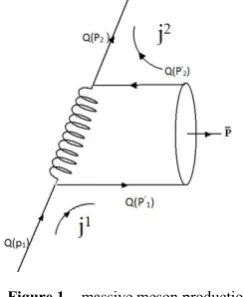
Figure 1. massive meson production
The Feynman diagram for this massive meson production is shown in Fig.1 at leading order (LO). Here we would like to consider the process of a heavy quark fragmentation with respect to a wave function at the origin (WFO). New chances have been brought up to apply non-relativity methods that are successful for bounded states in high-energy physics, which have been considered in the discovery of massive flavor mesons. So, for studying these mesons, evaluation of the Schrödinger equation is very important [6]. For calculate of the WFO, we used a global potential [5] in the following form, as:
8.81715
,
46122
.
0
,
070585
)
(
)
(
=
=
=
+
+
=
c
k
c
r
r
k
r
V
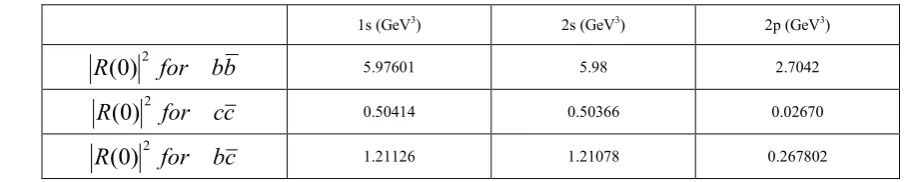
The constants can be determined when we fit method with the experimental data. The wave function at the origin with values calculated using the exact solution of the Schrödinger equation for the potential of the ground state is listed in Table 1.
Table 1. The numerical values of the radial wave function at the origin,R(0)2= Ψ(0)2 4
π
, for 1S, 2S, 2P state of bb,cc,bcsystem with respect to the global potential in reference [5].1s (GeV3) 2s (GeV3) 2p (GeV3)
b
b
for
R
(
0
)
2 5.97601 5.98 2.7042c
c
for
R
(
0
)
2 0.50414 0.50366 0.02670c
b
for
R
(
0
)
2 1.21126 1.21078 0.2678023. Fragmentation function
In the Parton model each particle carry out,
X
i fraction of the momentum-energy of meson with the constraint of1
i i
X
=
∑
.In the infinite four- momentum frame, the output four-momentum of meson is
P
which produces a jet. Then the four- momentum particles have these momentums as:1 1
P ,
2 2P
P
′
µ=
X
P
′
µ=
X
. (1)Therefore we can write for each particle four- momentums in the following form:
1 1 1 2 2 1
2 1
,
(1
)
P
X ZP
P
X ZP
P
Z P
µ µ µ µ
µ µ
′
=
′
=
= −
(2)
Where we used the fragmentation parameter, z, as given by,
Hadron
Quark i
P
P
Z
P
P
=
=
(3)
With the choice of the wave function at origin according to a global potential that is obtained from [14], the fragmentation function for massive quark has the following general form, as:
0 0
( , )
( , )
xn n
n
D z
µ
=
∑
d z
µ
o
(4)
where
d z
n( , )
µ
0 gives the probability for the Parton i to form a jet that includes acc
pair in the state labeled by n, and xn
o
is proportional to the probability for a point likecc
pair in the n- state. According to the current- current interaction and hard amplitude scattering [9], the probabilityo
nx given by the following form:(
)
(
)
(
)
(
)
(
)
2
3 3 3
1 2
3 2
1 2 2 1
1 2
01 02 02 01
01 02 02 01 2 2
1 2
3
2
1 2 2 1
3 3 3
1 2 2 2
01 02 02 01 01 02 02 01
(
)
2
(
)
1
2
xn H
f s
H Q M
x
n f s
o
d Pd P d P T
WFO
p p
p
p
C g m m
T
T
WFO
p
p
p
p
p p p p
o
C g m m WFO
p p
p
p
d Pd P d P
p p p p
p
p
p
p
δ
δ
→′
′
=
′
+
′
+
−
=
=
′
+
′
+
−
′ ′
=
′
+
′
+
−
′
′
×
′ ′
′
+
′
+
−
∫
∫
M
M
Here
T
H is the hard scattering amplitude.Also the unpolarized fragmentation that average over initial quark spin and sum over final state particles has the following form for invariant amplitude:
(6)
Where, is invariant under proper Lorentz transformations and parity operation .Therefore the invariant amplitude in the infinite momentum limit can be written:
(
)(
) (
)(
)
2
1 2 1 2 1 2 1 2
4
8
p p
.
p p
.
p p
.
p p
.
q
′
′
′ ′
=
+
M
(7) The dot products in Eq.6 are given by:
( )
(
)
(
)
(
)
(
)
2 1 2 2
1 2 1 2 T
1
2 2 2
1 2 2 2 1 T
2
2 2
1 2
1 2 2 1
2 1
2 2 2 2 2
1 2 1 T 2 T T
X Z
1-Z
2( . )
m +
m +P
X Z
1-Z
1
2( . )
(m )+X Z m +P
X Z
X
X
2( . )
(m )+
(m )
X
X
1
2( . ) 1-Z m
P +
m +P -2P
1-Z
P P
P P
P P
P P
′
=
′ =
′ ′ =
=
+
Where
X
2= = −
X 1 X
1.Therefore, the fragmentation function for heavy meson with WFO of global potential [5] is obtained from equations (5, 6), as we have:
(
)
(
)
(
)
2 2
0 1 2
3
2
1 2 2 1
3 3 3
1 2 2 2
01 02 02 01 01 02 02 01
( , ) (
)
(
)
1
2
qq qg f s
D z
P
P
C g m m WFO
p
p
p
p
d Pd P d P
p p p p
p
p
p
p
µ
δ
=
+
′
+
′
+
−
′
′
×
′ ′
′
+
′
+
−
∑∫
M
(8) WhereP P
qq,
qgare the functions obtained from [10]. In order to solving integrals in phase space, we can integrate into two integrals elements. Thus we obtain the solution of phase space integrals according to the following equations, as:3 3 3
1 2
d P d Pd P
=
′
′
(
)
(
) (
)
3
0 2 1
3 01
2 4
01 0 02 01 2
p
p
p
p
d P
p p
p
p
p p
δ
+
−
=
+
−
+
∫
(9) 3 2 2 2 1 2 2 2 01( , )
( , )
( ,
)
T T L T
T
f z P d P
f z P dP d P
x M p f z P
=
=
∫
∫
(10)(
)(
)
(
)(
)
(
)(
) (
)(
)
[
]
2 41 1 1 1
2 2 2 2
2
1 2 1 2 1 2 1 2
4 1
1/ 2 ( ) ( ) ( ) ( )
1/ 2 ( ) ( ) ( ) ( )
8 . . . .
Q Q Q spin Q spin
q L L
L U p U p U p U p
L U p V p U p V p
p p p p p p p p q
µν µν
µν µ µ
In the infinite momentum limit, the integration from longitudinal momentum convert to energy integration and also transverse integration convert to average transverse momentum, respectively. This means simply replace
P
T with its average value. Finally, we have(
)
(
)
( )
(
( )
)
2
4 2 2 2 2 3
3 2 2
2 2 2 2 2
1 T 1
2
2 2 2 2
1 1
2
(
)
( ) (
(32 )(
(
)
) ((1
)
) )
1
(1
)
2
1
1
1
m +P (
) m (
)
1
1
qq qg
f s
T
Z P
P
D Z
C g WFO MX
Z X M
X
Z M
Z
X
X
X
XZ
X Z
Z
XZ
XZ
X
X
m
X Z m
P
q
XZ
π
ξ
ξ
+
=
−
−
−
Λ
−
−
−
Λ =
+
+
+
+
+
−
−
+
+
=
=
M
(11) This equation defines the fragmentation function for
J
ψ
meson.4. Result and Discussion
The explicit form of Eq.(11) in our calculations, for
J
ψ
meson at two caseM=m +m
1 2andM=M
exp., is givenby the following form, respectively, as:
(
)
2 2
2 2 2 2 2 4
2 2 2
2 2
2 2
4(1 (1
) ) 4(1
)
( ) 0.9062(
)
3
3(1
)
(3.7968(1
)
4.309
0.9742(1
)
4.309(1
)
0.5433 )
( (1.9485(1
)
2.43567(1
)
0.7371 )
2(1.9485(1
)
0.7371 )
(1.9485 0.4871
) )
1
z
z
K
D Z
z
z
F
K
z
z
z z
z z
z
F
z
z
z z
z
z
z
z
z z
+ −
+
=
+
×
−
=
−
+
−
−
+
−
+
=
−
+
−
+
−
+
×
+
−
−
(12) and
2 2
2 2 2 2 2 4
2 2 2
2 2
2
4(1 (1
) ) 4(1
)
( ) 0.5927(
)
3
3(1
)
(3.7968(1
)
4.0678
0.7917(1
)
4.6338(1
)
0.5327 )
( (1.9485(1
)
2.8568(1
)
0.7299 )
1.8206(1.9485(1
)
0.8895 )
(1.9485 0.5878
1
z
z
K
D Z
z
z
F
K
z
z
z z
z z
z
F
z
z
z z
z
z
z
z
+ −
+
=
+
×
−
=
−
+
−
−
+
−
+
=
−
+
−
+
−
+
×
+
−
−
(
z z
)
) )
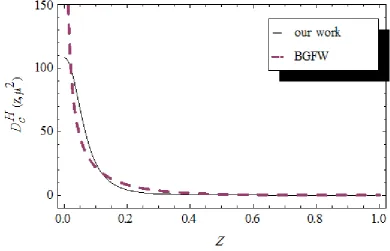
2 (13)Figure 2a. Our Fragmentation function according to z for 0
µ
=
3.5 GeV
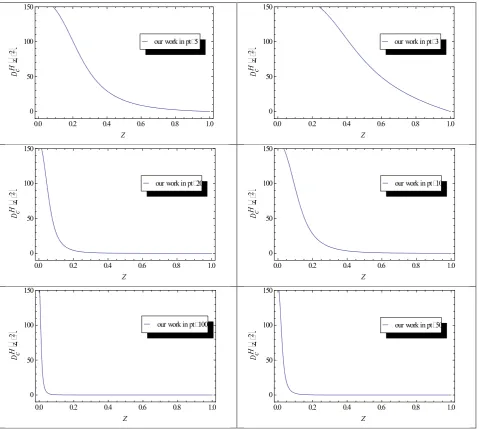
scale compared with BFGW predication model (dash line) [image:5.595.110.501.361.612.2]Figure 3. Fragmentation functions at different pt(GeV) scales
5. Conclusion
In the heavy quark limit we have obtained the exact analytical fragmentation functions for S-wave two heavy mesons at leading order perturbative QCD. The wave function at the origin (WFO) for bound state wave function of mesons has been used. In this model, the C quark mass is considered to be 1.3959 Gev. Fragmentation functions have been calculated for LEP energy. In this determination we used the vertex invariant under parity, Laurence transfer, and hard scattering amplitude for heavy mesons.
REFERENCES
[1] B. Andersson et. al., Phys. Rept. 97 (1983) 31 B, R. Webber Nucl. Phys. B 238 (1984)492
[2] C. Peterson et. al., Phys. Rev. D 27(1983) 105
[3] E.L.Berger and D.Jones, Phys.Rev.D23(1981) 1521 S.D.Ellis, M.Einhorn and C.Quigg, Phys.Rev.Lett.36 (1976) 1263 M.Cacciari and M.Greco, Phys.Rev.Lett.(1994)1586; K.Sridhar, A.D.Martin and W.J.Stirling,
phys.lett.B438(1998)211; A.Petrell, Nucl.phys.Proc.Supp.86(2000)533. FredCooper, et.al.,
arXiv:hep-ph/0402219v2(2004)
[4] C.Albajar, et.al.,phys.lett.B256(1991)112; F.Abe,
et.al.,Phys.Rev.Lett.69(1992)3704 F.Abe, et.al.,Phys.Rev.Lett.71(1993)2537; RaphaelGranierde,
Cassagnac, PHENIXCollaboration,J.Phys.G: Nucl.and Part.Phys.30(2004)S1341;
[5] G. R. Boroun and H. Abdolmalki, Phys. Scr. 80 (2009) 065003.
0.0 0.2 0.4 0.6 0.8 1.0 0
50 100 150
Z
Dc
H
z,
2
our work in pt30.0 0.2 0.4 0.6 0.8 1.0 0
50 100 150
Z
Dc
H
z,
2
our work in pt50.0 0.2 0.4 0.6 0.8 1.0 0
50 100 150
Z
Dc
H
z,
2
our work in pt100.0 0.2 0.4 0.6 0.8 1.0 0
50 100 150
Z
Dc
H
z,
2
our work in pt200.0 0.2 0.4 0.6 0.8 1.0 0
50 100 150
Z
Dc
H
z,
2
our work in pt500.0 0.2 0.4 0.6 0.8 1.0 0
50 100 150
Z
Dc
H
z,
2
[6] C.Quigg and J.L.Rosner, Phys. Rep. 56,(1979) 167. [7] Braaten E and Cheung K 1995 Phys. Rev. D 51 4819 [8] E.Eichten and C.Quigg, Phys. Rev. D 49, (1994) 5845.
[9] M.A. GomshiNobary and B. Javadi,
Eur.Phys.J.C42,(2005)37.