INSTITUTION
Hasyamuddin Bin Othman1, Abdullah Bin Sulaiman2, Nor Ratna Binti Masrom3, Yahya Bin Buntat (PhD)4 1Faculty of Technical Education, Universiti Tun Hussein Onn [email protected], 2Faculty of Art, Science, and Heritage, Universiti Tun Hussein Onn Malaysia [email protected], 3Faculty of Technology
Management And Technopreneurship, Universiti Teknikal Malaysia Melaka, [email protected], 4Faculty of Education, Universiti Teknologi Malaysia [email protected]
Abstract
Education is one of the vital fields that contributes to the development of a nation. Therefore, countless efforts have been made by the Malaysian Ministry of Education and Ministry of Higher Education in order to enhance and improve education system in Malaysia. Although the traditional approach which focuses on learning through lectures is capable to transmit the content of certain knowledge, it has been criticized for producing students who are passive. It has also been known to ignore the students’ different needs according to their capabilities.Living their lives on campus, it is very important for students to interact with their lecturers and fellow students (Thomas, S.L., 2000). There has been evidence which proves a mismatch of skills that are required by employers and their capability to employ the graduates who possess those skills (Hesketh (1999). A survey that was done on a group of executives cynically said that the education industry itself is imparting the wrong knowledge, in which most who have been employed had to undergo various training all over again (Badaway M.K., 1995). To clarify this matter, a study is conducted to find alternative learning approaches so that graduates who will be produced by universities will be able to fulfill the industry’s requirements especially on the aspect of employability skills. Study will be done on Manufacturing Engineering students using methods of data collection by way of mixed methods. Qualitative data was collected through trigulation with analyzing report documents in order to identify employability skills and its indicators that can fulfill the requirements of industries in Malaysia. Reports on the employability skills that were made as the base for this study were from SCAN, Conference Board of Canada, ACCER and Ministry of Higher Education Soft Skills Module. The study will also be using Problem Based Learning (PBL) model in order to infuse employability skills that will be measured through quasi-experiment as a primer quantitative data. Early studies and today’s global demand clearly prooves that PBL model has a vast opportunity to succeed as an alternative learning approach in order to strengthen and enhance employability skills among Manufacturing Engineering students in public univeristies throughout Malaysia.
2
1. INTRODUCTION
Education is undeniably one of the most important factors that contributes to the development of any country. In Malaysia, every effort is being taken by the Ministry of Education (MOE) and the Ministry of Higher Education (MOHE) to improve and raise the education system towards producing competent man power for the country (Ibrahim Ahmad et al, 2005).
In many conventional education system especially at school level, teachers give as much guidance as possibly could while the learners merely play the role of passive recipients. With limited face-to-face classroom hours and what more the exam-oriented education system not much time is allocated for active learner interaction among themselves and the teacher.
Even though the conventional approach of merely listening to lectures can deliver but this approach has been criticised for producing students who are passive and does not take into account the different needs and abilities of the students (Mok Soon Sang, 1997). In general, conventional learning merely requires students to go through rote learning where interaction, a most crucial element for effective learning, is absent.
According to Hesketh (1999), there is clear evidence showing “mismatch” of skills required by the employer and the ability of the graduates. According to Badaway (1995):
”Industry told us that we were teaching all the wrong things. They explained that academe is industry’s only supplier with quality so bad that 100% of the incoming goods require rework – that is, more training”
At university, it is important that students interact more often among themselves, with the lecturers and learning materials. Thomas (2000) stressed the importance of students interacting frequently because study life at university or college is very demanding and requires high level interaction among the campus citizens and learning materials.
Therefore, it is only approapriate that a better learning approach that provides more interaction and learning opportunity be adopted towards producing graduates with higher employability skills needed by the industry.
2. BACKGROUND OF PROBLEMS
The economic scenario of Malaysia which was previously conventional has now changed to K-economy. Malaysia is now known as a New Industrialized Country (NIC) meaning we need fully and semi-skilled workforce who possess the necessary features of a k-worker as required by the industry.
In relation to that, Yerion (1995) said that collaborative learning (CL) combined with Problem-based Learning (PBL) should be apllied in the classroom as the it helps to encourage active learning among the students. Both PBL and CL are student-oriented learning approaches and have been proven successful in engaging students to focus and learn more deeply on related subject matters.
According to Parnell (1995), learning should be meaningful and purposeful because both are important elements for students to be fully engaged in their learning process. Yazici (2005) was of the view that to force oneself to work harder in a group is crucial towards effective management of the working environment which is getting more sophisticated and challenging and PBL can deliver this.
University curriculum should not only emphasize on technical knowledge but communication and collaborative skills should be infused among the undergraduates. Students who work well in groups can handle, solve problems and apply better communication strategy related to their study or work better. They also need to be given ample opportunity for sharing of ideas towards forming alternative solutions in problem solving. According to Lippert et al, (1997), the sharing of knowledge helps to form better learning environment that would be otherwise difficult.
PBL is thus a learning approach that uses current issues. Other than being able to increase student’s learning skills this approach also helps to expose students to real world problems that they would encounter at the workplace upon graduation later.
Ward and Lee (2004) said that PBL has been proven to have the ability to deliver learning content effectively. This view is supported by Stepien, et al., (1993) who felt that that PBL is an effective skills training method in problem soling at the work place. According to Steinemann (2003).
In general, scholars are of the view that PBL is a group learning strategy whereby the students interact among gthemselves and help each other in the learning process. Using PBL, the different levels of learning abilities among the students (higher and low) can actually benefit both parties. The weaker students can get help from the better ones and at the same time the better ones can better consolidate their mastery of knowledge and skills. No matter what, both parties can also benefit in terms of development of generic skills like teamwork, leadership, communication skills, respect and deep understanding.
3. PROBLEM STATEMENT
PBL can help build the needed important realationship between theory, application, education as well as professional practice expected of completing graduates, expecially enhancement of employability skills.
4. OBJECTIVES OF STUDY
To identify the effectiveness of using PBL in teaching and learning
4
ii. To identify the realationship between PBL and employability skills
iii. To develop a model for the infusion of employability skills based on PBL for use at public institutions of higher learning in Malaysia
5. IMPORTANCE OF THE STUDY
PBL is seen as an effective alternative to the current teaching and learning strategies used in the learning classrooms. The outcome of this study should be beneficial to all especially the students, lecturers, university and stakeholders.
6. THEORETICAL FRAMEWORK
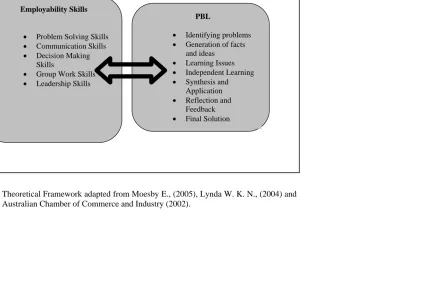
Employability Skills in focus consist of problem solving, communication, decision making, group work and leadership skills.
PBL
• Identifying problems • Generation of facts
and ideas • Learning Issues • Independent Learning • Synthesis and
Application • Reflection and
Feedback • Final Solution Employability Skills
• Problem Solving Skills • Communication Skills
• Decision Making
Skills
• Group Work Skills
• Leadership Skills
Figure 6.1: Theoretical Framework adapted from Moesby E., (2005), Lynda W. K. N., (2004) and
[image:5.595.170.671.93.380.2]Manufacturing Industry
Problem-Based
Learning
Employability
Skills
Model
Facilitators of Public Universities Manufacturing
Students
[image:6.595.68.772.68.442.2]7. RESEARCH METHOD
This study shall combine the use of qualitative and quantitative approaches.. This study shall also sought the views of several lecturers on a suitable design of PBL manual for employability skills by means of interview. The mixed and combination of views from the industry and public sectors should conotribute towards the development of a more accurate and comprehensive PBL manual for enhancing employabililty skills.
Qualitative approach using document analysis method to explore document by The Canada Conference Board (CCB), The Secretary's Commission on Achieving Necessary Skills (SCAN), The Australian Council for Educational Research (ACER), The Soft Skills Module by Ministry of Higher Education and several report by government.
As for sampling of quantitative approach, the samples of this study shall be collected from manufacturing undergraduates from Universiti Teknikal Malaysia Melaka (UTEM). This is using quasi-experimental approach.
8. CONCLUSION
It could be summarized that unlike the converntional learning approach of merely lectures that has many restrictions for effective learning using PBL has helped the students to become more independent and acgive in their learnign process. They also had that much opportunity to develop their employability skills like communication, leadership and problem solving. Finally, using PBL has not only helped the students but helped the lectures better to provide a more systematic student-focused learning environment towards producing better employable graduates. From result, shown that PBL can improve student employability skills more that coventional method.
REFERENCES
Australian Chamber of Commerce and Industry and Business Council of Australia (2002). “Employability skill for the future.” Canberra: Department Of education, Science and Training,.
Azhar Abd halim (2000). “Globalization and Its Impact On Technical And Vocational Education in Malaysian.” Journal Technology And Vocational Education: Globalization and Future trends. 256-259.
Badawy M. K. (995). “Developing Managerial Skills in Engineers and Scientists: Succeeding As aTechnical Manager.” Published Van Nostrand Reinhold. Barrows H (1983). “Problem-based, self-directed learning.” Journal of the American
Medical Association (JAMA), Vol.250
2
Beaumont C., Dr Sackville A. dan Chew Swee Cheng (2003). “Identifying Good Practice In The Use Of PBL To Teach Computing.” Polytechnic, Singapore. Beaumont C. dan Frank B. (2003). “Enhancing Employability through Problem-
Based Learning.” Delivering Employability Conference. UCLAN
Beaumont C., Sackville A., Cheng C. (2004) “Identifying Good Practice in the Use of PBL to teach Computing.” ITALICS e-journal, Vol.3 Issue.2.
Hesketh, A.C. (1999), “Towards a new economic sociology of the student financial experience of higher education.” Journal of Education Policy.
Ibrahim B. Ahmad, Baharuddin B. Aris dan Jamalludin B. Harun (2005). “
Prosiding Seminar Pendidikan JPPG 2005: Pembelajaran Mata Pelajaran ICT menggunakan ICT menerusi pendekatan PBM. 1(1). 271-276.
Imran Idris (2005). “Negara perlukan lebih 40,000 tenaga professional.” Dicapai
dari: http://www.Laman Web Adun Negeri Johor.htm. pada 05 Mac 2007)
Kementerian Pengajian Tinggi (2006). Capaian maklumat September 16, 2007 dari
http://www.mohe.gov.my
Knight, P.T. (2002). “Small-Scale Research: Pragmatic Inquiry in Social Science and the Caring Professions.” London : Saga Publications.
Lippert K. S. dan Granger J. M. (1997). “Peer learning in an introductory programming course.” International Academy for Information management.
Lynda, W.K.N. (2004). “Jump Start Authentic PBL.” Singapore: Prentice Hall. 22-131.
Mok, Soon Sang(1997). “Pedadogi 2 :Pelaksanaan Pengajaran.” Kuala Lumpur : Kumpulan Budiman SDN BHD.
Omardin Ashaari (1998). “Peranan, Tugas dan Tanggungjawab Guru Di Sekolah.” Utusan Publications dan Distributors Sdn.Bhd.
Parnell, D. (1995). “Why do I have to learn this?” Waco: Center for Occupational Research and Development.
Steinemann, A. (2003). “Implementation Sustainable Development Through Problem-Based Learning: Pedagogy and practices.” Journal of professional issues in Engineering education and practices.
Thomas, L., Ratcliffe, M., Woodbury, J. dan Jarman, E. (2002). “Learning Style and Performance in the Introductory programming Sequence.” University of Wales. Thomas, S.L. (2000). “A social Network Approach To Understanding Students
Integration Persistance.” The Journal of Higher Education. 71(5). 46-52. Ward, J.D dan Lee, L.L. (2004). “Teaching Strategies for FCS : Student
Achievement in problem-Based Learning Versus Lecture-Based Instruction.” Journal of Family and Consumer Sciences.” 96(1). 23-32
Wiersma, W. (1995). “Research Methods in Education: 6th Edition. New York : Allyn and Bacon.
Wiersma, W (2000). “Research Methods in Education: An Introduction.” Boston: Allyn and Bacon.
Yazici, J. H. (2005). “A study of collaborative learning style and team learning performance.” Emerald Group Publishing Limited.
Woods, D. R. (1996). Problem-based Learning: helping your students gain the most from PBL.” Dicapai dari www.chemeng.mcmaster.ca/pbl/pbl.htm pada 23 Januari 2007.