Contents
Foreword
3
Introduction
5
Mission
6
Objectives and Update
8
01 —
Trinity’s Strategy for the Future
11
02 —
Education
21
03 —
Knowledge Generation and Transfer
35
04 —
Student Experience
47
05 —
Engagement with Society
53
06 —
Enabling the Strategy
61
Conclusion and Look to the Future
73
Back row, left to right:
Ms Darina Kneafsey Chief Operating Officer Prof Vinny Cahill Dean of Research
Dr Gerard Lacey Bursar and Director of Strategic Innovation Mr John Coman Secretary to the College
Mr Tony McMahon Director of Human Resources
Prof James Wickham Dean of Arts, Humanities and Social Sciences Mr Ian Mathews Chief Financial Officer
Front row, left to right:
Prof Linda Hogan Vice-Provost/Chief Academic Officer Dr Patrick Prendergast Provost and President
Prof Jane Ohlmeyer Vice-President for Global Relations Prof Clive Williams Dean of Engineering, Maths and Science Prof Mary McCarron Dean of Health Sciences
3 — Foreword
Foreword
This mid-term review of the strategic plan shows that many of the
objectives set in 2009 are being achieved, while some others are proving
challenging given the changed economic climate since the plan was
ap-proved. Despite the severe financial situation in the country, the mid-term
review takes an optimistic tone. If you read this document I am sure you
will be impressed with what Trinity is achieving. We have a vision for
Trinity College Dublin as a university of global consequence, contributing
effectively to how Ireland makes its mark in the world.
To achieve this vision, Trinity must continue to excel in its core mission of delivering high quality research-based education. From now to the end of the strategic plan, this requires that we both increase income and eliminate unnecessary costs by implementing the following four programmes: the eStrategy projects to enable new ways of working using IT; the Global Relations Strategy; the Communications Strategy; and the START Programme for Renewal of Administrative and Support Services.
The purposes of a Trinity education are two-fold: to give our students the opportunity for a rewarding career and to give them the skills to participate as active citizens in whatever country they will live.
In this regard we are ever cognisant of the value of institutional autonomy and academic freedom in creating the educational environment that makes this possible, but we also recognise how this must be balanced with accountability for the stewardship of our resources and reputation. I thank all my colleagues who have performed this mid- term review and set the course to achieve this strategy by end 2014. In particular I wish to thank the Vice-Provost/Chief Academic Officer Professor Linda Hogan for championing this mid-term review together with the staff in her office.
5 — Introduction
Introduction
This Mid-Term Review of the College’s Strategic Plan 2009-14 takes
place against the backdrop of a vastly changed external environment
than that which pertained when the plan was originally conceived.
The uncertainty surrounding the national economy, the decrease in state
funding and the constraints of the Employment Control Framework (ECF)
have required both strategic and pragmatic responses so as to safeguard
the College’s core mission of delivering high-quality,
internationally-competitive education and research. These responses, detailed throughout
this Mid-Term Review, combine a programme of income generation,
strategic investment and cost-reduction.
Such responses have been developed while higher education provision in Ireland contin-ues to be reviewed and reformed under the umbrella of the National Strategy for Higher Education to 2030. In this context the College has made several submissions to high-level consultation documents issued by the HEA, including on the future landscape of higher education 1 and on a new funding model for
higher education institutions. The College is awaiting a response to its submissions. In addition, the national provision of third-level education in key areas including initial teach-er education, nursing and midwifteach-ery, and the creative arts is also under review, the implica-tions of which will only become clear over the next number of years.
Notwithstanding the challenges arising from financial instability and sectoral review, Trin-ity is determined to strengthen its reputation as a university of global consequence. Indeed, as the Mid-Term Review confirms, Trinity has continued to excel in education and research, and in providing students with a dynamic learning environment. Moreover under the direction of Provost Prendergast major new strategies have been implemented to enable Trinity to overcome the challenges posed by the environment.
6 — Mission
Mission
As we reach the mid-point of the Strategic Plan 2009-14, it is important
to reiterate our Values, Mission and Vision as stated in 2009. The external
changes since these were articulated only serve to reinforce the
signifi-cance of their original intent.
It is important to recall that at Trinity we value:
— the university as an interactive, multidisci-plinary community with a passion for ideas and a love of learning,
— opportunities to achieve excellence in a challenging, yet nurturing environment, — the inclusivity of our community, which offers equality of access and opportunity to all, seeking out and recognizing talent wherever it exists,
— international recognition for our research and the building of academic strengths through teamwork and collegiality, — the interdependence of teaching and
re-search, and the diversity of our research and teaching methods,
— creativity and innovation, including the development of an entrepreneurial spirit among staff and students, to deliver the widest benefit to society,
— national and international collaborations forged by students, staff, alumni and friends,
— the engagement of staff and students in public discourse,
— our role as a creative hub for Ireland in the heart of Dublin city,
— our use of the most effective instruments to apply our values, including:
• autonomy in the management of
resources, matched by clear and transparent accountability to society, and • academic freedom to pursue all avenues of enquiry and to disseminate the results of research and scholarship.
Through the implementation of new strate-gies, we are moving towards realising Trinity’s vision, as originally articulated, to further strengthen its reputation as a university of global consequence. We are also proud to re-state our Mission to which we are determined to remain true, namely that:
‘Through our research and teaching, we engage students and society in the quest for knowledge, seeking to achieve excellence in all we do, and responding with creativity and imagination to the challenges and opportunities of a shared future.’
8 — Strategic Plan 2009-14: Objectives & Update
Strategic Plan 2009-14:
Objectives & Update
1. Promote education, research, and in-novation as mutually reinforcing parts of an integrated community of scholars
— Advanced under new Provostship through a focus on research-led curricu-lum and new innovation strategy2.
— Progressed through TCD-UCD Innovation Alliance.
— Ongoing through Creative Arts, Technologies and Culture Initiative.
2. Increase student numbers by 15% to 18,000 in strategic areas, while main-taining the student:staff ratio through a specially funded new blood scheme
— On target to meet 15% increase in student numbers by 2014/15.
— Staff:Student ratio of 17:1 in 2010/11.
— 40 new-blood posts created through Ussher initiative since 2009.
3. Reinvigorate undergraduate education through the newly launched undergra-duate curriculum encompassing core and elective parts, maximising engagement of senior academic staff in research-led teaching, broadening access to 22% of admissions, achieving a 90% comple-tion rate, and introducing a College-wide on-line teaching evaluation system
— Major new college-wide initiatives underway in the areas of admissions, curriculum renewal, modularisation and harmonisation of regulations.
— On track to meet broadening access and completion targets.
— New focus on the 3-stage student journey of transition / orientation, reten-tion and preparareten-tion for employment.
4. Transform graduate education to facili-tate more creative, innovative and en-trepreneurial postgraduates, and launch the TCD-UCD Innovation Academy
— Graduate education strategy incorpo-rating innovation and entrepreneur-ship being rolled out across College.
— TCD-UCD Innovation Academy established with joint Graduate Certificate in Innovation and Entrepreneurship available to PhD students.
5. Continue the consolidation and growth of Trinity’s identified strengths in research and scholarship, and differentiate the major programmes of scale and their convergence towards the delivery of a sustainable society
— Established and emerging research themes being underpinned by enhanced research infrastructure, led by Dean of Research.
6. Introduce special initiatives to enhance the overall student experience, and particularly the experience of international students and students from non-traditional backgrounds
— New initiatives in train led by Dean of Students and Vice-President for Global Relations.
— Academic Registry opening May 2013.
7. Implement an Open Innovation approach to intellectual property to stimulate knowledge transfer and enterprise de-velopment, increase the rate of new campus company formation, and engage more effectively with enterprise
— Open Innovation Policy implemented 2009 /10.
— Full review of IP policy underway in light of new IP framework for universities.
8. Develop flagship collaborations across education, research and innovation to achieve international scale and impact:
9 — Strategic Plan 2009-14: Objectives & Update
Obstacles:
Decrease in state funding, risking reduced invest-ment in educational provision, student services and capital projects.
Government-imposed restrictions on recruitment and promotions through Employment Control Framework.
Uncertainty regarding the outcome of HEA-led reviews under the Government’s National Strategy for Higher Education to 2030.
Reduction in national research funding sources.
Trinity’s Reponses:
New strategies developed to safeguard and enhance our position as Ireland’s university on the world stage (e.g. Rankings, Global Relations, Communications).
Measures in place to increase College-generated income to the university through internation-alisation, commerciinternation-alisation, philanthropy and research funding diversification.
Increased efficiency and cost reductions will result from implementation of eStrategy and START.
Initiatives in train for renewal and innovation in education.
Theological Institute; Economic and Social Research Institute; Carlow College.
— The Lir — National Academy of Dramatic Art serves as cultural hub in the city.
— Establishment of Trinity Health Ireland July 2011.
— TCD-UCD Innovation Alliance launched in November 2010 and expanded to incorporate Queen’s University Belfast (QUB) in 2012.
9. Deliver major capital development pro-grammes to underpin objectives for interna-tionally competitive research and education:
— Major capital projects facilitating multi-disciplinary research have been completed with the Trinity Long Room Hub, 2010 and the Trinity Biomedical Sciences Institute, 2011.
— New strategy underpinning the deliv-ery of E3 — The Engineering, Energy and Environment Institute’ developed by Schools of Engineering and Natural Sciences.
— New Business School under develop-ment, underpinned by an Innovation and Entrepreneurship strategy.
— Student Centre will not go ahead as envisaged in Strategic Plan 2009-14 because funding model rejected by student plebiscite. However, Academic Registry to open in May 2013.
— Central Services Building to be developed.
10. Streamline the College’s management processes through the implementa-tion of new informaimplementa-tion systems
— eStrategy Programme commits €23m of invest-ment in Student Administration, Finance, HR Systems and Enterprise Architecture between 2011-2014. Implementation underway in GeneSIS, (student administration), CoreHR budgeting tool and Financial Information System (FIS).
11 — Trinity’s Strategy for the Future
Trinity’s Strategy for
the Future
Trinity College Dublin is recognized internationally as Ireland’s premier
university. It is a multidisciplinary academic community where a passion
for learning and discovery drives the academic mission, and where
excel-lence is recognized and rewarded.
STRATEGIC PLAN 2009-14: TRINITY’S STRATEGY FOR THE FUTURE
Trinity’s ambition is to be recognised every-where as a university of global consequence. Trinity continues to hold a distinctive posi-tion among Irish universities, and has an already established record as a university with an international reputation for excel-lence in teaching, research and innovation. We are recognised internationally as Ireland’s leading university in all relevant rankings. Trinity has top 50 rankings in four subjects and top 100 rankings in a further 14 areas in the recently published QS Subject Rankings 2012 3. In the area of teaching and learning,
Trinity’s distinctiveness is shown through its research-led curriculum, through which it educates Ireland’s brightest minds to be socially-engaged citizens, being receptive to new ideas and applying knowledge to new contexts. Trinity’s distinctiveness in research and innovation is also a key driver of its high international standing. Excellence in research and innovation is underwritten by the quality of its staff, its infrastructural resources, and
its interdisciplinary environment. It is intend-ed that the new Global Relations Strategy will also enhance Trinity’s distinctive interna-tional outlook, by recruiting high-calibre international students from around the world, establishing bilateral relationships with the highest-ranked universities, and engaging more effectively with the Trinity alumni dias-pora. The distinctiveness of our regional focus is established by our engagements throughout the island, while also being embedded in the heart of Ireland’s capital as the University of Dublin, serving the local community through access initiatives and the city through civic engagement. Our strategy is to maintain and enhance this position and to use it for the ben-efit of our students and the country as a whole. We will do so by building on our strengths and by overcoming the obstacles presented by the current environment.
3 http://www.topuniversities.com/university-rankings/world-university-rankings/2012/subject-rankings
12 — Trinity’s Strategy for the Future
The financial and operational constraints placed on the Irish university sector during the difficult budgets of recent years have the potential to stultify the achievement of our goals. For instance, exchequer funding for the universities has decreased since 2007, notwithstanding the very significant increase in student numbers. The decline in funding, combined with the constraints imposed by the Employment Control Framework, has added to the workloads of staff, and has begun to impact on our staff:student ratio and on our ability to recruit and retain high-quality aca-demic staff. If unaddressed, these constraints will pose a threat to the quality of the educa-tional provision and to the student experience, which in turn will impact on our reputation, reflected in the university rankings.
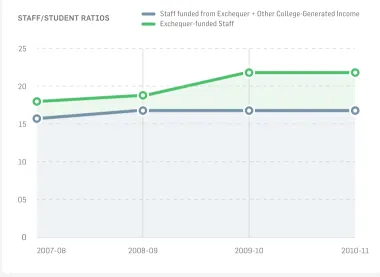
Trinity’s staff:student ratio has risen from 16:1 in 2007 / 08 to 17:1 in 2010 / 11. However if only state-funded staff were taken into account,
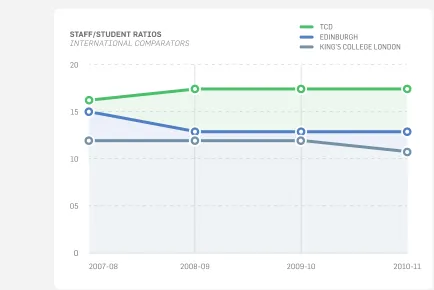
the staff:student ratio would show a marked increase, from 18:1 in 2007 / 08 to 22:1 in 2010 / 11, reflecting the decline in the level of state funding [SEE FIGURE 1]. However, Trinity has mitigated the effect of this decline significant-ly by the application of new streams of non-exchequer income to employ additional aca-demic staff, for example the forty new Ussher Lecturers and new philanthropically-funded Professors. Even with this additional income, Trinity’s institutional staff:student ratio of 17:1 in 2010 / 11 (which is based on staff funded from the exchequer plus other College-gener-ated income) is already high when compared to its international peers [SEE FIGURE 2].
A central focus of our strategy therefore has been to ensure that we are funded at the level required for international competitiveness by generating new streams of income. Such additional income will allow Trinity to protect its core mission of education and research and
2007-08
STAFF/STUDENT RATIOS
Exchequer-funded Staff
0 05 10 15 20 25
2008-09 2009-10 2010-11
[image:13.539.102.482.442.719.2]Staff funded from Exchequer + Other College-Generated Income
13 — Trinity’s Strategy for the Future 2007-08 0
05 10 15 20
2008-09 2009-10 2010-11
0 10 20 30 40 50 60 70 80 90 100
COLLEGE-GENERATED STATE FUNDING
STATE VS OTHER COLLEGE-GENERATED INCOME
2007 2008 2009 2010 2011
35% 38% 36% 43% 43%
[image:14.539.50.484.91.381.2]65% 62% 64% 57% 57%
[image:14.539.105.485.428.713.2]FIGURE 2 — STAFF:STUDENT RATIOS: INTERNATIONAL COMPARATORS
14 — Trinity’s Strategy for the Future
will supplement the declining funding the Col-lege receives for government-funded students. Progress has already been made in increasing the level of income derived from non-exche-quer sources (from 35% of total income in 2007 to 43% in 2011) [SEE FIGURE 3].
This growth has counteracted the impact of the decrease in exchequer funding (from 65% in 2007 to 57% in 2011). However, a step-change in the proportion of our recur-rent funding that comes from non-exchequer sources is still to be obtained. This will be achieved through the implementation of a number of ambitious strategies related to internationalisation, philanthropy and com-mercialisation.
The internationalisation agenda is being pursued through the implementation of the Global Relations Strategy, adopted by Board in December 2011 4. In 2012 the College invested
€3m in the Global Relations Strategy and it will deliver €11m in additional income over 4 years. The educational and reputational benefits of the Global Relations Strategy are tangible, and provide a major impetus for its implementation. As important however will be its key role in enabling Trinity to achieve a measure of financial and political autonomy through the generation of income. This income will be re-invested in Schools and student services.
Philanthropic funding has also acquired an increased significance in supporting our teaching and research and in developing our infrastructure. The Trinity Foundation is the primary vehicle for this. It has undergone a re-organisation and expansion, supported by an investment in order to support the achieve-ment of the target of €87m in gifts to support College priorities for the 5-year period ending September 2014.
The development of a commercialisation strat-egy will be finalised in early 2013. A Director of Commercialisation will be recruited to suc-cessfully implement the strategy.
The diversification of sources from which Col-lege receives research funding is also a prior-ity, particularly given its reliance on national research funding which increased significant-ly in 2002. The strategy to diversify focuses on maximising the College’s capacity to attract research funding from three main non-exche-quer sources: the European Commission’s (EC’s) Framework Programme (FP7 / Horizon 2020), from US research and other foundations and funding from industry.
While such strategies are invaluable in enabling the College to achieve its core mis-sion, it is also imperative that the funding model used by the HEA to allocate resources for government-funded students be substan-tially reformed. This model is currently under review by the HEA and the College is cur-rently formulating its response. The response highlights the serious and growing divergence between the escalating enrolments, the rising per-student costs and the steady decline in government funding through recurrent grants and capital investment. The College’s response will argue that the current model must be significantly reformed, and not simply revised since it currently does not address the issue of financial sustainability. The College will also need Government to allow a more dynam-ic human resource poldynam-icy if it is to be success-ful in implementing its strategy. Currently the restrictive principles applied across the public sector are applied to all universities, notwithstanding the fact that 43% of Trinity’s funding comes from private and non-exche-quer sources.
The Provost will continue to argue the case for a strong university sector based on bench-marked academic excellence, financial sustainability and public accountability. The value of higher education will continue to be highlighted, not just in economic terms but in terms of its value as a public good.
15 — Trinity’s Strategy for the Future
It will be essential to establish in the public mind that universities like Trinity are vital for the wellbeing of society, not only through their contribution to an innovative and dynamic economy but also in the role they play in the promotion of democratic values through educating graduates to be reflective and responsible citizens. The newly devel-oped Communications Strategy will be a key enabler of this.
Trinity’s mission is to provide high-quality education and research and to maintain and develop further strength in research across all disciplines to underpin research–led teaching. Therefore attracting and retaining high-qual-ity staff remains a priorhigh-qual-ity. In this context the College continues to work to identify funding sources particularly to support the recruit-ment of Professors. In the current economic climate however, retaining high performing academics has also become critical. In light of the restrictions imposed on the promo-tions process by the ECF and due to finan-cial constraints, alternative mechanisms for recognising and rewarding the contribution of academic staff will be developed in 2012 / 13.
The quality of the education and the attrac-tiveness of our students to employers depend on Trinity maintaining existing standards in the face of a declining grant and a growing student population. In addition to funding issues, it is recognised that serious consider-ation will need to be given to the nature of the profile of the student body. This has emerged as a new issue in this Mid-Term Review and will be a focus of our strategy for the remain-der of this Plan. In the context of the Mid-Term Review it is also noted that new policies are being developed which aim to further improve retention rates and enhance the student expe-rience. In particular there is a renewed focus on admissions policy and on the transition from second to third level.
The Mid-Term Review has highlighted that many of the actions of the Strategic Plan 2009-14 form part of the College’s ongoing strategic
activities and the great progress achieved is largely due to the loyalty and commitment of Trinity’s staff and students, as individuals and working in collaboration with colleagues. Despite Ireland’s current difficulties, Trin-ity has continued to provide education and research that matches our international com-petitors. The success in so doing derives from the ability and dedication of our academic staff, with the support provided by our admin-istration and support services.
We are confident that we are successfully implementing our current strategy and that significant progress has been made in meet-ing the specific objectives and actions set out in the Strategic Plan 2009-14. Moreover as a result of a number of critical interventions during this period, Trinity will be in a stronger position to pursue its vision into the second half of this decade and beyond.
Overarching Goals of the Strategic Plan 2009-14
The three overarching goals of the Strategic Plan 2009-14, namely, to build the Innovation Alliance, to establish Trinity Health Ireland, and to promote Dublin as an international city of learning, culture and innovation continue to form an important part of our strategy and an update is provided below. These specific goals are themselves expressions of Trinity’s commitment to developing and enhancing its international and regional collaborations, thereby optimising its contribution to research and teaching. Trinity has had long-standing and highly-valued collaborations with edu-cational institutions with a complementary mission and ethos. We have, for example, joint degrees with the Dublin Institute of Technol-ogy (DIT), the Royal Irish Academy of Music (RIAM) and UCD. Using the impetus of the HEA’s consultation on the future of the higher education landscape 5 we have engaged in a
consultation process with our associated col-leges, with a view to deepening and extending the relationships, where appropriate.
16 — Trinity’s Strategy for the Future
In this context a new relationship with the Royal Irish Academy of Music has emerged, which has resulted in a decision in November 2012 that it become an Associated College of Trinity College Dublin. We also remain com-mitted to the TCD / UCD Innovation Alliance which is the highest profile example of col-laboration in the sector.
We will continue to bring value to Dublin city and its reputation as a centre for educational excellence. As part of that commitment we will now combine our resources with DIT to create a Global City Innovation Initiative which aims to create a flexible environment in which students, researchers and other stake-holders (including the City of Dublin) come together to respond to the pressing global issues of our time by experiment, design and the discovery of new solutions, products, ser-vices and interventions.
Build the Innovation Alliance
Through the Innovation Alliance launched in 2009, Trinity and UCD formed a partnership with the goal of producing a new kind of PhD graduate, one who is expert in a particular discipline but who is also more innovative, entrepreneurial and business-aware than ever before. The centre-piece of the TCD-UCD Inno-vation Alliance is the InnoInno-vation Academy which builds on the respective strengths of the universities to create a robust and mutu-ally beneficial continuum between teach-ing, research and innovation. Through the Innovation Academy, flagship joint structured PhD programmes have been developed. These programmes have established innovation and entrepreneurship alongside excellence in research and education as an integral ele-ment of the PhD. The Innovation Academy was expanded to incorporate Queen’s University Belfast (QUB) in 2012.
Under the auspices of the Alliance, the two institutions collaborated for Cycle 5 of the HEA’s Programme for Research in Third Level Institutions (PRTLI) which cemented signifi-cant graduate education platforms between
both. It is now timely to extend and enhance cooperation across the institutions and a process has been initiated to evaluate oppor-tunities for collaboration in education. A top-down / bottom-up process has commenced with the goal of strengthening collaboration in teaching and learning between the tions. Furthermore, as part of the two institu-tions’ response to the Government’s national strategy, Trinity and UCD have jointly initiated a process to evaluate opportunities for col-laboration in de-duplication and the sharing of resources.
Establish Trinity Health Ireland
The original goal of creating a Trinity Aca-demic Medical Centre with affiliated teaching hospitals has been achieved through Trinity Health Ireland. In July 2011, a collaborative agreement in relation to the establishment of Trinity Health Ireland (THI) was signed by the three participating institutions: Tallaght Hospital, St. James’s Hospital and Trinity Col-lege Dublin. This allows for the incorporation of operational activities between the School of Medicine at Trinity and its major teaching hospitals, in a manner designed to maxi-mise the capacity for delivering high-quality clinical care, providing excellence in medical education and training and delivering high-quality biomedical research and contributing to the economic and social development in an integrated way. In 2011 / 12, the THI Commit-tee, under the chairmanship of Professor Sir Gordon Duff, worked on developing priorities and identifying areas to maximise opportuni-ties from a clinical, educational and research, and operational perspective to provide econo-mies of scale, but also to develop a focus of real strength within medicine in Ireland.
Dublin as an International City of Learning, Culture and Innovation
17 — Trinity’s Strategy for the Future
been involved in the development of a new era of partnerships, underpinned by its Cre-ative Arts, Technologies and Culture (CATC) Initiative, incorporating education, research, creative practice and entrepreneurship. It now plans to draw on existing links with RIAM and DIT to enter into new strategic partnerships. By harnessing specialisms and complemen-tarities in the performing arts with RIAM and in the digital arts and creative technologies with DIT, Trinity seeks to consolidate Dublin’s position as a centre of excellence for research-led education and creative arts practice in the performing arts and creative technologies.
The promotion of Dublin as a city of learn-ing, culture and innovation is also achieved through the Science Gallery. An award-win-ning college initiative, funded through both public monies and philanthropy, the Science Gallery engages the public with critical issues in science through interactive exhibitions, events, discussion and debates. This initiative has had a positive impact on the public per-ception of science and scientific research and has contributed significantly to Trinity’s and Ireland’s science outreach programme, includ-ing Dublin City of Science 2012. It serves as a gateway between the university and the local community, opening up the campus to the city and country. Under the auspices of Science Gallery International, the Science Gallery’s successful format is being replicated in other cities such as London, Moscow, New York, Bangalore and Singapore.
Key Facts and Figures
Total income 2011: €309m
Decrease in State income from 2007 to 2011:
€193m (65% of total) to €176m (57% of total)
Increase in College-generated income (excluding State income) from 2007 to 2011: €106m (35% of total) to €133m (43% of total)
Total Student/Staff ratio in 2011: 17/1
Trinity is ranked 67th position in the top 100 world universities (QS World University Rankings 2012)
Trinity is ranked 38th in Europe (Times Higher World University Rankings 2012 / 13)
Trinity is ranked 22nd in the world in terms of ‘International Outlook’ (Times Higher Education World University Rankings 2012 / 13)
Trinity’s Top 50 Rankings:
(QS World University Rankings by Subject 2012)
14th in the world in English Language and Literature
38th in the world in History
40th in the world in Geography
18 — Trinity’s Strategy for the Future
Strategic Highlight
the lir theatre
The Lir was officially opened in October 2011 and is the National
Academy of Dramatic Art at Trinity College Dublin. Its aim is
to train young actors, designers, directors, playwrights, stage
managers and theatre technicians to the highest international
standards for careers in the theatre and allied professions.
The training offered by The Lir will be closely linked to the ever-changing needs and direc-tions of the theatre and related industries. The staff of The Lir have extensive experience of professional theatre and will continue to work in and maintain close contacts with it. The Lir offers two undergraduate programmes, namely a 3-year Bachelor in Acting (Hons) and a 2-year Professional Diploma in Stage Management and Technical Theatre, and a postgraduate Masters in Fine Art. It also offers several short courses and workshops.
The Lir was conceived as a cultural hub in its own right, with a diverse range of students on a variety of courses linked to the distinct professional disciplines. At night, it opens its doors to the public and will offer a developing programme of performances, films, play read-ings, talks and lectures.
21 — Education
Education
Education of future generations is the true purpose of a university, and
Trinity’s foundation documents attest to this… Our vision for 2014 is of a
university providing further leadership in education while being fully
re-sponsive to the changing needs of society… In the coming years the ethos
and quality of undergraduate education will be maintained and developed
through research-led teaching and curriculum renewal… Trinity College
Dublin is at the forefront of graduate education in Ireland
STRATEGIC PLAN 2009-14: EDUCATION
At the heart of Trinity’s core mission, educa-tion and research are seen as interdependent and mutually reinforce each other through Trinity’s commitment to research-led teaching. Trinity is committed to providing its stu-dents with a first-class educational experi-ence, which will enable them to flourish in a globalised world. This is achieved through a research-led curriculum which is challenging, dynamic and innovative, both in terms of its content and its delivery.
Trinity has a full-strength arts and sciences programme of courses and remains commit-ted to the principle of a university that offers the full spectrum of subjects and facilitates the interdisciplinary synergies that develop. Demand for our programmes, both our four-year undergraduate degrees and our post-graduate courses, is high and we consistently attract highly-qualified students. Within the
national context, one of Trinity’s distinct fea-tures is its position as a centre of excellence for postgraduate provision. It is at the forefront of graduate education in Ireland and provides a wide range of taught Masters’ courses and doctoral research programmes. We envisage extending our provision at the postgraduate taught course level, for both full-time and part-time students, as we respond to the need for continuous professional development.
In the context of achieving our vision of a uni-versity that provides high-quality, research-led education, this Mid-Term Review has high-lighted the over-riding importance of two key objectives under whose heading much of the planned activity of the Strategic Plan 2009-14 will continue to be prioritised. These are the objectives of reviewing the educational experi-ence and balancing the profile of the student body composition. The development of the
22 — Education
activities of the Innovation Academy also con-tinues to form a vital part of our strategy and the Academy is set to become synonymous with innovation and entrepreneurial training across the College.
Review the Educational Experience
During the lifetime of the Strategic Plan 2009-14, there have been major changes in the edu-cation policy landscape and Trinity has been actively involved in developing new policies in order to address emerging issues. Although Trinity has long-since been committed to fostering continuous improvement in educa-tion, and ensuring that quality teaching is supported through curriculum renewal, more recently there has been a greater emphasis on the undergraduate level. In particular critical policy developments in key areas including admissions, the research-led curriculum, the harmonisation of academic regulations and modularisation are being implemented under this heading.
Admissions
During 2011 / 12 Trinity addressed the chal-lenge of finding a fairer and better way of admitting students to university. An inter-national conference on admissions was held in College on 18 May 2012 to address these challenges (see www.tcd.ie / undergraduate-studies). Arising from that conference, Trinity has developed a feasibility study to exam-ine whether it might be possible to assess applicants using a range of different criteria, including but not limited to their results in the Leaving Certificate and A-Levels (the terminal examinations at second-level in Ireland and UK). The University Council approved this feasibility study in October 2012, and follow-ing a suitable lead-in period the first students under this new admissions route will enter Trinity in September 2014. The objective of the feasibility study is to discover whether it might be possible to develop a new admissions system that can identify and admit applicants who not only have demonstrated academic excellence, but who are also passionate about learning, motivated and suitable for their
chosen courses. The admissions scheme used for this feasibility study will adopt a holistic approach, using a range of materials to make an assessment about the academic ability and potential of each applicant, attempting to match the right person to the right course, in a process underpinned by College’s commit-ment to diversity. The feasibility study is being conducted on behalf of the Irish universities, and the procedures and results will be shared with the Irish third-level sector at all stages.
Transition
Under the new Provostship there has been a renewed focus on easing the transition of new students from second to third-level. Much of the work in this regard is being led by the Dean of Students (see chapter 4 for fur-ther details).
Curriculum Renewal
Trinity is committed to maintaining and devel-oping the quality of undergraduate education through research-led teaching and curriculum renewal. A key objective over the past decade has been the promotion and development of nine attributes in our graduates so that they are inquisitive, analytical, reflective, creative, adaptable, widely-read and ethically respon-sible, with an independent mind and an international outlook. The curriculum seeks to develop student leadership skills, and to inspire graduates to be reflective citizens and active members of the wider community. It is committed to providing an excellent teach-ing and learnteach-ing experience, informed by up-to-date research and facilitated by a high-quality learning environment. In 2012 / 13 the Senior Lecturer / Dean of Undergraduate Stud-ies has embarked on a major new college-wide initiative designed to strengthen curriculum renewal, and to articulate the nature of a Trinity education, the outcome of which will be presented to the University Council in Trin-ity Term 2013.
Harmonisation
23 — Education
proposal on the Harmonisation of Assessment and Progression Regulations was considered during 2011 / 12 by the University Council. The purpose of this is to provide greater trans-parency and equity of treatment of students. Regulations were devised which, within the limits imposed by the diversity of the academ-ic programmes, are consistent, simple and practical. The University Council has adopted the recommendations of the Harmon-isation Working Group and new regulations have been implemented for the academic year 2012 / 13.
Modularisation
The modularisation of courses at undergradu-ate level provides a framework to support the ‘core and elective curriculum’. The ‘core and elective curriculum’ policy requires all courses to provide structured opportunities for all students to take elective modules outside their main disciplines. The implementation of the new student administration system will strengthen the College’s capacity to achieve the benefits of enhanced modularisation.
Taught postgraduate courses are organised to enable modules to be shared across cognate courses, where academically appropriate, and to achieve greater efficiencies in terms of staff and physical resources. The Graduate Edu-cation Strategy, approved by the University Council in May 2010, and now being rolled out, seeks to enable the creation of innovative, flexible, and possibly inter-disciplinary cours-es from the wide range of modulcours-es offered across the College. It also facilitates inter-institutional collaboration in graduate educa-tion, in line with sectoral strategic objectives. Modularisation throughout the postgraduate curriculum has also underpinned the develop-ment of the Structured PhD, whereby doctoral research students may avail of a broad range of modules treating advanced research skills and specialist topics offered within Trinity and also in collaboration with other universi-ties in the region and further afield.
Quality Assurance
While progress has been made in the area of quality assurance, such as the introduction of mandatory student evaluation of modules since 2010 / 11, significant new work is being undertaken in 2012 / 13 to thoroughly review the quality assurance of the educational provi-sion. A high-level working group chaired by the Vice-Provost / Chief Academic Officer has started work to progress this.
Life-Long Learning
Trinity recognises its responsibility to contrib-ute to social and economic development by providing access to knowledge-based skills and professional development. Trinity meets this responsibility primarily through an exten-sive range of postgraduate taught courses in all disciplines which, in 2011, attracted nearly 6,000 applicants, 32% of whom ultimately reg-istered 6. We are committed to extending our
provision at the postgraduate taught course level as a response to the need for continuous professional development and as we build on advances in technology and professional practice, for example, to the MSc in Neurosci-ence, the Masters in European Business Law, the MSc in Dementia, the MSc in Engineering (Environmental / Structural / Transportation), the MSc in Business and Management and the PG Diploma in Sustainable Energy. To respond to the requirements of the professional body, Engineers Ireland, Computer Science and Engineering will be offering integrated five-year programmes, consisting of a four-five-year undergraduate degree programme followed by an optional fifth year leading to a Masters.
Trinity recognises a growing need for part-time and flexible learning options and consid-ers that the College can best make its contri-bution to national objectives at the level of postgraduate taught courses. Flexible learning options have been introduced in courses such as the MSc in Nursing and the Masters in Edu-cation and many of our postgraduate courses are delivered on a part-time basis,
24 — Education
for example the MSc in Health Informatics and the Masters in Theological Studies. The provision of part-time postgraduate taught courses will increase to accommodate the growing number of students who combine study and work.
The MSc in Pharmaceutical Manufacturing Technology is delivered online and we intend to further develop online provision, bearing in mind the significant investment required in technology and the reputational risk if quality cannot be assured. Work is ongoing in relation to the enhancement of the delivery of the undergraduate curriculum, in areas such as limited investment in the Virtual Learning Environment (VLE). In 2012 / 13 the Dean of Graduate Studies is undertaking a major study of the opportunities for Trinity in this field and will prepare a report on the educational and other benefits of such opportunities.
We remain committed to lifelong learning and offer a range of extra-mural evening courses in many different fields, from history of art to social work, philosophy to psychology, Greek and Roman mythology and religion to neuro-science and a wide variety of languages.
Balance the Profile of the Student Body Composition
The Strategic Plan 2009-14 envisaged that College would increase its student numbers to 18,000 students by 2014 and within that context also to increase the number and pro-portion of international students, of graduate students and of students from non-traditional backgrounds. A review has shown that this target of increasing student numbers to 18,000 will be met by 2014. It also confirms that the targets relating to graduate students and non-traditional entrants will also be met and exceeded. However the targets in relation to international students have not yet been met, although the recent adoption of a new Global Relations Strategy will ensure that this will be prioritised in the coming years. In light of these changes it is opportune to consider the composition of our student body in the context
of our determination to maintain the quality of a Trinity education.
To give some context, in 2010 / 11 there were 16,747 7 registered students in Trinity College
Dublin, of which 71% were undergraduate dents. Of the nearly 5,000 postgraduate stu-dents 46% were research stustu-dents. Part-time students accounted for 12% of the student pop-ulation, the majority of which were registered on postgraduate courses in professional areas such as engineering, education, pharmacy, medicine, and nursing and midwifery.
Our student population represents every county in Ireland and more than 95 nationali-ties. Among universities in the Republic of Ireland, Trinity has traditionally attracted the largest number of students from Northern Ireland and we are committed to increasing this proportion.
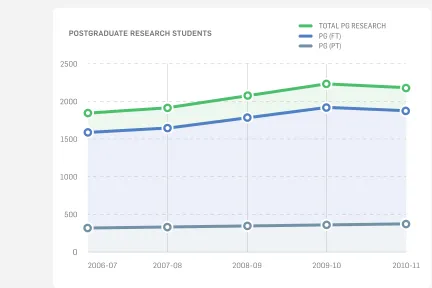
Trinity has more postgraduate research stu-dents than any other Irish university, with nearly 2,000 PhD students in 2010 / 2011 8.
There were over 1,000 PhD applicants for admission in 2011 / 12, 542 (54%) of which reg-istered 9. Many of these students were
attract-ed to Trinity by the opportunity to work with internationally renowned researchers. Growth in postgraduate research is dependent on the ability of the state and the university to pro-vide funded studentships — a necessity when competing globally. However, 2010 / 11 figures show a decrease in the number of registered PhD students [SEE FIGURE 4]. We are addressing this though the Global Relations Strategy and philanthropic initiatives, for example the Grat-tan Scholarships 10. Increased diversification of
sources of research income will also halt this possible decline.
7 This includes one-year and one-term visiting students. 8 Based on 2010/11 student numbers returned to the HEA
March 2011.
9 Dean of Graduate Studies Annual Report, 2010/2011, Appendix 7.
25 — Education
Table 1 [ABOVE] illustrates the geographical dis-tribution of the student body based on nation-ality in 2010 / 11, with Irish nationals account-ing for 79% of the student body in 2010 / 11.
11 Based on data from Dean of Graduate Studies Annual Report 2010/2011, p. 10
12 Includes 352 from Northern Ireland based on home address details.
13 Based on Senior Lecturer’s Annual Report 2010/2011,Appendix B
The pre-dominance of students of Irish nationality dates from the late 1980s when Trinity oriented itself to meet the demand for higher education nationally. However in the last decade in particular Trinity has come to appreciate the educational and other benefits that accrue from a greater international ori-entation. The quality of our education will be enhanced by attracting the best students and Area No. of students 2010 / 11 % Distribution 2010 / 11
Ireland 12 13,149 78.5%
Europe (EU) (excl. Ireland) 1,892 11.3%
North and Central America 731 4.4%
Asia 535 3.2%
Africa 241 1.4%
Europe (non EU) 152 0.9%
Australasia 28 0.2%
South America 19 0.1%
Total 16,747 100%
2006-07 0
500 1000 1500 2000 2500
[image:26.539.51.483.92.380.2]2007-08 2008-09 2009-10 2010-11
FIGURE 4 —POSTGRADUATE RESEARCH STUDENT NUMBERS 2006 / 07 TO 2010 / 11 11
[image:26.539.107.482.423.609.2]26 — Education
staff in the world and by having a more cultur-ally diverse student body. The Global Rela-tions Strategy incorporates a non-EU incen-tivisation scheme to encourage an increase in non-EU student numbers and envisages an additional 922 non-EU students from the Global Relations Strategy, 482 from Study Group International (SGI) and 80 from Singa-pore Institute of Technology (SIT), by 2016 / 17. With the student body composition clearly set to change, planning has begun to deal with the resulting consequences for the College’s finances, quality and reputation. For instance, the impact of increased student numbers on our staff:student ratio could be a matter of concern, and if not properly managed, could have implications for the quality of our teach-ing and the student experience, and in turn could affect our reputational standing.
In this context, until the complex issues of funding higher education, outlined in the
Review of Funding Model for Higher Education Institutions Consultation Document July 2012, are resolved, it is not possible to commit to any significant increase in undergraduate EU student numbers. However, Trinity remains open to considering targeted increases as appropriate.
Trinity has always attached great value to having a diverse and inclusive student popula-tion and is an active participant in the DARE and HEAR third-level access schemes, winners of a Public Service Excellence Award, 2012. We are committed and on target to achiev-ing a 22% entrance rate by under-represented groups and a 13% entrance rate by under-represented socio-economic groups by 2013. Applications from mature students and those from backgrounds of social disadvantage or with a disability are actively encouraged. In 2011, 18.8% of new undergraduate entrants were admitted using key access criteria (socio-economically disadvantaged, mature stu-dents, students with a disability). The Trinity Access Programmes (TAP) have formed a cen-tral part of Trinity’s plan to encourage young adults, adults and ethnic minority students
who come from socio-economic groups under-represented in higher education, to go to university.
The National Institute for Intellectual Disabil-ity (NIID) was established at TrinDisabil-ity in 1998 to promote the inclusion of people with intel-lectual disability and their families. The NIID promotes lifelong learning for people with intellectual disability through:
— The Certificate in Contemporary Living, an inclusive education programme for students with intellectual disabilities
— Development and implementation of
inclusive research practice
— Analysis and commentary on relevant legislation and policy
— Parent / family education
— Consultancy and partnership with service and advocacy agencies
— Public Education.
Develop the TCD-UCD Innovation Academy
27 — Education
Academy to foster cross-border student mobil-ity and inter-institutional sharing of mod-ules. This collaboration ensures that doctoral candidates in Trinity, UCD and QUB benefit from the expertise that is available within each institution, as well interacting with an expanded network of contacts, entrepreneurs and spin-out companies. Through the TCD-UCD-QUB Innovation Academy, the students interact across disciplinary boundaries, across institutions and across jurisdictions.
The Innovation Academy is part-funded by PRTLI (cycle 5) to recruit staff to foster links with industry and to interact with students in small group learning sessions. The universi-ties also fund the Innovation Academy by pro-viding academic staff expertise, administra-tive support and teaching facilities. Staff from two of the institutions are collaborating on the academic management of the programme, delivery of the course and the development of the Innovation Academy. The institutions are developing international links, engaging in outreach events (such as ESOF 2012 and Falling Walls Competition) and disseminating their work at international conferences. Trin-ity is committed to supporting and developing this interaction.
28 — Education
Summary Update of Actions under Education
ACTIONS OF STRATEGIC PLAN 2009-14 — MID-TERM REVIEW UPDATE
2.1 Review course provision and the composition of the student body
— College-wide initiative designed to strength-en curriculum rstrength-enewal begun by Sstrength-enior Lecturer / Dean of Undergraduate Studies. — Target of increasing student numbers to 18,000
will be met by 2014 / 15.
— The prioritisation of disciplines that have at-tained international excellence in terms of research and teaching strengths, that have a particular relevance to economic and social development in Ireland or where there is stu-dent demand for new programmes has not been completed. Such a prioritisation process will require the support of the Strategic Planning and Projects Unit which will be established under START.
2.2 Strengthen the focus on quality assurance and improvement
— Student evaluation of modules mandatory across College since 2010 / 11.
— All courses undergo external examination annually.
— Significant new work being undertaken in 2012 / 13 to review quality assurance of the educational provision; high-level working group established to progress in 2012 / 13.
— Alumni pilot programme of reviews not com-pleted. Instead, other more appropriate means of involving alumni are being considered, e.g. through the GRS, to develop mutually beneficial relations with our alumni (e.g. an alumni men-toring programme for internships for Trinity students, and career development support for our younger alumni).
2.3 Increase the use of learning technologies — Upgraded VLE (Blackboard) available to staff
and students for new academic year 2012 / 13. — See action 6.2.
2.4 Curriculum innovation and renewal in under-graduate education
— Structure of undergraduate courses has been redesigned to accommodate introduction of modules with ECTS values and learning out-comes at programme and module levels. — Policies of harmonisation (to be implemented
in 2012 / 13) and modularisation provide a framework to support the ‘core and elective curriculum’.
2.5 Dedicate resources to enhance the delivery of the undergraduate curriculum
— Additional small group teaching space provided through TBSI (551m2) and South Leinster Street
(422m2). See action 6.8.
2.6 Improve retention on undergraduate programmes
— Initiatives of the Senior Lecturer / Dean of Undergraduate Studies and the Dean of Students aim to improve admissions and transition / orientation processes which in turn would improve retention rates on under-graduate programmes.
2.7 Implement College’s Access Plan, 2009–13 — College is on target to achieve 22% entrance
29 — Education
2.8 Increase the proportion of international students
— International (non-EU student numbers) to increase through the GRS by 2016 / 17: ► Incorporating non-EU
incen-tivisation scheme: 922
► Study Group International (SGI) (Trinity and UCD contract signed with SGI in 2010 / 11): 482 ► Singapore Institute of Technology (SIT)
(Trinity entered into an agreement in 2011 / 12 with SIT to provide degree programmes in Physiotherapy and Occupational Therapy): 80
2.9 Establish the TCD-UCD Innovation Academy — TCD-UCD Innovation Academy launched in
November 2010 and expanded to include QUB in 2012.
— Further developed through successful bid for funding through the PRTLI programme. — Joint TCD-UCD Graduate Certificate in
Innovation and Entrepreneurship established in 2010 / 11.
— Business plan approved by Board in 2011 / 12 set-ting out plan for future sustainability.
2.10 Increase the number and scope of collab-orative programmes with other universities and encourage mobility
— Trinity has almost 300 exchange and mobil-ity options for students and staff looking for a challenging international experience. — The DRHEA Inter-Institutional Collaborative
Agreement (2009) enables Graduate education module delivery and student mobility between Trinity, UCD, DCU, NUI Maynooth, DIT and IT Tallaght.
— GRS aims to increase number of student ex-change programmes with leading universities.
2.11 Increase modularisation, flexibility and quality control in taught programmes
— The modularisation of courses at undergradu-ate level provides a framework to support the ‘core and elective curriculum’.
— Graduate Education Strategy, approved by Council in May 2010, seeks to enable the creation of innovative, flexible, and possibly inter-disciplinary courses from the wide range
of modules offered across the College. — Stand-alone postgraduate modules are
avail-able in specific areas in College and an associ-ated fee structure is in place.
2.12 Increase the number of targeted Ph.D. studentships
— PRTLI (cycle 5) funding has led to the creation of structured PhD programmes in a number of research areas across College.
— GRS and philanthropic initiatives, e.g. Grattan Scholarships, will aim to increase PhD numbers.
2.13 Enhance the reputation of the Trinity Ph.D. — Will be addressed through the Communications
Strategy which aims to protect and promote Trinity’s name and reputation nationally and internationally as Ireland’s leading university.
2.14 Increase the number of international and non-EU graduate students
— See Action 2.8.
2.15 Review and update the life-long learning policy
— Extensive range of postgraduate taught courses available in all disciplines. College is committed to extending its provision at the postgraduate taught course level as a re-sponse to the need for continuous professional development.
— Lifelong learning is on the targetted Undergraduate Studies Committee work pro-gramme for 2012 / 13.
— Wide range of extra-mural evening courses available in many different fields.
2.16 Increase flexibility for progression in un-dergraduate studies
— See action 2.7.
2.17 Increase the flexibility and modularisa-tion of educamodularisa-tional provision, and facilitate the recognition of achievement
— See action 2.4 re harmonisation. — ‘Trinity Teaching Award for Postgraduate
30 — Education
Headline Items to 2014 and Beyond
Broaden Undergraduate Admissions
— Long-term aim is to broaden undergraduate admissions using a range of different modali-ties to identify students with the ability and promise to thrive academically.
— First students to be admitted through new admissions route in 2014.
Foster continuous improvement in education — Under the remit of Senior Lecturer / Dean of Undergraduate Studies an education strategy to embrace the challenges of the 21st century for the next 8 years incorporating admissions policy is in development in 2012 / 13.
Improve Quality Assurance of education provision
— Working Group set up in 2012 / 13 to address rec-ommendations of IRIU Quality Review in detail in the context of planning for and implement-ing improved procedures and processes, as resources allow in what is a difficult operating environment.
— Role of the Quality Committee to be reviewed in 2012 / 13 in terms of its authority to system-atically monitor the implementation of quality assurance and enhancement processes and outcomes.
Development of the Business School
— Develop the Business School, underpinned by an Innovation and Entrepreneurship strategy.
Enhance Innovation Academy — Formal launch of the TCD-UCD-QUB
Innovation Academy (2012 / 13).
Develop On-line Education
32 — Knowledge Generation and Transfer
Strategic Highlight
trinity long room hub
As Trinity College Dublin’s Arts and Humanities Research
Institute, the Trinity Long Room Hub collaborates with its seven
constituent Schools and the Library. In addition to providing a
world-class research environment that harnesses and expands
the excellence of Trinity’s Arts and Humanities research, the
Institute facilitates cross-disciplinary collaborative projects and
is responsible for increasing the visibility and the impact of this
research and demonstrating its relevance for today’s societies.
Its signature building at the heart of the campus opened in 2010 and, enabled by a HEA PRTLI 4 grant, signifies the centrality of the Arts and Humanities for the university and Irish society. It hosts major EU-funded digital humanities projects such as the FP7 Cendari infrastructure project led by Trinity and by the Irish contribution to the European Digi-tal Humanities network, DARIAH. It also hosts the PRTLI 5-funded Structured PhD Programme in Digital Arts and Humanities which is led by Trinity and involves seven Irish institutions.
The Trinity Long Room Hub operates a Visiting Research Fellows Programme which attracts leading international scholars to the uni-versity and runs an intensive programme of academic events promoting and showcasing research in the Arts and Humanities.
35 — Knowledge Generation and Transfer
Knowledge Generation
and Transfer
Our vision for 2014 is for a College where the excitement of scholarship
and scientific discovery will be further embedded in the Trinity culture,
where established fields will have grown to international scale and where
new emerging fields — with demonstrated potential to enhance Trinity’s
international profile — will be identified and supported.
STRATEGIC PLAN 2009-14: KNOWLEDGE GENERATION AND TRANSFER
In the Strategic Plan 2009-14 we highlighted our intention to be at the forefront of research that has global impact and that can help address the major challenges of our time. The research theme of ‘Sustainable Society’ was proposed as the convergent theme for research in Trinity, and many important research initia-tives have been undertaken under this head-ing, including in immunology and infection, bioengineering, digital humanities, interna-tional integration and smart and sustainable cities. Substantial progress has also been made in implementing the proposed actions relating to attracting excellent researchers and to developing the research infrastructure. However, it is important to note that several of the initiatives require continuous atten-tion and reinforcement so that progress made to date is not lost. In the current economic climate, with reduced exchequer research funding, there is a risk that fewer research
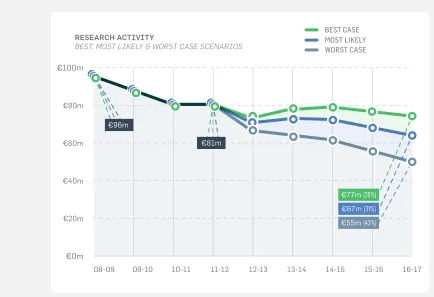
opportunities may be available to Trinity researchers. Such a scenario, if unaddressed, could impact negatively on the quality of Trinity’s research and on the College’s ability to attract world-class staff, and which, in turn would affect the College’s rankings [SEE FIGURE 5]. In order to mitigate this threat, a number of research funding diversification initiatives have been developed.
Improving Trinity’s position in international rankings remains an important strategic prior-ity. However, it should be clear that our cur-rent ranking in any of the world rankings is a complex function of a number of factors, over many of which we have little direct control but which are intrinsic to the working of the College. In this respect, it is not meaningful to consider a strategy for increasing our posi-tion in the rankings in isolaposi-tion from other on-going initiatives. For example, maintaining
36 — Knowledge Generation and Transfer
our research impact depends critically on our ability to attract and retain scholars of international repute, as well as on our ability to maintain the current level of research fund-ing. The rankings also measure Trinity’s repu-tation globally, and it is recognised that we must improve our processes for promoting our achievements. This is being tackled via the Board-approved Communications Strategy.
It should therefore be clear that our approach to maintaining our international ranking is founded on addressing those central issues which could have a serious impact on the ability of Trinity to deliver its core mission. A series of recommendations in the Rank-ings Strategy will be progressed in 2012 / 13 which include the establishment of a Strate-gic Planning Unit for Trinity (in line with the START Taskforce’s recommendation approved by Board) in order to collect, analyse, moni-tor and report on institutional data to the university’s policy-makers in a systematic, standardised and timely manner. Moreover, in order to improve our academic reputation in rankings surveys, a new marketing strategy will be required over and above the regular
university communications and public rela-tions activities. Under the new Communica-tions Strategy, a Director of CommunicaCommunica-tions and Marketing will be recruited.
Attract and Develop World-Class Teachers / Research-Active Academic Staff (Principal Investigators)
The College has been particularly success-ful in attracting and developing world-class Principal Investigators over recent years. The Ussher programme has, for example, seen the creation of forty new non-exchequer funded posts linked to strategic areas across the College. The College is also attracting Euro-pean Research Council (ERC) grant awardees. However, in the area of Engineering, Maths and Science our ability to continue to succeed in this regard is strongly linked to funding. In order to continue to attract and retain high-performing academics Trinity must increase the level of non-exchequer income it gener-ates. Such income will be used to support the recruitment of Professors in areas of critical importance for College, as well as to support the research infrastructure. Trinity’s Library is integral to this infrastructure. Access to 08-09 09-10 10-11 11-12 12-13 13-14 14-15 15-16 16-17 €0m €20m €40m €60m €80m €100m
€55m (43%)
€81m €96m
€67m (31%)
[image:37.539.53.487.88.385.2]€77m (20%)
37 — Knowledge Generation and Transfer
electronic journal and other digital research resources support the work of our research-ers at all levels and have a direct relationship with research outputs and research impact. It will be vital, in this time of economic crisis, to ensure that the Library continues to provide the required service to staff and students.
In the current climate, a particular focus must also be on retaining and developing (especial-ly junior) staff within the present constraints of the ECF. The College has robust retention mechanisms for existing academic staff. However, further consideration needs to be given to mechanisms to retain, for example, junior staff on programmes such as SFI Start-ing Investigator Research Grant (SIRG) and other ‘soft’ funding. In the second half of the span of the Strategic Plan 2009-14, consid-eration will be given to whether the College can underwrite the employment of such staff so that they can submit funding proposals in their own right. Schools will be encouraged to develop School-based strategies for attract-ing further ERC grant awardees. In addition a Working Group has been set up to consider whether and how associated staff such as emeritus and adjunct staff can contribute to the College’s research and to identify the proper mechanisms that would need to be put in place to facilitate this.
Diversify Research Funding Sources
The need to develop and invest in robust strategies for research funding development and diversification is critical. The College has recently approved a 5-year investment plan entitled Structures for Diversification of Research Funding in Trinity College Dublin. In the context of the projected downturn in the College’s research funding of 30% over the next 5 years, no new sources of funding are likely to become available and there is intense competition for existing funding streams. Therefore the strategy focuses on maximising the College’s capacity to attract research fund-ing from three main non-exchequer sources: the European Commission’s (EC’s) Framework Programme (FP7 / Horizon 2020), US funders
and funding from industry. Ambitious targets have been set for securing in excess of €154m over the lifetime of Horizon 2020 and €11.9m from US funding. In order for these targets to be achieved, two key approaches will be necessary, namely, (i) increasing participation in the funding programmes and (ii) ensuring higher quality applications. It is envisaged that the successes of these approaches will be incremental. It is also recognised that they will require various supports such as a men-toring programme for staff seeking to develop proposals to new sponsors (in collaboration with the Staff Development Office), and sup-port for buy-out of staff time to develop pro-posals of scale,
and an increased number of FP7 / Horizon 2020 specialists. With regard to the Horizon 2020 programme, it will be vital to have the supports in place before the first call goes out, as the environment will be highly com-petitive. UK funding is more constrained for non-UK applicants but there are moves at governmental level for research collaboration to increase between the UK and Ireland which may have implications for Trinity. A strategy to address industry funding will be developed in the future. The College’s new Communica-tions Strategy has as one of its objectives to promote opportunities for research collabora-tions with industry and to continue to develop outreach to the corporate and venture capital community.