
Analysis of Credit Risk Measurement Models in the
Evaluation of Credit Demands
Mehmet Ali Canbolat
1,*, Abdurrahman Gümrah
21Department of Management and Organization, VSSC, Karamanoglu Mehmetbey University, Turkey 2 Department of Accounting and Tax, VSSC, Karamanoglu Mehmetbey University, Turkey
Copyright © 2015 Horizon Research Publishing All rights reserved.
Abstract
The mission of the loan associations is simply to convert deposits collected with lower interest rates, into credits with higher interest rates. However, return of this cycle involves high potential of risk. In order to minimize the risk, several financial models are utilized. Since these models are insufficient, new models are required to be developed. The purpose of this study is to compile literature reviews on credit risk measurement methods used for assessment of credit demands. The method used is literature scan. This scan was conducted with printed publications and articles from the databases scanned. The information is compiled from these sources. It is discussed that risk mitigation should be given importance instead of guarantee, for evaluation of credit demands with Basel II criteria. A credit requesting entity’s future prediction by examining financial statements can only be possible utilizing financial statements analysis techniques (comparative financial statements analysis, vertical analysis, ratio analysis and cash flow statements) together. As a consequence, in 2009 a software ,named “Scoring Model” has been developed for giving credit decisions which uses the techniques together mentioned above. This software merely based on a model is proposed to be integrated into banking system after being reprogrammed as commercial software.Keywords
Credit, Assessment of Credit Demands, Credit Risk1. Introduction
Credit, meaning financial dignity, is defined as granting financial entity or purchasing power as service or commodity to a promising person or corporation based on promised future payment; or opportunity to be able to benefit from reputation of a third party[1]. In banking the credit has four basic elements which are maturity, confidence, risk, and revenue.
In Banking, risk is defined as the sum of threats likely to occur until encashing of the money loaned and fulfillment of the commitments subject to warranty. In other words risk is the amount of credits granted a person/corporation any date as cash, commodity, surety and collateral. In credit
transaction minimizing the risk factor is essential [2]. In financial terms, risk is the probability of deviation of expected profit from actual profit [3]. Assessment of the information obtained from the financial reports of the corporations according to risk measurement models, which is of great importance, provides remarkable benefits to investors and borrowers [4].
In order to ensure security of loans, following points should be paid attention [5]
The Corporation has to be investigated whether it has positive financial structure. This should be retroactive and comparatively done at the end of the current year. By the way the financial data relating to items such as capital, equity, debts, receivables, profitability and net working capital should be examined carefully. According to the obtained results, the explanation of the uncertain points which were observed should be left to the company's statement.
Market intelligence about the company planned to be given credit should be necessarily gathered and positive results should be taken into evaluation. The credit’s compliance with the determined
repayment schedule should be assessed by considering its intended purpose and it is necessary to be convinced with an affirmative decision on this process,
The company's commercial relations with other banks should be considered; detailed information about used and being used credits must be obtained. Collateral that will be taken from the company
should be carefully selected and should be considered to be the most appropriate coverage. Experience and morality should be evaluated.
Credit management includes these efforts as follows; making consistency bank's crediting applications consistent with bank policies; making credit principal and proceeds payments in credit portfolio on time; managing in a way that the problems can be identified previously [6].
steps [7]:
Determination of conditions in case of forward sales,
Determination of collaterals,
Research on customers' ability to pay,
Determination of credit limits that can be offered to clients,
Collection of the credit at due date,
Credit transactions require banks to make the right decisions on the credibilities of the borrowers. These decisions may not always be accurate or borrowers' creditworthiness may decline over time, depending on various factors. Accordingly, the credit risk, the main risk the banks suffer, is a situation in which the borrower violates the conditions of the agreement [8].
2. Basel
The Basel Committee on Banking Supervision Committee was established in 1974 within the structure of the BIS (Bank for International Settlements) in order to make it easy to understand important matters related to banking supervision and improve banking supervision in the worldwide [9].
In general, the Basel-I credit approval process starts with the client’s submitting credit request to a credit department officer. Required documents and information relating to credit request is supplied from the client and the decision on loan is taken in credit committee or the board of directors, which is top level authority."
After Basel-I, significant changes have emerged in the process in ‘Basel II. "These changes are distinguished in data used in approval process and calculation of capital requirement. In terms of data used, the most important change is that risk mitigation techniques replace deposit" [10].
The ability to manage credit risk depends on its being measured. In this context, the Basel II regulations made it possible for banks to choose among three methods of the standardized approach, basic internal ratings-based approach and advanced internal ratings-based approach to calculate the capital requirement linked with credit risk [11].
Along with minimizing the risk of non-performing loans, reduction of provisions, improving the quality of assets and prevention of the decline in profitability, which have gained importance in economics and finance sector, within the scope of Basel II Capital Agreement studies continuing in many countries, including Turkey, need for a good estimator model is increased significantly. [12]
3. Credit Risk Measurement Models
Banks and advisers have begun to develop credit risk models in the second half of the 1990’s and measurement of the potential loss according to identified levels of privacy has been determined as the target [13]. Approach based on risk measurement and management, will be evaluated optimally by obtaining data from effective sources, affordable pricing will be held, and the bank's capital structure will be preserved [14]. Credit risk model, being key factors in the preliminary determination determine the probability of default and combined or quantitative score of the debtor [15].İç & Yurdakul (2000) have developed a model named
Analytic Hierarchy Process (AHP), which evaluates financial analysis methods existing in the literature as methods of evaluation for loan demands and some qualitative and quantitative factors of a company such as “subjective credit worthiness, status of the sector operating and loan guarantees” together and expresses the result with an overall credit score. [16]
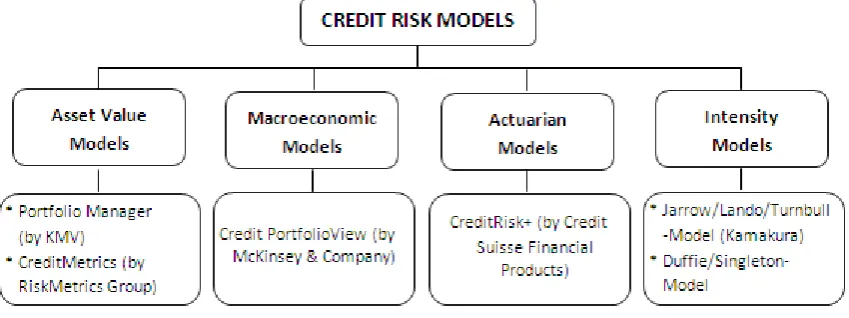
[image:2.595.93.518.541.700.2]Bluhm et al. (2003) have classified the credit risk models as in Figure 1 [17].
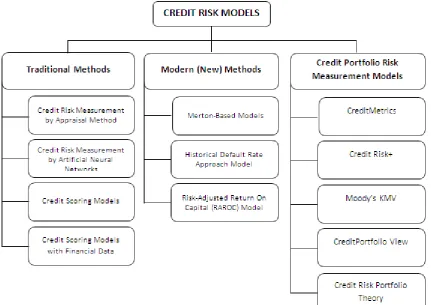
Yılmaz (2011) have taken models as methods and made the following classification. [18]
Figure 2. Credit Risk Models
However, there is another research stating that using financial statement analysis techniques together gives more
effective results. Sevim & Canbolat have developed a model
named "Scoring Model", which requires analysis techniques (comparative financial statements analysis, vertical analysis, ratio analysis and cash flow statements) to be used together. In Scoring Model, in addition to ratio analysis and cash flow statements techniques, comparative financial statements analysis and vertical analysis techniques, which were never used in software models before, were also used. As a result of these techniques applied, financial statements of the firm requesting loan are interpreted by the software and credit score of the company is created based on these interpretations. When two credit scores, which were obtained by entering the financial statements of a sample company into the demo version of scoring model software and received based on personal opinions of the bank loan officers, were compared, the score received from software reached the same conclusion with the score given by bank loan officers at a ratio of 78% [19].
It is possible to list Internationally Approved Programs that evaluate the credit risks as follows:
CreditMetrics™
Merton-Based KMV Software CreditPortfolio View
CreditRisk+
Credit Metrics:
In CreditMetrics Model, estimated losses that may occur in the event of default are measured. This model was developed in conjunction with value at risk model (VAR) in 1997.
Merton-Based Models:
Merton-based models focus on micro-economic indicators such as probability of default, fluctuations in the capital structure and asset prices. A variety of software products developed by Moody's KVM make risk measurements using the database of Merton.
CreditPortfolio View:
CreditPortfolioView is a multi-factor model which is used to simulate the joint conditional distribution of default and migration probabilities for various rating groups in different industries, for each country, conditional on the value of macroeconomic factors like the unemployment rate, the rate of growth in GDP, the level of long-term interest rates, foreign exchange rates, government expenditures and the aggregate savings rate[21].
Credit Risk+:
[image:3.595.90.522.100.405.2]Table 1. Owerview: Main Differences Between Industry Models[23]
KMV-Model CreditMetrics Credit Portfolio View CreditRisk Intensity Models
Risk
Driver Asset Value Process Asset Value Process Macro-economic Factors Default Intensity Intensity Process Definition of
Risk Distance to Default (DtD) Mark-to-Model of Loan Value Mark-to-Model of Loan Value Default Risk Only Default Risk Only Risk
Scale DtD on contin Scale Down/Upgrade and Default Down/Upgrade and Default Default Default
Transition Probabilities
EDF-Concept, high migration probabilities
Historic Rating
Changes, from S&P Stochastic, via Macrofactors Not Implemented Not Implemented
Correlations Asset Value Factor Model Equity Value Factor Model Macroeconomy Implicit by Implicit by Sectors Intensity Proc. Correlated
Severity (Beta-Distr.) and Stochastic Fixed
Stochastic (Beta-Distr.) and
Fixed
Stochastic, Empirically
[image:4.595.61.548.92.328.2]Calibrated Stoch. Modifications Deterministic LGD, Deterministic LGD
Table 2. Comparison of the Models as Data Requirements [24]
KMV-Model CreditMetrics Credit Portfolio View CreditRisk+ Intensity Models
Data Requirements
Equity Prices, Credit Spreads, Correlations,
Exposures
Historical Transition Matrix, Credit Spreads & Yield Curves, LGD,
Correlations, Exposures
Historical Transition Matrix, Macroeconomic
Variables, Credit Spreads, LGD,
Exposures
Default Rates and Volatility, Macroeconomics
Factors, LGD, Exposures
Debt and Equity Prices, Historical Transition Matrix, Correlations,
Exposures
There are various differences between models in terms of calculation of the parameters. In KMV and CreditMetrics Models; distance value from default, correlation matrix and latent variables are used. In CreditRisk+ model; default probabilities and "Gamma Distribution" are considered as parameters. [25]
These models do not have a confirmation method generally accepted. Banks should perform verification by using following two methods minimally [26]:
Comparison: Bank should compare the results with the results of alternative or non-bank, and must also use other quantitative validation tools. This analysis should be based on data and information that is appropriate for the portfolio, updated regularly and include an observation period suitable for purpose. Banks’ own internal assessments on the performance of the models should be based on long data history covering a set of economic conditions and ideally one or more economic cycle.
Retrospective tests: Banks should apply retrospective tests for the purpose of proving that deviations between actual results and results of model predictions occur in acceptable ranges. Banks should form data bases including actual data and estimates to perform retrospective tests and verification. The basic philosophy of credit risk management should not be as “not taking risks” but rather should be as “to take the credit risk that could be measured". Measurement of credit risk should be made according to objective, corporate criteria; not by individual preferences and objective rules of decision-making bodies. Unforeseeable credit risk can cause
speculative conclusions and cannot become suitable for advanced management methods. The main purpose of credit risk management is to provide profit optimization in a manner of “increasing the power of competition in the market” and “minimizing the occurrence of non-performing loans (problem loans)” [27].
REFERENCES
[1] Osman Tunaboylu, Orta Vadeli Kredi Uygulaması ve Kaynakları, İstanbul, İstanbul Bankası T.A.Ş., p.3. 1977.
[2] Nezih Perçin, Temel Kredi Bilgileri, Demirbank, T.A.Ş.
Eğitim Müdürlüğü Yay.,p.9.1999.
[3] Ali Ceylan, Turhan Korkmaz, Sermaye Piyasası ve Menkul
Değer Analizi, İkinci basım, Bursa, Ekin Kitabevi, p.424,
2004.
[4] S.Chattopadhyay, F.J. Arcelus and G. Srinivasan, Deferred Taxex and Bond Ratings: A Canadian Case, Journal of
Business Finance & Acoounting, 24 (3) & (4), April 1997,
0306-686X.
[5] Tülay Akbulut, Ticari Bankalarda Kredilendirme Esasları ve
Problemli Krediler, Yayınlanmamış Yüksek Lisans Tezi,
Marmara Üniversitesi BSE, pp.7-8, 2003.
[6] Belkıs Seval, Kredilendirme Süreci ve Kredi Yönetimi,
İstanbul, Avcıol Basım Yayın, p.17, 1990.
[7] Niyazi Berk, Finansal Yönetim, Yedinci basım, İstanbul,
Türkmen Kitabevi, pp.226-227, 2003.
[8] Emre Aklin, Tuğrul Savaş ve Vedat Akman, Bankalarda Risk
Yönetimine Giriş, İstanbul, Çetin Matbaacılık, p.110, 2001.
[9] Hasan Candan, Alper Özün, Bankalarda Risk Yönetimi ve
Basel II, Türkiye İş Bankası Kültür Yayınları, İstanbul, p.6,
2006
[10] Rıdvan Çabukel, Bankaların Kurumsal Kredileri Açısından
Kredi Riski Yönetimi ve Basel II Uygulaması, Yayınlanmamış Doktora Tezi, Gazi Üniversitesi SBE,
pp.26-27, 2006.
[11] Mehmet Akan, Melek Acar Boyacıoğlu, Bankacılık Teori,
Uygulama ve Yöntem, Nobel Yayınları, p.575, 2011.
[12] Başak Tanınmış Yücememiş, İnanç Asım Sözer, Bankalarda
Takipteki Krediler: Türk Bankacilik Sektöründe Takipteki
Kredilerin Tahminine Yönelik Bir Model
Uygulaması,Finansal Araştırmalar ve Çalışmalar Dergisi,
ISSN 1903-1123, [S.l.], v.3, n. 5, pp.49, jul. 2011.
[13] Edward Altman, Andrea Resti and Andrea Sironi, Default Recovery Rates in Credit Risk Modelling: A Review of the Literature and Empirical Evidence, Economic Notes by Banca Monte dei Paschi di Siena SpA, vol.33, no. 2, p.189, 2004.
[14] Roger W. Ferguson, Credit Risk Management: Model and
Judgment, New York, 2001, http://www.federalreserve.gov/
boarddocs/speeches/2001/20011016/default.htm,
(02.09.2014).
[15] A. Foglia, S. Iannotti and P.Marullo Reedtz, The Definition of the Grading Scales in Banks’ Internal Rating Systems, Economic Notes by Banca Monte dei Paschi di Siena SpA, vol.30, no. 3, p.428, 2001.
[16] Yusuf Tansel İç, Mustafa Yurdakul, Analitik Hiyerarşi Süreci
(AHS) Yöntemini Kullanan Bir Kredi Değerlendirme Sistemi,
Gazi Üniversitesi Müh.Mim.Fak. Der., Cilt 15, No 1, pp.1,
2000.
[17] Christian Bluhm, Ludger Overbeck, Christoph Wagner, An
Introduction to Credit Risk Modeling, Chapman&Hall/Crc
Press, pp.52-53, 2003
[18] Songül Yılmaz, Ticari Bankalarda Kredi Portföyü ve Kredi
Riski Yönetimi – Bankacılık Sektöründe Bir Uygulama,
Yayınlanmamış Yüksek Lisans Tezi, Kadir Has Üniversitesi
SBE, pp. vi, 2011.
[19] Şerafettin Sevim, Tunga Bozdoğan, Mehmet Ali Canbolat,
Kredi Taleplerinin Değerlendirilmesinde Bilgisayar Destekli Mali Analiz Sonuçlarının Puanlanması ve Bir Model Denemesi, Uşak Üniversitesi Sosyal Bilimler Dergisi 2/2 p.8,
2009.
[20] Şahap Kavcıoğlu, Ticari Bankacılıkta Kredi Riskinin Ve
Kredi Riski Ölçüm Modellerinin Değerlendirilmesi, Finansal
Araştırmalar ve Çalışmalar Dergisi, ISSN 1903-112,3 [S.l.], v.
3, n. 5,pp.16-17, jul. 2011.
[21] Michel Crouhy, Dan Galai, Robert Mark, A Comparative Analysis Of Current Credit Risk Models, Journal of Banking
& Finance, Volume 24 (2000), Issue 1-2, January, pp. 113.
[22] Kemal Çağatay Şimşek, Bankacılıkta Risk ve Risk Ölçüm
Yöntemleri, Yayınlanmamış Yüksek Lisans Tezi, Ankara
Ünviersitesi SBE, pp. 59-60, 2007.
[23] Christian Bluhm, Ludger Overbeck, Christoph Wagner, An
Introduction to Credit Risk Modeling, Chapman&Hall/Crc
Press, pp.52-53, 2003
[24] Anthony Saunders, Linda Allen, Credit Risk Measurement,
Second Edition, John Wiley & Sons, Inc., Newyork, pp. 136,
2002.
[25] Volkan Dayan, Sibel Karğın, Basel II Düzenlemeleri
Çerçevesinde Kullanılan Kredi Riski Modelleri:
Karşılaştırmalı Bir Çalışma, Journal of Yaşar University,
2013 8(32) 5433-5464, pp.5455, 2013.
[26] TBB Çalışma Grubu, Kredi Riski Modelleri, Bankacılar
Dergisi, Sayı 57, 2006, p.52
https://www.tbb.org.tr/Dosyalar/Arastirma_ve_Raporlar/kre di_riski_modelleri.pdf (04.09.2014)
[27] Cengiz M. Göğebakan, Musa Arda, Kredi Risk Yönetimi
Açısından İçsel Derecelendirme Modeli, Ocak-Şubat, Active
![Table 2. Comparison of the Models as Data Requirements [24]](https://thumb-us.123doks.com/thumbv2/123dok_us/8780281.903825/4.595.61.548.92.328/table-comparison-models-data-requirements.webp)
