Microstructure and Properties of Al-B
4
C Functionally
Graded Materials Produced by Powder
Metallurgy Method
Aykut Canakci
*, Temel Varol, Serdar Özkaya, Fatih Erdemir
Department of Metallurgical and Materials Engineering, Karadeniz Technical University, Trabzon, Turkey *Corresponding Author: [email protected]
Copyright © 2014 Horizon Research Publishing All rights reserved.
Abstract
In the present work, three differenttypes-layered Al-B4C functionally graded materials were fabricated via powder metallurgy. The Al-B4C powder mixtures were cold pressed in two different pressures (400 and 500MPa) and sintered at 600oC for 3h under argon atmosphere. After investigating the pressure and sintering process of the mixed powder with different compositions, the density, microstructure, elemental distribution and hardness variation of the produced FGMs were evaluated. A detailed characterization of the microstructure of the FGMs was carried out using scanning electron microscopy and energy dispersive X-ray analysis. The results revealed that the mechanical properties of the Al-B4C FGMs system strongly depend on constitutional variation, and display various graded distributions as well. The microstructure of FGMs so produced exhibits a gradual change of hardness from 165BHN in aluminum to 250BHN in B4C region.
Keywords
Functionally Graded Materials, Powder Metallurgy, Metal Matrix Composite, Boron Carbide1. Introduction
As modern technology develops, more demands on material properties are raised in advanced engineering applications. On some occasions, service conditions require materials performance to vary with locations [1]. Functionally graded materials (FGMs) provide a novel solution to this requirement and realize multifunctions that cannot be achieved by monolithic or homogeneous materials [2]. By definition, FGMs are used to produce components featuring engineered gradual transitions in microstructure and/or composition. They accommodate a gradient transition of the properties of different materials from one end to another, where the property mismatch (mechanical, thermal, or electrical) can be reduced to minimum [1, 3]. The introduction to FGM has been expected to have a strong impact on the design and development of new components and structures with better performance [4]. So far, FGMs
have been extensively applied in many areas, including structural [5], thermal [6], electrical [7], biomedical [8] and military [9]. Bhattacharyya et al. [6] studied that Synthesis and characterization of Al/SiC and Ni/Al2O3 functionally graded materials. They reported that Al/SiCFGMs fabricated by powder metallurgy route, exhibit microstructures with a homogeneous distribution of fragmented and clustered SiC particles.
The fabrication process is one of the most important fields in FGM research. A large variety of production methods have been developed for the processing of FGM, such as, powder metallurgy, sheet lamination, laser cladding, and chemical vapor deposition [5]. It is noted that the powder metallurgy method is one of the most commonly employed techniques due to its wide range control on composition and microstructure and shape forming capability. In general, the forming methods used include slip casting [10, 11], tape casting [12,13], centrifugal casting [14], thixotropic casting [15], electromagnetic separation [16, 17], electrophoretic deposition [18], combustion [19], and die pressing followed by cold isostatic pressing [20]. The sintering techniques employed include pressureless sintering [21], hot pressing [22], and hot isostatic pressing [23].
hydroxyapatite-Ti (HA-Ti) functionally graded biomaterial (FGM) by the powder metallurgical process. They stated that FGM microstructure varies gradually with the diversification of chemical composition, which eliminates the macroscopic interfaces of HA-Ti bonding. A large number of works has been reported on aluminum-based FGM with alumina, silicon carbide, titanium carbide, and titanium diboride as reinforcements. Synthesis of Al-B4C monolithic composite is also reported in the literature [32, 34, 36, 37]. B4C is an excellent reinforcement for Al-based composites having high hardness close to diamond, excellent thermal stability, and remarkable inertness.
The most of the studies on FGMs have devoted Al2O3 and SiC reinforced FGMs [38-40] and research into B4C reinforced FGMs is relatively limited [41]. Fabrication of aluminium-based FGMs with B4C reinforcement was made by centrifugal casting and studied the effect of centrifugal force on B4C gradient. However, Al-B4C FGMs produced by powder metallurgy method has not been reported in the literature. Therefore, a specific attempt was made in this work to fabricate Al-B4C FGMs by powder metallurgy. In this work, the desired B4C gradient was obtained.
The purpose of this work is to develop fundamental constitutional control technique of FGM by powder metallurgy, expecting to optimize FGM fabrication process and further improve its performance. The microstructure and the composition of the fabricated FGM by powder metallurgy were studied and the green and sintered density and the Brinell hardness of each layer in the FGM were measured. The relationship between microstructure, composition and some other physical and mechanical properties were discussed.
2. Experimental
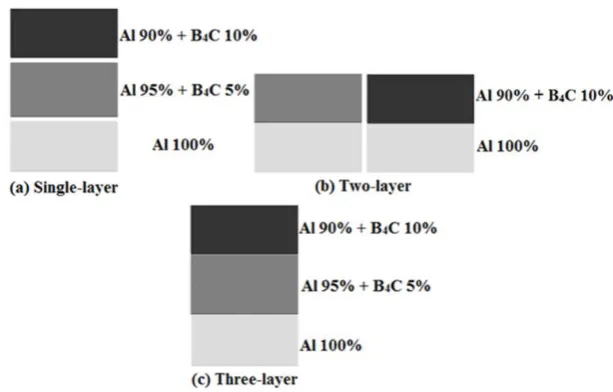
B4C and aluminium powders were used as raw materials to fabricate the FGMs. The as-atomized Al powders (99.9% purity) with an average particle size of 113µm (Gündoğdu Exotherm Company, Turkey) were used as the matrix materials, and B4C powders with an average particle size of 102µm (Wacker Ceramics Kempten GmbH, Germany) were used as the reinforcements. Al powders, with different weight percentages of B4C powders (0, 5, and 10 wt. %, was blended in mixer for 0.5h. The FGM was designed to comprise three different type layers. In addition to pure Al, Al-5wt. % B4C, and Al -10wt. % B4C single-type-layers, the intermediate structure consisted of two different type layers with different ratios of B4C and Al, namely, Al-5wt. % B4C + Al, Al-10wt. % B4C+Al two-type-layers, Al-10wt. % B4C + Al-5wt. % B4C+Al three-type-layer, respectively, as shown in Fig. 1.
The mixed powders were filled and uniaxially cold pressed in a steel die at 400 and 500MPa. Then the green formed FGMs compacts were subjected to sintering at 600oC for 3h under argon atmosphere. The experimental densities of the FGMs samples were measured Archimedes’s method. The theoretical densities were calculated using the mixture rule according to the weight fraction of the B4C powders. Then, green density, sintered density and densification percent were calculated considering densities of 2,70g/cm3 and 2,52 g/cm3 for Al and B4C, respectively. The microstructure and elemental distribution on the cross-section of FGM were observed by means of optical microscope and Zeiss Evo LS10 scanning electron microscope, respectively. In addition, image analysis and computerised scanning X-ray tomography were employed to quantitatively determine the B4C distribution. The hardness of the FGM samples was measured using the Brinell hardness method under a load of 31.25kg for a dwell time of 20s.
[image:2.595.149.456.535.731.2]Figure 2. Microstructure of a cross-section for Al-B4C FGM; (a) back scattered mode of three- type-layer (b) back scattered mode of two-type-layer
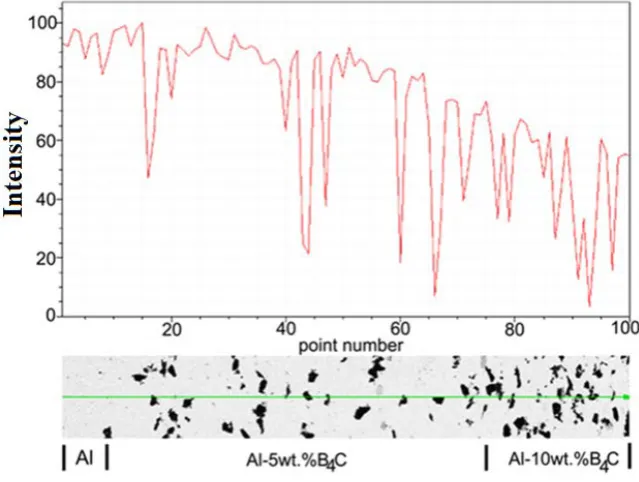
Figure 3. X-ray attenuation profiles showing effect of powder metallurgy technique on B4C distribution in Al-B4C FGMs.
3.Results and Discussion
Fig. 2 shows the general view and different interfaces details of microstructures of a cross section for this FGM. There are no indications of craking with in individual layers or of decohesion at interfaces in any of the specimens. In the microstructures, dark gray is the B4C ceramic phases and light gray is Al phase. With the variation of composition, the microstructure of interlayer changes in a stepwise manner from Al side to Al-10wt. %B4C side. From the microstructures in the details for the different interfaces of the FGM, one can be seen that both the metal and composites are constant in microstructures. Thus there is no macroscopic interface in the FGM. This good continuity of microstructure can eliminate the disadvantage of traditional macroscopic interface in metal/composites joint and reflects the design ideal of FGM.
No cracking can be found in the FGMs in this study (Fig. 2), indicating that the FGMs have good strength, good thermal stability and thermal shock due to the better metal-ceramic bond, continues in microstructure at the interfaces of FGMs, as reported in previous studies [39, 43]. The results of the topography study are presented in Fig.3. The X-ray attenuation decreased with B4C weight fraction thus enabling the B4C distribution to be monitored. Clearly, the X-ray attenuation is reduced step by step as the B4C content decreases in the FGM specimen whereas the X-ray attenuation trace for the specimen shows a much smoother and more B4C distribution. Small peaks on the attenuation curves could be correlated with surface defects or discontinuities as seen in the SEM micrographs.
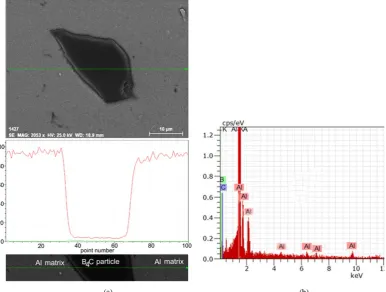
[image:3.595.63.548.77.255.2] [image:3.595.144.464.286.527.2]clustering of B4C and (iii) good integrity at the interfaces of aluminium matrix-reinforcing particulates. In this study, there is no evidence of other phases either at the particle-matrix interface or in the matrix suggesting that no reaction occurs between B4C and Al during manufacturing (Fig. 4a and 4b). The interface chemistry of the B4C-Al couple has been addressed in several studies [44–48]. Boron carbide and aluminum react at temperatures greater than 700 oC producing AlB
2 and aluminum boron carbide, Al3BC, which has only recently been identified [45, 49]. Other more complicated phases develop at temperatures greater than 900 oC; however, such temperatures can easily be avoided during processing since the melting point of aluminum is 660 oC. The decomposition mechanisms of boron carbide in liquid aluminum between 700oC and 900oC have been summarised by Viala et al. [45]. The formation of these phases degrades the particles and results in composites with poor mechanical properties [44, 45, 49]. These phases may form during prolong working at high temperatures as well as during processing if the production temperature is high. It is therefore important to develop low temperature production methods for B4C-aluminum alloy composites [50].
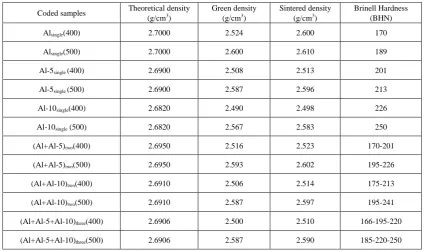
The experimental density measurements in Table 1 showed that the density values decreased with an increase in the weight percentage of B4C along the deposition direction and this contradicted with the theoretical reasoning whereby specimens from the lower B4C end should be denser than those from the high B4C end. This observation can be rationalized in term of porosity levels, which increased with
the weight percentage of B4C. The densification of the brittle B4C powders is due to powder sliding followed by powder fragmentation. The literature reveals that the use of addivities, such as liquid and solid lubricants, substantially increase fluidity and therefore densification [51, 52]; however, the ceramics were cold pressed without additive showing unbonded interparticle contacts. Although a decrease was also seen in the experimental densities, the values are lower than those of the theoretical ones (Table 1). The density measurements showed that FGMs contain some porosity, and the amount of porosity in the FGMs increased with the increasing weight fraction of the B4C powders (Table 1). In general, the B4C powder clustering increased with B4C content as did the associated porosity. The increase in porosity levels with an increase in B4C powders can be attributed to the combined effects of the increase in the clustering tendency with increasing weight percentages of B4C powders and the increasing friction between Al-B4C powder mixtures leading to a lower densification extent. At the highest pressing pressure (500MPa), the green and sintered densities of FGMs increase (Table 1) while the porosity values increase. However, It is seen from these values that the green and sintered densities of FGMs decreased with increasing B4C powder content in Table 1 whereas the porosity values increasing B4C powder content in Table 1. This means that, the higher the weight fraction of B4C powders added to the aluminium matrix, the higher porosity of the functionally graded composites, similar to the observations of some previous studies [38, 53].
[image:4.595.116.503.436.728.2](a) (b)
Table 1. Physical and mechanical properties of FGMs
Coded samples Theoretical density
(g/cm3)
Green density (g/cm3)
Sintered density (g/cm3)
Brinell Hardness (BHN)
Alsingle(400) 2.7000 2.524 2.600 170
Alsingle(500) 2.7000 2.600 2.610 189
Al-5single (400) 2.6900 2.508 2.513 201
Al-5single (500) 2.6900 2.587 2.596 213
Al-10single(400) 2.6820 2.490 2.498 226
Al-10single (500) 2.6820 2.567 2.583 250
(Al+Al-5)two(400) 2.6950 2.516 2.523 170-201
(Al+Al-5)two(500) 2.6950 2.593 2.602 195-226
(Al+Al-10)two(400) 2.6910 2.506 2.514 175-213
(Al+Al-10)two(500) 2.6910 2.587 2.597 195-241
(Al+Al-5+Al-10)three(400) 2.6906 2.500 2.510 166-195-220
(Al+Al-5+Al-10)three(500) 2.6906 2.587 2.590 185-220-250
The influence of the varying microstructure on the hardness of the FGM sample is obvious, as shown in Table 1. As the content of B4C increases from 0 wt. % to 10 wt. %, the hardness changes and the hardness increases substantially. This is mainly caused by the gradual variation of the microstructure in the functionally graded composites. As compared to the Al matrix, the hardness of the FGMs was found to be greater, and the addition of B4C particles increases the hardness of the Al [54, 55]. An increase in the hardness of the Al-B4C functionally graded composite with increasing weight fractions of B4C from the matrix to B4C graded regions, for both the FGM fabricated at 400 and 500MPa, respectively (Table 1), as observed in the previous investigations [40, 56]. The effect of the amount of B4C (wt.%) on the hardness can occur in at least two ways: first, by influencing the load carrying between the matrix particles and second, by influencing inhibit dislocation movement.
4. Conclusions
Three different-type-layered Al-B4C FGMs has been successfully fabricated by powder metallurgy method. Microstructural examination showed that the B4C distributions were generally homogeneous in the Al matrix while in the higher B4C content layers some large B4C clustering were also present. No cracking in the FGMs showed that the composites and the FGM fabricated in this study have good graded composition and good strength due to the better metal-ceramic bond and continuous in microstructure at the interface of FGM.The density of FGMs
was decreased with increasing B4C weight fraction and
decreasing pressing pressure, but the porosity and hardness of the FGMs were increased with increasing particle content.
However, the porosities of FGMs were decreased with
increasing pressing pressure whereas the hardness values were increased with increasing pressing pressure SEM observations indicated that there was no interface reaction between B4C powders and Al matrix during production.
Acknowledgement
The authors are grateful to the Karadeniz Technical University Research Fund for financially supporting this research (Grant no. 2007.112.10.2). The researchers would also like to thank the Gundogdu Exotherm Service for providing the Al powders.
REFERENCES
[1] Mortensen A., Suresh S., Int. Mater.Rev., 40 (1995), 239-265. [2] Kawasaki A., Watanabe R., Ceram Int., 23 (1997), 73-83.
[3] Ma J., Tan Geb., J., Mater. Process. Technol., 113 (2001), 446-449.
[4] Rajan Tpd., Pillai Rm., Pai Bc., J. Alloys Compd.,453 (1997), L4-L7.
[5] Sun L., Sneller A., Kwon P., Mater. Sci. Eng.A 488 (2008):31-38
[6] Bhattacharyya M., Kumar An., Kapuria S., Mater. Sci. Eng A., 487 (2008), 524-535.
[7] Takagi K., Li Jf., Yokoyama S., Watanabe R., J. Eur. Ceram. Soc. 23 (2003), 1577-1583.
(1999), 95-100.
[9] Gooch Wa., Chen Bhc., Burkins Ms., Palicka R., Rubin J., Ravichandran Ks., Mater. Sci. Forum (1999), 308–311, 614-621.
[10] Canakci A., Varol T., Ozsahin S., Met. Mater. Int. 19 (2013), 519-526.
[11] Lopez-Esteban S., Bartolome Jf., Pecharroman C., Moya Js., J. Eur. Ceram. Soc., 22 (2002), 2799-2804.
[12] Yeo Jg., Jung Yg., Choi Sc., J. Eur. Ceram. Soc., 18 (1998), 1281-1285.
[13] Yeo Jg., Jung Yg., Choi Sc., Mater. Lett., 37 (1998), 304-311. [14] Zhang J., Wang Yq., Zhou Bl., Wu Xq., J. Mater. Sci. Lett.,
17 (1998), 1677-1679.
[15] Ruys Aj., Kerdic Ja., Sorrell Cc., J. Mater. Sci., 31 (1996), 4347-4355.
[16] Song Cj., Xu Zm., Li Jg., Mater. Sci. and Eng. A., (2007), 445-446:148-154 .
[17] Song Cj., Xu Zm., Li Jg., Comp. Part A., 252 (2007), 427-433.
[18] Corni I., Ryan Mp., Boccaccni Ar., J. Eur. Ceram. Soc., 28 (2008)., 1353-1367.
[19] Chen Sp., Meng Qs., Zhao Jf., Munir Za., J.Alloys Compd.,476 (2009), 889–893
[20] Jung Yg., Paik U., Choi Sc., J. Mater. Sci., 34 (1999), 5407-5416.
[21] Torrecillas R., Espino Am., Bartolome Jf., Moya Js., J. Am. Ceram. Soc., 83 (2000), 454-456.
[22] Ma J., Tan Geb., He Z., Metall. Mater. Trans. A ., 33 (2002) , 681–685.
[23] Winter An., Corff Ba., Reimanis Ie., Rabin Bh., J Am. Ceram. Soc., 83 (1998), 2147-2154.
[24] Rodriguez-Castro R., Wetherhold Rc., Kelestemur Mh., Mater. Sci. and Eng. A323 (2002) 445–456
[25] Lillo Tm., Mater. Sci. and Eng. A., 2005 410–411, 443-446.
[26] Nai Sml., Gupta M., Lim Cyh., Mater. Sci. and Technol., 20 (2004), 57-67.
[27] Froster Mf., Hamilton Rw., Dashwood Rj., Lee Pd. Mater. Sci. and Technol., 263 19 (2003), 1215-1219.
[28] Watanabe Y., Kawamoto A., Matsuda K., Compos. Sci. Technol., 62 (2002), 881-888.
[29] Melgarejo Zh., Suarez Om., Sridharan K,. Scr. Mater., 55 (2006), 95-98.
[30] Duque Nb., Melgarejo Zh., Suarez Om., Mater. Charact., 55 (2005), 167-171.
[31] Kelly Am., Reiswig Rd., Hill Ma., Bluementhal Wr., Mater.
Charact., 32 (1994), 35-39.
[32] Kennedy Ar., Brampton B., Scr. Mater., 44 (2001), 1077-1082.
[33] Canakci A., Arslan F., Yasar I., J.Mater. Sci., 42 (2007), 9536-9542.
[34] Kennedy Ar., J.Mater.Sci., 37 (2002), 317–323.
[35] Kerti I., Toptan F., Mater. Lett., 62 (2008), 1215-1218.
[36] Canakci A., J. Mater. Sci., 46 (2011), 2805-2813.
[37] Canakci A., Arslan F., MMCs. Int. J. Adv. Manuf. Technol. 2012, DOI 10.1007/s00170-012-274 3931-8
[38] Nai Sml., Gupta M., Mater. Res. Bull., 38 (2003), 1573-1589.
[39] Li Jq, Sun Wa, Ao Wq, Gu Km, Xiao P . Composites: Part A 2007,38:615-620
[40] Lin Cy., Bathias C., Mcshane Hb., Rawlings Rd., Powder. Metall., 42 (1999), 29-33.
[41] Rao Ag., Mohape M., Katkar Va., Gowtam Ds., Deshmukh Vp., Shah Ak., Mater. Manuf. Processes., 25 (2010), 572-576.
[42] Hashim J., Looney L., J. Mater. Process. Technol., 123 (2002), 251-257.
[43] He Z., Ma J., Tan Geb., J. Alloys and Compd., 486 (2009), 815-818.
[44] Halverson Dc., Pyzik Aj., Aksay Ia., Snowden We., J. Am. Ceram. Soc., 72(1989), 775-780.
[45] Viala Jc., Bouix J., Gonzalez G., Esnouf C., J. Mater. Sci., 32(1997), 4559-4573.
[46] Chernyshova Ta., Rebrov Av., J. Less-Common Met., 117 (1986), 203-207.
[47] Lee Kb., Sim Hs., Cho Sy., Kwon H., Mater. Sci. Eng. A., 302 (2001), 227-234.
[48] Meyer Fd., Hillebreccht H., J. Alloy Compd., 252 (1997), 98-102.
[49] Pyzik Aj., Beaman Dr., J.Am. Ceram. Soc., 78(1995), 305-312.
[50] Hashim J., Looney L., Hashmi Msj., J. Mater. Process. Tech., 119 (2001), 324-328.
[51] Wang Cm., Ceram. Int., 22 (1996), 113-117.
[52] Bhattacharya Sk., Chaklader Acd., Ceram. Int., 9 (1983), 49-52.
[53] Lee Hl., Lu Wh., Chan Sli., Wear ,159 (1992), 223-231. [54] Kök M., J. Mater. Process. Technol., 161 (2005), 381-387.
[55] Purazrang K., Abachi P., Kainer Ku., Composites A., 25 (1994), 296-302.