Structure and Properties of the Bi
0.85
Nd
0.15
FeO
3
,
BiFe
0.85
Mn
0.15
O
3
, and Bi
0.85
Nd
0.15
Fe
0.85
Mn
0.15
O
3
Multiferroics Solid Solutions
Andrei Klyndyuk
*, Yekaterina Chizhova
Department of Physical and Colloid Chemistry, Belarusian State Technological University, Belarus Republic
Copyright © 2015 Horizon Research Publishing All rights reserved.
Abstract
The Bi0.85Nd0.15FeO3, BiFe0.85Mn0.15O3, andBi0.85Nd0.15Fe0.85Mn0.15O3 ferrites solid solutions were
synthesized and their crystal structure, magnetic susceptibility, thermal expansion, electrical conductivity, thermo-EMF and dielectric properties were studied. It was found that Bi0.85Nd0.15FeO3 and BiFe0.85Mn0.15O3 had
rhombohedral structure (space group R3c), but Bi0.85Nd0.15Fe0.85Mn0.15O3 one had orthorhombic structure
(space group Pnma) and all the complex oxides studied were the antiferromagnetic semiconductors of p-type, which electrical conductivity values were larger than for unsubstituted bismuth ferrite BiFeO3, Neel temperature and
thermo-EMF coefficient sharply decreased at partial substitution of iron by manganese and linear thermal expansion coefficient values varied within (10.0–13.4)·10– 6K–1. The values of charge carriers transfer parameters in
(Bi,Nd)(Fe,Mn)O3 phases were calculated.
Keywords Bismuth Ferrite, Multiferroics, Magnetic
Susceptibility, Thermal Expansion, Electrical Conductivity, Thermo-EMF, Dielectric Susceptibility, Dielectric Losses1. Introduction
As a base for development of multiferroics of new generation which able to find use in a variety of devices of electronics, spintronics, etc., bismuth ferrite with perovskite structure BiFeO3 is considered [1], since this double oxide possesses high
values of temperatures of antiferromagnetic (near 640K) and ferroelectric ordering (near 1100K) [1, 2]. The disadvantage of BiFeO3 is the presence in it of an incommensurate spatially
modulated structure of cycloid type, and therefore it does not have a linear magnetoelectric effect, and possesses only considerably less intense quadratic one [1].The suppression of the spatially modulated structure, giving the possibility to obtain multiferroics with large linear magnetoelectric effect based on BiFeO3,can be achieved by the application of large
magnetic fields, by production thin films based on the bismuth
ferrite or its derivatives, as well as by partial substitution of bismuth ions in BiFeO3 by ions of rare earth elements(REE)
[4,5] or of iron ions by 3d-metal ions [6, 7].
One can effectively regulate the physico-chemical properties of perovskite oxides (ABO3) by means of joint
substitution of cations located in the А- and B-sublattices of their crystal structure with maintaining (ABO3) or violation
their oxygen stoichiometry (ABO3–δ). Similar approach was
used by different authors [8–10], which have studied magnetic and dielectric properties of Bi1–xDyxFe1–xMnxO3
(0.03 ≤x≤ 0.30) solid solutions [8], thermal expansion and electrical properties of Bi1–xPrxFe1–xCoO3 (0.0 ≤x≤ 1.0)
bismuth–praseodymium ferrites–cobaltites [9], as well as the magnetic properties of Bi1–xLaxFe1–xCoxO3 (1.0 ≥x≥ 0.7)
solid solutions [10].
In analysis of properties of double-substituted solid solutions it is difficult to isolate the impact of individual replacing ion. Therefore the aim of this work was to study the effect of separate and joint replacement of bismuth ions by neodymium ions and of iron ions by manganese ions on the crystal structure and physico-chemical properties of Bi0.85Nd0.15FeO3, BiFe0.85Mn0.15O3, and Bi0.85Nd0.15Fe0.85Mn0.15O3
solid solutions.
2. Materials and Methods
The Bi0.85Nd0.15FeO3, BiFe0.85Mn0.15O3и
Bi0.85Nd0.15Fe0.85Mn0.15O3 ceramic samples were synthesized
by means of solid-state reaction method from Bi2O3
(chemically pure grade), Nd2O3 (super pure grade), Fe2O3
(super pure grade) и Mn2O3 (super pure grade) in air within
pure grade) for the Nexus Thermonicolet Fourier spectrometer in the frequency range 300–1500 cm–1
(∆ν ≤ ±2 cm–1). The apparent density of the samples (ρ) was
determined using their mass and geometrical dimensions. The specific magnetization (σ) of the samples in a magnetic field of 0.86 T in the temperature range 80–1000 K by Faraday method was measured at the Scientific and Practical Materials Research Centre of the NAS of Belarus.
Thermal expansion, DC and AC (1 kHz frequency) electrical conductivity, thermo-EMF, dielectric susceptibility and dielectric losses (1 kHz frequency) of the sintered samples were studied in air within 300–1100 K (for thermal expansion within 300–760 K) using methodics described in [9, 11, 12]. Values of the linear thermal expansion coefficient (LTEC, α) of the samples were calculated from the linear parts of ∆l/l0 = f(T) dependences.
Activation energy of electrical conductivity (EA) and thermo-EMF (ES) of ceramic samples were calculated from the linear parts of ln(σT) = f(1/T) and S = f(1/T) dependences respectively.
3. Results and Their Discussion
On the powder diffractograms of the samples after final stage of the synthesis in addition to the reflexes of main phase (BiFeO3-type perovskite) the reflexes of impurity
phases – Bi25FeO39 (syllenite) and Bi2Fe4O9 (mullite) were
detected (Figure 1). Our results are in a good accordance to the literature data [13, 14], which claim that using solid-state reactions method the monophase samples of perovskite bismuth ferrite cannot be obtained practically, because due to the difficulties of transfer of bismuth oxide through the layer of product – BiFeO3 – the reaction
Bi2O3,s+Fe2O3,s=2BiFeO3,s
cannot be completed: along with the reaction product – BiFeO3 perovskite – in the reaction mixture remains some
amount of semiproducts – enriched by bismuth oxide Bi25FeO39 syllenite and enriched by iron oxide Bi2Fe4O9
mullite [14]. This problem cannot be solved by increasing of annealing time or temperature, because will lead either to the depletion of mixture by Bi2O3 due to its sublimation into gas
phase or to the peritectic melting of BiFeO3 – in both cases
the ceramics formed will be enriched by mullite (Bi2Fe4O9)
[13].
The Bi0.85Nd0.15FeO3 and BiFe0.85Mn0.15O3 samples had
rhombohedrally distorted perovskite structure (space group R3c) like BiFeO3, but Bi0.85Nd0.15Fe0.85Mn0.15O3 had the
orthorhombically distorted perovskite structure (space group Pnma) (Figure 1, Table 1). This structural change at transition from Bi0.85Nd0.15FeO3 and BiFe0.85Mn0.15O3 to
Bi0.85Nd0.15Fe0.85Mn0.15O3 is due, probably, to the increasing
concentration of cations-substituents in the latter (from 7.5 mol.% to 15 mol.%). So, it was found in [15], that in the BiFeO3–NdMnO3 quasi-binary system the Bi1–xNdxFe1–
xMnxO3 solid solutions at x < 0.12 (concentration of
substituting cations is less than 12 mol.%) had rhombohedrally distorted perovskite structure, but at x > 0.12 (concentration of substituting cations is more than 12 mol.%) had orthorhombically distorted perovskite structure.
According to the literature data, the a and b unit cell parameters of BiFeO3 are equal to 0.56207(3) and 1.3692(13)
[image:2.595.96.509.478.637.2]nm [4], 0.55786 and 1.38667 nm [5], 0.5576 and 1.386 nm [9], and 0.558760 and 1.38670 nm [16] respectively.
Figure 1. X-ray powder diffractograms (CuKα-radiation) (1–3) and IR-absorption spectra (4–6) of Bi0.85Nd0.15FeO3 (1, 4), BiFe0.85Mn0.15O3 (2, 5), and
Bi0.85Nd0.15Fe0.85Mn0.15O3 (3, 6) samples. Symbols * and # depict the reflexes of impurity phases Bi2Fe4O9 and Bi25FeO39 respectively
Table 1. Syngony, space group, parameters (a, b, c) and volume (V) of the unit cell, volume of perovskite unit cell (Vp) of Bi0.85Nd0.15FeO3,
BiFe0.85Mn0.15O3, and Bi0.85Nd0.15Fe0.85Mn0.15O3 ferrites solid solutions
Sample Syngony Space group a, nm b, nm c, nm V, nm3 V p, nm3
Bi0.85Nd0.15FeO3 R R3c 0.5575(3) – 1.382(1) 0.3772(6) 0.0629(1)
BiFe0.85Mn0.15O3 R R3c 0.5573(4) – 1.381(1) 0.3716(8) 0.0619(2)
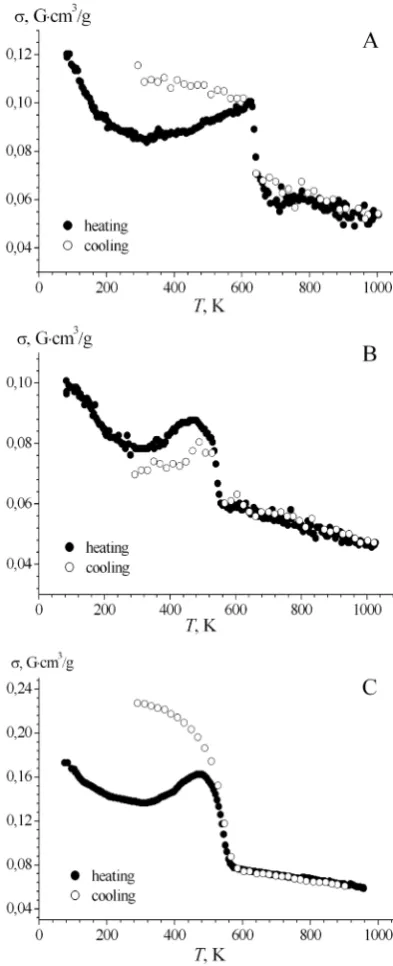
[image:2.595.57.549.692.743.2]Figure 2. Temperature dependences of specific magnetization of Bi0.85Nd0.15FeO3 (A), BiFe0.85Mn0.15O3 (B), and Bi0.85Nd0.15Fe0.85Mn0.15O3 (C)
powders
Partial substitution of bismuth ions by neodymium ions and of iron ions by manganese ions led to the expected decreasing of the unit cell parameters of solid solutions formed (according to [17], ionic radii of Bi3+, Nd3+, Fe3+ and
Mn3+ for C.N. = 6 are equal to 0.102 nm, 0.0995 nm, 0.0645
nm and 0.065 nm respectively [17]) which was most pronounced for double-subsituted Bi0.85Nd0.15Fe0.85Mn0.15O3
solid solution (Table 1).
On the IR-absorption spectra of Bi0.85Nd0.15FeO3 and
BiFe0.85Mn0.15O3 solid solutions having rhombohedrally
distorted perovskite structure four absorption bands with
maxima at 357–363 cm–1 (ν
1), 390 cm–1 (ν2), 436–445 cm–1
(ν3) and 550–553 cm–1 (ν
4) were observed (Figure 1). On
the IR-absorption spectrum of Bi0.85Nd0.15Fe0.85Mn0.15O3
having orthorhombically distorted perovskite structure only two absorption bands with maxima at 388 cm–1 (ν
2) and 561
cm–1 (ν
4) were found (Figure 1). According to [18], these
absorption bands correspond to the stretching (ν4) and bending (ν3) vibrations of the (Fe,Mn)–O bonds and vibrations of (Bi,Nd)–O bonds (ν1, ν2) in the crystal
structure of these complex oxides. We have previously found that for BiFeO3 values of ν1, ν2, ν3, and ν4 absorption
bands on the IR-absorption spectrum are equal to 350 cm–1,
384 cm–1, 430 cm–1, and 540 cm–1 respectively [9].
Comparing results of this work with the data for BiFeO3 we
can conclude that partial substitution of bismuth ions by neodymium ions and of iron ions by manganese ions in bismuth ferrite with perovskite structure leads to the increasing of energy of metal–oxygen interactions in the structure of (Bi,Nd)(Fe,Mn)O3 solid solutions. It should be
note that IR-absorption spectroscopy results are in a good accordance with the XRD data which show that unit cell parameters for(Bi,Nd)(Fe,Mn)O3 oxides are less than for
unsubstituted bismuth ferrite BiFeO3 (Table 1).
On the temperature dependences of specific magnetization of bismuth–neodymium ferrites–manganites during heating and cooling at temperatures below Neel temperature hysteresis was observed: values of specific magnetization of Bi0.85Nd0.15FeO3 and
Bi0.85Nd0.15Fe0.85Mn0.15O3 powders in the antiferromagnetic
region during cooling were larger (Figure2A, 2C), but for BiFe0.85Mn0.15O3 sample were smaller than during heating
(Figure 2B).
The reason of hysteresis observed is probably presence in the samples of small amounts of impurity phases – Bi25FeO39и Bi2Fe4O9 (Figure 1). Syllenite (Bi25FeO39) is
paramagnetic within 5–950 K [19] and for mullite (Bi2Fe4O9) magnetic phase transition from
antiferromagnetic into paramagnetic state take place at 260 K [20]. Taking this into account, the hysteresis on the σ = f(T) dependences for the (Bi,Nd)(Fe,Mn)O3 oxides
(Figure 2) can be associated with partial ordering having ferromagnetic nature of microdomains of impurity phases (syllenite and mullite) and microdomains of the main phase (solid solution on the base of perovskite bismuth ferrite) while cooling the samples in magnetic field.
The value of Neel temperature (TN) for Bi0.85Nd0.15FeO3
solid solution was 624 K, is close to the Neel temperature of BiFeO3 (640 K [2]), but for the BiFe0.85Mn0.15O3 and
Bi0.85Nd0.15Fe0.85Mn0.15O3 solid solutions TN values were
equal to 470 K and 473 K respectively (Table 2).
Thus, the intensity of the magnetic interactions of iron ions in bismuth ferrite BiFeO3at partial substitution of Fe3+
ions by Mn3+ ions decreases stronger than at the partial
Table 2. Magnetic properties of Bi0.85Nd0.15FeO3(BNFO), BiFe0.85Mn0.15O3(BFMO), and Bi0.85Nd0.15Fe0.85Mn0.15O3(BNFMO) ferrites
Sample TN, K Θ, K C, cm3·K/mol 103·∆χ, cm3/mol 103·χTN, cm3/mol 103·χT=0, cm3/mol
p
effexp , µBp
efftheor, µBBNFO 624 –1054 4.090 1.37 3.81 2.61 5.72 6.01
BFMO 470 –938 3.564 0.89 3.42 1.98 5.34 5.76
BNFMO 473 –764 3.932 2.96 6.14 2.57 5.61 5.86
The values of jump of molar magnetic susceptibility (∆χ) of (Bi,Nd)(Fe,Mn)O3 ferrites–manganites at their transition
from antiferromagnetic into paramagnetic state was ≈(0.9– 3.0)·10–3 cm3/mol and was greatest for
Bi0.85Nd0.15Fe0.85Mn0.15O3(Table 2). Value of molar
magnetic susceptibility of ceramics studied at Neel temperature varied within (3.4–6.1)·10–3 cm3/mol and was
maximal for Bi0.85Nd0.15Fe0.85Mn0.15O3 – 6.14·10–3 cm3/mol
(Table 2). Extrapolation of linear parts of χmol = f(T) dependences at T < TN to the T = 0 K for the samples studied gave us their χT=0 values (Table 2). It is known
thatfor uniaxial antiferromagnetics having two sublattices the theoretical valueof χT=0/χTN is 2/3 = 0.667 [21]. For
Bi0.85Nd0.15FeO3 this ratio (0.69) was close to the theoretical
value, but for BiFe0.85Mn0.15O3, and
Bi0.85Nd0.15Fe0.85Mn0.15O3 it was equal to 0.58 and 0.43
respectively, which is significantly smaller.
In the paramagnetic region the temperature dependences of molar magnetic susceptibility of the samples obeyed Curie–Weiss law
,
mol
T
C
χ
=
− Θ
(1) where C is a molar Curie constant and Θ is a Weiss constant (paramagnetic Curie temperature).Table 2 lists the values of constant of Curie–Weiss law (C and Θ), and the effective magnetic moment (
p
effexp ) per formula unit evaluated from the Curie constant (C) as3RC,
exp
peff NA B=
µ (2)
where R is gas constant, NA is Avogadro’s number, and μB is the Bohr magneton. Also given inTable 2 are ( theor
eff
p )
theoretical values obtained as 2 1
.
theor eff i ip
==
∑
µ
(3)Here µi is the magnetic moment per cation in the ith magnetic subsystem,
( 2)
i n n B
µ = + µ (4) where n is the average number of unpair electrons per magnetic cation (n = 3, 4, and 5 for Nd3+, Mn3+, and Fe3+
ions respectively).
As can be seen from the data given in the Table 2, for all
samples studied C values are close each other and paramagnetic Curie temperatures are negative, which points to a negative sign of exchange interactions between the magnetic ions in the structure, that is, to antiferromagnetic order of the magnetic moments of 3d transition metals cations (Fe3+ and Mn3+) and Nd3+ cations in the
(Bi,Nd)(Fe,Mn)O3 perovskites.
Ratio Θ/TN for the Bi0.85Nd0.15FeO3, BiFe0.85Mn0.15O3,
and Bi0.85Nd0.15Fe0.85Mn0.15O3 ferrites is equal to 1.69, 2.00,
and 1.62 respectively. Values of exp
eff
p
for Bi0.85Nd0.15FeO3, BiFe0.85Mn0.15O3,and Bi0.85Nd0.15Fe0.85Mn0.15O3 were 0.29 µB(4.8%), 0.42 µB(7.3%), and 0.25 µB (4.3%) respectively smaller than
theor eff
p
ones (Table 2) which is may be due to the high covalence of metal–oxygen bonds in the crystal structure of these oxides or due to the fact that part of iron or manganese ions present in the crystal lattice of these phases in the low-spin state.Comparing values of apparent density of the (Bi,Nd)(Fe,Mn)O3 samples (Table 3) with ρ values of
BiFeO3 ceramics, sintered at the same conditions (4.87
g/cm3 [9]) one can conclude that sinterability of BiFeO 3
derivatives deteriorates at partial substitution of bismuth ions by neodymium ions and improves at partial substitution of iron ions by manganese ions in these compounds.
Temperature dependences of the relative elongation of the samples were linear practically. So, within 300–750 K temperature region these complex oxides do not undergo the structural phase transitions. Value of LTEC (Table 3) for Bi0.85Nd0.15FeO3 and BiFe0.85Mn0.15O3 solid solutions
was larger but for Bi0.85Nd0.15Fe0.85Mn0.15O3 was smaller
than for BiFeO3 (11.9·10–6 K–1 [9]).
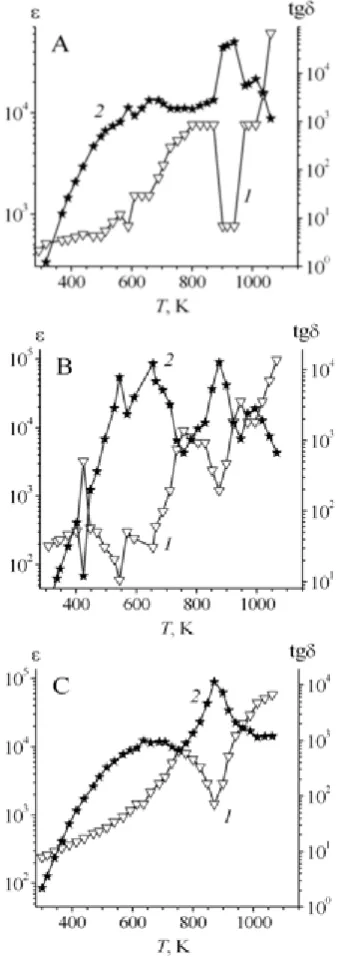
The dielectric susceptibility and dielectric losses of the samples studied, in the whole, increased at temperature increasing, passing through a number of extrema (minima for ε=f(T) dependences and maxima for tgδ=f(T) ones) (Figure3), associated with the transition samples from antiferromagnetic into paramagnetic phase (T≈TN) as well with processes of dipoles disordering which occurs in oxides (Bi,Nd)(Fe,Mn)O3 at elevated temperatures.
Values of ε300 and tgδ300 for Bi0.85Nd0.15FeO3,
BiFe0.85Mn0.15O3, and Bi0.85Nd0.15Fe0.85Mn0.15O3 were equal
Figure 3. Temperature dependences of dielectric susceptibility (1) and dielectric loss tangent (2) of Bi0.85Nd0.15FeO3 (A), BiFe0.85Mn0.15O3 (B),
andBi0.85Nd0.15Fe0.85Mn0.15O3 (C) ceramic samples.
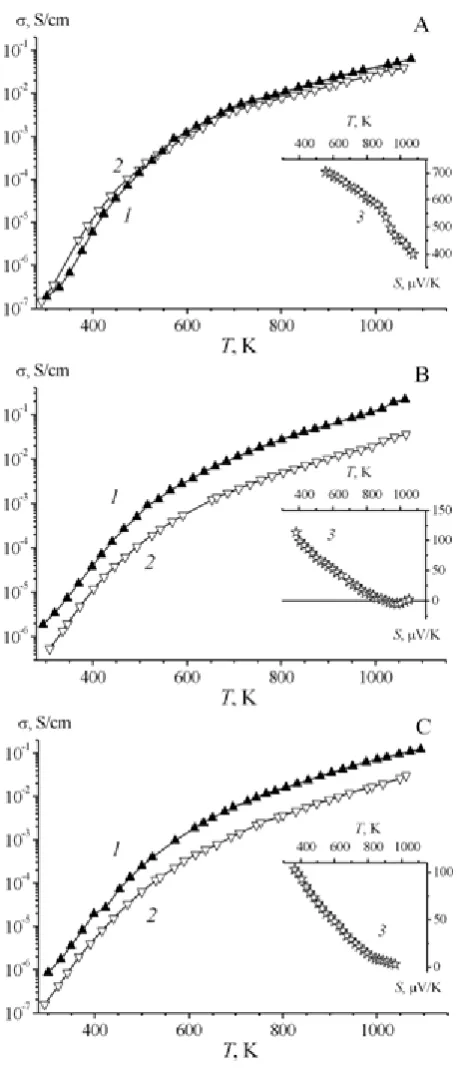
As can be seen from the Figure 4, all the (Bi,Nd)(Fe,Mn)O3 ceramic samples studied were
semiconductors (∂σ/∂T > 0) of p-type (for BiFe0.85Mn0.15FeO3
ceramics within 930–1030 K temperature interval the values of Seebek coefficient were negative (S<0)).
Values of DC electrical conductivity of bismuth– neodymium ferrites–manganites studied within 300–1100 K temperature interval varied within 1.9·10–7–0.062 S/cm,
1.9·10–6–0.218 S/cm, and 8.6·10–7–0.221 S/cm for
Bi0.85Nd0.15FeO3, BiFe0.85Mn0.15O3, and
Bi0.85Nd0.15Fe0.85Mn0.15O3 respectively and at elevated
temperatures were significantly larger than for unsubsituted bismuth ferrite (according to [9], σ values for BiFeO3
increased from 1.3·10–6 to 0.026 S/cm at temperature
increasing from 300 to 1100 K). Comparing results, obtained for (Bi,Nd)(Fe,Mn)O3 oxides, one can conclude
that partial substitution of iron ions by manganese ions in BiFeO3 results in higher increasing of σ values of ceramics
forming than partial substitution of bismuth ions by neodymium ions.
Values of DC and AC electrical conductivity of Bi0.85Nd0.15FeO3 compound for all temperature interval
studied were close each other (Figure 4A), but for BiFe0.85Mn0.15O3 and Bi0.85Nd0.15Fe0.85Mn0.15O3 samples DC
electrical conductivity values were larger than AC ones (Figure 4B, C). The last is probably due to the fact that the electrical conductivity of these samples are making a significant contribution impurity phases (Bi25FeO39,
Bi2Fe4O9 and their solid solutions), located at the grain
boundaries of ceramics and having a higher conductivity than the main phase(BiFe0.85Mn0.15O3 and
Bi0.85Nd0.15Fe0.85Mn0.15O3 perovskite solid solutions)
The values of activation energy of electrical conductivity (EA) of the (Bi,Nd)(Fe,Mn)O3samples ranged within 0.454–
0.547 eV (DC), 0.454–0.499 eV (AC) (Table 3) and were significantly lower than for BiFeO3 (0.632 eV [9], 0.628 eV
[22]. Thus, partial substitution of Bi3+ by Nd3+ and of Fe3+ by
Mn3+ in BiFeO
3 leads to decreasing of activation energy of
[image:5.595.93.263.78.558.2]electrical conductivity of solid solutions forming, herewith the minimal values of EA possesses the Mn-substituted compound and for Nd- and Nd,Mn-substituted samples the EA values are close each other.
Table 3. Values of apparent density (ρ), linear thermal expansion coefficient (α) and charge carriers transfer parameters (EA, ES, Em) for Bi0.85Nd0.15FeO3,
BiFe0.85Mn0.15O3, and Bi0.85Nd0.15Fe0.85Mn0.15O3 sintered ceramics
Sample ρ, g/cm3 α·106, K–1 DC A
E
, eVE
AAC, eV ES, eV Em, eVBi0.85Nd0.15FeO3 4.80 12.9 0.540 0.487 0.212 0.328
BiFe0.85Mn0.15O3 5.40 13.4 0.454 0.454 0.073 0.381
[image:5.595.65.548.634.715.2]Figure 4. Temperature dependences of DC (1) and AC (2) electrical conductivity and thermo-EMF (3) of Bi0.85Nd0.15FeO3 (A), BiFe0.85Mn0.15O3
(B), and Bi0.85Nd0.15Fe0.85Mn0.15O3 (C) sintered ceramics
Values of thermo-EMF coefficient for (Bi,Nd)(Fe,Mn)O3
ceramics were lower than for unsubstituted bismuth ferrite (according to [9], Seebek coefficient of BiFeO3 within 623–
1073 K varies from 595 to 1000 µV/K) (Figure 4), and for Mn-containing solid solutions, taking into account the values of their electrical conductivity, were abnormally low (so, for example, within 600–800 K temperature region σ(BiFe0.85Mn0.15O3) ≈ σ(Bi0.85Nd0.15Fe0.85Mn0.15O3), but
S(BiFe0.85Mn0.15O3) >> S(Bi0.85Nd0.15Fe0.85Mn0.15O3)), and
for BiFe0.85Mn0.15O3 the temperature coefficient of
thermo-EMF at 980 K changed sign from negative (∂S/∂T < 0) to positive (∂S/∂T > 0) (Figure 4B). Similar anomalies of thermo-EMF are not typical for semiconductors, but may occur in the strongly correlated systems, which include many perovskites and layered cobaltites of REE and barium, layered sodium or calcium cobaltites as well as perovskite bismuth ferrite.
So, in the work [23] at describing of thermo-EMF of sodium cobaltite NaxCoO2was used modificated Heikes’s
equation
3 4
4 3
[Co ]
ln ,
[Co ] g k S
e g
+ +
=
(5)
where k is Boltzmann’s constant, e is charge of electron, g4
and g3 are degeneracy of Co4+and Co3+cations respectively,
and [Co3+] and [Co4+] are their concentrations in the
NaxCoO2structure.
It was shown by authors of [22] that depending on spin states (low-spin state, intermediate-spin state, high-spin state) of Co4+ and Co3+ cobalt cations in the Na
xCoO2structure the
value of thermo-EMF coefficient of this phase can vary from –84 to 214 µV/K. Taking it into account we can assume that partial substitution of iron ions by manganese ions in BiFeO3
leads to the change of spin state of iron ions in the structure of the Mn-substituted solid solutions which stipulates observed anomalies of thermo-EMF of the BiFe0.85Mn0.15O3,
Bi0.85Ln0.15Fe0.85Mn0.15O3 phases.
Temperature dependences of electrical conductivity and thermo-EMF of strongly correlated systems are described with the formulae
exp EA ,
A
T kT
σ = −
(6)
exp ES ,
k
S B
e kT
= − +
(7)
where EA = ES + Em and ESare the activation energies of
electrical conductivity and thermo-EMF, herewith the ES characterizes the excitation energy of charge carriers and Em does energy of their transfer [24].
In [9] was found that for BiFeO3ES and Em values were
equal to 0.422 and 0.210 eV respectively. As it follows from the data given in the Table 3, the partial substitution Nd3+ → Bi3+, Mn3+ → Fe3+ in BiFeO
3 significantly reduces
excitation energy of charge carriers but increases the energy of their transfer, herewith electrical transport is the most difficult for the double-substituted Bi0.85Nd0.15Fe0.85Mn0.15O3
solid solution which is characterized by highest concentration of ions substituents.
3. Conclusions
By means of solid state reactions method the
Bi0.85Nd0.15Fe0.85Mn0.15O3 bismuth–neodymium ferrites–
manganites solid solutions were synthesized and their crystal structure, magnetic susceptibility, thermal expansion, electrical conductivity, thermo-EMF, dielectric susceptibility and dielectric losses were studied and the effect of partial substitution of Bi3+ by Nd3+ and of Fe3+ by
Mn3+ on the crystal structure and physicochemical properties
of the (Bi,Nd)(Fe,Mn)O3 solid solutions was discussed.
It was found that Bi0.85Nd0.15FeO3 and BiFe0.85Mn0.15O3
compounds had rhombohedrally distorted perovskite structure (space group R3c), but Bi0.85Nd0.15Fe0.85Mn0.15O3
one had orthorhombically distorted perovskite structure (space group Pnma) and all the complex oxides studied were the antiferromagnetic p-type semiconductors, which electrical conductivity values were large than for based bismuth ferrite BiFeO3, Neel temperature and thermo-EMF
coefficient sharply decreased at partial substitution of iron by manganese and linear thermal expansion coefficient values varied within (10.0–13.4)·10–6 K–1. It was established that
partial substitution Nd3+ → Bi3+, Mn3+ → Fe3+ in BiFeO 3
reduces excitation energy of charge carriers but increases the energy of their transfer in the (Bi,Nd)(Fe,Mn)O3 solid
solutions.
Acknowledgements
Authors are very grateful to Kononovich V.M. (Belarus State Technological University) for recording of X-ray diffraction spectra of the samples, to Galyas A.I. (Scientific and Practical Materials Research Centre of the NAS of Belarus) for measurement of specific magnetization of the samples and to professor Bashkirov L.A. (Belarus State Technological University) for the helpful discussions of magnetic properties of the samples. This work was supported by Belarusian Republican Foundation for Fundamental Research (grant X13–005).
REFERENCES
[1] A.P. Pyatakov, A.K. Zvezdin. Magnitoelectric and multiferroic media, Physics-Uspekhi, Vol. 55, No. 6, 557– 581, 2012.
[2] I.O. Troyanchuk, M.V. Bushinsky, A.N. Chobot, O.S. Mantytskaya, N.V. Tereshko. Weak ferromagnetism in BiFeO3-based multiferroics, JETP Letters, Vol. 89, No. 4,
180–184, 2009.
[3] G. Catalan, J.F. Scott. Physics and Applications of Bismuth Ferrite, Adv. Mater., Vol. 21, 2463–2485, 2009.
[4] P. Suresh, S. Srinath. Observation of high coercivity in multiferroic lanthanum doped BiFeO3, J. Alloys and Comp., Vol. 554, 271–
276, 2013.
[5] P. Sati, M. Arora, S. Chauhan, M. Kumar, S. Chhoker. Effect of Dy substitution on structural, magnetic and optical
properties of BiFeO3 ceramics, J. Phys. and Chem. of Solids,
Vol. 75, 105–108, 2014.
[6] D. Kothari, V.R. Reddy, A. Gupta, D.M. Phase, N. Lakshmi, S.K. Deshpande, A.M. Awasthi. Study of the effect of Mn on the BiFeO3 system, J. Phys.: Condens. Matter., Vol. 19,
136202 (8 pages), 2007.
[7] A. Kumar, K.L. Yadav. A systematic study on magnetic, dielectric and magnetocapacitance properties of Ni doped bismuth ferrite, J. Phys. and Chem. of Solids, Vol. 72, 1189–1194, 2011.
[8] V.V. Ivanova, V.V. Gagulin, S.K. Korchagina, Yu.A. Shevchuk, V.V. Bogatko. Synthesis and Properties of BiFeO3–DyMnO3, Inorg. Mater., Vol. 79, No. 7, 745–748,
2003.
[9] A.I. Klyndyuk, Ye.A. Chizhova, A.A. Zatsiupo, L.A. Bashkirov, V.V. Gusarov, Ye.A. Tugova. Synthesis, structure and physicochemical properties of the solid solutions in the BiFeO3–PrCoO3 quasi-binary system, Proc. NAS of Belarus,
Ser. Chem.. sci., No. 4, 5–9, 2012. [in russian]
[10] A.A. Zatsiupa, L.A. Bashkirov, G.S. Petrov, L.S. Lobanovskii, S.V. Trukhanov, Magnetic Properties of Ferrites–Cobaltites Bi1–xLaxFe1–xCoxO3 (1.0 ≥x≥ 0.7) with a
Perovskite Structure, Glass Phys. Chem., Vol. 39, No 5, 589– 596, 2013.
[11] A.I.Klyndyuk, Ye.A. Chizhova. Thermoelectric properties of the layered oxides LnBaCu(Co)FeO5+δ (Ln = La, Nd, Sm, Gd),
Funct. Mater., Vol. 16, No 1, 17–22, 2009.
[12] A.I. Klyndyuk, E.A. Chizhova. Structure and Properties of Solid Solutions of La1–xPrxBaCuFeO5+δ, Glass Phys. Chem., Vol. 38, No. 2,
234–239, 2012.
[13] M.I. Morozov, N.A. Lomanova, V.V. Gusarov. Specific Features of BiFeO3 Formation in a Mixtures of Bismuth (III)
and Iron (III) Oxides, Rus. J. Gen. Chem., Vol. 73, No 11, 1676–1680, 2003.
[14] M.S.Bernardo, T. Jardiel, M.Peliteado, A.C. Caballero, M. Villegas. Reaction pathways in the solid state synthesis of multiferroic BiFeO3, J. Eur. Ceram. Soc., Vol. 31, 3047–3053,
2011.
[15] A.I. Klyndyuk, E.A. Chizhova. Structure, Thermal Expansion, and Electrical Properties of BiFeO3–NdMnO3 Solid Solutions,
Inorg. Mater., Vol. 51, No. 3, 272–277, 2015.
[16] J.M. Moreau, C. Michel, R. Gerson, W.J. James. Ferroelectric BiFeO3 X-ray and neutron diffraction study, J. Phys. and
Chem. of Solids, Vol. 32, 1315–1320, 1971.
[17] R.D. Shannon, C.T. Prewitt. Revised Values of Effective Ionic Radii, Acta Crystallogr. Vol. 25B, Pt. 5, 946–960, 1969. [18] V.Annapu Reddy, N.P. Pathak, R. Nath. Particle size dependent magnetic properties and phase transitions in multiferroic BiFeO3
nano-particles, J. Alloys Comp., Vol. 543, 206–212, 2012. [19] A.A.Zatsiupa, L.A.Bashkirov, I.O.Troyanchuk, G.S.Petrov,
A.IGalyas, L.S.Lobanovsky, S.V.Trukhanov. Magnetization, magnetic susceptibility, effective magnetic moment of Fe3+
ions in Bi25FeO39 ferrite, J. of. Solid State Chem., Vol. 212,
147–150, 2014.
[20] J.–T. Han, Y.–H. Huang, R.J. Jia, G.–C. Shan, R.–Q. Guo, W. Huang, Synthesis and magnetic property of submicron Bi2Fe4O9,
[21] S.G. Krinchik. Physics of Magnetic Phenomena, MSU, Moscow, 1976. [in russian]
[22] M. Yasin Shami, M.S. Awan, M. Anis-ur-Rehman. Phase pure synthesis of BiFeO3 nanopowders using diverse
precursor via co-precipitation method, J. Alloys and Comp.,
Vol. 509, 10139–10144, 2011.
[23] W. Koshibae, K. Tsutsui, S. Maekawa. Thermopower in cobalt oxides, Phys. Rev. B., Vol. 62, No. 11, 6869–6872, 2000–I. [24] N. Mott, E. Davis. Electronic processes in Non-Crystalline