IN VITRO SHOOT MULTIPLICATION IN SIMMONDSIA CHINENSIS
(LINK) SCHN.).
Somnath kirwale and Narayan Pandhure Tissue culture Laboratory,Department of Botany,
Dr. Babasaheb Ambedkar Marathwada University, Aurangabad
Simmondsia chinensis seedling explants were cultured on a MS medium, supplemented with various concentrations of 6-benzyladenine viz, 1.0, 1.5, 2.0, 2.5, 3.5, 4.0, 4.5 and 5.0 mg/l alone and in combination with silver nitrate. Shoot proliferation was successful at all the concentrations tested, with 3.0 mg/l BAP and lower concentration of IAA maximum number of shoots per original explant. Shoots produced during the proliferation stage were treated with -naphthalene acetic acid, indole-3-butyric acid and indole-3-acetic acid to induce rhizogenesis, reaching 64% rooting in some treatments. When the rooted explants were transferred to the mist system for acclimatization, 35% to 50% of them survived and continued to grow after a period of one month.
Key Words: In vitro, Simmondsia chinensis , Shoot multiplication.
Introduction:
The Simmondsia chinensis belong to family Simmondsiaceae (jojoba family),
has only 1 genus, Simmondsia, which consists of only one species, jojoba, S. chinensis. Once
considered an isolated member of the box family (Buxaceae), jojoba is now regarded as
sufficiently distinct to be placed in its own family. Jojoba is found from coastal and
cismontane southern California east to central Arizona and south to Sonora and Baja
California (Munz 1974). It is a characteristic plant of upland shrub communities in the
Sonoran and Colorado Deserts and is also quite common as a component of chaparral. The
scientific name of Simmondsia chinensis, Jojoba does not originate in China; the botanist
Johann Link, originally named the species Buxus chinensis, after misreading a collection
label "Calif" as "China". Jojoba is a sparsely branched, decumbent to erect shrub that grows
to 2 or rarely 3 m in height. Its large (2- to 4-cmlong), opposite, entire leaves are evergreen,
leathery, and dull gray. Plants are extremely tolerant of drought (Al-Ani and others 1972) and
their foliage is a source of nutritious forage for sheep, goats, and cattle, as well as for wild
ungulates and smaller browsers such as rabbits. The large seeds have been used locally as a
food source by indigenous people. In large quantities, the seed meal is toxic to many
mammals, and the indigestible wax acts as a laxative in humans. The Seri, who utilize nearly
every edible plant in their territory, do not regard the beans as real food and in the past ate it
only in emergencies. The most noteworthy feature of jojoba from a human perspective is the
unusual liquid wax that makes up the storage reserve of its seeds. This substance, a fatty acid
ester of a long-chain alcohol, is unique in the plant kingdom. It has chemical and rheological
properties similar to those of sperm whale oil, which make it useful in a host of applications.
Jojoba oil is used as a replacement for whale oil and its derivatives, such as cetyl
alcohol. The ban on importing whale oil to the US in 1971 led to the discovery that jojoba oil
is "in many regards superior to sperm oil for applications in the cosmetics and other
industries. Jojoba oil is found as an additive in many cosmetic products, especially those
marketed as being made from natural ingredients. In particular, such products commonly
containing jojoba are lotions and moisturizers, hair shampoos and conditioners. Or, the pure
oil itself may be used on skin, hair, or cuticles.[10][11]Jojoba oil is a fungicide, and can be used
for controlling mildew. Like olestra, jojoba oil is edible but non-caloric and non-digestible,
meaning the oil will pass through the intestines unchanged and can cause a stool condition
called steatorrhea. Jojoba biodiesel has been explored as a cheap, sustainable fuel that can
serve as a substitute for petroleum diesel.
MATERIALS AND METHODS
Jojoba seedlings were grown in the greenhouse of botanical garden; these plants were used as
experimental material. Plants were grown in the beds. The temperature in the greenhouse
varied from 28 to 320C. No artificial light was provided. Various explants were used for
establishing present works, including nodal segment, axillary shoots, etc. Axillary shoot and
nodal segments were taken from six month -old plants while axillary shoots and root segment
explants were removed from 10–15 day-old seedlings. Axillary shoots (0.5–0.8 cm) taken
with 0.01% (w/v) mercuric chloride for 2–3 min, washed 3– 4 times with sterile double
distilled water and inoculated on agar solidified MS medium supplemented with different
concentrations of KIN, BAP, IAA, and IBA either alone or in combination. The pH of the
medium was adjusted to 5.8 before the autoclave. Cultures were maintained at 25±1ºC with a
16-h photoperiod with 40 mol m²/s provided by cool white fluorescent tubes light.
In vitro culture was sub cultured after 25 days on the original multiplication-inducing
medium. For the growth of axillary shoots arise from using the nodes of nodal segments as an
explants. Nodal segments (1–2 cm) were taken from lateral branches and surface-sterilized
with 0.2% mercuric chloride and inoculated on agar-solidified MS medium supplemented
with different concentrations of BA and KIN (alone or in combination). For root segments of
10–15 day old seedlings were cultured on the MS-based agar solidified medium
supplemented with 2, 4-D (2 mg /l) and KIN (0.2mg /l) for callus formation. Tubes
inoculated with root segments (0.8–1.0 cm) were incubated both in light and dark at 25ºC.
Culture conditions
After the inoculation culture tubes and culture vessels were transfers to culture room under a
16 h photoperiod supplied by cool white fluorescent tubes light and 21 ± 0C temperature. At
least ten cultures were raised for each treatment.
Data record
Data were measured after 30days of five replicate for, shoot multiplication and shoot length
Mean (µ) values ± SE.
RESULTS AND DISCUSSION
The explants did not show any activity of shoot initiation when cultured on control medium
(without PGRs) or on those containing only an auxin at lower concentration.
Multiplication of Shoots
Small (0.5 cm) individual shoots from 5-week-old cultures inoculated on 1/2 MS+BAP
(1.0mg/l) + IAA (0.5mg/l) these culture no effect of shoot multiplication. When these excised
shoots were carefully transferred to full-strength MS medium supplemented with BAP on
various concentration viz, 1.0, 1.5, 2.0, 2.5, 3.5, 4.0, 4.5 and 5.0 mg/l and lower
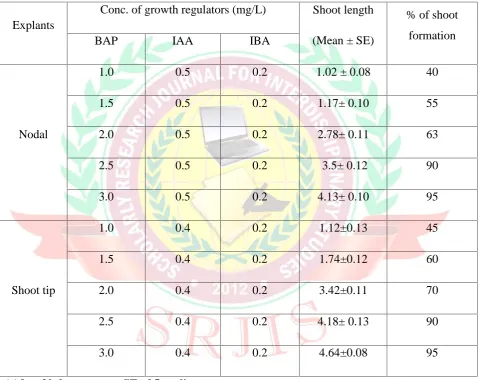
concentration of IAA or IBA as shown table 1, for elongation of shoots and multiplication of
shoots. Though each axillary shoot, which had grown fairly long, when these were cut into
single node segments and transferred to fresh medium for further multiplication. The number
And other multiplication treatments examined were various concentration cytokinin like BAP
and KIN combination with Auxins IAA or IBA at lower concentration. At least 12-cultures
were raised for each treatment and all the experiments were repeated at three times.
Observations on number of cultures showing contamination, bud-break, shoot elongation and
[image:4.595.67.547.215.595.2]rooting were made at weekly intervals. Mean was calculated and is indicated by sign.
Table 1:- Effect of BAP for multiplication of nodal and shoot tip explants
Explants
Conc. of growth regulators (mg/L) Shoot length
(Mean ± SE)
% of shoot
formation
BAP IAA IBA
Nodal
1.0 0.5 0.2 1.02 ± 0.08 40
1.5 0.5 0.2 1.17± 0.10 55
2.0 0.5 0.2 2.78± 0.11 63
2.5 0.5 0.2 3.5± 0.12 90
3.0 0.5 0.2 4.13± 0.10 95
Shoot tip
1.0 0.4 0.2 1.12±0.13 45
1.5 0.4 0.2 1.74±0.12 60
2.0 0.4 0.2 3.42±0.11 70
2.5 0.4 0.2 4.18± 0.13 90
3.0 0.4 0.2 4.64±0.08 95
*After 30 days mean ± SE of 5 replicate
Root initiation
For rooting, terminal 3 cm long portions of elongated shoots with 3–4 nodes were excised and cultured on MS medium supplemented with indole-3-butyric acid (IBA) or NAA in the
range of 1 to 5 mg/l. MS+ 1.0 mg l IBA, MS+ 2.0 mg l IBA, MS+ 3.0 mg l IBA, MS+ 4.0 mg
l IBA, MS+ 5.0 mg l IBA. Another treatments examined for rooting were MS basal medium
simultaneously promote both elongation and rooting. Shoot proliferation was successful at
the entire concentrations tested, with a maximum number of 10-15 shoots per original
explants. When the rooted explants were transferred to the green house for acclimatization,
35% to 50% of them survived and continued to grow after a period of one month. MS+BAP
3mg /l + kin 1.5mg /l proved optimum for shoot multiplication but it did not facilitate Shoot
growth. Therefore, 0.5 cm long individual shoots were excised carefully after 5 weeks and
transferred to MS+BAP 1mg /l supplemented with 0.5mg/l IAA or IBA for elongation. On M
S+BAP 1mg/l, the original shoot attained a length of 8.5 cm, with 8 nodes, after 5 weeks in
95% cultures Thus, eight-fold shoot multiplication every 5 weeks could be achieved on
MS+BAP by cutting the solitary shoot into s ingle node segments and culturing them on
fresh medium. This rate of shoot multiplication was maintained. More than 20 times the
nodal explants were taken and used for shoot multiplication. Since every time the explants
were taken from freshly formed in vitro shoots, therefore, we have not observed any
significant difference (variation) in the results, this was observed. Islam et al., (1997) used a
medium with a lower level of BAP (0.1 mg/ l) for shoot elongation, suggesting that the shoots
remained very small on the multiplication medium and required an elongation step to obtain
shoots suitable for rooting.
REFERENCES
A. R. Place, 1992. "Comparative aspects of lipid digestion and absorption: physiological
correlates of wax ester digestion" (abstract). AJP - Regulatory, Integrative and Comparative
Physiology 263 (3): 464–R471. PMID 1415629. Retrieved 2008-03-17.
Al-Ani H.A., Strain B.R., Mooney H.A. 1972. The physiological ecology of diverse
populations of the desert shrub Simmondsia chinensis. Journal of Ecology 60: 41–57.
D.J. Undersander, E.A. Oelke, A.R. Kaminski, J.D. Doll, D.H. Putnam, S.M. Combs,
and C.V. Hanson (1990). "Jojoba". Alternative Field Crops Manual.
Islam, R., A. Hoque, M. Khalekuzzaman and O.I. Joarder, 1997. Micropropagation of
Azadirachta indica A. Jus s . from explants of mature plants . Plant Tis sue Cult., 7: 41–46. Munz P. A. 1974. A flora of southern California. Berkeley, University of California Press.
1086.
Murashige T, Skoog F (1962). A revised medium for rapid growth and bioassay for tobacco
tissue cultures. Physiol. Plant. 15: 473-497.
Steven J. Phillips, Patricia Wentworth Comus (eds.) (2000). A Natural History of the