Quality Samples for Reliable Results
Eng. Suhad Ali Jumean*, Eng. Tareq I. Al-Shawaheen**
*Royal Medical Services, Amman-Jordan
** UTM-IJN Cardiovascular Engineering Center, School of Biomedical Engineering and Health Sciences, Faculty of Engineering, Universiti Teknologi Malaysia, 81310 UTM Johor Bahru, Johor, Malaysia. email address:[email protected]
DOI: 10.29322/IJSRP.8.11.2018.p8351
http://dx.doi.org/10.29322/IJSRP.8.11.2018.p8351
Abstract—Always there is a potential for laboratory results to become wrong results. Therefore, performing quality control using quality samples on the medical devices existed in the laboratory will be with great benefits as well as ensuring the perfect performance of the equipment.
Motivation: In this paper, some important highlights will be reported. Some definitions of the associated terms will be discussed.
Method: Some well-known papers will be referred to in order to provide some valuable information about this topic.
Conclusion: Performing a quality sample provide correct information and enables the medical staff to make preventive or corrective measures early.
Keywords: Quality Parameters and Quality Sample.
1. INTRODUCTION
Recently, the interest in the medical sector has increased and technology has invaded all
its fields. However, the doctor, the nurse and the patient are also keen to obtain laboratory
results that are of high accuracy and do not expose the patient to the suffering of repeated
sample work again. Not only this, but also reducing the chances of waste of resources in the
labs, preservation of property and reduce its expenses. From here, the term “control sample” is
emerged recently [1, 2].
A control sample is known as controls and is defined as any type of any
well-known forensic sample and its objective is to ensure analyses, as well as tests, are properly
of composition, identification, source and type. Researchers and scientists illustrate the
importance of these samples in two approaches:
i. Assure that a test run is valid.
ii. Assure that results are reliable [3].
In the laboratory technology, control samples should be utilized in the execution of each
inspection. Moreover, control samples should be addressed in the precise same technique as the
test samples and are used to validate the test run[4]. Recently, each laboratory should employ its
standards for run acceptance established on instructions from the manufacturer's kit (i.e. the
negative and positive control provided with the kit) insert and in-lab validation of an external
quality control sample.
2. ANALYSES WORKFLOW
Before the delivering of the first lab test, the journey starts. It starts with making a
calibration to the devices. Some devices might be programmed in advance to make a self-test
every morning at a specific time and some devices ask the technician to make the calibration
because it may require some reagents. Each workflow involving different consecutive steps that
modify depending on the sample type and iterate the sample until it is contingent to extract its
information and turn it into actionable results. Challenges are within every step promptly
regarded to the sample type and analysis technologies, and at each step, there is a high risk for
things to go in the wrong direction. Therefore, performing accurate quality control is of high
importance to ensure quality results and reliable interpretation[5].
In fact, there are four significant quality parameters which enable to characterize the
quality of what is called the nucleic acid samples and these four parameters determined
depending on the downstream application. The four parameters are: quantity, purity, size and
sequence. Before considering the features embedded in these parameters, it is important to note
the importance of the stability in these parameters. Indeed, various variation in these parameters
may manipulate the experiments and impact the data quality as well as results interpretation.
The influence of the four significant parameters on downstream applications should be
with great effort. This influence implies evaluating these parameters, performing quick and
simple quality control of various measures and increase the chances of success on the assay[6].
In general, quantity implies enough material to perform the assay. It is the first step to
ensure the correct results. The technician should be able to determine the accurate sample
quantification. However, the accidental estimation errors might impact the downstream assays.
Figure (1) below shows three bottles with different materials to perform the assay and it is easily
seen that first bottle on the right is the one with the suitable quantity.
Fig (1): Quantity Parameter
Another parameter impacts the results of an assay is the purity. It is the parameter that
ensures that the sample does not contain any contaminants. As a consequence, impurities have a
high risk to interpose with the downstream application. Figure (2) below illustrates this
parameter and it is obvious that the bottle in the middle is the one with no contaminants.
Fig (2): Purity Parameter
An equally significant aspect is the size parameter. The size parameter can be defined as
Accordingly, estimating the size of the nucleic acid size distribution affords insights into the
integrity of the sample, in addition, this action will distinguish any poor quality or any degraded
samples that are not well performed for analysis. Figure (3) below shows the size parameter
Fig (3): Size Parameter
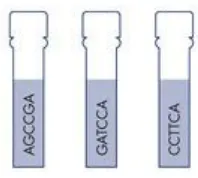
At last, the sequence is the fourth parameter. Performing this parameter enables the
technician to assure that the sample is the with the right genotype. It is the final step; it is
considered as the primary validation step. This parameter ensures that the technician is
performing the full credit to obtain right results interpretation. Figure (4) below illustrates this
parameter
Fig (4): Sequence Parameter
A lot of risks face the technicians of a laboratory when neglecting the principles of
quality control in general and quality samples specifically. Performing these actions in the
morning demand not more than a few minutes and does not cost a lot of money. On the contrary,
performing these actions has the possibility to ensure that the technicians' task is performing the
samples of the highest quality so, in other words, it might save the money as well as the time.
Validating everything associated with a quality control in its right way in the lab might
ensure in advance stages a profitable investment. Also, it is very important to use
[image:4.612.255.354.397.486.2]researchers and scientists are much more sensitive to detection technologies than before. But we
should also consider that these technologies are not necessarily more firm in terms of tolerating
variations into the quality of a sample.
3. CONCLUSIONS
Monitoring the success of any experiment stands in front of a lot of parameters. The
control sample characterizes the ultimate success step and it is important to ensure the existence
of the four parameters before performing the assay.
4. REFERENCES
1. Lyon, L., W. Jeng, and E. Mattern, IJDC| Peer-Reviewed Paper. International Journal of
Digital Curation, 2017. 12(1): p. 46-64.
2. Frye, S.V., et al., Tackling reproducibility in academic preclinical drug discovery. Nature Reviews Drug Discovery, 2015. 14(11): p. 733.
3. Freedman, L.P., I.M. Cockburn, and T.S. Simcoe, The economics of reproducibility in preclinical research. PLoS biology, 2015. 13(6): p. e1002165.
4. Betsou, F., et al., Identification of evidence-based biospecimen quality-control tools: a report of the International Society for Biological and Environmental Repositories (ISBER) Biospecimen Science Working Group. The Journal of Molecular Diagnostics, 2013. 15(1): p. 3-16.
5. Ilie, M., et al., Use of circulating tumor cells in prospective clinical trials for NSCLC patients–standardization of the pre-analytical conditions. Clinical Chemistry and Laboratory Medicine (CCLM), 2018. 56(6): p. 980-989.