Mapping the Potential for Social Enterprises in Coastal
Areas
Kresnawati*, Siti Hanila**
* Department of Accounting, Universitas Dehasen Bengkulu, email; [email protected] ** Department of Management, Universitas Dehasen Bengkulu, email; [email protected]
DOI: 10.29322/IJSRP.9.12.2019.p9678 http://dx.doi.org/10.29322/IJSRP.9.12.2019.p9678
Abstract- This research was conducted in order to obtain the best
innovation strategy for Village-Owned Enterprises (BUMDES) to improve the economic welfare of the coastal communities of Sukasari, Lawang Agung and Kunkai Baru, Seluma Regency. Mapping analysis of potentials and problems that occur in BUMDES in coastal areas is done by using the Focus Group Discussion (FGD) method through SWOT analysis techniques and Criterium Plus - Analytical Hierarchy Process analysis. The results of the study show that there are 4 priority problems that occur in existing BUMDES, namely the problem of weak financial governance, weak BUMDES management, limited marketing access, and the similarity of the BUMDES business field to other BUMDES. Problem solving strategies can be carried out through efforts to build marketing networks, business feasibility studies through BUMDES health checks and build synergies with local governments.
Index Terms- Strategy; Bumdes; Welfare; Coastal Society
I. INTRODUCTION
n the Village Law, BUMDesa defined as a business entity whose entire or most of the capital is owned by the Village through direct participation from village assets that are separated to manage assets, services, and other businesses for the maximum welfare of the village community. In its development, the Village-Owned Enterprises (BUMDes) in encouraging the protection of the community through the business units they built, are still far from expectations (Purnamasari, 2017). The factors that influence it include: Understanding the village apparatus about BUMDES is very lacking, the concept of village development is still limited to understanding physical development and on the direction of the structure from above. Weak human resource development so that village institutional and entrepreneurial capacity is not developing. Communication between the village elite and community members regarding various issues has not been going well.
Other factors include corrupt behavior, making the spirit of creating social change for the community become sluggish, and even mimic those actions. Evidently there are hundreds of village heads who are currently facing court because they are suspected of misusing village funds for their own interests. Many government programs before BUMDes such as KUD, BUUD and various other programs failed. Some villagers thought that they did not have to return the funds that should have been
capital for village businesses run by BUMDes. Inadequate mastery of managerial skills, and it is still difficult to convince young people that BUMDes can guarantee prosperity for its activists. Conditions that make young people have not been much active in BUMDes, resulting in the business logic built by most BUMDes implemented with conventional models and not many innovations have been carried out by BUMDes.
The continuous campaign that creates the image that BUMDes must generate substantial profits in the form of benefit (rupiah) is evident from the measure of BUMDes success, which often measured from the profits deposited into the village treasury. This perspective makes the village heads and village officials add a heavy burden because they have to create business units with significant turnover and profit for the village. On the other hand the issue of economic welfare, especially in coastal areas still needs to be a concern of the government. Common problems faced by coastal communities include poverty levels (economic uncertainty), damage to coastal resources, and environmental health, as well as the use of marine areas for fishermen (Firdaus, 2017).
Some things that become fundamental problems for BUMDes, in general, are the limited human resources in managing the business units contained on BUMDes itself. The lack of innovation in managing Production for BUMDes whose business units in the field of Production and tourism make its problems. The products produced by BUMDes have not been able to compete with factory-made Production, and the ability to explore the economic potential of the village and business planning is still lacking.
Inside Seluma Regency, Bengkulu Province, a total of 177 BUMDes stood out of a total of 182 villages, with 145 BUMDes said to be active (DPMD Bengkulu Province, 2019). Of these, the average BUMDes position is still in the pilot BUMDes cluster position. Characteristics of start-up BUMDes marked by traditional management systems, limited human resources, and inadequate marketing. Sukasari, Kungkai Baru and Lawang Agung villages are part of the Air Periukan sub-district, Seluma Regency, Bengkulu Province (map of Seluma district, 2017). These three villages located in coastal areas directly adjacent to the Indian Ocean. As a coastal region, these villages have potential coastal resources, including agricultural and plantation products such as oil palm, corn, and coconut, as well as livestock products such as fish ponds and cattle, and marine products such as fish, shrimp, and fish ponds. With this potential, supported by the existing BUMDes it should be able to improve the welfare of
the people in the coastal region. Necessary study in mapping the BUMDes problem so that the right problem solving obtained. This study aims to examine the efforts made by BUMDes to improve the potential and economic prosperity in the coastal area of Air Periukan District. The output of this research is to find the right innovation strategy and hope that the one village one product program can be realized based on the potential and available resources.
II. MATERIALS AND METHODS
1. Village-Owned Enterprises (BUMDES)
BUMDes is a business entity determined through a Village Regulation based on the results of a Village Deliberation decision, based on a Village Regulation. It does not require endorsement from a Notarial Deed. However, based on Article 7 of Law Number 6 of 2014 concerning Villages, BUM Desa can consist of business units with legal entities such as Limited Liability Companies (PT) and Micro Finance Institutions (LKM). The legal basis of BUMDes consists of:
a). Law Number 6 of 2014 concerning Villages;
b). Government Regulation No. 43 of 2014 concerning Regulations for Implementing Law Number 6 of 2014 regarding Villages;
c). Government Regulation Number 47 of 2015 concerning Amendment to Regulations for Implementation of Law number 6 of 2014 concerning Villages;
d). Regulation of the Minister of Villages, Development of Underdeveloped Regions, and Transmigration No. 4 of 2015 concerning the Establishment, Management and Management, and Dissolution of Village-Owned Enterprises.
The objectives of BUMDesa include raising the village economy, optimizing village assets to benefit the welfare of the village, increasing community efforts in managing the economic potential of the town opening employment, improving community welfare through improving public services, growth, and equitable distribution of the village economy; and increase the income of the village community and the village's original salary. Village Capital Participation, consisting of grants from private parties, social and economic institutions and/or donor agencies, Government assistance through the Village APB mechanism, Village assets submitted to the Village APB following the provisions of the legislation on Village Assets.
2. Strategy
The strategy is the overall approach related to the implementation of ideas, planning, and execution of activity within a specified period. In a good plan, there is coordination of the work team, has a theme, identifies supporting factors that are following the principles of implementing ideas rationally, is efficient in funding, and has tactics to achieve goals effectively (Porter, 2008).
3. Innovation
According to Law No. 18 of 2002, innovation is a research, development, and or engineering activity carried out intending to
develop a practical application of the values and context of new knowledge or even new ways to apply existing science and technology to products or processes its production.
Innovation strategy is related to the Company's strategy response in adopting innovation. In previous studies, various types of innovation strategy typologies have used.
Based on Freeman (1978) in Hadjimanolis & Dickson (2000), who proposed six classification typologies of innovation strategies, namely: offensive innovation strategy, defensive, imitative (like to imitate), dependent, traditional, and opportunist strategy. This classification based on the speed and time of entry from the Company into new technology areas.
Urban & Hauser (1980) in Hadjimonalis & Dickson (2000) distinguish the typology of innovation strategies from proactive strategies, where the company tries to predict and anticipate changes in the environment. This type is usually the first company to innovate (first movers). Its advantages are building market share and reputation for innovation. Still, it has weaknesses because it has to pay high development costs and the risk of investment in technology or design that is wrong. The reactive strategy is a company that only reacts to consumer demand and competitor activity, and tends to adopt other companies' innovation processes (Rogers, 1983).
4. Potential Economic Welfare
Prosperity in economics is a branch of economics that uses microeconomic techniques to determine the efficiency of allocations from macroeconomics and the consequence of interrelated income distribution (Lincoln Arsyad in Djamaludin, 2012) simultaneously. According to the Coordinating Ministry for People's Welfare, the meaning of prosperity is a condition of society that has met its basic needs. These basic needs include the adequacy and quality of food, clothing, shelter, health, education, employment, and other requirements such as a clean, safe, and comfortable environment. Economic indicators that are widely used by international institutions include income per capita (GNP or GDP) and the amount of savings, while signs of economic growth are the structure of the economy and the level of urbanization.
5. Coastal Society
Coastal communities, or known as foreign languages Coastal Community, is a society that has the main characteristics that do not produce goods and services economically. According to Soegiarto in Dahuri (2012), coastal communities are people who live in coastal areas with their lives in the marine ecosystem.
Research Road Map
The following research road map that will be carried out to create an independent, productive BUMDes, has a competitive advantage and can maximize the potential in the Seluma district coastal area, by developing innovative BUMDes, so that economic prosperity is:
Figure 1. Research Road Map
Research Location and Time
This research will be carried out in three villages in the coastal area of Air Periukan Subdistrict, Seluma Regency, Bengkulu Province, including Sukasari, Kunkai Baru, and Lawang Agung. The study was conducted for four months, starting from observation, field visits, and the FGD process to data processing.
Data Types and Sources
The data used in this study are primary data obtained by conducting FGD (Focus Group Discussion) and direct observation of BUMDes and community activities. Secondary data collected through literature, ministerial decrees, as well as data from the Central Bureau of Statistics (BPS), as well as research related to strategy, innovation, and BUMDes.
Method of collecting data
Data collection techniques in this study used purposive sampling through FGD patterns with BUMDes management, Village Heads, and community leaders, fishers, farmers/traders. FGDs are conducted readily to enable other community members to attend. Accidental sampling did by conducting interviews and direct observation of BUMDes and village communities. The selection of research sites based on the resource potential and socioeconomic conditions of the neighborhood (Sekaran, 2011).
Data analysis method
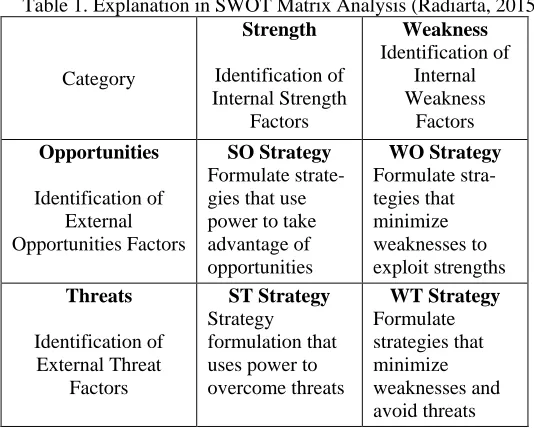
Data analysis methods used are descriptive analysis, SWOT analysis (Strength, Weakness, Opportunity, Threat) and Criterium Plus - Analytica Hierarchy Process. The SWOT analysis was carried out to get a picture of the problems with BUMDes in the coastal areas of the Air Periukan sub-district, Seluma Regency. David (2015) states that SWOT is an essential tool for developing four types of strategies: 1). Strength-Opportunity Strategy, 2). Weakness Strategy - Opportunities, 3). Weakness Strategy - Threats, 4). Strength Strategy - Threats. Marimin in Firdaus (2016), there are three stages in conducting a
SWOT analysis, namely, taking data by conducting external and internal evaluations. The second is an external, internal matrix, and a SWOT matrix, the third stage of decision making. The steps of the SWOT analysis are in Table 1.
By using AHP, a problem will be solved in an organized frame of mind, so that it can be expressed to make effective decisions on the problem. Complex issues can be simplified and accelerated the decision-making process (Saaty in Marimin, 2011).
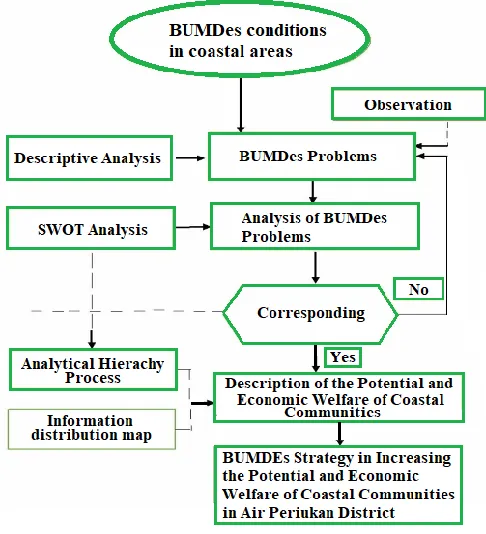
[image:3.612.302.569.222.436.2] [image:3.612.301.573.225.436.2]After conducting the SWOT analysis process and obtaining input from categorized problems that were responded by respondents in the FGD activities, the question then weighted in AHP analysis in each coastal village in Air Periukan District.
Table 1. Explanation in SWOT Matrix Analysis (Radiarta, 2015)
Category
Strength
Identification of Internal Strength
Factors
Weakness
Identification of Internal Weakness
Factors
Opportunities
Identification of External Opportunities Factors
SO Strategy
Formulate strate-gies that use power to take advantage of opportunities
WO Strategy
Formulate stra-tegies that minimize weaknesses to exploit strengths
Threats
Identification of External Threat
Factors
ST Strategy
Strategy formulation that uses power to overcome threats
WT Strategy
Formulate strategies that minimize weaknesses and avoid threats
AHP is carrying out after the SWOT analysis is complete, to illustrate the priority of the problem based on general categories and occurs in each village. The values and definitions of qualitative opinions from the comparison scale Saaty (1983) present in Table 2.
Table 2. Value and definition of qualitative opinions from the comparison scale Saaty (1983)
Score Explanatiom
1 The vertical factor is as important as the horizontal factor
3 The vertical factor is more important than horizontal factor
5 The vertical factor is clearly more important than the horizontal factor 7 The vertical factor is clearly more
important with the horizontal factor 9 The vertical factor is absolutely more
important than the horizontal factor 2, 4, 6, 8 When in doubt between two values of
adjacent elements 1 / (2-9) Opposite of captions 2-9
[image:3.612.304.528.537.706.2]Figure 2. flow chart of a study of the conditions of the Bumdes in the coastal area
III. FINDINGS AND DISCUSSIONS
A. Findings
1. General Conditions of Lawang Agung Village, Sukasari Village and Kungkai Baru Village
Lawang Agung Village is the path that goes to Sukasari Village and Kungkai Baru Village if we are from the direction of the capital city of the Seluma Regency. The majority of the population in the village of Lawang Agung are the indigenous people of the Serawai ethnic group, while for the town of Sukasari and Kungkai Agung, they were transmigration areas in 1970, so many of them were Javanese and Balinese.
BUMDES Lawang Agung's superior products include papaya dodol, managing village Pamsimas, while for Sukasari village, it includes Red Ginger juice drink products, Dishwashing Soap and Lemongrass Oil, managing village markets and savings and loan activities. For the Village of Kungkai Baru, the BUMDES line of business includes renting a shophouse and maintaining the beach as a tourist area. But this is still a problem because, according to BKSDA, the beach is a protected forest area, but the community hopes that BUMDES can manage the forest as a tourist forest area. This issue is still in the process of reducing the status of the protected forest area to TWA so that the community /BUMDES can manage it.
2. Strategy for solving the BUMDes problem in the Seluma Regency Coastal region
Problem-solving strategies are solved using SWOT analysis tools. The Internal Factors Analysis Summary (IFAS) using a matrix model to describe the strengths and weaknesses of the internal conditions of the Banda Neira community, while to describe the opportunities and threats of the external terms of the Banda Neira community using the External Factors Analysis
Summary (EFAS) matrix. IFAS and EFAS matrix model assessments are obtained based on the weight given by respondents to the conditions and problems and analyzed according to the SWOT analysis criteria, namely strengths, weaknesses, opportunities, and threats. The weighted results present in the form of IFAS and EFAS matrix models. The results of the internal factor assessment (IFAS) describe in Table 3 below.
Table 3. Internal Factors of BUMDes Condition in Coastal Areas of Seluma Regency
Internal Factor Weight Rating Score
Strength
Community Participation in BUMDes
0.125 7 0.875
Human Resources Managers BUMDes
0.120 7 0.840
Support from the village government and related stakeholders
0.085 6 0.510
Village and beach markets 0.080 6 0.480 Cultural customs / traditions
of the community
0.090 6 0.540
Total Strength 3,245
Weakness
BUMDes Product Marketing 0,12 3 0,36 Information technology
facilities
0,11 2 0,22
Availability of Raw Materials
0,09 3 0,27
Inadequate Education and Training
0,09 2 0,18
Transportation facilities in the Coastal region are inadequate.
0,08 2 0,16
Total Weakness 1,19 Total Internal Factor 4,435 Source : Data processing results, 2019
Based on the analysis of internal factors (IFAS), the total value of internal factors is 4.435.
The main strength with the highest value is community participation of 0.875 with a total strength value of 3.245, while the main weakness with the highest value is the means of transportation to the coastal areas of the district with a total value of weakness of 0.80.
[image:4.612.302.566.194.511.2]EFAS's assessment of BUMdes in Pesisisr village, Seluma district is presented in Table 4 below.
Table 4. External Factors of BUMDes Condition in Coastal Areas of Seluma Regency
External Factor Weight Rating Score
Opportunities
Alternative livelihoods 0.075 6 0.450 Potential coastal and
agricultural resources
0.125 7 0.875
Central/Regional Government Policy
0.100 7 0.700
Community Empowerment 0.115 7 0.805 Potential tourist and cultural
areas
0.090 6 0.540
Total Opportunities 3,370
Threats
BUMdes products have not been able to compete.
0,111 2 0,222
The same business unit as other BUMDes
0,115 2 0,230
Issues of regional forests and abrasion
0,112 2 0,224
BUMDes Management and Governance
0,073 3 0,219
Utilization of tourist areas is not optimal
0,085 3 0,255
Total Threats 1,114 Total External Factor 4,518 Source : Data processing results, 2019
Based on the analysis of external factors (EFAS), the total value of external factors is 4.518. This value indicates that the environmental conditions of the coastal areas of the Seluma district can provide positive responses; opportunities can utilize to minimize existing threats. The main opportunities with the highest value are the potential of coastal and agricultural resources by 0.875 with a total opportunity value of 3.37, while the main threat with the highest value is that BUMDes products have not been able to compete by 0.22 with a total threat value of 1.148.
The condition of coastal and marine resources is still good, and agricultural potential is an opportunity for the Seluma Regency coastal communities to be developed in improving the welfare of the community through BUMDes. Also, the possibility of a white sand beach area and Cemara Plant, commonly called Cemoro Sewu, can be developed into a tourist area managed by the DUMDes so that it will support the community's economy. Plantation and horticultural areas (lemongrass) are also a potential opportunity for the Seluma Coastal community to improve the economy. The activities of local people and tourists who come to the villages of Lawang Agung, Sukasari, and Kungkai Baru in Seluma Regency, and the distance is quite close to the Regency and Province Cities, if supported by excellent transportation will help increase community income through BUMDes.
Some alternative strategies that can be developed in the management of coastal and marine areas by BUMDes include the
use of waters in the National Park area that must aim at supporting the function of the city while increasing community welfare.
The resolution of the BUMDes problem in the Seluma Regency's Pesisisr region requires consideration of strengths and weaknesses, as well as opportunities and threats that exist in the area. The combination of SWOT strategy components refers to making optimal use of strengths and opportunities to minimize weaknesses and threats. Priority and problem mapping are essential in solving problems. This done so that the issue can be resolved as a whole and reduce the negative impact arising from a challenge.
Based on the results of the FGD and field observations, a description of the problems that exist in BUMDES, Sukasari Village, Kungkai Baru Village, and Lawang Agung Village are weak financial management, marketing constraints, availability of raw materials, business type selection, licensing of tourism forest management and support from local governments while the potential owned by BUMDES is high community cohesion and participation to support village programs, adequate human resources, and exotic places of worship and beaches.
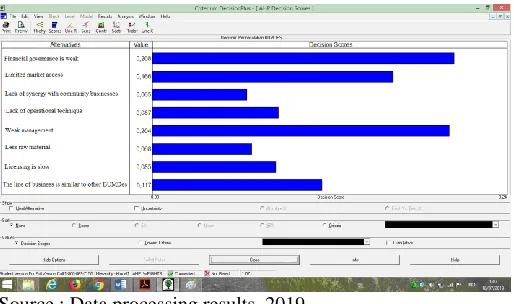
[image:5.612.25.288.114.408.2]Problems in the hierarchical analysis (AHP) are problems that are responded to and are considered necessary by respondents with consideration of issues and environmental conditions, as well as strategies developed based on SWOT analysis. Determination of the priority of problems in each village in the Seluma Coastal Region carried out using AHP, and the distribution of the issues illustrated by spatial analysis. The priority order of items in general at BUMDes in the Seluma Coastal region presented in Figure 3 below.
Figure 3. Priority of BUMDes Problems in the Seluma Regency Coastal Area
Source : Data processing results, 2019
Based on the AHP, three priority problems exist in BUMDes in the Seluma Regency coastal areas, including a weak BUMDes Management and governance system, as well as limited marketing access. Another problem is that the business units are relatively the same as other village-owned BUMDes such as renting chairs and tents so that this business unit has minimal marketing reach.
B. Discussions
[image:5.612.314.571.435.587.2]become a fundamental problem for the existing BUMDes through capacity building for BUMDes managers and management. This form of improvement can imply by attending training and comparative studies at BUMDes that have a similar business field to BUMDes owned. BUMDes Desa Lawang Agung and BUMDes Sukasari Village have a business unit in the area of Production, so it is better to conduct a comparative study to BUMDEs whose business units are in the field of Production and proven to be successful, one of them is with indicators of community empowerment in supporting BUMDEs that have been well implemented and improved the welfare of their village communities. For the Kungkai Baru village that has a business unit in the field of tourism, it can conduct a comparative study in a village that has a business unit in the field of tourism.
In the field of BUMDes financial governance so far, BUMDes Treasurers are not all of the educational backgrounds in the field of finance/accounting, so the recording is still very manual. It is not too problematic if the business turnover is still on a small scale, but it is quite troublesome if the businesses managed by BUMDEs begin to develop. Increased capacity for financial managers is also a critical segment so that business turnover in terms of profit and whether or not it can be appropriately known. Some fundamental problems for BUMDes include the difficulty of marketing their products. The inability to compete with products outside is the only problem. The importance of support for BUMDes to sell their products so that consumers are interested in them is needed, in terms of training "branding" products both through good packaging to managing products from raw materials to finished products. The need for BUMDes and local governments to partner with third parties such as educational institutions or universities to carry out community service through assistance or guidance for BUMDes.
IV. CONCLUSION
The complexity of the problems faced by BUMDes in the Seluma district Coastal region must comprehensively be resolved. Based on the analysis of internal factors (IFAS), the main strength in the Seluma Coastal Region is community participation, while the main weakness is the means of transportation to the Seluma Regency coastal area. The results of the analysis of external factors (EFAS) show that the Seluma district's coastal environmental conditions can provide a positive response; opportunities can be utilized to minimize threats. The main opportunities that exist are the potential of coastal and marine resources, while the main threat is inadequate transportation facilities. Based on AHP results, four (4) priority problems that exist in BUMDes in coastal areas, including management, weak BUMDEs financial governance, weak marketing access, and similarity of business units with other BUMDes. The problem-solving strategy is carried out by assessing the importance of the problem in the short and long term. In the short term, it is necessary to make efforts to increase the capacity of BUMDes for BUMDes managers, by identifying the role, potential, Business plan so that governance and management of BUMDes can run well. In the long run, it is hoped that the marketing reach will be wider with the use of
adequate human resources, including the use of information technology and social media. Innovation techniques can be carried out through product management in accordance with the standards desired by consumers, so they are able to compete with outside products.
Policy Implications This study is expected to be input to relevant stakeholders in solving BUMDes problems. Strategies that can use include the formulation of regulations and programs to increase the capacity of BUMDes HR and Innovation, For this reason, the plan that must be carried out in the effort to develop BUMDES is to study the BUMDES health check internally and build stronger synergy with local governments.
ACKNOWLEDGMENT
Special thanks to the Director of Research and Community Service, Directorate General of Research and Development - Ministry of Research, Technology and Higher Education of the Republic of Indonesia in 2019 funding through the Beginner Lecturer Research scheme.
REFERENCES
[1] Ancok, Djamaludin. 2012. Psychology of Leadership & Innovation. Jakarta. Publisher : Erlangga.
[2] Bengkulu Province Bappeda, 2017. Regional Action Plan Document for the Acceleration of Development of Disadvantaged Regions in Bengkulu Province 2017 Budget Year.
[3] Dahuri, Rochmin. 1996. Integrated Management of Coastal and Ocean Areas. Jakarta. Publisher: Pradnya Paramita.
[4] David Fred, Forest. 2015, Strategic Management : An Approach to Competitive Advantage - Concepts. Jakarta: Salemba Empat.
[5] Firdaus, Tampubolon, P. 2017, Strategy for solving the socio-economic problems of coastal communities in the Banda Neira islands, Central Maluku district. Jakarta. Yayasan Strategi Konservasi Indonesia.
[6] Marimin, Magfiroh, .N. 2011. Technical Application of Decision Making in Supply Chain Management. IPB Press. pp 92-98
[7] Village Minister Regulation. 2015. Underdeveloped Area Development and Transmigration No. 4 of 2015 concerning the Establishment, Management and Management, and Dissolution of Village-Owned Enterprises.
[8] Government regulations No. 43. 2014. concerning Implementation Regulations of Law Number 6 of 2014 concerning Villages
[9] Government regulations No. 47. 2015. concerning Amendment to the Regulations for Implementing Law No. 6 of 2014 concerning Villages. [10] Porter, Michael, E., 2008. Competitive Strategy. Tangerang. Kharisma
Publising Group
[11] Purnamasari Nurul, 2016. Potential and problems faced by village-owned enterprises (BUMDes), Yogyakarta. Publisher : Yayasan Penabulu.
AUTHORS
First Author – Kresnawati, Department of Accounting, Universitas Dehasen Bengkulu, [email protected].
Second Author – Siti Hanila, Department of Management, Universitas Dehasen Bengkulu, [email protected].
Correspondence Author – Jusuf Wahyudi, Department of