DESIGN OF A NONLINEAR SELF-TUNING PARAMETERS ALGORITHM
FOR DIFFERENT TYPES OF PID CONTROLLERS BASED ON
ARTIFICIAL INTELLIGENT
Khulood E. Dagher
Al-Khwarizmi Collage of Engineering, University of Baghdad, Baghdad, Iraq E-Mail: [email protected]
ABSTRACT
A new nonlinear self-tuning parameters algorithm for two types of the PID controllers is designed, the first type is traditional PID controller and the second is nonlinear PID controller, with intelligent algorithm for nonlinear magnetic levitation system (MagLev) is presented in this study. The proposed scheme of the on-line self-tuning control algorithm is based on neural network and PSO algorithm to make both controllers are an on-line adaptive PID controllers by calculating the optimal nonlinear values of the PID parameters in order to generate the best or near optimal value of the control action that will guarantee the output of the actual model accurately represents the desired position output of the magnetic ball. From numerical simulation results, the nonlinear adaptive PID controller is the best from the traditional adaptive PID controller with the proposed nonlinear self-tuning parameters algorithm in terms of fast on-line learning and tuning the nonlinear parameters of the controller with best voltage control action that generated to precisely track the motion of magnetic ball and reach to the desired position with convergence of the position error to zero value.
Keywords: PID controller, neural networks, self-tuning, nonlinear mag lev system, PSO algorithm.
INTRODUCTION
In general, the aim of the magnetic levitation (MagLev) system is provided that a ferromagnetic ball to be levitated and/or held in a reference position in the air without any friction problems because the suspension depends on an electromagnet technique. Therefore, there are many industrial applications for MagLev system such as high-speed rail transportation, vibration isolation in sensitive devices, and magnetic frictionless bearings (Yaseen, 2017). However, MagLev systems consider a high nonlinear dynamic structure with unstable behavior therefore, MagLev system has a challenging problem to control it that leads to make the MagLev system a good test bed for tuning control strategies such as a self-tuning robust full-state feedback controller (Bidikli and Bayrak, 2018), parameters self-adjusting fuzzy PID controller (Ma, et al., 2008), auto-tuning PID controller (Cetin and Iplikci, 2015), an adaptive backstepping controller (Adıguzel, et al., 2017). Also, many types of control algorithms have been used to build the modelling of MagLev system and controlling it, such as PID controllers (Yaseen, 2017, Hypiusová, and Osuský, 2017, Hypiusová and Kozáková, 2017, Bojan-Dragos, et al., 2017), fuzzy logic controller (Sahoo, et al., 2018), neural network controller (Rubio, et al., 2016), high-order sliding mode controller (Goel and Swarup, 2016), model predictive controller (Sgaverdea, et al., 2015) and robust
𝐻∞ controller (Khan, et al., 2016). In this study, the
nonlinear self-tuning control parameters algorithm has been designed based on neural network and PSO algorithm for obtaining the optimal control gains kp, ki, kd
of the two different types of the adaptive PID controllers in order to stabilize and improve the dynamic behavior of the magnetic ball position of the MagLev system through generating an optimal voltage control action. The motivation of this work is to make the PID controller as
on-line adaptive PID controller that leads to generate the best or near to optimal value of the control action that will improve the dynamic behavior of the closed loop feedback system through guaranteed the magnetic ball position of the MagLev system is accurately represented the desired position. The main contribution of this study is the proposing a nonlinear self-tuning parameters algorithm of the two types of PID controllers for nonlinear MagLev system in order to fast find and tune the optimal nonlinear values of the PID parameters that leads to design an on-line adaptive PID controller that will stabilize the closed loop system and to generate the optimal value of the control action that generated to precisely track the motion of magnetic ball and reach to the desired position with convergence of the position error to zero value.
This paper is organized as follows: Section 2 describes the mathematical MagLev model. Section 3 explains the proposed self-tuning parameters algorithm for two different types of PID controllers. Section 4 demonstrates the performance of the on-line adaptive PID controllers through numerical Matlab simulation results. Finally, Section 5 gives the conclusions for the proposed self-tuning control algorithm.
NONLINEAR MAGLEV MODEL
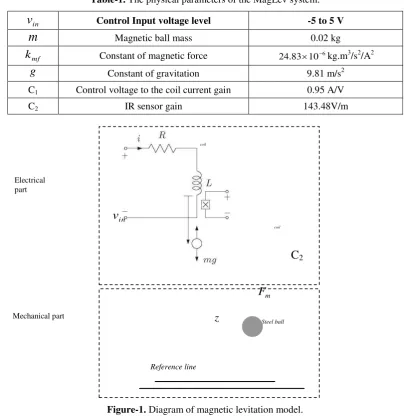
In general, the schematic diagram of a one dimensional magnetic levitation system is shown in Figure (1) which considers a highly nonlinear dynamic behavior and unstable system and the physical parameters are given in Table-1 (Al-Araji, 2016).
The mathematical mode of the nonlinear MagLev system can be analysed into two parts, 1) electrical part and 2) mechanical part.
) ( ) ( )
( R i t
dt t di L t
vin coil coil
(1)
Where,
i
:
is the input current value to the electromagnetic coil.v
in:
is the variable voltage controlaction. Lcoil : is the coil inductance. Rcoil : is the resistance
of the circuit
The relationship between the current i(t) that flows in the coil and the voltage vin(t) can be expressed as
given in Equation. (2)
) ( )
(t C1 v t
i in (2)
Where, C1: is the control voltage to the coil
current gain.
The mechanical part can be illustrated the electromagnet force based on Newton’s 2nd law:
m g
a
F
F
F
(3)
Where:
F
a:
is the magnetic ball’s accelerationforce.
F
m:
is the electromagnetic attraction force.F
g:
isthe magnetic ball’s gravity force.
The dynamic behaviour of the electromagnetic force is nonlinear behaviour as equation (4) (Qin, et al., 2014). 2 ) ( z i k Fm f
(4)
Where,
k
f:
denotes the magnetic force constant.z
: denotes the variable position of the ball in the magnetic field.So we can describe the mathematical mode of the second part as equation (5) that represents the open-loop nonlinear and unstable system.
2 1 ) ( z C v k mg m z in f
(5)
Where,
m
:
is the ball massg
:
gravitation constant value 9.81m.sec-2.z
: is the ball velocity
z
: is the ball acceleration.CONTROLLER DESIGN
The proposed nonlinear self-tuning parameters algorithm of the adaptive PID controller for nonlinear MagLev system is described in this section that it consists of two parts, as shown in Figure-2.
First part: a feedback PID controller such as linear or nonlinear scheme uses to minimize the error value of the performance index by tracking the actual position of the magnetic ball, so the discrete time tracking position error is described as in follows:
𝑒1(𝑘) = 𝑧𝑟𝑒𝑓(𝑘) − 𝑧(𝑘) (6)
𝑒1̇ (𝑘) =𝑧𝑟𝑒𝑓(𝑘)−𝑧𝑇𝑠𝑟𝑒𝑓(𝑘−1)−𝑧(𝑘)−𝑧(𝑘−1)𝑇𝑠 (7)
𝑒2(𝑘) = 𝑒1̇ (𝑘) + 𝛼𝑒1(𝑘) (8)
Where:
z
ref(k) denotes the reference position of the magnetic ball; α denotes a constant positive gain.The general scheme of the traditional or linear PID controller can be represented as shown in Figure-3, and the proposed discrete control law equation is represented as in equation (9):
) 1 ( )) 1 ( ) ( ( )) 1 ( ) ( ( ) ( )
(k k e2 k k e2 k e2 k k e2 k e2 k Vk
V p i d (9)
Where, kp denotes the proportional gain; ki
denotes the integral gain; kd denotes the derivative gain; V(k) denotes the voltage control action and e2(k) denotes
the error signal as in equation (9).
The structure of the proposed nonlinear PID controller is shown in Figure-4. So the discrete control law can be described as follows:
H1: denotes bipolar nonlinear node, H2: denotes unipolar nonlinear node, G: denotes a gain function in the output of the control action.
2
)
(
k
G
O
V
(10) O2 is the output of the unipolar activationfunction H2(-) as in equation (11) (Zurada, 1992):
)) 1 ( ( 1 1 1 ) (
2
O V k
e
H (11)
O1 is the output of the bipolar activation function
H1(-)as in equation (12) (Zurada, 1992):
1
1
2
)
(
1
( )
net e
H
(12))
(
net
is calculated from equation (7):)) 1 ( ) ( ( ) 1 ( ) ( ( ) ( ( )
( kp e2 k ki e2 k e2k kde2k e2 k
net (13)
Second part: a nonlinear self-tuning parameters algorithm uses to obtain and tune the on-line control parameters of the PID controller in order to find optimal or near optimal control effort that will lead to minimizing the cost function and will achieve excellent tracking of the desired output. The proposed structure of the nonlinear self-tuning parameters algorithm based on multi-layer perceptron neural network (Nells, 2001) is shown in Figure-5.
v(k-1)] in order to improve the dynamic behavior of the neural network structure.
The second layer is the activation or hidden layer which has proposed five neurons with bipolar activation function in each neuron to make the nonlinear behavior of the control parameters.
The third layer uses a nonlinear unipolar activation function with gain more than 1 in order to limit the range of control parameters between (0 to kpmax, kimax,
kdmax] values for avoiding the negative sign in the
parameters that leads to stabilize the acting of the PID controller.
The proposed parameters law can be calculated as in follows: 1 ] 1 1 [ ) ( g e k kp kb net
(14)
2 ] 1 1 [ ) ( g e k ki ki net
(15)
3 ] 1 1 [ ) ( g e k kd kd net
(16)
Where, g1, g2and g3 are experience gains.
𝑛𝑒𝑡𝑘𝑝= ∑𝐵=5𝑏=1ℎ𝑏𝑤𝑏,𝑐 (17)
Where, c=1, that means the first output of the neural network.
𝑛𝑒𝑡𝑘𝑖 = ∑𝐵=5𝑏=1ℎ𝑏𝑤𝑏,𝑐 (18)
Where, c=2, that means the second output of the neural network.
𝑛𝑒𝑡𝑘𝑑 = ∑𝐵=5𝑏=1ℎ𝑏𝑤𝑏,𝑐 (19)
where c=3, that means the third output of the neural network. 1 1 2 b net b e
h
(20)𝑛𝑒𝑡𝑏 = ∑𝐴=4𝑎=1𝑍𝑎𝑉𝑎,𝑏 (21)
Where, b=1 …5.
To generate the optimal nonlinear values of the control parameters (kp,ki,kd) for the PID controller from the
proposed structure of the neural network, PSO algorithm is used to learn and tune the weights parameters of the neural network because PSO is an intelligent algorithm and has fast and stable algorithm. The numbers of weights in each particle are equal to 35 weights that represent all weights in the proposed structure of the neural network as shown in Figure-5.
There are two equations that describe the motion of the particles, the first is updated velocity equation (22)
and the second equation (23) is updated the position of the particles, respectively (Mohamed, et al., 2017).
) (
) ( 22 1 1 1 k i k k i k i k i k
i Weight cr pbest Weight cr gbest Weight Weight
(22) 1 1 k i k i k
i Weight Weight
Weight (23)
Where, 1
k i
Weight is the ith particle’s velocity
(neural network weights) at kth iteration; k i
Weight is the ith
particle’s position (neural network weights) at kth iteration;
: denotes the value of the inertia weight factor which
equals to 0.75 in order to decrease the iterations number of the evaluation function; c1 and c2 are the positive values
that equal to 1.25 because (c1 + c2)< 4 (Sundaravadivu, et al., 2016); r1 and r2 are random values (0 to 1); pbestiis
the ith particle’s best previous weight; gbestdis the best particle from the overall population.
The on line cost function is described by mean square error as in Eq. (24) .
𝑂𝑛𝐿𝑖𝑛𝑒𝑃𝐼 =𝐾1∑ [(𝑧𝐾𝑖=1 𝑟𝑒𝑓− 𝑧)2] (24)
𝑘: denotes maximum iteration number.
NUMERICAL SIMULATION RESULTS
Matlab package (2017) is used to apply the proposed structure of a nonlinear self-tuning parameters algorithm for the two types of the PID controllers for MagLev system. The 4th order Range Kutta method is used in the numerical simulation with 0. 01 second sampling time.
To investigate the optimal nonlinear values of the control parameters (kp,ki,kd) for the two types of the PID
controllers from the proposed structure of the neural network, PSO algorithm requires initialization to learn and tune the 35 weights of the neural network based on equations (22) and (23) as follows:
Total particles size= 30; the number of weights in each particle = 35; the best number of on-line iterations = 25; the maximum number of samples=600; the experience gains g1, g2, and g3 are equal to 3, 2.5, and 2 respectively.
PID controllers based on an on-line self- tuning parameters neural network PSO algorithm in terms of optimal smooth voltage control action with very small spikes without oscillations that leads to deliver a stable suspension of the steel ball in the desired position.
During 600 samples, the parameters kp, ki, kd of
the two types of PID controllers are generated from the self-tuning neural network PSO algorithm have stable, smooth, and optimal nonlinear values as shown in Figure (9-a and b) in order to improve the transient response of the feedback control system and achieve the stability. Figure (10-a and b) show the on-line position error convergence for the response of the MagLev’s steel ball based on the mean square error function during the carried out 600 samples.
CONCLUSIONS
Two different types of the adaptive PID controllers based on a new on-line self-tuning nonlinear parameters neural network with PSO algorithm for MagLev system have been designed and simulated for different desired magnetic ball positions using Matlab package are presented in this study. From the numerical simulation results, the proposed on-line self-tuning nonlinear parameters algorithm leads to the excellent performance in terms of: i) fast and smooth parameters kp,
ki, kd of the PID controller are calculated, ii) Optimal and
[image:4.595.92.497.308.728.2]smooth voltage control action is generated without saturation state and no oscillations control action response, iii) High precision tuning control parameters are obtained for faster tracking the desired ball position and high reduction the on-line tracking position error that reaches zero value.
Table-1. The physical parameters of the MagLev system.
in
v
Control Input voltage level -5 to 5 Vm
Magnetic ball mass 0.02 kgmf
k
Constant of magnetic force 610 83 .
24 kg.m3/s2/A2
g
Constant of gravitation 9.81 m/s2C1 Control voltage to the coil current gain 0.95 A/V
C2 IR sensor gain 143.48V/m
Figure-1. Diagram of magnetic levitation model.
C
2z
inv
m
F
Reference line
Steel ball
coil coil
Electrical part
Figure-2. The general structure of the proposed controller.
Figure-3. The traditional or linear PID controller structure.
Figure-4. The proposed nonlinear PID controller structure.
kp
ki
H1
e
2(k)
e
2(k)+e
2(k-1)
V(k-1)
V(k)
+
kd
e
2(k)-e
2(k-1)
G
H2
Z
-1×
O
1O
2kp
ki
+
e
2(k)
+
e
2(k)+e
2(k-1)
V(k-1)
V(k)
kd
e
2(k)-e
2(k-1)
Z
-1Neural
Network
Adaptive PID
Controller
Magnetic Levitation
Model
PSO
Algorithm
Desired
Position Position Actual
V(k) Voltage
Action e2(k)
e1(k) e1(k)
𝑒̇1(k) V(k-1)
V(k)
kp ki
kd
Self-Tuning Parameters Algorithm
Figure-5. The proposed structure of the nonlinear self-tuning parameters algorithm.
Figure-6. The magnetic ball actual position response.
Figure-7. The magnetic ball position error response.
Z=
kp(k)
𝑒
1(k)
ki(k)
𝑒
1̇
(k)
kd(k)
V(k)
V(k-1)
H1
H1
H1
H1
H1
H2
H2
H2
V
a,bFigure-8. The voltage control action response.
Figure-9-a. The on-line self-tuning control parameters of the nonlinear PID controller.
Figure-10-a. The on-line MSE for nonlinear PID controller.
Figure-10-b. The on-line MSE for linear PID controller.
REFERENCES
Adıguzel F., E. Dokumacılar, O. Akbat and T. Turker. 2017. Design and implementation of an adaptive backstepping controller for a magnetic levitation system. Transactions of the Institute of Measurement and Control, DOI: 10.1177/0142331217725146, 2: 1-10.
Al-Araji A. S. 2016 .Cognitive Nonlinear Controller Design for Magnetic Levitation System. Transactions of the Institute of Measurement and Control. 38(2): 215-222.
Bidikli B. and A. Bayrak. 2018. A self-tuning robust full-state feedback control design for the magnetic levitation system. Control Engineering Practice. 78: 175-185.
Bojan-Dragos C -A., R-E. Precup, M-L. Tomescu, S. Preitl, O-M. Tanasoiu and S. Hergane, 2017. Proportional-Integral-Derivative Gain-Scheduling Control of a
Magnetic Levitation System. International Journal of Computers Communications and Control, 12(5): 599-611.
Cetin, M. and S. Iplikci. 2015. A novel auto-tuning PID control mechanism for nonlinear systems. ISA Transactions, 58:, DOI: 10.1016/j.isatra.2015.05.017.
Goel A. and A. Swarup. 2016. A Novel High-Order Sliding Mode Control of Magnetic Levitation System. Proceeding of the IEEE 59th International Midwest Symposium on Circuits and Systems (MWSCAS), pp. 1-4.
Hypiusová M. and A. Kozáková. 2017. Robust PID Controller Design for the Magnetic Levitation System: Frequency Domain Approach. Proceeding of the 1st International Conference on Process Control (PC). pp. 274-279.
International Conference of Cybernetics and Informatics. pp. 1-7.
Khan, M., A. Siddiqui and A. Mahmoud. 2016. Robust H∞ control of Magnetic Levitation system based on parallel distributed compensator. Ain Shams Engineering Journal, DOI:10.1016/j.asej.2016.06.005.
Ma J., W. Fan and F. He. 2008. Parameters Self-adjusting Fuzzy PID Control in Magnetic Levitation System. Proceeding of the 2nd International Symposium on Systems and Control in Aerospace and Astronautics, DOI: 10.1109/ISSCAA.2008.4776264.
Mohamed R., A. Mohanraj S. Anand and K. Poomani. 2017. PSO Tuned PID Controller for Magnetic Ball Levitation System. International Journal of Trend in Research and Development, 4: 19-21.Nells O. 2001. Nonlinear system identification. Springer – Verlag Berlin Heidelberg..
Qin Y., H. Peng, W. Ruan, J. Wu and J. Gao. 2014. A modelling and control approach to magnetic levitation system based on state-dependent ARX model. Journal of Process Control. 24: 93-112.
Rubio J., L. Zhang, E. Lughofer, P. Cruz, A. Alsaedi and T. Hayat. 2016. Modeling and control with neural networks for a magnetic levitation system. Neurocomputing, DOI:10.1016/j.neucom.2016.09.101.
Sahoo N., A. Tripathy and P. Sharma. 2018. Single axis control of ball position in magnetic levitation system using fuzzy logic control. IOP Conference Series: Materials Science and Engineering. 323: 1-6.
Sgaverdea S., C. Bojan-Dragos R. Precup, S. Preitl and A. Stinean. 2015. Model Predictive Controllers for Magnetic Levitation Systems. Proceeding of the 10th Jubilee IEEE International Symposium on Applied Computational Intelligence and Informatics. pp. 171-176.
Sundaravadivu K., C. Ramadevi and R. Vishnupriya. 2016. Design of Optimal Controller for Magnetic Levitation System Using Brownian Bat Algorithm. Artificial Intelligence and Evolutionary Computations in Engineering Systems. 394: 1321-1329.
Yaseen M. 2017. A comparative study of stabilizing control of a planer electromagnetic levitation using PID and LQR controllers. Results in Physics. 7: 4379–4387.