MATHEMATICAL MODEL OF THE VISCOUS FLUID MOTION CAUSED
BY THE OSCILLATION OF A FLAT POROUS SURFACE
Nikolay Grigoryevich Taktarov, Olga Aleksandrovna Runova and Nadezhda Aleksandrovna Khramova
Mordovian State Pedagogical Institute named after M. E. Evseviev, А Studencheskaya Street, Saransk, Russia E-Mail: [email protected]
ABSTRACT
This paper proposes and studies a mathematical model of the motion of a viscous fluid caused by the oscillation of a plane porous surface. The motion of liquid inside and outside of a porous medium is considered in a fixed coordinate system. The porous medium performs harmonic translational-oscillatory motion parallel to an impenetrable flat surface, which limits the porous medium from below and moves with its velocity. Exact analytical solutions of the nonstationary Brinkman equation describing the motion of a liquid in a porous medium and the Navier-Stokes equation describing the motion of a liquid outside of a porous medium are found. A numerical analysis of the proposed mathematical model is carried out. The profiles of filtration rates in a porous medium and free liquid are constructed for different values of the model parameters. It is shown that, in special cases, the previously obtained solutions of problems of the motion of a viscous fluid caused by the vibration of a solid impermeable flat surface follow from the results obtained.
Keywords: translational-oscillatory motion, viscous fluid, porous medium, Brinkman equation, Navier-Stokes equation.
1. INTRODUCTION
The study of the fluid motion through porous media has great theoretical and practical significance in connection with various applications in the modeling of certain technological processes, as well as in the study of natural phenomena. Of great practical and scientific interest is the construction and investigation of mathematical models of the flow of a viscous fluid inside and outside of the porous surfaces of planar, spherical and cylindrical configurations since for them special analytic solutions to the corresponding boundary value problems can be found under special assumptions.
The work [5] proposes solutions to problems of the motion of solid bodies in a viscous fluid. In [9] a mathematical model of the motion of a pulsating solid body in a viscous oscillating fluid is constructed. Analysis of fluid flows between a porous medium and a liquid layer was carried out in [1]. The problems of flow past an impenetrable sphere and a cylinder in a porous medium, using the Brinkman model, are solved in [6]. In this paper, attention is drawn to the fact that in the Brinkman filtration model, as a boundary condition on the contact surface of a porous medium and an impenetrable solid body, in general, instead of the fluid adherence condition, it is necessary to take the condition for its slippage. The flow of a viscous incompressible fluid in a long cylindrical pore, the inner surface of which is covered by a permeable porous layer, was considered in [4]. In the paper [10], the fluid motion caused by the rotational-vibrational motion of the porous sphere is determined using the non-stationary Brinkman equation. In [11], a mathematical model of the viscous fluid motion caused by the translational-vibrational motion of a plane layer of a porous medium in a moving coordinate system in which the surface element is at rest is constructed and investigated.
This paper is devoted to the study of the viscous fluid motion caused by the oscillation of a plane porous surface immersed in this liquid in a fixed coordinate system. Theoretical research results can expand the scope of the
hydrodynamic methods of solving applied problems in various fields of science and technology, and also used to calculate parameters for technical devices that use viscous liquids in contact with a porous medium.
2. RESEARCH METHODS
To construct and study the considered mathematical model, the methods of mathematical physics, vector analysis, as well as numerical methods, are applied. To describe the motion of a liquid in a porous medium, the non-stationary Brinkman equation is used, and for the description of the motion of a free liquid outside a porous medium - the Navier-Stokes equation. When determining the boundary conditions, the possible sliding of the liquid with respect to an impermeable surface, which limits the porous medium, is taken into account. On the interface between the porous medium and the free fluid, the condition for the continuity of the fluid velocity is taken, and the jump in the tangential stresses in the liquid is assumed to be proportional to the relative velocity of the liquid at the interface (in a particular case these stresses can be continuous).
3. MATHEMATICAL MODEL CONSTRUCTION A plane porous surface performs a harmonic translational-oscillatory motion with a frequency ω in a direction parallel to the impermeable plane, which limits the porous surface from below and moves with the speed of this surface.
It is assumed that the porous medium is homogeneous, isotropic, non-deformable, has a high permeability and a sufficiently high porosity. Such properties can, for example, belong to fibrous, as well as strongly foamed materials, in which the permeability coefficient K reaches values of 10-4 cm2. In a porous medium, fluid vibrations may occur at which the velocity of the porous medium and the velocity of the fluid will differ.
plane surface of a porous medium, a fixed Cartesian coordinate system is chosen so that the interface between the porous medium and the free liquid coincides with the plane; the porous medium is determined by the inequality:
0
* 1
H
x
(region 1), and the free liquid is determined by the inequality: 2*
0
x
H
(region 2). Theplane 2 *
H
x
coincides with the free surface of the liquid. From below, a flat porous medium is bounded by an impenetrable, flat surface 1*
H
x
, which moves alongwith the porous medium. The axis
y
* is parallel to the direction of oscillation of the porous surface and the plane1 *
H
x
. Here the symbol "*" denotes dimensional variables, and the dimensionless variables are further denoted by the same symbols, but without this sign. The subscripts 1 and 2 denote the quantities corresponding to a porous medium and a free liquid, respectively. Figure-1 shows the scheme of the problem.Figure-1. Scheme of the task.
The speed of the translational-oscillatory motion of a plane porous medium and the plane surface bounding
it along the axis
Oy
*is a function of timet
*:)
exp(
* 0*
t
i
U
u
, where, U0R,u
*
u
*y.It should be noted that in the final results of calculations only the real parts of the corresponding complex expressions have a physical meaning.
The flow of a viscous fluid in a porous medium in the framework of the Brinkman model is described by a system of equations [2, 3, 7, 8, 11, 12]:
* * 1 * * 1 * *
*
1
1
grad
1
1
F
u
u
t
p
,div
0
* 1
*
u
(1)Here Γ is the porosity (Γ = const); ρ is the density of a viscous liquid;
p
1*- average pressure on the porevolume;
u
1*- the filtration rate (* 1 * 1
ν
u
,ν
1*is the average velocity of the fluid in the pore volume);
/
, where
is the effective viscosity of the liquid in a porous medium;
/
, where is theviscosity of the free liquid outside of the porous medium;
)
)(
/
(
* *1 *
u
u
F
is the density of the resistance force of the porous medium.In the case when the permeability coefficient of a porous medium
0
, it follows from the system of equations (1) thatu
*1
u
*. This means that the viscous fluid will move along with the porous medium. If thevelocity
u
*is zero, thenF
* will be of a known kind of Darcy force.The motion of a liquid outside of a porous medium is described by the equations [5]:
* 2 * * 2 * 2
2 *
*
2 (u )u 1grad u
u
p
t , div 0
* 2 *
u . (2)
Because of the symmetry, all the variables are independent of the z * coordinate and will be functions only of time
t
* and the vertical coordinatex
*. From the continuity equations (1) and (2) it follows thatu
1*x
const,
u
*2x
const. These constants are assumed to beequal to zero, since on surfaces
x
*
H
1 andx
*
H
20
* 1x
u
and *0
2x
u
. From this, we can conclude that,0
* 1x
u
,u
2*x
0
everywhere, and also(
)
0
*
j j
u
u
(j= 1, 2). Thus, the nonlinear terms fall out of the equations of motion (1) and (2) and velocities
u
*1,* 2
u
are directedeverywhere parallel to the axis
y
*.It follows from the x * -component of equations (1) and (2) that in the case of a horizontal arrangement of the porous layer, the pressures
p
1*andp
*2 also depend onthe time
t
*and coordinatesx
*, that is, they do not affect the nature of the motion of the viscous liquid in the horizontal direction, therefore takep
1*
const,
* 2
p
const and do not take into account the influence of gravity on the motion of a viscous fluid.Introduce the notation 1* * 1
u
u
y
,* 2 * 2
u
u
y
. Thenfrom (1) and (2), we obtain:
)
(
1
* *1 2
* * 1 2
* *
1
u
u
x
u
t
u
, *2* 2 2
* * 2
x
u
t
u
(3)
account the assumptions made [6, 8, 10, 11, 12]: condition on the boundary of an impermeable flat surface
( 1
*
H
x
):* * 1 * 0 *
1
exp(
)
x
u
B
t
i
U
u
; (4)conditions on the interface between a porous medium and a free liquid (
x
*
0
):* * 2 * *
1
u
u
u
u
;)
(
* * 1 * * 2 * * 1u
u
x
u
x
u
, (u
*
*);condition on the free surface of the liquid ( 2 *
H
x
):0
* * 2
x
u
.Here
u
1*,u
*2,u
* are the velocity with respect to the fixed coordinate system; B and Λ are constants with a length dimension, depending on the properties of the viscous fluid and the porous medium. The first condition (4) expresses the possible sliding of a viscous liquid with respect to an impermeable flat surface bordering a porous medium. If B = 0, then the first boundary condition (4) becomes the usual condition for liquid adherence on a solid surfacex
*
H
1:exp(
*)
0 *
1
U
i
t
u
. The second condition (4) shows the continuity of the relative filtration rate and fluid velocity at the interface between the porous medium and the free liquid ( *
0
x
). In the third condition (4) we take into account the connection between the shear stress jump at the interface of region 1 and region 2 with the tangential velocity of the fluid. If Λ → ∞, then this boundary condition becomes the condition of continuity of shearing stresses. If Λ = 0, then the third boundary condition (4) becomes the sticking condition on the surface of the porous medium. The fourth condition expresses the absence of tangential stresses on the surface of a free fluid.A mathematical model of the motion of a viscous fluid caused by the oscillation of a plane porous surface is a boundary value problem consisting of equations (3) and boundary conditions (4).
4. SOLUTION OF THE BOUNDARY PROBLEM Measure the length in unitsH H1H2, time -
1 / ω, speed - in units of U0. Let us introduce dimensionless variables
H
x
x
*/
,
t
t
*, 0 * 1 1u
/
U
u
, 0* 2 2
u
/
U
u
,)
exp(
/
0 *it
U
u
u
.In dimensionless form, equations (3) have the form: ) ( 1 2 2 1 2 1 2 u u H x u t u
H
, 2 2 2 2 2 x u t u H
(5)
The dimensionless boundary conditions for equations (5) have the form:
1
h x :
x
u
u
u
11 ; (6)
0
x
: u1uu2u,exp(
)
0 *
it
u
u
u
;u
u
x
u
x
u
1 2 1 21
;
2
h
x : 2
0
x
u
.
Here h1H1/H, h2H2/H ,
B
/
H
,
/
H
,
2/
.
Find the solution of equations (5) with the boundary conditions (6) in the form:
) exp( ) ( ) , ( 1
1 x t F x it
u ,u2(x,t)F2(x)exp(it) (7)
From equations (5) obtain:
2 1 2 1 2 1 2 1 2 2
F H
dx F d
, 2
0
2 2 2 2 2
F
dx
F
d
, (8)
where
2 2 2 1 2 2 12
H
i
H
, 2 2 22 2
i H ,
12
,
22
.The solutions of equations (8) in general form:
C x B x A x
F1( ) 1exp1 1exp(1 ) , (9)
) exp( exp
)
( 2 2 2 2
2 x A x B x
F ,
where
2 2 11
i
H
, 2 2
(
1
)
i
H
,2 2 1
/
)
(
1
i
C
, 42 4 1 2 1 2
1
1
1
1
.The arbitrary constants
A
j,B
j (j
1, 2) in (9), defined with the help of boundary conditions (6), have the form: 2 1 1D
D
A
,1 1 1 2 1 1 1 1 1 1
2
exp
)
1
(
)
1
(
exp
)
1
(
D
h
D
h
C
B
, 1 1 2 2 1 2 4 2 5 1 2exp
)
2
exp
1
)(
1
(
h
h
1 1 2
2 1
2
4 2 5 1 2
exp
)]
2
exp(
1
)[
1
(
h
h
D
D
D
D
D
B
,1 1 1 2 4 3 2 1
1
(
C
)
D
D
(
1
)
exp
h
D
,5 3 2 6 1
2
D
D
D
D
, D3 12th2h2,, exp ) 1 )( 1
( 1 1 1
4 C C h
D
1 1 1 1 1
5 2sh h 2 ch h
D ,
1 1 1 1 1
6 2ch h 2 sh h
D .
Solutions (7) and (9) describe transverse standing waves in which the velocities directed parallel to the Oy
axis in a porous medium u1(x,t)and in a free liquid )
, (
2 x t
u are perpendicular to the direction of propagation of the wave along the Ox axis.
If we replace the porous medium with an impenetrable layer with a thickness H1 that oscillates
with velocity
exp(
*)
0*
t
i
U
u
, that is, we pass to the limit Λ → 0 (λ → 0), K → 0 (10), then the solutions (9) take the form:
1
F ,
2 2
2 2 2
ch
)
(
ch
)
(
h
x
h
x
F
.The velocity field in region 2, in this case, will have the following form in the dimensional form:
) exp( cos
) (
cos )
,
( *
2 2
* 2 2 0 * * *
2 i t
H k
x H k U t x
u ,
2 2
1 i k (10)
This expression coincides with the result [5, §24]. If the porous medium is replaced by a free fluid, i.e., go to the limit Γ → 1, K → ∞ (1), β → 0, then the velocity field will be determined by an expression similar to expression (10), in which H2 should be replaced by H.
In the limit ω → 0 (2) we have the velocity field of a viscous liquid inside and outside the porous medium for the case of uniform motion of a flat porous surface with velocity 0
*
U
u
.If we write F (x) in the form )
( ) ( )
(x F x iF x F r i , then
t x F t x F it x
F( )exp( )] r( )cos i( )sin
Re[ .
5. MODEL ANALYSIS
The results of the analysis of the mathematical model of the motion of a viscous fluid caused by the oscillation of a flat porous surface are presented in Figures 2-5. We construct the graphs
2
/
[8, 12]. All the figures in the fixed coordinate system show the dependence of the real part Re(u1,u2)on x, that is,Re
u
1on x (h1x0) and Reu2on x (0xh2). The
regions 1 and 2 are respectively determined by inequalities 0
1
h x and 0xh2. The motion of a fluid is
nonstationary (time-dependent). In this connection, the profiles of the filtration velocity and the velocity of the free liquid in regions 1 and 2 continuously vary with time. For definiteness, the profiles of the filtration velocity and the velocity of the free fluid are constructed at time t = 0. At some other time, they will differ slightly from the ones listed below, but their quality will be of the same kind. Numerical estimates of the quantities are given for an example of a machine oil with a density ρ = 0.9 g/cm3
and a viscosity η = 1.2 g/cm · s (
/
≈ 1.3 cm2/s). The presence of discontinuities in the graphs on the surface of a porous medium is explained by the fact that the motion of a viscous liquid is considered in a fixed coordinate system. In the case of motion in the moving coordinate system, as was shown in [11], there are no discontinuities.
In Figure-2, the graphs of the dependence )
,
Re(u1u2 on x are plotted in the interval
2
,
0
8
,
0
x
, that is, for the case when the thickness of the region of the free liquid is less than the thickness of the porous medium. Numerical calculations were carried out for the following values of the parameters: Γ = 0.95, λ → ∞, the value H/15 is fixed but H/2 equals 2; 4; 6;8. The graphs in Figure 2 (a) are built for β = 0, and in Figure-2 (b) for β = 1.
It can be seen from Figure. 2 that if β = 0, then for all graphs Re(u1,u2) with xh1. If β = 1, then
for Re(u1,u2) if xh1. This phenomenon can be
explained by the effect of liquid sliding on the surface
1
h
x . It is observed for all β ≠ 0.
For graphs 3 and 4 in Figure-2 (a, b) in region 2, there are two layers of fluid with opposite directions of velocities. According to Figures 3 and 4 in Figure-2 (a), the velocity of a viscous liquid in a porous medium rapidly decays as it moves away from the surface
x
0
,
8
.For all the graphs in Figure 2, the value of H ≈
7.3 · 10-2 cm. Table-1 shows the values of the frequency ω, with which the plane porous surface performs the translational-oscillatory motion, for different values of the value H/2 and the values of the other parameters listed above.
Table-1. The values of the frequency ω for different values H/2 at Γ = 0.95, H/15, K = 10
-2 cm2, ν ≈ 1.3 cm2
/s.
2
/
H 2 4 6 8
ω, с–1
2 · 103 8,7 · 103 17,3 · 103 32,5 · 103
In Figure 3, the profiles of the filtration rate and free liquid are given for a symmetric gap
5
,
0
5
,
0
x
at Γ = 0.95, β = 0, λ → ∞. For the graphsin Figure 3 (a) H/1 5, and for the graphs in Figure 3
(b) H/110. Numbers 1 - 5 designate the curves constructed for the values H/2= 1; 1.5; 2; 2.5; 3.5.
Figure-3. Dependence Re(u1,u2) on х
(–0,5; 0,5): β = 0, λ → ∞, Γ = 0,95, H/2 = 1; 1,5; 2; 2,5; 3,5 (1 – 5).It can be seen from Figure-3 that the motion of the liquid penetrates from the region of the free liquid the porous medium. With increasing H/1values of the
velocities in the porous medium and the free liquid, they increase, and in the porous medium the filtration rate changes slightly with increasing of H/1. Figure-3 (b)
shows that the velocity profile in a porous medium at
given parameter values is constant and equal to the value of porosity.
For graphs 1 - 5 in Figure-3 (a), the value of H ≈ 7.3 · 10-2 cm; for the graphs in Figure-3 (b) H ≈ 14.5 · 10-2 cm. Table-2 shows the values of the frequency ω for
5 /1
H and H/110 for different values of H/2
and the values of the other parameters listed above.
Table-2. The values of the frequency ω for different values H/2 at Γ = 0.95, K = 10
-2
cm2, ν ≈ 1.3 cm2/s.
2
/
H 1 1,5 2 2,5 3,5
ω, с–1
(H/15) 0,49 · 10
3
1,1 · 103 2,0 · 103 3,1 · 103 6,5 · 103 ω, с–1
(H/110) 0,12 · 103 0,28 · 103 0,49 · 103 0,72 · 103 1,5 · 103
Figures 4-5 show graphs of profiles of filtration rates in a porous medium and free liquid outside the porous medium for the interval 0,2x0,8, i.e., for
Figure-4. Dependence Re(u1,u2) on х (–0,2; 0,8): β = 1, Γ = 0,95, H/15, H/2 = 2; 4; 6; 8 (1 – 4).
The graphs of the velocity profiles in Figure-4 are constructed for β = 1, Γ = 0.95, H/15. Numbers 1-4 indicate the curves constructed for the values H/2= 2;
4; 6; 8. For the graphs in Figure-4 (a) λ = 0.5; for the graphs in Figure-4 (b) λ → ∞.
It can be seen from Figure-4 that the liquid penetrates from the layer of free liquid the porous medium. With increasing λ, the velocities in both regions increase.
Figure 5. Dependence Re(u1,u2) on х (–0,2; 0,8): β = 0, λ → ∞, H/15, H/2 = 2; 4; 6; 8 (1 – 4).
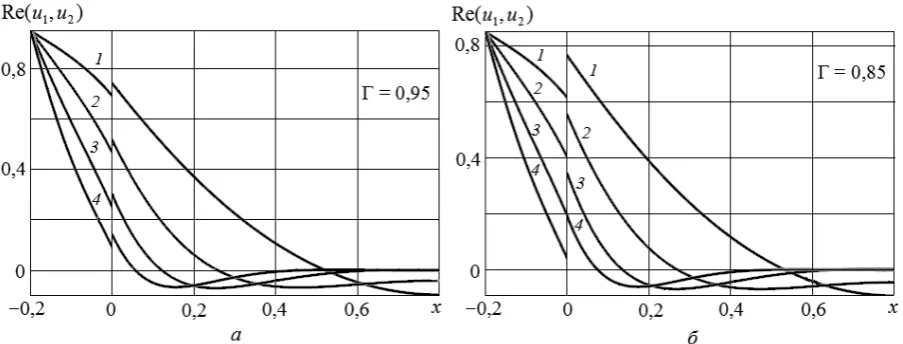
The graphs in Figure-5 are constructed for β = 0, λ → ∞,H/15. The value H/2takes the value 2; 4;
6; 8. For the graphs in Figure-5 (a), the porosity value is Γ = 0.95; for the graphs in Figure-5 (b), Γ = 0.85. It can be seen from Figure-5 that the liquid velocities in regions 1 and 2 strongly decay. As the porosity decreases, the values of the velocities in the porous medium decrease, and in the free liquid the values of the velocities increase.
6. CONCLUSIONS
The problem of viscous fluid flows caused by the oscillation of a flat porous surface is solved. The motion of the liquid inside and outside of the porous medium was considered in a fixed coordinate system. Precise analytical solutions to the Navier-Stokes equation describing the motion of a free fluid outside of a porous medium and the non-stationary Brinkman equation describing viscous fluid
flows in a porous medium are obtained. In regions 1 and 2, non-stationary fields of fluid velocities are found. It is revealed that the velocity of a viscous liquid in a porous medium and in a region outside the porous medium is perpendicular to the direction of propagation of standing transverse waves. The profiles of the filtration speed and free liquid velocity for some specific values of the parameters are shown in the graphs. If β = 0, then for all graphs Re(u1,u2)with xh1. If β = 1, then
) ,
Re(u1 u2 for xh1. With increasing values of
1
/
[image:6.595.73.525.376.548.2]other by signs. The velocity of a liquid in a porous medium is not zero. The velocity of the liquid outside the porous medium (in the region of the free liquid) attenuates with distance from the surface of the porous medium. It is shown that, in particular cases, the previously obtained solutions to problems of the motion of a viscous fluid caused by the vibration of a solid impermeable plane surface are obtained from the results achieved.
ACKNOWLEDGEMENTS
The research was carried out within the framework of a grant for the research on priority areas of scientific activity of partner universities in network interaction (South Ural State Humanitarian Pedagogical University and the M.E. Evseviev Mordovian State Pedagogical Institute).
REFERENCES
[1] Alazmi B. 2001. Analysis of fluid flow and heat transfer interfacial conditions between а porous medium and а fluid layer. International Journal оf Heat and Mass Transfer. 44: 1735-1749.
[2] Aureault J. L. 2009. On the domain of validity of Brinkman's equation. Transp. Porous Med. 79(2): 215-223.
[3] Brinkman H. C. 1947. A calculation of the viscous force exerted by a flowing fluid on a dense swarm of particles. Appl. Sci. Res. 1: 27-34.
[4] Filippov A. N. 2012. Techenie vyazkoy zhidkosti v tsilindricheskom kanale s pokrytoy poristym sloem poverkhnost'yu [The flow of a viscous fluid in a cylindrical channel with a porous surface covered by a surface]. Trudy RGU nefti i gaza im. I. M. Gubkina. 3(268): 63-72.
[5] Landau L. D. 2006. Gidrodinamika [Hydrodynamics]. Moscow: Fizmatlit. p. 736.
[6] Leont'ev N. E. 2014. Techeniya v poristoy srede vokrug tsilindra i sfery v ramkakh uravneniya Brinkmana s granichnym usloviem Nav'e [Flows in a porous medium around a cylinder and a sphere in the framework of the Brinkman equation with the Navier boundary condition]. Izvestiya RAN. Mekhanika zhidkosti i gaza. 4: 107-112.
[7] Nield D. A.1989. Spin-up in a saturated porous medium. Transp. Porous Med. 4(5): 495-497.
[8] Ochoa-Tapia J. A. 1995. Momentum transfer at the boundary between a porous medium and a
homogeneous fluid. - I. Theoretical development. Int. J. of Heat and Mass Transfer. 38: 2635-2646.
[9] Sennitskiy V. L. 2001. O dvizhenii pul'siruyushchego tverdogo tela v vyazkoy koleblyushcheysya zhidkosti [On the motion of a pulsating rigid body in a viscous oscillating fluid]. Prikladnaya mekhanika i tekhnicheskaya fizika. 42(1): 82-86.
[10]Taktarov N. G. 2017. Vliyanie granichnykh usloviy na dvizhenie zhidkosti, vyzvannoe vrashchatel'no-kolebatel'nym dvizheniem poristogo shara [Influence of boundary conditions on fluid motion caused by the rotational-vibrational motion of a porous sphere]. Izvestiya vysshikh uchebnykh zavedeniy. Povolzhskiy region. Fiziko-matematicheskie nauki. 1(41): 32-43.
[11]Taktarov N. G. 2017. Dvizhenie vyazkoy zhidkosti, vyzvannoe postupatel'no-kolebatel'nym dvizheniem ploskogo sloya poristoy sredy [Motion of a viscous fluid caused by the translational-vibrational motion of a plane layer of a porous medium]. Izvestiya vysshikh uchebnykh zavedeniy. Povolzhskiy region. Fiziko-matematicheskie nauki. 3(43): 73-86.