Solving the Hidden Terminal problems Using
Directional-Antenna Based MAC Protocol for Wireless
Adhoc Networks
Mekala Mahesh Reddy
*, Pallapothu Venkata Mahesh Varma
**, Modugula Narasimha Reddy
**, T.
Ravi
***, T.Praveen Blessington
***[*][**]
Final Year B.Tech, Dept. of ECE, KLUniversity, Vaddeswaram, AP, India [***] Associate Professor B.Tech, Dept. of ECE, KLUniversity, Vaddeswaram, AP, India
Abstract- In wireless networks, hidden terminal problem is common and leads to collision which makes it difficult to provide the required quality of multimedia services or support priority based services. To overcome these problems a directional antennas have been extensively used in designing MAC protocols for wireless network. Directional antennas provide many advantages over the classical antennas. In this paper, we show that directional antennas can be used effectively to solve a common hidden and exposed terminal problem by using an energy efficient MAC protocol for wireless sensor networks. This directional Antenna could be rotated in case of base station node to avoid directional hidden terminal problem.
Index Terms- MAC protocol, Energy efficiency, Directional-Antenna, Transmission ranges, Mac frames.
I. INTRODUCTION
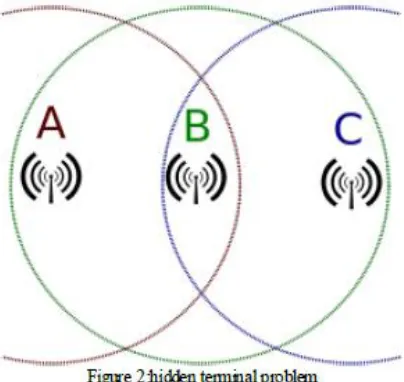
n wireless networking [1], the hidden node problem or hidden terminal problem [6] occurs when a node is visible from a wireless access point (AP), but not from other nodes communicating with said AP. This leads to difficulties in media access protocol. The hidden node problem can be observed easily with many nodes that use directional antennas and have high upload. IEEE 802.11 uses 802.11 RTS/CTS acknowledgment [2] and handshake packets to partly overcome the hidden node problem. RTS/CTS is not a complete solution and may decrease throughput. CSMA/CA has failed to solve the hidden and exposed terminal problems. In wireless network it is obvious that some stations are out of the transmission and detection range of each other. It is possible that transmission and detection range of A is reaching to B, but not to C. Same is the case with the B, but not C.Same is the C. That means A and C are A is reaching to same is the case with the C. That means A and C are the C cannot detect that the medium is busy and it can also transmit data to B at the same time. Hence there will be a collision. and Clear-to-Send (CTS). The RTS/CTS [3] are the control packets exchanged between two nodes just before the transmission of actual data. When a sender wants to send the data and finds the medium free, it first sends an RTS packet to the receiver (after waiting for back-off time if the medium was found busy in packet to the receiver (after waiting for back-off time if the medium was found busy in indicating the duration of whole data
transmission. After receiving the RTS, the receiver responds with the CTS packet, provided that the receiver is willing to accept the data at the moment. Otherwise CTS is not responded to the sender. The CTS packet gives the permission to the sender that it can transmit data to the intended receiver. Now the sender transmits the actual data safely to the required receiver. The CTS packet also contains the length of data transmission After transmitting the RTS packet, if sender does not receive the CTS packet within a designated period, it is assumed a collision and eventually will time out. The packet is scheduled for retransmission in the future. There is a use of extra packets RTS/CTS, which are overhead and load in the network. They are likely to cause delay in communication. Moreover, the scheme does not completely eliminate the problem of hidden and exposed terminal exists in CSMA/CA. In this paper we are using directional antennas are nearly invisible to nodes that are not positioned in the direction the antenna is aimed at, directional antennas should be used only for very small networks. Use Omni directional antennas for widespread networks consisting of more than two nodes. 1. Ranges: There are three types of ranges defined for wireless Adhoc Network [4]-
Transmission Range(TXRange):- The range within which a packet can be successfully received. This value is mainly determined by the transmission power, the receiver sensitivity thershold,SNR requirement and radio propagation environments.
Carrier Sense Range (CS_Range):- For a sending node,CS_Range is the range within which all other nodes will detect the channel busy. It is determine by the power sensing threshold(CS_Thresh), the antenna sensitivity, and radio propagation properties.
Interference Range(I Range):- For a receiving node,I_Range is the range within which an unrelated transmitter can corrupt the packet at the receiver.
II. PROBLEM DEFINITION
1. Hidden terminal problem:-Hidden nodes in a wireless network refer to nodes that are out of range of other nodes or a collection of nodes[5]. Take a physical star topology with an access point with many nodes surrounding it in a circular fashion: Each node is within communication range of the AP, but the nodes cannot communicate with each other, as they do not have a physical connection to each other. In a wireless network, it is likely that the node at the far edge of the access point's range, which is known as A, can see the access point, but it is unlikely that the same node can see a node on the opposite end of the access point's range, B. These nodes are known as hiddden.The problem is when nodes A and B start to send packets simultaneously to the access point. Since node A and B
cannot sense the carrier, Carrier sense multiple access with collision avoidance (CSMA/CA) does not work, and collisions.
2. Algorithm:-
A and C cannot hear each other. A sends to B, C cannot receive A.
C wants to send to B, C senses a “free” medium (CS fails).
Collision occurs at B.
A cannot receive the collision (CD fails). A is “hidden” for C.
3. DATA FLOW DIAGRAM
[image:2.612.65.267.489.680.2]
Figure 3: flow chart of hidden terminal problem
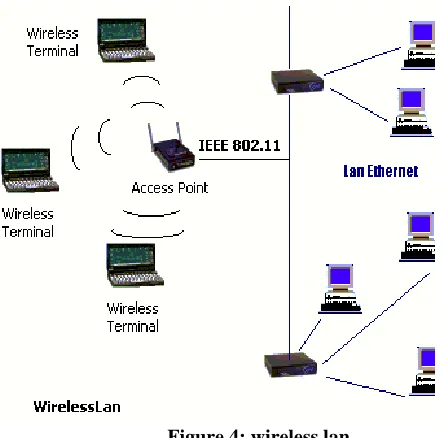
Figure 4: wireless lan
Wireless LANs[6] offer the following productivity, convenience, and cost advantages over wired networks:
5. Benefits:-
Mobility: Wireless LAN[6] systems can provide LAN users with access to real-time information anywhere in their organization. This mobility supports productivity and service opportunities not possible with wired networks.
Installation Speed and Simplicity: Installing a wireless LAN system can be fast and easy and can eliminate the need to pull cable through walls and ceilings.
Reduced Cost of Ownership: While the initial investment required for wireless LAN hardware can be higher than the cost of wired LAN hardware, overall installation expenses and life-cycle costs can be significant lower.Long-term cost benefits are greatest in dynamic environments requiring frequent moves and changes.
Scalability: WirelessLAN systems can be configured in a variety of topologies to meet the needs of specific applications and installations. Configurations are easily changed and range from peer-to-peer networks suitable for a small number of users to full infrastructure networks of thousands of users that enable roaming over a broad area.
Cost: Finally, the cost of installing and maintaining a WLAN is on average lower than the cost of installing and maintaining a traditional wired LAN, for two reasons. First, WLAN eliminates the direct costs of cabling and the labor associated with installing and repairing it. Second, because WLANs simplify moving, additions, and changes, the indirect costs of user downtime and administrative overhead are reduced.
6. Energy related issues during omnidirectional antenna :-Accordingly antennas are usually classified by the radiation
characteristics into omnidirectional and directional antennas. The most common type of antenna for transmitting and receiving signals at a wireless network is a monopole or Omni directional antenna. The traditional omnidirectional antennas can propagate the electromagnetic energy of transmission in all around it, i.e., in all directions. Since the transmission range of a signal depends on the power level of transmission, it is usually inefficient to propagate a signal in all direction when there may be only a few intended recipients propagating a signal in all directions instead of directing the signal towards the intended recipients. The directional antennas focus energy in a particular direction, so that such antenna could consume less energy compared to omnidirectional. The transmission medium is also not allocated appropriately during this Omni directional antenna halve of medium access control is unused and it is simple wasted even though t other nearest nodes are waiting to use this medium. Energy can also be dissipated during packet collisions. which is common problem in such shared channel with omnidirectional antennas .Since the o Omni directional antenna propagates the signal in all direction, this allows the collusion of actual packet with unwanted signal of its nearest node. The signal could also not propagate large distance in this antenna; therefore the propagation delay is high. an antenna is an indication of how the Radio frequency energy is focused in one or two directions at a time. Even though, the amount of Radiofrequency energy is remain the same in both directional and Omni directional [13] antenna, but in case of directional antenna is distributed over less area, as a result the apparent signal strength is higher and it propagate large distances. This apparent increase in signal strength is the antenna gain. Therefore in directional antennas the interference of a signal is much reduced
Figure 5: directional antenna
III. PROPOSED SOLUTION
[image:3.612.313.569.421.632.2]Sensor-MAC protocols so that the antenna is rotated during idle time by hearing its nearest node transmission schedules beams. However, these directional antenna MAC protocol. also present new issues which have not been addressed when using omni-directional antennas. This problem is called omni-directional hidden terminal problem. To avoid this and others related problems, our direction is rotated in an idle state with in some every direction. Whenever it receives antenna beams from its schedule to receive antenna beams from nearest node, the node wake up and starts its communication In a directional antennas Gain and directivity are closely related in antennas directions The directivity often antenna is an indication of how the Radio frequency energy is focused in one or two d directions’ at a time. Even though, the amount of Radiofrequency energy is remain the same in both directional and Omni directional antenna, but in case of directional antenna is distributed over less area, as a result the apparent signal strength is higher and it propagate large distances. This apparent increase in signal strength is the antenna gain. Therefore in directional antennas the interference of a signal is much reduced in both sender and receiver sides
IV. ANALYSIS OF RESULT
The problem of hidden terminal problem is a common problem in the shared medium access control of wireless network. Hidden terminal arises when two sender no des out of range of each o their transmit packets at the same time, to the same receiver, resulting in collisions at the receiver. Since sender nodes are out of range of each other, they do not detect carrier even though the other node is sending data, and if their data packets reach the destination at the same time, these packets are dropped due to collision at the receiver.
1. Carrier senses multiple access with collision avoidance
(CSMA/CA:-In wireless network multiple access method in which: A carrier sensing scheme is used.
A node wishing to transmit data has to first listen to the channel for a predetermined amount of time to determine whether or not another node is transmitting on the channel within the wireless range. If the channel is sensed "idle," then the node is permitted to begin the transmission process. If the channel is sensed as "busy," the node defers transmission for a random period of time. Once the transmission process begins, it is still possible for the actual transmission of application data to not occur.
CSMA/CA[9] is a modification of CSMA/CA avoidance is used to improve CSMA performance by not allowing wireless transmission of a node if another node is transmitting, thus reducing the probability of collision due to the use of a random time. Collision avoidance is used to improve the performance of CSMA[14] by attempting to divide the wireless channel somewhat equally among all transmitting nodes within the collision domain.. Collisions cannot be detected while occurring
at the sending node, thus it is vital for CSMA/CA or another access method to be implemented. CSMA/CA is used in 802.11 based wireless LANs and other wired and wireless communication systems. One of the problems of wireless data communications is that it is not possible to listen while sending, therefore collision detection is not possible. Another reason is the hidden terminal problem, whereby a node A, in range of the receiver R, is not in range of the sender S, and therefore cannot know that S is transmitting to R.
2. Directional antenna:-
A highly directional antenna improves the signal reception because it is pointed at the origin of the signal Multi-and Omni-directional antennas[10] pick up all signals from all directions, resulting in too many incoming signals and a weaker signal from the direction of choice. Highly directional antennas also "ignore" signals coming from places other than the one they are directed to, which cuts down the interference with a chosen signal. Another advantage these antennas offer is the ability to change the focus of the receiver to another. direction.In point-to-point connection with in a sample small direction.Inpoint-to-point connection with in a sample small directional antenna at a physical layer has high significant to avoid hidden terminal problem.
transmissions of long messages. Sensor-MAC can also achieve energy savings by minimizing communication overhead, includes the concept of the message passing, in which long messages are divided into frames and sent in a network traffic burst.
[image:5.612.325.566.217.343.2]3. Parameters for Medium Access:Several parameters for controlling the waiting time before medium access are important[8]. Below Figure, shows the three different parameters that define the priorities of medium access. The values of the parameters depend on the physical layer and are defined in relat ion to a slot time. Slot time is derived from the medium propagation delay, transmitter delay, and other physical layer dependent parameters.
Figure 8 :Medium access and inter-frame spacing
Short inter-frame spacing (SIFS):
The shortest waiting time for medium access (so the highest priority) is defined for short control messages, such as Acknowledgements of data packets or polling responses
PCF inter-frame spacing (PIFS):
A waiting time between DIFS and SIFS (and thus a medium priority) is used for a time -bounded service. An access point polling other nodes only has to wait PIFS for medium access . PIFS is defined as SIFS plus one slot time.
DCF inter-frame spacing (DIFS):
This parameter denotes the longest waiting time and has the lowest priority for medium access. DIFS is defined as SIFS plus two slot times.
Basic DFWMAC-DCF Using CSMA/CA:
Basic DFWMAC-DCF using CSMA/CA is based on carrier sense multiple accesses with collision.
avoidance (CSMA/CA), which is a random access scheme with carrier sense and collision avoidance through random back-off. The basic CSMA/CA mechanism is shown in Figure. If the medium is idle for at least the duration of DIFS, a node can access the medium at once. But as more and more nodes try to access the medium, additional mechanisms are needed.
Figure 9: Content ion window and waiting time
V. CONCLUSION
In this paper, at first, we have explained the hidden terminal problem in wireless networks. These problems have an impact on the performance of throughput .We have briefly explained the solution methods. After analyzing the problems, we have proposed the directional antenna[15] based MAC protocol that used with Sensor-MAC Protocol to increase the performance of the output of wireless sensor network. Directional antenna based MAC protocol since the signals are focus on a narrow beam with large distance the number o f mult i-hop can be reduced. The directional antennas focus energy in a particular direction, so that unfair channel allocation and wastage of channels between each node can be avoided.
REFERENCES
[1] RappaportT.S.,“WirelessCommunication
principleandpractice,2ndEditionPrentice Hall (1996)
[2] HUANG AND C. SHEN A comparison study of omnidirectional and directional MAC protocols for ad hoc networks. In Proceedings of IEEE Globecom(Taipei, Taiwan, Nov. 17-21 2002)
[3] Y.-B. Ko and N. H. Vaidya, “Medium access control protocols using directional antennas in ad hoc networks ”, in IEEE INFOCOM, Vol. 1, Pages: 13 – 21, 2000
[4] IEEE standard for Wireless LAN Medium Access Control (MAC and Physical Layer (PHY) specifications, ISO/IEC 802-111999(E) , Aug. 1999 [5] Nilsson, Martin’s Directional antennas for wireless sensor networks. In:
9th Scandinavian Workshop on Wireless Adhoc Networks (Adhoc'09), 4-5 May 2009
[image:5.612.46.299.457.558.2][7] https://learningnetwork.cisco.com/thread/36372
AUTHORS
First Author – M.Mahesh Reddy* was
born in 1992 at Ongole of Andhra Pradesh. He is pursuing B.Tech in Dept. of ECE of KLUniversity. He is
interested in Communications and Networking., E-mail:
Second Author – .P.V.Mahesh Varma**
was born in 1992 at Chirala of Andhra Pradesh. He is pursuing B.Tech in Dept. of ECE of KLUniversity. He is interested in Telecommunications and Networking., E-mail:
Third Author – M.Narasimha Reddy**
was born in 1992 at Guntur of Andhra Pradesh. He is pursuing B.Tech in Dept. of ECE of KLUniversity. He is interested in Communications and Networking., E-mail:
Fourth Author – T. Ravi*** is
working as Associate Professor in KL University. He is interested in Image Processing, E-mail:
Fifth Author – T. Praveen
Blessington*** is working as
Associate Professor in KL University. He is interested in VLSI and
Networking.,
Correspondence Author – M.Mahesh Reddy,