Multi-Level SLAs with Dynamic Negotiations for Remote
Sensing Data as a Service
V.Spoorthy
1, C.Sreedhar
21
G.Pulla Reddy Engineering College
Abstract- Cloud computing is another form of internet. In cloud computing the online services are conducted to be pay-as-you-use. The Service Level Agreements (SLA) are agreements signed between user and service provider. In this paper, we mainly focus on Multi-level SLAs and Dynamic Negotiations. In the Multi-level SLAs each user is specified with an SLA by service provider and the Dynamic Negotiation is occurred when we need to specify the exact constraint for the user’s service request. Also, in this paper we designed a model for Data as a service for remote sensing data from that model. We used weighted sum model (WSM) to decide which provider finally provides best requirement made by the user.
Index Terms- Cloud computing, Multi-level SLA, Negotiations, MCDM method, WSM, QoS, EContract
I. INTRODUCTION
n cloud computing the online services are conducted on a pay-as-you-use basis. Cloud computing that provides cheap and pay-as-you-go computing resource is rapidly gaining momentum as an alternative to traditional IT infrastructure. Due to the dynamic nature of the cloud, continuous monitoring on Quality of Service (QoS)[10] attributes is necessary to enforce SLAs [1][2]. An important element that provides some degree of assurance to both users and service providers is the Service Level Agreements. The service level agreement is an agreement that is established between a user who has Quality of Service (QoS)[10] metrics like data, service, budget and deadline. Who put a request for the service also data and to execute his service needs some infrastructure. Here each provider provides service to the user Quality of Service (QoS); also each provider has its own SLA [1]. The SLAs varies depends upon the type of the user, requesting for the service. In this paper, mainly we study about Multi-level SLAs and to negotiate constraint of user dynamically by using some MCDM (multi-criteria decision making) methods. Mainly in this research work, if there are multiple users (e.g., student, researcher, employee etc) each of them has own QoS and put a request. Then we are designing one model in which we see QoS parameters or metrics of the user and remote sense data from Data Provider (e.g., NRSC) as we designed one algorithmic model for that, by accepting SLAs [1] that are established by Data provider. Then service provider provides service to execute that data in the requested infrastructure by the user. Here our main intension is to reduce the budget for every user who are requesting for a service by providing best cost after evaluating in a process. Here we mainly discussing about the users that are
requesting for service to the service providers. Our main intension is like we act as a broker like if user request for an data and service that are defined in QoS parameters then we who acts as a broker we get data by remote sensing from the data provider and getting service to execute the service of user also an infrastructure to run the service. Finally by gathering the total cost of service from the providers we give the best least cost for the user to execute service in the cloud. In this paper, further we can see how the data has been remote sensed; also we give best least cost for the user requested service.
The cloud architecture has three layers IaaS (Infrastructure as a service), SaaS (software as a service), PaaS (platform as a service). IaaS [6] is determined as utility computing model and it is a cloud computing service model in which hardware is virtualized in the cloud and the service vendor owns the equipment like servers, storage, and network infrastructure. The virtualized resources are mapped to real system, when the client interact with an IaaS[6] service and requests resources from the virtual systems, those requests are redirected to the real servers that do the work, the IaaS has public clouds which are Amazon(EC2, S3, SQS, cloud front), proof point, right scale.
PaaS[6] provides the development tools for
application/service design on time without installation the development can be carried out. For e.g.: provide .Net, SQL as online tools no need of installation.
In SaaS [6]consumer uses an application, but does not control the hardware, operating system or network infrastructure on which it is running. A SaaS deployment does not require any hardware and can run over the existing internet access infrastructure. The PaaS providers are Microsoft Windows Azure, Google, Sales force.com, and SaaS providers are Google and workday.
II. RESEARCHWORK
Recently, in cloud computing SLAs have became interesting topic. It is been used in various fields like organization, institutes etc, to get any service from the provider or to publish his service in the cloud then the SLAs plays an vital role in Cloud computing[4]. There are already defined SLAs metrics [2] that are frequently used by the services (such as IaaS, PaaS, and SaaS).
In our research work we came to know that the multi-level SLAs and Dynamic Negotiations [7] combined not done in research works. As to know the main metrics for agreement formation of SLAs [1[and multi-level SLAs [2] in between the user and provider. For each type of cloud service there is some
SLA parameters include: availability, scalability, a clear method for cost calculation, the configuration of service, and security and privacy. A basic architecture for developing the service level agreement contract between service consumers and other parties such as service providers and external agents. The effective service level agreement is the key to ensure that a service provider delivers the agreed terms of services to the cloud consumer. In cloud computing, cloud consumers with clear definition of SLA parameters and flexible negotiation methods can increase the reliability and trust level of Cloud provider-cloud consumer relationship. After the SLA metrics for service provider has been defined then we need to construct one model for remote sensing data from that model. So we used NRSC data price model to get the data in one place. It is private one so NRSC has its own SLA metrics and SLAs for all users. There may be number of data providers from all that providers we choose NRSC [11] data price model which provides data to remote sense data from that. Again we need to get provider for service to execute the data in particular infrastructure. So, here mainly we act as a broker in between the various users and service providers, our main aim is to get the best least cost for the user request for service from service providers. We discovered on model that is mainly used to get best provider for user request i.e., the MCDM (Multi-criteria Decision making) methods [8] which comes under the direct negotiation under negotiation strategies. Our model consists of multi-level SLAs for multiple users and dynamic negotiation is used for reducing cost of service to user service. We need to develop table for each provider (data, service, and infrastructure) to confirm which provider is best for user service request. The service provider and infrastructure provider are linked up internally but in between each has its own SLAs, like if service provider wants to run its service in the infrastructure( like to compute, to storage etc) infrastructure provider has its own SLAs , if the service provider accepts that SLAs then it has to pay some amount for executing its service. Now in our model we who act as an broker in between users and the service providers we get costs from all providers for the user requested service after that we compare costs of all providers to choose the least best cost to reach/ to satisfy the user request by using WSM (weighted sum model) which is used to define the particular provider who can reach the QoS parameters [10] (like data, service, budget and deadline) of the user. The data provider( NRSC) has its own SLAs and it can make its own SLA metrics[3] in matrix , but in the case of the service providers and the infrastructure provider it has to use the SLA metrics that are proposed like which are frequently used metrics. Finally after the negotiation is done dynamically by the broker (we) in between all providers we can give the best least cost for the user who request service by giving some QoS parameters to the broker (we). Finally an EContract [3] is signed between the user and the providers by agreeing to some SLAs
III. RELATEDWORK
Recently, much of growing interest has been pursued in the context of Multi-level SLAs [1]-[2] and Dynamic Negotiations [3]-[4]-[7]-[8]
While researching about SLAs role in cloud computing, we came to know that there are several types of SLAs present in
cloud computing for providing agreement between users and service providers. In Multi-Level SLAs [2],the SLA is split into the different levels, each addressing different set of customers for the same services in the same SLA. We focused on Multi-level SLA as it is new one and comes near to our work. For the providers in cloud there are some metrics which are defined and are used frequently in work The SLA metrics[3] for IaaS: cpu capacity, memory size, boot time, storage, scale up, scale down, scale up time, scale down time, auto scaling, max number can be configured on physical server, availability and response time. SLA metrics[3] for PaaS: integration, scalability, pay as you go billing, environments of deployment, servers, browsers, number of developers The SLA metrics[3] for SaaS: reliability, usability, scalability, availability and customizability. When we come to the negotiation strategies, there are some possible negotiations strategies like the direct negotiation in which the user directly request for service to the provider without any mediators and in this the Multi-Criteria Decision Making methods from that we use one model like Weighted Sum Model to get the particular provider for user request. Finally an EContract [4] is established between the user and the provider.
IV. PROBLEMSTATEMENTANDGOAL
Our main work is to get a model which will dynamically provide the minimum cost for the user who requested service by providing some QoS parameters [10] (like data, application, budget and deadline). For this we have no model yet to decide which provider give best requirement for the user QoS. Also both Multi-Level SLAs[3] and negotiations [8] are not dynamically constructed because some providers like AMAZON WEB SERVICES have their own SLAs it is not possible to get minimum cost for the budget of user. So, we designed one model. Here we have two types of giving minimum cost and time to the user like:
By requesting providers to provide their SLAs and cost for the service. Finally we receive many ways to select which one is best for the user request
Another way is like we request for service for providers, as we use dynamic model we get required provider cost and total cost within deadline for the user request
Now we developed model for NRSC [11] data price model for remote sensing data like data provider which has its own SLAs and algorithmic design for that model. Still we need to construct algorithm for each provider by using WSM [8] (weighted Sum Model) method. We are just using method for getting required budget and deadline requested by user in QoS parameters. So, we need to design dynamic model in between multiple users and multiple providers for getting MSLAs [2] with dynamic negotiations for the user request.
V. SYSTEMDESIGN
[11] provider by taking its data price list as base to get data to execute in one of service provider which internally request for infrastructure to run the service
Fig.1 NRSC Data Price List
A. Algorithmic Design
Data provider
:
Resolution types, P= (H, M, L)
H= high resolution M= medium resolution L= low resolution
Data provider, D= (pi, Sc, C)
pi= ith product type (i=1, it is high resolution),
Sc= scale at accuracy C= price per scene
pi= { si, tj, rk , tpl}
S= set of satellite-ids si= ith satellite type
si ϵ S
S= {cartosat-2, cartosat-1, IRS-P6, IRS-1C/1D, IRS-P6, oceansat-1, N OAA}
T= set of sensors tj= jth sensor type
tj ϵ T
T= {PAN, PAN-A/F, LISS-4, PAN, LISS-III, AWIFS, OCM, AVHRR} R= set of resolutions
rk= kth resolution type
rk ϵ R
R={1m, 2.5m, 5x, 5m, 24m, 56m, 360m, 1km}
TP= set of type of service tpl= lth type of service
tpl ϵ T
TP={ system corrected geo-referenced mono, ortho-kit with RPC AOI, geo
reference mono, stereo ortho kit, ortho corrected, standard, precesion geo coded, standard full scene, precision geo coded, standard full scene, standard quadrant, full scene, 18 degree latitude }
Scale, Sc={ 25,000 , 50,000 , 25,000 , 50,000 , 25,000 , 2,50,000 }
Price, C= {6,500, 8,000, 12,000, 6,000, 7,000, 6,000, 7,000}
Finally,
D= ({si, tj, rk, tpl}, Sc, C)
Service provider:
Service provider, Sp= (sn)
sn = nth service name
sn ϵ TPs
TPs= {system corrected geo reference mono (9.6km×9.6km)……)
TPs= {(sn, Spi , Csj, {IP}) …}
Cs= cost for service provided by service provider IP= infrastructure provider
Infrastructure provider:
Infrastructure provider, Ip= (O, R, P, A) Cost, C= (oi, rj, pn, am)
Where,
O= operating system oi= ith operating system
oi ϵ O
O= {windows XP, windows7, windows vista, LINUX…}
R= RAM rj= jth RAM
rj ϵ R
R= {512Mb, 500Mb, 1 GB, 2 GB …} P= processors
pn= nth processor
pn ϵ P
P= {2, 4, 6, 9…} A=architecture am= mth architecture
am ϵ A
A= {INTEL , AMD….}
E-contract:
e-contractiDJN= ( tui, {s}, {Dd,Sj,In}, SLAidjn )
Where,
tui= type of user (like i=1 is public user, i=2 is
private user…)
s= service requested by user ‘i’ Dd= dth data provider, where Dd ϵ D
Sj= jth service provider, where Sj ϵ Sp
SLAidjn= SLA is established between ith user
and dth data provider, jth service provider , nth infrastructure provider.
In the above algorithm we can see various users such as academic, private and public users. We designed algorithmic design for data provider based on NRSC[11] data price list and also we assumed some parameters and designed algorithm for service provider and infrastructure provider
B. Dynamic Model
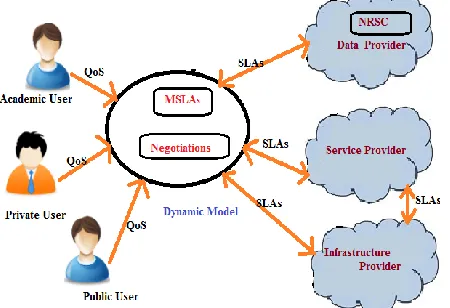
[image:4.612.63.288.518.672.2]In this we need to implement an dynamic model in which we get minimum cost in requested deadline of user for the service. Here each user is assigned with some particular SLAs this is called the Multi-Level SLA, also after the budget had been set and dynamic negotiations come to the picture like to provide the total cost which can reach the user budget by getting from providers. This can be done by using the MCDM[8] method which is one of approach of negotiation strategies also we use one of the method of MCDM i.e. the Weighted Sum Method(WSM)[8] , we construct table with matrix format for every provider, we take SLAs metrics that are commonly used by service providers (application provider and infrastructure provider). But these SLA metrics are only used by application and infrastructure provider not by data provider because it has its own private SLA metrics which only gives to us, but never publish publicly to all others. Then based on the algorithmic model we came to know that if the user requests for a service by providing its QoS to us (we acts as a broker), then we see who is the best providers that can reach all QoS parameters of user. As we studied that present WSM[8] is not completely implemented in our model only we take some portions for an idea how to assume an dynamic model for the MSLAs and negotiations in between the users and the providers. The main intension of using the MSLAs in our dynamic model is that, each provider is assigned with some SLAs to access the service from the provider, also each user has own QoS parameters[10] to request an service to provider. Mainly SLA only provides agreement between
Fig. 2 Dynamic Model for MSLAs and Negotiations
A user and the provider but the MSLA is different from the SLA i.e. the SLAs are split in different types for the different users, each user is proposed with some SLA on the provider side
by assuming them as SLA metrics. Where in the case of Dynamic Negotiations [6], if we get budget in some kind of list like user must select from the proposed list, so we go with dynamic way like we give exact cost in particular deadline for the user who requested for service. These are the two ways so we go with the second way like we provide exact cost in particular deadline by using WSM[8] method.
VI. CONCLUSION
As we conclude that it is possible to give service for user by using dynamic model of Multi-level SLA [3] and negotiations [4]. We can get minimum cost to reach the user requested budget in QoS parameters [10]. In future work we need to build a dynamic model in the form of matrix form by giving all SLA metrics on one side and providers for that metrics. So that it is easy to pick best provider for the user request that are stated in QoS parameters [10].
REFERENCES
[1] Service Level Agreement from Wikipedia, the free Encyclopediahttp://en.wikipedia.org/wiki/Service level_agreement [2] Pnankesh Patel, Ajith Ranabahu, Amit Sheth. Service Level Agreement in
Cloud Computing
[3] Mohammed Alhamad, Tharam Dillon, Elizabeth Chang. Conceptual Frame work for Cloud computing (2010)
[4] Surya Nepal, John Zic. A Conflict Neighbouring Negotiation Algorithm for Resource Service in Dynamic Collaborations (2008)
[5] Philipp Grandits, Gerald Margreiter, Andreas Juch and Mathias Ertl Tu Wein. https://er.tl/paper.pdf
[6] Linlin Wu and Raj Kumar Buyya. Service Level Agreement (SLA) in Utility Computing Systems (Submitted on 14 Oct 2010)
[7] Rafael Lopes Gomes, Edmundo Madeira. An Automatic SLA Negotiation Protocol for a Future Internet (submitted on 2011 conference)
[8] E.Triantaphyllou, Multi-Criteria Decision Making Methods: A Comparative Study, P. M. Parlos, Ed. Dordrecht, Boston, London: Kluwer Academic Publishers, (2000)
[9] Antoine Pichot, Phillip Wieder, Oliver Waldrich, Wolfgang Ziegler. Dynamic SLA-negotiation based on WS-Agreement (2010)
[10] Praveen Ganghishetty, Rajeev Wankar .Quality of service (QoS) design in Clouds (2011)
[11] http://www.nrsc.gov.in/assets/pdf/Data_price.pdf
AUTHORS
First Author –Miss. V.Spoorthy has completed B.Tech in
Computer Science and Engineering from G.Pulla Reddy Engineering College in the year 2010; presently she is pursuing her M. Tech from G.Pulla Reddy Engineering College
(Autonomous), Affiliated to JNTUA.,[email protected]
Second Author – Mr. C.Sreedhar received B.E (Computer