Email: [email protected]
Received 20 May 2014; revised 9 June 2014; accepted 5 July 2014
Copyright © 2014 by authors and Scientific Research Publishing Inc.
This work is licensed under the Creative Commons Attribution International License (CC BY).
http://creativecommons.org/licenses/by/4.0/
Abstract
This paper used the intervention analysis model to fit the data of seven-day annualized yield of Yu Ebao, by regarding the Niu’s comment as intervention. We constructed the linear model and the intervention model. The result showed that though Niu’s comment was not the most important cause of the decline of the yield, its effects cannot be ignored. And it caused the yield of Yu Ebao fallen 0.148% faster than before.
Keywords
Yu Ebao, Yield, Intervention Analysis Model
1. Introduction
Recently, a series of internet financial products were launched by many internet companies and fund manage-ment companies, which attracted a lot of investors’ attention. Yu Ebao is one of these products. Yu Ebao was a balance value-added service built by the third party payment platform Alipay, which was launched in June 13, 2013. Essentially, it is a monetary fund launched by the Alipay cooperated with the Tianhong Asset Manage-ment Company. The users will access certain benefits by transferring the money to Yu Ebao. Due to that fact that its yield was higher than the bank current deposit interest rate, and the account funds could be used for on-line shopping or transferring at any time, it attracted a large number of young people fascinated in onon-line shop-ping. As of February 27, 2014, Yu Ebao user amount has exceeded 81 million, and its asset size was larger than 5 hundred billion.
Figure 1. The seven-day annualized yield of Yu Ebao.
peak.
On the day of February 21, 2014, Wenxin Niu whom is the chief executive editor and chief commentator of CCTV security information channel, accused that Yu Ebao was a “vampire” lying on the bank, a typical “finan-cial parasite”, and advocated to ban this product. Niu’s comment was reported by many authoritative media, and sent shock waves throughout the internet. Because of this, the yield of Yu Ebao fallen sharply. Even though on March 4, Xiaochuan Zhou, president of the people’s bank of China, indicated that they won’t ban the Yu Ebao, that’s unable to block the yield decline. Based on the background above, we regarded Niu’s comment as the in-tervention, applying the intervention analysis model to analyze and predict the trend of seven-day annualized yield, quantitatively studying its running track.
2. Intervention Analysis Model
The intervention analysis model is proposed by Box and Tiao, professors of University of Wisconsin, depart-ment of statistics [1]. Intervention analysis is to evaluate the impacts of policy events or emergency on the eco-nomic environment and process from the angle of quantitative analysis [2]. The intervention parameters fall into two categories, continuous and transitory. The continuous parameter refers that the intervention event still af-fects the changes after the moment T. The basic variable of intervention analysis model is the intervention varia-ble, i.e.
(
)
(
)
0, before the intervention 1, after the intervention
T t t T S t T < = ≥
The intervention model is
1 T t t Z S B
ω
δ
=− , where ω represents the unknown parameter of the intervention
effect strength,
δ
represents the intervention duration, B is delay operator. Four kinds of intervention type concluded as below:1) The influence of intervention appears all of a sudden, and continues for a long time; 2) The influence of intervention appears gradually, and continues for a long time; 3) The intervention occurs suddenly, and the influence is temporary;
4) The intervention occurs gradually, and the influence is temporary.
the model is significant under the significant level 0.05, all of these show that the model fitting effect is great.
3.3. Intervention Model Construction
With the linear model we got above, we predict the yield xˆ0t from February 21 to April 30. Then we compute the intervention effect value Zt = −xt xˆ0t, Zt is the quantitative impact value of Niu’s comment on Yu Ebao’s yield. We estimate the parameters of the intervention model and get this:
0.014 1 0.928 t Z B = − −
where the model goodness of fit R2=0.985, model F Test F=4108.933
(
P=0.000)
, and all the parameters in the model is significant under the significant level 0.05, all of these show that the model fitting is great.3.4. Purified Series Model Construction
The purified series refer to the series without the intervention impact, i.e.
1
T
t t t
y x S
B
ω
δ
= − −
(
T=51,t=1, 2,,120)
. We still chose the linear model to fit the purified series, the result is:ˆt 6.774 0.013
y = − t
where the model goodness of fit 2
0.979
R = , model F Test F=5377.901
(
P=0.000)
, and all the parameters in the model is significant5, all of these show that the model fitting is great.3.5. The Final Intervention Analysis Model
Combining the intervention model and the purified series model, we get the final intervention analysis model:
0.014 6.774 0.013
1 0.928
T
t t
x t S
B − = − + −
(
)
(
)
0, before February 21, 2014 51 1, February 21, 2014 and after 51
T t t S t < = ≥
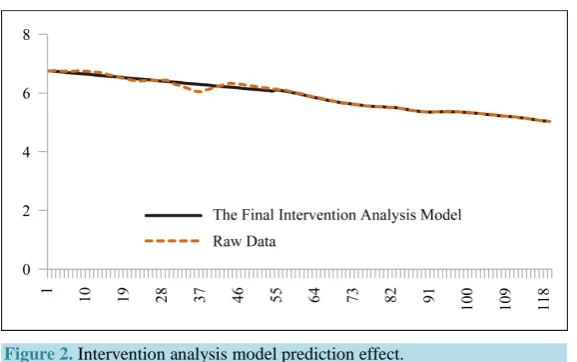
By comparing the prediction value of intervention analysis model and the raw data (Figure 2), we know that the two series are highly consistent, which shows that the model we constructed is reasonable.
According to the analysis above, we conclude that Niu’s comment made the yield fallen faster and faster, the average impact is −0.148%, i.e. after the comment, the yield of Yu Ebao fallen 0.148% faster than before.
4. Conclusion and Improvement
Figure 2. Intervention analysis model prediction effect.
will make their own choices to enter or exit the market according to the good or bad news; what’s more, that will affect yield of the product. Through the intervention analysis model, we fitted the impact of “ban Yu Ebao” comment on its yield accurately.
Yu Ebao as a monetary fund product, is restricted by the deposit rate of the bank, so that its yield won’t never keep on the high level [4]. Dengfeng Wang, fund manager of the Tianhong asset management company, ex-plained that the reason why the yield was so high is that the money is in short supply at the end of the year and before the Spring Festival, so the investors who invest the monetary fund enjoyed a higher income. But after the Spring Festival, the money supply tension reduced, the yield of Yu Ebao is returned to the normal level. There-fore, though Niu’s comment was not the most important cause of the decline of the yield, with the analysis above, its effects cannot be ignored [5].
This paper only considered the linear and curve regression model when we constructed the model. We haven’t considered applying some general time series model, such as ARIMA model, ARCH model, etc. So in the future research work, we will apply more types of model and compare their fitting effect.
Acknowledgements
This work was jointly supported by the National Social Science Fund (No. 13BTJ009).
References
[1] Box, G.E.P. and Tiao, G.C. (1975) Intervention Analysis with Applications to Economic and Environmental Problems.
Journal of the American Statistical Association, 70, 70-79. http://dx.doi.org/10.1080/01621459.1975.10480264 [2] Xu, G. (2008) Statistical Forecasting and Decision-Making. 3rd Edition, Shanghai University of Finance & Economics
Press Co., LTD., Shanghai.
[3] Fan, M. (2013) The Trend, Influence and Policy Suggestion of “Yu Ebao” Business. Times Finance, 528, 138-139. [4] Li, Q.Y. (2013) Yu Ebao: The High Yield Will Not Be Lasted. Finance & Accounting, 11, 72.
2014/1/9 6.737 2014/2/18 6.241 2014/3/30 5.374
2014/1/10 6.738 2014/2/19 6.22 2014/3/31 5.361
2014/1/11 6.721 2014/2/20 6.201 2014/4/1 5.356
2014/1/12 6.703 2014/2/21 6.183 2014/4/2 5.357
2014/1/13 6.695 2014/2/22 6.165 2014/4/3 5.362
2014/1/14 6.67 2014/2/23 6.147 2014/4/4 5.367
2014/1/15 6.618 2014/2/24 6.136 2014/4/5 5.37
2014/1/16 6.595 2014/2/25 6.114 2014/4/6 5.373
2014/1/17 6.554 2014/2/26 6.093 2014/4/7 5.373
2014/1/18 6.517 2014/2/27 6.062 2014/4/8 5.368
2014/1/19 6.48 2014/2/28 6.031 2014/4/9 5.36
2014/1/20 6.46 2014/3/1 6.001 2014/4/10 5.351
2014/1/21 6.423 2014/3/2 5.971 2014/4/11 5.339
2014/1/22 6.398 2014/3/3 5.928 2014/4/12 5.327
2014/1/23 6.413 2014/3/4 5.895 2014/4/13 5.315
2014/1/24 6.422 2014/3/5 5.864 2014/4/14 5.3
2014/1/25 6.424 2014/3/6 5.835 2014/4/15 5.287
2014/1/26 6.434 2014/3/7 5.805 2014/4/16 5.272
2014/1/27 6.416 2014/3/8 5.774 2014/4/17 5.253
2014/1/28 6.441 2014/3/9 5.744 2014/4/18 5.239
2014/1/29 6.432 2014/3/10 5.716 2014/4/19 5.224
2014/1/30 6.36 2014/3/11 5.69 2014/4/20 5.21
2014/1/31 6.293 2014/3/12 5.668 2014/4/21 5.2
2014/2/1 6.253 2014/3/13 5.647 2014/4/22 5.188
2014/2/2 6.205 2014/3/14 5.628 2014/4/23 5.171
2014/2/3 6.158 2014/3/15 5.61 2014/4/24 5.152
2014/2/4 6.085 2014/3/16 5.592 2014/4/25 5.13
2014/2/5 6.051 2014/3/17 5.568 2014/4/26 5.109
2014/2/6 6.044 2014/3/18 5.555 2014/4/27 5.087
2014/2/7 6.096 2014/3/19 5.544 2014/4/28 5.067
2014/2/8 6.135 2014/3/20 5.538 2014/4/29 5.048
currently publishing more than 200 open access, online, peer-reviewed journals covering a wide range of academic disciplines. SCIRP serves the worldwide academic communities and contributes to the progress and application of science with its publication.