Recommender System: Review
Akshita
II year, M.Tech PDM College Of Engineering For Women, Haryana, India
Smita
Associate Professor PDM College Of Engineering
For Women, Haryana, India
ABSTRACT
One of the major data mining applications is Recommender System. It is the intelligent system that basically investigate the dataset present in existing system and based on which it will give some suggestions to the user regarding further process. This paper discuss various techniques proposed for recommendations including content based, collaborative based and other techniques. To improve performance, these methods have sometimes been combined in hybrid recommenders. It also discuss about growing area of research in the area of recommender systems that is mobile recommender systems.
General Terms
Information retrieval, Stop words
Keywords
Recommender system; Content based; Collaborative based; Data mining, Hybrid Recommender System
1.
INTRODUCTION
The recommender system is about to identify the knowledge about the similar user or the event and derive the favorable aspect based on it. It is the criteria of “individualized” and “interesting and useful” that separate the recommender system from information retrieval systems or search engines. Recommender systems help E-commerce sites increase sales, recommender systems typically produce a list of recommendations in three ways - through collaborative-based, content-based filtering, knowledge based. One common thread in recommender systems research is the need to combine recommendation techniques to achieve peak performance. These techniques can be used individually or combined together in different ways. The paper is arranged into sections further describing recommendation techniques and hybrid approach by combining different techniques.
2.
RECOMMENDATION TECHNIQUES
Recommendation techniques are information agents that attempt to predict which items out of large pool a user may b interested in and recommend the best one to the target user. Recommendation techniques have a number of possible classifications. Of interest in this discussion is not the type of interface or the properties of the user’s interaction with the recommender, but rather the sources of data on which recommendation is based and the use to which that data is put. Specifically, recommender systems have (i) background data, the information that the system has before the recommendation process begins, (ii) input data, the information that user must communicate to the system in
order to generate a recommendation, and (iii) algorithm that combines background and input data to arrive at its suggestions.
Figure 1: Classification of recommendation techniques
The whole classification is broadly categorized into the personalized and non personalized recommendation, and discuss all the personalized recommendation techniques shown in Figure 1.personalized recommendation is an enabling mechanism to overcome information overload occurred when shopping in an internet marketplace, use personalized information for better recommendations to the user.
Non personalized recommendations are the simplest form of recommendations in which without any consideration of user’s specifications some items are recommended. The most popular method is the recommendation based on ranking of items. However, since they don’t take user’s preferences into account, the quality of their results are low. For example in an electronic shop most sold items are recommended to all users [1].
Collaborative based recommendation systems recommend items based on similarity measures between users and/or items. The items recommended to a user are those preferred by similar users. CF methods can be further subdivided into neighborhood-based and model-based approaches [10]. Neighborhood-based Collaborative Filtering In neighborhood-based techniques, a subset of users are chosen based on their similarity to the active user, and a weighted combination of their ratings is used to produce predictions for this user.
Model-based Collaborative Filtering Model-based techniques provide recommendations by estimating parameters of statistical models for user ratings.
Knowledge-based recommendation attempts to suggest objects based on inferences about a user’s needs and preferences. Knowledge-based approaches are distinguished in that they have functional knowledge: they have knowledge about how a particular item meets a particular user need, and can therefore reason about the relationship between a need and a possible recommendation.
2.1
Knowledge source of Recommendation
Techniques
Figure 2: Recommendation techniques and their knowledge Sources
Figure 2 shows Collaborative recommenders uses a profile from the current user and a profile database of the other users. The system commonalities between the current user and those in the profile database, and generate new recommendations based on inter-user comparisons. Content based recommender drawing from the user profile and also from the feature database content based recommender learns a profile of the user’s interests based on the features present in the object the user has rated. The knowledge based recommender uses the query to make the recommendations based on inferences about a user need and preferences [11].
[image:2.595.312.548.128.389.2]2.2
Comparing Recommendation
Techniques
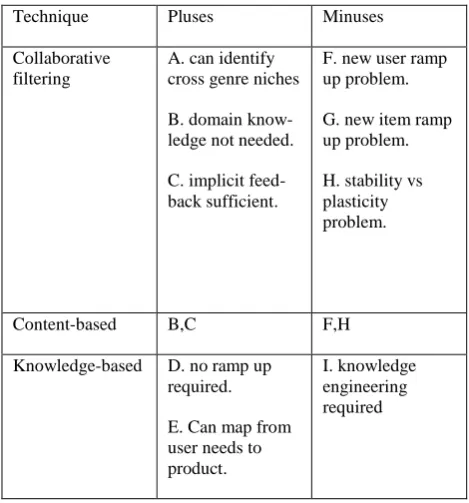
Table 1 summarizes the three recommendation techniques that we have discussed, pointing out the pros and cons of each. Collaborative, content-based techniques suffer from the ramp-up problem in one form or another. The ramp-ramp-up problem has
the side-effect of excluding casual users from receiving the full benefits of collaborative and content-based recommendation [5].
Table 1. Tradeoffs between Recommendation Techniques
2.3
Other Techniques
Demographic recommender systems aim to categorize the user based on personal attributes and make recommendations based on demographic classes [9].
Utility-based recommenders make suggestions based on a computation of the utility of each object for the user.
3. RECOMMENDER SYSTEM EXMPLES
In the following section we present six e-commerce businesses that utilize one or more variations of recommender system technology in their web sites [3,2].
3.1 Amazon.com
Customers who Bought: Like many E-commerce sites, Amazon.com™ (www.amazon.com) is structured with an information page for each book, giving details of the text and purchase information.
Amazon.com Delivers: Amazon.com Delivers is a variation on the Eyes feature. Customers select checkboxes to choose from a list of specific categories/genres (Oprah books, biographies, cooking). Periodically the editors at Amazon.com send email announcements to notify subscribers of their latest recommendations in the subscribed categories.
3.2 CDNOW
Album Advisor: The Album Advisor feature of CDNOW™
(www.cdnow.com) works in two different modes. In the single album mode customers locate the information page for a given album. The system recommends 10 other albums related to the album in question. In the multiple artist mode customers enter up to three artists. In turn, the system recommends 10 albums related to the artists in question.
Technique Pluses Minuses
Collaborative filtering
A. can identify cross genre niches
B. domain know- ledge not needed.
C. implicit feed-back sufficient.
F. new user ramp up problem.
G. new item ramp up problem.
H. stability vs plasticity problem.
Content-based B,C F,H
Knowledge-based D. no ramp up required.
E. Can map from user needs to product.
I. knowledge engineering required
Profile
database
Knowledge
database
Collaborative
recommender
Content-based
recommender
Knowledge-based
recommender
Current
user
profile
Feature
database
[image:2.595.313.548.133.385.2] [image:2.595.53.286.332.529.2]3.3 eBay
Feedback Profile: The Feedback Profile feature at eBay.com™ (www.ebay.com) allows both buyers and sellers to contribute to feedback profiles of other customers with whom they have done business. The feedback consists of a satisfaction rating(satisfied/neutral/dissatisfied) as well as a specific comment about the other customer
3.4 Levis
Style Finder: Style Finder allows customers of the Levi Straus™ (www.levis.com) website to receive recommendations on articles of Levi’s clothing. Customers indicate whether they are male or female, then view three categories -- Music, Looks, Fun -- and rate a minimum of 4 “terms” or “sub-categories” within each. They do this by providing a rating on a 7-point scale ranging from “leave it” to “love it.” They may also choose the rating of “no opinion.” Once the minimum number of ratings are entered customers may select “get recommendations.” Here, they are provided with thumbnails of 6 items of recommended clothing.
3.5 Moviefinder.com
Match Maker: Moviefinder.com’s Match Maker
(www.moviefinder.com) allows customers to locate movies with a similar “mood, theme, genre or cast” to a given movie. From the information page of the movie in question, customers click on the Match Maker icon and are provided with the list of recommended movies, as well as links to other films by the original film’s director and key actors.
3.6 Reel.com
Movie Matches: Similar to Amazon.com’s Customers who Bought, Reel.com’s Movie Matches (www.reel.com) provides recommendations on the information page for each movie. These recommendations consist of “close matches” and/or “creative matches.”
3.
RELATED WORK
In year 2002, Robin Burke in the paper “Hybrid Recommender Systems: Survey and Experiments” author describes variety of techniques have been proposed for performing recommendation, including content-based, collaborative, knowledge-based and other techniques and to improve performance these methods have sometimes been combined in hybrid recommenders. This paper surveys the landscape of actual and possible hybrid recommenders, and introduces a novel hybrid, Entrée C, a system that combines knowledge-based recommendation and collaborative filtering to recommend restaurants [5].
In year 2007, Michael J Pazzani in the “Content Based Recommendation System” discusses content-based recommendation systems, i.e., systems that recommend an item to a user based upon a description of the item and a profile of the user’s interests [4].
In year 2006, K S Esmaili in the paper “Comparing Performance of recommendation Technique in the Blogshere” describe Weblogs one of fundamental components of Web have difficulties in finding relevant blogs. Recommender 2.0 and there are a lot of unskilled bloggers and visitors who systems are a solution to the information overload problems. In this paper a weblog recommender system based on link structure of weblog graph is introduced. Here we treat links
between weblogs as some kind of rating. The methods are implemented on a real dataset [7].
In year 2001, J. Ben Schafer in the paper “E-Commerce Recommendation Applications” examine how recommender systems help E-commerce sites increase sales and analyze the recommender systems at six market-leading sites. Based on these examples, create a taxonomy of recommender systems, including the inputs required from the consumers, the additional knowledge required from the database, the ways the recommendations are presented to consumers, the technologies used to create the recommendations, and the level of personalization of the recommendations[2].
In year 2004, Jonathan L. Herlocker in the paper “Evaluating collaborative filtering recommender systems” review the key decisions in evaluating collaborative filtering recommender systems: the user tasks being evaluated, the types of analysis and datasets being used, the ways in which prediction quality is measured, the evaluation of prediction attributes other than quality, and the user-based evaluation of the system as a whole [13].
4.
HYBRID RECOMMENDER SYSTEM
Hybrid recommender systems combine two or more recommendation techniques in order to increase the overall performance. The main idea is using multiple recommendation techniques to suppress the drawbacks of an individual technique in a combined model. Netflix are good examples of hybrid systems. The Netflix Prize sought to substantially improve the accuracy of predictions about how much someone is going to enjoy a movie based on their movie preferences. On September 21, 2009 awarded the $1M Grand Prize to team “BellKor’s Pragmatic Chaos” [8]. A number of privacy issues arose around the dataset offered by Netflix for the Netflix Prize competition. Although the data sets were anonymized in order to preserve customer privacy, in 2007, two researchers from the University of Texas were able to identify individual users by matching the data sets with film ratings on the Internet Movie Database. As a result, in December 2009, an anonymous Netflix user sued Netflix in Doe v. Netflix, alleging that Netflix had violated U.S. fair trade laws and the Video Privacy Protection Act by releasing the datasets. This led in part to the cancellation of a second Netflix Prize competition in 2010 [14].
The taxonomy is based on the hierarchy and input/output relations of recommenders. some of the combination methods that have been employed [5].
4.1. Weighted
A weighted hybrid recommender is one in which the score of a recommended item is computed from the results of all of the available recommendation techniques present in the system. The benefit of a weighted hybrid is that all of the system’s capabilities are brought to bear on the recommendation process in a straightforward way and it is easy to perform post-hoc credit assignment and adjust the hybrid accordingly.
4.2. Switching
parameterization. However, the benefit is that the system can be sensitive to the strengths and weaknesses of its constituent recommenders.
4.3. Mixed
Where it is practical to make large number of recommendations simultaneously, it may be possible to use a “mixed” hybrid, where recommendations from more than one technique are presented together. It does not get around the “new user” start-up problem, since both the content and collaborative methods need some data about user preferences to get off the ground.
4.4. Feature Combination
Another way to achieve the content/collaborative merger is to treat collaborative information as simply additional feature data associated with each example and use content-based techniques over this augmented data set. The feature combination hybrid lets the system consider collaborative data without relying on it exclusively, so it reduces the sensitivity of the system to the number of users who have rated an item.
4.5. Cascade
In this technique, one recommendation technique is employed first to produce a coarse ranking of candidates and a second technique refines the recommendation from among the candidate set. Cascading allows the system to avoid employing the second, lower-priority, technique on items that are already well-differentiated by the first or that are sufficiently poorly-rated that they will never be recommended.
4.6. Feature Augmentation
One technique is employed to produce a rating or classification of an item and that information is then incorporated into the processing of the next recommendation technique.
4.7. Meta-level
Another way that two recommendation techniques can be combined is by using the model generated by one as the input for another. This differs from feature augmentation: in an augmentation hybrid, we use a learned model to generate features for input to a second algorithm; in a meta-level hybrid, the entire model becomes the input. The benefit of the meta-level method, especially for the content/collaborative hybrid is that the learned model is a compressed representation of a user’s interest, and a collaborative mechanism that follows can operate on this information-dense representation more easily than on raw rating data.
5.
MOBILE RECOMMENDER SYSTEM
One growing area of research in the area of recommender systems is mobile recommender systems. With the increasing ubiquity of internet-accessing smart phones, it is now possible to offer personalized, context-sensitive recommendations. Advances in sensor, wireless communication, and information infrastructures such as GPS, and RFID have enabled us to collect large amounts of location traces (trajectory data) of individuals or objects. Such a large number of trajectories provide us unprecedented opportunity to automatically discover useful knowledge, which in turn deliver intelligence for real-time decision making in various fields, such as mobile recommendations. Indeed, a mobile recommender system promises to provide mobile users access to personalized
recommendations anytime, anywhere. One example of a mobile recommender system is one that offers potentially profitable driving routes for taxi drivers in a city[12]. This system takes as input data in the form of GPS traces of the routes that taxi drivers took while working, which include location (latitude and longitude), time stamps, and operational status (with or without passengers). It then recommends a list of pickup points along a route that will lead to optimal occupancy times and profits. This type of system is obviously location-dependent, and as it must operate on a handheld or embedded device, the computation and energy requirements must remain low.
6.
CONCLUSION
All existing recommender systems employ one or more of a handful of basic techniques: content-based, collaborative, demographic, utility-based and knowledge-based. A significant amount of recent research has been dedicated to the exploration of various hybrids, including the six hybridization techniques discussed in this paper: weighted, mixed, switching, feature combination, feature augmentation, and meta-level. This paper also shows the advantages and disadvantages of different techniques and their knowledge source. Examine how recommender systems help E-commerce sites increase sales and analyze the recommender systems at six market-leading sites An introduction is given for the mobile recommender system. A lot future work has to b done under the mobile recommender system.
7. REFERENCES
[1] Kyumars Sheykh Esmaili, Mahmood Neshati, Mohsen Jamali, Hassan Abolhassani and Jafar Habibi, “Comparing Performance of Recommendation Techniques in the Blogsphere” ,in ECAI 2006 workshop on recommender system.
[2] J. Ben Schafer, Joseph Konstan, John Riedl, “E-Commerce Recommendation Applications”, Applications of Data Mining to Electronic Commerce ,2001, pp 115-153, springer US
[3] J. Ben Schafer, Joseph A. Konstan, and John Riedl, “Recommender systems in e-commerce”, in ACM Conference on Electronic Commerce, pp. 158–166, (1999).
[4] Michael J. Pazzani and Daniel Billsus, “Content-Based Recommendation Systems”, The Adaptive Web, LNCS 4321, pp. 325 – 341, 2007
[5] Robin Burke, “Hybrid Recommender Systems: Survey and Experiments”, User Modeling and User-Adapted Interaction, November 2002, Volume 12, Issue 4, pp 331-370
[6] Joseph Konstan, Introduction to Recommender Systems, June 10, 2008. Retrieved from http://www users.cs.umn.edu/~konstan/SIGMOD-2008-Tut.pdf.
[7] Jia Wang, Qing Li, Yuanzhu Peter Chen and Zhangxi Lin, “Recommendation in Internet Forums and Blogs”,Proceedings of the 48th Annual Meeting of the Association for Computational Linguistics, pages 257– 265, Uppsala, Sweden, 11-16 July 2010. c 2010 Association for Computational Linguistics
[9] M. Pazzani. A framework for collaborative, content-based, and demographic fltering. Artifcial Intelligence Review,1999.
[10]Prem Melville and Vikas Sindhwani, Recommender Systems, Encyclopedia of Machine Learning, 2010
[11]Francesco Ricci and Lior Rokach and Bracha Shapira, Introduction to Recommender Systems Handbook, Recommender Systems Handbook, Springer, 2011, pp. 1-35
[12]Yong Ge, Hui Xiong, Alexander Tuzhilin, Keli Xiao, Marco Gruteser,Michael J. Pazzani (2010). "An
Energy-Efficient Mobile Recommender System". Proceedings of the 16th ACM SIGKDD Int'l Conf. on Knowledge Discovery and Data Mining. New York City, New York: ACM. pp. 899–908. Retrieved 2011-11-17.
[13]Jonathan L. Herlocker, Joseph A. Konstan, Loren G. Terveen and John T. Riedl, “Evaluating collaborative filtering recommender systems”, in Jouranl ACM Transactions on Information Systems, volume 22 Issue 1, January 2004.