Utilizing TV Frequency Bands using Coalitional Game
Theory according to the Standard of IEEE 802.22
A.I.A. Jabbar,
Ph.DEmad A. Mohammed
Engineering college Technical college of Mosul
Department of electrical engineering Computer engineering technology
Mosul university department
ABSTRACT
In this paper a cooperative spectrum sensing system based on IEEE 802.22 standard is proposed and modeled as cooperative game theory scheme. The proposed method considers each secondary user as a single sensing terminal that implies energy detection as spectrum sensing method with different signal to noise ratios (SNR's) to estimate the existence of TV stations. The final decision of TV stations existence is made by fusion center after receiving each secondary user decision. The secondary users will form coalitions to make the final decision of the fusion more accurate. The cooperative game theory that proposed in this paper is based on AND, OR and majority rule for coalitions.
General Terms
Computer Network, Wireless Network, Modeling
Keywords
Cognitive radio, spectrum sensing, WRAN, TV band, IEEE 802.22, game theory
1. INTRODUCTION
Due to the huge user demands for wireless communication, more and more spectrum resources are needed. The majority of the available spectrum bands are allocated to licensed services. However, a lot of licensed bands are not utilized efficiently, resulting in spectrum wastage. This encourages (FCC) organization to open some of the licensed bands to unlicensed users using cognitive radio (CR) technology[1] . Cognitive Radios (CR's) are wireless devices with the ability to change their transmission parameters and to adjust their communication behaviors and patterns in accordance with the environment requirements. The spectrum sensing is the most important point of CRs allowing them to detect unused spectrum parts and use them with minimum interference to other CRs or licensed users[2]. IEEE 802.22 for wireless regional area network (WRAN) is the first wireless standard which is based on Cognitive Radios (CR). It relies on TV frequencies from 54MHz to 862MHz in the VHF/UHF bands. WRAN cell consists of base station (BS) and several consumer premise equipments (CPE's) as shown in figure (1). It is worth to mention that these bands are used for wireless services without any effective interference to TV stations [3]. From practical point of view, spectrum sensing becomes an important task because the channel from the primary to the secondary users can be subjected to shadowing and time varying multipath fading problems. It is possible to conclude that detecting a TV station based on the observation of a single secondary user is not sufficient, especially under low SNR conditions. Hence to overcome this problem, cooperative spectrum sensing technique is envisaged, whereby the signal detection of some secondary users can be used to enhance the final detection decision[4]. A new idea to achieve an efficient cooperative spectrum sensing based on game theory is proposed. It is a mathematical tool that deals
with the strategic interactions between multiple decision makers (DM's)[5].
The rest of this paper is organized as follows:
section 2 shows the related works in this field. In section 3 modeling of a typical spectrum sensing system is presented. In section 4 signal detection based on coalitional game principals with the necessary flowcharts are presented. Section 5 shows the simulation results. Finally the conclusions is presented in section 6.
2. RELATED WORKS
A number of publications that deal with energy detection are listed as follows:
The performance of energy detector under lognormal shadowing is studied in[6]. The efficiency of energy detection for spectrum sensing in the presence of non-cooperating secondary users is investigated in [7]. An enhanced energy detector via algebraic approach for spectrum sensing in cognitive radio networks is proposed in [8]. The most fundamental concepts of game theory, with a necessary explanation of how these concepts can be introduced in designing spectrum sharing protocols in cognitive radio networks are detailed in [5]. A study of how the dynamic behavior of a network of secondary users can reduce the interference on the TV stations using a special centralized solution for organizing the sensing is proposed in [9]. The ability to model single independent decision maker whose action can affect all other (DM's) using game theory to analyze the performance of ad hoc networks is presented in [10]. An evolutionary game theory for distributed spectrum sensing scheme is designed in [11].
3. MODELING A TYPICAL SPECTRUM
SENSING SYSTEM
3.1. System Model Assumptions
The system which is based on cooperative spectrum sensing technique consists of the following:
1. Multi TV stations are located outside a WRAN cell. 2. WRAN cell consists of base station (BS) and
secondary users (SU).
3. Energy detection technique is used to make decision about the existence of TV station signal.
4. The base station applies game theory to make the final decision about the presence of TV station signals.
5. The received signal by the secondary user is sampled at Nyquist rate (6MHz for TV channel). 6. The secondary users are assumed to be stationary. 7. The minimum detectable signal to noise ratio is
3.2. Spectrum Sensing Technique
The received power by i-th secondary user can be calculated using:
(1)
where: P is the TV transmitter power
di is the distance of the i-th user from TV transmitter
is the path loss exponent is a scalar quantity
Signal detection can be defined using the following hypothesis:
yi(k) = n(k) for null hypothesis H0
yi(k) = x(k)+n(k) for alternative hypothesis H1
k=1……M, where M is the number of samples (2) where: yi(k) is the received signal by i-th secondary user (Sui)
n(k) is additive white Gaussian noise x(k) is the TV station signal
The decision statistic can be calculated using the following equation:
(3)
The optimal hypothesis testing solution (according to Neyman-Pearson criteria likelihood ratio) is measured by a pair of detection and false alarm probabilities (pd, pfa). Each
pair has a given threshold (γ) that test decision statistics: > γ means signal present
< γ means signal absent
The decision statistic without signal has central Chi-square distribution with a degree of freedom equal to 2M, on the other hand, the decision statistic with the signal has non-central Chi-square distribution with a degree of freedom equal to 2M. The central limit theorem can be applied to approximate the test statistic as Gaussian distribution.
Normal (σw2 , σw4/M) under H0
Normal (σw2 + Pi , (σw2 + Pi)2/M) under H1
where: σw 2
is the noise variance.
Then for i-th user pfai and pmdi can be calculated using:
σ γ (4)
σ σ γ (5)
The probability of miss detection is defined as:
pmdi=1-pdi (6)
4. SIGNAL DETECTION BASED ON
COALITIONAL GAME THEORY
4.1. Coalitional Game Theory
.It is possible to describe any game by three main components according to the following form:
G=<N, A, {ui} > .
Where:
N: represents the number of (DM's).
Ai: is the set of all possible actions that (DM) can choose. On
the other hand, the total action space (A) is calculated by: A=A1× A2× ….. AN (7)
ui: is utility or payoff functions of i-th user. The utility set of
all (DM) is given by:
U={U1 U2……UN} (8)
A set of (DM) can cooperate with others by forming cooperating groups to improve their payoff in a game. The coalition S can be formed from a non-empty subset of N (DM) with the condition that they are agreed to cooperate together, they can be considered as one entity and is associated with v(S) which represents the usefulness of S. This means that, a coalitional game can be determined by N and v(S).
As an example, assume that:
1. The number of (DM's) n in the game is equal or greater than (2), numbered from 1 to n.
2. N is equal to the set of (DM's), N = {1, 2, . . . , n}. A coalition, S, is a subset of N, S ⊂ N, and the set of all coalitions is denoted by 2N. The set N is also a coalition, called the grand coalition. If in case of having two (DM's), n = 2, four coalitions, { Ø, {1}, {2},N}can be generated. For n (DM's), the set of coalitions is equal to 2N, with 2n elements.
The pair (N, v) is the coalitional form of an n-person game, where N = {1, 2, . . . , n} is the set of (DM) and v is the characteristic function of the game, defined on the set, 2N, of TV frequencies
transmitter
Fig.1 WRAN cell
DM 3
DM 6
DM 5
DM 4 DM
2
DM
1
BS
all coalitions (subsets of N), and satisfying the following conditions:
(i) v(Ø) = 0
(ii) If S1 and S2 are disjoint coalitions (S1 ∩ S2= Ø), then the
following superadditivity can be achieved
v(S1) + v(S2) ≤ v(S1∪ S2). (9)
On the other hand, and due to superadditvity, the (DM) have the right to form the grand coalition N.
4.2. Case Study
This case is based on the following assumptions:
(i) 7 secondary users cooperate with each other in a grand coalition (N=7).
(ii) The users are placed in different places within the WRAN cell.
(iii) They are separated by different distances from the TV station transmitters (TV transmitters). (iv) The secondary users apply energy detection
technique to sense the TV broadcasting for each TV station transmitter.
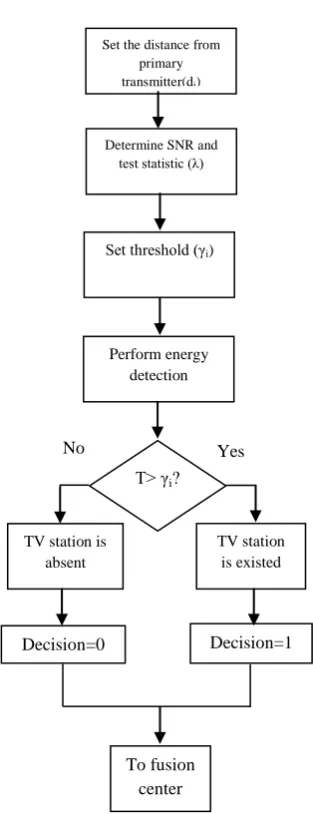
Figure (2) shows the flowchart of the energy detection technique.
The fusion center will achieve certain algorithms to enhance v(S), these algorithms are based on:
1. AND rule, fusion center will confirm the presence of primary signal if the secondary users have the same decision, this can be represented by:
(10)
2. OR rule, fusion center will ensure the presence of primary signal if the decision of any secondary user is positive, this can be formulated using:
(11)
3. Majority rule, fusion center will declare the presence of primary signal if most of the secondary users decide that, or:
(12)
Figure (3) shows the flowchart of various decision algorithms at the fusion center.
5. SIMULATION RESULTS
In this paper, simulation results according to the assumptions are listed below:
1. The noise power is constant and equal to -125dB (including the receiver noise figure).
2. The transmitted power of each primary transmitter (P) is 100W.
3. Path loss exponent ( ) is 2.5.
4. The number of samples is taken using different sensing times (1ms, 2ms and 16ms).
5. The BW of the signal is 6MHz.
6. Three cooperative game schemes ( as fusion center approach) are used to make the final decision about the existence of the TV station at certain frequency. 7. Energy detection is used with different SNR's. 8. The same procedure will be used for the other TV
stations frequencies.
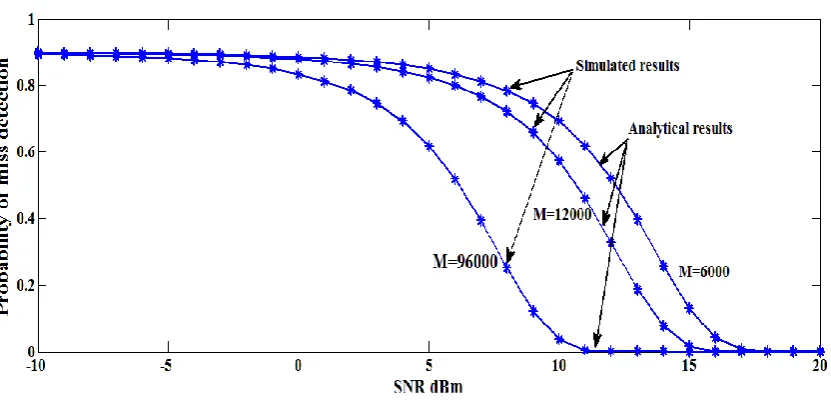
Figure (4) shows the simulated and analytical results of the energy detector. The probability of miss detection for different values of SNR at different number of samples are plotted, given that the probability of false alarm is set to 0.1. Fig (5) shows the probability of detection at the (DM) receivers with respect to the different distances from the TV stations transmitter and for different TV channels frequencies, given that sensing time is 1ms, and probability of false alarm is 0.1.
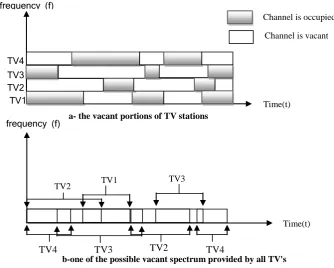
Simulated and analytical probability of detection of each (DM) which participate in the coalition game is shown in figures (6) . A possible frequency-time channels state of TV stations are shown in figure (7-a),the vacant portions shown in the figure can be used by any network freely (using energy sensing technique). The SNR's of the seven users, probability of detection and probability of false alarm are listed in Table(1). The decision of each (DM) and the final decision of the fusion center based coalitional game are shown in Table (2).
Set the distance from primary transmitter(di)
Determine SNR and test statistic ( )
Perform energy detection
Set threshold (γi)
T> γi?
TV station is existed TV station is
absent
Yes No
Decision=1 Decision=0
To fusion center
[image:3.595.98.255.289.697.2]Fig. 4 Theoretical and simulation results for energy detector probability
of miss detection against SNR Number of (DM)
(N)=7
[image:4.595.88.504.488.690.2]Decision of (DM) v(S)
Fig. 3 A general flowchart of the algorithms based on AND, OR and majority rules. Fusion Center
algorithm selection
Majority rule algorithm
V(S)>N/2? Yes
No
Final decision=1 TV station
is existed
Final decision=0
TV station is absent OR rule algorithm
V(S)≥1? Yes
No
Final decision=1
TV station is existed
Final decision=0
TV station is absent AND rule algorithm
V(S)=N? Yes
No
Final decision=1
TV station is existed
Final decision=0
Fig.7 Possible frequency-time of channels state
Channel is vacant frequency (f)
Time(t) a- the vacant portions of TV stations
TV1 TV2 TV3 TV4
Channel is occupied
b-one of the possible vacant spectrum provided by all TV's frequency (f)
Time(t)
TV2 TV1
TV3 TV2
TV4
TV3
[image:5.595.91.478.303.451.2]TV4
Fig.5Theoretical and simulation results of probability of detection versus
distance
Fig. 6 The probability of decision at the receivers of DM's based on game theory
1 2 3 4 5 6 7
0.2 0.3 0.4 0.5 0.6 0.7 0.8 0.9 1
DM ID
P
r
o
b
a
b
il
it
y
o
f
d
e
te
c
ti
o
n
[image:5.595.117.452.502.770.2]Numbe r of (DM) DM decision vector OR rule final decision AND rule final decision Majorit y rule final decision
2 (1 1) 1 1 1
3 (1 1 1) 1 1 1
4 (1 1 1 0) 1 0 1
5 (1 1 1 0 0)
1 0 1
6 (1 1 1 0 0 0)
1 0 1
7 (1 1 1 0 0 0 1)
1 0 1
6. CONCLUSIONS
In this paper, a cooperative spectrum schemes for sharing TV bands is proposed based on cooperative game principals. (DM) apply energy detection as main strategy. The minimum SNR that satisfied IEEE 802.22 standard requirements is -22dB. The results show that the minimum SNR can be detected is -23.346 dB when the sensing time is 16 ms and the probability of false alarm of each decision maker is within the range(0-0.1). The results of our proposed detection scheme, show that when more than half of the number of samples is greater than the threshold, the decision maker will decide the presence of primary signal successfully, while in IEEE 802.22 standard, 90% of the samples should exceed the threshold to decide the presence of primary signal. So the proposed scheme gives more protection for the TV stations. The coalitional game results show that the cooperative scheme gives right decision even with SNR's less than -22dB. The highest probability of detection is 0.9818. Finally, it is possible to conclude that majority rule is the most realistic
type which can be used to detect the presence of TV stations signals, and the efficiency of utilizing the vacant portions of the spectrum will be increased as the number of TV stations increased, this will yield a reliable computer network performance (i.e without interrupt), see fig.7-b.
7. REFRENCES
[1] Lu Lu, Xiangwei Zhou, Uzoma Onunkwo and Geoffrey Ye Li "Ten years of research in spectrum sensing and sharing in cognitive radio" EURASIP Journal on Wireless Communications and Networking 2012. [2] Liljana Gavrilovska · Vladimir Atanasovski, "Spectrum
Sensing Framework for Cognitive Radio Networks" Wireless Pers Commun (2011) 59:447–469.
[3] Mayank Mittal, and Jaikaran Singh and Mukesh Tiwari " Modelling and Performance Evaluation of Physical Layer of Wireless, Regional Area Networks (IEEE 802.22) over AWGN Channel" International Journal of Electrical, Electronics and Computer Engineering 1(1): 15-18(2012)
[4] Vinod Sharma and ArunKumar Jayaprakasam "An Efficient Algorithm for Cooperative Spectrum Sensing in Cognitive Radio Networks" arXiv: 0809.2931 [cs.IT],17 September 2008.
[5] Beibei Wang*, Yongle Wu, K.J. Ray Liu " Game theory for cognitive radio networks: An overview" ELISVIER, Computer Networks, Volume 54, Issue 14, 6 October 2010, Pages 2537–2561.
[6] Hyoil Kim and Kang G. Shin " In-band Spectrum Sensing in Cognitive Radio Networks:Energy Detection or Feature Detection?" San Francisco, California, USA, MobiCom’08, September 14–19, 2008.
[7] Abubakar U. Makarfi and Khairi A. Hamdi " Efficiency of Energy Detection for Spectrum Sensing in the Presence of Non-Cooperating Secondary Users" IEEE, Global Communications Conference (GLOBECOM), 2012.
[8] Amira Ben Jemaa, Monia Turki and Wael Guib`ene '' Enhanced Energy Detector Via Algebraic Approach for Spectrum Sensing in Cognitive Radio Networks" 7th International ICST Conference on Cognitive Radio Decision maker ID (i) Distanc e di(km) SNR (dBm) Threshold (γi) dBm Analytical pdi Simulated pdi Analytical pfai Simulate d pfai
Decision
1 110 11.6225 -95.182 0.9809 0.9818 0.0995 0.1001 1
2 125 9.0104 -95.182 0.8773 0.8773 0.0995 0.0998 1
3 155 7.346 -95.182 0.5592 0.5587 0.0995 0.099 1
4 200 4.1134 -95.182 0.2998 0.2988 0.0995 0.0995 0
5 185 5.267 -95.182 0.3587 0.3590 0.0995 0.0994 0
6 170 6.3489 -95.182 0.4421 0.4428 0.0995 0.1 0
7 140 8.2409 -95.182 0.7129 0.7128 0.0995 0.0989 1
Table 1. Simulated and analytical coalition sensing results at the receivers of DM's
Oriented Wireless Networks and Communications (CROWNCOM), 2012.
[9] Li Yan, Yang Zhen " Collaborative Spectrum Sensing using Coalitional Games in Cognitive Radio Networks" In proceeding of: Computer Science and Information Technology (ICCSIT), 3rd IEEE International Conference on, Volume: 3. 2010.
[10]Vivek Srivastava, James Neel, Allen B "Using Game Theory To Analyze Wireless Ad hoc Network" IEEE communications, volume 7, no.4.2005.
[11]Sabita Maharjan, Chau Yuen, Yong Huat Chew, Yan Zhang and Stein Gjessing "Distributed Spectrum Sensing for Cognitive Radio Networks with Heterogeneous Traffic" 3rd International Symposium on Applied
Sciences in Biomedical and Communication Technologies (ISABEL), 2010.
[12]Walid Saad, Zhu Han, M´erouane Debbah, Are Hjorungnes and Tamer Basar "Coalitional Game Theory for Communication Networks: A Tutorial" arXiv:0905.4057 vl [cs IT], 25 may 2009.
[13]Juan E. Suris, Luiz A. DaSilva, Zhu Han, Allen B. MacKenzie, and Ramakant S. Komali " Asymptotic Optimality for Distributed Spectrum Sharing using Bargaining Solutions" IEEE transaction on wireless communications, Vol. 8, no. 10, October 2009.