Munich Personal RePEc Archive
Nonstationary increments, scaling
distributions, and variable diffusion
processes in financial markets
Bassler, Kevin E. and McCauley, Joseph L. and Gunaratne,
Gemunu H.
University of Houston
30 September 2006
Nonstationary Increments, Scaling Distributions, and Variable
Diffusion Processes in Financial Markets
Kevin E. Bassler1,2
, Joseph L. McCauley1,3
, and Gemunu H. Gunaratne1,4∗ 1
Department of Physics, University of Houston, Houston, TX 77204
2
Texas Center for Superconductivity at the University of Houston, Houston, TX 77204
3
Senior Fellow, Department of Economics,
J.E.Cairnes Graduate School of Business and Public Policy, NUI Galway, Ireland and
4
The Institute of Fundamental Studies, Kandy, Sri Lanka
Arguably the most important problem in quantitative finance is to under-stand the nature of stochastic processes that underlie market dynamics. One aspect of the solution to this problem involves determining characteristics of the distribution of fluctuations in returns. Empirical studies conducted over the last decade have reported that they are non-Gaussian, scale in time, and have power-law (or fat) tails [1–5]. However, because they use sliding interval methods of analysis, these studies implicitly assume that the underlying process has stationary increments. We explicitly show that this assumption is not valid for the Euro-Dollar exchange rate between 1999-2004. In addition, we find that fluctuations in returns of the exchange rate are uncorrelated and scale as power-laws for certain time intervals during each day. This behavior is consistent with a diffusive process with a diffusion coefficient that depends both on the time and the price change. Within scaling regions, we find that sliding interval methods can generate fat-tailed distributions as an artifact, and that the type of scaling reported in many previous studies does not exist.
Our analysis is conducted on one-minute intra-day prices of the Euro-Dollar exchange rate (obtained from Olsen and Associates, Z¨urich) which is traded 24-hours a day. Let
P(t) represent the exchange rate at time t and define the return of the exchange rate as ¯
x(τ;t)≡log [P(τ+t)/P(t)]. Heretrepresents a time during the day andτ a time increment that is initiated att. The analysis presented below is predicated on the assumption, for which we provide evidence, that the stochastic dynamics of ¯x(τ;t) is the same between trading days. Then, we find that the average movement taken over the approximately 1500 trading days during 1999-2004, x¯(τ;t) nearly vanishes for each value of t. A value of τ = 10 min is used so that the autocorrelations in the signal P(t) have decayed sufficiently. The rest of our analysis is conducted on fluctuations x(τ;t) = ¯x(τ;t)− x¯(τ;t) about the mean.
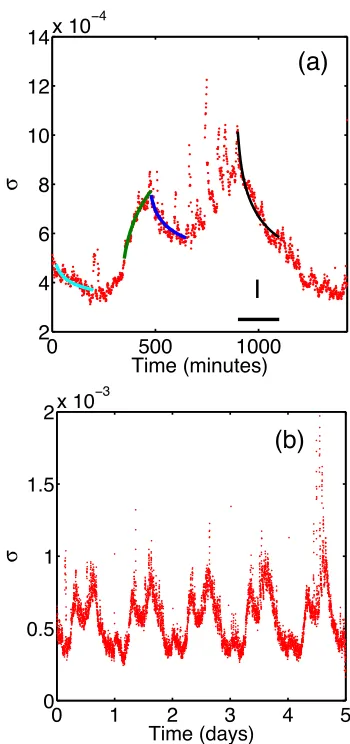
A stochastic process has stationary increments if the distribution ofx(τ;t) is independent oft; otherwise, increments are nonstationary. Figure 1(a) shows the behavior of the standard deviation σ(τ;t) ≡ x(τ;t)2
of the Euro-Dollar rate as a function of the time of day. If the stochastic increments are stationary, the curve would be flat. Clearly, it is not. Instead
σ(τ;t) exhibits complicated nonstationary behavior while changing by more than a factor of 3 during the day.
corresponding analysis of fluctuations throughout a trading week [6]. Figure 1(b) shows the standard deviation of returns averaged over the 300 weeks studied. The approximate daily periodicity of σ(τ;t) is evident, thereby justifying our approach. Similar observations were made on price increaments for Euro-Dollar rate in Ref. [6].
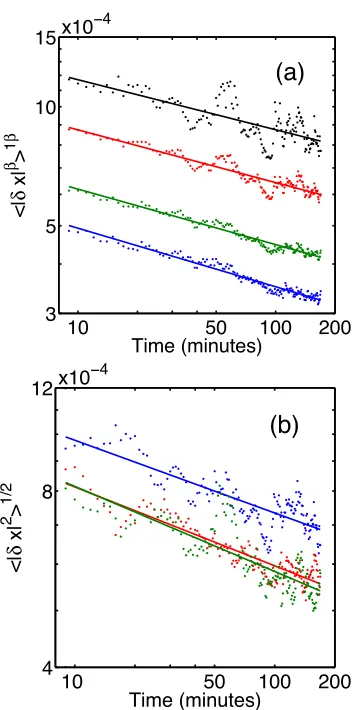
The standard deviation scales as power-laws with time during several intervals within the day. Power-law fits to the data in some of these intervals are shown by colored lines in Fig. 1(a). We focus our analysis on the time interval I which begins at 9:00 AM New York time and lasts approximately 3 hours. The data shown in red in Fig. 2(a) shows that the standard deviation within this interval scales liket−η wheretis measured from the beginning
of the interval and the indexη= 0.13±0.04. This scaling extends for more than 1.5 decades in time. Note that the value of η is different for the other time intervals during which the standard deviation scales in time. Similar variation in scaling exponents during the day has been reported previously [7].
The scaling index withinIdoes not change significantly during the six years studied. This is demonstrated by independently analyzing three two-year periods 1999-2000, 2001-2002, and 2003-2004. Figure 2(b) shows that the scaling index remains nearly unchanged between these two-year periods.
We have also analyzed the behavior of other moments|x(τ;t)|β1/β
of the returns. Figure 2(a) shows that each of the moments β = 0.5, 1.0, 2.0, and 3.0 also scales as a power-law in time, and furthermore that the scaling index for each of them is consistent with the value of η = 0.15. This nearly uniform scaling of the different moments suggests that the return distribution itself scales in time. Denote the distribution of x(τ;t) by W(x, τ;t), where the final argument reiterates that the distribution can depend on the starting time of the interval. In particular, when the increments are nonstationary W(x, τ;t) depends ont. Our scaling anzatz is
W(x, τ; 0) = 1
τHF(u) (1)
where H is the scaling index, u = x/τH the scaling variable and F the scaling function.
Note that the scaling anzatz is for a time intervalstarting from the beginning of I.
In addition to scaling, the stochastic dynamics appears to have no memory. This can be demonstrated by evaluating the auto-correlation function
Aτ(t1, t2) =
x(τ;t1)x(τ;t2) σ(τ;t1)σ(τ;t2)
We find that forτ = 10,Aτ(t1, t2) = 1 if t1 =t2, and of the order of 10− 3
when|t1−t2| ≥10.
This observation eliminates fractional Brownian motion [8] as a description for the underlying stochastic dynamics, and strongly indicates that ∂W(x, τ; 0)/∂τ depends only on x(τ; 0) and τ. If, in addition, W(x, τ; 0) has finite variance (see Fig. 4), it has been analytically established that the evolution ofW(x, τ; 0) is given by a diffusion equation [9, 10]
∂W(x, τ; 0)
∂τ =
1 2
∂2
∂x2 (D(x, τ)W(x, τ; 0)), (2)
where D(x, τ) is the diffusion coefficient. There is no drift term in Eq. (2) because x(τ;t) has zero mean for all t. Note that the stochastic dynamics is completely determined by the diffusion coefficient, which, as shown below, depends onH. Hence, H can be considered to be the dynamical scaling index.
Because we have found scaling, consider solutions of the form (1) to Eq. (2). When
H = 1/2, the diffusion coefficient has been shown to be a function ofu; i.e., D(x, τ) =D(u) [9]. If, in addition, D(u) is symmetric inu, it is related to the scaling function by F(u) =
D(u)−1exp−udy y/D(y) [9, 11]. When H = 1/2, we can “rescale” time intervals by
˜
τ =τ2H
[6, 12]. In ˜τ, the stochastic process has a scaling index 1/2 and a diffusion coefficient of the form D(x/√˜τ). Converting back to τ, D(x, τ) = 2Hτ2H−1
D(u) [12].
Statistical analyses of financial markets have often been conducted using sliding interval methods [2–6, 13, 14], which implicitly assume that increments are stationary even if they are not. For example, they compute the distribution WS(x, τ) = W(x, τ;t)t, where .t
indicates an average over t. Many of these studies have reported that WS(x, τ) scales as
WS(x, τ) =
1
τHSFS(v), (3) wherev =x/τHS and H
S ≈1/2. It has also been reported that the scaling function FS has
power-law (or fat) tails [4, 5]. However, it is important to understand that WS(x, τ) is a
solution of Eq. (2) only when the stochastic process has stationary increments, in which case
H =HS = 1/2. In general, HS and WS(x, τ) are different fromH and W(x, τ; 0). Next, we
give an explicit example where this is the case, and, in addition, WS(x, τ) appears to have
fat-tails even though W(x, τ; 0) does not.
Consider a diffusive process initiated at x = 0 that has a variable diffusion coefficient 2Hτ2H−1
(1 +|u|). Its distribution has a scaling index H and a scaling function F(u) =
1
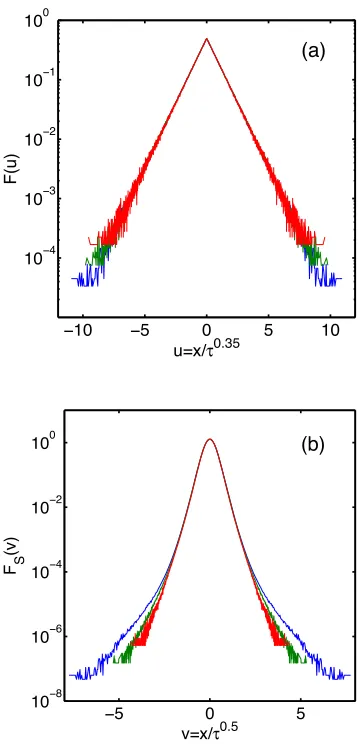
stochastic process for H = 0.35 confirms this claim, see Fig. 3(a). In contrast, WS(x, τ)
calculated fromthe same dataappears to scale with an index HS =
1
2. Unlike F which is
bi-exponential, the apparent scaling functionFS (shown in Fig. 3(b)) has fat-tails. However, a
careful analysis reveals that distributionsWS(x, τ) do not scale in the tail region, and hence
that FS is not well-defined. Differences analogous to those between H and HS have been
noted for L´evy processes [15] and for the R/S analysis of Tsallis distributions [13].
The behavior of σ(τ;t) (Fig. 2(a)) can be calculated for variable diffusion processes. Assuming that τ is small, Ito calculus gives δx2
≡ x(τ;t)2
= D(x, t)τ. Averaging over returns at t gives
δx2 =
dxW(x, t; 0)D(x, t)
τ. (4)
In a variable diffusion process, W(x, t; 0) = t−HF(u) and D(x;t) = 2Ht2H−1D(u);
conse-quently
δx2
∼tH−1/2, (5)
independent of the exact form ofD(u). Results for the Euro-Dollar rate within the interval
I (Fig. 2(a)) which showed that η ≈ 0.15 are therefore consistent with a scaling index
H = 1
2 −η ≈ 0.35. Note that, unlike for L´evy processes and fractional Brownian motion, H <1/2, and is substantially less thanHS reported in previous analyses of the Euro-Dollar
exchange rate (between 0.5 and 0.6) [6, 14, 16]. A general calculation for the moments of a variable diffusion process gives
|δx|β1/β
∼tH−1/2
, (6)
for all β, consistent with results shown in Fig. 2(a).
In order to estimate HS for an arbitrary variable diffusion process, we note first that x(t+τ; 0)2
=x(t; 0)2
+x(τ;t)2
for any diffusive process without memory (see Ref.[9]). Then, using the scaling anzatz (1), setting c=
du uF(u), and taking the sliding interval average
x(τ;t)2
t=c(t+τ)
2H
−ct2H
t≈2Hct
2H−1
tτ, (7)
where the last approximation is valid whenτ ≪t, a condition that is true for most intervals of length τ in a sliding interval calculation. Hence x(τ;t)2
t∼τ. Consequently, HS = 1/2
regardless of the value of H!
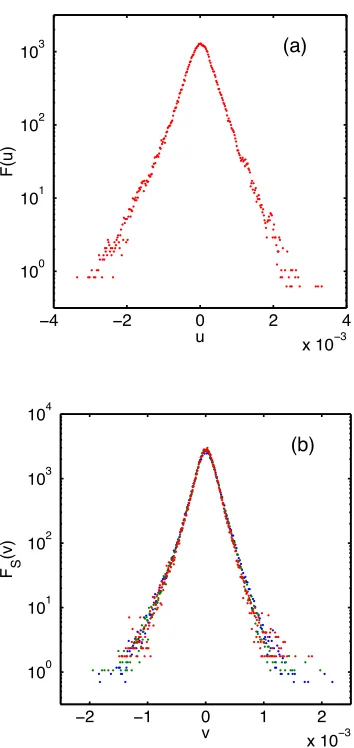
accurately using the usual method of collapsingW(x, τ; 0) for multiple values ofτ. However, since we have determinedH(≈0.35) independently, we can use Eq. (1) for multiple values of
τ in the interval I(i.e., τ between approximately 10 and 160 minutes) to determineF. The result is shown in Fig. 4(a). Note that the distribution has an approximate bi-exponential form. Since exponential distributions have finite variance, all assumptions needed for the derivation of Eq. (2) are justified. However, it is asymmetric and decays more slowly on the negative side. By contrast, the empirical sliding interval scaling function FS(v) for the
same time interval is shown in Fig. 4(b). For this case, the scaling collapse is achieved for
HS = 1/2. FS(v) appears to have fat tails, consistent with previous reports [5, 16]. However,
in light of the example discussed earlier and the fact thatH = 1/2, it is unlikely that FS is
well-defined for this financial market data within the interval I.
Variable diffusion processes exhibit another signature (stylized fact) of market fluctua-tions. Although their autocorrelation vanishes, a large fluctuation will typically produce a large value of|x|, and hence a return with a large diffusion coefficient. Consequently, a large fluctuation is likely to be followed by additional large fluctuations whose signs are uncor-related to the first [9]. As a result, the autocorrelation function for the signal |x(τ;t)| (or for the signal x(τ;t)2
) will decay slowly in t. Such behavior, referred to as the “clustering of volatility” is seen in the Euro-Dollar exchange rate and has been reported in empirical studies of other financial markets [17–19].
The analysis given here applies to stochastic dynamics of a single scaling interval. How-ever, the daily fluctuations in the Euro-Dollar rate are a combination of scaling intervals with distinct scaling indices, and possibly regions with no scaling. We have not yet deter-mined how to extend our analysis beyond a single scaling region. Bacuase of this, it is not clear how to interpret the distributions over intervals longer than a scaling region, including inter-day data.
case within the intervalI.
The authors would like to thank A. A. Alejandro-Quinones for discussions. They also acknowledge support from the Institute for Space Science Operations (KEB, GHG) and the NSF through grants DMR-0406323 (KEB), DMR-0427938 (KEB) and DMS-0607345 (GHG).
[1] B. B. Mandelbrot, The Variation of Certain Speculative Prices,J. Bus. 36, 394 (1963).
[2] J. L. McCauley and G. H. Gunaratne, An Empirical Model of Volatility Returns and Options
Pricing, Physica A329, 170 (2003).
[3] R. N. Mantegna and H. E. Stanley, Scaling Behavior in the Dynamics of an Economic Index,
Nature 376, 46 (1995); Turbulence in Financial Markets, Nature 383, 587 (1996).
[4] R. Friedrich, J. Peinke, and Ch. Renner, How to Quantify Deterministic and Random
Influ-ences on the Statistics of the Foreign Exchange Market, Phys. Rev. Lett.84, 5224 (2000).
[5] L. Borland, A Theory of Non-Gaussian Option Pricing, Quan. Finance 2, 415 (2002).
[6] S. Galluccio, G. Caldarelli, M. Marsili, and Y. C. Zhang, Scaling in Currency Exchange,
Physica A 245, 423 (1997).
[7] A. Carbone, G. Castelli, and H. E. Stanley, Time-dependent Hurst Exponents in Financial
Time Series, Physica A 344, 267 (2004).
[8] B. Mandlebrot and J. W. van Ness, Fractional Brownian Motion, Fractional Noise and
Appli-cations, SIAM Rev.10, 422 (1968).
[9] G. H. Gunaratne, J. L. McCauley, M. Nicole, and A. T¨or¨ok. Variable Step Random Walks
and Self-Similar Distributions, J. Stat. Phys.121, 887 (2005).
[10] S. Chandrasekhar, Stochastic Problems in Physics and Astronomy, Rev. Mod. Phys., 15, 1
(1943).
[11] A. A. Alejandro-Quinones, K. E. Bassler, M. Field, J. L. McCauley, M. Nicol, I. Timofeyev,
A. T¨or¨ok, and G. H. Gunaratne, A Theory of Fluctuations in Stock Prices, Physica A 363,
383 (2006).
[12] K. E. Bassler, G. H. Gunaratne, and J. L. McCauley, Markov Processes, Hurst Exponents,
and Nonlinear Diffusion Equations with Applications to Finance, Physica A,369, 343 (2006).
Phenomeno-logical Model, Phys. Rev. E 57, 6634 (1998).
[14] S. Ghashghaie, W. Breymann, J. Peinke, P. Talkner, and Y. Dodge, Turbulent Cascades in
Foreign Exchange Markets, Nature381, 767 (1996).
[15] H. C. Fogedby, T. Bohr, and H. J. Jensen, Fluctuations in a L´evy Flight Gas, J. Stat. Phys.
66, 583 (1992).
[16] U. A. M¨uller, M. M. Dacorogna, R. B. Olsen, O. V. Pictet, M. Schwarz, and C. Morgenegg,
Statistical Study of Foreign Exchange Rates, Empirical Evidence of a Price Change Scaling
Law, and Inter-day Analysis, J. Bank. Fin.14, 1189 (1990).
[17] R. Cont, M. Potters, and J.-P. Bouchard, Scaling in Stock Market Data: Stable Laws and
Beyond, in ”Scale Invariance and Beyond”, eds. B. Dubrulle, F. Graner, and D. Sornette,
Springer, Berlin, 1997.
[18] C. C. Heyde and Y. Yang, On Defining Long Range Dependence, J. Appl. Prob. 34, 939
(1997).
[19] C. C. Heyde and N. N. Leonenko, Student Processes, Adv. Appl. Prob.37, 342 (2005).
[20] M. Couillard and M. Davison, A Comment on Measuring the Hurst exponent of Financial
0 500 1000 2
4 6 8 10 12
14x 10
−4
Time (minutes)
σ
(a)
I
0 1 2 3 4 5
0 0.5 1 1.5
2x 10
−3
Time (days)
σ
(b)
FIG. 1: (a) The standard deviation σ(τ;t) ≡
x(τ;t)2
of the daily Euro-Dollar exchange as a
function of the time of day (in GMT). Here τ = 10 min to ensure that autocorrelations in P(t)
have decayed sufficiently. Our statistical analysis assumes that x(τ;t) follows the same stochastic
process each trading day. The average indicated by the brackets.is taken over the approximately
1500 trading days between 1999-2004, and the standard error at each point is typically 3%. Note
that, if the stochastic dynamics had stationary increments, σ(τ;t) would be constant. Instead, it
varies by more than a factor of 3 during the day, thus showing explicitly that the exchange rate has
nonstationary increments. Notice also that σ(τ;t) scales in time during several intervals, four of
which are highlighted by colored lines that are power-law fits. Our analysis focuses on the interval
Ishown by the horizontal solid line. (b) The weekly behavior ofσ(τ;t) for the same data. Observe
that it exhibits an approximate daily periodicity, thereby justifying our assumption of the daily
[image:10.612.218.393.70.442.2]x10−4
10 50 100 200
3 5 10 15
Time (minutes)
<|
δ
x|
β >
1
β
x10−4
(a)
x10−4
10 50 100 200
4 8 12
(b)
Time (minutes)
<|
δ
x|
2 >
1/2
x10−4
FIG. 2: (a) A log-log plot of x(τ;t)β1/β
for β = 0.5,1.0,2.0, and 3.0, demonstrating power law
decayt−η for each index. Heretis measured in local New York time stating at 9:00AM. The data
forβ = 0.5,1.0,2.0, and 3.0, shown in blue, green, red, and black, respectively, have scaling indices
(given by the slopes of the solid lines)η= 0.15±0.02, 0.14±0.02, 0.13±0.04 and 0.13±0.08. All of
these values are consistent withη≈0.15, and hence a dynamical scaling index ofH= 12−η ≈0.35.
The error estimates on the exponents are the standard errors from the nonlinear fit including the
standard deviations for each time point, but neglecting any correlations between them. (b) The
behavior of the standard deviation σ(τ;t) in the interval I during each of the periods 1999-2000
(blue), 2001-2002 (red), and 2003-2004 (green). The scaling index from nonlinear fits for the three
data sets are 0.13±0.06, 0.14±0.04 and 0.14±0.07. The near equality of these indices shows that
[image:11.612.218.395.67.422.2]−10 −5 0 5 10
10−4
10−3
10−2
10−1
100
u=x/τ0.35
F(u)
(a)
−5 0 5
10−8
10−6
10−4
10−2
100
v=x/τ0.5
F S
(v)
(b)
FIG. 3: (a) The scaling function of the return distribution F calculated from a collapse of data
for τ = 10 (blue), 100 (green), and 1000 (red) units. The results are from a set of 5,000,000
independent stochastic processes with variable diffusion. The scaling index used was H = 0.35,
and the diffusion coefficient was 2Ht2H−1
(1 +|u|). Note that F is bi-exponential, as discussed
in the text. (b) The sliding interval scaling function FS calculated from the same runs. Shown
are results for sliding intervals with τ = 10 (blue), 100 (green) and 1000 (red) units from runs of
length 10,000 units. Unlike F, it appears to have fat tails. The scaling index used here for which
the scaling collapse is achieved isHS = 1/2 even though the dynamical scaling index isH = 0.35.
[image:12.612.216.395.71.443.2]−4 −2 0 2 4
x 10−3
100
101
102
103
u
F(u)
(a)
−2 −1 0 1 2
x 10−3
100
101
102
103
104
v
F S
(v)
(b)
FIG. 4: (a) The empirical scaling function F for intervalIcalculated assuming the scaling anzatz
Eq. (1) with H = 0.35 and values of τ between 10 and 160 minutes. Note that F is slightly
asymmetric and approximately bi-exponential. Since exponential distributions have finite variance,
all assumptions needed for the derivation of Eq. (2) are justified. (b) The empirical sliding interval
scaling function FS for interval I calculated by scaling collapse of data using the anzatz Eq. (3)
[image:13.612.218.395.66.440.2]