Optimal Bundle of Multimedia Services
in Emerging Mobile Markets
Lee, ChanGi and Lee, SeongCheol and Lee, DeockHee and
Lee, HyeongJik
COMMUNICATIONS STRATEGIES
September 2006
Online at
https://mpra.ub.uni-muenchen.de/3551/
COMMUNICATIONS & STRATEGIES, no. 63, 3rd quarter 2006, p. 33.
Optimal Bundle of Multimedia Services
in Emerging Mobile Markets
(*)ChanGi NAM, SeongCheol KIM (**), DeockHee CHO & HyeongJik LEE
School of IT Business, Information and Communications University, Korea
Abstract: Although various emerging technologies have been launched, they present limitations as far as offering full-scale ubiquitous services independently is concerned. In view of this fact, service providers are likely to provide bundled services among possible combinations of services. Indeed, making a timely decision regarding the value maximization of bundled service is directly related to service providers' future growth and success in the turbulent market environment. This paper aims to find the optimal service bundle among five emerging mobile services: T-DMB, S-DMB, WiBro, HSDPA, and Telematics. Considering what kinds of service features among the five emerging services offer differentiation to customers, we examine four attributes (TV, voice, portable wireless internet, and location-based services) using conjoint analysis to distinguish the service features. Our results show that TV service is the most favored among the attributes, followed by voice service in second position, and the internet and location-based service in third and fourth place respectively. Our result implies that mobile operators would be better off bundling HSDPA and S-DMB first, and then adding other services later, while fixed operators would be better off bundling WiBro and S-DMB first and other services later.
Key words: telecommunications and broadcasting convergence, emerging service, 4G Technology, T-DMB, S-DMB, WiBro, HSDPA, telematics, customer preference.
s the telecommunications network evolves, emerging services undreamt of just a few decades ago are being launched on the market. Some of these services have already been commercialized, while others are expected to be launched in the near future. It is argued, however, that none of these services alone can fully satisfy customers' diverse needs (SUK & KAI, 2003). The recent trend towards convergence demonstrates this phenomenon. Traditionally separate fixed and mobile services are merging to provide a seamless service. Telecommunications
(*) This research was financially supported by the Ministry of Information and Communication (MIC), Korea, under the Information Technology Research Center (ITRC) support program of the Institute of Information Technology Assessment (IITA).
carriers are attempting to broadcast content through their network and broadcasting companies are providing data services, and vice versa. This dynamic trend is very rapidly dismantling conventional barriers between networks, industries, and services.
While several studies on each emerging telecommunications service have been done, few researchers investigate emerging services comprehensively. Most of the previous studies examine each service from the perspective of the technology evolution path (JOSEPH, 2005; YOUNG, 2001; FLAMMIA, 2000), or focused on a two-paired comparison analysis (LEHR & McKNIGHT, 2003) between emerging services such as HSDPA and WiBro (SHIN et al, 2005), and T-DMB and S-DMB (SHIN, 2005b). This paper attempts to analyze several emerging services using a more comprehensive user-oriented approach and proposes a plausible future for the emerging mobile market.
This paper first chooses five emerging services - T-DMB (Terrestrial Digital Multimedia Broadcasting), S-DMB (Satellite Digital Multimedia Broadcasting), WiBro (Wireless Broadband Internet), HSDPA (High Speed Downlink Packet Access), and telematics (a compound word of Telecommunication + Informatics) - as the representative emerging services in the Korean mobile telecommunications market. It then examines four attributes - TV service, voice service, location-based service and portable wireless internet - as distinguishing factors among emerging services. Given that each service can be regarded as a good potential bundling partner with other services, thus providing additional benefits to customers, the purpose of this paper is, firstly, to measure customer preferences in terms of the attributes of emerging services using conjoint analysis, and, secondly, to find an optimal bundle of emerging services based on the found part-worths associated with the attributes. Some implications are also discussed.
Five emerging mobile services
in the Korean telecommunications market
Technology). Some of these services might be relatively new to other countries since Korea is one of the first countries to launch and commercialize them. Korea is well known as a test bed for IT products and services 1. Korea's domestic market is big enough to measure consumer
reactions to new IT products and services, making it an attractive place for foreign companies to test their IT products and services before selling them worldwide. Thus, studying potential Korean customer reactions to emerging mobile services is meaningful to those countries planning to launch similar services.
Specifically, we chose five representative emerging mobile services out of eight services designated by the "IT 8.3.9 project" 2, which has been designed by the Korean Ministry of Information and Communication (MIC) to trigger a second growth engine (KIM, 2004). In view of the fact that the Korean government is spurring demand and service providers are seeking new cash cows together, these five services are very likely to be successful in the market.
As these five emerging mobile services are expected to compete with and complement each other in the market, the perceived value of each service by customers becomes important not only because each service's success depends on service features, but also because future service convergence will offer clients additional benefits. In this vein, we will briefly describe each service in an effort to determine which features could be perceived as offering customers differentiated value.
Two Digital Multimedia Broadcasting (DMB) services
Digital Multimedia Broadcasting (DMB) is an expanded version of Digital Audio Broadcasting (DAB), already offered in the United States and Europe, with TV and video added to the audio programming (SWANG et al., 2005). DMB is currently divided into terrestrial and satellite DMB, depending on the involvement of satellites and the service frequency band. While S-DMB
1 Motorola Inc. recently chose the Korean market to launch its newest code-division multiple access "Razr" phone before selling it worldwide.
(Satellite DMB) is offered by the telecommunications industry 3, T-DMB (Terrestrial DMB) is supplied primarily by the broadcasting industry.
Although there are some technical differences between S-DMB and T-DMB, they provide similar value to consumers by transmitting audio, streaming video and other multimedia content (PARK, 2005). S-DMB offers 11 video channels, 26 audio channels and a data broadcast channel for a monthly fee of 13,000 Korean won covering the whole nation 4. T-DMB
provides seven video channels, 13 audio channels, and eight data broadcast channels free of charge in the metropolitan Seoul area. S-DMB currently has an advantage in the number of broadcast channels and nationwide coverage, while T-DMB has an advantage in terms of pricing. However, the important difference between S-DMB and T-DMB is that real-time terrestrial broadcast content is only available with T-DMB 5. Since terrestrial broadcast
content is regarded as the most popular form of multimedia in Korea, service providers who have business licenses to transmit terrestrial broadcast content are said to have an advantage over those who do not (SHIN, 2005a).
Two wireless technologies for mobile broadband internet: WiBro and HSDPA
Wireless mobile broadband internet access is becoming an important part of the telecommunications industry (SHIN et al., 2005), with the launch of some related emerging technologies plannd in Korea in the near future. WiBro is one of those related technologies - it provides seamless connectivity regardless of time and place (LAWTON, 2005) and from June 30th, 2006 has been available commercially. As this technology is characterized by portability, mobility, high speed, and multimedia communication, it is expected to fill the gaps in existing mobile broadband technologies.
HSDPA (High Speed Downlink Packet Access) is another advanced technology for mobile broadband service. As an evolutionary technology of WCDMA, one of the 3G standards, HSDPA is expected to offer speeds of up
3 One service provider, TU-Media, is offering S-DMB services in Korea. 4 www.tu4u.com
to seven times faster than current WCDMA. Given that HSDPA is compatible with existing WCDMA systems and at a lower installation cost, wireless network operators such as SK Telecom and NTT DoCoMo, which have already invested in WCDMA networks, might prefer HSDPA (SHIN et al., 2005).
Although both WiBro and HSDPA have been developed for mobile data services, there are some differences between them 6. However, some have
predicted that they will compete with each other for the next generation mobile communications market because they have similar capacity, coverage, and plans for almost simultaneous expected commercialization -both in 2006.
Telematics service
Telematics currently provides services such as driver navigation, vehicle remote control and automatic notification of air bag deployment in cars 7. In
fact, automobile design offers tremendous potential to converge heterogeneous technologies to offer various value-added services. The fact that the car has the advantage of relatively sufficient power supply also supports the strong belief that telematics will be a growth area and stands to become a technical "must-have" in the society (McMORROW, 2004).
The potentials of the five emerging services
As all of the emerging services are included in mobile services, this paper attempts to examine their potential by comparing customers' perceived value in general of mobile service concepts, including coverage, mobility, and speed. Although the intuitive perception of the value offering varies from individual to individual and is hard to empirically measure, it is useful to try to identify the differences between the services. For example, as table 1 shows, S-DMB offers advantages in coverage, but limits in speed, whereas WiBro offers an advantage in data transmission speed, thus differentiating between the two services. No service in this table can, on its own, provide
6 For example, WiBro is expected to provide internet content through existing web browsers, while HSDPA offers internet content via a customized WAP protocol on a small handheld device display.
full value to customers without an additional service bundle. This illustrates that some bundles of emerging services could provide more value to consumers. Therefore, which service bundle gives the highest value to consumers becomes an important and reasonable question.
Table 1 - Value offerings of five emerging services
Value offering S-DMB T-DMB WiBro HSDPA Telematics
Coverage ++++ (*) + ++ +++++ ++++ Mobility ++ ++ ++ +++++ +++ Data speed + + +++++ ++++ +
(*) The number of +s indicates the amount of value provided.
Finding an optimal bundle of emerging services
Consumer recognition and preference are important in both empirically examining which properties hold more appeal in emerging services, and in finding a plausible optimal bundle of those services. We designed and conducted a survey asking respondents to rank a set of alternatives and examined their preferences among five emerging mobile technologies - S-DMB, T-S-DMB, WiBro, HSDPA, and telematics - using conjoint analysis. This type of analysis is often used by corporate marketing research groups and consulting firms to evaluate new product or service concepts (GREEN & SRINIVASAN, 1978).
Conjoint analysis relates to multiattribute choice problems. Given some set of alternatives, which are characterized by multiple attributes, conjoint analysis is concerned with measuring, simultaneously, the joint effects of several attributes (the independent variables) on the rank order of respondent preferences for sets of attribute combinations (the dependent variable).
proportion of each attribute's range to the total for all attributes. The advantages of this analysis are not only that we can say that one combination is preferred to another, but also that we can say how much one combination is preferred over another.
Research design
[image:8.595.60.395.315.403.2]The first step of conjoint analysis is to define attributes and levels. Unbundling each service into attributes and levels is very important because each will be mixed with other service attributes and levels and then presented to respondents as a combined service profile for the purpose of preference ranking. The attributes and levels as a combination should be distinctive among other services to identify the optimal bundle later. Details on the attributes and levels used in this paper are shown in table 2.
Table 2 - Attributes and levels
Attributes Description Level
TV service Provision of terrestrial broadcast content No; LT (*); RT+α (**) Voice service Dummy variable for mobile phone service Not available; available Location-based
service Dummy variable for location-based service Not available; available Portable wireless
Internet The type of portable wireless Internet
No; laptop-based; handset-based (*) Live terrestrial TV broadcast content.
(**) Recorded terrestrial TV programmes plus multiple choice of additional channels.
TV broadcast services (mobile entertainment services)
Firstly, we focused on the fact that customers perceive value from mobile entertainment services. The concept of entertainment may differ from individual to individual (i.e., games, movies, and/or music), but we chose terrestrial TV broadcast programmes, not only because they offer the most popular multimedia content broadcast in Korea, but also because they reflect the current telecommunications and broadcasting convergence trend very clearly (SHIN, 2005a). Only S-DMB and T-DMB broadcast terrestrial TV programmes among the five services in this study.
As both T-DMB and S-DMB provide almost the same multimedia broadcast service quality, terrestrial TV content was regarded as having differentiated value in the beginning phase of S-DMB commercialization. After a long and fierce controversy, the Korean Broadcasting Committee allowed S-DMB service providers to retransmit "recorded content" from terrestrial broadcast companies 8.
T-DMB, however, gives more value to customers compared to S-DMB since it provides live terrestrial TV broadcast services, while the S-DMB service is limited to retransmitting recorded terrestrial TV content.
We defined three levels with which to differentiate the value in these attributes: no TV service, live terrestrial broadcast service (T-DMB), and multiple channels including recorded terrestrial broadcast service (S-DMB).
Voice services (mobile communications services)
The mobile network is assumed to provide three classes of communication service: basic voice service, data service, and multimedia service (MARSAN et al., 2000). Even although customers' perception of value in this communication category comes from all three communication components, we chose the fundamental voice service as the perceived value in this category. This was because HSDPA service, which has evolved from the cellular network, is expected to provide the voice service, while other services in this study have technical limitations in providing VoIP services thus far (RIAZ & CHAN, 2003).
8 ET News, April 7th
Hence, this attribute will have two levels: not available (other services), and available (HSDPA).
Location-based service (mobile information services)
Mobile information services are generally known as providers of services such as customized breaking news and personalized stock quotes. They contain user information; thus the value increases along with the customized personal information in this category. We chose location-based service because it is considered as the most rapidly expanding field in the mobile communications sector (SPANOUDAKIS et al., 2003), and this attribute successfully distinguishes telematics from other services.
With this attribute, we define two levels of availability: not available (other services), and available (telematics).
Portable wireless internet services (mobile connection services)
In this category, customers perceive value when they are connected to the portable wireless network while on the move. Both WiBro and HSDPA can provide fast enough wireless internet access to enjoy multimedia services, while other services cannot. Thus in this paper, we focus on the single value of the expected way that internet content will be displayed in both services. According to a KISDI (Korea Information Strategy Development Institute) report (PARK et al., 2005), WiBro will be the dominant mobile internet service for laptop users, while HSDPA is expected to be implemented in small handheld devices in the near future.
We define three different levels in this attribute: no internet service (other services), laptop-based (WiBro), and handheld-based (HSDPA).
Data and results
male, while 39.7% were female. While the age range is from 16 to 59, the majority (65.4%) of respondents were in the age range of 20 to 39 and included those who are supposed to use the bundled services more frequently.
In the questionnaire, in addition to the basic demographical questions, respondents were asked to rank the preference order of a total of eleven combinations of attributes. Since voice and location-based services have two levels each, and TV services and portable wireless internet services have three levels each, the total number of possible combinations of attribute levels is 36. However, to make it easier for the respondents to rank their preferences from the most favored to the least favored profile combination, we showed nine representative profile combinations - known to be an orthogonal array - and two holdout cards instead of presenting all possible 36 profile combinations.
Considering respondents may not be aware of emerging services such as T-DMB, S-DMB, WiBro, HSDPA, and telematics, we paraphrased each service attribute in plain language. A combination of the different levels of attributes was given in an easy sentence for the purpose of respondents' better understanding of the total of eleven service combinations, for example, "in this service bundle, you can make mobile phone calls, watch live terrestrial TV content on the move, use a location-based service, and access the Internet with your laptop computer on the move".
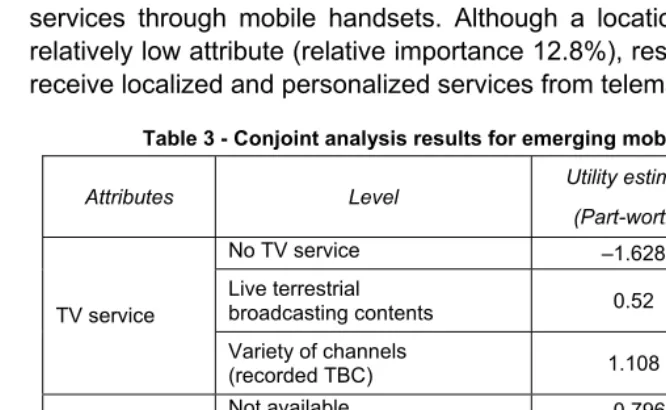
Table 3 shows the results of conjoint analysis. As shown in the table, in selecting emerging mobile services, respondents considered the TV service as most important attribute (relative importance 39.5%). The result implies that potential consumers prefer to receive the TV service, rather than the mobile internet access or voice telephony services currently being offered by existing telecommunications carriers. Respondents wanted to enjoy various broadcast channels rather than watch real-time terrestrial broadcast channels, as shown in table 3. In other words, potential consumers can perceive the differences between S-DMB and T-DMB, although they provide similar TV services, and, as a result, the two services might compete with each other to attract consumers.
emerging services (relative importance 22.3%). Web-enabled mobile handsets are increasingly preferred because, as shown in table 3, most respondents wished to receive cellular-based internet services rather than web browser-based internet services. As the Japanese see cell phones as devices for surfing the internet, as mentioned by Okazaki (OKAZAKI, 2006), potential Korean consumers will most likely prefer to use mobile internet services through mobile handsets. Although a location-based service is a relatively low attribute (relative importance 12.8%), respondents expected to receive localized and personalized services from telematics services.
Table 3 - Conjoint analysis results for emerging mobile services (*)
Attributes Level Utility estimate (Part-worths)
Importance (%)
No TV service –1.628 Live terrestrial
broadcasting contents 0.52 TV service
Variety of channels
(recorded TBC) 1.108
39.537
Not available –0.796 Voice service
Available 0.796 25.315 Not available –0.334
Location-based
service Available 0.334 12.812 No internet service –0.571
Laptop-based portable internet 0.176 Portable
Internet service Handheld-based
portable internet 0.395
22.336
(Constant) 5.377 100%
(*) The statistical software package SPSS 14.0 was used to analyze the survey data. Pearson's R = 0.988, Kendall's tau = 0.889
Table 4: Estimated utilities of five emerging services
Attributes S-DMB HSDPA T-DMB WiBro Telematics
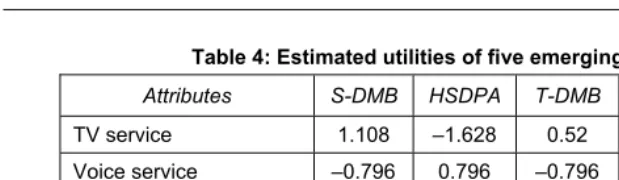
TV service 1.108 –1.628 0.52 –1.628 –1.628 Voice service –0.796 0.796 –0.796 –0.796 –0.796 Location-based service –0.334 –0.334 –0.334 –0.334 0.334 Portable internet access –0.571 0.395 –0.571 0.176 –0.571 (Constant) 5.377 4.784 4.606 4.196 2.795 2.716
For further analysis, this paper searches the probable bundles of emerging services and estimates their potential value using the numerical data in tables 3 and 4. Given that the preference perspective is different for service operators, this paper suggests two bundling cases for wireless operators and fixed-line operators. Firstly, in the case of wireless operators, it should be considered that they already have mobile networks and provide a mobile voice telephony service to consumers. Therefore, for simplicity, this paper assumes that wireless operators have offered only voice telephony service using their mobile networks 9 and are planning to make bundling
services by adding emerging services. The initial utility value of the current mobile communications service (2G) that offers only voice telephony service without any TV, internet access, or telematics services, becomes 3.64 10 as
shown in figure 1.
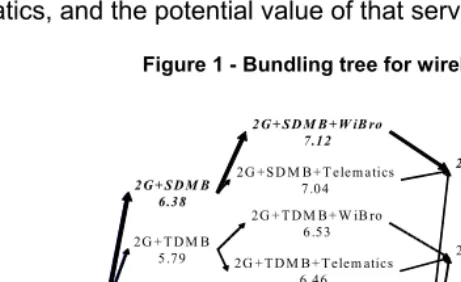
Wireless operators initially have two options: combine 2G with one emerging service or upgrade their network and offer HSDPA. If they have plans to invest in HSDPA, they had better switch their existing network to HSDPA because the potential value of a bundle of HSDPA and other services is relatively higher than that of a bundle of 2G and other services. The dominant provider and second MNO in Korea, SK Telecom, is likely to invest in upgrading the WCDMA network, switch to HSDPA and then try to create service bundles. After switching to HSDPA, wireless operators will most likely combine S-DMB with HSDPA first because the potential value of that bundle is the highest among the probable cases. Next, it is expected that they will try to add telematics to increase the potential value of the
9 Given that the current mobile internet service offered by wireless operators has some limitations, including low transmission speed and high price, it can be differently perceived from WiBro or HSDPA. This paper, therefore, does not consider current mobile internet service in estimating the potential value of current mobile communications service.
bundle. Since HSDPA has a competitive relationship with WiBro, as shown in figure 1, there is no combination of them. Wireless operators, then, can offer customers the best bundling service, consisting of HSDPA, S-DMB and telematics, and the potential value of that service is 8.01 11.
Figure 1 - Bundling tree for wireless operators
2 G 3 .6 4
2 G + T e lem a tic s 4 .3 1 2 G + W iB r o
4 .3 8
H S D P A 4 .6 1
2 G + T D M B 5 .7 9
2 G + S D M B 6 .3 8
H S D P A + S D M B 7 .3 4
H S D P A + T D M B 6 .7 5
H S D P A + T e le m atic s 5 .2 7 2 G + S D M B + T e le m a ti cs
7 .0 4
2 G + T D M B + T e le m atic s 6 .4 6
2 G + S D M B + W iB ro 7 .1 2
2 G + T D M B + W iB ro 6 .5 3
2 G + W iB ro + T e le m a ti cs 7 .0 4
2 G + S D M B + W iB ro + T e lem a tics 7 .7 9
2 G + T D M B + W iB r o + T e le m a ti cs 7 .2 0
H S D P A + S D M B + T e le m a ti cs 8 .0 1
H S D P A + T D M B + T e le m a ti cs 7 .4 2
Alternatively, if it is difficult to switch to HSDPA 12, wireless operators are
likely to search for an optimal bundle that can give the highest value to consumers, and then combine S-DMB services with 2G first. They will subsequently include WiBro to increase potential value by offering mobile internet services. Telematics might also be added at the end.
Figure 1 shows that, regardless of switching to HSDPA, DMB is the most attractive service with which to constitute an optimal bundle of services from the perspective of wireless operators. Figure 1 also shows that there is a considerable difference in the potential value between the best and the worst bundling cases. Even though wireless operators can offer four applications - voice telephony, TV, internet access, and telematics services - in the bundling service, the potential value of that service ranges from 7.20 to 8.02. While we can't say that the difference (0.78) between the maximum and minimum values of the bundling is big or small enough, it is similar to the range magnitude of contributing values for the location-based (0.67) or
11 This is estimated by adding the constant utility and the part-worths of other services, HSDPA (0.395), S-DMB (1.108) and telematics (0.334).
internet access (0.96) services, which shows that the loss of utility from the least desirable bundling strategy is almost the same as that of one important application, such as a telematics service.
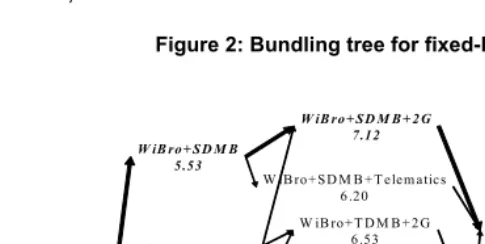
Figure 2: Bundling tree for fixed-line operators
W iB r o 2 .8 0
W iB r o + T e le m a tic s 3 .4 6 W iB r o + 2 G
4 .3 9 W iB r o + T D M B
4 .9 4
W iB r o + S D M B 5 .5 3
W iB r o + S D M B + T e le m a tic s 6 .2 0
W iB r o + T D M B + T e le m a tic s 5 .6 1
W iB r o + S D M B + 2 G 7 .1 2
W iB r o + T D M B + 2 G 6 .5 3
W iB r o + 2 G + T e le m a tic s 7 .0 4
W iB r o + S D M B + 2 G + T e le m a tic s 7 .7 9
W iB r o + T D M B + 2 G + T e le m a tic s 7 .2 0
In the case of fixed-line operators, this paper suggests that they will try to invest in WiBro first because, as the technology developed from WLAN, WiBro among the five emerging services can be easily approached from the perspective of fixed-line operator 13. As shown in figure 2, fixed-line
operators will first prefer S-DMB as the emerging service to make an optimal service bundle. Next, they will add 2G to increase the potential value of the bundle by offering mobile voice telephony 14 and telematics to provide
location-based services. As shown in figures 1 and 2, both wireless and fixed-line operators will select S-DMB to maximize the potential value of the bundle. Although the potential value of T-DMB is lower than that of S-DMB, it will be preferred as a component of a bundle. The figures also show that the combination of WiBro and others has lower value than that of HSDPA and others because WiBro has relatively lower potential value than HSDPA, as mentioned in table 2. WiBro service operators need to develop killer applications that are differentiated from other services. For example, if WiBro offers voice telephony service by adding VoIP technology, the potential value can increase to the level of HSDPA.
13 Basically, fixed-line operators will attempt to combine emerging services with WLAN first, but, for simplicity of analysis, this paper does not consider WLAN because the potential value of WLAN cannot be obtained from the data in table 3.
Implications and conclusions
Several promising emerging telecommunications services have been launched to satisfy the various requirements of consumers as yet unsatisfied by current technologies. The combination of services might offer more value to consumers than a subscription to each service individually. Using conjoint analysis this paper empirically investigates which factors should be considered important amongst customer preferences and shows that a TV service is regarded as the most important attribute. In addition, this paper estimates the relative utility value of five emerging services and tries to find the probable bundling combinations for fixed-line and wireless operators.
The results suggest that mobile operators would be better off combining DMB services with HSDPA first and adding other services later. However, given the high implementation costs of the best bundling service and their limited budget, they should focus on investment in HSDPA in order to switch current network systems to HSDPA. Mobile operators may try to invest in HSDPA efficiently through the joint management of infrastructure and base stations with other mobile operators. They may subsequently try to create service bundles gradually according to the bundling tree suggested, and finally achieve an optimal bundle that can give the highest value to consumers. They should not only combine in-house services, but also establish aggressive partnerships with various other players to provide these bundles economically. The partnerships will also help them to provide a seamless integrated technical platform for consumers by promoting interoperability and technical convergence.
The results also show that fixed operators would be better off combining DMB services with WiBro and then adding other services later. Although there are some limitations that require further explanation, bundling trees are expected to be helpful in terms of determining the bundling strategies of business players.
References
COURSARIS C. (2003): "M-Commerce in Canada: An Interaction Framework for Wireless Privacy", Canadian Journal of Administrative Sciences, vol. 20, pp. 54-73.
FLAMMIA G. (2000): "The Wireless Internet Today and Tomorrow", IEEE Expert Intelligent Systems & Their Applications, vol. 15, p. 82.
GREEN P.E. & SRINIVASAN V. (1978): "Conjoint Analysis in Consumer Research: Issues and Outlook", Journal of Consumer Research, vol. 5, pp. 103-123.
JOSEPH J.P. (2005): "Converged Wireline-Wireless Network Evolution: Opportunities and Challenges", Bell Labs Technical Journal, vol. 10, pp. 57-80.
KIM G.O. (2004): "IT 839 Project, Telematics Industry", IT KOREA Journal, vol. 8, pp. 54-58.
KUO Y.F. & CHEN P.C. (2006): "Selection of Mobile Value-Added Services for System Operators Using Fuzzy Synthetic Evaluation", Expert Systems with Applications, vol. 30, pp. 612-620.
LAWTON G. (2005): "What Lies Ahead for Cellular Technology?", Computer, vol. 38, pp. 4-17.
LEHR W. & McKNIGHT L.W. (2003): "Wireless Internet Access: 3G vs. WiFi?", Telecommunications Policy, vol. 27, pp. 351-370.
MARSAN M.A., MARANO S., MASTROIANNI C. & MEO M. (2000): "Performance Analysis of Cellular Mobile Communication Networks Supporting Multimedia Services", Mobile Networks and Applications, vol. 5, pp. 167-177.
McMORROW M. (2004): "Telematics – Exploiting its Potential", Manufacturing Engineer, vol. 83, pp. 46-48.
OKAZAKI S. (2006): "What Do We Know About Mobile Internet Adopters? A Cluster Analysis", Information and Management, vol. 43, pp. 127-141.
PARK D.W., YOON D.Y., LEE E.G. & HAN J.Y. (2005): "Current Status of Mobile Broadband Internet Service in Korea", KISDI Issue Report, Seoul, Korea Information Strategy Development Institute.
PARK Y.J. (2005): "Special Report 1: Trend of KOREA 'S DMB INDUSTRY", IT KOREA Journal, vol. 11, pp. 1-26.
RIAZ A. & CHAN H.A. (2003): "Wireless VoIP Phone Architecture and Hardware Requirements", 29th Annual Conference of the IEEE Industrial Electronics Society (IECON'03), pp. 1521-1526
SHIN D.H.:
- (2005a): "Prospectus of Digital Multimedia Broadcasting: Another Bubble or Killer Application?", Telematics and Informatics, vol. 23, issue 4, pp. 253-270.
- (2005b): "Socio-technical Challenges in the Development of Digital Multimedia Broadcasting: A Survey of Korean Mobile Television Development", Technological Forecasting & Social Change, vol. 74, Forthcoming.
SHIN S., KANG C.K., KIM J.C & OH S.H. (2005): "The Performance Comparison between WiBro and HSDPA", Proceedings of the 2nd International Symposium on Wireless Communication Systems, ISWCS2005, Siena, Italy, pp. 346-350.
SPANOUDAKIS M., BATISTAKIS A., PRIGGOURIS I., IOANNIDIS A., HADJIEFTHYMIADES S. & MERAKOS L. (2003): "Extensible Platform for Location Based Services", Proceedings of the Fourth International Conference on Web Information Systems Engineering Workshops (WISEW'03), pp. 72-79.
SUK Y.H. & KAI H.Y. (2003): "Challenges in the Migration to 4G Mobile Systems", IEEE Communications Magazine, vol. 41, pp. 54-59.
SWANG Y.H., LEE J.S., & Han H.S. (2005): "Market Acceptance for the Satellite DMB (Digital Multimedia Broadcasting) Services in Korea", Proceedings of the International Conference on Mobile Business (ICMB'05), pp. 413-419.