Munich Personal RePEc Archive
Does Collateral Help Mitigate Adverse
Selection ? A Cross-Country Analysis
Weill, Laurent and Godlewski, Christophe
University Robert Schuman, IEP, LaRGE
November 2006
Online at
https://mpra.ub.uni-muenchen.de/2508/
Does Collateral Help Mitigate Adverse Selection?
A Cross-Country Analysis
Laurent Weill+
Universite Robert Schuman 47 avenue de la Foret Noire
67000 Strasbourg
e-mail: [email protected]
and
Christophe J. Godlewski
Universite Louis Pasteur 61 avenue de la Foret Noire
67000 Strasbourg
e-mail: [email protected]
Does Collateral Help Mitigate Adverse Selection?
A Cross-Country Analysis
Last revised: November 2006
Abstract
We investigate whether collateral helps to solve adverse selection problems. Theory predicts a negative relationship between presence of collateral and risk premium, as collateral constitutes a signalling instrument for the borrower to be charged with a lower risk premium. However, bankers’ view and most empirical evidence contradict this prediction in accordance with the observed-risk hypothesis. We provide new evidence with loan-level data and country-level data for a sample of 5843 bank loans from 43 countries. We test whether the degree information asymmetries affects the link between the presence of collateral and risk premium. We include five proxies for the degree of information asymmetries, measuring opacity of financial information, trust, and development. We find that a greater degree of information asymmetries reduces the positive relationship between the presence of collateral and the risk premium. This finding provides support for the adverse selection and observed-risk hypotheses, as both hypotheses may be empirically validated depending of the degree of information
asymmetries in the country.
JEL Codes: G20, O5
1. Introduction
There is widespread evidence regarding the massive use of collateral by banks for
firm loans. Berger and Udell (1995) observe that 53% of firm loans are secured in the
USA, whereas Davydenko and Franks (2005) observe that 75.7% of firm loans are
secured in France and 88.5% in Germany.
It is therefore of utmost interest to know why banks use collateral. A first intuitive
reason is that collateral provides a reduction in the risk of loan loss for the bank in the
event of default. It can also be argued however that collateral helps solve problems
resulting from information asymmetries, and notably the problem of moral hazard after
the loan is granted. By giving collateral, the interests of the borrower are forcibly aligned
with those of the bank. Furthermore, collateral, which in turn helps minimize adverse
selection, constitutes a signalling instrument by providing the bank with valuable
information at the time of lending. Indeed, collateral helps the bank obtain private
information owned by the borrower, as high-quality borrowers are more likely to provide
collateral in compensation for a low loan rate than low-quality borrowers.
Extensive publications provide theoretical support for this latter argument (Bester,
1985; Chan and Kanatas, 1985; Besanko and Thakor, 1987), which is quite easily
testable. Indeed, the signalling role of collateral and its ability to mitigate adverse
selection problems should lead to lower rates for secured loans.
However, two surprising observations emerge from the empirical literature. The
first one is the small number of studies on this topic, which are all single-country studies,
and all investigate this issue in developed countries (Berger and Udell, 1990, 1995,
Degryse and Van Cayseele, 2000, Jimenez and Saurina, 2004).
The second and most striking observation is the consensual lack of empirical
support for the adverse selection hypothesis in the use of collateral. Indeed most papers
conclude to a positive relationship between collateral and risk premium, with such
finding in accordance with the commonly accepted view among bankers that riskier loans
would be associated with more collateral, as mentioned by Berger and Udell (1990) and
Jimenez and Saurina (2004). The rationale is that banks would be able to sort the
riskier borrowers with higher loan rates and require higher collateral from these
borrowers. This argument is commonly called the observed-risk hypothesis.
The aim of this paper is therefore to provide a broad and ambitious investigation of
the role of collateral to mitigate adverse selection problems. Our starting point is the
consideration that the conflicting debate between the adverse selection hypothesis and the
observed-risk hypothesis is flawed. Indeed, both hypotheses may be empirically validated
depending of the degree of information asymmetries. Namely, they differ regarding the
importance of the information asymmetries between the borrower and the bank. In
presence of strong information asymmetries, the incentives for the borrower would be
stronger to signal his quality to the bank, while in case of low information asymmetries
the bank is more likely to know the quality of the borrower and therefore to charge the
borrower with a greater loan rate and a higher probability to require collateral from him.
Therefore, both hypotheses may be validated depending on the degree of information
asymmetries in a country.
To this end, we perform a cross-country investigation of the relationship between
collateral and risk premium to allow the consideration of different national frameworks.
We do so by using the dataset Dealscan which provides detailed information on loan
characteristics for a large set of countries. It enables a major contribution to the role of
collateral to mitigate adverse selection problems by investigating the possible impact of
country-specific variables influencing information asymmetries on this role. We use five
proxies to capture the degree of information asymmetries between the borrower and the
bank before the loan is granted. They control for opacity of financial information, trust,
economic and financial development.
Namely, the adverse selection hypothesis would be rejected whether a positive link
between collateral and risk premium is observed. However it also receives some support
in parallel with the observed-risk hypothesis if we conclude that factors reducing
information asymmetries contribute to strengthen the positive link between collateral and
risk premium. Such finding would indeed mean that the relationship between collateral
and risk premium is dependent of the degree of information asymmetries between the
The rest of the paper is organized as follows. Section II presents the framework of
the role of collateral to solve adverse selection problems. We first develop the
background on this role, before describing the country-level variables adopted to control
for this relationship in our investigation. Section III describes the data and loan-level
variables. In section IV, we report the results. We finally provide some concluding
remarks in section V, and the Appendix contains explanations of all variables we use in
the paper.
II. Collateral and adverse selection: a conceptual framework
II.1 Theoretical and empirical background
This section presents the literature on the adverse selection argument for the use of
collateral. Before presenting the empirical tests, it is necessary to develop the theory
underlying the argument.
Collateral may solve the problem of adverse selection thanks to the better
information owned by the borrower in comparison to the bank before the lending
decision. This private information may lead to credit rationing because of the inability of
the bank to price the loan according to the borrower’s quality (Stiglitz and Weiss, 1981).
Therefore, high-quality borrowers have incentives to show their quality, using a credible
signal, one that can not be provided by low-quality borrowers. Collateral is such a signal,
as it is more costly for low-quality borrowers since they have a higher chance of
defaulting and hence of losing the collateral (Bester, 1985; Chan and Kanatas, 1985;
Besanko and Thakor, 1987). Consequently, as collateral acts as a signalling device, it
conveys valuable information about the borrower to the bank, which can then screen
borrowers by offering the choice between a secured loan with a low interest rate and an
unsecured loan with a high interest rate. A high-quality borrower will be inclined to
choose the secured loan since his low risk of default diminishes the probability of losing
collateral and increases the probability of repaying interest.
This argument supports a negative link between collateral and credit risk, as a
secured loan would be associated with a higher quality of borrowers. However, the fact
that collateral is associated with greater credit risk has gone mainstream among bankers
underlying the observed-risk hypothesis is that, with information on the quality of
potential borrowers, banks are able to charge riskier borrowers with higher rates,
simultaneously requiring more collateral from these borrowers to reduce loan loss in the
event of default. Since collateral reduces potential loss, the bank would be more inclined
ceteris paribus to demand collateral from high-risk clients.
The coexistence of this hypothesis and the adverse selection argument makes the
link between collateral and risk premium of utmost interest. Therefore, we tackle the
question of knowing whether the selection adverse argument is empirically validated for
the use of collateral.
Empirical literature remains however relatively scarce on this issue. Berger and
Udell (1990) investigate the relationship between collateral and credit risk on a sample of
one million loans from US banks. They test the hypothesis that adverse selection matters
for the use of collateral by regressing the risk premium on a set of loan characteristics
including a dummy variable considering whether the loan is secured or not. The
conclusion does not corroborate the adverse selection argument, as a positive and
significant relationship is observed between collateral and risk premium. This finding
may be explained by the fact that banks require more collateral from riskier borrowers
who are also charged with higher loan rates, in accordance with the observed-risk
hypothesis.
However, in a work focusing on the associations between collateral, banking
relationship and risk premium, Degryse and Van Cayseele (2000) find a negative link
between the presence of collateral and interest rate for a sample of 18 000 Belgian loans.
It is important to note, however, that this result, in accordance with the adverse selection
hypothesis, may be influenced by the specificities of the dataset. This study is the only
one on this topic, using loans from only one bank, as all loans come from a major Belgian
bank. Therefore the behavior of the bank in loan collateralization affects the results and
limits their generalization.
Jimenez and Saurina (2004) focus on the determinants of the probability of default
of bank loans analyzing 3 million loans provided by Spanish banks. Probability of default
is considered as an ex post credit risk measure. As a consequence, they do not only test
solves moral hazard problems. The probability of default is explained by a set of loan
characteristics including information on collateral. Depending on the collateralized share
of the loan, the model takes into account three dummy variables. The authors find a
greater probability of default for secured loans, which is in accordance with the view of a
positive link between the presence of collateral and credit risk.
Finally, the most recent study from Jimenez, Salas and Saurina (2006) takes a
broader perspective by analyzing a wide range of determinants of the presence of
collateral. This study does not however analyze the link between the presence of
collateral and risk premium. Tested determinants include the characteristics of the
borrower with credit quality, but also the characteristics of the bank, the competition on
the loan market and the macroeconomic conditions. Credit quality, related to the theories
on a bank’s use of collateral, is proxied by a dummy variable which takes into account
the fact that the borrower had recently a loan in default. The authors then observe that the
credit quality of the borrower positively affects the presence of collateral, which is in
accordance with the observed-risk hypothesis.
This presentation of the literature devoted to the adverse selection argument for the
use of collateral leads to two main conclusions. First, empirical evidence tends to support
the observed-risk hypothesis, according to which riskier borrowers are more often
required to provide collateral. This hypothesis is commonly accepted by bankers. At first
glance, this element tends to invalidate the theoretical argument of the use of collateral to
resolve adverse selection problems. Second, the few studies that exist remain limited to
few developed countries. Therefore, no study testing this role of collateral has ever been
performed in developing countries. Consequently, their results may be influenced by
hidden variables such as institutions and development. Our empirical work aims to
address these deficiencies.
II.2 Country-level explanatory variables
Our work investigates the role that collateral plays in mitigating adverse selection.
To this end, we test the relationship between collateral and risk premium with a set of 43
countries. Next to the general relationship observed between these both variables, one
Indeed, the theoretical argument supporting the role of collateral to mitigate ex ante
information asymmetries is based on its signalling role. The opposite hypothesis, the
observed-risk hypothesis, considers that, before the loan is granted, information
asymmetries are overestimated and that banks can sort the borrowers from information
they have on their credit quality.
As a consequence, we can consider that country-specific factors exert an impact on
information asymmetries, affecting the relationship between collateral and risk premium.
Namely, all factors increasing ex ante information asymmetries should favor the adverse
selection hypothesis and therefore support a negative relationship. Meanwhile, all
elements reducing ex ante information asymmetries should strengthen the observed-risk
hypothesis and consequently support a positive relationship. Three categories of variables
can notably affect the magnitude of ex ante information asymmetries between the
borrower and the bank.
First, the opacity of a borrower’s financial information before the loan is granted
exerts an obvious impact on the information asymmetries. Greater quality and availability
of financial information for the bank reduces information asymmetries. In our study, we
adopt an indicator for the quality of financial information, Accounting Standards.
Following La Porta et al. (1998) and Bushman, Piotroski and Smith (2004), this variable
proxies quality of financial information about firms. It measures the number of items
listed on firms’ financial statements, an indicator ranging from zero to 90 and compiled
by Center for International Financial Analysis and Research (CIFAR).
A second variable is the presence of information sharing mechanisms. Indeed,
following Japelli and Pagano (2002), two types of information sharing institutions can be
implemented in a country: private bureaus and public registries. Private bureaus are based
on principles of voluntary membership and mutuality of data flows. They are commercial
organizations in most cases. Public registries are generally founded by the central bank or
a banking supervisory authority and gather information for credits over a certain
threshold. Information from public registries may be free of charge for banks. Japelli and
Pagano (1993) have shown that information sharing institutions reduce information
asymmetries in the relationship between the borrower and the bank by allowing a
It is taken into account through a dummy variable equal to unity if an information
sharing institution operates in the country (Information Sharing). This variable is also
replaced by its two components in some estimations: Public Registry and Private Bureau,
which are dummy variables respectively equal to one if a public registry or a private
bureau operates in the country, and otherwise zero. This process investigates which
information sharing institution contributes the most to the link between collateral and risk
premium.
Second, the behavior of the borrower and the resulting expectations of the bank
may affect information asymmetries. A borrower’s honesty contributes to reduce
information asymmetries by decreasing hidden information. Additionally, a bank’s trust
of its borrower reduces the efforts of banks to mitigate problems resulting from
information asymmetries.
Following Knack and Keefer (1997), Zak and Knack (2001) and La Porta et al.
(1997b), we adopt a measure of trust from World Values Survey (Trust). It is defined as
the weighted average normalized to scale 0 to 100 of survey responses to the question:
“Generally speaking, would you say that most people can be trusted or that you can’t be
too careful in dealing with people?”, where a response of 1 indicates that most people can
be trusted and 0 indicates that you can’t be too careful. A greater value of this measure is
therefore expected to be associated with lower information asymmetries. Consequently, a
greater degree of trust should enhance the link between collateral and risk premium.
Third, bank behavior can exert an impact on information asymmetries. Better skills
of bank employees in risk analysis of loans are likely to reduce the information
asymmetries before the loan granting. We can then consider that such skills are favored
by financial and economic development, owing to better knowledge and learning of bank
employees. Economic Development is defined as the logarithm of GDP per capita
averaged between 1994 and 2003, with data coming from Penn World Tables 6.2. Several
measures of financial development can be applied as done by Levine, Loayza and Beck
(2000). However, as our focus is on the skills of bank employees in risk analysis of loans,
the adopted measure of financial development for our study needs to proxy the
importance of bank credit in a country. Therefore, we define Financial Development as
1997 period. That ratio measures the extent to which credit is allocated to private firms,
as opposed to government or state-owned firms. It is widely used in the empirical
literature to proxy for the development of financial intermediaries (e.g. Beck and Levine,
2004). We expect a positive impact of these variables on the relationship between
presence of collateral and risk premium, as they are both associated with lower
information asymmetries.
We also include some control variables in our analysis. These variables are chosen
according to their expected explanatory power of the risk premium, the explained
variable in the regressions. Following a large body of research on law and finance
pioneered by La Porta et al. (1997a), we adopt two variables for the impact of legal
environment. Protection of creditor rights is measured with the index developed by La
Porta et al. (1998) (Creditor Rights). This index is scored on a scale from zero to four
with a higher score indicating better protection. It considers four aspects of the protection
of creditor rights. Law enforcement is measured with the ‘Rule of Law’ index provided
by Kaufmann, Kraay and Zoido-Lobaton (1999a, b) (Rule of Law). This indicator
assesses the respect of a country’s citizens for their country’s legal framework. It refers to
“the extent to which agents have confidence in and abide by the rules of society,” taking
into consideration that a chief component of this cluster is the enforceability of contracts.
We prefer to use this indicator rather than La Porta et al. (1998)’s “Rule of Law” index,
owing to its availability.
A third control variable takes bank costs into account. Indeed risk premium is
expected to cover operating costs of banks. Therefore, bank costs should be positively
associated with risk premium. Bank Costs is defined as the ratio of overhead costs to total
banking assets for 1999, following Barth, Caprio and Levine (2004). This information is
III. Data and variables
The sample of bank loans is obtained from the Dealscan database, which is
supplied by the Loan Pricing Corporation (LPC, Reuters), which provides detailed
information on loans to large companies. As the focus of our research is the investigation
of country-level factors on the use of collateral to solve adverse selection problems, we
only keep loans from countries for which we have country-level information for most of
the required factors. We use loan data for the period January 1991 to August 2006.
Indeed the dataset goes back to the late 1980s but the coverage of bank loans is poor
during this decade.
Following Qian and Strahan (2007), we drop loans to firms from the financial
industry (SIC 6) and from the public sector (SIC 9). Public ownership or the monopoly
situation is likely to influence the risk of loans granted to these firms, which may bias the
use of collateral in comparison to what would be observed in manufacturing and other
services. These criteria produced a sample of 5,843 bank loans made to borrowers located
in 43 countries (excluding the US).
The focus of our research is the investigation of the relationship between risk
premium and the presence of collateral. To this end, we proceed to regressions of risk
premium on a set of variables including the presence of collateral and some loan-level
control variables. Risk premium is the difference between the loan rate and the prime rate
used by the bank for the loan pricing. Information on risk premium is directly provided in
the database.
We estimate the following equation using OLS regression:
Risk Premium = f(Intercept, Collateral, Collateral Key Variable,× X, )ε (1)
The explanatory variable of primary concern is the presence of collateral, which, in
accordance with most works on the use of collateral, is measured by a dummy variable
(Collateral) equal to one if the loan is secured and to zero if it is not. We also investigate
how the degree of information asymmetries influences the relationship between risk
Collateral×Key Variable, which is an interaction term between each country-level
variable measuring this degree and the presence of collateral in the regressions.
X is a vector of control variables. These include information on loan maturity
(Maturity), on the type of loan, which is controlled through a dummy variable equal to
one if the loan is a term loan and otherwise to zero1 (Type). As many loans are
syndicated, we control for the number of lenders involved in the loan by measuring the
logarithm of the number of lenders, following notably Qian and Strahan (2007) (Number
of Lenders). We also take into account information on loan size (LoanAmount), which is
defined as the amount of the tranche of the loan in thousand dollars. Indeed syndicated
loans are granted by tranches, which can be charged with different loan rates. Finally, the
presence of covenants in the loan contracts is controlled through a dummy variable equal
to one if the loan contract includes covenants and otherwise to zero (Covenants). Dummy
variables for each industry (for each 1-digit SIC code) and each year are also included in
the estimations to control for industry effects and year effects. ε is the residual which is
supposed to be normally distributed.
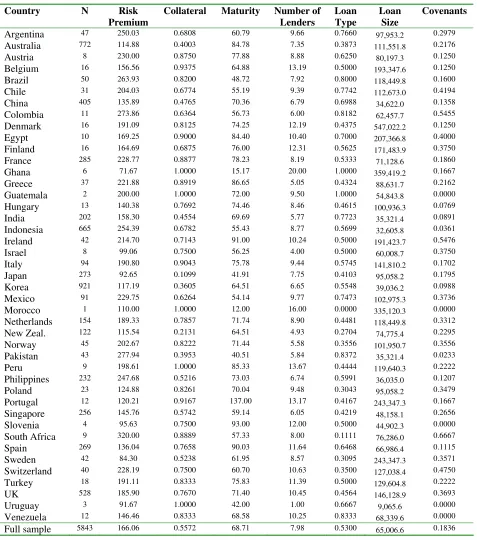
Table 1 reports mean values for the loan-level variables by country. Risk premium
varies considerably, from 71.67 basic points in Ghana to 320 in South Africa, with a
mean value of 166.06 basic points for the full sample. These differences partly reflect the
differences in economic development which contribute to reduce the risk premium, even
if significant exceptions exist. The proportion of secured loans strongly varies across
countries from 10.99% in Japan to 100% in five countries (Ghana, Guatemala, Morocco,
Peru, and Uruguay). On the full sample, 55.72% of loans are secured.
Regarding the maturity of loans, the cross-country discrepancies are rather limited
with mean maturities ranging from 12 months in Morocco to 137 months in Portugal. As
many loans are syndicated, the number of lenders ranges from 1 in Uruguay to 20 in
Ghana, with a mean of 7.98 lenders for the full sample.
The share of term loans, which is provided by the value of Loan Type, varies from
0% in Morocco to 100% in Ghana and Guatemala. As the 1st and the 9th deciles are
respectively 31% and 82%, we can however conclude that a significant proportion of
most countries’ loans are term loans and other loans. Here again, the extreme values are
linked, at least in part, to the small size of national samples. The mean size of loans varies
considerably across countries, even if all loans have a substantial amount in accordance
with the coverage of Dealscan. The range goes from 9,065.6 thousand dollars in Uruguay
to 547,022.2 thousand dollars in Denmark.
IV. Results
This section displays the results of our study on the role of collateral to solve
adverse selection problems. In our regression models, we begin by testing the link
between risk premium and the presence of collateral in cross-country estimations. These
estimations provide some benchmark regressions for the rest of the study. We then
investigate how the degree of information asymmetries influences the relationship
between risk premium and the presence of collateral. To this end, we add an interaction
term between each country-level variable measuring this degree and the presence of
collateral in the regressions.
Next we perform two kinds of robustness check tests. First, we test whether our
findings are sensitive to the inclusion of other country-level variables, and second, we
investigate the issue of the endogeneity of collateral in our estimations.
IV.1 The benchmark estimations
We first present the results of the regression of risk premium for the different sets
of variables. These estimations are benchmarks for the ones including the interaction
terms, as they provide valuable information on the coefficient of Collateral and on the
coefficients of the control variables, which are likely to be affected by the inclusion of the
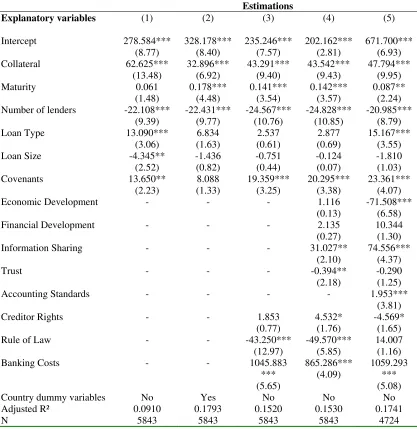
interaction terms. The results are displayed in table 2.
We perform five estimations by testing different combinations of country-level
variables. The first estimation does not include any country-level variable (column 1).
The second estimation includes dummy variables for countries to control for all
country-specific variables (column 2). The third one adds the control variables (Creditor Rights,
Rule of Law, Bank Costs) as explanatory variables in the estimation (column 3).
The fourth and fifth estimations (columns 4 and 5) add the country-level variables
Accounting Standards, Economic Development, Financial Development). As Accounting
Standards is only available for 35 countries among the 43 in our sample, we perform the
estimations with and without this variable.
The major finding is the positive coefficient of Collateral, which is significant at
the 1% level in all regressions. This result is robust to all five estimations. We therefore
observe that risk premium increases when the loan is secured. This broad evidence does
not support the theoretical argument according to which collateral helps solve the
problem of adverse selection. It corroborates in contrast the observed-risk hypothesis
according to which banks would ask for more collateral from riskier companies, which
are already charged with higher loan rates. We then support most empirical evidence on
this issue, which concludes a positive link between the presence of collateral and risk
premium.
Turning to the loan-level control variables, we can stress the robustness of their
signs across the five estimations. Maturity is positive in all estimations and significant in
four of them, suggesting that longer loans are charged with greater risk premium in
accordance with literature. Number of Lenders has a significant and negative coefficient
in all estimations, in accordance with the view of a lower risk premium for loans with a
greater number of lenders. This is an expected result as syndicated loans benefit from
lower risk premium than other loans (Allen, 1990).
Loan Type is positive in all estimations, suggesting that term loans are charged with
greater risk premium. This finding can be explained by the lower risk of term loans than
of other loans, once maturity is controlled. The coefficient of Loan Size is negative in all
estimations, even if it is significant only once. This finding supports the view that bigger
loans are charged with lower risk premium, as shown in the literature. Finally the
presence of covenants is positively associated with risk premium.
This subsection has shown that collateral is positively associated with risk premium
in our cross-country sample. Supporting the observed-risk hypothesis, this is a major
result, as it is the first study that uses a cross-country sample. The heterogeneity of our
country sample presents a major advantage which must be exploited for a thorough
investigation of the role of collateral to solve adverse selection. Indeed, the positive link
asymmetries between the borrower and the bank before the loan is granted. Therefore, the
adverse selection hypothesis can also receive some support if we observe that greater
information asymmetries reduce the positive link between collateral and risk premium. In
this aim, we perform estimations controlling for the influence of the degree of
information asymmetries.
IV.2 The estimations with an interaction term
We now turn to estimations including an interaction term between Collateral and
one country-specific variable which might influence the degree of ex ante information
asymmetries between the borrower and the bank. To examine the sensitivity of the
results, we perform the regressions with two different condition information sets of
country-level variables. The first set of regressors includes the control variables and the
variable interacting with Collateral, while the second set includes all country-level
variables. We then aim to reduce the chances that the cross-country regressions include a
selected group of regressors which yields a favored result.
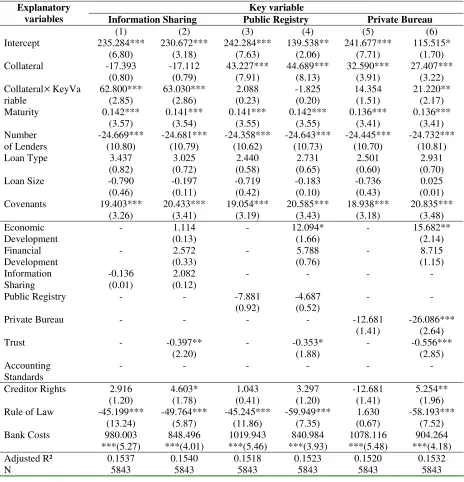
The first estimations are devoted to the opacity of financial information. We test the
role of two variables: Accounting Standards, and Information Sharing. In addition, as
Information Sharing can be decomposed into its two components, we also investigate the
role of Public Registry and Private Bureau. The estimations with Accounting Standards
are displayed in table 3, while those for Information Sharing and its components are
presented in table 4. We observe that the coefficient of the interaction term is
significantly positive for the estimations with Accounting Standards and Information
Sharing. These findings therefore support the view that a lower degree of information
asymmetries increases the positive relationship between collateral and risk premium, and
consequently enhances the likelihood of the observed-risk hypothesis. They may also be
in accordance with the adverse selection hypothesis, as a low degree of one of these
variables could be small enough to favor a negative relationship between collateral and
risk premium.
Therefore, we check whether the relationship might be negative in some countries.
To this end, we compute the overall coefficient of Collateral for all estimations, which is
value of the key variable. Indeed the overall coefficient of Collateral may be negative for
low values of the key value. The thresholds are computed in all cases and compared to
the values of countries.2 The threshold is 40.966 with Accounting Standards. We have
three countries with values for this variable below the threshold (Egypt, Peru, Uruguay).
With Information Sharing, the threshold is 0.271. As this is a dummy variable, countries
with a zero value are below the threshold. In this case is only India. Therefore, the link
between collateral and risk premium can be negative in some countries owing to their
strong degree of information asymmetries.
A final remark concerns the results for both variables taking the presence of
information-sharing institutions into account. We can observe that the positive and
significant sign of Information Sharing is explained by the component Private Bureau, as
the interaction term is significant in the estimation with Private Bureau and is not in the
one with Public Registry. This result supports the view that, contrary to the existence of
public registries, the existence of private bureaus contributes to improve the information
owned by banks.
The second estimations concern Trust, and are displayed in Table 3. Our results
show again a positive and significant coefficient for the interaction term. As Trust proxies
honesty of the borrower and trust of the bank towards the borrower, this finding is again
in favor of the view that a lower degree of information asymmetries contributes to
strengthen the positive relationship between collateral and risk premium. With Trust, the
overall coefficient of Collateral is always positive as both coefficients for Collateral and
for the interaction term are positive. Therefore, the degree of Trust can not lead to some
countries in which collateral would affect negatively risk premium.
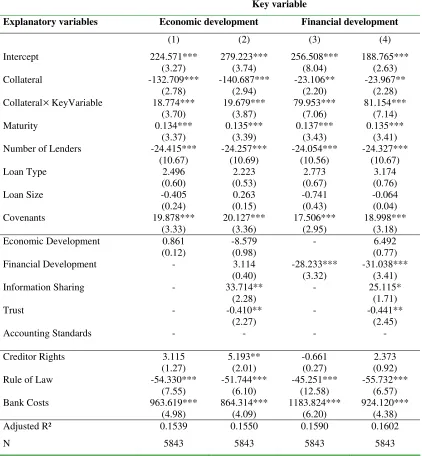
Finally, the third set of estimations is devoted to the role of economic and financial
development and is presented in table 5. As mentioned above, the argument is that bank
employees would benefit from better skills in analysis of risk default for loans in a
country with a greater level of economic and financial development. Therefore, they
would face a lower degree of ex ante information asymmetries. Once again, we observe
positive and significant coefficients for the interaction term in the regressions. As greater
2
economic and financial development is associated with lower information asymmetries,
these findings support the views that lower information asymmetries increase the positive
link between collateral and risk premium.
We can again wonder whether there exist some countries characterized by
information asymmetries strong enough to lead to a negative link between presence of
collateral and risk premium. With Economic Development, the threshold is 7.149.
However the minimum value for this variable is 7.149. As a result, no country has an
overall coefficient of Collateral which is negative. With Financial Development, the
threshold is 0.295. Thirteen countries have a value below this threshold (Argentina,
Ghana, Guatemala, Honduras, Mexico, Pakistan, Peru, Poland, Slovenia, Turkey,
Uruguay, Venezuela), which mean that the overall coefficient of collateral is negative for
these countries.
In summary, the findings clearly support the hypothesis that the degree of
information asymmetries exerts an influence on the relationship between collateral and
risk premium. We therefore provide some support for the observed-risk hypothesis and
the adverse selection hypothesis, as both hypotheses may be empirically validated
depending on the degree of information asymmetries in the country. In accordance with
this remark, we observe that the relationship between presence of collateral and risk
premium, which was positive in benchmark regressions, can be negative in countries with
strong information asymmetries. Such finding is only observed for developing countries,
which may explain why this result contradicts former evidence on this topic. It also
constitutes a major motivation ex post for this seminal investigation on a sample of
countries, including some developing countries.
IV.3 Robustness tests
Our robustness checks include two sets of tests. The first one investigates the
endogeneity of collateral in our estimations. In all robustness tests, we display results
from model specifications with the full conditioning information set.
We first test the inclusion of alternative country-level variables. We start by adding
“fundamental variables” in the estimations. Namely, such variables affect institutional
variables which were adopted in our estimations. We test the presence of two sets of
fundamental characteristics. We add variables for legal origin, as this dimension has been
shown to influence financial development (La Porta et al., 1997a). We add dummy
variables if legal origin is Common law, French origin, German origin, or Socialist
origin. The dummy variable for Scandinavian origin is dropped. As legal origin exerts an
impact on creditor rights and rule of law, we exclude these latter variables from the
regressions that take legal origin into account. Furthermore, we control for culture, which
can be defined as “those customary beliefs and values that ethnic, religious, and social
groups transmit fairly unchanged from generation to generation.” (Guiso, Sapienza and
Zingales, 2006). Following Stulz and Williamson (2003), we proxy culture by religion
and define primary religion as the one practiced by the largest fraction of the country. We
add dummy variables if the primary religion is Catholic, Protestant, Muslim, or Buddhist.
The dummy variable if another religion is the most practiced is dropped.3
Additionally, we test the presence of alternative variables for legal environment to
check the sensitivity of our findings to the choice of legal environment variables. We add
legal formalism, which measures costs of enforcing contracts through courts, based on
surveys of lawyers and judges, and which is provided by Djankov et al. (2003). This
variable is strongly correlated with Rule of Law. Therefore, this latter variable is excluded
from the estimation including Legal Formalism.
We also account for corruption. Indeed corruption may influence the behavior of
the banks, as more corruption may increase banks’ safeguards against loan loss, owing to
unpredictable court decisions or loans granted by bribed employees. Corruption is
measured with the World Bank’s index “Corruption” (Corruption) (Kaufmann, Kraay
and Zoido-Lobaton, 1999a,b). This composite index aggregates indicators of corruption
3
obtained from experts’ surveys and indices of corruption resting on residents’ surveys. It
ranges from -2.5 to 2.5 with greater values for less corrupted countries. For clarity, we
rescaled the index from 0 for the lowest corruption to 10 for the highest corruption.
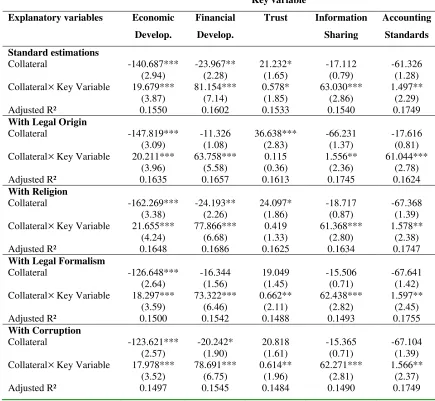
The estimations with all these alternative sets of variables are presented in table 6,
in which we display coefficients for Collateral and for the interaction term between
Collateral and the country-level variables proxying the degree of information
asymmetries. Most of our findings are robust to the specification of the set of
country-level variables. This specification for all variables does not affect the sign and the
significance of the interaction term, with certain exceptions for the significance of the
interaction term with Trust. For this latter variable, the interaction term is significant in
estimations with Corruption and Legal Formalism, as it was in standard estimations.
However the introduction of “fundamental” country-level variables cancels the
significance of the interaction term. Such results can be explained by the influence of
“fundamental” variables on trust, notably by the potential impact of religion on trust.
This first set of tests leads to the conclusion that our findings are robust to the
choice of country-level variables, as alternative specifications do not alter our results.
We now turn to the issues of endogeneity in our estimations. Following previous
studies (Berger and Udell, 1990; Harhoff and Körting, 1998), we have assumed that
collateral and risk premium are determined in a sequential procedure, with the collateral
decision preceding the determination of risk premium. This assumption of sequentiality is
widely accepted in empirical works (Dennis, Nandy and Sharpe, 2000; Dennis and
Sharpe, 2005; Bharath et al., 2006). However, such an approach ignores the potential
endogeneity issue of collateral with risk premium, as well as the potential simultaneity
between these both loan characteristics.
In order to tackle these issues, we re-estimate the model specifications using a
simultaneous equations framework4. Under the hypothesis of sequentiality in the
collateral and risk premium decision, we assume a unidirectional relationship between
4
Risk Premium and Collateral, following Dennis, Nandy and Sharpe (2000) and Bharath
et al.(2006). The two equations structural model can be described as follows5
* *
Risk Premium (Intercept, Collateral , Collateral Key Variable, , ) Collateral (Intercept, , )
f X
g Z
ε υ
⎧ = ×
⎨
=
⎩ (2)
*
Collateral is the fitted value of Collateral estimated in a first stage and
*
Collateral ×Key Variable is the crossed variable using the fitted value of Collateral and
the investigated Key Variable. Xis a vector of the explanatory variables used in the
individual regressions already described. Z is a vector of the following explanatory
variables : Loan Type, Loan Amount, Number of Lenders, Distribution Method, Seniority,
and dummy variables for industries and years. ε and υ are the residuals which are
supposed to be normally distributed. Distribution Method is a dummy variable equal to 1
if the loan is syndicated (82.94% of our sample) and Seniority is a dummy variable equal
to 1 if the loan is senior (45.30% of our sample).
We use the three stages least squares (3SLS) method to estimate the two equations
model in order to exploit the correlation of the disturbances across the equations6. The
estimation of the system is complicated by the presence of both continuous (Risk
Premium) and discrete choice (Collateral) variables. We follow Angrist (2001) and
estimate the equation explaining Collateral with a probit regression in a first stage. The
instruments for the 3SLS estimates are obtained from the benchmark and with interaction
terms regressions and the specification for Collateral. The explanatory variables for the
former have been selected following statistical analysis: we have retained the variables
which are the most correlated with Collateral and the least correlated with Risk Premium.
The results of stepwise discriminant analysis and probit regression confirm this selection.
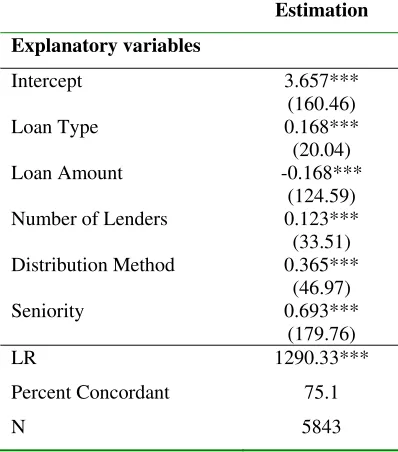
Results from the probit regression of Collateral are displayed in table 7. The
statistics of the regression are satisfactory, with a significant likelihood ratio and a
5
We present the general specification, although we first estimate the equations system for the benchmark regressions and then for the interaction terms.
satisfactory percentage of concordance (above 75%). All of the coefficients have
expected significant signs.
We display the results from model specifications with the full conditioning
information set in tables 8 and 9. Table 8 gives the results of the re-estimation of the
specification for the two benchmark regressions in columns 4 and 5 from table 2. The
main finding is the switch of sign for the coefficient of Collateral, which becomes
significantly negative. This is in sharp contrast with former studies on the link between
collateral and risk premium (e.g. Berger and Udell, 1990). However all former studies did
not control for endogeneity of collateral.
On a theoretical basis, this result is consistent with the adverse selection hypothesis,
according to which collateral serves as a signalling instrument (Bester, 1985; Chan and
Kanatas, 1985; Besanko and Thakor, 1987).
In addition, this view is supported by Bharath et al. (2006). These authors
investigate the benefits of relationship banking for companies. To this end, they analyze
the determinants of loan price on a sample of US loans, including the presence of
collateral. They therefore obtain similar findings to ours. On the one hand, the OLS
regressions show a positive and significant sign for the presence of collateral as an
explaining variable of the loan price. On the other hand, the estimations performed with a
simultaneous equations model controlling for endogeneity change this result to a negative
and significant coefficient for the presence of collateral.
This is a major finding, as it suggests that, when endogeneity is controlled, a
negative link emerges between collateral and risk premium. However, our key issue is
not the sign of this relationship for the full sample, but whether the degree of ex ante
information asymmetries influences this link. This is a more relevant issue to understand
the use of collateral by banks, since it tends to demonstrate that adverse selection and
observed-risk hypotheses may not be antagonistic, and can both be empirically validated
depending of the degree of the country.
To this end, we perform estimations with interaction terms between Collateral and
the country-specific variables proxying the degree of ex ante information asymmetries for
the interaction terms remain unchanged when endogeneity is controlled. These
estimations are reported in table 9.
All coefficients of the interaction terms remain positive, but some are not
significant. More specifically, the estimations with Trust, Economic Development and
Financial Development show positive and significant coefficients for the interaction
term, while the coefficients for the interaction term with Accounting Standards and
Information Sharing are not significant, even if their sign does not switch.
Consequently, we conclude that the tests controlling for endogeneity do not hamper
our key finding regarding the role of information asymmetries on the relationship
between collateral and risk premium. Indeed, we still observe that lower information
asymmetries increase the overall coefficient of Collateral to explain Risk Premium.
Therefore, these robustness tests strengthen our main conclusion that both observed-risk
and adverse selection hypotheses may be empirically validated depending of the degree
of information asymmetries in the country.
V. Concluding remarks
In this paper, we analyze the role of collateral to mitigate adverse selection
problems on a large set of loans from 43 countries. According to the adverse selection
hypothesis, we should observe a negative relationship between the presence of collateral
and risk premium, as collateral constitutes a signalling instrument for high-quality
borrowers. The observed-risk hypothesis is however in favor of a positive link between
these both variables, owing to the ability of the bank to sort borrowers according to their
quality.
At first glance, these hypotheses are contradictory, even though they are both based
on the degree of information asymmetries before the loan granting. Indeed, the adverse
selection hypothesis assumes the existence of strong information asymmetries resulting in
the need for the borrower to use quality signals, while observed-risk hypothesis considers
low information asymmetries leading to the ability of the bank to observe borrower risk.
As a consequence, both hypotheses may be empirically validated depending on the
We find that a lower degree of information asymmetries, proxied through five
country-level variables, enhances the positive relationship between the presence of
collateral and risk premium. We therefore provide some support for the adverse selection
and observed-risk hypotheses, as both hypotheses may be empirically validated
depending on the degree of information asymmetries in the country. In addition, this
result is robust to tests controlling for the potential endogeneity of collateral.
Our findings strongly qualify the view that the role of collateral to mitigate adverse
selection problems should be rejected, in sharp contrast to the existing empirical
literature. They are in line with the theoretical arguments provided notably by Bester
(1985), Chan and Kanatas (1985) and Besanko and Thakor (1987).
The normative implications of our findings are the support of the efforts to reduce
information asymmetries before the loan granting. Indeed, collateral requirements have
been widely mentioned to constitute major obstacles to the access to credit. Therefore, as
lower information asymmetries reduce such requirements, they favor access to credit and
consequently promote investment. Authorities can contribute to reduce information
asymmetries through better quality of financial information and the implementation of
References:
1. Allen, T., 1990. "Developments in the International Syndicated Loan Market in the 1980," Bank of England Quarterly Bulletin, February 71-77.
2. Angrist, Joshua, 2001. "Estimation of Limited Dependant Variable Models with Dummy Endogenous Regressors: Simple Strategies for Empirical Practice,"
Journal of Business and Economic Statistics 19, 2-16.
3. Barth, James, Gerard Caprio and Ross Levine, 2004. "Bank Regulation and Supervision: What Works Best?A New Database on Financial Development and Structure," Journal of Financial Intermediation 13, 205-248.
4. Beck, Thorsten, Asli Demirgüc-Kunt and Ross Levine, 2000. "A New Database on Financial Development and Structure," World Bank Economic Review 14, 597-605.
5. Beck, Thorsten, and Ross Levine, 2004. "Stock markets, Banks, and Growth: Panel Evidence," Journal of Banking and Finance 28, 423-442.
6. Berger, Allen, and Gregory Udell, 1990. "Collateral, Loan Quality, and Bank Risk," Journal of Monetary Economics 25, 21-42.
7. Berger, Allen, and Gregory Udell, 1995. "Relationship Lending and Lines of Credit in Small Firm Finance," Journal of Business 68, 351-382.
8. Besanko, David, and Anjan Thakor, 1987. "Collateral and Rationing: Sorting Equilibria in Monopolistic and Competitive Credit Markets," International Economic Review 28, 671-689.
9. Bester, Helmut, 1985. "Screening vs. Rationing in Credit Markets with Imperfect Information," American Economic Review 25, 21-42.
10.Bharath, Sreedhar, Sandeep Dahiya, Anthony Saunders and Anand Srinivasan, 2006. "Lending Relationships and Loan Contract Terms: Does Size Matter?", mimeo, Stern School of Business.
11.Bushman, Robert, Joseph Piotroski, and Abbie Smith, 2004. "What Determines Corporate Transparency?" Journal of Accounting Research 42, 2, 207-252. 12.Chan, Yuk-Shee, and George Kanatas, 1985. "Asymmetric Valuation and the
Role of Collateral in Loan Agreements," Journal of Money, Credit and Banking
17, 85-95.
13.Davydenko, Sergei, and Julian Franks, 2005. "Do Bankruptcy Codes Matter? A Study of Defaults in France, Germany and the UK," EFA 2005 Moscow Meetings Paper.
14.Degryse, Hans, and Patrick van Cayseele, 2000. "Relationship Lending Within a Bank-Based System: Evidence from European Small Business Data," Journal of Financial Intermediation 9, 90-109.
15.Dennis Steven and Ian Sharpe, 2005. "Firm Size Dependence in the Determinants of Bank Term Loan Maturity," Journal of Business, Finance and Accounting 32, 31-64.
16.Dennis Steven, Nandy Bebarshi and Ian Sharpe, 2000. "Determinants of Contract Terms in Bank Revolving Lines of Credit," Journal of Financial and Quantitative Analysis 35, 87-109.
18.Guiso, Luigi, Paola Sapienza and Luigi Zingales, 2006. "Does Culture affect Economic Outcomes?" Journal of Economic Perspectives 20, 2, 23-48.
19.Harhoff, Dietmar, and Timm Körting, 1998. "Lending Relationships in Germany – Empirical Evidence from Survey Data," Journal of Banking and Finance 22, 1317-1353.
20.Japelli, Tullio, and Marco Pagano, 1993. "Information Sharing in Credit Markets," Journal of Finance 48, 1693-1718.
21.Japelli, Tullio, and Marco Pagano, 2002. "Information Sharing, Lending and Defaults: Cross-Country Evidence," Journal of Banking and Finance 26, 2017-2045.
22.Jimenez, Gabriel, Vicente Salas and Jesus Saurina, 2006. "Determinants of Collateral," Journal of Financial Economics 81, 255-281.
23.Jimenez, Gabriel, and Jesus Saurina, 2004. "Collateral, Type of Lender and Relationship Banking as Determinants of Credit Risk," Journal of Banking and Finance 28, 2191-2212.
24.Kaufmann, Daniel, Aart Kraay and Pablo Zoido-Lobaton, 1999a. "Aggregating Governance Indicators," World Bank, Working Paper n°2195.
25.Kaufmann, Daniel, Aart Kraay and Pablo Zoido-Lobaton, 1999b. "Governance Matters," World Bank, Working Paper n°2196.
26.Knack, Stephen, and Philip Keefer, 1997. "Does Social Capital have an Economic Payoff? A Cross-Country Investigation," Quarterly Journal of Economics 112, 1251-1288.
27.La Porta, Rafael, Florencio Lopez-de-Silanes, Andrei Shleifer and Robert W. Vishny, 1997a. "Legal Determinants of External Finance," Journal of Finance 52, 1131-1150.
28.La Porta, Rafael, Florencio Lopez-de-Silanes, Andrei Shleifer and Robert W. Vishny, 1997b. "Trust in Large Organizations," American Economic Review 87, 333-338.
29.La Porta, Rafael, Florencio Lopez-de-Silanes, Andrei Shleifer and Robert W. Vishny, 1998. "Law and Finance," Journal of Political Economy 106, 1113-1155. 30.Levine, Ross, Norman Loayza and Thorsten Beck, 2000. "Financial
Intermediation and Growth: Causality and Causes," Journal of Monetary Economics 46, 31-77.
31.Qian, Jun, and Philip Strahan, 2007. "How Laws & Institutions Shape Financial Contracts: The Case of Bank Loans,” Journal of Finance (forthcoming).
32.Stiglitz, Joseph, and Andrew Weiss, 1981. "Credit Rationing in Markets with Imperfect Information," American Economic Review 71, 393-410.
33.Stulz, Rene, and Rohan Williamson, 2003. "Culture, Openness and Finance,"
Journal of Financial Economics 70, 261-300.
Table 1
Summary statistics on key variables by country
This table provides means for Risk Premium (in basic points), Maturity (in months), Number of Lenders, Loan Size (in thousand dollars), and frequencies for Collateral, Loan Type, Covenants. N is the number of loans.
Country N Risk
Premium
Collateral Maturity Number of Lenders
Loan Type
Loan Size
Covenants
Argentina 47 250.03 0.6808 60.79 9.66 0.7660 97,953.2 0.2979
Australia 772 114.88 0.4003 84.78 7.35 0.3873 111,551.8 0.2176
Austria 8 230.00 0.8750 77.88 8.88 0.6250 80,197.3 0.1250
Belgium 16 156.56 0.9375 64.88 13.19 0.5000 193,347.6 0.1250
Brazil 50 263.93 0.8200 48.72 7.92 0.8000 118,449.8 0.1600
Chile 31 204.03 0.6774 55.19 9.39 0.7742 112,673.0 0.4194
China 405 135.89 0.4765 70.36 6.79 0.6988 34,622.0 0.1358
Colombia 11 273.86 0.6364 56.73 6.00 0.8182 62,457.7 0.5455
Denmark 16 191.09 0.8125 74.25 12.19 0.4375 547,022.2 0.1250
Egypt 10 169.25 0.9000 84.40 10.40 0.7000 207,366.8 0.4000
Finland 16 164.69 0.6875 76.00 12.31 0.5625 171,483.9 0.3750
France 285 228.77 0.8877 78.23 8.19 0.5333 71,128.6 0.1860
Ghana 6 71.67 1.0000 15.17 20.00 1.0000 359,419.2 0.1667
Greece 37 221.88 0.8919 86.65 5.05 0.4324 88,631.7 0.2162
Guatemala 2 200.00 1.0000 72.00 9.50 1.0000 54,843.8 0.0000
Hungary 13 140.38 0.7692 74.46 8.46 0.4615 100,936.3 0.0769
India 202 158.30 0.4554 69.69 5.77 0.7723 35,321.4 0.0891
Indonesia 665 254.39 0.6782 55.43 8.77 0.5699 32,605.8 0.0361
Ireland 42 214.70 0.7143 91.00 10.24 0.5000 191,423.7 0.5476
Israel 8 99.06 0.7500 56.25 4.00 0.5000 60,008.7 0.3750
Italy 94 190.80 0.9043 75.78 9.44 0.5745 141,810.2 0.1702
Japan 273 92.65 0.1099 41.91 7.75 0.4103 95,058.2 0.1795
Korea 921 117.19 0.3605 64.51 6.65 0.5548 39,036.2 0.0988
Mexico 91 229.75 0.6264 54.14 9.77 0.7473 102,975.3 0.3736
Morocco 1 110.00 1.0000 12.00 16.00 0.0000 335,120.3 0.0000
Netherlands 154 189.33 0.7857 71.74 8.90 0.4481 118,449.8 0.3312
New Zeal. 122 115.54 0.2131 64.51 4.93 0.2704 74,775.4 0.2295
Norway 45 202.67 0.8222 71.44 5.58 0.3556 101,950.7 0.3556
Pakistan 43 277.94 0.3953 40.51 5.84 0.8372 35,321.4 0.0233
Peru 9 198.61 1.0000 85.33 13.67 0.4444 119,640.3 0.2222
Philippines 232 247.68 0.5216 73.03 6.74 0.5991 36,035.0 0.1207
Poland 23 124.88 0.8261 70.04 9.48 0.3043 95,058.2 0.3479
Portugal 12 120.21 0.9167 137.00 13.17 0.4167 243,347.3 0.1667
Singapore 256 145.76 0.5742 59.14 6.05 0.4219 48,158.1 0.2656
Slovenia 4 95.63 0.7500 93.00 12.00 0.5000 44,902.3 0.0000
South Africa 9 320.00 0.8889 57.33 8.00 0.1111 76,286.0 0.6667
Spain 269 136.04 0.7658 90.03 11.64 0.6468 66,986.4 0.1115
Sweden 42 84.30 0.5238 61.95 8.57 0.3095 243,347.3 0.3571
Switzerland 40 228.19 0.7500 60.70 10.63 0.3500 127,038.4 0.4750
Turkey 18 191.11 0.8333 75.83 11.39 0.5000 129,604.8 0.2222
UK 528 185.90 0.7670 71.40 10.45 0.4564 146,128.9 0.3693
Uruguay 3 91.67 1.0000 42.00 1.00 0.6667 9,065.6 0.0000
Venezuela 12 146.46 0.8333 68.58 10.25 0.8333 68,339.6 0.0000
Table 2
Benchmark regressions
Definitions of variables appear in the Appendix. The dependent variable is Risk Premium. Table reports coefficients with t-statistics in parentheses. *, **, *** denote an estimate significantly different from 0 at the 10%, 5% or 1% level. Dummy variables for industries and years are included in the regressions but are not reported.
Estimations
Explanatory variables (1) (2) (3) (4) (5)
Intercept 278.584*** (8.77) 328.178*** (8.40) 235.246*** (7.57) 202.162*** (2.81) 671.700*** (6.93) Collateral 62.625*** (13.48) 32.896*** (6.92) 43.291*** (9.40) 43.542*** (9.43) 47.794*** (9.95) Maturity 0.061 (1.48) 0.178*** (4.48) 0.141*** (3.54) 0.142*** (3.57) 0.087** (2.24) Number of lenders -22.108***
(9.39) -22.431*** (9.77) -24.567*** (10.76) -24.828*** (10.85) -20.985*** (8.79)
Loan Type 13.090***
(3.06) 6.834 (1.63) 2.537 (0.61) 2.877 (0.69) 15.167*** (3.55)
Loan Size -4.345**
(2.52) -1.436 (0.82) -0.751 (0.44) -0.124 (0.07) -1.810 (1.03) Covenants 13.650** (2.23) 8.088 (1.33) 19.359*** (3.25) 20.295*** (3.38) 23.361*** (4.07)
Economic Development - - - 1.116
(0.13)
-71.508*** (6.58)
Financial Development - - - 2.135
(0.27)
10.344 (1.30)
Information Sharing - - - 31.027**
(2.10)
74.556*** (4.37)
Trust - - - -0.394**
(2.18)
-0.290 (1.25)
Accounting Standards - - - - 1.953***
(3.81)
Creditor Rights - - 1.853
(0.77)
4.532* (1.76)
-4.569* (1.65)
Rule of Law - - -43.250***
(12.97)
-49.570*** (5.85)
14.007 (1.16)
Banking Costs - - 1045.883
*** (5.65) 865.286*** (4.09) 1059.293 *** (5.08)
Country dummy variables No Yes No No No
Adjusted R² 0.0910 0.1793 0.1520 0.1530 0.1741
Table 3
Regressions with interaction variables for trust and accounting standards
Definitions of variables appear in the Appendix. The dependent variable is Risk Premium. Table reports coefficients with t-statistics in parentheses. *, **, *** denote an estimate significantly different from 0 at the 10%, 5% or 1% level. Dummy variables for industries and years are included in the regressions but are not reported.
Key variable
Explanatory variables Trust Accounting Standards
(1) (2) (3) (4)
Intercept 257.672*** (7.95) 217.578*** (3.00) 200.414*** (3.85) 750.576*** (7.30) Collateral 21.046 (1.63) 21.232* (1.65) -58.475 (1.27) -61.326 (1.28)
Collateral×KeyVariable 0.585*
(1.87) 0.578* (1.85) 1.452** (2.31) 1.497** (2.29) Maturity 0.140*** (3.52) 0.143*** (3.59) 0.079** (2.05) 0.087** (2.25) Number of Lenders -24.478***
(10.72) -24.782*** (10.83) -21.816*** (9.12) -20.939*** (8.77)
Loan Type 2.060
(0.49) 2.811 (0.67) 14.268*** (3.30) 14.129*** (3.29)
Loan Size -0.389
(0.22) -0.182 (0.10) -2.266 (1.30) -1.622 (0.93) Covenants 20.190*** (3.38) 20.394*** (3.40) 26.453*** (4.61) 23.642*** (4.12)
Economic Development - 1.103
(0.13)
- -71.889*** (6.62)
Financial Development - 2.313
(0.29)
- 5.040 (0.61)
Information Sharing - 30.737**
(2.08) - 80.213*** (4.65) Trust -0.637** (2.52) -0.739*** (2.85) - -0.263 (1.13)
Accounting Standards - - 0.785
(1.22)
0.769 (1.06)
Creditor Rights 2.383
(0.95) 3.954 (1.52) -0.235 (0.10) -4.756* (1.72)
Rule of Law -45.066***
(12.61) -49.252*** (5.81) -44.480*** (6.84) 18.104 (1.48)
Bank Costs 955.301***
(4.92) 874.504*** (4.13) 921.210*** (4.64) 1082.382*** (5.18)
Adjusted R² 0.1526 0.1533 0.1652 0.1749
Table 4
Regressions with interaction variables for information sharing and its components
Definitions of variables appear in the Appendix. The dependent variable is Risk Premium. Table reports coefficients with t-statistics in parentheses. *, **, *** denote an estimate significantly different from 0 at the 10%, 5% or 1% level. Dummy variables for industries and years are included in the regressions but are not reported.
Key variable Explanatory
variables Information Sharing Public Registry Private Bureau
(1) (2) (3) (4) (5) (6) Intercept 235.284*** (6.80) 230.672*** (3.18) 242.284*** (7.63) 139.538** (2.06) 241.677*** (7.71) 115.515* (1.70) Collateral -17.393 (0.80) -17.112 (0.79) 43.227*** (7.91) 44.689*** (8.13) 32.590*** (3.91) 27.407*** (3.22) Collateral×KeyVa
riable 62.800*** (2.85) 63.030*** (2.86) 2.088 (0.23) -1.825 (0.20) 14.354 (1.51) 21.220** (2.17) Maturity 0.142*** (3.57) 0.141*** (3.54) 0.141*** (3.55) 0.142*** (3.55) 0.136*** (3.41) 0.136*** (3.41) Number of Lenders -24.669*** (10.80) -24.681*** (10.79) -24.358*** (10.62) -24.643*** (10.73) -24.445*** (10.70) -24.732*** (10.81)
Loan Type 3.437
(0.82) 3.025 (0.72) 2.440 (0.58) 2.731 (0.65) 2.501 (0.60) 2.931 (0.70)
Loan Size -0.790
(0.46) -0.197 (0.11) -0.719 (0.42) -0.183 (0.10) -0.736 (0.43) 0.025 (0.01) Covenants 19.403*** (3.26) 20.433*** (3.41) 19.054*** (3.19) 20.585*** (3.43) 18.938*** (3.18) 20.835*** (3.48) Economic Development
- 1.114
(0.13) - 12.094* (1.66) - 15.682** (2.14) Financial Development
- 2.572
(0.33) - 5.788 (0.76) - 8.715 (1.15) Information Sharing -0.136 (0.01) 2.082 (0.12) - - - -
Public Registry - - -7.881
(0.92)
-4.687 (0.52)
- -
Private Bureau - - - - -12.681
(1.41)
-26.086*** (2.64)
Trust - -0.397**
(2.20) - -0.353* (1.88) - -0.556*** (2.85) Accounting Standards - - - -
Creditor Rights 2.916 (1.20) 4.603* (1.78) 1.043 (0.41) 3.297 (1.20) -12.681 (1.41) 5.254** (1.96) Rule of Law -45.199***
(13.24) -49.764*** (5.87) -45.245*** (11.86) -59.949*** (7.35) 1.630 (0.67) -58.193*** (7.52) Bank Costs 980.003
***(5.27) 848.496 ***(4.01) 1019.943 ***(5.46) 840.984 ***(3.93) 1078.116 ***(5.48) 904.264 ***(4.18)
Adjusted R² 0.1537 0.1540 0.1518 0.1523 0.1520 0.1532
Table 5
Regressions with interaction variables for economic and financial development
Definitions of variables appear in the Appendix. The dependent variable is Risk Premium. Table reports coefficients with t-statistics in parentheses. *, **, *** denote an estimate significantly different from 0 at the 10%, 5% or 1% level. Dummy variables for industries and years are included in the regressions but are not reported.
Key variable
Explanatory variables Economic development Financial development
(1) (2) (3) (4)
Intercept 224.571*** (3.27) 279.223*** (3.74) 256.508*** (8.04) 188.765*** (2.63) Collateral -132.709*** (2.78) -140.687*** (2.94) -23.106** (2.20) -23.967** (2.28)
Collateral×KeyVariable 18.774***
(3.70) 19.679*** (3.87) 79.953*** (7.06) 81.154*** (7.14) Maturity 0.134*** (3.37) 0.135*** (3.39) 0.137*** (3.43) 0.135*** (3.41) Number of Lenders -24.415***
(10.67) -24.257*** (10.69) -24.054*** (10.56) -24.327*** (10.67)
Loan Type 2.496
(0.60) 2.223 (0.53) 2.773 (0.67) 3.174 (0.76)
Loan Size -0.405
(0.24) 0.263 (0.15) -0.741 (0.43) -0.064 (0.04) Covenants 19.878*** (3.33) 20.127*** (3.36) 17.506*** (2.95) 18.998*** (3.18) Economic Development 0.861
(0.12)
-8.579 (0.98)
- 6.492 (0.77)
Financial Development - 3.114
(0.40)
-28.233*** (3.32)
-31.038*** (3.41)
Information Sharing - 33.714**
(2.28)
- 25.115* (1.71)
Trust - -0.410**
(2.27)
- -0.441** (2.45)
Accounting Standards - - - -
Creditor Rights 3.115
(1.27) 5.193** (2.01) -0.661 (0.27) 2.373 (0.92)
Rule of Law -54.330***
(7.55) -51.744*** (6.10) -45.251*** (12.58) -55.732*** (6.57)
Bank Costs 963.619***
(4.98) 864.314*** (4.09) 1183.824*** (6.20) 924.120*** (4.38)
Adjusted R² 0.1539 0.1550 0.1590 0.1602