Citation:
Tee, JC and Bekker, S and Collins, R and Klingbiel, J and van Rooyen, I and van Wyk, D and Till, K and Jones, B (2018) The efficacy of an iterative "sequence of prevention" approach to injury prevention by a multidisciplinary team in professional rugby union. Journal of Science and Medicine in Sport, 21 (9). pp. 899-904. ISSN 1440-2440 DOI: https://doi.org/10.1016/j.jsams.2018.02.003 Link to Leeds Beckett Repository record:
http://eprints.leedsbeckett.ac.uk/4748/
Document Version: Article
Creative Commons: Attribution-Noncommercial-No Derivative Works 4.0
The aim of the Leeds Beckett Repository is to provide open access to our research, as required by funder policies and permitted by publishers and copyright law.
The Leeds Beckett repository holds a wide range of publications, each of which has been checked for copyright and the relevant embargo period has been applied by the Research Services team.
We operate on a standard take-down policy. If you are the author or publisher of an output and you would like it removed from the repository, please contact us and we will investigate on a case-by-case basis.
1
The efficacy of an iterative "sequence of prevention" approach to injury prevention by a multidisciplinary team in professional rugby union
Tee, J. C.; Bekker, Sheree; Collins, Rob; Klingbiel, Jannie; van Rooyen, Ivan; van Wyk, David; Till, Kevin; Jones, Ben
Journal of Science and Medicine in Sport ISSN 1440-2440
2
ABSTRACT
Objectives: Due to the complex-systems nature of injuries, the responsibility for injury risk management cannot lie solely within a single domain of professional practice. Interdisciplinary collaboration between technical/tactical coaches, strength and conditioning coaches, team doctors, physical therapists and sport scientists is likely to have a meaningful impact on injury risk. This study describes the application and efficacy of a multidisciplinary approach to reducing team injury risk in professional rugby union.
Design: Observational longitudinal cohort study.
Methods: Epidemiological injury data was collected from a professional rugby union team for 5 consecutive seasons. Following each season, these data informed multidisciplinary intervention strategies to reduce injury risk. The effectiveness of these strategies was iteratively assessed to inform future interventions. Specific examples of intervention strategies are provided.
Results: Overall team injury burden displayed a likely beneficial decrease (-8 %; injury rate ratio (IRR) 0.9, 95%CI 0.9 to 1.0) from 2012 to 2016. This was achieved through a most likely beneficial improvement in non-contact injury burden (-39 %; IRR 0.6, 95%CI 0.6 to 0.7). Contact injury burden was increased, but to a lesser extent (+18 %; IRR 1.2, 95%CI 1.1 to 1.3, most likely harmful) during the same period.
Conclusions: The range of skills required to effectively manage complex injury phenomena in professional collision sport crosses disciplinary boundaries. The evidence presented here points to the effectiveness of a multidisciplinary approach to reducing injury risk. This model will likely be applicable across a range of team and individual sports.
3
INTRODUCTION
Injury is a known issue in professional rugby union, with overall incidence estimated at 81 injuries per 1000 playing hours in the professional game1. Recent research within rugby union2 and other sports3 has shown links between team injury burden and performance.
Injuries result from complex interactions between a variety of internal and external risk factors4. Bittencourt and colleagues5 recently presented a multi-factorial complex-systems model for sports injury prediction, consisting of emerging patterns of injury determined by risk or protective regularities, and a highly complex ‘web of determinants’. Sports injury prevention outcomes, on this view, are influenced by several factors, including “intrapersonal, interpersonal, organisational, community, and societal factors”6
. Sports injury prevention, therefore, is best understood as a complex task, undertaken within a complex environment6.
4
METHODS
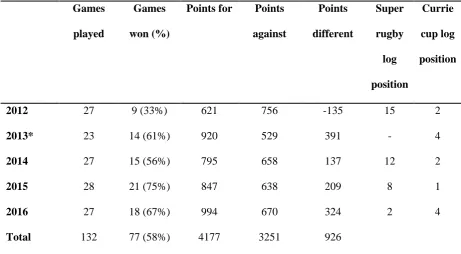
This research was conducted in a professional Rugby Union team competing in the Super Rugby and Currie Cup competitions. The University of Johannesburg’s ethical review committee granted ethical approval for this research, and permission to publish historical injury data was provided by the Golden Lions Rugby Union. All research was conducted in accordance with the Declaration of Helsinki (2013). Over the course of the research period (2012 to 2016), 102 different players (mean stature 186 ± 7 cm, body mass 105.6 ± 11.7 kg) represented the team in senior competition. The team’s results during the research period are summarised in Table 1.
<Insert Table 1 here>
The MDT consisted of three technical/tactical coaches, a S&C coach, team doctor, physiotherapist, biokineticist and sport scientist. The MDT composition is typical of the support staff available to a professional rugby team.
5
<Insert Figure 1 here>
Step 1 - Establish the extent of the problem. The team doctor collected data for all injuries during the
observation period. Injury data were collected in accordance with the “time-loss” injury definition in the International Rugby Board consensus statement on injury data collection procedures12. Injury burden was calculated as the total number of days that players were unavailable due to injury across a whole season. Further data collected related to the site and type of injury, as well as to whether injury occurred during contact or non-contact events12. An injury audit was completed for each season for the duration of the study, and was primary data used to inform interventions throughout this study.
Injury burden was normalized to a 32-week season to account for differences in the number of playing weeks in different seasons. 95% confidence intervals were calculated using standard equations13. Injury rate ratios (IRR) with 95% confidence intervals and magnitude-based inferences (MBI) were used to determine differences in injury burden across seasons. MBI represents the likelihood that the true value is substantially positive or negative.14 The threshold for significant benefit or harm was set at 5%. Changes were considered meaningful if the likelihood of positive or negative change was greater than 95% (i.e. likely, very likely or most likely)
Step 2 - Establish aetiology and mechanisms of injury. In the context of a professional sports
6
Step 3 - Introduce preventive measures. Following the initial injury audit, and similarly following the
injury audit each season, a series of inclusive “risk assessment”15
meetings took place, incorporating all members of the MDT. These meetings aimed to determine the best areas for injury prevention intervention based on the results of the injury audit. MDT members presented potential injury prevention strategies from within their area of expertise and experience. These prevention strategies were informed by recent research and through discussions of best practice with colleagues in the field. Interventions were pragmatically assessed on the basis of both the potential to reduce team injury burden, and the resources and time available to affect the intervention. This approach ensured pragmatic solutions, responsive to the complexity of the context and setting. Once the most appropriate injury prevention interventions were selected, these were discussed with the player leadership group to agree suitability, before being presented to the wider player group. Interventions were then delivered by the relevant members of the MDT, during training, over the course of a season. This step is further described in the discussion of this article.
Step 4 - Assess effectiveness by repeating stage 1. Continuous, longitudinal observation of team injury
outcomes was conducted over successive seasons (2012 to 2016). Injury audits were undertaken each season at the conclusion of competition, and were used to assess the effectiveness of interventions. Previously implemented intervention strategies were assessed and either continued, discontinued or modified based on their effect in the subsequent injury audit.
RESULTS
7
<Insert Figure 2 here>
The first iteration of the sequence of prevention approach resulted in a 42% decrease in non-contact injuries (IRR 0.6, 95%CI 0.5 to 0.6, most likely beneficial), and a concomitant 49% increase in contact injuries (IRR 1.5, 95%CI 1.4 to 1.6, most likely harmful). Overall, this amounted to a small increase (≈7%) in total injury burden from 2012 to 2013 (IRR 1.1, 95%CI 1.0 to 1.1, likely harmful).
Following this first iteration (2012 to 2013), the burden of non-contact injuries stabilized at approximately 680 (95%CI 630 to 730) days for the following three seasons. Over the same time period (2013 to 2016), progressive decreases in contact injury burden were apparent (-21%, IRR 0.8, 95%CI 0.7 to 0.8, most likely beneficial).
Figure 2b illustrates the contribution of injuries at particular injury sites to overall injury burden in each of the 5 seasons studied. The 6 most injurious sites overall are included in the graph. Concussion injury burden was meaningfully reduced by 87% from 2013 to 2016 (IRR 0.2, 95%CI 0.1 to 0.3, most likely beneficial). Posterior thigh injury burden was meaningfully lower in 2015 and 2016 compared
to 2012 to 2014 (-61%, IRR 0.3, 95%CI 0.2 to 0.4, most likely beneficial). Ankle injury burden was increased from 2012 to all other seasons, but 2015 and 2016 were meaningfully lower than 2013 and 2014 (-51%, IRR 0.6, 95%CI 0.5 to 0.7, most likely beneficial). Lower leg/Achilles injuries were meaningfully reduced in 2013, 2015 and 2016. Other injury sites displayed differential results. Knee injury burden was meaningfully lower than the median value (2014) in 2013 and 2016, but meaningfully greater in 2012 and 2015. Similarly, shoulder/clavicle injuries were significantly greater than the median (2016) in 2013, but meaningfully reduced in 2014 and 2015.
DISCUSSION
8
five seasons. This is a positive and encouraging addition to sports injury prevention literature, demonstrating that such real-world approaches in complex settings are effective.
Next, we discuss in more detail the implementation of the injury prevention approach used, as informed and underpinned by the methods described above.
The results of the 2012 season injury audit revealed that the team was experiencing greater player-time losses due to injury than expected for senior men’s professional teams1. Additionally, the team performed poorly in 2012 and the high injury burden was identified as a contributory cause. As a result, both coaches and medical staff committed to engaging in the process of reducing team injury burden.
Analysis of the 2012 injury audit identified areas where the application of injury prevention interventions may be successful in reducing team injury burden. Foremost among these was the time lost to non-contact injuries - 46% (982, 95%CI 920 to 1043 days) of total injury burden (Figure 2a). Previous research had demonstrated that high training loads and inadequate recovery are risk factors for non-contact soft tissue injury16. Therefore, since these are manageable factors, this presented a good target for the initial injury risk intervention.
9
as hyperbaric oxygen therapy20 and plasma-rich platelet therapy21 were introduced to accelerate recovery. High-level scientific evidence of the efficacy of these approaches is not yet available, but positive effects were observed in this environment.
Other areas identified by the MDT for the implementation of injury prevention interventions were the burden of knee and lower leg / Achilles injuries (Figure 2b). Season 2012 injury data showed that 10 non-contact knee injuries had occurred for a total injury burden of 532, 95%CI 487 to 577 days (supplementary data). This equated to 24% of the team’s total injury burden. Research has
demonstrated the efficacy of neuromuscular training programs for reducing the incidence of non-contact lower limb injuries22. Following from this, the team warm up was adjusted to include a number of dynamic stretching, jumping, agility and balance tasks.
The effect of the injury prevention interventions in 2013 was difficult to determine. The 2013 injury audit indicated that non-contact injury burden was reduced by 42 ± 4% (Figure 2a). This was largely the result of a 64 ± 4% reduction in knee and a 59 ± 6% reduction in lower leg / Achilles injuries (Figure 2b). These results pointed to the success of the improved training and monitoring programs. However, in the same period, there was a 49 ± 7% increase in contact injury burden, resulting in a 7 ± 5% increase in overall team injury burden (Figure 2a). Further reasons for the increased contact injury burden were meaningful increases in the burden of shoulder / clavicle and ankle injuries (Figure 2b). The majority of these (96%) were contact mechanism injuries.
10
injury burden by 96 days. This required further refinement of the injury risk mitigation strategy, and forced the MDT to consider whether contact injury risk could be modified.
Some previous research has excluded contact injuries from risk assessment strategies because these injuries have been seen as “inevitable” or “unavoidable” and unrelated to training load24
. However, evidence has begun to emerge that contact injuries may be related to movement quality18, skill25, and fatigue26 factors. Therefore, mitigation strategies were developed to specifically address these contact injury problems. It was determined that some of the shoulder injury burden may be related to insufficient shoulder strength among the players27. Team strength training was adjusted to improve this parameter. Review of the mechanism of injury occurrence demonstrated that a number of shoulder injuries were the result of players performing tackles in sub-optimal body positions. This led to a coaching intervention where greater emphasis was placed on correcting technical components of the tackle.
An understanding emerged that some of the contact injury burden was related to the game plan that the team employed, where players in certain positions were regularly required to carry the ball into contact. It was a challenge to keep these players injury free because of how regularly they were tackled. In addition, physical profiling of the squad revealed that the available personnel were unlikely to physically dominate opponents and that a game plan based on skill and ball movement might be more effective for this team. Based on this and other tactical drivers, the game plan evolved to place more emphasis on avoiding contact and moving the ball into space.
11
that the emphasis placed on stability and balance training to address both knee and ankle injury burden, may have resulted in additional fatigue in the lower limb, increasing the propensity for injury. Going forward, a minimum effective dose28 approach was adopted to implementing prehabilitation type training. In line with this approach, the frequency and volume of lower leg balance and stability training was progressively reduced. This yielded incremental improvements in 2015 and 2016.
Following the 2014 injury audit, the complex systems nature of injury occurrence5,6 became apparent to the MDT. Relationships within the system were non-linear and dynamic in nature with changes that had positive effects in certain areas, resulting in negative effects in other areas. For example, the 2014 injury audit indicated that the shoulder injury mitigation strategy (increased strengthening and skill/technique interventions) was associated with a decrease shoulder injury burden. An unexpected, but related benefit was a reduction in concussion injury burden (Figure 2b). The MDT theorised that this was the result of improved conditioning and improved tackle technique. As a result of increased time spent practicing contact skills, players’ tackle technique improved, and they were less likely to get their heads into dangerous positions during tackles.
In contrast, the increased emphasis on conditioning and training contact skills did not relate to improved knee injury outcomes (Figure 2b). The absolute number of contact knee injuries during training didn’t increase as a result of the increased emphasis on contact skills training (supplementary data) however, some particularly severe knee injuries did occur during contact training in 2014 and 2015. On the balance of evidence, it was decided to maintain the emphasis on contact skills in training, but to try to manage injury risk through manipulations of session intensity and duration. Reducing the impact of knee injuries is a challenging performance problem and remains a concern in the current environment.
12
had the lowest injury incidence in South Africa during this season29. During the same time period, South African teams on average showed an increase in injury incidence30, illustrating the effectiveness of the intervention. The 2016 season resulted in further meaningful decreases in team injury burden. Absolute numbers of head, shoulder and knee injuries were the lowest recorded in all seasons (The total burden of shoulder injuries increased from 2015 due to two particularly severe injuries) (supplementary data). During the same period the team attained their best ever competition results (Table 1), demonstrating the positive effect that improved injury outcomes may have had on performance. The multidisciplinary team drew on expertise in coaching, skill acquisition, video analysis, sports medicine and rehabilitation, sport science and S&C to affect this positive outcome.
A number of research challenges and limitations were present in this research due to the applied setting in which it was conducted. It was not possible to assess season to season injury burden variability prior to study commencement. This was addressed through the determination of confidence limits13 and magnitude-based inferences14 to provide confidence that the changes observed were real. No control group was available, but where possible comparisons were made with teams participating in the same competitions29,30. In 2013, the team played in a lower standard competition, the effect of
this on injury burden is difficult to determine. Furthermore, as is the nature of professional sport, and
as a reflection of the complexity of sport itself, movement of players between teams could not be controlled, and as such the player group was different for each season.
CONCLUSION
Many sport injury prevention approaches are developed in closed-system, scientific conditions, and as a result transfer poorly into real-world settings. The injury prevention approach described here demonstrated the effectiveness of a multidisciplinary approach to injury prevention within professional team sport setting.
13
This study provides important considerations for those aiming to implement sports injury prevention interventions in applied settings.
The ability to evolve, learn, and adapt is necessary and desirable.
Positive impacts may take time (3 years in this case), and perhaps only occur after outcomes
have become worse in the short-term as the system adjusts.
A complex open system may self-regulate, and the multiple components of such a system
interact in unpredictable and sometimes hidden or unforeseen ways.
REFERENCES
1. Williams S, Trewartha G, Kemp S, et al. A meta-analysis of injuries in senior men's professional Rugby Union. Sports Med. 2013;43(10):1043-55 doi:10.1007/s40279-013-0078-1
2. Williams S, Trewartha G, Kemp SP, et al. Time loss injuries compromise team success in Elite Rugby Union: a 7-year prospective study. Br J Sports Med 2015;50(11):651-6 doi: 10.1136/bjsports-2015-094798
3. Drew MK, Raysmith BP, and Charlton PC. Injuries impair the chance of successful performance by sportspeople: a systematic review. Br J Sports Med 2017 Published Online First: 26 April 2017. doi: 10.1136/bjsports-2016-096731
4. Bahr R, and Krosshaug T. Understanding injury mechanisms: a key component of preventing injuries in sport. Br J Sports Med 2005;39(6):324-9 doi: 10.1136/bjsm.2005.018341
5. Bittencourt NF, Meeuwisse WH, Mendonça LD, et al. Complex systems approach for sports injuries: moving from risk factor identification to injury pattern recognition-narrative review and new concept. Br J Sports Med 2016;50(21):1309-14 doi: 10.1136/bjsports-2015-095850
14
7. Mooney M, Charlton PC, Soltanzadeh S, et al. Who 'owns' the injury or illness? Who 'owns' performance? Applying systems thinking to integrate health and performance in elite sport. Br J Sports Med 2017 Published Online First: 22 March 2017. doi: 10.1136/bjsports-2016-096649
8. Dijkstra HP, Pollock N, Chakraverty R, et al. Managing the health of the elite athlete: a new integrated performance health management and coaching model. Br J Sports Med 2014;48(7):523-31 doi: 10.1136/bjsports-2013-093222
9. Elphinston J, and Hardman SL. Effect of an integrated functional stability program on injury rates in an international netball squad. J Sci Med Sport. 2006;9(1-2):169-76 doi:
10.1016/j.jsams.2005.11.002
10. Orchard JW. On the value of team medical staff: can the "Moneyball" approach be applied to injuries in professional football? Br J Sports Med 2009;43(13):963-5 doi: 10.1136/bjsm.2009.058404 11. van Mechelen W, Hlobil H, and Kemper HC. How can sports injuries be prevented. National Institute for Sports Health Care (NISGZ) 1987
12. Fuller CW, Molloy MG, Bagate C, et al. Consensus statement on injury definitions and data collection procedures for studies of injuries in rugby union. Br J Sports Med. 2007;41(5):328-31 doi: 10.1136/bjsm.2006.033282
13. Knowles SB, Marshall SW, and Guskiewicz KM. Issues in estimating risks and rates in sports injury research. J Athl Train. 2006;41(2):207-15.
14. Hopkins, WG, Marshall, S, Batterham, A, and Hanin, J. Progressive statistics for studies in sports medicine and exercise science. Med Sci Sports Exerc. 2009;41: 3-13 doi:
10.1249/MSS.0b013e31818cb278
15. Fuller CW, Junge A, and Dvorak J. Risk management: FIFA's approach for protecting the health of football players. Br J Sports Med 2012;46(1):11-7 doi: 10.1136/bjsports-2011-090634
16. Gabbett TJ, and Jenkins DG. Relationship between training load and injury in professional rugby league players. J Sci Med Sport. 2011;14(3):204-9 doi: 10.1016/j.jsams.2010.12.002
15
18. Tee JC, Lambert MI, and Coopoo Y. GPS comparison of training activities and game demands of professional rugby union. International Journal of Sport Science and Coaching 2016;11(2):200-211 doi: 10.1177/1747954116637153
19. Tee JC, Klingbiel JF, Collins R, et al. Preseason Functional Movement Screen component tests predict severe contact injuries in professional rugby union players. J Strength Cond Res
2016;30(11):3194-203 doi: 10.1519/JSC.0000000000001422
20. Babul S, and Rhodes EC. The role of hyperbaric oxygen therapy in sports medicine. Sports Med 2000;30(6):395-403.
21. Hamid MSA, Yusof A, and Ali MRM. Platelet-rich plasma (PRP) for acute muscle injury: a systematic review. PloS one 2014;9(2):e90538 doi: 10.1371/journal.pone.0090538
22. Herman K, Barton C, Malliaras P, et al. The effectiveness of neuromuscular warm-up strategies, that require no additional equipment, for preventing lower limb injuries during sports participation: a systematic review. BMC Medicine 2012;10:75 doi: 10.1186/1741-7015-10-75
23. Soltanzadeh S, and Mooney M. Systems Thinking and Team Performance Analysis. International Sport Coaching Journal 2016;3(2):184-191 doi: 10.1136/bjsports-2012-091434
24. Gabbett TJ. The development and application of an injury prediction model for noncontact, soft-tissue injuries in elite collision sport athletes. J Strength Cond Res 2010;24(10):2593-603 doi: 10.1519/JSC.0b013e3181f19da4
25. Burger N, Lambert MI, Viljoen W, et al. Tackle technique and tackle-related injuries in high-level South African Rugby Union under-18 players: real-match video analysis. Br J Sports Med
2016;50:932-38 doi: 10.1136/bjsports-2015-095295
26. Gabbett TJ. Influence of fatigue on tackling technique in rugby league players. J Strength Cond Res 2008;22(2):625-32 doi: 10.1519/JSC.0b013e3181635a6a
16
28. Bickel CS, Cross JM, and Bamman MM. Exercise dosing to retain resistance training adaptations in young and older adults. Med Sci Sports Exerc. 2011;43(7):1177-1187 doi:
10.1249/MSS.0b013e318207c15d
29. Starling L, Sewry N, and Brown J. South African Rugby Union: The
Currie Cup Injury Surveillance Report, p1 - 26, August 2015 - October 2015. 2015 Currie Cup FINAL report 2016 (1).pdf. 2016.
30. Schwellnus M, Janse van Rensburg DC, Janse van Rensburg C, et al. An increasing incidence of injuries during the Super Rugby tournament: A prospective study over 4 years involving 69 194 player-hours (Abstract). Br J Sports Med 2017;51(4):385 doi: 10.1136/bjsports-2016-097372.257
17
TABLESTable 1 – Summary of results of a professional rugby union team across 5 seasons (2012 to 2016)
Games played
Games won (%)
Points for Points against
Points different
Super rugby log position
Currie cup log position
2012 27 9 (33%) 621 756 -135 15 2
2013* 23 14 (61%) 920 529 391 - 4
2014 27 15 (56%) 795 658 137 12 2
2015 28 21 (75%) 847 638 209 8 1
2016 27 18 (67%) 994 670 324 2 4
Total 132 77 (58%) 4177 3251 926
18
FIGURE LEGENDS
Figure 1 – An iterative “sequence of prevention” cycle for reducing sports injury risk. Modified from van Mechelen et al. (1987)
Figure 2 – Injury burden for a professional rugby union team across five successive seasons. a: Total, contact and non-contact injuries, b: Injuries at the six most injurious sites