Runnymede Trust, 7 - 12. ISBN 9781906732783 Link to Leeds Beckett Repository record:
http://eprints.leedsbeckett.ac.uk/691/
Document Version: Book Section
Creative Commons: Attribution-Noncommercial-No Derivative Works 3.0
The aim of the Leeds Beckett Repository is to provide open access to our research, as required by funder policies and permitted by publishers and copyright law.
The Leeds Beckett repository holds a wide range of publications, each of which has been checked for copyright and the relevant embargo period has been applied by the Research Services team.
We operate on a standard take-down policy. If you are the author or publisher of an output and you would like it removed from the repository, please contact us and we will investigate on a case-by-case basis.
Focusing on discretion by the police, criminal justice practitioners and the courts at different stages in the criminal justice process, this chapter explores whether their judgements and decisions contribute to the overrepresentation of those from black, minority ethnic and lower social status backgrounds in the criminal justice system. The chapter asks whether overrepresentation is due to alleged discrimination or reflects typical patterns of offending, and the policy implications.
The structure of the chapter is first to present the most recent official data about overrepresentation taking note of recent trends. Contrasting this data with self-reported offending data shows that the overrepresentation of some ethnic groups in the criminal justice system is not a true picture of their actual offending. Second, I argue that an exclusive focus on ethnicity ignores social determinants such as socio-economic status and in any case the ethnic categories used to compare criminal justice outcomes are too crude. Third, I argue that residual discrimination by the police and the courts varies between and within jurisdictions and neighbourhoods, and by their ethnic and social
class makeup. Fourth, because discretion is least visible and discrimination most likely at the police stage of criminal justice, police stop and searches are examined. Fifth, the conclusions examine police reform since the Lawrence Inquiry before broadening the discussion to wider structural issues of policy and reform.
Overrepresentation:
Continuities and Change
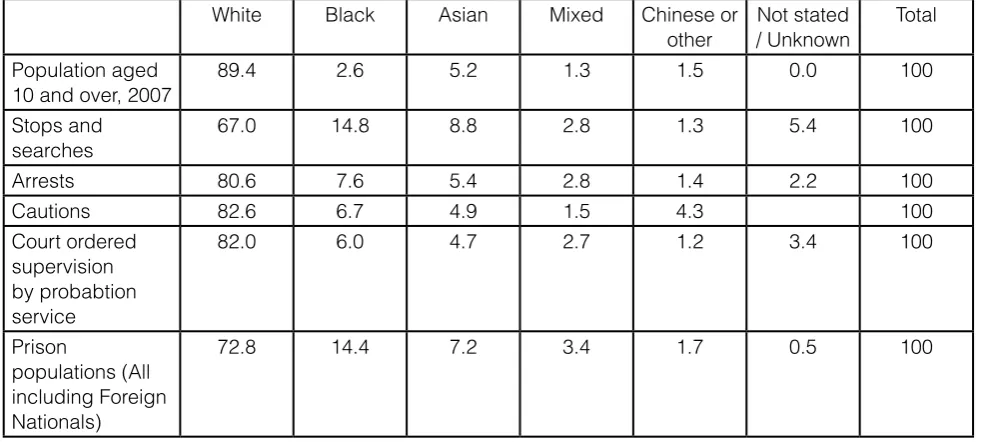
It is undeniable that some black and minority ethnic groups are significantly overrepresented in the criminal justice system and whites are under-represented compared to their numbers in the population (Table 1). It is also frustratingly difficult to establish definitive answers as to why this occurs, as studies over many years have been too distant from, and have been unable to discover, the interpretations and attitudes of police officers and criminal justice officials when deciding who to stop and search, whether to arrest and what sentence to give. Another problem has been that studies have not controlled for socio-demographic
2. Different Forms of Discrimination in the Criminal
Justice System
Colin Webster
[image:2.595.52.543.554.775.2]Leeds Metropolitan University
Table 1. Percentage at different stages of the Criminal Justice System compared with ethnic breakdown of general population, England and Wales, 2008/09
White Black Asian Mixed Chinese or other
Not stated / Unknown
Total
Population aged 10 and over, 2007
89.4 2.6 5.2 1.3 1.5 0.0 100
Stops and searches
67.0 14.8 8.8 2.8 1.3 5.4 100
Arrests 80.6 7.6 5.4 2.8 1.4 2.2 100
Cautions 82.6 6.7 4.9 1.5 4.3 100
Court ordered supervision by probabtion service
82.0 6.0 4.7 2.7 1.2 3.4 100
Prison
populations (All including Foreign Nationals)
72.8 14.4 7.2 3.4 1.7 0.5 100
factors to ensure that proper individual and group comparisons are made when seeking influences on, and outcomes of, practices and decisions.
As Table 1 shows, black and mixed-race people are overrepresented at all stages of the criminal justice process from stop and search to imprisonment, while Asians are overrepresented in stop and search and in prisons and are under-represented at other stages (Ministry of Justice, 2010). There has not been significant change
in these patterns over 30 years, and they are as marked among young people as they are among the adult population (Ministry of Justice, 2010; Phillips and Bowling, 2007). In the recent period mixed race and Asians have newly emerged and grown as overrepresented groups. Another recent concern is the striking growth in stop and searches of black people and Asians compared to whites. Between 2004/5 and 2008/9 the number of white people being stopped and searched increased by around 30 per cent, while the number of black and Asian people being stopped and searched increased by over 70 per cent. (Ministry of Justice, 2010: 10, see Table 2). Contrast this with the relative stability of the large ethnic differences in arrests, although arrests did significantly increase for Asians and continued to be highest for black compared to other groups. Ethnic differences and disproportion in cautioning, prosecutions, sentencing, supervision and custody remained relatively stable over this period for all ethnic groups (Ministry of Justice, 2010).
Disproportion: Disparities
between Offending and
Representation?
Self-report offending studies have consistently shown over many years that white and black rates
and patterns of offending were and remain very similar, although offending rates reported by Asians were substantially lower. Indeed, these sorts of studies in which individuals of different ethnicities report their own offending, tend to suggest that whites offend more than any other group. In other words, the overrepresentation of some groups in the criminal justice system is not explained by differences between these group’s offending rates. Neither is it explained by significant differences in patterns or types of offending between groups, except in relation to robbery where two per cent of black young people reported having ever committed such an offence compared to half a percent of white young people. These relatively small differences between black and other groups in self-reported robbery offences hardly explain the extent of overrepresentation of black young people for this offence found in the youth justice system where black young people made up 27 per cent of robbery offences dealt with by the Youth Justice Service in 2004, but were only 3 per cent of the 10-17 year old population, and whites were severely under-represented.
[image:3.595.54.542.648.776.2]This key issue will be returned to later. Similarly, despite young white males reporting significantly higher drug use than young black males, whites were under-represented for drugs offences whereas the black group was substantially overrepresented in the youth justice system (Feiltzer and Hood, 2004; Flood-Page et al., 2000; Graham and Bowling, 1995; Sharp and Budd, 2005; Webster, 2007). Simply on the basis of this sort of evidence it would seem that a prima facie case can be made that there is different or discriminatory treatment of black and Asian groups by the police and criminal justice system. If studies paid sufficient care in delineating socio-economic status as well as ethnicity then the case would be even clearer.
Table 2. Police stop and searches per 1000 population, by ethnic group, England and Wales, 2007-08 and 2008-2009
2007-08 2008-09
Rate per 1000 Proportionality ratio Rate per 1000 Proportionality ratio
White 16.5 0.76 17.9 0.75
Black 108.5 5.01 135.0 5.65
Asian 33.5 1.54 40.1 1.68
Mixed 42.5 1.96 51.7 2.16
Chinese / other 17.7 0.82 20.2 0.84
Total 21.7 1.00 23.9 1.00
Interpreting the Data:
Justice by Geography,
Ethnicity and Class?
Some problems and issues continue to haunt understandings of discrimination in the criminal justice system. The ethnic categories used confuse race and ethnicity and do not sufficiently capture social and ethnic variation within and between categories. This is a particular problem when significant new migration to the UK is taken into account, considerably complicating Britain’s white and visible minority ethnic makeup. White ethnicity has been ignored, although Mooney and Young (1999) found that foot stops of Irish men in North London were higher than for any other group because the police focus on groups that are disproportionately working class and/or male as well as visible ethnic groups. Waddington et al.’s (2004) study of stop and search in Reading and Slough found that white urban lower class men who were available to be stopped suffered disproportionate stop and search regardless of visible ethnicity.
Ethnic and certain socio-economic and demographic factors increase the risk of
individuals becoming involved in the sorts of crime which may bring them to the attention of the police. The police in turn disproportionately target young males whose profile tends to be of lower class background, living in lone parent families, that have often been in care, lack education and/or are unemployed, who live in urban areas of high crime and social deprivation, who have an active street life and who consequently form a core component of the population available for policing. Once having come to the attention of the police, young people are sucked into a spiral of amplified contact and conflict. Although more likely to be present among British mixed white/Caribbean and British Caribbean compared to the general white British population and other visible minorities, these risks are also present within marginalized white groups (FitzGerald, 2009; McAra and McVie, 2005).
The culturally supported values and beliefs of police officers and criminal justice officials are an important element in explaining their practices towards marginal white, black and minority victims, suspects and offenders. Values and beliefs vary within and between organizations and jurisdictions so that, for example, London seems in some respects quite different to many provincial cities in respect of the policing and court disposals of
minority and marginalized groups (Jefferson et al., 2008; Newburn and Reiner, 2007; Walker, 1988). Local studies controlling for social and economic factors which might explain overrepresentation, have shown that different forms of discrimination by the police and the courts may be closely tied with variation in the social class and ethnic makeup within and between neighbourhoods and jurisdictions. This make-up in turn influences local police and court values and beliefs. Crudely put, some areas suffer discrimination more than others, according to local police and court cultures and the make-up of local populations.
This variation of justice by geography and class can be shown within and across jurisdictions and neighbourhoods. An early study of the court disposal of young males in London, by ethnicity, concluded that since the police tended to deal with people of lower social class, and black people also tend to be of lower social class, it is to be expected that black people are overrepresented in the criminal justice system compared to the general population of London (Walker, 1988).
A study in Leeds of differences in treatment of blacks, Asians and whites at different stages in the criminal justice system attempted to overcome negligence of the influence of class on race found in other studies (Jefferson et al., 2008). They compared stop and search and arrest rates, and arrest outcomes of those of different ethnicity living in the same (small) areas which broadly shared similar social and economic environments. Overall, they found that black males had a higher stop and search and arrest rate than comparable whites and Asians, but whites living in ‘blacker’ areas had a higher stop and search arrest rate than blacks and blacks living in ‘whiter’ areas had higher rates than whites. Consistent with studies since, proportionately more blacks were tried in the Crown Court and were acquitted but sentencing in the magistrates’ courts and Crown Courts did not differ between ethnic groups. Arrest rates were related to areas of residence, disadvantage and deprivation, the transience of the white population and housing tenure. The police had more difficulty operating in black areas and whiter areas were more ‘out of bounds’ to blacks, and ‘being out of place’ seemed more important in Leeds than in London.
a small number of offenders but most often popularly associated with black young people). MVA and Miller (2000), in a study of stops and searches, found higher police deployment in at least one of the areas they studied. The area had predominantly larger black populations but concomitant crime levels at the aggregate level did not appear to justify this greater police attention. We have already seen that black young people are disproportionately present in the Youth Justice System for robbery offences at a level unsupported by their self-reported offending. An alternative way of looking at this is through incidents where the victim could say something about the offender. On this basis, approaching a third of all ‘muggings’ was committed by black offenders and only half by white in 1999 (Clancy et al., 2001: Table 2.3). According to the British Crime Survey (BCS) a third of ‘muggings’ and 43 per cent of police recorded robberies were in London and over half of those arrested for robbery in London were judged by officers to be black (Clancy et al., 2001). This is twice the rate for all police recorded crime and violent offences in London and approaching three times the rate of BSC recorded incidents of ‘mugging’ elsewhere in the country.
This astonishing geographical concentration of robbery in London – according to police records and victims’ reports – requires interpretation and explanation. Of course, close to half the adult black and Asian population live in London but what is of most significance is that in predominantly black areas like Lambeth 86 per cent of suspects are identified as black. To a lesser extent this geographic concentration is repeated in other areas outside London with significant black populations such as Birmingham (64%) and Bristol (58%) city centres. In predominantly white places like Stockport, Preston and Blackpool – according to victim reports and police records – black and Asian suspects are negligible as suspects are overwhelmingly white (Smith, 2003). A number of things might be happening here. First, there are more opportunities for personal robbery in London compared to elsewhere, carried out disproportionately by young black men in predominantly black areas. Second, despite the relative rarity of robbery and its small core of practitioners (even in London; see Hallsworth, 2005), compared to say, assault, vehicle theft or burglary, in which young black men seem underrepresented compared to whites, it generates a good deal of police activity in London compared to other places (judging by police records). Third, this targeting is disproportionate
to the scale of robbery incidents, the numbers of offenders involved, and is concentrated in black areas. Once again, the question arises why this particular offence is not given the same attention in Newcastle as it is in London?
Hood’s (1992) examination of sentencing patterns in Crown Courts in the West Midlands found significant residual racial discrimination in one court but not another, with easily foreseen cumulative consequences of rises in the black prison rate (Phillips and Bowling, 2007). Similarly, Feiltzer and Hood (2004) examining decisions relating to minority ethnic groups at all the various stages of the youth justice process found large differences or discriminatory treatment of minority ethnic young people between eight Youth Offending Team areas. Other studies have shown that black suspects are less likely to admit offences because they are more likely to be arrested
when innocent, or have less faith in the fairness of the police and the courts than white people. A particularly consistent finding of such studies has been that black people and Asians were more likely than white people to be arrested and charged when there was not sufficient evidence to proceed with a prosecution against them (Phillips and Brown, 1998).
Stop and Search: Available
Populations?
for being stopped and searched, rather than any particular selectivity on the part of the police.
These findings were criticized by Bowling and Phillips (2007) arguing that experiences of stop and searches revealed by the self-report (British Crime Survey) and police stop and search data are still the best measures of whether disproportionate and discriminatory treatment by the police is taking place. They concluded from this data that the use of police powers against black people continued to be disproportionate and that this is ‘an indication of unlawful racial discrimination.’ In any case the concept of ‘available populations’ as a criterion against which to compare the rate at which groups are stopped and searched is not a neutral concept but is highly socially determined. The extent to which a social group is available to be stopped and searched in public places at vulnerable times depends on structural factors of unemployment, employment in occupations that involve evening and night work, exclusion from school and homelessness, all of which are known to be associated with ethnic origin (Bowling and Phillips 2007). Those stopped and searched are most likely to be drawn from the population of young people not in education, employment or training, to which we now turn.
Discussion and Policy
Implications: ‘Reform or
“Business as Usual”?’
Figures show that the number of 16- to 24-year olds not in education, employment or training (NEET) was at a record high at the end of 2010. Some 938,000 young people in this age group were ‘Neets’ and this is likely to rise over the next five years (Shepherd, 2011). Research has shown that it is from this group that offenders are most likely drawn and are most likely to be ‘available’ to be stopped and searched by the police. Their core are some of the most marginalised, socially excluded young people who lack trust in the police and accrue a surfeit of ‘risk factors’ associated with severe deprivation and sometimes, criminality. Their members disproportionately belong to white, black and minority ethnic groups from lower socio-economic backgrounds (House of Commons, 2007). The accruing of experiences more likely to lead to antisocial and delinquent behaviour has been intergenerational. We have been here before and policy makers forget this at their peril as the long-term, intergenerational effects and costs on social cohesion and justice are well documented
and very considerable indeed (Ferri et al., 2003; Webster, 2007).
We have seen how police powers to stop and search continue to be a particular area for
concern in regards to discrimination in the criminal justice system. It might be considered whether the ‘hit rate’ (percentage of searches resulting in an arrest) – which is identical at 10 per cent for black and white populations – justifies the sense of discrimination, disaffection and distrust engendered by this tactic, or whether stop and search should be curtailed or disbanded. Police powers of stop and search have been greatly increased through the ‘back door’ of the Terrorism Acts. Despite this enlargement under counter terrorism powers, in 2009/10 of the 101,248 people stopped and searched under these powers, none of them were arrested for terrorism-related offences and only 0.5 per cent was arrested for any offence, compared with a 10 per cent arrest rate for street searches under normal police powers (EHRC, 2010).2
Data collected nationally about race and the criminal justice system needs to refine the ethnic categories used and take more account of the socio-economic backgrounds of those finding themselves stopped, arrested and sentenced so as to capture a wider range of experiences, discretion and discrimination. To take one simple example, while the disproportionate stop rate for Asians has remained the same at twice the rate whites are stopped, this underestimates the number of Muslims stopped as the statistics usually conflate Muslims with ‘Asians’ (Bowling and Phillips, 2007). Alongside these aggregate data more attention needs to be given to local variation of practices across and within neighbourhoods and jurisdictions, and variations within the police and criminal justice agencies. Policing and justice by geography has created a patchwork of inconsistent treatment in which the likelihood of discrimination is greater in some places than others.
partly accounted for by popular local media concerns about serious street crime – especially robbery in London – and the Metropolitan Polices’ disproportionate responsibility for the majority of s44 Terrorism Act searches, which do not require grounds (Ministry of Justice, 2010). The police have been as defensive and implacable as ever in defending their ‘patch’ and ‘organizational ego’ since the Lawrence Inquiry, insisting on their autonomy and consistently resisting demands for greater accountability. Despite Lawrence – and because the best intentioned reforms tend to be overtaken by events – they have maintained and enhanced their powers rather than reforming. Despite very substantial reductions across the range of offending since the early to mid-1990s, any return to disenfranchising and marginalizing another generation of young people, accompanied by concomitant heightening of policing, criminal justice and penal responses, begs the question