• No results found

Practice Patterns of Korean Urologists for Screening and Managing Prostate Cancer according to PSA Level

N/A
N/A
Protected

Academic year: 2020

Share "Practice Patterns of Korean Urologists for Screening and Managing Prostate Cancer according to PSA Level"

Copied!
6
0
0

Loading.... (view fulltext now)

Full text

(1)

Practice Patterns of Korean Urologists for Screening and

Managing Prostate Cancer according to PSA Level

Mun Su Chung,

1

Seung Hwan Lee,

1

Dong Hoon Lee,

1

Se Joong Kim,

2

Choung Soo Kim,

3

Kyu Sung Lee,

4

Jae Il Jung,

5

Sae Woong Kim,

6

Yil Seob Lee,

7

and Byung Ha Chung

1 Departments of Urology, 1Yonsei University College of Medicine, Seoul; 2Ajou University College of Medicine, Suwon;

3Asan Medical Center, Seoul; 4Samsung Medical Center, Seoul; 5Busan Paik Hospital, Busan;

6The Catholic University of Korea, Seoul; 7GSK Inc., Seoul, Korea.

Received: September 30, 2011 Revised: December 1, 2011 Accepted: December 29, 2011

Corresponding author: Dr. Byung Ha Chung, Department of Urology, Gangnam Severance Hospital, Yonsei University College of Medicine, 211 Eonju-ro, Gangnam-gu, Seoul 135-720, Korea.

Tel: 82-2-2019-3474, Fax: 82-2-3462-8887 E-mail: [email protected]

∙ The authors have no financial conflicts of interest.

© Copyright:

Yonsei University College of Medicine 2012

This is an Open Access article distributed under the terms of the Creative Commons Attribution Non-Commercial License (http://creativecommons.org/ licenses/by-nc/3.0) which permits unrestricted non-commercial use, distribution, and reproduction in any medium, provided the original work is properly cited.

Purpose: There are still debates on the benefit of mass screening for prostate can-cer (PCA) by prostate specific antigen (PSA) testing, and on systemized surveil-lance protocols according to PSA level. Furthermore, there is a paucity of literature on current practice patterns according to PSA level in the Korean urologic field. Here, we report the results of a nationwide, multicenter, retrospective chart-review study. Materials and Methods: Overall 2122 Korean men (>40 years old, PSA >2.5 ng/mL) were included in our study (from 122 centers, in 2008). The primary endpoint was to analyze the rate of prostate biopsy according to PSA level. Sec-ondary aims were to analyze the detection rate of PCA, the clinical features of pa-tients, and the status of surveillance for PCA according to PSA level. Results: The rate of prostate biopsy was 7.1%, 26.3%, 54.2%, and 64.3% according to PSA lev-els of 2.5-3.0, 3.0-4.0, 4.0-10.0, and >10.0 ng/mL, respectively, and the PCA de-tection rate was 16.0%, 22.2%, 20.2%, and 59.6%, respectively. At a PSA level >4.0 ng/mL, we found a lower incidence of prostate biopsy in local clinics than in general hospitals (21.6% vs. 66.2%, respectively). A significant proportion (16.6%) of patients exhibited high Gleason scores (≥8) even in the group with low PSA values (2.5-4.0 ng/mL). Conclusion: We believe that the results from this na-tionwide study might provide an important database for the establishment of prac-tical guidelines for the screening and management of PCA in Korean populations.

Key Words: Mass screening, prostate biopsy, prostate specific antigen

INTRODUCTION

Prostate cancer (PCA) is the most common male cancer in Western countries.1,2 In

Korea, it is the fifth most common cancer in men, and its incidence is the most rap-idly increasing among all cancers.3,4 Although the level of serum prostate-specific

antigen (PSA) is considered the most useful currently available tumor marker for prostate cancer,5-7 it clearly has some limitations,6,8,9 including racial differences.10

(2)

surveil-or a histsurveil-ory of prostate surgery and those who had previ-ously been taking a 5 alpha-reductase inhibitor, androgen blocker, or saw palmetto.

PSA assay

Serum PSA was assayed using a chemiluminescence meth-od with commercially available kits that varied among the different institutions (Elecsys®, Roche, Switzerland;

Archi-tect®, Abbott, IL, USA; Immulite®, DPC, Bad Nauheim,

Germany). Regardless of different institutions, all assays measured equimolar total PSA and were then calibrated against the World Health Organization (WHO) buffer-based reference material to ensure the accuracy of the results of any determination of PSA.

Study endpoints and assessments

The primary endpoint of this study was to analyze the rate of prostate biopsy performed by Korean urologists accord-ing to PSA level. Secondary aims were 1) to analyze the detection rate of PCA according to PSA level, 2) to analyze the clinical features (age, comorbidity, familial PCA, etc.) of patients according to PSA level, and 3) to analyze the status of surveillance for PCA according to PSA level. Ad-ditionally, we analyzed the number of biopsy cores.

Statistical analysis

Analysis of prostate biopsy rate according to PSA level and percentage of the patients who had PCA according to PSA level was performed using the chi-square test and Cocharn-Armitage test, respectively. Statistical analysis was per-formed with software SAS (version 9.2). Results were con-sidered significant at p<0.05.

RESULTS

Patient disposition

The 122 centers included 63 general hospitals (1627 men, 76.2%) and 59 local clinics (510 men, 23.8%). The regional distribution of our study population was as follows: 603 (28.4%) in Seoul, 498 (23.5%) in Gyeonggi/Incheon, 478 (22.5%) in Gyeongsang, 281 (13.2%) in Jella and Jeju, 218 (10.3%) in Chungcheong, and 44 (2.1%) in Gangwon areas. From a total of 2137 men, 2122 were included in our study. The main reasons for exclusion were low PSA (<2.5 ng/mL, n=2), young age (<40 years, n=1), and recent history of medication (5-alpha reductase inhibitors, anti-androgen, or lance protocols according to PSA level are still under debate.

In Korean men, the incidence of PCA to date has been quite low compared with that of white men,11-13 and it has

been suggested that the age-specific PSA reference ranges for Korean men might be lower than those for white,14,15

Japanese,10 and Taiwanese men.16 Accordingly, various

re-ports11,14,17 have suggested that the cut-off value of PSA

should be lowered, or age-specific references should be con-sidered in Korean men. As for PSA screening, its benefit is also the subject of ongoing debates in European (ERSPC) and US studies.18,19

Since there is a paucity of literature providing basic infor-mation to establish practical guidelines for Korean men, we performed a nationwide survey of the current strategies used by Korean urologists for surveillance and management of PCA according to PSA level and report the survey results herein. To our knowledge, this is the first nation-wide study including data from general hospitals and local clinics on this issue in Korea.

MATERIALS AND METHODS

    Study design

We conducted a nationwide, multicenter, retrospective study defining the current spectrum of practice patterns used by Korean urologists for the management of patients accord-ing to PSA level (sponsored by GSK Inc., Seoul, Korea). Data were collected by retrospectively reviewing the charts, from 122 referral hospitals (63 general hospitals and 59 lo-cal clinics) in Korea from January 2008 to December 2008. The protocol was approved by the ethics committees of the participating centers. Based on the assumptions that a biop-sy rate would be 40.6%4 (PSA >4.0 ng/mL), that the

num-ber of patients with PSA <4.0 ng/mL would be 3.2 times greater than those with PSA >4.0 ng/mL, and that 30% of patients would not be eligible for inclusion because of the nature of retrospective study, a sample size of at least 2215 subjects was required to obtain a power of 90%, with a type 1 error of 0.05 (for a two-sided test).

Study population

(3)

ANOVA test) (Table 1).

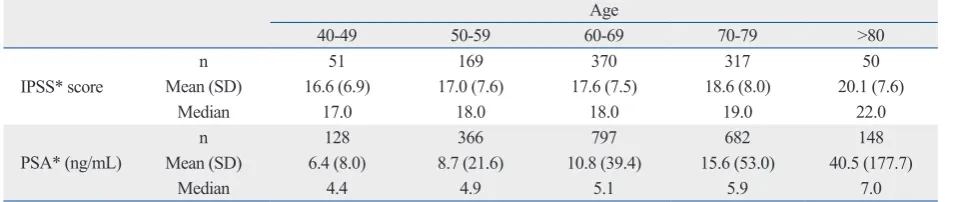
We also analyzed IPSS, and PSA according to age (Table 2). IPSS was found to be higher with increasing age (p= 0.032). PSA also increased with age (p=0.021).

The median interval from PSA detection to prostate biop-sy was 4.5 days. The distribution of GS according to PSA level is shown in Table 3.

Practice patterns

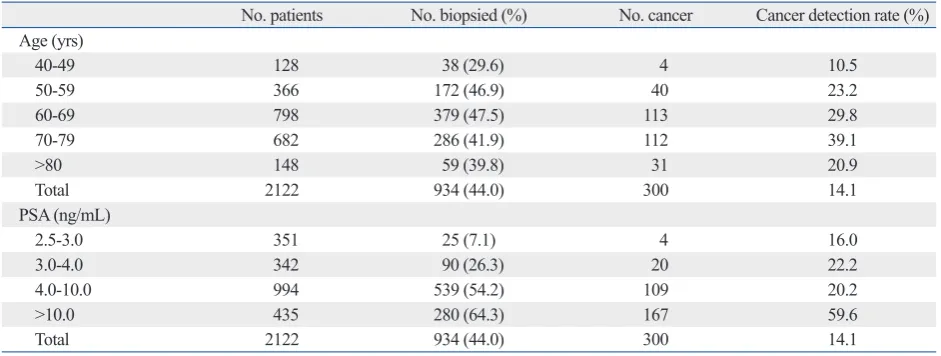
Prostate biopsy rate and PCA detection rate (Table 4)

The rate of prostate biopsy according to PSA level was 7.1%, 26.3%, 54.2%, and 64.3%, for PSA levels of 2.5-3.0 ng/mL, 3.0-4.0 ng/mL, 4.0-10.0 ng/mL, and >10.0 ng/mL, respectively. This correlation was also observed when we analyzed the biopsy rates of each age group according to PSA level. The PCA detection rate was 16.0%, 22.2%, 20.2%, and 59.6%, respectively. When the PCA detection rate was analysed by dividing our patients according to PSA levels of 2.5-3.0 ng/mL, 3.0-10.0 ng/mL, and >10.0 ng/mL, the detection rates of 16.0%, 42.4%, and 59.6%, respective-sopalmetto; n=12).

Patient demographics and characteristics

For the total patients in our study, the mean age was 66.2 years, mean height was 167.4 cm, and mean weight was 67.3 kg. The incidence of current smoking was 27.1%, and 14.0% (n=42) of patients with PCA (n=300) had a positive family history of PCA. Baseline demographics and charac-teristics according to PSA level are shown in Table 1.

For the overall study population, the reasons for PSA test-ing were as follows: suspicion of benign prostatic hyperpla-sia (70.1%), suspicion of PCA (21.8%), regular follow-up (7.2%), acute prostatitis (5.8%), and others (1.6%). Among the study patients, 43.5% (924/2122) had comorbidity disor-ders: hypertension (28.3%), diabetes (10.8%), cardiovascular disease (5.2%), cerebrovascular disease (3.9%), and sexual function disorders (1.2%).

[image:3.595.57.530.385.572.2]

There was no significant difference in prostate volume according to PSA level (p=0.425) (Table 1). There was no significant difference in international prostate symptom scale (IPSS) score according to PSA level (p=0.36 from

Table 1. Patient Demographics and Characteristics

PSA (ng/mL)

2.5-3 (n=351) >3-3.5 (n=170) >3.5-4.0 (n=172) >4 (n=1429) Total (n=2122)

Age (yrs) n 351 170 172 1428 2121

Mean (SD) 64.2 (9.3) 64.0 (9.9) 65.5 (9.7) 67.0 (9.6) 66.2 (9.7)

Height (cm) n 138 80 66 657 941

Mean (SD) 169.0 (5.6) 167.5 (5.8) 167.4 (6.4) 167.0 (5.7) 167.4 (5.8)

Weight (kg) n 141 81 69 679 970

Mean (SD) 70.1 (8.6) 67.1 (8.0) 66.8 (8.1) 66.9 (8.8) 67.3 (8.7)

Smoking n 273 130 129 1145 1677

n (%) 79 (28.9) 48 (36.9) 40 (31.0) 288 (25.2) 455 (27.1)

IPSS score n 149 76 88 645 958

Mean (SD) 17.5 (7.2) 16.6 (7.6) 18.9 (8.1) 18.0 (7.8) 17.9 (7.7)

PV (gm) n 43 29 22 211 305

Mean (SD) 35.2 (11.0) 35.1 (7.9) 36.0 (9.4) 36.7 (11.2) 36.3 (10.7) IPSS, international prostate symptom score; PSA, prostate-specific antigen; PV, prostate volume; SD, standard deviation.

Table 2. IPSS and PSA according to Patient Age

Age

40-49 50-59 60-69 70-79 >80

IPSS* score

n 51 169 370 317 50

Mean (SD) 16.6 (6.9) 17.0 (7.6) 17.6 (7.5) 18.6 (8.0) 20.1 (7.6)

Median 17.0 18.0 18.0 19.0 22.0

PSA* (ng/mL)

n 128 366 797 682 148

Mean (SD) 6.4 (8.0) 8.7 (21.6) 10.8 (39.4) 15.6 (53.0) 40.5 (177.7)

Median 4.4 4.9 5.1 5.9 7.0

[image:3.595.55.534.608.709.2]
(4)

baseline PSA level (54.1%, 60.0%, 64.0%, and 73.8%, for PSA levels of 2.5-3.0 ng/mL, >3.0-3.5 ng/mL, >3.5-4.0 ng/ mL, and >4.0 ng/mL, respectively; p<0.0001 from Co-chran-Armitage trend test). Moreover, the interval from ini-tial testing to follow-up testing of PSA value decreased with increasing baseline PSA level (mean 4.6 months vs. 8.6 months for PSA level of >4.0 ng/mL vs. 2.5-4.0 ng/mL, respectively).

Number of biopsy cores

Among 800 patients who had biopsies, the number of biop-sy cores was 12 in 345 patients (43.1%), 10 in 169 patients (21.1%), 6 in 135 patients (16.8%), and 8 in 82 patients (10.2%).

DISCUSSION

Since Catalona, et al.20 addressed that serum PSA

concentra-tion of 4.0 ng/mL should be used as a general guideline for biopsy in all age groups, there have been numerous studies on the PCA detection rate according to PSA level. Because it is a matter of racial difference, it is truly important to stan-ly, were observed.

Comparison of general hospitals (GH) and local clinics (LC)

We analyzed the biopsy rate according to GH and LC and the incidence of top hospital referral. In our analysis, the bi-opsy rate was higher in GH than in LC for all PSA levels. In particular, the rate of biopsy was much higher in GH (66.2%) than in LC (21.6%) at a PSA level >4.0 ng/mL.

We also compared the detection rate of PCA according to PSA level between GH and LC: for a PSA level of 2.5-4.0 ng/mL, the detection rate of PCA was 15.1% (16/106) in GH and 44.4% (4/9) in LC. However, this result was limited by the small number of patients in LC. For a PSA level >4.0 ng/mL, the detection rate of PCA was similar between GH and LC [34.3% (260/759) in GH and 32.8% (20/61) in LC].

Follow-up

[image:4.595.69.543.82.172.2]

Follow-up of total PSA level was performed in 67.9% (1440/ 2122) of patients, and follow-up of free PSA level was per-formed in 47.7% (132/277). Follow-up of uroflowmetry (Q max) and post-void residual urine was performed in 14.9% (120/808) and 15% (114/760) of patients, respectively. The rate of follow-up for PSA value increased with increasing

Table 3. Distribution of Biopsy Gleason Score according to Serum PSA Level

Biopsy Gleason score

No. patients <6 6 7 ≥8 Total

PSA (ng/mL)

2.5-3.0 0 (0) 2 (50.0) 1 (25.0) 1 (25.0) 4 (100.0)

3.0-4.0 0 (0) 14 (70.0) 3 (15.0) 3 (15.0) 20 (100.0)

>4.0 18 (6.5) 63 (22.8) 96 (34.7) 99 (35.8) 276 (100.0)

Total 18 (6.0) 79 (26.4) 100 (33.3) 103 (34.3) 300 (100.0)

PSA, prostate specific antigen.

Data in parenthesis represents percentage.

Table 4. Prostate Biopsy Rate and Cancer Detection Rate by Age and Serum PSA Level

No. patients No. biopsied (%) No. cancer Cancer detection rate (%) Age (yrs)

40-49 128 38 (29.6) 4 10.5

50-59 366 172 (46.9) 40 23.2

60-69 798 379 (47.5) 113 29.8

70-79 682 286 (41.9) 112 39.1

>80 148 59 (39.8) 31 20.9

Total 2122 934 (44.0) 300 14.1

PSA (ng/mL)

2.5-3.0 351 25 (7.1) 4 16.0

3.0-4.0 342 90 (26.3) 20 22.2

4.0-10.0 994 539 (54.2) 109 20.2

>10.0 435 280 (64.3) 167 59.6

Total 2122 934 (44.0) 300 14.1

[image:4.595.70.541.211.389.2]
(5)

similar to (or silghtly greater than) that of patients with PSA of 4.0-10.0 ng/mL (22.2% vs. 20.2%): the PCA detection rates of 16.0%, 42.4%, and 59.6% were found for PSA lev-els of 2.5-3.0 ng/mL, 3.0-10.0 ng/mL, >10.0 ng/mL, respec-tively. For GS, 34.4% (103/300) (Table 3) of the cancers were GS 8 to 10 in the biopsy, which was significantly higher proportion than that of western countries.4,23-26 In our

study, a significant proportion (16.6%) of the patients had PCA with GS >8 even at the level of PSA <4 ng/mL. There-fore, these findings on the detection rates and GS distribu-tion in Korean men are in good agreement with the previ-ous reports,11,14,17 emphasizing the need for lowering the

cut-off value of PSA in Korean men.

The main concern of this nationwide study was to show the biopsy incidence and practice patterns, including PSA follow-up according to PSA level, in current urologic field in Korea. Considering current inconclusiveness on this is-sue (including the role of PSA screening), we believe that our present results, including the survey result on the biop-sy incidence by Korean urologists, detection rate of PCA, and GS distribution according to PSA level, can be an im-portant database for Asian urologists, as well as Korean.

Our study is limited by the fact that we evaluated the rate of prostate biopsy by dividing only PSA level and digital rectal examination finding was not considered. This is a limitation of this retrospective, chart-reviewing study. An-other limitation is that some variations in the PSA value might have occurred: despite the narrowing in differences among PSA assays since the introduction of the WHO 96/670 reference preparation, interchangeability of PSA values obtained by commercial PSA assays remains inade-quate.27

In conclusion, we believe that the results from this nation-wide study might provide an important database for the es-tablishment of practical guidelines for the screening and management of PCA in Korean populations.

ACKNOWLEDGEMENTS

This study was sponsored by GSK Inc., Korea.

REFERENCES

1. Parker SL, Tong T, Bolden S, Wingo PA. Cancer statistics, 1997. CA Cancer J Clin 1997;47:5-27.

dardize prostate biopsy according to PSA level in a country. Moreover, considering inconclusiveness on the benefit of screening for PCA by PSA testing, the database including the practice pattern of urologists of the country should be estabilished basically.

Accordingly, some authors21,22 reported their survey

re-sults on the practice patterns of urologists regarding pros-tate biopsy in their own country. In 2008, through a nation-wide questionnaire-based study, Burden, et al.21 found that

there was a widespread variation in the application of PSA cut-off values among urologists in the United Kingdom. Leippold, et al.22 conducted a nationwide survey of all

urol-ogists in Switzerland to investigate indications, patient preparation and technique with regard to prostate biopsy, and found that 84% of respondents used a serum PSA level of 4 ng/mL as a cut-off value.

The present study was a nationwide, multicenter, retro-spective chart-review study of patients with serum PSA ≥2.5 ng/mL who visited urologists in Korea. The aim was to evaluate the current spectrum of practice patterns used by Korean urologists for the management of patients ac-cording to PSA level and to identify the clinicopathological features of the patients. In Korean urologic field, it has been well-known that the age-specific PSA reference ranges for Korean men might be lower than those for white,14,15

Japa-nese,10 and Taiwanese16 men, and the cut-off value of PSA

should be lowered.11,14,17 Nevertherless, there has so far

been no report showing the current data on practice patterns of Korean urologists according to PSA level. In this respect, we think that this study could carry a significant meaning.

In our survey, the rate of prostate biopsy according to PSA level was 7.1%, 26.3%, 54.2%, and 64.3%, for PSA levels of 2.5-3.0 ng/mL, 3.0-4.0 ng/mL, 4.0-10.0 ng/mL, and >10.0 ng/mL, respectively: the proportion of patients who under-went prostate biopsy at the PSA level below 4.0 ng/mL was 16.5% (115/693). This finding might suggest that there are yet not many Korean urologists who perform prostate biop-sy at the level of PSA <4.0 ng/mL, even though it is well known that the cut-off value of PSA should be lowered in Korean men. When we compared the incidence of prostate biopsy according to the type of center (GH or LC), the rate of biopsy was much higher in GH (66.2%) than in LC (21.6%) at PSA levels >4.0 ng/mL, possibly suggesting the need for establishment of patient referral system from LC to GH in the Korean urologic field.

(6)

Panser LA, et al. Serum prostate-specific antigen in a community-based population of healthy men. Establishment of age-specific reference ranges. JAMA 1993;270:860-4.

16. Kao CH. Age-related free PSA, total PSA and free PSA/total PSA ratios: establishment of reference ranges in Chinese males. Anti-cancer Res 1997;17:1361-5.

17. Lee TK, Chung TG, Kim CS. Age-specific reference ranges for prostate specific antigen from a health center in Korea. Korean J Urol 1999;40:583-8.

18. Schröder FH, Hugosson J, Roobol MJ, Tammela TL, Ciatto S, Nelen V, et al. Screening and prostate-cancer mortality in a ran-domized European study. N Engl J Med 2009;360:1320-8. 19. Andriole GL, Crawford ED, Grubb RL 3rd, Buys SS, Chia D,

Church TR, et al. Mortality results from a randomized prostate-cancer screening trial. N Engl J Med 2009;360:1310-9.

20. Catalona WJ, Hudson MA, Scardino PT, Richie JP, Ahmann FR, Flanigan RC, et al. Selection of optimal prostate specific antigen cutoffs for early detection of prostate cancer: receiver operating characteristic curves. J Urol 1994;152(6 Pt 1):2037-42.

21. Burden HP, Davis CR, Tate S, Persad R, Holmes CH, Whittington K. The trends in prostate specific antigen usage amongst United Kingdom urologists--a questionnaire based study. BMC Urol 2008;8:17.

22. Leippold T, Preusser S, Engeler D, Inhelder F, Schmid HP. Pros-tate biopsy in Switzerland: a representative survey on how Swiss urologists do it. Scand J Urol Nephrol 2008;42:18-23.

23. Song C, Ro JY, Lee MS, Hong SJ, Chung BH, Choi HY, et al. Prostate cancer in Korean men exhibits poor differentiation and is adversely related to prognosis after radical prostatectomy. Urology 2006;68:820-4.

24. Egawa S, Suyama K, Arai Y, Tsukayama C, Matsumoto K, Ku-wao S, et al. Treatment outcome by risk group after radical prosta-tectomy in Japanese men. Int J Urol 2001;8:295-300.

25. Hsu YS, Wang JS, Wu TT. E-cadherin expression in prostate ade-nocarcinomas in Chinese and its pathological correlates. Urol Int 2004;73:36-40.

26. Freedland SJ, Mangold LA, Walsh PC, Partin AW. The prostatic specific antigen era is alive and well: prostatic specific antigen and biochemical progression following radical prostatectomy. J Urol 2005;174(4 Pt 1):1276-81.

27. Stephan C, Klaas M, Müller C, Schnorr D, Loening SA, Jung K. Interchangeability of measurements of total and free prostate-spe-cific antigen in serum with 5 frequently used assay combinations: an update. Clin Chem 2006;52:59-64.

2. Brawley OW. Prostate carcinoma incidence and patient mortality: the effects of screening and early detection. Cancer 1997; 80:1857-63.

3. Jung KW, Park S, Kong HJ, Won YJ, Boo YK, Shin HR, et al. Cancer statistics in Korea: incidence, mortality and survival in 2006-2007. J Korean Med Sci 2010;25:1113-21.

4. Song C, Ahn H, Lee MS, Park J, Kwon TG, Kim HJ, et al. Mass screening for prostate cancer in Korea: a population based study. J Urol 2008;180:1949-52.

5. Wang MC, Valenzuela LA, Murphy GP, Chu TM. Purification of a human prostate specific antigen. Invest Urol 1979;17:159-63. 6. Oesterling JE. Prostate specific antigen: a critical assessment of

the most useful tumor marker for adenocarcinoma of the prostate. J Urol 1991;145:907-23.

7. Partin AW, Oesterling JE. The clinical usefulness of prostate spe-cific antigen: update 1994. J Urol 1994;152(5 Pt 1):1358-68. 8. Glenski WJ, Malek RS, Myrtle JF, Oesterling JE. Sustained,

sub-stantially increased concentration of prostate-specific antigen in the absence of prostatic malignant disease: an unusual clinical sce-nario. Mayo Clin Proc 1992;67:249-52.

9. Hudson MA, Bahnson RR, Catalona WJ. Clinical use of prostate specific antigen in patients with prostate cancer. J Urol 1989;142: 1011-7.

10. Oesterling JE, Kumamoto Y, Tsukamoto T, Girman CJ, Guess HA, Masumori N, et al. Serum prostate-specific antigen in a com-munity-based population of healthy Japanese men: lower values than for similarly aged white men. Br J Urol 1995;75:347-53. 11. Choi YD, Kang DR, Nam CM, Kim YS, Cho SY, Kim SJ, et al.

Age-specific prostate-specific antigen reference ranges in Korean men. Urology 2007;70:1113-6.

12. Seo HK, Chung MK, Ryu SB, Lee KH; Korean Urological Onco-logic Society Prostate Cancer Study Group. Detection rate of prostate cancer according to prostate-specific antigen and digital rectal examination in Korean men: a nationwide multicenter study. Urology 2007;70:1109-12.

13. Chung JS, Choi HY, Song HR, Byun SS, Seo SI, Song C, et al. Nomogram to predict insignificant prostate cancer at radical pros-tatectomy in Korean men: a multi-center study. Yonsei Med J 2011;52:74-80.

14. Choi YD, Hong SJ, Rha KH, Kim BH, Cha KB, Song JS, et al. Age-specific reference ranges for serum prostate-specific antigen: community-based survey in namhae region. Korean J Urol 2001; 42:834-9.

Figure

Table 1.  Patient Demographics and Characteristics
Table 3. Distribution of Biopsy Gleason Score according to Serum PSA Level

References

Related documents