THE DEMONSTRABLE LINK BETWEEN HUMAN RESOURCE
PRACTICES AND ORGANISATIONAL PERFORMANCE
Jared Mark Ochieno Matabi
Phd Student at Pan Africa Christian University, Nairobi
ABSTRACT
Globalisation is generating immense organisations’ competitive environment. To grow and
survive in such environment, organisations are obliged to perform. Performance is one of the
major goal for organisation, which many human resource management scholars are trying to
demonstrate the link between HRM and organisational performance. There are studies that
affirm the conviction and those that are doubtful of the demonstrable link between HRM and
organisational performance. There is however, a continuous need to improve theoretical and
analytical frameworks of HRM, performance and the link between HRM and organisational
performance. This conceptual paper, theoretically shows HR practices that define HRM; levels
of performance outcomes that makes the link between HRM and performance more evident; and,
comparison of linear causal models through which HR practices ultimately impact
organisational performance. This paper synthesises key models that illustrate the link between
HR practices and organisational performance. While, drawing from various theories and
(linear) models, this paper established so. However, there are continuous arguments over the
number of HRM mediating variables and its content to show a clear link between HR practices
and organisational performance. This challenge notwithstanding, the literature review opens an
opportunity to develop a (cyclical) model, which is inclusive of common variables that
International Research Journal of Human Resources and Social Sciences
ISSN(O): (2349-4085) ISSN(P): (2394-4218) Impact Factor- 5.414, Volume 5, Issue 01, January 2018 Website- www.aarf.asia, Email : [email protected] , [email protected]
acknowledges the core significance of employee abilities, motivation and opportunity to
participate; in the wake of global and rapidly changing environment that demands organisations
to be competitive. Thus, the need for future research.
Keywords: HRM, HR practices, organisational performance, demonstrable link
1.1 Introduction
In the midst of globalisation and rapid technological changes, organisations must be competitive
and perform. Human resources and their management are viewed critical in the accomplishment
of organisation‟s sustainable competitive advantage. Human resource management (HRM) is
emphasized in the face of globalization (Smale, et al., 2012; Othman, 2009; Miles, 2008; Simón
& Allard, 2008). There conflicting study findings affirming and negating the link between HRM
and performance (Edgar & Geare, 2009; Paauwe, 2009). If HRM influences performance, then
what is the demonstrable link between the two constructs?
According to Savaneviciene and Stankeviciute (2012), there is still little understanding of
the instruments through which human resources (HR) practices influence organisational
effectiveness. The remaining gap of the linkage between HRM and performance linkage is what
is commonly referred to as the “black box” (Boselie, et al., 2005). To unravel this mystery, there
are theories and models that attempt to link HRM and performance. Specifically, all the models
are based on organisational outcomes‟ categorisation by Dyer and Reeves‟ (1995, as cited in
Paauwe & Boselie 2005). The HRM-performance advocates have discreetly or openly treated the “black box” as a linear causal process, but differing on number and content of the smaller „boxes‟.
This paper highlights the general trends of the models of the linkage between HRM and
performance, by considering the theoretical and analytical frameworks of HRM, performance,
and linkage between the two constructs.
1.2 Constructs of HRM and performance
In today‟s rapidly changing and highly competitive environment, HR is the critical factor –
potential to learn, grow, and contribute – for organisational success (Lee, et al., 2010). The
debate on what adds value to the organisation – the HR or their management (Kazlauskaite &
approach, this argument has been shut down due to the „strategic‟ and „humanistic‟ nature of
HRM to contribute to a range of positive organisational outcomes.
But still, there is consensus on the nature of HRM (Paauwe & Boselie, 2005). For
instance, first there is no a clear meaning of HR practices and their number (Boselie, et al., 2005)
- only four HR practices are commonly identifiable, including to identification and recruitment
of performing staff, provision of staff skills and confidence to work effectively, monitoring of
staff progress towards the required performance targets, and rewarding of staff well for meeting
or exceeding performance target (Paauwe & Boselie, 2005). Secondly, there is no clear
distinction between intended HR practices (those designed on a strategic level), actual HR
practices (those implemented by the line manager) and perceived HR practices (those perceived
by the employees) (Wright & Nishii, 2006). This only depend on an approach one follows – the
universalistic (there are “best practices” with positive impact on performance irrespective of
context), the contingency (provides certain practices suitable under certain conditions for
effectiveness), or the configurational (the combination of HRM practices is the power which
drives performance).
According to Savaneviciene and Stankeviciute (2012), this leads to other definitions of
HRM such as “strategic HRM”, “high involvement management”, “high commitment management” or “high performance work systems” (p.185). In this regard, it can be
acknowledged that there is link between HRM and performance, considering the common
practice of HRM explored.
As we observe the link between HRM and performance, some ambiguities (“the black box”) are notable while clarifying and defining the performance measures (Colakoglu, et al.,
2006). For the purpose of this paper, measures of HRM effectiveness are posited in four levels of
outcomes by Dyer and Reeves‟ (1995, as cited in Boselie & van der Wiele, 2002; Wright &
Haggerty, 2005; Paauwe & Boselie 2005) – as per proximal outcomes to HR practices and distal
outcome to proximal outcomes, as illustrated in the Figure 1.1 below.
According to Paauwe (2009) the far are the performance indicators from proximity of
HRM practices, greater the effect on organisation‟s competitiveness. But just assuming that there
is a link between HRM and performance without theoretical basis, the analysis will be void of
It is therefore important to emphasise that the establishment of the link between HRM
and performance is related with two arguments by Guest (1997, as cited in Savaneviciene &
Stankeviciute, 2012) – theory of HRM and a theory on performance.
1.3 Theories of HRM and performance
There are three commonly used theoretical perspectives to establish the scientific rationale of the
link between HRM and performance. These include: contingency theory, resource-based view,
and the, “Abilities, Motivation, Opportunities” (AMO) framework (Boselie, et al., 2005).
Contingency theory holds that HRM strategy would be more effective only when
appropriately integrated with a specific organisational and environmental context (Chang &
Huang, 2005) to achieve better performance outcomes in comparison to organisations that do not
(Liao, 2005; Huang, 2001). The competitive strategies available to organisation and an
appropriate HRM strategy for each competitive strategy (Becker & Huselid, 2006), include:
prospector business strategy with utilizer HRM strategy, defender business strategy with
accumulator HRM strategy, and analyser business strategy with facilitator HRM strategy (Wang,
& Shyu, 2008). The match imply that limited number of competitive strategies indicates limited
number of HRM strategies (Becker & Huselid, 2006).
Resource based view holds that organisation‟s competitive advantage comes from the
internal resources that the organisation possesses. Organisational performance can be attributed HR related
outcomes
(affective,
cognitive and
behaviour)
Organisation
al outcomes
(productivity,
quality,
efficiencies)
Financial
outcomes
(profit,
sales,
ROI)
Market
based
outcomes
(market
value) HR
practices
Performance outcomes
B
l
a
c
k
-B
o
x
to unique (valuable, rare, inimitable and without substitutes) resources and capabilities rather
than the organisation‟s structural characteristics (Guthrie, et al., 2004).
AMO framework holds that the organisational interests are best served by an HRM
system that attends to employees' interests such as skill requirements, motivations and the quality
of their job (Harney & Jordan, 2008). Employee perform well, when (Boselie, 2010): 1) they can
do the job because they possess the necessary knowledge and skills - they are able to do so – (A
= Abilities); 2) they will do the job because they want to and are adequately incentivised - they
have the motivation to do so - (M = motivation); and, 3) their work environment provides the
necessary support and avenues for expression - (O = opportunity to participate).
Overlapping each other, contingency theory and resource-based view, focus on the HRM
at the organisational level and are mainly interested in its performance effects from a business
perspective. They reflect the central assumptions behind the conceptualisation of what HRM is
and does: namely, that it responds accurately and effectively to the organisation‟s environment
and complements other organisational systems (contingency theory) and that it delivers added value through the strategic development of the organisation‟s internal resources (employee) (the
resource-based view) (Boselie, et al., 2005). On the other hand, the AMO framework represents
an established tradition, having its foundations in industrial/organisational psychology, and in
comparison to the other two theoretical perspective, it is the most common (Paauwe, 2009), as it
is also treated as an extension of the resource-based view (Paauwe & Boselie, 2005).
The disclosure of the significance of the three theoretical approaches lead to the analysis
of demonstrable link between HRM and organisational performance.
2.0. The demonstrable link between HRM practices and organisational performance 2.1 Description of HR practices and organisational performance link models
There are several model holding the conviction concerning the demonstrable link between HR
practices and organisational performance. Based on the literature review, models of Becker,
Huselid, Pickus and Spratt (1997); Guest (1997); Purcell et al. (2003); Wright and Nishii (2006);
Armstrong (2006) and Boxall and Purcell (2008) are repeatedly used in theoretical and empirical
researches. These models are the focus of this paper, and later making comparison of models
2.1.1 Becker et al. (1997) model
The model holds that HRM system is linked to organisation business and strategic initiatives for
organisational performance. With the proper alignment of HRM system, the HRM practices have
a direct impact on employee skills, employee motivation and job design and structures, which
consequently influence employee‟s creativity, productivity and discretionary behaviour. These
variables, in turn, result in operational performance, which relates to profitability and growth,
ultimately determining firm market value (Figure 2.1).
2.1.2 Guest (1997) model
The model holds that improved performance is achieved through the people in the organisation.
The model is grounded on the expectancy theory as a possible basis for developing a more
coherent rationale about the link between HRM and performance. The theory proposes that
performance at individual level depends on high motivation, possession of the necessary skills
and abilities and an appropriate role and understanding of that role. This conclusion is a cause to
choose such HRM practices that lead to high employee commitment, high quality staff and
highly flexible staff to enhance performance (Figure 2.2).
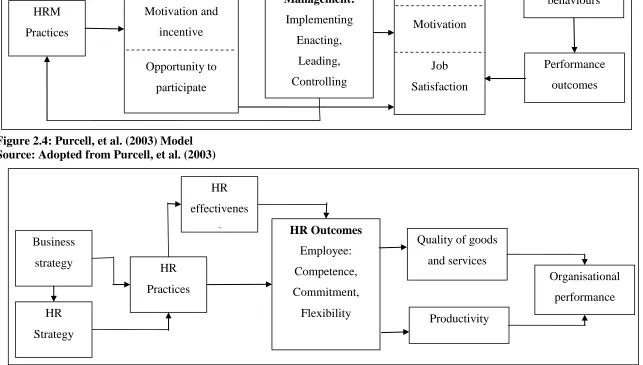
2.1.3 Purcell, et al., (2003) model
This is a people-performance model, which advances the concept of discretionary behaviour by
suggesting that virtually all employee have the capacity to engage in discretionary behaviour;
and that line managers play a critical role of having discretion in the way that they apply HRM
and the way they behave towards employee (Figure 2.4).
2.1.4 Armstrong (2006) model
This model holds that performance of an organisation is a function of people, process and
technology. For effective interaction of people with technology and process, the people in the
organisation have to be competent enough, with the required knowledge, skill and abilities.
Competence of the individual is an important factor that decides operational effectiveness in
terms of providing quality products and services within a short time. HRM practices such as
selection, training, work environment and performance appraisal may enhance the competence of
2.1.5 Wright and Nishii (2006) model
This hold that relationship between HRM and performance occur at multiple levels of analysis.
The model includes “intended” HR practices, “actual” HR practices, “perceived” HR practices,
employee reactions and performance (Figure 2.5).
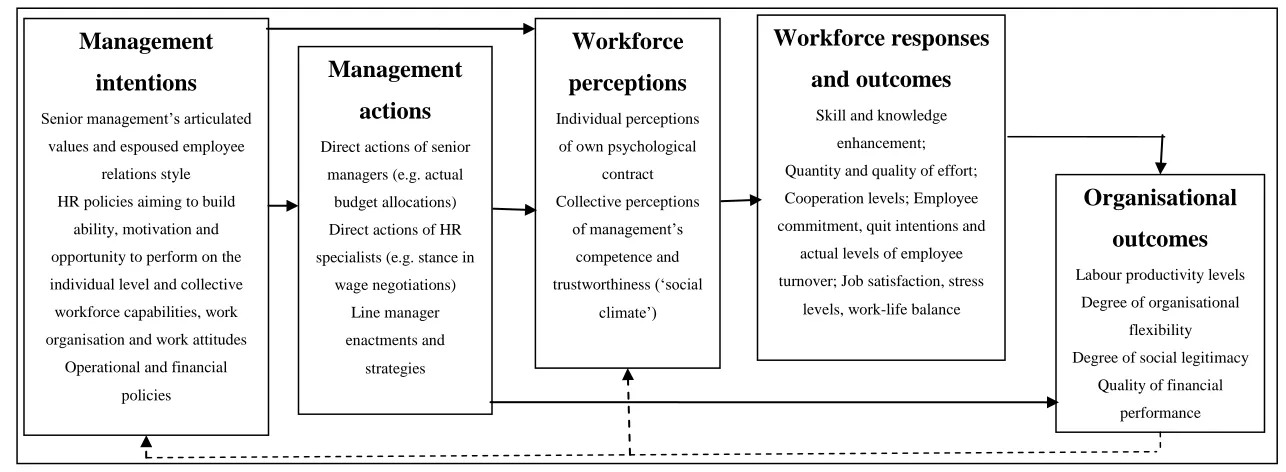
2.1.6 Boxall and Purcell (2008) model
This model is based on Wright and Nishii (2004) model and ideas of Purcell & Kinnie (2007)
and involves intentions, actions, perceptions and responses and hereby strives to integrate the
individual and collective levels of analysis (Figure 2.6).
Market value Profit and growth Improved operating performance Productivity Creativity Discretionary effort Employee skills Employee motivation Job design and work
structures Design of HRM system Business and strategic initiatives Financial outcomes: Profit ROI Performance outcomes: High: Productivity, Quality, & Innovation Low: Absence, Labour turnover, Conflict, & Customer complaints Behaviour outcomes: Effort/ motivation Co-operation Involvement Organisational citizenship HRM outcomes: Commitment Quality Flexibility HRM practice Selection, Training, Appraisal, Rewards, Job design, Involvement, Status and Security HRM Strategy Differentiation (innovation) Focus (quality) Cost (cost
Figure 2.1: Becker, et al., (1997) model Source: Adopted from Becker, et. al., (1997)
2.2 Analysis of HR practices and organisational performance link models
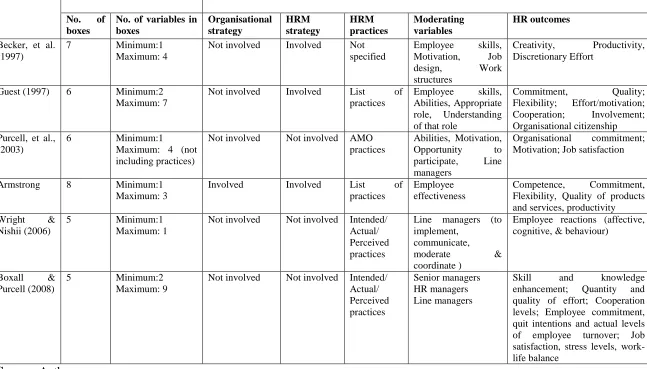
The six models offer broad awareness on the opening of the “black box”, on demonstrating the
link between HRM and performance. However it should be acknowledged that the mentioned
models differ, quantitatively and qualitatively, as illustrated in Table 2.1. Key questions that
arise are the: number of small boxes to be included on the “black box” and the number of variable to be included in each of the small box, and “the most important intermediate outcomes”
(Becker and Huselid, 2006).
As a result of the comparison of the six HRM and performance models, the following
findings can be drawn. First, although all authors have implicitly or explicitly treated the “black box” as a linear causal process, different models incorporates different number of boxes and the
content of that boxes is heterogeneous. Secondly, in spite the accurate assessment of linkage
between HRM and organisational performance requires reliable and valid assessment of HR
practices (Gardner, et al, 2001, cited in Savaneviciene & Stankeviciute, 2012), different models
comprise various HRM practices, admitting that HRM deals with a wide range of issues
(Kersiene & Savaneviciene, 2009), as illustrated in Table 2.1. Thirdly, employees abilities,
motivation and opportunity to participate (AMO framework) and role of the line manager to “bring policies to life” (Purcell, et al., 2003) are two vital variables by which HR practices influence organisational outcomes. Fourthly, employees‟ reactions are central to all models,
because causal link is flowing from practices to performance via responses of employees. Fifth,
human resource related outcomes impact more distal performance outcomes: only when HR
Performance
outcomes
Front line Management:
Implementing
Enacting,
Leading,
Controlling Ability and
Skills
Motivation and
incentive
Opportunity to
participate HRM
Practices
Organisational
Commitment
Motivation
Job
Satisfaction
Discretionary
[image:9.792.87.718.42.236.2]behaviours
Figure 2.4: Purcell, et al. (2003) Model Source: Adopted from Purcell, et al. (2003)
Organisational
performance
HR Outcomes
Employee:
Competence,
Commitment,
Flexibility Business
strategy
Quality of goods
and services HR
Practices
HR
Strategy
HR
effectivenes
s
[image:9.792.88.731.109.474.2]Productivity
Psychological contract
Organisational
performance
Psychological contract
Employee reaction
(affective,cognitive, behaviour)) Perceived HR practices Actual HR practices Intended HR practices
[image:10.792.66.727.50.196.2] [image:10.792.75.718.272.508.2]Implementation Communication Moderation Coordination
Figure 2.5: Wright & Nishii (2006) model Source: Adopted from Wright & Nishii (2006)
Organisational outcomes
Labour productivity levels Degree of organisational
flexibility Degree of social legitimacy
Quality of financial performance
Workforce responses and outcomes
Skill and knowledge enhancement; Quantity and quality of effort; Cooperation levels; Employee commitment, quit intentions and
actual levels of employee turnover; Job satisfaction, stress
levels, work-life balance
Workforce perceptions
Individual perceptions of own psychological
contract Collective perceptions of management‟s competence and trustworthiness („social climate‟) Management actions
Direct actions of senior managers (e.g. actual
budget allocations) Direct actions of HR specialists (e.g. stance in
wage negotiations) Line manager enactments and strategies Management intentions
Senior management‟s articulated values and espoused employee
relations style HR policies aiming to build
ability, motivation and opportunity to perform on the individual level and collective workforce capabilities, work organisation and work attitudes
Table 2.1: Comparison of HRM and performance linkage models
Model Quantitative characteristics Qualitative characteristics
No. of boxes
No. of variables in boxes Organisational strategy HRM strategy HRM practices Moderating variables HR outcomes
Becker, et al. (1997)
7 Minimum:1
Maximum: 4
Not involved Involved Not specified
Employee skills, Motivation, Job design, Work structures
Creativity, Productivity, Discretionary Effort
Guest (1997) 6 Minimum:2 Maximum: 7
Not involved Involved List of practices
Employee skills, Abilities, Appropriate role, Understanding of that role
Commitment, Quality; Flexibility; Effort/motivation; Cooperation; Involvement; Organisational citizenship Purcell, et al.,
(2003)
6 Minimum:1
Maximum: 4 (not including practices)
Not involved Not involved AMO practices
Abilities, Motivation, Opportunity to participate, Line managers
Organisational commitment; Motivation; Job satisfaction
Armstrong 8 Minimum:1 Maximum: 3
Involved Involved List of practices
Employee effectiveness
Competence, Commitment, Flexibility, Quality of products and services, productivity Wright &
Nishii (2006)
5 Minimum:1
Maximum: 1
Not involved Not involved Intended/ Actual/ Perceived practices
Line managers (to implement,
communicate, moderate & coordinate )
Employee reactions (affective, cognitive, & behaviour)
Boxall & Purcell (2008)
5 Minimum:2
Maximum: 9
Not involved Not involved Intended/ Actual/ Perceived practices Senior managers HR managers Line managers
Skill and knowledge enhancement; Quantity and quality of effort; Cooperation levels; Employee commitment, quit intentions and actual levels of employee turnover; Job satisfaction, stress levels, work-life balance
3.0 Conclusions
The objective of this paper was to find out if there is demonstrable link between HR practices
and organisational performance. This conceptual paper drawing from various theories and
models, established so. HRM practices affect organisational performance through their effect on
employee development and behaviours. These practices determine the type of employees who
are selected, the skills and motivation of the employees, and the opportunities and incentives
they have to design new and better ways of doing their jobs (Moideenkutty, et al., 2011).
Moreover, a study by Al-Kaha and his colleagues (2011) found that, HR practices are
positively related to organisational performance. They concluded that the most important effect
of human resource policy on organisational performance is the employees‟ participation in
decision making, however, this policy is not widely implemented because cultural attitude that discourages employees‟ participation in decision making or because of the nature of certain jobs
that seem to be critical, risky, and systematic.
According to Akdere (2009, cited in Ibrahim & Zulkafli, 2016) HR practices focused on
quality management was directly related to multiple dimensions of organisational performance
outcomes (i.e., intangible – employee satisfaction and customer satisfaction – and tangible –
profit). Knowledge management and strategic management were found to be positively related to
the financial performance of firms implementing quality management. Process management is
found to be negatively related to employee satisfaction. General HR practices were positively
related to both employee and customer satisfaction. Employee focus of the firms is also
positively related to employee satisfaction. Employee satisfaction is also related to both customer
satisfaction and financial performance while customer satisfaction is found to be positively
related to employee satisfaction.
However, there is still continuous arguments over the number of mediating variables and its
content for a clearly demonstrable link between HR practices and organisational performance
(Becker & Huselid, 2006; Gardner, 2003). This examination, therefore, still remain the most
demanding theoretical and empirical challenge in the HRM literature.
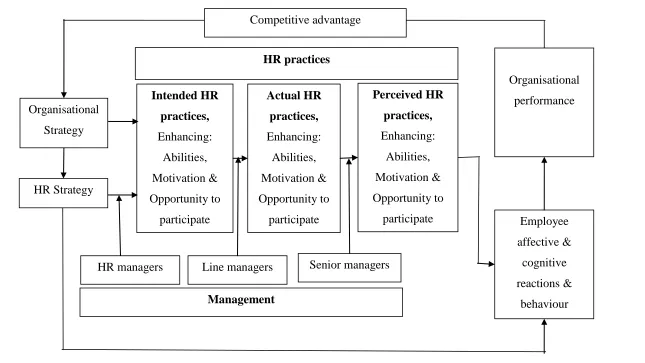
This challenge notwithstanding, the literature review opens an opportunity to develop a
(cyclical not linear) model that is inclusive of common variables that acknowledges the core
significance of employee abilities, motivation and opportunity to participate, and senior, HR and
line managers; in today‟s wake of global and rapidly changing environment that demands
the link between HR practices and organisational performance among different types of
Intended HR practices,
Enhancing:
Abilities,
Motivation &
Opportunity to
participate
Actual HR practices,
Enhancing:
Abilities,
Motivation &
Opportunity to
participate
Perceived HR practices,
Enhancing:
Abilities,
Motivation &
Opportunity to
participate HR Strategy
Organisational
Strategy
Employee
affective &
cognitive
reactions &
behaviour Organisational
performance
HR practices
HR managers Line managers Senior managers
Management
[image:14.792.91.736.48.411.2]Competitive advantage
References
Akdere, M. (2009). A multi-level examination of quality-focused human resource practices and firm performance: evidence from the US healthcare industry. The International Journal of Human Resource Management, 20, 9, 1945–1964.
Alkalha, Z.S., Al-Zu'bi, Z.M.F., Al-Dmour, H., Alshurideh, M., & Masa'deh, R.M.T. (2012). Investigating the Effects of Human Resource Policies on Organisational Performance: An Empirical Study on Commercial Banks Operating in Jordan. European Journal of Economics, Finance and Administrative Sciences, 51, 45-67.
Armstrong, M., (2009). Armstrong’s hand book of human resource management practice (11th ed.). London and Philadelphia. Kogan Page.
Becker, B. E., & Huselid, M. A. (2006). Strategic human resource management: Where do we go from here? Journal of Management, 32, 898-925.
Boselie, P., (2010). High performance work practices in the health care sector: a Dutch case study. International Journal of Manpower, 31(1), 42-58.
Boselie, P., Dietz, G., & Boon, C. (2005). Commonalities and contradictions in HRM and performance research. Human Resource Management Journal, 15(3), 67-94.
Boselie, P., & Van der Wiele, T. (2002). High performance work systems: “Research on
research” and the stability of factors over time. Erasmus Research Institute of Management (ERIM), Erasmus University Rotterdam
Chang, W.J. A., & Huang, A. (2005). Relationship between strategic human resources
management and firm performance. A contingency perspective. International Journal of Manpower, 26(5) 434-449.
Colakoglu, S., Lepak, D. P., & Hong, Y. (2006). Measuring HRM effectiveness: Considering multiple stakeholders in a global context. Human Resource Management Review, 16, 209-218.
Edgar, F., & Geare, A. (2009). Inside the “black box” and “HRM”. International Journal of Manpower, 30(3), 220-236.
Gardner, T. M., Moynihan, L. M., Park, H. J., & Wright, P. M. (2001). Beginning to unlock the black box in the HR firm performance relationship: The impact of HR practices on employee attitudes and employee outcomes. CARHS Working Paper Series, 06, 1-43. Guest, D. E. (2011). Human resource management and performance: still searching for some
answers. Human Resource Management Journal, 21(1), 3-13.
Guthrie, J. P., Datta, D. K., & Wright, P. M. (2004). Peeling back the onion competitive
advantage through people: Test of a causal model. CARHS Working Paper Series, 09, 1- 32.
Harney, B., & Jordan, C. (2008). Unlocking the black box: line managers and HRM
performance in a call centre context. International Journal of Productivity and Performance Management, 57(4), 275-296.
Huang, T.C., (2001). The effects of linkages between business and human resource management strategies. Personnel Review, 30 (2), 132-151.
Ibrahim, H., & Zulkafli, A. (2016). Corporate governance, HRM practices and organisational performance. Socio-Economic Problems and the State. 14 (1), 30-40.
Kazlauskaite, R., & Buciuniene, I. (2008). The role of human resources and their management in the establishment of sustainable competitive advantage. Inzinerine Ekonomika-Engineering Economics (5), 78-84.
competence based on cross-cultural perspective. Inzinerine Ekonomika-Engineering Economics (5), 56-66.
Lee, F-H., Lee, T-Z., & Wu, W-Y. (2010). The relationship between human resource
management practices, business strategy and firm performance: evidence from steel industry in Taiwan. The International Journal of Human Resource Management, 21(9), 1351-1372.
Liao, Y.S. (2005). Business strategy and performance: the role of human resource management control. Personnel Review, 34 (3), 294-309.
Lytras, D. M., and Ordonez de Pablos, P. O. (2008). The rule of a “make” or internal human resource management system in Spanish manufacturing companies: empirical evidence.
Human Factors and Ergonomics in manufacturing, 18(4), 464-479.
Miles, L. (2008). The significance of cultural norms in the evolution of Korean HRM practices.
International Journal of Law and Management, 50(1). 33-46.
Moideenkutty, U., Al-Lamki, A., & Rama Murthy, Y. S. (2011). HRM Practices and Organisational Performance in Oman. Personnel Review, 40(2), 239 -251.
Othman, A. E. A. (2009). Strategic integration of human resource management practices:
Perspectives of two major Japanese electrical and electronics companies in Malaysia. Cross Cultural Management. An International Journal, 16(2). 197-214.
Paauwe, J. (2009). HRM and performance: Achievements, methodological issues and prospects.
Journal of Management Studies, 46(1), 129-142.
Paauwe, J., & Boselie P. (2005). HRM and performance: what next? Human Resource Management Journal, 15(4), 68-83.
Purcell, J., Kinnie, N., Hutchinson S., Rayton B., & Swart, J. (2003). Understanding the people and performance link: unlocking the black box. London.
Savaneviciene, A., and Stankeviciute, Z., (2012). Human resource management and
performance: From practices towards sustainable competitive advantage. InTech, 180-206. http://dx.doi.org/10.5772/47800.
Simón, C, & Allard, G. (2008). Competitiveness and the employment relationship in Europe: Is there a global missing link in HRM? in John J. Lawler, Greg Hundley (ed.) The Global Diffusion of Human Resource Practices: Institutional and Cultural Limits. Advances in International Management, Vol. 21), Emerald Group Publishing Limited, 9-32.
Smale, A., & Bjorkman, I. and Sumelius, J. (2012). HRM integration mechanism usage in MNC subsidiaries in China. Personnel review, 41(2), 180-199.
Wang, D., & Shyu, C.L. (2008). Will the strategic fit between business and HRM strategy influence HRM effectiveness and organisational performance? International Journal of Manpower, 29 (2), 92-110.
Wright, P. M., & Nishii, L. H. (2006). Strategic HRM and organisational behaviour: integrating multiple levels of analysis. CARHS Working Paper Series, 05.