ASSET WISE PREFERENCE OF DEPRECIATION METHOD(S): A
STUDY OF PRACTICE OF CORPORATE SECTOR IN INDIA
Dr. Rupinder Singh
Associate Professor and Head PG Department of Commerce and Management Traishatabdi GGS Khalsa College Amritsar
ABSTRACT
For providing depreciation different methods are available. The paper in hand tried to
evaluate the asset wise preference of depreciation method(s) by sample entities. Assets are
broadly classified into i) Building ii) Plant iii) Vehicles and remaining assets are clubbed
under the banner of Other assets.
Key Words: Assets, Depreciation methods, Straight line method, Written Down Value method.
Introduction
Depreciation is an important charge against revenues of a company. Because of use, wear and tear, obsolescence, efflux of time etc. the value of asset diminishes. Whitehead considers depreciation as, “Reduction in the book value of an asset due to wear and tear."
Pitman says," Depreciation is an annual allowance made in balance sheet for reduction in value, owing to wear and tear of machinery and other tools, fixtures and furniture, building and other commercial plant." Malchman and Slavin define, “Depreciation refers to the process of estimating and recording the periodic changes to expense due to expiration of the usefulness of a capital asset." In accounting theory for computation of depreciation amount various methods viz. Straight line method (SLM), Written down value method (WDV), Sum of Year's Digits Method (SYD) Double Declining Balance Method (DDBM), Annuity Method (AM), Sinking Fund Method (SFM), Insurance Policy Method (IPM) and
Units-of-International Research Journal of Human Resources and Social Sciences ISSN(O): (2349-4085) ISSN(P): (2394-4218) Impact Factor- 5.414, Volume 4, Issue 12, December 2017
Website- www.aarf.asia, Email : [email protected] , [email protected]
Production Method (UPM) are available. But Company Act in India restricts the companies to choose between straight line and Written down value methods only. So the companies are to choose between SLM or WDV methods or they can use both methods for similar assets when there is change in the depreciation method. Similar assets e.g. on one plant it is SLM and on other WDV. Regarding this it has been discovered from the annual reports of the companies that the application of both methods on similar asset is because of change of depreciation method for the new asset on or after a certain cut off date. As the companies have been found mentioning in their annual reports e.g. “Plant assets acquired up to (say) 1-4-95 will be depreciated according to WDV and acquired after 1-1-4-95 will be depreciated as per SLM.” This implies that on the similar asset both methods of depreciation are simultaneously in operation and would remain till the asset purchased before cutoff date is fully depreciated or the depreciation method is further changed to one method for all similar assets.
Review of Literature
Venkata Rao (1966) in a published article viz. “Depreciation Methods” considered the merits and demerits of different methods like Straight line Method, Diminishing balance method, Output Method, Production Hour method and Revaluation method
Barefield and Comiskey (1971) undertook an empirical research of 100 firms under research title “Depreciation Policy and the Behaviour of Corporate Profits”. Under this depreciation policy was examined empirically to determine whether there was an inherent smoothing potential in the use of straight-line method versus Accelerated depreciation method. As a subsidiary matter, the impact of depreciation policy on the rate of growth was also examined. The most predominant view seem to be that earnings variability was less under straight-line method as it was under accelerated depreciation. The evidence obtained supports the position that, for the period covered by study, the use of straight-line method in general produced a smoother earnings stream than did accelerated depreciation method. Whereas the rate of growth in earnings was revealed to be higher under an accelerated policy than under straight-line method.
Kapoor (1973) in his doctoral research titled “Depreciation accounting”, considered definitions and methods of depreciation. He made a good discussion on three depreciation methods viz.
(ii) Reducing balance Method
Sum of digits Method and analyzed their impact on business decisions by giving comparative statements of results under different methods
Schlorff(1973) had done doctorate on “The Reliability of Depreciation “. Under this
study various criteria such as relevance, usefulness, objectivity, reliability etc were considered in relation to the selection of alternative methods of depreciation. He recommended that “reliability” was the best criterion for selecting one depreciation method over another. Further he suggested that time adjusted method was the most reliable and sum of years’ digit was the least reliable method of providing depreciation.
Hardin, Ergas and Small (1999) presented a paper in Industry Economics Conference on topic “Economic Depreciation in Telecommunications Cost Models” This paper considered that the Forward-looking cost models were playing an increasingly important role in setting and assessing access prices and determining universal service costs in Australia’s telecommunications industry. In such models, depreciation usually accounted for a large proportion of total costs, and hence the appropriate method for estimating depreciation had been the focus of considerable attention by both regulators and industry operators. Rather than the use of accounting depreciation, which simply allocates the historic cost of the asset over the periods which it was to be used, depreciation in forward-looking cost models should reflect the period on period decline in the market value of the asset – a concept known as economic depreciation. While it could be shown that under specific conditions accounting depreciation aligned with economic depreciation, these were not the conditions under which telecommunications operators in Australia were required to operate. Rather, competition and short duration contracts meant that the profile of depreciation was critical to meeting a firm’s dual objectives of remaining competitive and recovering capital costs. This paper identified the difference between accounting and economic depreciation and discussed that the regulatory and competitive state of Australia’s telecommunications market made the latter the appropriate for use in forward-looking cost models.
Objective of Study
The sole objective of the study is:
To study the asset wise preference of depreciation method(s) by sample entities. Sample size and Data
Study
Asset wise Preference of Depreciation Method(s)
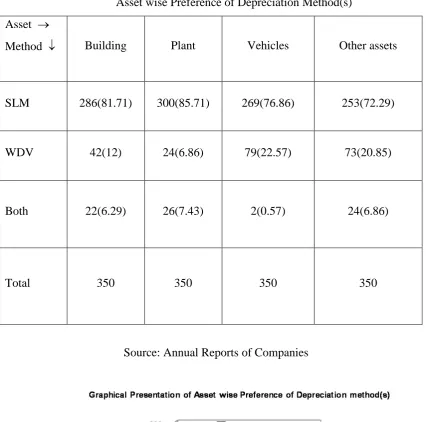
To fulfill the aim of the study i.e. to find the practice of Indian corporate sector regarding the provision of asset wise depreciation. After going through the annual reports of sample entities the data is compiled and studied. For more precision assets are classified into four major heads viz. “Building”, “Machinery”, “Vehicles” and all remaining assets are clubbed under one head “Other assets”. The table 1 and figure 1 depict the overall position of preference of method of depreciation for each asset taken separately. As per this table one could observe that out of 350 sample entities 286 (81.71 percent) are using SLM, 42(12 percent) have opted for WDV and remaining 22(6.29 percent) are using SLM and WDV simultaneously for providing depreciation on buildings. For plant and machinery 300 (85.71 percent), 24 (6.86 percent) and 26(7.43 percent) companies have been found using SLM, WDV and both methods respectively. In case of vehicles the position is that 76.86 percent, 22.57 percent and 0.57 percent of companies are following SLM, WDV and simultaneous use of both methods respectively. Further 253 (72.29 percent), 73 (20.85 percent) and 24 (6.86 percent) companies have opted for SLM, WDV and both methods respectively for other assets.
Findings and Conclusion
81.71 percent of the sample entities are using SLM, 12 percent have opted for WDV and 6.29 percent are using SLM and WDV simultaneously for providing depreciation on buildings.
For plant and machinery 85.71 percent), 6.86 percent and 7.43 percent companies have been found using SLM, WDV and both methods respectively.
In case of vehicles the position is that 76.86 percent, 22.57 percent and 0.57 percent of companies are following SLM, WDV and simultaneous use of both methods respectively. 72.29 percent, 20.85 percent and 6.86 percent companies have opted for SLM, WDV and
both methods respectively for other assets.
from the annual reports of the companies that there is lower percentage of companies which are using both methods on similar asset.
TABLE 1
Asset wise Preference of Depreciation Method(s) Asset
Method
Building Plant Vehicles Other assets
SLM 286(81.71) 300(85.71) 269(76.86) 253(72.29)
WDV 42(12) 24(6.86) 79(22.57) 73(20.85)
Both 22(6.29) 26(7.43) 2(0.57) 24(6.86)
Total 350 350 350 350
References
Barefield, Russell M. and Eugene E. Comiskey.(1971), “Depreciation Policy and the Behaviour of Corporate Profits”, Journal of Accounting Research, Vol.9, No. 2, Autumn 1971,pp 351-358
Hardin ,Alexis , Henry Ergas and Johan Small.(1999) “ Economic Depreciation in
Telecommunications Cost Models.” A paper prepared for 1999 Industry Economics Conference Regulation, Competition and Industry Structure 12-13 July, Hotel Ibis,
Melbourne
Kapoor, O.N. (1973), “Depreciation Accounting”, Doctoral Research, Lucknow.
Malchman and Slavin.(2004), cited from “Financial Management: Theory and Practice”, S.K Gupta and R.K.sharma, Kalyani Publishers, Ludhiana, 4th ed., pp24.1-24.8.
Pitman. (2004), cited from “Financial Management: Theory and Practice”, S.K Gupta and R.K.sharma, Kalyani Publishers, Ludhiana, 4th ed., pp24.1-24.8.
Schlorff, Harold Lee.(1973), “The Reliability Of Depreciation” , A Doctoral dissertation of The university of Missouri- Columbia, adapted from Dissertation Abstract International, Vol.34,1974.