A Monthly Double-Blind Peer Reviewed Refereed Open Access International e-Journal - Included in the International Serial Directories.
GE-International Journal of Management Research (GE-IJMR) ISSN: (2321-1709)
1 | P a g e
GE-International Journal of Management Research
Vol. 4, Issue 12, December 2016 Impact Factor- 5.779 ISSN(O): 2321-1709, ISSN(P): 2394-4226© Associated Asia Research Foundation (AARF)
Website: www.aarf.asia Email : [email protected] , [email protected]A STUDY ON IMPACT OF COMPETENCY MAPPING ON
ORGANIZATIONAL EFFECTIVENESS WITH SPECIAL REFERENCE
TO IT INDUSTRY IN CHENNAI
Dr. M. Sakthivel Murugan
Professor-In-Charge& Principal (Retd.), DhanrajBaid Jain College, Thoraipakkam, Chennai – 600 097, Tamil Nadu, India.
ABSTRACT
Competency Mapping is a part of Human Resource Development practice, only a
competent employee play a major role in determining the success of an organization. The
competency mapping concept plays a vital and profound role in organizational effectiveness.
It also brings out collective efforts and dynamic potential from the source of human and
converts these constructive tides into a tool for development.The Competency analysis is
conducted by an experienced facilitator in every organization who obtains consensus from
job practitioners regarding the skills required for the job. It focuses on the general
statements of competence, which are the major units of work that employees perform. This
paper focus on factors influencing the competency mapping of IT companies.
Key Words: Competency Mapping, Organizational Effectiveness, Performance Appraisal,
Leadership & Job Appropriateness
INTRODUCTION
Competency Mapping is a part of Human Resource Development practice,only a
competent employee play a major role in determining the success of anorganization. The
competency mapping concept plays a vital and profound role inorganizational effectiveness.
It also brings out collective efforts and dynamicpotential from the source of human and
converts these constructive tides into a toolfor development. Many industries have strived to
A Monthly Double-Blind Peer Reviewed Refereed Open Access International e-Journal - Included in the International Serial Directories.
GE-International Journal of Management Research (GE-IJMR) ISSN: (2321-1709)
2 | P a g e LeBoterf.G, a French experton competence, “Competence is the combination of relevant
resources that theindividual mobilizes to reach a particular result”. The organization has
realized thatin order to carry out the business in a superior manner they need to identify
whattype of competencies the employee should possess further increase and practice it
toincrease the job performance and achieve its goals.
The Competency analysis is conducted by an experienced facilitator in
everyorganization who obtains consensus from job practitioners regarding the skillsrequired
for the job. It focuses on the general statements of competence, which arethe major units of
work that employees perform. The areas of competence breakdown into the skills,
knowledge, abilities and behaviors that are required for eachunit of work.
NEED AND IMPORTANCE OF THE STUDY
The slowing down of the economy around the world has put new andincreased
pressure on an organization to get more capabilities out of the availableresource they have
and this often translates into pressure on the individualemployees. The future success of the
organization relies on the ability to manage theworkforce effectively. Especially for IT
industries where various projects areinvolved as a work schedule, there is a requirement for
repeatable and rigorousapproach of competency assessment to create confidence among the
clients.Confidence comes from the active demonstration of both capability and
competence.Even though India is in a better condition to supply graduates who could be
turnedinto IT professionals, but yet IT firms face the challenge to convert these graduatesinto
multi-skilled employees. Hence the study relating to Competency mapping ofemployee is
considered as a critical issue.
The competency mapping model helps in managing and developing thestandards
which reflect the direction, monitor and measure skills, provide feedbackand action is taken
later accordingly. There is a necessity for IT industry to use acompetency framework to guide
the individual for development and also helpemployees to identify hot skills and knowledge
available to them and therequirement of further skills to sustain in the competitive field.
Competencymapping, measuring tools needs to be communicated to the employees so that
theycan understand what is being expected from them which help to develop them totheir
career. In order to bring an organizational change IT industry has to matchcompetency with
performance so that it fosters innovation, increases productivity ofthe firm and finally
A Monthly Double-Blind Peer Reviewed Refereed Open Access International e-Journal - Included in the International Serial Directories.
GE-International Journal of Management Research (GE-IJMR) ISSN: (2321-1709)
3 | P a g e STATEMENT OF THE PROBLEM
Competency mapping is applied in every field of Human resourcemanagement
different elements like leadership, performance appraisal, jobappropriateness, Knowledge
and Skill, Interpersonal Communication, Teameffectiveness, Core Competencies, Innovation,
Goal setting, Customer care andNegotiation considered here are positive predictors of
Organizational effectivenessas it brings an organizational change and development. Hence it
is essential to findout the perception of employees towards competency mapping as an
indicator ofOrganizational effectiveness. Thus the present study aims at analyzing the impact
ofcompetency mapping on organizational effectiveness in selected IT (software)companies in
Chennai.
SIGNIFICANCE OF THE STUDY
Creating Competency based culture is the need of the hour. As survival ispurely
knowledge-driven, IT firms hire competent people and develops theworkforce with the
competency framework. At the same time the need to enhancethe potential of the Indian
software development industry has made the industry toidentify and understand the skills of
people within the industry. Hence the study ofcompetency mapping is carried out in IT
industry as it is required for day to daysurvival.
OBJECTIVES OF THE STUDY
The major objective of the study is:
To evaluate the factors, influencing competency mapping among the employees in IT
companies.
Sampling size and design
The primary data are collected through survey method and the survey isconducted
using a well formulated Questionnaire. There are almost 31 IT companieswhich have
registered with NASSCOM in Chennai. Out of these top ten ITcompanies were considered
for the research based on their revenue and totalemployees. The researcher for the research
purpose has selected Tier 1 (whoserevenue is more than 1 billion dollars and have more than
50, 000 employees) andTier 2 (whose revenue is more than 100 million dollars and
A Monthly Double-Blind Peer Reviewed Refereed Open Access International e-Journal - Included in the International Serial Directories.
GE-International Journal of Management Research (GE-IJMR) ISSN: (2321-1709)
4 | P a g e K MEANS CLUSTER ANALYSIS
The factor analysis by principal component method derived elevenpredominant
factors and they are appropriately named as Performance appraisal,Leadership, Job
Appropriateness, Knowledge and Skill, InterpersonalCommunication, Team effectiveness,
Core competence, Innovation, Goal-setting,Customer care and Negotiation. These factors act
as a basis to classify therespondents into heterogeneous groups. This would reveal the
perceptual differenceamong the respondents towards pre-dominant factors. At this juncture
the „K” meanscluster analysis is applied and the following results are obtained.
I. Classification of sample unit with respect to Competency mapping factors:
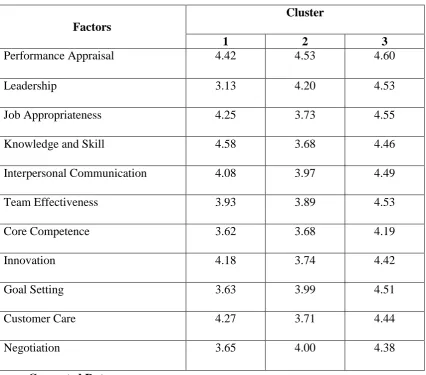
[image:4.595.86.513.299.674.2]The eleven factors act as a basis to classify the sample unit.
Table 1: Final Cluster Centers for factors of Competency Mapping
Factors
Cluster
1 2 3
Performance Appraisal 4.42 4.53 4.60
Leadership 3.13 4.20 4.53
Job Appropriateness 4.25 3.73 4.55
Knowledge and Skill 4.58 3.68 4.46
Interpersonal Communication 4.08 3.97 4.49
Team Effectiveness 3.93 3.89 4.53
Core Competence 3.62 3.68 4.19
Innovation 4.18 3.74 4.42
Goal Setting 3.63 3.99 4.51
Customer Care 4.27 3.71 4.44
Negotiation 3.65 4.00 4.38
A Monthly Double-Blind Peer Reviewed Refereed Open Access International e-Journal - Included in the International Serial Directories.
GE-International Journal of Management Research (GE-IJMR) ISSN: (2321-1709)
[image:5.595.65.532.66.183.2]5 | P a g e Table 2: Number of Cases in each Cluster for Competency Mapping
No of Respondent Percentage (%)
Cluster
1 120.000 19.417
2 184.000 29.773
3 314.000 50.809
Valid 618.000 100.00
Source: Primary Data
From the above table it is found that the first cluster consists of 120
[19.417%]respondents who moderately agree with leadership, team effectiveness,
corecompetence, goal setting and negotiation factors of Competency mapping.Therefore, this
group of employees can be named as “Melioration Employees” (a state of being
improved). The second cluster consists of 184 [29.773%]respondents who disagree with job
appropriateness, knowledge and skill,interpersonal communication, team effectiveness, core
competence, innovation, goalsetting and customer care factors of competency mapping.
Therefore, this group ofemployees can be named as “Univocal employees” (single sharply
defined sense of nature). The third cluster consists of 314 [50.809%] respondents who
stronglyagree with performance appraisal, leadership, job appropriateness, knowledge
andskill, interpersonal communication, team effectiveness, core competence,innovation, goal
setting, customer care and negotiation factors of competencymapping and hence this group of
employees can be named as “Proficient employees” (Competent or skilled in doing the
job).
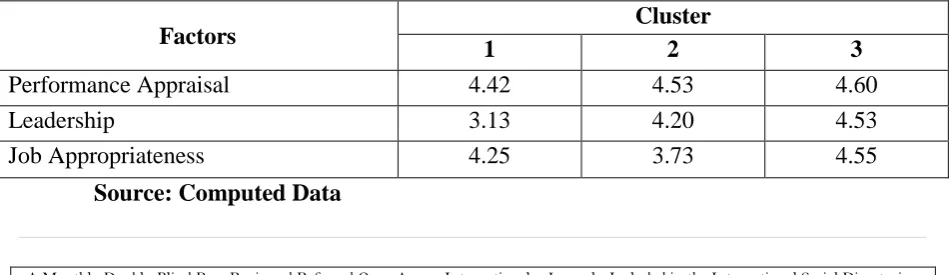
II. Classification of sample unit with respect to Organizational
"Effectiveness:The factor analysis derived three factors change management,
Talent management and Organizational Development. These factors act as a basis
toclassify the sample unit
Table 3: Final Cluster Centers for Organizational Effectiveness
Factors Cluster
1 2 3
Performance Appraisal 4.42 4.53 4.60
Leadership 3.13 4.20 4.53
Job Appropriateness 4.25 3.73 4.55
[image:5.595.61.537.627.764.2]A Monthly Double-Blind Peer Reviewed Refereed Open Access International e-Journal - Included in the International Serial Directories.
GE-International Journal of Management Research (GE-IJMR) ISSN: (2321-1709)
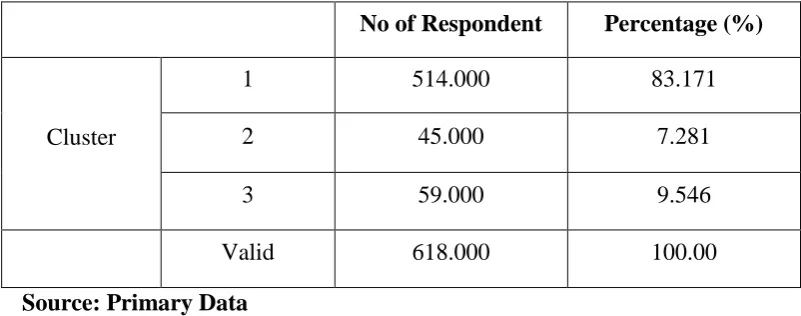
[image:6.595.97.498.66.224.2]6 | P a g e Table 4: Number of Cases in each Cluster for Organizational Effectiveness
No of Respondent Percentage (%)
Cluster
1 514.000 83.171
2 45.000 7.281
3 59.000 9.546
Valid 618.000 100.00
Source: Primary Data
From the above table it is found that first cluster consists of 514 [83.171%]
respondents whostrongly agree with change management, talent management and
organizational development. Therefore, this group of employees can be named as“Dynamic employees” (positive in attitude and new ideas). The second clusterconsists of 45 [7.281%]
respondents who disagree with talent management andorganizational development. Hence
this group of employees can be named as“Improvement seekers” (seek for betterment).
The third cluster consists of 59[9.546%] respondents who moderately agree with change
management andorganizational development and therefore this group of employees can be
named as“Unambiguous employees’ (admitting of no doubt).
A MODEL OF RELATIONSHIP BETWEEN COMPETENCY MAPPINGAND
ORGANIZATIONAL EFFECTIVENESS
After reviewing National and International literature the researcher appropriately
identified important elements related to competency mapping. Thenext research question
arises with this preamble, how these core competencies createeffectiveness over the
organization. The research subsequently used a well-designedquestionnaire to check the
reliability and validity of research instrument withrespective to the perception of employees
in IT companies. Therefore a StructuralEquation Model is developed to check the nature of
the relationship betweencompetency mapping and organizational effectiveness. With the
A Monthly Double-Blind Peer Reviewed Refereed Open Access International e-Journal - Included in the International Serial Directories.
GE-International Journal of Management Research (GE-IJMR) ISSN: (2321-1709)
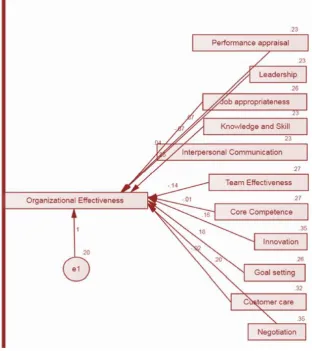
[image:7.595.145.458.94.446.2]7 | P a g e FIGURE 1 EMPRICAL MODEL OF RELATIONSHIP BETWEEN COMPETENCY
MAPPING AND ORGANIZATIONAL EFFECTIVENESS
This model implies that competency mapping elements are well related to
organizational effectiveness with the variance contribution .23, .23, .26, .23, .23, .27, .27, .35,
.26, .32, .35 respectively. There variance values are highly significant in explaining the
effectiveness on the organization, the model fit is identified through significant chi-square
value 17.1 under the default model constructed holds good for relating competency mapping
and organizational effectiveness.
Thus the relation between competency mapping and organizational effectiveness is
identified in this chapter. The existence of the relation between the personal and
organizational variable on competency mapping factors is also examined.
CONCLUSION
The study concludes that competent employees are the main resource of IT industry in
A Monthly Double-Blind Peer Reviewed Refereed Open Access International e-Journal - Included in the International Serial Directories.
GE-International Journal of Management Research (GE-IJMR) ISSN: (2321-1709)
8 | P a g e prepare the current and future workforce, improve the conception and realization of the
business vision and strategy and above all retains the skilled employees to meet the job
requirements. Information technology industries implement the competency mapping
effectively to improve the performance, opportunities, motivation and commitment. IT is a
knowledge based industry and the practice of competency mapping is an innate fit for human
resource here. This sector evaluates the present skill level of their employees to face various
issues relating to recruiting the distinguished workforce, their retention, compensation, career
planning and technological annihilation.
Growth and sustainability of IT organization is based totally on thedevelopment and
retention of talented manpower. They have created a competencymodel that essentially
recognizes and communicate certain behavior, skills and traitsto employees. They
continuously perform the process of competency mapping toenhance the knowledge, plan for
manpower, develop career and sharpen the skill ofthe employees. These skill development
fabricates responsibility create cordialrelationship, encourages in retaining the best talent and
employee involvementgenerate a proactive behavior for promotion of the firm. They avoid
losing their Keyperformers to their competitors by caring and feeding the workforce with
changemanagement. Thus competency mapping in IT industry has formed the basis fortalent
management by identifying the core competence of employees, which in turnis matched with
the organizational requirement. The attraction, prosperity andwithholding of the talented
employees through competency mapping deliversuperior performance, eventually mould IT
organization to grow leaps and bounds toenhance organizational effectiveness.
References
1. AtikaModassir and Tripti Singh 2008 “Relationship of Emotional Intelligence with
Transformational Leadership and Organizational Citizenship Behavior” International
Journal of Leadership Studies, Vol. 4 Iss. 1, Pp. 3-21.
2. Boyatzis, R.E. 2008, “Competencies in the twenty-first century”, Journal of
Management Development Vol. 27, Pp. 5-12.
3. Caroline Aba Anane 2013, Competency Based Training: Quality delivery for
technical and vocational education and training (TVET) Institutions, Educational
Research International Volume 2, Pp 117-127.
4. Fred C. Lunenburg 2011, “Motivating by enriching jobs to make them more
interacting and challenging” International Journal of Management, Business and
A Monthly Double-Blind Peer Reviewed Refereed Open Access International e-Journal - Included in the International Serial Directories.
GE-International Journal of Management Research (GE-IJMR) ISSN: (2321-1709)
9 | P a g e
5. IIhaamicAbdualGhaniAzmi, ZainalArffin Ahmad &YuserrieZainuddin 2009, The
Effects of Competency Based Career Development and Performance Management
practices on Service Quality: Some evidences from Malaysian Public organizations :
International Review of Business Research papers Volume 5, Pp 97-112.
6. MalikehBeheshtifar& Mahmoud NekoieMoghadam 2011, Studying the
Competency-related models in Succession planning, European Journal of Economics, Finance and
Administrative Sciences Pp 113-121.
7. Nancy M. Campbell 2006, “Correctional leadership competencies for the 21st Century
Managers and Supervisors levels” National Institute of corrections, US, Department
of Justice P 307.
8. Robertson, I., Callinan, M. and Bartram, C. (Eds) 2002, Organizational Effectiveness: