PII. S0161171203212242 http://ijmms.hindawi.com © Hindawi Publishing Corp.
APPROXIMATE SOLUTION FOR EULER EQUATIONS
OF STRATIFIED WATER VIA NUMERICAL
SOLUTION OF COUPLED KdV SYSTEM
A. A. HALIM, S. P. KSHEVETSKII, and S. B. LEBLE
Received 23 December 2002
We consider Euler equations with stratified background state that is valid for in-ternal water waves. The solution of the initial-boundary problem for Boussinesq approximation in the waveguide mode is presented in terms of the stream func-tion. The orthogonal eigenfunctions describe a vertical shape of the internal wave modes and satisfy a Sturm-Liouville problem. The horizontal profile is defined by a coupled KdV system which is numerically solved via a finite-difference scheme for which we prove the convergence and stability. Together with the solution of the Sturm-Liouville problem, the stream functions give the internal waves profile. 2000 Mathematics Subject Classification: 76B15, 76B70, 76B55, 37L65, 65M06, 65M12.
1. Introduction. The basic system of Euler equations for internal water waves in two dimensions(xz), with a stable stratified ambient state and the buoyancy frequencyN(z), is
ux+wz=0,
ρout= −ρo →
v ,→∇ u−px,
ρowt= −ρo →
v ,→∇w−pz−ρg,
Tt+wT¯z= − →
v ,→∇ T,
(1.1)
whereu,vare velocity components,ρois the density,pis the pressure,ρgis the body force due to stratification, ¯Tzis the vertical background temperature gradient, andTis the temperature variable [3]. Combining the equations in (1.1) and using the state relation for liquidρ= −ρoαT,α= −ρz/(ρT¯z)is the coefficient of thermal expansion, and ¯Tz=N2/(αg), we obtain
∆wtt+N2wxx−N2 →
v ,→∇ t
0w dt
xx
+→v , →∇ wzdx
txz+ →
v ,→∇ wtxx=0.
Rescaling the dimensionless variables (primed) usingxi=λixi,t=2π t/Nβ,¯ u=λzNu¯ /2π, w=βλzNw¯ /2π, αT=T, N=NN¯ /2π, ¯N is the average buoyancy frequency andβis a scale parameter. Substitute in (1.2) and omit primes for simplicity to obtain
λz Nβ¯
2π 3w
xx λ2
x + wzz
λ2 z tt+
N¯
2π 3
(βN)2 w
xx λx
−
N¯
2π
3(βN)2
λx u
t
0
wxdt+w t
0 wzdt
xx
+
Nβ¯
2π 3
λλ2xz
uwx+wwz
xxt
+λ1 z
uwz+w t
0 wzdx
z
xzt =0.
(1.3)
Introduce the stream functionψ, w= −σ ψx andu=σ ψz(σ is a scale pa-rameter). Integrate, with respect tox,
ψzztt+N2ψxx= −β2ψxxtt−σψzψxz−ψxψzzzt
+σ N2
ψz t
0ψxxdt−ψx t
0ψxzdt
x.
(1.4)
Substitute in (1.4) by the stream function of the form
ψ(z, x, t)= m
Zm(z)θm(x, t), (1.5)
multiply byZn, integrate with respect toz, and use the separation of variables that give
Zn zz= −
N2 c2
n
Zn. (1.6)
So (1.4) becomes
θttn−cn2θxxn
=cn2β2 N2 θ
n
xxtt+σ cn2
m,k
an m,k
θmθk
x
t+
bn
m,kθmθkt+enm,kθxm t
0 θk
xdt
x
,
where
anm,k=N2 h
−h
−1 ck2+
1 c2m
zzmzkzndz, bnm,k= −N2
ck2 h
−hz m
zzkzndz,
enm,k=N2 h
−hz mzk
zzndz.
(1.8)
System (1.7) describes the two oppositely directed propagated modes. The equations of the separated propagated modes are obtained by substituting θn
t =un,cnθxn=vn, so (1.7) becomes
unt −cnvxn= c3
nβ2 N2 v
n
xxx+σ c2n
m,k anm,k
t
0u
mdt·vk ck
t
+
bnm,k
t
0u
mdt·uk+en m,k vm cm t 0 vk ck dt x ,
vtn−cnunx=0.
(1.9)
Using projection operators,
P+=12
1 1+c2N2β22∂2 x
1−c2N2β22∂ 2 x 1 ,
P−=1
2
1 −1−c2β2
2N2∂ 2 x
−1+c2N2β22∂2
x 1 . (1.10) So P+ un vn = ϕn+
kϕn+
, P−
un vn = ϕn−
−kϕn−
(1.11)
or
un=ϕn++ϕn−, vn=ϕn+−ϕn−−c2β2
2N2∂ 2 x
ϕn+−ϕn−. (1.12)
Operating P+, P− on (1.9) and using (1.12), we obtain the equations for the separated modesϕn+,ϕn−as
ϕtn+−cnϕnx+− c3β2
2N2ϕ n+
xxx− σ c2
n 2
m,k anm,k
t
0
ϕ++ϕ−mdt·
ϕ+−ϕ−k ck t + bn m,k t 0
ϕ++ϕ−mdt·ϕ++ϕ−k
+en m,k
ϕ+−ϕ−m cm
t
0
ϕ+−ϕ−k ck
dt
ϕtn−+cnϕnx−+ c3β2
2N2ϕ n−
xxx− σ c2
n 2
m,k anm,k
t
0
ϕ++ϕ−mdt·
ϕ+−ϕ−k ck
t
+
bn
m,k t
0
ϕ++ϕ−mdt·ϕ++ϕ−k
+en m,k
ϕ+−ϕ−m cm
t
0
ϕ+−ϕ−k ck
dt
x
=0. (1.13)
Letϕn+=ηn+
t ,ϕn−=ηnt−, so (1.13) becomes
ηnt+−cnηnx+= c3β2
2N2η n+
xxx+ σ c2
n 2
m,k
anm,kη++η−mη+−η−kx
+bnm,k
η++η−m·η++η−kx
+ e n m,k ckcm
η+−η−mxη+−η−k,
ηnt−+cnηnx−= − c3β2
2N2η n−
xxx+ σ c2
n 2
m,k anm,k
η++η−mη+−η−kx
+bn m,k
η++η−m·η++η−kx
+ e n m,k ckcm
η+−η−mx
η+−η−k.
(1.14)
In what follows we will consider both directed modes. In this work we eval-uate only for short time to describe the phenomena, so we consider only one direction of the propagating modes. Hence the system that describes one di-rection of (1.7) has the form (return toθvariable for convenient)
θnt+cnθxn+σ
m,k
gm,kn θmθxk+β2dnθnxxx=0, (1.15)
gnm,k= σ N2c2
n 2
h
−h
−1 cm2 +
2 c2k
ZkZzm−
1 cmck
ZmZzk
Zndz, dn= c3
n 2N2.
(1.16)
2. Physical model. In this model, we simulate the initial stage of McEwan experiment [4,5] for a rectangular tank of dimension 50 cm inxby 25 cm inz directions filled by a linearly stratified water of constant buoyancy frequency 1.23s−1. The internal water waves are described by system (1.1). The solution of this system is constructed as the representation for the stream function (1.5), whereZn(z)are solutions of the correspondent Sturm-Liouville problem (1.6),Zzz+(N2/cn2)Z=0,Z(0)=Z(h)=0, and describe a vertical shape of the wave modes. The linear propagation velocitiescnplay the role of eigenvalues. The coefficient functions θn(x, t) are solutions of the coupled KdV system (1.15) with coefficients from (1.16). We select a localized initial condition along x-axis described by a smooth enough function that models the paddle motion as in the experiments of McEwan [5]. The function is also chosen antisymmetric alongx-axis in relation to the paddle axis centered in the middle of the tank. The time intervals of simulations are taken such that the initial disturbance decays essentially but does not reach the boundaries.
3. Computation. When the coefficients in the Sturm-Liouville equation (1.6) are constant, it has very simple general solution
Zn=B nsin
nπ z
h , n=1,2,3, . . . , L, (3.1)
which tends to zero at boundaries. The eigenvalues
cn= Nh
nπ, n=1,2,3, . . . , L, (3.2)
have the sense of linear internal gravity waves velocities. Normalization is de-termined by0h(Zn)2N2dz=1 and givesB
n=(2/N2h)1/2. Hence
Zn(z)=
2
N2h 1/2
sin nπ z
h . (3.3)
To solve the coupled KdV system (1.15) an initial condition is required. We can select the initial perturbation for the stream function (1.5) which has the general form
ψ(z, x,0)= L
n=1
Zn(z)θn(x,0)=ϕ(x, z)=ϕ
1(x)ϕ2(z). (3.4)
ϕ1(x)= a cosh(x/l),
ϕ2(z)=
2
N2h 1/2
sechbz−z0
tanhbz−z0
,
(3.5)
as the initial condition we model the impact of a wave-productor.
The choice of the form and the constantsa, b,lqualitatively reflects the paddle movement (we restrict the movement by some isolated pulse), and the numerical value for the amplitude is estimated also from the description of the experiment of McEwan [5]. Then the scalar product gives
Zj, ψ= L
n=1
Zj, Znθn(x,0)=Zj, ϕ2(z)
ϕ1(x), (3.6)
Zj, ϕ
2(z)= h
0
N2Zjϕ
2(z)dz, (3.7)
and using the orthogonality,
Zj, Zn=
h
0N
2ZjZndz=1, (j=n),0, (j≠n). (3.8)
Hence, (3.6) givesθn(x,0), the initial condition of system (1.15) which is solved by the numerical method introduced below.
4. Numerical method. For the coupled KdV system (1.15) we introduce a numerical (finite-difference) method of solution, a two-step three-time-level scheme similar to the Lax-Wendroff one [1,7]. The usual Lax-Wendroff scheme is modified such that the order of the first derivative becomes of orderO(x4). The approximation of the nonlinear terms is changed such that the integral of θ2is a conserved one. The scheme has the form
θnj+1/2
i −
θnj
i !
τ/2 +
cn θnji+1−
θnj i−1
!
2h
+
k,m gn
mk
θmj i
θkj i+1−
θkj
i−1 !
2h
+
dn−
cnh2 6
θnj i+2−2
θnj
i+1+2
θnj i−1−
θnj
i−2 !
2h3
=0,
(4.1)
for the intermediate layer as
θnj+1
i −
θnj
i !
τ +
cn θnji++11/2−
θnj+1/2 i−1
!
2h
+
k,m gnmk
θmji+1/2
θkj+1/2 i+1 −
θkj+1/2 i−1
!
2h
+en θ nj+1/2
i+2 −2
θnj+1/2 i+1 +2
θnj+1/2 i−1 −
θnj+1/2 i−2
!
2h3 =0.
(4.2)
To support the results, we prove stability and convergence of the scheme in AppendicesAandB[2]. Beside these proofs, we would like to mention that the order of errors of the difference formulas is improved at the same time they preserve conservation laws of the KdV-type equations [6].
5. Results. Figure 5.1is a contour plot presenting the initial perturbation ψ(z, x,0)for the upper half of the tank due to antisymmetry.
[image:7.468.94.364.99.201.2]Figure 5.2is one-dimensional(x)plots for the second tenth modes.
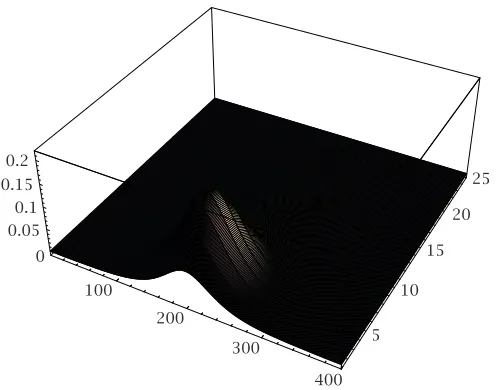
Figure 5.3is a three-dimensional plot for the wave profile (1.5) att=0.02 second for the same half of the tank.
100
200
300
400 5
10 15
20 25
0 0.05
0.1 0.15
0.2
[image:7.468.111.359.354.549.2]−0.07
−0.05
−0.03
−0.01 0.01
0.25 0.15 0.05
−0.05
−0.15
−0.25
x-axis
Second mode, series 1(t=0), series 2(t=0.02 s) Series 1
Series 2
−0.01 0.01 0.03 0.05 0.07
0.25 0.15 0.05
−0.05
−0.15
−0.25
x-axis
Fourth mode, series 1(t=0), series 2(t=0.02 s) Series 1
Series 2
−0.07
−0.05
−0.03
−0.01 0.01
0.25 0.15 0.05
−0.05
−0.15
−0.25
x-axis
Sixth mode, series 1(t=0), series 2(t=0.02 s) Series 1
Series 2
−0.01 0.01 0.03 0.05 0.07
0.25 0.15 0.05
−0.05
−0.15
−0.25
x-axis Eighth mode, series 1(t=0),
series 2(t=0.02 s) Series 1
Series 2
−0.07
−0.05
−0.03
−0.01 0.01
0.25 0.15 0.05
−0.05
−0.15
−0.25
x-axis
Tenth mode, series 1(t=0), series 2(t=0.02 s) Series 1
Series 2
100
200
300
400 5
10 15
20 25
0 0.2 0.4
Figure 5.3. Three-dimensional (x, y, z) plot of the wave profile ψ(z, x, t)att=0.02 second for the upper half of the tank. The hor-izontal numbers(25,400)indicate the number of mesh points used in plotting inxandzdirections while the dimensions are 12.5 cm inzand 50 cm inx, respectively.
All the plots for the modes and for the sum (stream function) show the be-havior that is typical for the multisolitonic perturbation. It looks like a decay of the initial condition to solitons in the single KdV equation theory. The process of the wave propagation is accompanied by interaction that implies the energy transfer between modes. This phenomenon may be considered as a possible reason for the vertical fine-structure generation [3]. The combination of the fine structures may explain McEwan experiments [4,5].
6. Summary. In the commonly accepted approximations (incompressibil-ity, Boussinesq approximation, and so forth), the solution of the system of Euler equations with stratified background state is constructed as the repre-sentation for the stream function. The horizontal profile is defined by a cou-pled KdV system which is numerically solved via a finite-difference scheme for which stability and convergence are proved. Together with the solution of the Sturm-Liouville problem that describes the vertical profile, the stream function gives the complete internal waves profile.
Appendices
perturbation of the initial data. Consider the differential
Ti,rn,j+1=
"∂θn,j+1 i ∂θrn,j
# ,
dθn,jr = θin,j−2 θin,j−1 θin,j θin,j+1 θin,j+2 !t
(A.1)
and define the norm
$$dθj$$=
r
n
dθrn,j2h
1/2
. (A.2)
We can write
dθn,ji +1=Ti,rn,j+1dθn,jr =Ti,rn,j+1T n,j i,r dθ
n,j−1
r =Πr
Ti,rnrdθn,o
r , (A.3)
wheredθin,j+1is the perturbation of the discrete solution anddθn,or is a small perturbation of the initial data. Stability required the boundness ofΠr(Tn
i,r)r, that is,Tris bounded. We calculateTfrom the difference scheme as follows:
Ti,rn,j+1=δi,r− cnτ
2h
δi+1,r−δi−1,r
−τ m,k
gnm,k
2h %
θm,ji
δi+1,r−δi−1,r
+δi,r
θik,j+1−θ k,j i−1
&
−τen 2h3
δi+2,r−2δi+1,r+2δi−1,r−2δi−2,r
.
(A.4)
Rewriting the matrixT (A.4) in terms of identity(E), symmetric(S), and anti-symmetric(A), matrices yieldsT=E+S+A,
Sn,j+1
i,r= − τ 4h
m,k gn
m,k %
θim,j−θm,ji+1δi+1,r−
θm,ji −θim,j−1δi−1,r
+2δi,rθk,ji+1−θ k,j i−1
& ,
An,j+1
i,r= − cnτ
2h
δi+1,r−δi−1,r
−4hτ m,k
gm,kn %θim,j+θm,ji+1δi+1,r−
θim,j+θm,ji−1δi−1,r &
−enτ 2h3
δi+2,r−2δi+1,r+2δi−1,r−δi−2,r,
$$Sj+1$$≤τmax n,m,k
''gn m,k''max
i,m,k ''θm,j
θm,jx,i =
θim,j+1−θ
m,j i
h , θ` k,j x,i=
θik,j+1−θ
k,j i−1
2h , $$Aj+1$$≤τmaxn,m,k''g
n m,k'' h maxm,i
''θim,j''+τmaxn''cn''
h +
3τmaxn''en'' h3 , $$Tj+1$$2=$$$Tj+1∗Tj+1$$$=$$E−Aj+1+Sj+1E+Aj+1+Sj+1$$
≤1+2$$Sj+1$$+$$Aj+1$$+$$Sj+1$$2
≤1+2τmax n,m,k
''gn m,k''max
m,i ''θx,im,j''
+τ2
max n,m,k
''gn m,k''max
m,i
''θm,jx,i''+maxn,m,k''g n m,k'' h maxm,i
''θm,ji ''
+maxn''cn''
h +
3 maxn''en'' h3
2
≤eaτ,
a=1+2τmax n,m,k
''gnm,k''max m,i
''θx,im,j''
+τ2
max n,m,k
''gn
m,k''maxm,i ''θ m,j x,i''+
maxn,m,k''gnm,k'' h maxm,i
''θm,j i ''
+maxn''cn''
h +
3 maxn''en'' h3
2 ,
(A.5)
which is a necessary condition of stability. The scheme is stable ifa≤constant in spite ofτ,h→0. This is a conditional stability of the scheme. It means that it is required for stability thatτ→0 more faster thanh→0 or
τ≤(constant)·h6. (A.6)
B. Convergence proof of the scheme. We would prove that the solution of the difference equations (4.1) and (4.2) converges to the solution of (1.15) if the exact solution is a continuously differentiable one. We place here for brevity a proof that uses only one-step time difference equation and the whole proof may be developed by similar ideas. Therefore, we now consider the difference equation
θnj+1
i −
θnj
i τ +cn
θnj
i+1−
θnj i−1 2h +
m,k
gnm,kθmji
θkj i+1−
θkj
i−1 2h
+en
θnj i+2−2
θnj
i+1+2
θnj i−1−
θnj
i−2 2h3 =0.
We know that the KdV-type equation has the conservation law−∞∞ u2(x, t)dx= constant. It may also be shown that if a smooth enough solutionun(x, t)of the set of equations (1.15) exists, then it satisfies the inequality(Ln=1−∞∞ (un(x, t))2dx < B, for a finitet, whereBis a constant dependent on initial conditions only,L-number of modes taken into account by system (1.15). Therefore, it is natural to useL2-norm in the proof, and
$$Θj$$= i n %
θn2h&j i
1/2
. (B.2)
Here,his a grid step,iis a discrete space variable, andjis the discrete time. The symbolΘ denotes a columnΘj ≡(θ1)j (θ2)j (θ3)j ···t and the components of this column are columns also:
θnj≡ ··· θnj i−1
θnj
i
θnj i+1 ···
!t
, (B.3)
where(θn)j
i is a solution of the finite-difference equation (B.1). Let the vector(un)j
i=un(xi, tj)be an exact solution of (B.1) in the points of grid. Then the error(vn)j
i is given by
vnji=
θnji−
unji. (B.4)
The difference solution(θn)j
iconverges to the exact solution(un) j
iifVj →0 asτ, h→0, whereVj≡Θj−Uj. Substitute (B.4) into (B.1) and obtain
vnj+1
i −
vnj
i τ +cn
vnj
i+1−
vnj i−1 2h
+ m,k
gm,kn
umji
vkj i+1−
vkj
i−1 2h +g
n m,k
vmji
ukj
i+1−
ukj i−1 2h
+gn m,k
vmj
i
vkj i+1−
vkj
i−1 2h
+en
vnj i+2−2
vnj
i+1+2
vnj i−1−
vnj
i−2 2h3
= − un
j+1
i −
unj
i τ +cn
unj
i+1−
unj i−1 2h
+ m,k
gm,kn
umji
ukj i+1−
ukj
i−1 2h
+en
unj i+2−2
unj
i+1+2
unj i−1−
unj
i−2 2h3
.
Pick out (inv) a linear part of expression (B.5) and introduce for convenience an operatorTjby the expression
vnji−τ cn
vnj
i+1−
vnj i−1 2h
m,k
gm,kn umji
vkj i+1−
vkj
i−1 2h
+gm,kn
vmji
ukj i+1−
ukj
i−1 2h
+en
vnj i+2−2
vnj
i+1+2
vnj i−1−
vnj
i−2 2h3
= r
Tj+1ir
vnji, n=1,2,3, . . . , L.
(B.6)
Using the above expression forT and utilizing that(un)j
iis an exact solution of differential equations, due to the approximation, we use the fact that the right-hand-side term of (B.5) is a small one of orderO(τ+h2). Therefore, we can rewrite (B.5) as follows:
vnj+1
i −
r
Tj+1 ir
vnj
i
+τ m,k
gm,kn
vmji
vkj i+1−
vkj
i−1 2h =O
τ+h2
(B.7)
or
vnji+1=
r
(Tj+1)ir
vnji+τ
fn,m,kji, (B.8)
where
fnmkj
i= −τ
m,k gn
m,k
vmj i
vkj i+1−
vkj
i−1 2h +O
τ+h2, (B.9)
and the following estimation for the norm is valid:
$$Vj+1$$≤$$Tj+1$$$$Vj$$+τ$$fj$$. (B.10)
If we will consequently substitute (B.10) into itself, we will get $$vj+1$$≤$$Tj+1$$$$vj$$+τ$$fj$$
≤$$Tj+1$$$$Tj$$$$vj−1$$+τ$$Tj+1$$$$fj−1$$+$$fj$$ ≤$$Tj+1$$$$Tj$$$$Tj−1$$$$vj−2$$
+τ$$Tj+1$$$$Tj$$$$fj−2$$+$$Tj+1$$$$fj−1$$+$$fj$$.
Using the estimate of norm ofT in inequality (A.5), (B.11) becomes $$vj+1$$≤eaτj$$v0$$+τeaτ(j−1)$$f0$$+eaτ(j−2)$$f1$$+···$$fj$$
≤eaτj$$v0$$+Mmax k≤j
$$fk$$, M=τeatmax−1 eaτ−1 ;
(B.12)
Mis the sum of a geometric series andtmaxis the time of simulation, 0≤t≤ tmax. The norm of(fn,m,k)
j
i is given by simple estimations
$$fj$$=
i %
fmkji &2
h
1/2
=max n,m,k
''gnm,k''
i
m,k
vmj i
vkj i+1−
vkj
i−1 2h
2
h
1/2
≤max n,m,k
''gn m,k''
i
m %
vmj i
&2 h
i
k %
vkj i
&2 h
1/2 1 h3/2
≤maxn,m,k''g n m,k'' h3/2 $$V
j$$2
+Oτ+h2.
(B.13)
Using this estimate in inequality (B.12) yields
$$Vj+1$$≤eaτj$$V0$$+M
maxn,m,k''gnm,k'' h3/2 $$V
j+1$$2
+Oτ+h2
. (B.14)
Taking into considerationV0 =0, the above inequality gives the solution
$$Vj+1$$≤1−
-1−4Mmaxn,m,k''gnm,k''/h3/2
MOτ+h2
2Mmaxn,m,k''gm,kn ''/h3/2 MOτ+h2,
(B.15)
that is,Vj+1 →0 asτ, h→0. Hence the convergence is proved.
Acknowledgment. This work was partially supported by the KBN Grant no 5 PO3B 040 20.
References
[1] S. P. Kshevetskii,Analytical and numerical investigation of nonlinear internal grav-ity waves, Nonlinear Processes in Geophysics8(2001), 37–53.
[2] P. Lancaster,Theory of Matrices, Academic Press, New York, 1969.
[3] S. B. Leble,Nonlinear Waves in Waveguides: with Stratification, Springer-Verlag, Berlin, 1991.
[4] A. D. McEwan,Internal mixing in stratified fluids, J. Fluid Mech.128(1983), 59–80. [5] ,The kinematics of stratified mixing through internal wavebreaking, J. Fluid
[6] Z. Shaohong,A difference scheme for the coupled KdV equation, Commun. Nonlin-ear Sci. Numer. Simul.4(1999), no. 1, 60–63.
[7] J. C. Tannehill, D. A. Anderson, and R. H. Pletcher,Computational Fluid Mechanics and Heat Transfer, Taylor & Francis, Washington, 1997.
A. A. Halim: Theoretical and Mathematical Physics Department, Gdansk University of Technology, 80-952 Gdansk, Poland
E-mail address:[email protected]
S. P. Kshevetskii: Theoretical Physics Department, Kaliningrad State University, Kalin-ingrad 236041, Russia
E-mail address:[email protected]
S. B. Leble: Theoretical and Mathematical Physics Department, Gdansk University of Technology, 80-952 Gdansk, Poland