PII. S0161171202106028 http://ijmms.hindawi.com © Hindawi Publishing Corp.
A QUANTUM FIELD THEORETICAL REPRESENTATION
OF EULER-ZAGIER SUMS
UWE MÜLLER and CHRISTIAN SCHUBERT
Received 4 June 2001 and in revised form 16 January 2002
We establish a novel representation of arbitrary Euler-Zagier sums in terms of weighted vacuum graphs. This representation uses a toy quantum field theory with infinitely many propagators and interaction vertices. The propagators involve Bernoulli polynomials and Clausen functions to arbitrary orders. The Feynman integrals of this model can be decom-posed in terms of a vertex algebra whose structure we investigate. We derive a large class of relations between multiple zeta values, of arbitrary lengths and weights, using only a certain set of graphical manipulations on Feynman diagrams. Further uses and possible generalisations of the model are pointed out.
2000 Mathematics Subject Classification: 05A19, 11M06, 81T18.
1. Introduction. The perturbative evaluation of Green’s functions in quantum field theory leads to a class of iterated parameter integrals whose explicit calculation be-comes very difficult beyond the first few orders in the coupling constant expansion. Any progress in this area of work must be based on an intimate knowledge of the prop-erties of various types of special functions such as polylogarithms, hypergeometric functions, and their generalisations (see [39]).
In recent years, some structure is seen to emerge from the seemingly haphazard occurrence of those special functions as the values of individual Feynman diagrams. Kreimer’s hypothesis [27], based on a rule of associating knots to Feynman diagrams, allows one to predict from knot-theoretical considerations the level of transcenden-tality which can possibly appear in the counterterm coefficients of an ultraviolet di-vergent diagram. Even though it has been verified for a large number of examples [13] the raison d’être for the correspondence between graphs and knots remains presently mysterious. More recently, there are indications that knot-theoretical concepts may be of relevance even for the finite parts of Feynman diagrams [11].
The remarkably rich mathematical structures surfacing in this correspondence make Feynman diagrams increasingly interesting from the pure mathematician’s point of view. The objects encountered in the calculation of UV divergences in perturbative quantum field theory, multiple harmonic sums, are of considerable relevance to num-ber theory and other branches of mathematics (see [15,17,19,28,34,41,42,44]).
amplitudes inD-dimensional field theory in terms of first-quantized path integrals. An approach to quantum field theory along these lines has gained some popularity in recent years after it was discovered that it allows one to reorganise ordinary field theory amplitudes in a manner similar to string theory amplitudes [4,33,37,38,40]. In this type of formalism theD-dimensional space-time enters as a target space, and amplitudes are calculated in terms of an auxiliary field theory in one-dimensional pa-rameter space. Green’s functions in papa-rameter space are then used for the evaluation of Feynman diagrams in this one-dimensionalworldlooptheory.
As a simple example, consider the one-loop effective action for a scalar field theory with a(λ/3!)φ3interaction. This effective action can be expressed in terms of a first-quantized path integral as follows:
Γ[φ]=12 ∞
0 dT
T e −m2T
x(T )=x(0)Ᏸx(τ)e
−T
0dτ((1/4)x˙2+λφ(x(τ))). (1.1)
Here,Tis the usual Schwinger proper-time for the particle circulating in the loop. At fixedT a path integral has to be calculated over the space of closed loops in space-time with periodT. This integral contains a zero mode which is removed by fixing the center-of-mass of the loopx0≡(1/T )0Tdτx(τ). The reduced path integral is evalu-ated perturbatively by expanding the interaction exponential and using the parameter space Green’s function
Gτ1, τ2≡2T ∞
n=−∞
n=0
e2π in(τ1−τ2)/T
(2π in)2 =
τ1−τ2−τ1−τ22
T −
T
6. (1.2)
(The constant part of this Green’s function is irrelevant for the final physical results and usually deleted from the beginning.) Momentum space methods have also some-times been used, which in this case lead to Fourier sum representations. In [3,14], a number of such sums were calculated to provide a check on the resolution of certain ambiguities which in the first-quantized formalism can arise in curved backgrounds. In this comparison we find that terms given by simple polynomial integrals in coordi-nate space may, in momentum space, correspond to nontrivial multiple sums of the Euler-Zagier type.
In the present work we turn the logic around, and use this formalism as a tool for the systematic study of Euler-Zagier sums. Euler-Zagier sums, also called multipleζ values or multiple harmonic series, are defined by
ζk1, . . . , km=
n1>n2>···>nm>0
1
nk1
1 ···n
km
m
=Lik1···km(1, . . . ,1). (1.3)
They are special values of the multidimensional polylogarithms Lik1,...,km, defined as
Lik1···km
z1, . . . , zm≡
n1>n2>···>nm>0
zn1
1 ···z
nm
m
nk1
1 ···n
km
m
. (1.4)
We callmthe length (or depth) of such a series, andk1+k2+ ··· +km its level (or
that numerous relations exist between Euler-Zagier sums. Some simple examples are the following (all given by Euler):
ζ(2,1)=ζ(3),
ζ(3,1)=3 2ζ(4)−
1 2ζ
2(2)= π4 360,
ζ(2,2)=12ζ2(2)−12ζ(4)=120π4,
ζ(3,2)= −112 ζ(5)+3ζ(2)ζ(3),
ζ(4,1)=2ζ(5)−ζ(2)ζ(3).
(1.5)
Further results for the length-two case can be found in [1,43]. Systematic investiga-tions of Euler-Zagier sums of length higher than two have been undertaken only in recent years [2,6,9,20,21,22,24,25,31,32,35]. From the point of view of physics, the study of their relations is relevant for attempts at a classification of the possible ultraviolet divergences in quantum field theory [12,13].
We would like to be able to represent arbitrary such sums in terms of one-dimen-sional Feynman diagrams. To achieve this goal we have to generalise the usual world-line path integral formalism in the following ways:
(1) As explained above, the first-quantized loop path integral is defined to run over the space of all periodic functions, with the constant functions eliminated. Here we will restrict it to one “chiral half” spanned by the basis functionsfn(u)=e2π inu,
n=1,2, . . . .(This amounts to a complexification of spacetime.)
(2) We choose the kinetic term of our model in such a way that arbitrary inverse powers of derivatives will appear.
Those purely mathematical considerations lead us to define the ζ-model, a one-dimensional quantum field theory given by the following partition function,
Z(g, λ)=
ᏴᏰx(u)e −S,
S= 1
0 du1
1
0 du21
2x¯
u1I−λ2π i∂−1xu2− 1
0
duegx(u)+g¯x(u)¯ .
(1.6)
Here and in the following∂≡(d/du)denotes the ordinary derivative. The path inte-gral is to be performed over the Hilbert space
Ᏼ=
x(u)|x(u)= ∞
n=1
ane2π inu,
∞
n=1 an2
<∞
. (1.7)
The perturbative expansion of both the kinetic and the interaction terms for this toy model leads to the Feynman rules represented inFigure 1.1.
Verticesᐂp,q p, q=0,1,2, . . .
¯ gpgq
Propagators
k
1 2 k=0,1,2, . . .
λk(2π i)kg12(k)
Figure1.1. Feynman rules of theζ-model.
2. Basic properties. Inverting the kinetic part of our (nonlocal) Lagrangian (1.6), and writing∂−kin the defining basis of the Hilbert spaceᏴ, we find
g12(k)≡g(k)
u12= ∞
n=1
e2π inu12
(2π in)k. (2.1)
If we represent the unit circle in the complex plane, this sum will turn into thekth polylogarithm,
g12(k)= 1 (2π i)kLik
z1 z2
(2.2)
(u12=u1−u2, zi=e2π iui). We note the following properties ofg(k):
∂ ∂u1g
(k)
12 = − ∂ ∂u2g
(k)
12 =g
(k−1)
12 , (2.3)
g21(k)=(−1)
k
¯
g(k)12 =g(k)
1−u12,
g(k)(0)= ζ(k) (2π i)k, 1
0
du1,2g(k)12 =0.
(2.4)
Equation (2.3) can be inverted using the explicitly known integral kernel for inverse derivatives in this space [37],
g(k12+l)= 1
0
duu1∂−lug(k)u−u2,
u1∂−nu2= −n1!Bnu12signn
u12
= −Bn
u12 n! +
un12−1 2(n−1)!
signu12−1.
(2.5)
HereBkdenotes thekth Bernoulli polynomial. To writeg(k)12 more explicitly we split it into its real and imaginary parts,
g12(k)=g¯
(k)
12 +igˆ
(k)
Using the standard integral representation of the polylogarithm
Lik(z)=
(−1)k−1 (k−1)!z
1
0 dxln
k−1(x)
1−xz , (2.7)
it is then easy to show that
g12(0)=1 2
δu12−1+icotπ u12, (2.8)
g12(1)= 1 2
1 2sign
u12−u12+πi ln2 sinπ u12
,
g12(2)= 1 4
u12−u212− 1 6+
i π2
1
0 dξ
lnξsin2π u12 1−2ξcos2π u12+ξ2
,
g12(3)= − 1 24
signu12−2u12u12−u212
+ i
16π3 1
0 dξ
ξ lnξln
1−2ξcos2π u12+ξ2,
g12(k=0 even)= −1 2
1
k!Bku12
+ i
(2π )k
(−1)(k/2)+1 (k−1)!
1
0dξln
k−1
ξ sin
2π u12 1−2ξcos2π u12+ξ2, g12(k=1 odd)= −
1 2
1
k!Bku12sign
u12
+ i
2(2π )k
(−1)(k+1)/2 (k−2)!
1
0 dξ
ξ ln
k−2ξln1−2ξcos2π u12+ξ2, (2.9)
(u12∈[−1,1]). Note also that the imaginary part ofg(k)12 is, up to a normalisation factor, identical with the kth Clausen function Clk(2π u12) (see [29, 30]). Only the
real parts are present in the calculation of worldline path integrals in standard field theory. In particular, note that ¯g(2)is, up to a conventional factor of 4, identical with
the functionGintroduced in (1.2) (forT=1). Only the imaginary parts are capable of producingζ(n)’s withnodd.
A vacuum diagram in our model involves a multiple integral on the unit circle with an integrand which is a product of propagators (2.1). (One of the integrations is re-dundant due to translation invariance.) The result of the integrations can obviously be decomposed as a sum of multipleζvalues. Our model thus defines a map from the set of weighted vacuum graphs to the (vector space generated by) the Euler-Zagier sums. This map is, moreover, easily seen to be surjective; it will be immediately convincing that with the above Feynman rules, thesea shelldiagram (Figure 2.1) evaluates to
λkigg¯2m−1ζk1, . . . , km. (2.10)
Theu-integrations produceδfunctions formomentum conservationat every vertex, while the Fourier sums of the insertedg(0)propagators yield Heaviside step functions
leading to the desired ordering of the remaining sums.
0
0 0
0 • • •
•
k1 k2
k3
km
Figure2.1. Sea shelldiagram representing the general Euler-Zagier sum.
the folding of the elementary vertices with arbitrary sets of propagators. We denote the elementary vertex integral by
Ikl1···lq
1···kp
u1, . . . , up+q
≡
1
0
dug(k1)u1−u···g(kp)u p−u
×g(l1)u−u
p+1···g(lq)u−up+q
.
(3.1)
We note that it has the following obvious properties:
Il1···lq
k1···kp=0 ifp=0 orq=0,
¯ Il1···lq
k1···kp=(−1)
p i=1ki+
q
j=1ljIk1···kp
l1···lq .
(3.2)
3.1. Two-vertex integral. By construction two-point vertices can be integrated out trivially,
1
0
du3g13(k)g32(l)=g12(k+l). (3.3)
3.2. Three-vertex integral. The evaluation of vertex integrals is complicated by singularities which can appear due to the presence of the cotangent function ing(0).
Integrals involving cot(π u12)need to be performed using the principal value prescrip-tion. One way of calculating them is to transform them into complex contour integrals via the substitutionz=exp(2π iu),
1
0 du
n
k=1
cotπu−uk
=in
dz
2π iz
n
k=1 z+zk
z−zk
. (3.4)
Those are evaluated by means of residues (the poles on the contour give half val-ues due to the principal value prescription). (We remark that, if one expresses the propagators of the sea shell diagram via (2.2) and (2.7), and then calculates theui
1
0 ducot
πu−u1=0, 1
0 du 2
k=1
cotπu−uk
=δu1−u2−1, 1
0 du
3
k=1
cotπu−uk
=δu1−u2cotπu2−u3
+δu1−u3cotπu1−u2 +δu2−u3cotπu2−u1.
(3.5)
Alternatively one can also calculate those integrals recursively using, under the inte-gral, the following identity:
cotπ u12cotπ u13+cotπ u21cotπ u23+cotπ u31cotπ u32
= −1+δu12δu13. (3.6)
This identity will be of further use later on. With these results, the vertex integral of
three propagatorsg(0)is
I0 00
u1, u2, u3= 1
0
dug(0)u1−ug(0)u2−ug(0)u−u3
=14δu13δu23−δu13−δu23+1+δu13−1icotπ u23 +δu23−1icotπ u13−cotπ u23cotπ u13,
(3.7)
and can be identified as
I000
u1, u2, u3=g13(0)g
(0)
23. (3.8)
Applying the identity (3.6) gives also
I000
u1, u2, u3=g12(0)g
(0)
23 −g
(0)
12g
(0)
13 − 1 2g
(0)
13 =g21(0)g13(0)−g21(0)g23(0)−1
2g
(0)
23 =g12(0)g
(0)
23 +g
(0)
21g
(0)
13 − 1 2δ12g
(0)
13.
(3.9)
Folding of (3.8) withu1|∂−n|u1andu2|∂−m|u2leads to
I0
nm
u1, u2, u3= 1
0
dug(n)u1−ug(m)u2−ug(0)u−u3
=g(n)13 g
(m)
23 ,
(3.10)
whereas the forms (3.9) can be folded withu3|∂−k|u3
I00ku1, u2, u3= 1
0
dug(0)u1−ug(0)u2−ug(k)u−u3
=g(120)g(k)23 −g12(0)g(k)13 −1 2g
(k)
13 =g(210)g
(k)
13 −g
(0)
21g (k) 23 − 1 2g (k) 23 =g(120)g(k)23 +g21(0)g(k)13 −1
2δ12g
(k)
13.
1
2 3
+ 1
2 3
+ 1
2 3
=1+
2=1 3
+
2 1=3
+ −
1
3=2 • 1=2=3
Figure3.1.Three-point relation.
Nontrivial is the case
I0lk
u1, u2, u3= 1
0 dug
(0)u−u1g(k)u−u2g(l)u3−u
=Lilk
z31, z12.
(3.12)
The general case of all three indices different from zero can be reduced to this case by partial integrations, for example,
I111
u1, u2, u3= 1
0 dug
(1)u41g(1)u42g(1)u34
= 1
0
dug(1)u41g(0)u42g(2)u34
+ 1
0
dug(0)u41g(1)u42g(2)u34
=Li21
z31, z12+Li21
z32, z21.
(3.13)
3.3. A three-point relation. Beyond the three-point case the systematic investiga-tion of the elementary vertex integrals becomes cumbersome. We will be satisfied here to note that, from the representation (2.8) forg(0)and the identity (3.6) we easily
derive the following pair of (complex conjugate) three-point identities:
g21(0)g
(0)
31 +g
(0)
12g
(0)
32 +g
(0)
13g
(0)
23 =1+δ12g
(0)
32 +δ31g
(0)
21+δ23g
(0)
13 −δ12δ13, g12(0)g13(0)+g21(0)g23(0)+g31(0)g32(0)=1+δ12g23(0)+δ31g(120)+δ23g31(0)−δ12δ13.
(3.14)
We may represent the first identity graphically as inFigure 3.1. The second identity has all arrows reversed. Those identities can be used to transform any vertex integral involving twog(0)’s which are either both ingoing or both outgoing.
By iteration of this three-point identity we can contruct an analogous identity for an arbitrary number of points. The formulas are rather cumbersome and are not given here.
4. Derivation of multipleζ relations. Now we show how to use the formalism developed above for deriving a large class of multipleζrelations by simple lations on graphs, with no need to ever explicitly write down sums. In those manipu-lations we will make use of the following elements:
(1) the triviality of the real part ofg(0), ¯g(0)
12 =(1/2)(δ12−1)(see (2.8)); (2) partial integrations;
(4) the vanishing of diagrams containing a vertex with only ingoing or only out-going propagators;
(5) the two-vertex integration formula (3.3).
At intermediate steps sometimes ill-defined sums will appear such asζ(1). Those will be always cancelled out in the final results. The appearance of divergent sums could be easily avoided using a regularization such as in [9] but we will not do so here.
4.1. Length two. We begin at length two. The simplest way of arriving at identi-ties is provided by the first one of the points listed above. Consider the sea shell diagram at length two (Figure 4.1a), representingζ(a, b), and the same diagram with the middle propagator reversed (Figure 4.1b), representing ζ(b, a). (We will gener-ally disregard the coupling constant factors in the following.) Adding up both dia-grams we can replace the middle propagator by twice its real part (Figure 4.1). Since
¯
g(120)=(1/2)(δ12−1), this diagram can then be replaced by the sum of the two dia-grams shown in the right-hand side ofFigure 4.1. Using (3.3) on the rightmost one, we obtain the identity
ζ(a, b)+ζ(b, a)=ζ(a)ζ(b)−ζ(a+b). (4.1)
This identity is well known [9,21], and has been namedreflection formulain [9].
.
.
a 0 b + a 0 b = a b−a b
(a) (b)
Figure4.1. Diagrammatic representation of the reflection identity.
Another way of obtaining identities is partial integration. Instead of considering the sea shell diagram (Figure 4.1a), which representsζ(a, b), consider the more general diagram (Figure 4.2) that represents a numberGa,b,c=Ga,c,b. Fora=0,b=0, orc=0,
it can be represented by multipleζfunctions,
G0,b,c=ζ(b)ζ(c), Ga,b,0=Ga,0,b=ζ(a, b). (4.2)
To see the first of these identities, add the same diagram with the left propagator re-versed, and use elements one and four from the above list. For the later discussion we
a b c
[image:9.498.101.395.341.399.2] [image:9.498.201.289.546.618.2](a)
a b
c
=
(b) a−1
b+1 c
−
(c) a
b+1 c−1
Figure4.3. Integration by parts.
refer to these diagrams as zeta diagrams in contrast to the other, non-zeta diagrams. If botha andc are greater than 1, we use integration by parts at the upper vertex according toFigure 4.3and obtain
Ga,b,c=Ga−1,b+1,c−Ga,b+1,c−1. (4.3)
This can be repeated until eithera=0 orc=0
Ga,b,c= c
n=1 (−1)c+n
a+c−n−1 a−1
G0,a+b+c−n,n
+
a
n=1 (−1)c
a+c−n−1 c−1
Gn,a+b+c−n,0.
(4.4)
The right-hand side of this equation can be translated immediately intoζvalues by (4.2). Forb=0, we obtain the relation
ζ(a, b)=(−1)b
b
n=1 (−1)n
a+b−n−1 a−1
ζ(n)ζ(a+b−n)
+
a
n=1
a+b−n−1 b−1
ζ(n, a+b−n)
.
(4.5)
The divergentζ(1)andζ(1, a)appear here always in the combination
ζ(1)ζ(a+b−1)−ζ(1, a+b−1), (4.6)
which can be reexpressed in terms of convergent sums by the reflection identity (4.1). In this way, we obtain
ζ(a, b)=(−1)b
b
n=2 (−1)n
a+b−n−1 a−1
ζ(n)ζ(a+b−n)
+
a
n=2
a+b−n−1 b−1
ζ(n, a+b−n)
−
a+b−2 a−1
ζ(a+b)+ζ(a+b−1,1)
.
(4.7)
Here on the left-hand side we must assume thata >1 if regularization is to be avoided.
possi-(a) a
b
c
(b) a
b
c
(c) a
b
c
(d) a
b
c
Figure4.4. Diagrams related toζ(a, b, c). The propagators without label
areg(0)propagetors.
bilities.Figure 4.4shows the “standard” sea shell diagram, representingζ(a, b, c), as well as the diagrams related to it by a change of direction of one or both of theg(0)
propagators. Those diagrams represent the quantities (a) ζ(a, b, c),
(b) ζ(b, a, c)+ζ(b, c, a)+ζ(b, a+c), (c) ζ(a, c, b)+ζ(c, a, b)+ζ(a+c, b), (d) ζ(c, b, a).
Adding those diagrams in pairs to create ¯g(0)’s one obtains the following four
identi-ties,
ζ(a, b, c)+ζ(b, a, c)+ζ(b, c, a)+ζ(b, a+c)+ζ(a+b, c)−ζ(a)ζ(b, c)=0, (4.8)
ζ(a, b, c)+ζ(a, c, b)+ζ(c, a, b)+ζ(a+c, b)+ζ(a, b+c)−ζ(c)ζ(a, b)=0, (4.9)
ζ(b, a, c)+ζ(b, c, a)+ζ(c, b, a)+ζ(b, a+c)+ζ(b+c, a)−ζ(c)ζ(b, a)=0, (4.10)
ζ(a, c, b)+ζ(c, a, b)+ζ(c, b, a)+ζ(a+c, b)+ζ(c, a+b)−ζ(a)ζ(c, b)=0. (4.11)
These identities generalise the reflection identity (4.5). We call thempermutation iden-tities.
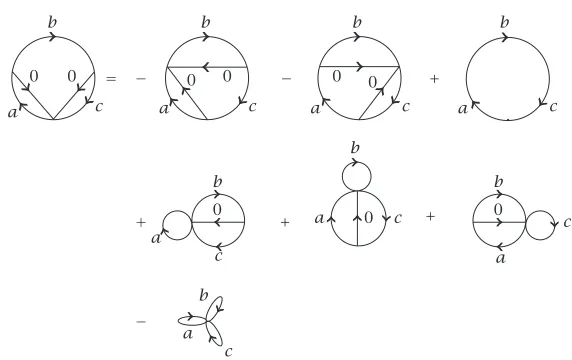
At length three, we can also make use of the three-point identities (3.14). We con-sider againFigure 4.4a, and apply the first one of the three-point relations to the two g(0)propagators running into therootvertex. The result is the diagrammatic identity
shown inFigure 4.5. It can be translated, term by term, into the followingζidentity:
ζ(a, b, c)= −ζ(b, c, a)−ζ(c, a, b)+ζ(a+b+c)+ζ(a)ζ(b, c)
+ζ(b)ζ(c, a)+ζ(c)ζ(a, b)−ζ(a)ζ(b)ζ(c). (4.12)
The identities (4.9) through (4.11) can be obtained by applying the permutations b →a→c →b, a↔c, b↔c on (4.8). Taking the latter identity and applying all permutations, we obtain six identities which can be written as
M z=a, (4.13)
.
ab
c
0 0 = −
a b
c
0 0 −
a b
c
0 0 +
a b
c
+
a b
0
c
+ a
b
c
0 + c
b
a 0
a b
c
−
Figure4.5. Diagrammatic identity derived from the three-point identity.
(and lower-length zeta values), for example, byζ(a, b, c)andζ(a, c, b). Taking into account also relation (4.12) the coefficient matrixMgets more rows but the rank does not change. Therefore, this relation is up to lower-length identities not independent of (4.8). When two of the argumentsa,b,ccoincide, sayb=c,zbecomes(ζ(a, b, b), ζ(b, a, b), ζ(b, b, a))and the rank ofMreduces to 2. For all arguments coinciding, the rank ofMis 1.
There is another possibility to derive an identity fromFigure 4.4d which generalises immediately toζvalues of larger length. Everyg(0)propagator inFigure 4.4d can be
replaced by the reverted propagator according to
g12(0)= −g
(0)
21 +δ12−1. (4.14) This leads to a sum of diagrams where all occurringg(0) propagators are directed
towards therootvertex. The resulting identity
ζ(c, b, a)=ζ(a, b, c)−ζ(a, b)ζ(c)+ζ(a, b+c) +ζ(a)−ζ(b, c)+ζ(b)ζ(c)−ζ(b+c) +ζ(a+b, c)−ζ(a+b)ζ(c)+ζ(a+b+c)
(4.15)
can be obtained also by subtracting (4.8) from (4.11) and applying appropriately the length-two identity (4.1), thus it is not a new identity.
Partial integrations yield additional identities. As forζ values of length two, we consider the more general figure (Figure 4.6) which evaluate to the numbersGa,k,b,l,c=
Ga,k,b,c,l. Some of these numbers can be identified withζvalues:
Ga,0,b,0,c=Ga,0,b,c,0=ζ(a, b, c), G0,k,b,0,c=G0,k,b,c,0=ζ(k)ζ(b, c). (4.16)
We start withζ(a, b, c)=Ga,0,b,0,c. First, we integrate by parts at the upper-right vertex
[image:12.498.109.395.75.255.2]a
k l c b
Figure4.6.Auxiliary diagrams for partial integrations at length three.
(a) 0
k l =
(b) 0
k l +
(c) 0
k l
=
(d)
k l −
(e)
k l
Figure4.7. Identity which proves thatkandlcan be exchanged when the
upper propagator is zero. Diagram (c) is zero because no propagator goes into the upper right vertex. Diagram (e) is zero for the same reason at the right vertex.
be identified withζvalues. In the terms whereb=0, the two inner propagators can be exchanged according to the identity depicted inFigure 4.7. After this exchange, we can integrate by parts at the upper-left vertex until terms witha=0 ork=0 arise. In terms ofζvalues, we obtain
ζ(a, b, c)=(−1)b
c
n=1
a
m=1
a+b+c−m−n−1 b−1, a−m, c−n
ζ(m, a+b+c−m−n, n)
+
b+c−n
m=1 (−1)m
b+c−n−1 b−1
a+b+c−m−n−1 a−1
×ζ(m)ζ(a+b+c−m−n, n)
+
b
n=1 (−1)c
b+c−n−1 c−1
ζ(a, n, b+c−n),
(4.17)
form=1 appear always in a combination which can be eliminated by identity (4.9),
ζ(1)ζ(a, b)−ζ(1, a, b)=ζ(a, b,1)+ζ(a,1, b)+ζ(a+1, b)+ζ(a, b+1). (4.18)
Alternatively we may after the first step, in the terms withb=0, rather than inter-changing the two inner propagators, those labelled “k” and “l” inFigure 4.6, instead interchange propagators “k” and “c.” Proceeding in the same way as before we obtain the following identity:
ζ(a, b, c)=(−1)c
b
n=1
b+c−n−1 c−1
ζ(a, n, b+c−n)
+(−1)c
c
n=1
a
m=1
b+c−n−1 b−1
a−m+n−1 n−1
×ζ(m, a−m+n, b−n+c)
+
c
n=1
n
m=1
(−1)c−m
a−m+n−1 a−1
b−n+c−1 b−1
×ζ(m)ζ(a−m+n, b−n+c).
(4.19)
Here again the terms involving aζ(1, . . . )appear only in the combination (4.9) and thus can be removed without the need for regularization.
4.3. Arbitrary length. All three different procedures which we have used for con-structing multiple ζ identities—partial integrations, reversion of g(0) propagators,
and the use of the three-point identity—can be generalised to the arbitrary length case without difficulty.
The generalisation of the permutation identities to an arbitrary length is based on finding representations of sea shell diagrams with reverted inner g(0) propagators,
which are added in order to use the two-point relation (4.14). Consider first the sim-plest case with one reverted propagatorFigure 4.8. Figures4.8b,4.8c, and4.8d can be expressed immediately byζvalues. Figures4.8a,4.8b, and4.8c represent the series
∞
n1,...,nl
n1>···>nm>0,
nm+1>···>nl>0
1
nk1
1 n
k2
2 ···n
kl
l
. (4.20)
By decomposing the summation range into regions where thenλ’s are completely
ordered, we obtain a sum ofζvalues which can be constructed as follows.
Denote byMa1,a2,a12⊂ {{1},{2},{1,2}}a1+a2+a12 the set of all(a1+a2+a12)-tuples
consisting ofa1elements{1},a2elements{2}anda12 elements{1,2}. Further, we define a map(l≡m+m)
ρam,m:Nl×Mm−a,m−a,a →Nl−a,
k1, . . . , km;km+1, . . . , kl;m1, . . . , ml−a→b1+b1, . . . , bl−a+bl−a
(a) km km+1
k2
k1 kl
kl−1 +
(b) km km+1
k2
k1 kl
kl−1 +
(c) km km+1
k2
k1 kl
kl−1
=
(d) kmkm+1
k1 kl
Figure4.8. Diagrammatic representation of permutation identities for
ar-bitrary length. The propagators without label areg(0)propagators.
where(b1, . . . , bl−a)results from(m1, . . . , ml−a)by replacing{2}with 0, and{1}and
{1,2}with k1, . . . , km (in this order);(b1, . . . , bl−a)results from(m1, . . . , ml−a)by
re-placing{1}with 0, and{2}and{1,2}withkm+1, . . . , kl(in this order). For example,
ρ21,2
k1, k2;k3, k4;{1},{1,2},{2}=k1, k2+k3, k4. (4.22)
With these definitions, the identity depicted inFigure 4.8can be written as
min(m,l−m) a=0
ξ∈Mm−a,l−m−a,a
ζρam,l−mk1, . . . , km;km+1, . . . , kl;ξ
=ζk1, . . . , km
ζkm+1, . . . , kl
.
(4.23)
The generalisation to the cases with more than one reverted propagator should be obvious. But we note that in these cases theζvalues of maximal length appear in combinations which can be constructed also from the identities (4.23). Thus, we conjecture that all identities which are based on the reordering of summation ranges are generated by (4.23).
Imitating the considerations in (4.13), we can write all permutation identities (4.23) for fixedl(but varyingm), where the arguments of the length-oneζvalues are taken from the set{k1, . . . , kl}in all possible orderings, in the form (4.13), where now the
components ofzconsist of all differentζvalues which result fromζ(k1, . . . , kl)by
permutations of the arguments;acontains onlyζvalues of length less than 1. As-sumingk1, . . . , klmutually different, we found that the coefficient matrixMhas rank
To generalise the partial integration procedure from length three to lengthm, we can proceed in various ways. For example, we can simply iterate the above exchange of inner propagators. In the first step we apply the same partial integration as in the length-three case to the rightmost vertex of the sea shell diagram (Figure 2.1). For those terms in the result wherekm−1=0 we make use of this newg(0) propagator to interchange the adjacent inner propagators. Then we perform partial integrations on the next-to-rightmost vertex until eitherkm−2=0 or the next inner propagator be-comes the zero propagator. In the first case the procedure continues with another in-terchange of inner propagators. After maximallym−1 such propagator interchanges, proceeding from right to left, the final step is reached, which is again the same as in the length-three case.
In the first step we have the same ambiguity as before. Depending on its resolu-tion, we arrive at a generalisation of either (4.18) or (4.19). We give here the formula generalising (4.19),
ζk1, . . . , km
=(−1)km
km−1
nm−1=1
km−1−nm−1+nm−1
km−1
ζk1, . . . , km−2, nm−1, km−1−nm−1+nm
+(−1)km
nm
nm−1=1 km−2
nm−2=1
km−1−nm−1+nm−1
km−1−1
km−2−nm−2+nm−1−1 nm−1−1
×ζk1, . . . , km−3, nm−2, km−2−nm−2+nm−1, km−1−nm−1+nm
+(−1)km
nm
nm−1=1 nm−1
nm−2=1 km−3
nm−3=1
km−1−nm−1+nm−1
km−1−1
km−2−nm−2+nm−1−1 km−2−1
×
km−3−nm−3+nm−2−1 nm−2−1
ζk1, . . . , km−4, nm−3, km−3−nm−3+nm−2, . . . ..
.
+(−1)km
nm
nm−1=1 nm−1
nm−2=1
···
n3
n2=1 k1
n1=1 m−1
n=2
kn−nn+nn+1−1 kn−1
k1−n1+n2−1 n2−1
×ζn1, k1−n1+n2, . . . , km−1−nm−1+nm
+
nm
nm−1=1 nm−1
nm−2=1
···
n2
n1=1
(−1)km−n1 m−1
n=1
kn−nn+nn+1−1 kn−1
×ζ(n1)ζk1−n1+n2, k2−n2+n3, . . . , km−1−nm−1+nm,
(4.24)
wherenm≡km. We also give the special casekm=1 of this formula which is
partic-ularly simple,
ζk1, . . . , km−1,1
=ζ(1)ζk1, . . . , km−1
−
m−1
κ=1
kκ
nκ=1
The terms involving ζ(1, . . . )can be removed by means of a special case of (4.23), namely
ζ(1)ζk1, . . . , km−1−ζ1, k1, . . . , km−1
=
m−1
κ=1
ζk1, . . . , kκ−1, kκ+1, kκ+1, . . . , km−1+ζk1, . . . , kκ,1, kκ+1, . . . , km−1. (4.26)
.
.
.
.
.
..
.
k1 k2
k3
km 0
0 0
0
Figure4.9. Modified sea shell diagram.
Up to here, the partial integrations were sequentially applied starting at the right-most vertex and ending at the leftright-most one. An interesting alternative is to do the opposite. Consider Figure 4.9. As in the derivation of the other partial-integration identities, this diagram representsζ(k1)ζ(k2, . . . , km). On the other hand, we can use
partial integrations at the leftmost vertex until we have only terms where eitherk1 ork2 became 0. Ifk1=0 then the resulting diagram represents a multiple ζvalue. Ifk2=0 then we exchange the adjacent inner propagators and repeat the whole pro-cedure at the next-to-leftmost vertex. This continues until the rightmost vertex is reached, where after the partial integrations all terms represent multiple ζvalues. The result is
ζk1ζk2, . . . , km
=
k2
n1=1
k2+k1−n1−1 k1−1
ζk2+k1−n1, n1, k3, . . . , km
+
m−1
κ=2
n0
n1=1 n1
n2=1
···
nκ−2
nκ−1=1 kκ+1
nκ=1
κ
λ=2
kλ+nλ−2−nλ−1−1 kλ−1
kκ+1+nκ−1−nκ−1
nκ−1−1
×ζk2+n0−n1, k3+n1−n2, . . . , kκ+1+nκ−1−nκ, nκ, kκ+2, . . . , km
+
n0
n1=1
n1
n2=1 ···
nm−2
nm−1=1 m
λ=2
kλ+nλ−2−nλ−1−1 kλ−1
×ζk2+n0−n1, k3+n1−n2, . . . , km+nm−2−nm−1, nm−1,
(4.27)
From our derivation clearly one would expect (4.24) and (4.27) to be equivalent. And indeed, it is a matter of pure combinatorics to show that (4.24) becomes trivially fulfilled if (4.27) is used on the right-hand side. Nevertheless, we suspect that the form (4.27) may be more useful for the application of these formulas to the problem of constructing a minimal basis of independent multipleζsums.
a1 a2
am−1
am c1
c2
ak−1
ck
b1
b2
bn−1
bn
Figure4.10. Peacockdiagram. The propagators without label areg(0)propagators. Equation (4.27) is a special case of a class of identities derived from (weight-length) shuffle algebras. In order to derive that whole class, considerFigure 4.10. It evaluates to a number which we denote by
Za1, . . . , amb1, . . . , bnc1, . . . , ck
=Za1, . . . , amc1, . . . , ckb1, . . . , bn
. (4.28)
Partial integrations at the top vertex yield, similarly to (4.4),
Z. . . , am,0b1, b2, . . .c1, c2, . . .
=
b1
ν=1
b1+c1−ν−1 c1−1
Z. . . , am, b1+c1−νν, b2, . . .0, c2, . . .
+
c1
ν=1
b1+c1−ν−1 b1−1
Z. . . , am, b1+c1−ν0, b2, . . .ν, c2, . . .
.
(4.29)
Considerations like inFigure 4.7show
Za1, . . . , am0, b1, . . .c1, . . .
=Za1, . . . , amc1, . . .0, b1, . . .
=Za1, . . . , am,0b1, . . .c1, . . .
. (4.30)
Starting with
ζa1, . . . , amζb1, . . . , bn=Z0a1, . . . , amb1, . . . , bn, (4.31)
and applying continually (4.29) and (4.30), we end up with terms of the form
Za1, . . . , am|0|b1, . . . , bn=Za1, . . . , amb1, . . . , bn0
=ζa1, . . . , am, b1, . . . , bn.
The resulting identities have the same form as the shuffle identities in the literature, but here advantageously the binomial coefficients in (4.29) explicitly encode (in part) the combinatorics implicit in the shuffle algebra.
Additional multipleζidentities can be derived using the three-point identity (3.14). At low lengths and levels it turns out that the multipleζidentities obtained in this way are not independent from the set of equations generated by the propagator reversions and partial integrations. Whether this property holds true in general we do not know.
5. Discussion. In the present work we have established a novel representation of multipleζsums in terms of Feynman diagrams in a 1+0 dimensional quantum field theory. We demonstrated the usefulness of this representation for the derivation of identities between such sums. The encoding into Feynman diagrams proposed here provides a very convenient book-keeping device for certain formal manipulations per-formed on such sums, as our examples should have amply demonstrated.
Concerning the novelty of the identities derived here, the length-two identities pre-sented inSection 4.1are, of course, well known. At length three, the identities derived by the partial integration procedure, (4.18) and (4.19), are similar, and presumably equivalent, to thedecomposition equationsderived in [9] by explicit series manipula-tions. Similarly, thepermutation equations, equation (1) [9, equation (2)] coincide with (4.9) in this paper. Equation (4.12) is contained as a special case in [21, Theorem 2.2]. However, we have not been able to locate in the literature an exact equivalent of our lengthmidentities (4.24) and (4.27). (The special case obtained by combining (4.25) and (4.26) is [21, Theorem 5.1].) The only identities available for arbitrary lengths and levels are those based on theshuffle algebra[6,7,8,10,26] and its generalisations [23]. Of those thedepth-lengthshuffle identities (which are also calledstuffle identities
or∗products [22]) are obviously related, and in fact equivalent to ourpermutation
identities, as we have convinced ourselves. Similarly theweight-lengthshuffle iden-tities are clearly related to our variouspartial integrationidentities. In this case, the question of equivalence is more difficult and requires further investigation.
Note that we did not make use at all of the precise form of the path integral action. Our considerations required the presence of all propagatorsg(k), as well as of all the
verticesᐂp,q, however they did not determine the statistical weights with which they
should appear in the Feynman diagrams. Our choice of the weights for the propagators is mainly motivated by the fact that it leads to a suggestive form for the free path integral determinant. Namely, a simple application of the “ln det=tr ln” identity shows that, formally,
lnZ(0, λ)=const+ ∞
n=1 λnζ(n)
n . (5.1)
(This calculation may be seen as achiralgeneralisation of the calculation of the Scalar QED Euler-Heisenberg Lagrangian performed in [36].) Comparing this expression with the well-known formula for the logarithm of theΓ function
Γ(1+x)=exp
−γx+ ∞
n=2 (−1)n
n ζ(n)x
n
we see that we can identify the free partition function with the Γ function under the assumption that the ill-definedζ(1)appearing in (5.1) is renormalised to Euler’s constantγ,
Zrenorm(0, λ)=const×Γ(1−λ). (5.3)
Considering the identitiesγ =limn→∞(nk=1(1/k)−lnn) and∞k=1(1/k)=(1/)+ γ+O()this assumption seems quite natural. Similarly the total propagator becomes relatively simple. Using the integral representation (2.7) of the polylogarithm, it is easily shown that
p12≡ ∞
k=0
λk(2π i)kg12(k)=g
(0)
12 + z12λ 1−λ 2F1
1,1−λ; 2−λ;z12. (5.4)
For the interaction term there seems to be no such preferred choice. A question of obvious interest (but equally obvious difficulty) is whether nontrivial interaction potentialsV (g,g)¯ exist such that theζ-model would be exactly solvable.
Recently the following generalisation of Euler-Zagier sums (1.3) has attracted some attention,
ζk1, . . . , km;σ1, . . . , σm
=
n1>n2>···>nm>0 σn1
1 ···σ
nm
m
nk1
1 ···n
km
m
, (5.5)
whereσj= ±1. ThosealternatingEuler-Zagier sums arise naturally in the calculation
of ultraviolet divergences in renormalisable quantum field theories, and in the ap-plication of knot theory to the classification of those divergences [13]. At the same time, the inclusion of alternating Euler-Zagier sums seems to simplify the problem of reducing the set of all such sums to a basic set via multipleζidentities [10]. (For a tabulation of alternating series see [5].)
More generally, arbitraryNth roots of unity in place of theσjhave been considered
in connection with the study of mixed Tate motives over SpecZ[18,34]. Those phase factors can be easily accommodated in theζ-model. To generate a phase factorσ= e2π is, the propagator (2.1) has to be simply replaced by
g(k)σ
u12≡
∞
n=1
e2π i(n+s)u12
(2π in)k . (5.6)
On the path integral level this can be achieved by changing from periodic to twisted boundary conditions,x(1)=σ x(0), and replacing∂by∂−2π is.
Acknowledgments. We would like to thank C. Zeta-Jones for inspiration. Helpful
References
[1] T. M. Apostol and T. H. Vu,Dirichlet series related to the Riemann zeta function, J. Number Theory19(1984), no. 1, 85–102.
[2] T. Arakawa and M. Kaneko,Multiple zeta values, poly-Bernoulli numbers, and related zeta functions, Nagoya Math. J.153(1999), 189–209.
[3] F. Bastianelli and P. van Nieuwenhuizen,Trace anomalies from quantum mechanics, Nu-clear Phys. B389(1993), no. 1, 53–80.
[4] Z. Bern and D. A. Kosower,The computation of loop amplitudes in gauge theories, Nuclear Phys. B379(1992), no. 3, 451–561.
[5] M. Bigotte, G. Jacob, N. E. Oussous, and M. Petitot,Tables des relations de la fonction zéta colorée, Report of the LIFL Publications, IT-322, University Lille I, 1998.
[6] J. M. Borwein, D. M. Bradley, and D. J. Broadhurst,Evaluations ofk-fold Euler/Zagier sums: A compendium of results for arbitraryk, Electron. J. Combin.4(1997), no. 2, 1–21. [7] J. M. Borwein, D. M. Bradley, D. J. Broadhurst, and P. Lisonˇek,Combinatorial aspects of
multiple zeta values, Electron. J. Combin.5(1998), no. 1, 1–12.
[8] ,Special values of multiple polylogarithms, Trans. Amer. Math. Soc.353(2001), no. 3, 907–941.
[9] J. M. Borwein and R. Girgensohn,Evaluation of triple Euler sums, Electron. J. Combin.3
(1996), no. 1, 1–27.
[10] D. J. Broadhurst, Conjectured enumeration of irreducible multiple zeta values, from knots and Feynman diagrams, preprint OUT-4102-65, 1996,http://arxiv.org/abs/ hep-th/9612012.
[11] , Solving differential equations for 3-loop diagrams: relation to hyperbolic ge-ometry and knot theory, preprint OUT-4102-74, 1998, http://arxiv.org/abs/ hep-th/9806174.
[12] D. J. Broadhurst, R. Delbourgo, and D. Kreimer, Unknotting the polarized vacuum of quenched QED, Phys. Lett. B366(1996), 421.
[13] D. J. Broadhurst and D. Kreimer,Association of multiple zeta values with positive knots via Feynman diagrams up to9loops, Phys. Lett. B393(1997), no. 3-4, 403–412. [14] J. de Boer, B. Peeters, K. Skenderis, and P. van Nieuwenhuizen,Loop calculations in
quan-tum mechanical non-linear sigma models with fermions and applications to anom-alies, Nuclear Phys. B459(1996), no. 3, 631–692.
[15] V. G. Drinfel’d,On quasitriangular quasi-Hopf algebras and a group closely connected withGal(Q¯/Q), Leningrad Math. J.2(1991), no. 4, 829–860.
[16] L. Euler,Meditationes circa singulare serierum genus, Novi Comm. Acad. Sci. Petropol.20
(1775), 140–186.
[17] H. Furusho, The multiple zeta value algebra and the stable derivation algebra, S¯urikaisekikenky¯usho K¯oky¯uroku (2001), no. 1200, 137–148.
[18] A. B. Goncharov,Polylogarithms in arithmetic and geometry, Proceedings of the Inter-national Congress of Mathematicians, Vol. 1, 2 (Zürich, 1994), Birkhäuser, Basel, 1995, pp. 374–387.
[19] ,Multiple polylogarithms, cyclotomy and modular complexes, Math. Res. Lett.5
(1998), no. 4, 497–516.
[20] A. Granville,A decomposition of Riemann’s zeta-function, Analytic Number Theory (Kyoto, 1996) (Y. Motohashi, ed.), London Mathematical Society Lecture Note Series, vol. 247, Cambridge University Press, Cambridge, 1997, pp. 95–101.
[21] M. E. Hoffman,Multiple harmonic series, Pacific J. Math.152(1992), no. 2, 275–290. [22] ,The algebra of multiple harmonic series, J. Algebra194(1997), no. 2, 477–495. [23] ,Quasi-shuffle products, J. Algebraic Combin.11(2000), no. 1, 49–68.
[24] M. E. Hoffman and C. Moen,Sums of triple harmonic series, J. Number Theory60(1996), no. 2, 329–331.
[26] C. Kassel,Quantum Groups, Graduate Texts in Mathematics, vol. 155, Springer-Verlag, New York, 1995.
[27] D. Kreimer,Knots and divergences, Phys. Lett. B354(1995), no. 1-2, 117–124.
[28] T. Q. T. Le and J. Murakami,Kontsevich’s integral for the Homfly polynomial and relations between values of multiple zeta functions, Topology Appl.62(1995), no. 2, 193– 206.
[29] L. Lewin,Polylogarithms and Associated Functions, North-Holland Publishing, New York, 1981.
[30] L. Lewin (ed.),Structural Properties of Polylogarithms, American Mathematical Society, Rhode Island, 1991.
[31] C. Markett,Triple sums and the Riemann zeta function, J. Number Theory48(1994), no. 2, 113–132.
[32] Y. Ohno,A generalization of the duality and sum formulas on the multiple zeta values, J. Number Theory74(1999), no. 1, 39–43.
[33] A. M. Polyakov,Gauge Fields and Strings, Harwood Academic, Chur, 1987.
[34] G. Racinet,Torseurs associés à certaines relations algébriques entre polyzêtas aux racines de l’unité[Torsor structure associated to some algebraic relations between polyzetas at roots of unity], C. R. Acad. Sci. Paris Sér. I Math.333(2001), no. 1, 5–10 (French). [35] R. S. Rao and M. V. Subbarao,Transformation formulae for multiple series, Pacific J. Math.
113(1984), no. 2, 471–479.
[36] M. G. Schmidt and C. Schubert,On the calculation of effective actions by string methods, Phys. Lett. B318(1993), no. 3, 438–446.
[37] ,Multiloop calculations in the string inspired formalism: The single spinor loop in QED, Phys. Rev. D53(1996), no. 4, 2150–2159.
[38] C. Schubert,An introduction to the worldline technique for quantum field theory calcula-tions, Acta Phys. Polon. B27(1996), 3965–4001.
[39] V. A. Smirnov,Renormalization and Asymptotic Expansions, Birkhäuser Verlag, Basel, 1991.
[40] M. J. Strassler,Field theory without Feynman diagrams: one-loop effective actions, Nuclear Phys. B385(1992), no. 1-2, 145–184.
[41] T. Terasoma, Mixed Tate motives and multiple zeta values, preprint, 2001, http://arxiv.org/abs/math.NT/0104231.
[42] ,Selberg integral and multiple zeta values, preprint, 1999,http://arxiv.org/abs/ math.AG/9908045.
[43] L. Tornheim,Harmonic double series, Amer. J. Math.72(1950), 303–314.
[44] D. Zagier,Values of zeta functions and their applications, First European Congress of Mathematics, Vol. II (Paris, 1992), Progress in Mathematics, vol. 120, Birkhäuser, Basel, 1994, pp. 497–512.
Uwe Müller: Institut für Physik, Johannes-Gutenberg-Universität Mainz,
Staudinger-Weg7, D-55099Mainz, Germany
E-mail address:[email protected]
Christian Schubert: Laboratoire d’Annecy-le-Vieux de Physique Théorique LAPTH,
Chemin de Bellevue, BP110, F-74941Annecy-le-Vieux CEDEX, France