Volume 2008, Article ID 364021,10pages doi:10.1155/2008/364021
Research Article
An Efficient Zero-Stable Numerical Method for
Fourth-Order Differential Equations
S. J. Kayode
Department of Mathematical Sciences, School of Sciences, Federal University of Technology, PMB 704, Akure, Ondo State, Nigeria
Correspondence should be addressed to S. J. Kayode,[email protected]
Received 9 July 2007; Revised 26 February 2008; Accepted 9 April 2008
Recommended by Michael Evans
The purpose of this paper is to produce an efficient zero-stable numerical method with the same order of accuracy as that of the main starting valuespredictorsfor direct solution of fourth-order differential equations without reducing it to a system of first-order equations. The method of col-location of the differential system arising from the approximate solution to the problem is adopted using the power series as a basis function. The method is consistent, symmetric, and of optimal orderp 6. The main predictor for the method is also consistent, symmetric, zero-stable, and of optimal orderp6.
Copyrightq2008 S. J. Kayode. This is an open access article distributed under the Creative Commons Attribution License, which permits unrestricted use, distribution, and reproduction in any medium, provided the original work is properly cited.
1. Introduction
Many problems leading to fourth-order differential equations of the form
yivft, y, y1, y, y, ym−1t0μm−1, m1,2,3,4, 1.1
are of great interest to scientists and engineers formulating mathematical models for elastic bodies. Investigators, both theoretical and numerical analysts, have concerned themselves with the study and solutions of such equations. However, only a limited number of analytical meth-ods are available for solving1.1directly without reduction to a first-order system of initial value problemsivpsof type
yft, y, yt0μ, f∈C1a, b, t∈R, y∈Rm. 1.2
The reduction of such problems of type1.1to systems of first-order equations, to our knowledge, leads to serious computational burden as well as wastage in computer time. These setbacks had been addressed by some authors5–7. In recent times, attempts have been made to formulate numerical algorithms capable of solving problem1.1 directly using differing methods of derivation with varying degree of accuracy8–12. These attempts are not with-out their associated limitations, some of which include low stepnumberk, too many function evaluations, and the combination of lower-order predictors with the correctors in the predictor-corrector methods13,14. All these have effects on the accuracy of the methods.
The proposed zero-stable order six methods are designed to have higher step number and reduced function evaluations, in order to address these observed problems. The derived method is capable of handling problems wherefis either linear or nonlinear. The numerical results of the method are compared with an existing method3.
2. Description of the method
Let the approximate solution to problem1.1be a partial sum of a power series of the form:
yx k 2
j0
ajxj. 2.1
Taking the fourth derivative of2.1and using this in1.1yields
k 2
j4
jj−1j−2j−3ajxj−4f
x, y, y, y, y. 2.2
To be able to obtain an open method with three function evaluations, collocation points are taken in2.2at all odd grid pointsxxn i, i12k. Equation1.2is interpolated at all grid
pointsxxn i, i01k−1, x∈R, whereRis the set of real numbers. The choice of number
of interpolation points was guided by the intended order of the method as well as the number of collocation points.
The system of equations obtained from the collocation and interpolation above is repre-sented by the matrix equation:
AXB, 2.3
whereA, anmbymmatrix,XandBare, respectively, given by
Am×m ⎡ ⎢ ⎢ ⎢ ⎢ ⎢ ⎢ ⎢ ⎢ ⎢ ⎢ ⎢ ⎢ ⎢ ⎢ ⎢ ⎢ ⎢ ⎢ ⎢ ⎢ ⎢ ⎣
0 0 0 0 24 120xn i · · · ξxk−n 21
0 0 0 0 24 120xn 3 · · · ξxk−n 23 · · · ·
0 0 0 0 24 120xn k · · · ξxnk−2k
1 xn x2n x3n x4n x5n · · · xnk 2
1 xn 1 x2n 1 x3n 1 x4n 1 x5n 1 · · · xnk 21 · · · · · · · · 1 xn k−1 x2n k−1 x3n k−1 x4n k−1 · · · xnk 2k−1
⎤ ⎥ ⎥ ⎥ ⎥ ⎥ ⎥ ⎥ ⎥ ⎥ ⎥ ⎥ ⎥ ⎥ ⎥ ⎥ ⎥ ⎥ ⎥ ⎥ ⎥ ⎥ ⎦
X a0 a1 a2 · · · ak 1 ak 2T, B fn 1 fn 3 · · · fn k yn yn 1 · · · yn k−1T, ξ k − 1kk 1k 2, fn i fxn i, yn i, yn i, yn i, yni, i 0,1,2, . . . , yn i yxn i, and T is
the usual matrix transpose.
Using the Gaussian method to solve the matrix2.3, the values ofajs, j0,1, . . . , k 2, fork5, are obtained as shown inAppendix A. These values ofajsare substituted into2.1. By using the transformationxth xn 4, t∈0,1withhbeing steplength, in the resulting
equation after the substitution, an open method with variable coefficients is obtained as
yt k−1
j0
αjtyn j h4 k
j0
βjtfn j, βk/0. 2.5
Takingk5, the coefficientsαjxandβjxas well as their first, second, and third derivatives
in2.5are computed and, respectively, obtained as shown inAppendix B.
The values oftcould be taken in the intervalI 0,1in order to obtain a particular discrete scheme. In this work, we take t 1 in2.5to have a zero-stable method and its derivatives as
yn 54yn 4−6yn 3 4yn 2−yn 1 h 4
24
fn 5 22fn 3 fn 1
, 2.6
yn 5 1 210h
853yn 4−1767yn 3 1128yn 2−157yn 1−57yn
h4 48
1319fn 5 20738fn 3 1679fn 1
,
2.7
yn 5 1 60h2
119yn 4−236yn 3 54yn 2 124yn 1−60yn
h4 8
159fn 5 1526fn 3 203fn 1
,
2.8
yn 5 1 40h3
−23yn 4 132yn 3−258yn 2 212yn 1−63yn
h4 12
317fn 5 1364fn 3 275fn 1
,
2.9
respectively.
The order of the open method2.6and its derivatives2.7,2.8,2.9is the same and isp6. The error constant of2.6is found to beCp 2≈ −4.31×10⁻². The method is consistent and zero stable, satisfying the necessary and sufficient conditions for convergence of linear multistep methods3,4.
3. Derivation of starting values for the method
Method2.6above and its derivatives are open;βk/0. This implies that the sample discrete
method 2.6 and its derivatives 2.7,2.8, 2.9 require additional closed starting values, βk0, for the evaluation offn i, i1,2, . . . , k. In this work, efforts are made at obtaining the
These predictors are obtained by using the same approach described inSection 2. The follow-ing consistent and zero-stable closed methods are obtained, fork5,4,
yt k−1
j0
αjtyn j k−1
j0
βjtfn j, k5,4. 3.1
Takingt1 and fork5, we have
yn 54yn 4−6yn 3 4yn 2−yn 1 h 4
6
fn 4 4fn 3 fn 2
, 3.2
yN 5 1 210h
898yn 4−1947yn 3 1398yn 2−337yn 1−12yn
h4 12
159fn 4 132fn 3 115fn 2
,
3.3
yn 5 1 15h2
38yn 4−92yn 3 63yn 2−2yn 1−7yn
h4 8
159fn 4 132fn 3 115fn 2
,
3.4
yn5− 1 10h3
11yn 4−54yn 3 96yn 2−74yn 1 21yn
h4 12
317fn 4−124fn 3 359fn 2
,
3.5
The main predictors3.2and its associated derivatives3.3,3.4, and3.5are each of order 6 and their error constantsCp 2are, respectively, 1.389×10⁻³, 6.948×10⁻³, 7.0367×10⁻², 3.269×10⁻¹.
Fork4, we have the following:
yn 44yn 3−6yn 2 4yn 1−yn h 4
6fn 3 4fn 2 fn 1, 3.6
orderp6,Cp 2≈1.389×10⁻³;
yn14 1 6h
26yn 3−57yn 2 42yn 1−11yn h 4
60
185fn 3 452fn 2 113fn 1
, 3.7
orderp5,Cp 2≈9.524×10⁻³;
yn24 1 h2
3yn 3−8yn 2 7yn 1−2yn h 4
60
449fn 3 452fn 2 149fn 1
, 3.8
orderp5,Cp 2≈7.778×10⁻²;
yn34 1 h3
yn 3−3yn 2 3yn 1−yn h 4
24
55fn 48fn 2 13fn 1
, 3.9
To be able to have sufficient collocation and interpolation points at the grid points that will not produce system of underdetermined equations, the minimum stepnumberkrequired for the derivation of any method for fourth-order problem is 4. Therefore, Taylor series expan-sion was adopted to evaluateyn i, yn1i, y
2
n i, y
3
n i, i1,2,3; seeAppendix C.
The initial values for the problems are used to evaluatey0, y01, y02, y03, wherey0r yrx0, r0,1,2,3.
4. Numerical experience
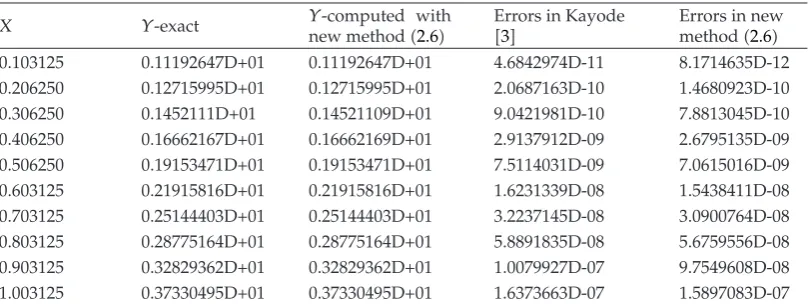
The accuracy of the proposed method2.6has been tested, and the results of the following two initial value problems are shown in the tables inAppendix Cbelow.
Test problem 1
y4 y20, 0≤x≤ π
2, y0 0,
y10 −1.1 72−50Π, y
20 1 144−100Π,
y30 1.2 144−100Π.
Theoretical solution:yx 1−x−cosx−1.2 sinx
144−100π .
4.1
Test problem 2
y4y12−yy#−4x2 ex1−4x x2, 0≤x≤1,
y0 1, y10 1, y20 3, y30 1.
Theoretical solution:yx x2 ex.
4.2
The test problems 1 and 2 were solved with method 2.6. The steplength h 1/32 is used for the purpose of comparison with the existing method Kayode3. The maximum errors obtained are compared with the method in Kayode3as shown in Tables1and2.
5. Conclusion
A predictor-corrector method whose main predictors3.2and3.6have the same order of accuracy with the corrector2.6was formulated. The method was tested to be consistent and zero stable with order six. It is remarkable to note that the main predictors are of the same order 6 as that of the method with comparable error constants. This, to a large extent, reduces the effects that global error could have on the accuracy of the method.
Table 1: Comparison of errors in Kayode3and new method2.6for Problem 1.
X Y-exact Y-computed with
new method2.6
Errors in Kayode
3 Errors in newmethod2.6
0.103125 0.13007993D-02 0.13007993D-02 0.49873300D-15 0.48355417D-16
0.206250 0.25317732D-02 0.25317732D-02 0.67654216D-15 0.13933299D-15
0.306250 0.36524788D-02 0.36524783D-02 0.31350790D-14 0.66893539D-15
0.406250 0.46959523D-02 0.46959523D-02 0.94360283D-14 0.20129384D-14
0.506250 0.56576413D-02 0.56576413D-02 0.22116857D-13 0.46736053D-14
0.603125 0.65077534D-02 0.65077534D-02 0.43379363D-13 0.91874598D-14
0.703125 0.72983134D-02 0.72983134D-02 0.77870869D-13 0.16069038D-13
0.803125 0.79985187D-02 0.79985187D-02 0.12863495D-12 0.25407974D-13
0.903125 0.86072451D-02 0.86072451D-02 0.19927116D-12 0.38108926D-13
1.003125 0.91242822D-02 0.91242822D-02 0.29323245D-12 0.54051538D-13
Table 2: Comparison of errors in Kayode3and new method2.6for Problem 2.
X Y-exact Y-computed with
new method2.6
Errors in Kayode
3 Errors in newmethod2.6
0.103125 0.11192647D 01 0.11192647D 01 4.6842974D-11 8.1714635D-12
0.206250 0.12715995D 01 0.12715995D 01 2.0687163D-10 1.4680923D-10
0.306250 0.1452111D 01 0.14521109D 01 9.0421981D-10 7.8813045D-10
0.406250 0.16662167D 01 0.16662169D 01 2.9137912D-09 2.6795135D-09
0.506250 0.19153471D 01 0.19153471D 01 7.5114031D-09 7.0615016D-09
0.603125 0.21915816D 01 0.21915816D 01 1.6231339D-08 1.5438411D-08
0.703125 0.25144403D 01 0.25144403D 01 3.2237145D-08 3.0900764D-08
0.803125 0.28775164D 01 0.28775164D 01 5.8891835D-08 5.6759556D-08
0.903125 0.32829362D 01 0.32829362D 01 1.0079927D-07 9.7549608D-08
1.003125 0.37330495D 01 0.37330495D 01 1.6373663D-07 1.5897083D-07
The methods3.2and3.6developed as main predictors are of the same order of ac-curacy with the corrector2.6. The method in Kayode 3has predictors of lower order of accuracy, this accounts for an improvement of method2.6over that of3as compared in the maximum errors shown in Tables1and2.
Appendices
A. The values ofajs
a0yn−a1xn−a2x2n−a3x3n−a4x4n−a5x5n−a6x6n−a7x7n,
a1 1 h
yn 1−yn
−a22xn h
−a33x2n 3hxn h2
−a44x3
n 6hx2n 4h2xn h3
−a55x4
n 10hx3n 10h2xn 5h3xn h4
−a66x5n 15hx4n 20h2x3n 15h3x2n 6h4xn h5
−a77x6n 21hx5n 35h2x4n 35h3x3n 21h4xn27h5xn h6
[image:6.600.99.504.300.452.2]a2 1 2h2
yn 2−2yn 1 yn
−a33xn 3h
−a46x2n 12hxn 7h2
−a510x3n 30hx2n 35h2xn 15h3
−a615x4n 60hxn3 105h2xn2 90h3xn 31h4
−a721x5n 105hx4n 245h2x3n 315h3x2n 217h4xn 63h5
,
a3 1 6h3
3yn 3−3yn 23yn 1−yn
−a44xn 6h
−a510x2
n 30hxn 25h2
−a620x3
n 90hx2n 150h2xn 90h3
−a735x4n 210hx3n 525h2x2n 630h3xn 301h4
,
a4fn 1
24 −5a5xn h−15a6
x2
n 2hxn h2
−35a7x3n 3hx2n 3h2xn h3
,
a5 1
240h
fn 3−fn 1
−6a6xn 2h
−21a7
x2n 4hxn 91
21h 2
,
a6 1
2880h
fn 5−2fn 3 fn 1
−7a6xn 3h
,
a7 1
20160h{12
yn 4−4yn 3 6yn 2−4yn 1 yn
h4fn 5−8fn 3−5fn 1
.
A.1
B. Coefficientsαjxandβjx
α0t 1
1680
132t 98t2−126t3−105t4−7t5 7t6 t7,
α1t − 1 420
272t 308t2−56t3−105t4−7t5 7t6 t7,
α2t 1 280
552t 658t2 14t3−105t4−7t5 7t6 t7,
α3t − 1 420
1392t 1148t2 84t3−105t4−7t5 7t6 t7,
α4t 1
1680
1680 3212t 1778t2 154t3−105t4−7t5 7t6 t7,
β1t 1
20160
−240t 284t2 630t3 420t4 35t5−28t6−5t7,
β3t 1
10080
1824t 3920t2 2814t3 735t4−14t5−35t6−4t7,
β5t 1
20160
48t 196t2 294t3 210t4 77t5 14t6 t7.
First derivative ofαjxandβjx:
α0t 1 1680h
132 196t−378t2−420t3−35t4 42t5 7t6,
α1t − 1 420h
272 616t−168t2−420t3−35t4 42t5 7t6,
α2t 1 280h
552 1316t 42t2−420t3−35t4 42t5 7t6,
α3t − 1 420h
1392 2296t 252t2−420t3−35t4 42t5 7t6,
α4t 1 1680h
3212 3556t 462t2−420t3−35t4 42t5 7t6,
β1t 1 20160h
−240 56t 1890t2 1680t3 175t4−168t5−35t6,
β3t
1 10080h
1824 7820t 8442t2 2940t3−70t4−210t5−28t6,
β5t 1 20160h
48 392t 882t2 840t3 385t4 84t5 7t6.
B.2
Second derivative ofαjxandβjx:
α0t 1 1680h2
196−756t−1260t2−140t3 210t4 42t5,
α1t − 1 420h2
616−336t−1260t2−140t3 210t4 42t5,
α2t 1 280h2
1316 84t−1260t2−140t3 210t4 42t5,
α3t − 1 420h2
2296504t−1260t2−140t3 210t4 42t5,
α4t 1 1680h2
3556924t−1260t2−140t3 210t4 42t5,
β1t 1 20160h2
56 3780t 5040t2 700t3−840t4−210t5,
β3t 1 10080h2
7820 16884t 8820t2−280t3−1050t4−168t5,
β5t 1 20160h2
392 1764t 2520t2 1540t3420t4 42t5.
Third derivative ofαjxandβjx:
α0t 1 1680h3
−756−2520t−420t2 840t3 210t4,
α1t − 1 420h3
−336−2520t−420t2 840t3 210t4,
α2t 1 280h3
84−2520t−420t2 840t3 210t4,
α3t − 1 420h3
5044−2520t−420t2 840t3 210t4,
α4t 1 1680h3
924−2520t−420t2 840t3 210t4,
β1t 1 20160h4
3780 10080t 2100t2−3360t3−1050t4,
β3t 1 10080h4
16884 17640t 2100t2−3360t3−1050t4,
β5t 1 20160h4
1764 5040t 4620t2 1680t3 2100t4.
B.4
C. Taylor series
yn i≡y
xn ih ∼
yxn
ihy1x n
ih2 2! y
2x n
ih3 3! y
3x n
ih4 4! fn
ih5 5! f
1
n · · ·,
yn1i≡y1xn ih ∼
y1xn
ihy2xn
ih2 2! y
3x
n
ih3 3! fn
ih4 4! f
1
n ih 5
5! f 2
n · · ·,
yn2i≡y2xn ih ∼
y2xn
ihy3xn
ih2 2! fn
ih3 3! f
1 n ih
4
4! f 2 n ih
5
5! f 3 n · · ·,
yn3i≡y3x n ih
∼
y3x n
ihf ih 2
2! f 1
n ih 3
3! f 2
n ih 4
4! f 3
n · · ·.
C.1
Noting that in1.1y4x
n fn, yn4 j fnj, j 0,1,2, . . . , fn0 fn, andfnj fjxn, yn, yn1, yn2, yn3, the values offn1, fn2are obtained by partial derivative technique as
f1 df
dx
∂f
∂x y
1∂f
∂y y
2 ∂f
∂y1 y3
∂f ∂y2 f
∂f ∂y3
,
f2 d 2f
dx2 2
Ay1 By2 Cy3 Df E F,
where
A ∂
2f
∂x∂y y
2 ∂2f
∂y∂y1 y
3 ∂2f
∂y∂y2 f ∂2f ∂y∂y3,
B ∂ 2f
∂x∂y y
3 ∂2f
∂y1∂y2 f ∂2f ∂y1∂y3,
C ∂
2f
∂x∂y2 f ∂2f ∂y2∂y3,
D ∂
2f
∂x∂y3,
Ey2∂f
∂y y
3 ∂f
∂y1 f
∂f ∂y2 f
∂f ∂y3,
F∂ 2f
∂x2
y12∂ 2f
∂y2
y22 ∂ 2f
∂y12
y32 ∂ 2f
∂y2 f
2 ∂2f
∂y32.
C.3
References
1 C. E. Abhulimen and F. O. Otunta, “A sixth order multiderivative multistep methods for stiffsystem of differential equations,” International Journal of Numerical Mathematics, vol. 1, no. 2, pp. 248–268, 2006.
2 R. P. K. Chan, P. Leone, and A. Tsai, “Order conditions and symmetry for two-step hybrid methods,”
International Journal of Computer Mathematics, vol. 81, no. 12, pp. 1519–1536, 2004.
3 S. J. Kayode, “An order six zero-stable method for direct solution of fourth order ordinary differential equations,” American Journal of Applied Sciences. In press.
4 J. D. Lambert, Computational Methods in Ordinary Differential Equations, John Wiley & Sons, London,
UK, 1973.
5 D. O. Awoyemi, “A new sixth-order algorithm for general second order ordinary differential equa-tions,” International Journal of Computer Mathematics, vol. 77, no. 1, pp. 117–124, 2001.
6 D. O. Awoyemi, “A P-stable linear multistep method for solving general third order ordinary diff er-ential equations,” International Journal of Computer Mathematics, vol. 80, no. 8, pp. 987–993, 2003.
7 D. O. Awoyemi and S. J. Kayode, “An optimal order continuous multistep algorithm for initial value problems of special second order differential equations,” Journal of the Nigerian Association of
Mathe-matical Physics, vol. 6, pp. 285–292, 2002.
8 R. A. Bun’ and E. D. Vasil’ev, “A numerical method for solving differential equations with an arbitrary order of derivatives,” Computational Mathematics and Mathematical Physics, vol. 32, no. 3, pp. 317–330, 1992.
9 S. O. Fatunla, Numerical Methods for Initial Value Problems in Ordinary Differential Equations, Computer
Science and Scientific Computing, Academic Press, Boston, Mass, USA, 1988.
10 G. Pittaluga, L. Sacripante, and E. Venturino, “A collocation scheme for linear third order differential equations,” Quaderno, N. 32, 2004.
11 I. Jacques and C. Judd, Numerical Analysis, Chapman & Hall, London, UK, 1987.
12 S. J. Kayode and D. O. Awoyemi, “A 5-step maximal order method for direct solution of second order ordinary differential equations,” Journal of the Nigerian Association of Mathematical Physics, vol. 9, pp. 279–284, 2005.
13 D. O. Awoyemi, “An algorithmic collocation approach for direct solution of special and general fourth-order initial value problems of ordinary differential equations,” Journal of the Nigerian
Asso-ciation of Mathematical Physics, vol. 6, pp. 271–284, 2002.
14 D. O. Awoyemi and S. J. Kayode, “Maximal order multiderivative collocation method for direct solu-tion of fourth order initial value problems of ordinary differential equations,” Journal of the Nigerian