Volume 2009, Article ID 539187,10pages doi:10.1155/2009/539187
Research Article
Exact Solutions and Localized Structures for
Higher-Dimensional Burgers Systems
Yan-ze Peng
School of Mathematics and Statistics, Wuhan University, Wuhan, 430072, China
Correspondence should be addressed to Yan-ze Peng,[email protected]
Received 3 July 2009; Revised 10 December 2009; Accepted 23 December 2009
Recommended by Prabir Daripa
A21dimensional Burgers equation and a coupled higher dimensional Burgers system is studied by the singular manifold method. The B¨acklund transformations are obtained. Some interesting exact solutions are given. Then localized structures, such as dromion and solitoff, are found, and their interaction properties are numerically studied. The fusion phenomena of two dromions, a dromion and a solitoff, are for the first time reported.
Copyrightq2009 Yan-ze Peng. This is an open access article distributed under the Creative Commons Attribution License, which permits unrestricted use, distribution, and reproduction in any medium, provided the original work is properly cited.
1. Introduction
The solitary wave solutions of11dimensional PDEs have been studied quite well and widely applied in many fields of physics 1, 2. In 21 dimensional, some significant nonlinear physical models such as the Kadomtsev-Petviashvili KP equation 3, Davey-StewartsonDSequation4and so forth. have been established. And some special types of localized solutions, dromions and solitoffs, for example, are obtained for these higher-dimensional models by means of different appropriates5,6. Dromions are exact, localized solutions of21dimensional evolution equations and decay exponentially in all directions. Solitoffs constitute an intermediate state between dromions and plane solitons, since they decay exponentially in all directions except a preferred one. Although some generalized dromion and solitoff structures have been exposed 7, 8, the construction of localized excitations in21dimensions is still a challenging and rewarding problem.
In this paper, we consider the construction of localized structures in a 2 1 -dimensional Burgers equation9:
and a coupled higher-dimensional Burgers system of the form10,11
utuxxuyy2uux2vuy,
vtvxxvyy2uvx2vvy. 1.2
Equation 1.1 reduces to the well-known Burgers equation when y x. Recently, Kaya and Yokus 12 obtained some plane solitary wave solutions by a modified Adomian’s decomposition method. However, localized structures of 1.1 and1.2have not yet been reported, to our knowledge.
The organization of the paper is as follows. InSection 2, a general functional separation solution containing two arbitrary functions is obtained for1.1. Equation1.2is transformed into a single heat equation by a function transformation in Section 3. Exact solutions and localized structures are discussed in Section 4, and their interaction properties are numerically studied. The conclusion and discussion are given inSection 5.
2. A General Solution to
1.1
Under the transformationuy vx,1.1is converted into a set of couple of nonlinear partial differential equations:
utuxyuuyuxv0,
uy vx.
2.1
According to the singular manifold method13,14, we truncate the Painlev´e expansion of
2.1at the constant level term
uϕ−1u 0u1,
vϕ−1v 0v1,
2.2
where ϕ is the singular manifold, and {u1, v1} is an arbitrary seed solution of 2.1. Substituting2.2into2.1and equating the coefficients of like powers ofϕyield
u0ϕx, v0ϕy, 2.3
whereϕsatisfies the equation
ϕtϕxyu1ϕyv1ϕx0, 2.4
which is called the singular manifold equation. Equations2.2,2.3, and2.4constitute an auto-B¨acklund transformation for2.1in terms of the singular manifoldϕ. If we takeu1ϕ,
v1∂−x1ϕy, then
u ϕx
whereϕsatisfies
ϕtϕxyϕϕyϕx∂−x1ϕy0. 2.6
Equations2.5and2.6are another auto-B¨acklund transformation for1.1. If we takeu1 0,v1 0, the Cole-Hopf type transformation or hetero-B¨acklund transformation
u ϕx
ϕ , 2.7
whereϕsatisfies
ϕtϕxy 0, 2.8
is obtained for 21-dimensional Burgers equation1.1. Now, we take the special seed solution as
u10, v1v1
y, t, 2.9
wherev1y, tis an arbitrary function of indicated variables. It can be directly checked that
2.4with2.9has the nonlinear separation solution
ϕexgy, thy, 2.10
withgy, tandhybeing arbitrary functions of indicated variables if we take
v1 −
gygt
g . 2.11
Thus, the direct calculation from 2.2, 2.3,2.9, and 2.10 yields a general functional separation solution of1.1
u e
xg
exgh, 2.12
withgy, tandhybeing arbitrary functions of indicated variables. The solution generated this way involves two arbitrary functions of space and time variables without any restriction. This implies that we can study a large diversity of solution structures for the 2 1 -dimensional Burgers equation 1.1by selecting appropriately these arbitrary functions in
2.12. It is necessary to point out that the21-dimensional Burgers equation1.1possesses some special types of localized coherent structures for the following potential field:
w≡uy gyh−ghy
ex/2ge−x/2h2, 2.13
3. The Linearization of
1.2
Through a similar analysis, we obtain the following auto-B¨acklund transformation of1.2:
u ϕx ϕ u1,
v ϕy ϕ v1,
3.1
where{u1, v1}is the seed solution to1.2andϕsatisfies the equation
ϕtϕxxϕyy2u1ϕx2v1ϕy, 3.2
with the constraintu1yv1x. Taking the seed solutionu1 ϕ, v1∂−x1ϕy, one obtains a new
B¨acklund transformation2.5, along withvϕy/ϕ∂−1
x ϕy, for1.2withϕsatisfying
ϕtϕxxϕyy2ϕϕx2ϕy∂−x1ϕy. 3.3
If taking the trivial seed solutionu1 v10, the Cole-Hopf type transformation
u ϕx ϕ ,
v ϕy ϕ ,
3.4
withϕsatisfying
ϕtϕxxϕyy 3.5
is obtained for 1.2. Thus, the nonlinear equation 1.2 is linearized into 3.5 by the transformation3.4. Through3.5, one may obtain many interesting solution structures of
1.2. However, the coupled higher-dimensional Burgers system1.2possesses special types of localized coherent structures for the potential fieldw≡uy, rather than the physical fieldu
orvitself.
4. Special Exact Solutions and Localized Structures for
1.1
and
1.2
By selecting appropriately these arbitrary functions in2.12, we can study many interesting solution structures for the2 1-dimensional Burgers equation1.1. Two new cases are considered as an illustrative example, and others can be obtained in a similar way to that in
9,13.
Case 1. We haveg exptanhl1y−ω1t exptanhl2y−ω2t≡exptanhξ1 exptanhξ2,
0.1 0 −5
0
5
−5 0
5
w
x
y t−5
a
0.3 0.2
0.1 0 −5
0
5 −4
−2 0
2 4
w
x
y t0
b
0.3 0.2
0.1 0 −5
0
5
−5 0
5
w
x
y t5
[image:5.600.124.475.94.363.2]c
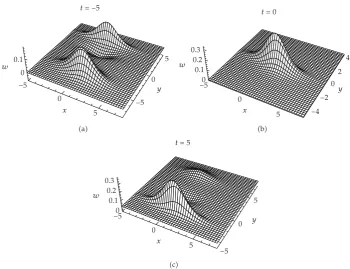
Figure 1: The evolution of three dromions-like for4.2.
From2.12, one gets an exact solution of1.1
ulnexpxexptanhξ1 exptanhξ2
exptanhξ Ax. 4.1
It follows from2.13that
wlnexpxexptanhξ1 exptanhξ2
exptanhξ Axy, 4.2
which is a three-dromion-like structuretwo dromions-like and one anti-dromion-like, ant its evolution with time is shown in Figure 1with parametersl1 1, ω1 1,l2 2, ω2
−1, l1, A4, andt−5, 0, 5, respectively. One can easily see that the interaction of three dromions-like is inelastic.
Case 2. We havegexpsechξ1 expsechξ2,hexpsechξ A.
Another exact solution of1.1reads
ulnexpxexpsechξ1 expsechξ2
expsechξ Ax. 4.3
The corresponding localized structure is
wlnexpxexpsechξ1 expsechξ2
which is a four dromions-like solution. Its evolution figures are very similar to those in Case1
and thus omitted. In what follows, the stress is played on solution structures for the coupled higher-dimensional Burgers system1.2. For the exact solution3.4of1.2, the functionϕ
must satisfies3.5. Some meaningful cases are considered.
Case 3. We haveϕ1ekxlyk2l2t
.
From3.4, one obtain
u 1
2k
1tanh1 2
kxlyk2l2t ,
v 1
2l
1tanh1 2
kxlyk2l2t ,
4.5
a shock wave solution of1.2.
Case 4. We haveϕ1ekxk2t
elyl2t
.
It follows from3.4that
u ke
kxk2t
1ekxk2t
elyl2t,
v le
lyl2t
1ekxk2t
elyl2t,
4.6
a new exact solution for1.2.
Case 5. We haveϕ1ekxk2t
elyl2t
Aekxlyk2l2t
.
From3.4, one gets another new exact solution for1.2
u ke
kxk2t
kAekxlyk2l2t
1ekxk2t
elyl2t
Aekxlyk2l2t,
v le
lyl2t
lAekxlyk2l2t
1ekxk2t
elyl2t
Aekxlyk2l2t.
4.7
Note thatk, l, Aare arbitrary constants, whereAguarantees that the expression4.7has no singularity. For exact solution4.7, the corresponding localized structure is
wln1ekxk2telyl2tAekxlyk2l2t
xy. 4.8
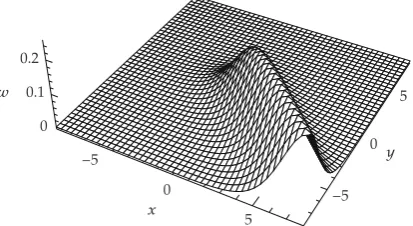
[image:6.600.89.527.128.585.2]When A /0, 4.8 is a one dromion structure. Its typical spatial structure is depicted in
Figure 2 with the parameters k 1, l 1, t 0 and A 2. When A 0, 4.8 is a one solitoffstructure. Its typical spatial structure is shown inFigure 3with the parameters
0.04 0.03 0.02 0.01 0
−5
0
5
−5 0
5
w
x
[image:7.600.196.406.101.213.2]y
Figure 2: A typical spatial structure for4.8withA2.
0.2 0.1
0 −5
0
5
−5 0
5
w
x
y
Figure 3: A typical spatial structure for4.8withA0.
phenomena for localized structures of1.2, which are not reported yet in literature to our knowledge.
Case 6. We have ϕ 1 ekxk2t
el1yl21t el2yl22t A1ekxl1yk2l12t A2ekxl2yk2l22t
A3el1l2yl1l2
2t
.
In this case, the localized structure of1.2reads
wln1ekxk2tel1yl21tel2yl22tA1ekxl1yk2l12t
A2ekxl2yk2l22tA3el1l2yl1l22t
xy,
4.9
which is a two-dromion-likea dromion-like and an anti-dromion-likestructure. And its evolution is illustrated inFigure 4with the parametersk 1, l1 −1, l2 2, A1 1, A2 2, A33 andt−5, 0, 5, respectively. From the figures, we see that two dromions-like are fused into a dromion-like after their interaction.
Case 7. We haveϕ1ekxk2t
[image:7.600.198.405.267.380.2]0.2 0.1 0 −0.1 −0.2 −5
0 5
10 15
20 0
10 20
w
x
y t−5
a
0.1 0.05 0 −0.05
−5 0
5
−5 0
5
w
x
y t0
b
0.1 0.05
0 −15
−10 −5
0
5−15 −10
−5 0
5
w
x
y t5
[image:8.600.117.479.82.377.2]c
Figure 4: The fussion phenomenon of two dromions-like for4.9.
This case is obtained from the above one through dropping the third exponential term. Thus, the localized structure is
wln1ekxk2tel1yl12tA1ekxl1yk2l21t
A2ekxl2yk
2l2
2tA3el1l2yl1l22t
xy,
4.10
which is a combination structure of one dromion-like and one solitoff-like. And its evolution is shown inFigure 5with the same parameter values as those inFigure 4. One can easily see from the figures that a dromions-like and a solitoff-like are fused into a solitoff-like after their interaction.
5. Conclusion and Discussion
0.2 0 −0.2
−5 0
5 10
15 20
0 10
20
w
x
y t−5
a
0.2 0.1
0 −5
0 5
−5 0
5
w
x
y t0
b
0.6 0.4 0.2 0 −15
−10 −5
0
5−15 −10
−5 0
5
w
x
y t5
[image:9.600.127.473.93.398.2]c
Figure 5: The fussion phenomenon of a dromion-like and a solitoff-like for4.10.
interaction of three dromions-like is inelastic. As far as1.2is concerned, it is found that two dromions-like can be fused into one while a dromion-like and a solitoff-like can be fused into a solitoff-like, which are not reported previously in the literature.
The singular manifold method is a powerful tool for obtaining exact solutions of nonlinear PDEs. Usually, the seed solution is taken as the trivial one in order to get the solution of the singular manifold equation. Due to the introduction of two arbitrary functions in our singular manifold function, one can study a variety of solution structures by choosing appropriately these arbitrary functions. Even more, the equation of interest may be linearized.
Acknowledgment
This work is supported by Research Fund for the Doctoral Program of Higher Education of Chinano. 20070486094.
References
1 I. Loutsenko and D. Roubtsov, “Critical velocities in exciton superfluidity,” Physical Review Letters, vol. 78, no. 15, pp. 3011–3014, 1997.
3 B. B. Kadomtsev and V. I. Petviashvili, “On the stability of solitary waves in weakly dispersive media,” Soviet Physics Doklady, vol. 15, pp. 539–541, 1970.
4 A. Davey and K. Stewartson, “On three-dimensional packets of surface waves,” Proceedings of the Royal Society A, vol. 338, pp. 101–110, 1974.
5 A. S. Fokas and P. M. Santini, “Dromions and a boundary value problem for the Davey-Stewartson 1 equation,” Physica D, vol. 44, no. 1-2, pp. 99–130, 1990.
6 J. Hietarinta, “One-dromion solutions for generic classes of equations,” Physics Letters A, vol. 149, no. 2-3, pp. 113–118, 1990.
7 Y. Z. Peng, “Periodic waves and periodic solitons and their interactions for a21-dimensional KdV equation,” Progress of Theoretical Physics, vol. 113, no. 5, pp. 927–933, 2005.
8 Y. Z. Peng and E. V. Krishnan, “The singular manifold method and exact periodic wave solutions to a restricted BLP dispersive long wave system,” Reports on Mathematical Physics, vol. 56, no. 3, pp. 367–378, 2005.
9 J. M. Burgers, The Nonlinear Diffusion Equation, Reidel, Dordrecht, The Netherlands, 1974.
10 K. M. Tamizhmani and P. Punithavathi, “Similarity reductions and Painlev´e property of the coupled higher-dimensional Burgers’ equation,” International Journal of Non-Linear Mechanics, vol. 26, no. 3-4, pp. 427–438, 1991.
11 M. Salerno, “On the phase manifold geometry of the two-dimensional Burgers equation,” Physics Letters A, vol. 121, no. 1, pp. 15–18, 1987.
12 D. Kaya and A. Yokus, “A decomposition method for finding solitary and periodic solutions for a coupled higher-dimensional Burgers equations,” Applied Mathematics and Computation, vol. 164, no. 3, pp. 857–864, 2005.
13 J. Weiss, M. Tabor, and G. Carnevale, “The Painlev´e property for partial differential equations,” Journal of Mathematical Physics, vol. 24, no. 3, pp. 522–526, 1983.