http://ijmms.hindawi.com © Hindawi Publishing Corp.
HOT-PRESSING PROCESS MODELING FOR MEDIUM
DENSITY FIBERBOARD (MDF)
NORBERTO NIGRO and MARIO STORTI
(Received 13 December 2000 and in revised form 14 June 2001)
Abstract.We present a numerical solution for the mathematical modeling of the hot-pressing process applied to medium density fiberboard. The model is based on the work of Humphrey (1982), Humphrey and Bolton (1989), and Carvalho and Costa (1998) with some modifications and extensions in order to take into account mainly the convective effects on the phase change term and also a conservative numerical treatment of the resulting system of partial differential equations.
2000 Mathematics Subject Classification. 65M60, 82C70, 76S05, 76T30.
1. Hot-pressing mathematical model. Hot pressing is the process in which a mat-tress composed of wood fibers and resin is cured by applying heat and pressure in a press (seeFigure 1.1). Continuum and batch presses do exist, and one of the main issues in reducing the cost of the final product is to reduce the press cycle time. In order to improve the heat transfer between the press platens and the inner layers, some amount of water is added to the mat. Another issue is to adjust the parameters and the temperature history of the cycle in order to obtain a given density profile in the board. Normally, it is desirable to have lower densities at the center of the board in order to increase the mechanical rigidity for a given total mass per unit area. Predict-ing the influence of these parameters, namely water content, press cycle duration, and history (pressure and temperature) is one of the main concerns of numerical models. Many numerical models have been reported to help in predicting the influence of the process parameters in the final product. Among the most complete, we can find the finite difference 2D (axisymmetrical) model presented by Humphrey [5] and, more recently the 3D model of Carvalho and Costa [3]. Both consider conduction, phase change of water from the adsorbed to the vapor state and convection. The stress devel-opment and the determination of the density profile are not included in these models. In this paper, we present a numerical model which includes all these features and makes some corrections to the energy balance equation, as presented in [3]. The model is based on the finite element model, so that it allows for a more versatile definition of geometry, dimensionality and, eventually, coupling with other packages. It also will allow the use of adaptive refinement, which may be an important issue at the lateral borders, where the hot steam flows from the board to the ambient. However, this issue is not considered in this paper.
z
r
heat heat
heat heat
mattress
upper press platen
lower press platen
moisture
and
heat
moisture
and
heat
Figure1.1. Hot pressing process description.
via“averaged equations” so that the intricate microstructure results in a continuum with averaged properties. The averaged equations and properties can be deduced in a rigorous way through the theory of mixtures and averaging operators (see Whitaker [14]).
1.2. Energy balance. We will not enter in the details of all the derivations but only for the averaged energy balance equation, which can be found in the appendix. The referred equation is
ρsCp
∂T ∂t = ∇·
k∇T−ρvVg
CpvT+λ+Ql
−m˙λ+Ql
, (1.1)
whereTis the temperature,tthe time,Cpthe specific heat,kthe thermal conductivity,
∇the gradient operator,ρsthe density of the dry board (solid phase),ρvvapor density,
Vgthe volume averaged gas velocity, that is,
Vg=vg, (1.2)
wherevgis the velocity averaged on the phase (see the appendix),Cpvthe specific heat
of vapor, ˙mthe evaporation rate,λthe latent heat of vaporization of free water, andQl
the adsorption heat. The main difference between this equation and that presented by both Carvalho and Costa [3] and Humphrey [5] is the addition of the water evaporation heat term in the convection term instead of considering the phase change effect only on the temporal term. This term should be included because both phases, the solid material and the vapor are in relative motion and we think that its influence is not negligible in a high temperature process.
1.3. Steam mass balance. Carvalho and Costa [3] proposed the following steam mass conservation equation
˙
m=MMw
R ∇·
−Dv∇
P
v
T
+1Vg
Pv
T
, (1.3)
where MMwis the molecular weight of water,Rthe gas constant,the board porosity,
Dv the diffusivity of water vapor in the air/vapor mixture, andPv the vapor partial
pressure. Considering that the steam is treated as an ideal gas, then
Pv
T =MMw −1Rρ
v, (1.4)
so it may be written, assumingconstant, as
˙
This expression is preferable to (1.3) because it is written in a conservative form that is more agreeable for a numerical treatment. The left-hand side term represents the mass interfacial transport and those in the right-hand side take into account the mass diffusion and the mass convection. However, it should be noted that this last expres-sion does not have a temporal term as every consistent balance equation does. For example, if evaporation is not considered, then (1.5) is valid only for a steady situ-ation, which is not the case in general. Then, we rewrite the steam mass balance as
∂ρv ∂t = ∇
Dv∇ρv−Vgρv
+m.˙ (1.6)
This is another difference between our model and that proposed by Carvalho and Costa [3].
1.4. Gas mixture mass balance. Finally, because the gas phase is composed of two main constituents, steam and air, we may use an additional equation for the mass transport of the whole gas phase. Carvalho and Costa [3] considered
∂P ∂t = −
1
∇·
−Kg
µ P T∇P
T+ m˙
MMa
T R+P T
∂T
∂t, (1.7)
wherePis the pressure of the gas phase andKgthe board permeability tensor. Again,
assuming ideal gas law as the state equation for this phase,
∂ ∂t
P
T
= − R
MMa∇·
−Kg
µ ρg∇P
+ mR˙
MMa
, (1.8)
we arrive to
∂ρg
∂t = −∇·
ρgVg+m.˙ (1.9)
In order to close the system of equations we need to introduce a relationship be-tween ˙mand∂Pv/∂t. Consider the steam mass balance (1.6) and the relation
ρsH=ρv+ρL, (1.10)
that represents the fact that the board moisture contentHis composed of vapor and bound waterρL. If we assume that no liquid phase is considered, then bound water
may be transferred to the gas phase only (solid to steam). So
˙
m= −∂ρL
∂t , (1.11)
and then ρs ∂H ∂t = ∂ρv ∂t + ∂ρL
∂t = ∇·
Dv∇ρv−Vgρv
. (1.12)
The air mass balance equation can be obtained by subtracting (1.6) from (1.9)
∂ρa
∂t = ∇·
−Dv∇ρv−Vgρa
. (1.13)
Due to the fact that the mean macroscopic diffusive fluxes should be null
the air mass balance equation is transformed in the following expression:
∂ρa
∂t = ∇·
Da∇ρa−Vgρa
, (1.15)
which is very similar to (1.6) but here valid for the air. Obviously, the air transport equation has no evaporation term.
2. Summary of equations and boundary conditions. In order to clarify the math-ematical model that is finally used for the simulation of hot-pressing process, we present the following brief summary of partial differential equations.
•Energy balance equation
ρsCp
∂T ∂t = ∇·
k∇T−ρvVg
CpvT+λ+Ql
−m˙λ+Ql
. (2.1)
• Water content balance equation
ρs
∂H ∂t = ∇·
Dv∇ρv−Vgρv
. (2.2)
• Air mass balance equation
∂ρa
∂t = ∇·
Da∇ρa−Vgρa. (2.3)
The boundary conditions are the following. • At the press platen
T=Tplaten(t), air/water mixture in equilibrium with platen temperature, Vg·ˆn=0, no mass flow across the platen,
∂ρa
∂z =0, no air diffusion across the platen, ∂ρv
∂z =0, no vapor diffusion across the platen.
(2.4)
where ˆnis the normal to the platen surface.
• At the center line (r=0), axial symmetry for all variables
∂T ∂r =0,
∂H ∂r =0,
∂ρa
∂r =0. (2.5)
• At the mid plane (z=0), symmetry for all variables
∂T ∂z =0,
∂H ∂z =0,
∂ρa
∂z =0. (2.6)
• At the exit boundary (r=Rext), ∂T
∂r =0, null diffusive heat flux,
Pv=Pv,atm, equilibrium with external air/water mixture, Pa=Pa,atm, equilibrium with external air/water mixture.
3. Numerical method. The above system of equations contains three main un-knowns, the temperature, the moisture content, and the air density representing the dependent variables of the problem, also called the state variable. In this work we have used as independent variables the time and two spatial coordinates (3D problems may be computed much in the same way). Due to the physical and geometrical inherent complexity of this problem this may be computed only by numerical methods. For the spatial discretization we have employed finite elements with multilinear elements for all the unknowns. Due to the high convective effects, the numerical scheme was sta-bilized with the SUPG (for“Streamline Upwind-Petrov Galerkin”) formulation (see [2]), otherwise spurious oscillations arise. Once the spatial discretization is performed, the partial differential system of equations is transformed into an ordinary differen-tial system of equations like
˙
U=R(U ), (3.1)
whereUis the state vector containing the three unknowns in each node of the whole mesh. So, the system dimension is 3NwhereNis the number of nodes in the mesh. The numerical procedure is as follow: knowing the state vector at the current time(tn),
that is,Uj(tn)=[Tj, Hj, ρa,j](tn), wherejrepresents a specific node in the mesh. To
get the residual, right-hand side of (3.1), the following steps should be done: • Obtain air pressure from the gas state equation ((T , ρa)→Pa).
• Obtain relative humidity from sorption isotherms ((T , H)→HR).
• Compute saturated vapor pressure from Kirchoff expression (4.11) (T→Psat). • Compute vapor pressurePv=HRPsat.
• Obtain vapor density in air from vapor state equation(T , Pv)→ρv.
• Compute coefficients from additional constitutive laws (P , H, T ) → (D, Kg,
kx,y, Cp).
• Compute gradients ofT,Pfrom nodal values at the Gauss points using the finite element interpolation.
• Assemble the element residual contributions in a global vector.
Once the whole residual vector att=tnis computed, the unknown variables at the
next time step is updated with
Un+1=Un+∆tRUn. (3.2)
This kind of scheme, called explicit integration in time, is very simple to be imple-mented but it has two major drawbacks, one is the limitation of the time step to en-sure numerical stability and the other is the bad convergence rate for ill-conditioned system of equations. In this application the last disadvantage is very restrictive be-cause the characteristic times of each equation are very different. To circumvent this drawback we have implemented an implicit numerical scheme
Un+1−∆tRUn+1=Un, (3.3)
where the residue is computed at the new state variable U (tn+1)instead of using the current valueU (tn). The non-linearities and the time dependency of the state
This nonlinear equation inUn+1is solved by the Newton method, which requires the computation of the Jacobian
J=∂R
∂U. (3.4)
In order to avoid the explicit computation of the Jacobian, we compute an approximate one by finite differences,
J≈Jnum=
R(U+δU )−R(U )
δU . (3.5)
This can be done element-wise, so the cost involved is proportional to the number of elements in the mesh. In our application and despite of the ill-condition of the problem, we have found a good convergence at each time step, in average 4 iterations per time step to reduce 10 orders of magnitude in the global residue.
4. Physical and transport properties
4.1. Thermal conductivity. Following Humphrey [5], the influence of board den-sity, moisture content, and temperature on the thermal conductivity is considered as an independent correction factor obtained experimentally
κz=Fκ,HFκ,T
1.172×10⁻²+1.319×10⁻⁴ρs
,
Fκ,H=1+9.77×10⁻³(H−12),
Fκ,T=(T−20)×1.077×103+1,
(4.1)
whereκz is the thermal conductivity in the pressing direction in W/m◦K andρs is
the oven dry density of the material in Kg/m3. The moisture correction factorFκ,H
(see [5, 7]) assumes H, the moisture content of the board material, in %, and the temperature correction factorFκ,T (see [5,8]) assumesT in◦C.
4.1.1. Heat flux direction correction. By far the greater part of conductive heat translation takes place in the vertical plane. However, the energy lost from the mtress is largely the result of radial vapor migration from the center toward the at-mosphere. The associated horizontal relative humidity gradient leads to a horizontal temperature gradient. Even though this gradient is always lower than the vertical one, its influence should be taken into account if multidimensional analysis is required. Ward and Skaar [13] made experimental measurements, and they observed that at a first glance a factor of approximately 1.5 may be a good initial guess before doing some extra measurements. Then
κxy=1.5κz. (4.2)
flow through a porous medium under the influence of a given pressure gradient. Dif-ferent mechanisms may be involved in this flow, a viscous laminar flow, a turbulent flow and a slip or Knudsen flow. In this study only the first type is included with the assumption that Darcy’s law is obeyed. This may be written as
Vg= −
Kg
µg∇
p, (4.3)
where∇pis the driving force andvgis the flow variable,Kg/µgis called the
super-ficial permeability, withµgthe dynamic viscosity of the gas phase andKgthe specific
permeability.
The kinetic theory of gases suggests that at normal pressure the viscosity is inde-pendent of pressure and it varies as the square root of the absolute temperature,
µ∝√T , 103< p <106. (4.4)
Corrections with the absolute temperature are often considered by Sutherland law
µ=BTT+3/C2, (4.5)
withBandCcharacteristic constants of the gas or vapor,µin Kgm−1s−1. Values for
B andCare available from Keenan and Keyes [6]. For this application the following expression was adopted,
µ=1.112×10⁻⁵×(T+273.15)1.5
(T+3211.0) (4.6)
withT in◦C.
4.2.1. Variation of vertical permeability with board material density. Even though we consider that the press is closed and the density profile is set up and fixed, we include here some conclusions from Humphrey [5] with results obtained by Denisov et al. [4] for 19 mm boards and others from Sokunbi [10]. The data to be fitted are the following.
4.2.2. Horizontal permeability. Sokunbi measures included in [5, Figure 2.7] shows the relation between the board thickness in mm and horizontal permeability. For ap-proximately 15 mm board thickness andρs=586 Kg/m3, the horizontal permeability
is 59 times the vertical value, in agreement with the values assumed by Carvalho and Costa [3].
4.3. Steam in air diffusivity. The interdiffusion coefficient of steam in air can be calculated from the following semi-empirical equation (see Stanish et al. [11]),
Da=2.20×10⁻⁵
101325
P
T
273.15
, (4.7)
where the diffusivity is in m2/s, pressure in N/m2andT in◦K.
4.4. Vapor density. For the pressure range likely to occur during hot pressing ( between 103and 3×10⁵N/m2
Table4.1. Vertical permeability density correction data.
Mean density Mean vertical permeability Kg/m3 m2×1015
425 64
475 40
525 24
575 16
625 11
675 7
725 5
775 3
825 2
875 2
and vapor density may be assumed. For fitting experimental data, Humphrey [5] pro-posed the following expression:
ρv=Psat6.0×10−8HR, (4.8)
withρvin Kg/m3,Psatin N/m2, and the relative humidity HR in %. This can be deduced from the relative humidity definition
HR= Pv
Psat
, (4.9)
and applying ideal gas law for gaseous phase
Pv
ρv =
¯
R
MMwT
. (4.10)
Taking ¯R=8314 J/K mol/K and MMw=18 Kg/K mol withT≈360◦K we obtain (4.8).
4.5. Saturated vapor pressure. Following the Kirchoff expression with data pre-sented by Keenan and Keyes [6], we include here the following equation:
log10Psat=10.745−
2141.0
T+273.15
, (4.11)
withPsatin N/m2andT in◦C.
4.6. Latent heat of evaporation and heat of wetting. Using Clausius-Clapeyron equation in differential form and after some simplification, the latent heat of vapor-ization of free water may be written as
λ=2.511×10⁶−2.48×10³T , (4.12)
withλin J/Kg andT in◦C.
For the differential heat of sorption we follow Humphrey [5] who used (see Bramhall [1])
Ql=1.176×10⁶e−0.15H, (4.13)
4.7. Specific heat of mattress material. It is computed by adding the specific heat of dry wood and that of water according to the material porosity and assuming full saturation. The specific heat of dry mattress material is taken as 1357 J/Kg/K and the specific heat of water has been taken to be 4190 J/Kg/K. From Siau [9], the expression for specific heat of moist wood is
Cp=41800.268+0.0011(T−273.15)+H
1+H , (4.14)
whereT in◦K andHin %.
4.8. Porosity. According to Humphrey [5], the volume of voids within the region may be computed with
=Vvoids
V =
1−ρρ
s
, (4.15)
whereis the porosity,ρis the density of the region, andρsis the dry density of the
board material.
Carvalho and Costa [3] included the expression of Suzuki and Kato [12]
=1−ρs
1/ρf+yr/ρr
1+yr
, (4.16)
whereρr is the cure resin density, ρf is the oven dry fiber density, andyr is the
resin content (resin weight/board weight). In [3], the authors usedyr =8.5% with
ρf=900 Kg/m3andρr=1100 Kg/m3.
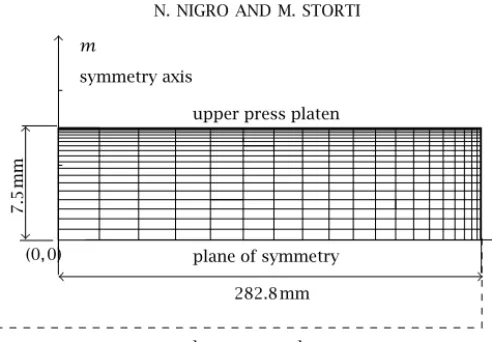
5. Numerical results. In this section, we present some results that can be com-pared with those reported in [5]. This numerical experiment allows the validation of the mathematical model and its numerical implementation for future applications to hot-pressing process simulation and control. This experiment consists of a round fiberboard of 15 mm of thickness and 0.2828 m of radius that according to its axi-symmetrical geometry needs as spatial coordinates only the radiusr and the axial coordinatez, assuming no variation in the circumferential coordinate. The axisym-metrical domain is discretized in 20×20 elements in each direction with a grading toward the press platen and the external radius as may be visualized inFigure 5.1. In order to follow the same assumptions as in that work we fixed the air density to a very low value(ρa≈10−6), as if the press was close with no air inside the fiberboard.
The boundary conditions are as inSection 2.
For the press platen temperature, we have applied a ramp from 30◦C at timet=0 to 160◦C att=72 s with a least square fitting from data in [5]. As initial conditions we have assumed a uniform temperature ofT (t=0)=30◦C in the whole solid material, with a uniform moisture content ofH=11%. The external atmosphere was considered to be atTatm=30◦C, HRatm=65%, in such a way that the internal moisture content is, at the initial state, in equilibrium with the external atmosphere.
m
r
symmetry axis
upper press platen
plane of symmetry 282.8 mm
lower press platen (0,0)
7
.
5m
m
Figure5.1. Finite element mesh.
0
symmetry plane
1 2 3 4 5 6 7 8
press platen
z(mm) 20
40 60 80 100 120 140 160
400 s 300 s
200 s 100 s
50 s 10 s
1 s
T(◦C)
Figure5.2. Axial temperature profile atr=0.
5.1. Original numerical experiment. Figure 5.2shows the temperature distribu-tion in time and the axial coordinate atr=0 (centerline). We can note the penetration in the axial direction of the temperature profile in time for t= 1,10,50,100,200,
300, and 400 s. Figure 5.3shows the same kind of plot for moisture content. Forr
not too close to the external radius, the problem is almost one-dimensional in thez
[image:10.516.130.376.61.232.2] [image:10.516.116.343.264.448.2]0
symmetry plane
1 2 3 4 5 6 7 8
press platen
z(mm) 0
2 4 6 8 10 12 14 16 18
400 s 300 s
200 s 100s 50 s
10 s 1s
H (%)
Figure5.3. Axial moisture content profile atr=0.
press platen symmetry plane press platen symmetry plane
0
symmetry plane
1 2 3 4 5 6 7 8
press platen
z(mm) 20
40 60 80 100 120 140 160 180 200
400 s 300 s
200 s 100 s 50 s 10 s
1 s
T(◦C)
Figure5.4. Axial temperature profile atr=R=0.2828 m.
the board at a given instant can be found by integrating the bound water content and the water in vapor phase. However, this last is negligible. We can see inFigure 5.3that the depression in water content near the board (for instance att=400 s) is larger than the water enrichment near the center plane. This is due to water migration from the center of the board to the external radius, where it flows to the external atmosphere.
The following figures show similar plots but at different locations: • Figure 5.4: temperature at external radius,
0
symmetry plane
1 2 3 4 5 6 7 8
press platen
z(m) 0
2 4 6 8 10 12
400 s 300 s
200 s 100 s
50 s
10 s 1 s
H (%)
Figure5.5. Axial moisture content profile atr=R=0.2828 m.
0
symmetry axis
0.05 0.1 0.15 0.2 0.25 0.3 0.35 external radius
r(mm) 20
30 40 50 60 70 80 90 100 110
400 s 300 s
200 s
100 s 1 s=10 s=50 s
T(◦C)
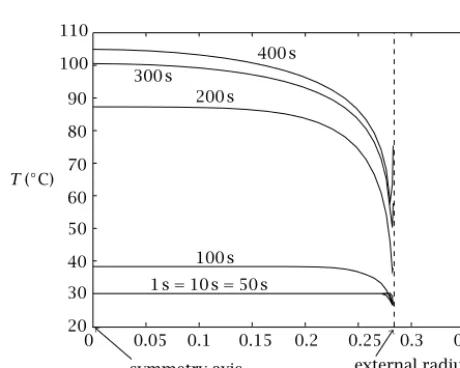
Figure5.6. Radial temperature profile atz=0.
• Figure 5.6: temperature at axial centerline(z=0), • Figure 5.7: moisture content at axial centerline(z=0), • Figure 5.8: moisture content at press platen.
Figure 5.9shows several isotherms att=200 s distributed in ther , zplane. Figure 5.10shows a three-dimensional view for moisture content represented by the third coordinate axis att=200 s as a function ofr , z.
[image:12.516.125.344.58.255.2] [image:12.516.122.352.305.489.2]0
symmetry axis
0.05 0.1 0.15 0.2 0.25 0.3 external radius
r(mm) 0
2 4 6 8 10 12 14
16 400 s 300 s
200 s
1 s=10 s=50 s=100 s
H (%)
Figure5.7. Radial moisture content profile atz=0.
0
symmetry axis
0.05 0.1 0.15 0.2 0.25 0.3 0.35 external radius
r(mm) 0
2 3 4 5 6 7 8
400 s 300 s 50 s 200 s 100 s
H (%)
1 s
10 s
Figure5.8.Radial moisture content profile at press platen.
5.2. Further numerical experiments. In [5], Humphrey included results for mois-ture and temperamois-ture in the vertical and radial directions at both central planes,r=0 andz=0, respectively. No mention about the vertical distribution atr=R=0.2828 m or about the moisture content at press platen. Moreover, he had used a uniform mesh of 10×10 elements without showing what happens at the last annuli of elements corresponding to the external radius.
symmetry plane r upper press platen
z
symmetry
axis
external
atmosphere
Figure5.9. Isotherms att=200 s (zandraxis not to scale).
8 6 4 2 0 0 2 4 6 8 10 12 14 16
0.35 0.30.250
.2 0.15 0.1 0.05 0
H (%)
z(mm)
r(m)
Figure5.10. 3D view for moisture content att=200 s.
problem, but it is due to large variations of the magnitude of vapor pressure and density at the boundary. In typical runs, vapor pressure varies from near 2 atm at the center of the board to 0.01 atm at the external radius. We think that this problem will be fixed if we solve for the air density also, but then a very fine grid will be necessary at the exit boundary, since large variations of the vapor molar fraction are expected (seeFigure 5.11). Molar fraction varies from nearly 100% at the interior of the mat to a 2% at the external atmosphere. This variation is produced in a thin layer of widthδ
δ
mat air Vapour partial pressure Total pressure
Figure5.11. Boundary layer in vapor partial pressure at external radius.
6. Conclusion. We presented a numerical model for the heat and mass transfer in the hot-pressing model of an MDF fiberboard. The model includes convective effects on the phase change term and also a conservative numerical treatment of the resulting system of partial differential equations. Convective effects are responsible of an increase in heat transfer from the platen to the center of the board due to water vapor evaporation and condensation. Two-dimensional simulations allow to estimate border effects.
Appendix
Derivation of the averaged energy balance equation. The microscopic energy bal-ance equation in the gas phase is
∂
∂t(ρh)+∇·(ρvh)= −∇·(k∇T ), (A.1)
wherehis enthalpy. For the other phases (solid and bound water) a similar expression holds, but neglecting the advective term. Applying the volume average operator [14], we arrive to the following equation averaged on the gas phase:
∂ ∂t
gρhg
+∇·gρhvg
= ∇·gk∇Tg
+Qg, (A.2)
whereg is the volumetric fraction of phaseg(i.e., gas) and Xg is the average of
quantityXon the volume occupied by phaseg,
Xg= 1
Ωg Ωg
X dΩ. (A.3)
The termQgis the total enthalpy flux through the solid-gas interfaceΓ
Qg=
Γ(ρh)g(v−w)·nˆdΓ, (A.4) where(X)g is the value of propertyX on the gside of the interface andw is the
velocity of the interface. Assuming thathgis constant on allΩg(for a certain volume
control) then
Qg= hg
Γ(ρ)g(v−w)·nˆdΓ= h
where ˙mis the rate of mass of water being evaporated. A common drawback of aver-aged equations is that, when products of variables likeρhappear in the microscopic equation, the average of the productρhgis obtained in the averaged equation. Now,
it is not true that
ρhg= ρghg, (A.6)
so that the averaged equation contains more unknowns than the original equation. A common assumption is that no correlation exists between variables and so (A.6) is approximately valid. This can be justified, for instance, if the variations of each quantity around the mean is small.
Then, applying the volume average operator over the gas, solid, and bound wa-ter phases and assuming no correlations between variables, we obtain the following averaged equations for the three phases:
∂ ∂t
gρghg
+∇·gρgvghg
= ∇·gk∇Tg
−mh˙ g, for the gas phase,
∂ ∂t
sρshs
= ∇·sk∇Ts
, for the solid phase,
∂ ∂t
lρlhl
=mh˙ l, for the liquid phase.
(A.7)
Also, the average operator is dropped from here on, and a subindexg ors implies averaging on that phase. Also,Vgthe volume averaged gas velocity is
Vg=
1 Ω Ωg
v dΩ=gvg. (A.8)
Note that in the body of the textVgis used instead ofvg. Now, summation of these
three equations gives
∂ ∂t
gρghg+sρshs+lρlhl+∇·gvgρghg
= ∇gk∇Tg+sk∇Ts
+m˙hl−hg
.
(A.9)
Now,
gk∇Tg+sk∇Ts=keff∇T, (A.10)
wherekeffis the average conductivity of the solid+water+gas mixture. The gas is assumed as an ideal mixture, so that the enthalpy is the sum of the enthalpy of its constituents, and neglect the contribution of the air constituent so that
ρghg=ρaha+ρvhv≈ρvhv. (A.11)
Taking a reference state for the enthalpy at a point on the adsorbed state
hv=Cpv
T−Tref
+λ+Ql. (A.12)
We also neglect the enthalpy of the gas phase with respect to the solid+water phases and put
sρshs+lρlhl=ρCpeff
whereρeff and Cpeff are averaged properties for the moist board, as a function of temperature and moisture content. Finally, the averaged equation is
∂ ∂t
ρCp
eff
T−Tref
+∇·gρvvg
Cpv
T−Tref
+λ+Ql
=∇·keffT )−m˙
λ+Ql
.
(A.14) This is equivalent to (1.1) through relation (1.2) and assumingTref=0◦C.
Acknowledgements. This work has received financial support from Consejo
Nacional de Investigaciones Científicas y Técnicas (CONICET, Argentina, grants PIP 0198/98, PIP 0266/98), Universidad Nacional del Litoral (Argentina, grants CAI+D 96-004-024, CAI+D 2000/43) and ANPCyT (Argentina, grants PICT 0051, PICT 12-06973, PID-99/74, PID-99/76). We made extensive use of freely distributed software as GNU/Linux OS, GNU/Octave and others.
References
[1] G. Bramhall,Mathematical model for lumber drying. i. principles involved, Wood Science and Technology12(1979), no. 1, 14–21.
[2] A. N. Brooks and T. J. R. Hughes,Streamline upwind/Petrov-Galerkin formulations for convection dominated flows with particular emphasis on the incompressible
Navier-Stokes equations, Comput. Methods Appl. Mech. Engrg.32(1982), no. 1-3, 199–259.
MR 83k:76005. Zbl 497.76041.
[3] L. M. H. Carvalho and C. A. V. Costa,Modeling and simulation of the hot-pressing process in
the production of medium density fiberboard (mdf), Chem. Eng. Comm.170(1998),
1–21.
[4] O. B. Denisov, P. P. Anisov, and P. E. Zuban,Untersuchung der permeabilitat von
span-fliesen, Holztechnologie16(1975), no. 1, 10–14 (German).
[5] P. Humphrey,Physical aspects of wood particleboard manufacture, Ph.D. thesis, Univer-sity of Wales, UK, 1982.
[6] J. Keenan and F. Keyes,Thermodynamic Properties of Steam, John Wiley and Sons, Lon-don, 1966.
[7] F. Kollmann and L. Malmquist,Uber die warmeleizahl von holz und holzwerkstoffen, Holz Roh-Werkstoff14(1956), no. 16, 201–204 (German).
[8] G. Kuhlmann,Untersuchung der termischen eigenshaften von holz und spanplatten in
abhängigkeit von feuchtogkeit und temperatur im hygroskopischen bereich, Holz
Roh-Werkstoff20(1962), no. 7, 259–270 (German).
[9] J. F. Siau,Transport Process in Wood, Springer-Verlag, Berlin, 1984.
[10] O. K. Sokunbi,Aspects of particleboard permeability, Master’s thesis, University of Wales, UK, 1978.
[11] M. A. Stanish, G. S. Shacjer, and F. Kahiyan,A mathematical model of drying for
hygro-scopic porous media, AIChE J. (1986), 1301–1311.
[12] M. Suzuki and T. Kato,Influence of dependent variables on the properties of mdf, Mokuzai Gakkaishi35(1989), no. 1, 8–16.
[13] R. Ward and C. Skaar,Specific heat and conductivity of particleboard as a function of
temperature, For. Prod. J.13(1963), no. 1, 32–36.
[14] S. Whitaker,Heat and mass transfer in granular porous media, Advances in Drying (A. S. Mujumdar, ed.), vol. 1, McGraw Hill, Hemisphere P.C., Washington, 1980, pp. 23–61.
Norberto Nigro: CIMEC-INTEC, Guemes3450, 3000Santa Fe, Argentina Mario Storti: CIMEC-INTEC, Guemes3450, 3000Santa Fe, Argentina
E-mail address:[email protected]