1
MKM227 Postgraduate Dissertation
Student Number: U1130289
Comments Max
Mark
Actual Mark
Introduction
Identification of a valid topic, research question and objectives framed to Masters Level standard with academic rationale developed, clear industry contextualisation of the research topic
Supervisor Comments:
10% 2nd marker Comments:
Critical Literature Review
Depth and breadth of literature search, engagement with seminal authors and papers, evidence of a critical approach toward the scholarly literature
Supervisor Comments:
2
Research Methodology
Evaluation of research philosophies and perspectives. Justification of
methodological approach, sampling strategy, data analysis and reliability and validity measures as applicable
Supervisor Comments:
15% 2nd marker Comments:
Data Analysis and Interpretation
Evidence of rigor in data analysis and interpretation procedures, identification of key patterns and themes in the research data, integration of academic theory into explanation of findings
Supervisor Comments:
3
Conclusions and Recommendations
Research question and objectives addressed with implications to theoretical and managerial concepts considered. Recommendations provided for theory, practice and future research
Supervisor Comments:
10% 2nd marker Comments:
Organisation, presentation and references.
Well structured and ordered dissertation with correct use of grammar and syntax. In-text citation and bibliography
conforming to “Cite Them Right”
Supervisor Comments:
5%
4
Total
First Marker Total
100%
Second Marker Total
Supervisor General Comments: Agreed Mark:
5
Supervisor’s Name: ……….. Signature: ………
2nd Marker’s Name: ………. Signature: ………
Emerging Global Business Landscape & Innovation Challenges, Issues & Implications for HRM Function- A case in Russia
A dissertation submitted in partial fulfilment of the requirements of the Royal Docks Business School, University of East London for the degree of International Human Resource
Management
September 2013
6 I declare that no material contained in the thesis has been used in any other submission for
an academic award
Student Number:U1130289 Date: 02.09.2013
Dissertation Deposit Agreement
Libraries and Learning Services at UEL is compiling a collection of dissertations identified by academic staff as being of high quality. These dissertations will be included on ROAR the UEL Institutional Repository as examples for other students following the same courses in the future, and as a showcase of the best student work produced at UEL.
This Agreement details the permission we seek from you as the author to make your dissertation available. It allows UEL to add it to ROAR and make it available to others. You can choose whether you only want the dissertation seen by other students and staff at UEL (“Closed Access”) or by everyone worldwide (“Open Access”).
I DECLARE AS FOLLOWS:
That I am the author and owner of the copyright in the Work and grant the University of East London a licence to make available the Work in digitised format through the Institutional Repository for the purposes of non-commercial research, private study, criticism, review and news reporting, illustration for teaching, and/or other educational purposes in electronic or print form
That if my dissertation does include any substantial subsidiary material owned by third-party copyright holders, I have sought and obtained permission to include it in any version of my Work available in digital format via a stand-alone device or a communications network and that this permission encompasses the rights that I have granted to the University of East London.
That I grant a non-exclusive licence to the University of East London and the user of the Work through this agreement. I retain all rights in the Work including my moral right to be identified as the author.
That I agree for a relevant academic to nominate my Work for adding to ROAR if it meets their criteria for inclusion, but understand that only a few dissertations are selected.
7 That I have exercised reasonable care to ensure that the Work is original, and does not to the best of my knowledge break any UK law, infringe any third party's copyright or other Intellectual Property Right, or contain any confidential material.
That I understand that the University of East London does not have any obligation to take legal action on behalf of myself, or other rights holders, in the event of infringement of intellectual property rights, breach of contract or of any other right, in the Work.
I FURTHER DECLARE:
That I can choose to declare my Work “Open Access”, available to anyone worldwide using ROAR without barriers and that files will also be available to automated agents, and may be searched and copied by text mining and plagiarism detection software. That if I do not choose the Open Access option, the Work will only be available for
use by accredited UEL staff and students for a limited period of time.
8
Dissertation Details
Field Name Details to complete
Title of thesis
Full title, including any subtitle
Emerging Global Business Landscape & Innovation Challenges, Issues &
Implications for HRM Function- A case in Russia
Author
Separate the surname (family name) from the forenames, given names or initials with a comma, e.g. Smith, Andrew J.
Yerlan, Agaidarov
Supervisor(s)/advisor Format as for author.
Wilma, Garvin
Author Affiliation
Name of school where you were based
Royal Docklands Business School
Qualification name
E.g. MA, MSc, MRes, PGDip
MA
Course Title
The title of the course e.g.
International Human Resource Management
Date of Dissertation
Date submitted in format: YYYY-MM
2013-09
Do you want to make the dissertation Open Access (on the public web) or Closed Access (for UEL users only)?
Open Closed
By returning this form electronically from a recognised UEL email address or UEL network system, I grant UEL the deposit agreement detailed above. I understand inclusion on and removal from ROAR is at UEL’s discretion.
Name: Yerlan Agaidarov
9
ABSTRACT
The fast changing landscapes of the HR in business organisations have increasingly made human resource management strategically important, thus has become an interest subject of management research studies. One interesting aspect of human resource management is the evolution of its role and functions as it copes with the increasingly becoming more complex human resources. A unique case for study on this matter is the HRM in Russia. With is dramatic transition from a planned economy during the Soviet
era to free- matic economic growth
has characterised the country, compelling greater economic performance of the country.
10
TABLE OF CONTENTS
CHAPTER ONE: INTRODUCTION
1.1 Background of the Study 11
1.2 Statement of the Problem 12
1.3 Objective of the Study 13
1.4 Importance of the Study 13
1.5 Structure of the Dissertation 14
CHAPTER TWO: CRITICAL LITERATURE REVIEW
2.2 The Human Resource Concept and Its Evolution 16
2.3 Major Emerging Global Business Landscapes
and Their Impact on HR 19
2.4 HR in Russia
23
CHAPTER THREE: RESEARCH METHODOLOGY
3.1 Introduction 26
3.2 Research Paradigm 26
3.3 Research Methodology 27
3.4 Research Method/Design 28
3.5 Research Technique 30
3.6 Data Analysis 32
11 3.8 Research Evaluation: Trustworthiness of the Study
33
CHAPTER FOUR: DATA ANALYSIS
4.1 Data Presentation 34
4.2 Data Analysis and Interpretation 41
CHAPTER FIVE: CONCLUSION 48
CHAPTER SIX: RECOMMENDATIONS 51
Reference List 54
CHAPTER ONE: INTRODUCTION
1.1 Background of the Study
The human capital is the dynamic capital that creates value. Without the human capital no value can be created. This alone makes the human resource strategic to organisations, especially business organisations. The cognition of the strategic value of HR to organisational productivity had not been automatic. But the unending search for higher productivity had sharply emphasised the strategic importance of the human capital and had compelled business the necessity of managing human resources as a distinct management function.
Since its inception, human resource management has been a subject of a plethora of studies concerning its definition, development, roles and functions, issues and challenges, best practices, and others. Ironically though until today, the search continues. As how dynamic human resources are, so is human resource management. This makes human resource management an exciting area of study. Furthermore, as HRM continuously evolves into a strategic partner of business organisation in making their HR most productive, HRM becomes an increasingly strategic area of study.
12 workforces, the roles and functions of HR professionals likewise changed.The sets of competencies and skill that made HR professionals champion few decades ago are nearly irrelevant and obsolete today.Thus, HR leaders must tune-in to constant changes and be proactive rather than reactive.To meet the increasingly becoming complex human resources along with the fast changing global business landscape, HR leaders ought to gain and embrace new set of skills and competencies.
One case that merits study due to its uniqueness is the management of HR in Russia. What made this case unique is the socio-politico-economic context in which the Russian workforces are managed and the unique
As reported in the Economist Intelligence Unit, Thorniley (2007) indicates that over 95% of western executives rated the Russian staff as best. This can be supported by educational training, culture, and work-ethics that Russians display in their workplaces. The report furthers that from office staff to floor workers, the excellence in performance of Russian is incomparable to any continents and regions of the world.
For many years since after the fall of Soviet Russia, the country has become a favourite location of MNCs for its rich natural resources and for its best performing yet cheaply paid workforces. However, the rich supply of Russian talents greatly changed since 2004 partly due to the deteriorating Russian educational system and partly due to its ageing workforces.
Demand for these quality talents is on the increase and way above the rate of supply from higher educational institutions. This has greatly contributed to the upward people costs in Russia and increase in talent poaching cases. With these developments, it has become increasingly challenging for local companies and multinationals alike to find the right talents to fill key positions and drive their organizations to another level.
13 challenges and threats posed by the ever changing global business
landscape. Closest to my areas of research the
Economist Intelligence Unit that focuses on the Human Resources in Russia, including the greatest challenges and greatest opportunities.
1.2 Statement of the Problem
Russia is considered one of the largest emerging economies of the world today,with a decade-long
6-VM Consult. 2011, p.4).This economic growth is compelling greater economic performance of the country. As such, the strategic importance of HR management comes to the fore, especially so that the pool of Russian talents is shrinking and which quality is beginning to weaken. Adding to this complication is the socio-politico-economic context within which HR in Russia operates. From a state-centralised managed economy to a free-market economy, HR practices found effective to managing HR in Russia are now causing headaches to Russian HR professionals.
productivity under a new economic system entirely different from the system
of talents, the role and function of HR has become more compelling. Such context is very unique that knowing what HR roles and functions this situation requires has stirredthe interest of the researcher. Thus against this backdrop, this study seeks to answer the question: What are the HR skills and competencies that Russian HR professionals perceived crucial for them to effectively fulfil their HR functions and make Russian companies succeed
1.3 Objectives of the Study
The objectives of this study are:
To establish emerging business landscapes in HR function in Russia,
14 To suggest possible skill set/competencies solutions to the emerging challenges and Issues in Russia.
1.4 Importance of the Study
This study, though exploratory in nature is important in the sense that it seeks to initially understand the changing roles and functions of HR professionals and leaders in a different context, specifically like that of Russia. As a result, this will add insights into proven lessons of effective HR management.
Thus, this will assist HR leaders and professionals of organizations operating in Russia (both local and multinational corporations) understand and appreciate the ever changing business landscape (as illustrated in the case of Russia) and equip them with proven skill sets and competencies essential in withstanding the likely shocks of the turbulent external environment. It is also expected that the study will be of significant value to other countries and regions faced with similar changes in the business landscape. As earlier mentioned, the world has become very small and an interlinked village and solutions to a given HR challenge or issue at one region, unless there is significant peculiarity, can be replicated with greater likelihood of success.
1.5 Structure of the Dissertation
This dissertation is structured following the usual structure of a dissertation. Thus, its six chapters are presented in a logical order.
1.5.1 Chapter 1: Introduction
15
1.5.2 Chapter 2: Critical Review of Literature
The aim of this chapter is to provide the theoretical background of the study.It is titled critical review of literature because the researcher does not simply discuss the literatures relevant to the study but also analyses their implications to the problem of study. As such, to provide a theoretical understanding on the HR in Russia, the following topics are included: The human resource concept and its evolution, major emerging global business landscapes and their impact on HR, and HR in Russia.
1.5.3 Chapter 3: Research Methodology
The aim of this chapter is to explain and justify the methodology used and the process undergone to arrive at the answer to the stated problem. It seeks to establish the trustworthiness of the study. Included here arethe underlying research paradigm that guided the overall design of the study, the research methodology that showed the conduct of research following the research paradigm, the research method/design that identified the specific steps taken to achieve desired result, the research techniques that specified the instruments used for generating and gathering the needed data, the procedures undergone toanalyse data, the limitations of the study, andthe evaluation of the trustworthiness of the study.
1.5.4 Chapter 4: data Analysis
The aim of this chapter is to present the analysis of data: How are data analysed and what analysis has transpired? Included here are the presentation of data and the analysis of data.
1.5.5 Chapter 5: Conclusion
The aim of this chapter is to present the findings of the study regarding the answer to the question of study and in relation to the objectives of the study.
1.5.6 Chapter 6: Recommendations
16
CHAPTER TWO: CRITICAL LITERATURE REVIEW
2.2 The Human Resource Concept and Its Evolution
2.2.1 Definition of human resource
To create goods and services, an organisation needs three major assets like
) (Weatherly 2003, p.1). Of which, human capital or human resource (HR) is widely perceived as the most important and crucial factor that can make an
organisation achieve world
(Kussy and McBain 1998; Weatherly 2003; Haslinda 2009; Mayo 2012; Tiwari and Saxena2012).
17 capabilities, potentials, values, attitudes, and beliefs), possessed knowledge, innovativeness, life experiences, dynamism and dedication that people opt to invest in their job (Weatherly 2003; Randhawa 2007). Thus, it is the Haslinda 2009). Without it, an organisation can achieve nothing because it is the only asset, either
value. (Mayo 2012) Hence, it can make or break an organisation. However given
As such, managing HR is undoubtedly a key organisational function.
2.2.2 Definition of human resource management
Human resource management (HRM),
that recognises that it is the intangible assets in an organisation that are the powerhouse of creating value (whether financial or
non-included, Mayo furthers, are the talented and mission-critical people. Hence,
compensation and benefits, labour and industrial relations and also the management of emp
2009).
2.2.3 History of HRM
There are two views regarding the origin of the HRM concept. One view that was further developed with the emergence of the Industrial Revolution in the latter part of the century. Another view traces it back to the
18 Actually, both views are logically correct even though they differ in time reference. The time reference of the first view, the apprentice era, makes sense because as Bal (2011) explains, it was during this time that the employer-employee relationship started and it was the Industrial Revolution that caused the dramatic increased of workers, which inevitably required the development of rules and regulations, and standard procedures to effectively
employer-employee relationship that seeded HRM, and it was the systematisation of workers for greater productivity that would later on bring out the deeper understanding of the HR which evolved into HRM. On the other hand, the time reference of the second view, though later, also makes sense because as Haslinda (2009) notes, it was the specialisation of personnel matters like hiring, firing, compensations, benefits, and training into another managerial function that had given way to the broadening concern as to how the HR should be handled for greater output, thus the emergence of the HRM concept that later on gradually replaced the PM. Hence, the second view also emphasises that PM and HRM are in fact two different terms, the former as the older term and the latter as the new term. However, Haslinda furthers that some found nothing significant to this change, saying that both terms are actually addressing the same concerns (i.e. hiring, organising, and maximising) in HR and that such change is only to make the term more appropriate to newly emerged ideas, concepts and beliefs regarding HR. Arguably though, it was precisely these new conditions, new issues, and new challenges that differentiated HRM from PM because if there is no difference then the evolution of PM into HRM would have not sufficed. For Beer and Spector (1985), such change could have been due to the varied definitions of the two terms, HR and PM.
Another logical way to look at the development of the HRM concept is by following the development of theories regarding the maximisation of labour because for business organisations maximised labour means greater profit. It was the utmost concern for greater profit that had driven business organisations to find ways how to best handle people that in anyway impact
19 maximisation of time to maximise labour. This was seen to automatise labour as it tended to treat labour simply as part of the machine. But a systematic automatised labour was not enough. Understanding and closing this gap led to the Hawthorne studies which showed the importance of human relations on labour efficiency
social context, establishing that the performance of employees is influenced by their surroundings and by the people that they are working with as much (Hindell 2008, par.1). The social dimension of understanding labour was further studied from various fields like psychology, biology, sociology, and political science, thus came the behavioural science era. It was the behavioural school of thought that broadened the perception of labour by focusing more on the interrelationship of the organisation and the individual worker. (Bal 2011) As such, it is believed that HRM developed from behavioural science because it was during this era that labour was addressed as an entity interdependent with the organisation.
20
2.3 Major Emerging Global Business Landscapes and Their Impact on HR
2.3.1 Major emerging global business landscapes
Over the last five decades, the world economy has dramatically changed and predictably will continue to be fifty years from now (Wilson and Purushothaman 2006). The globalisation of markets, the demise of communist economies, and the availability and accessibility of modern technologies that made global transportation and communication cheaper and speedier all these have contributed to change the global business landscape into what it is today (Knab 2009). The traditional leadership of North America, Europe, and Japan in designing and manufacturing innovative products is now being gradually overtaken by emerging economies as ideas and techniques to compete in the global marketplace, [while those] from developed
(Sara and Jackson 2010, p.1).
Understanding the changing global business landscape is currently a favourite topic of business studies and discussions. For example, Earnst& Young (2011) identifies six key global trends that are shaping global business landscapes in the 21st century. One, emerging markets will
21 regulation and transparency of the over-the-counter derivatives, and restrictions on proprietary trading and investments in hedge funds and Earnst& Young 2011, p.13). Four, governments increasingly appreciate and therefore improve their collaboration with the private sector. These efforts will continue as governments and private organisations distinguish themselves in the post-crisis world. Five, a smart, mobile world is being createdby rapid technology innovation. Consumers crave for devices and applications that are far more effective than what are presently on the market, while businesses look for technology that is more cost-effective in the context of the increasingly complex challenges confronting them. Addressing these demands will result to data and analytic explosion, the emergence of new competition in every business playing field, and to the inevitable changes and repositioning of many industries. Six, the global workforce is being transformed due to demographic shifts. Contrary to the rapid growth of global population is the contracting availability of the much needed skilled workers not only in advanced, aging countries like Japan and Italy but even in some emerging economies, specifically China and Russia. The war for critical-skill talent will further intensify in certain sectors.
Underlying and interconnecting these six trends, Earnst& Young furthers, are three drivers: (i) demographic shifts characterised by a significant growth in population, an increased urbanisation worldwide, a growing disparity between countries with young and rapidly aging populations, and a fast increasing middle class populations; (ii) reshaped global power structure due to the strengthened public-private sector from the worst recession ever; and (iii) disruptive innovations whereby the centres of innovations have growing middle class and low-income consumers that developed economies traditionally do not cater to.
22 economies the opportunity and motivation to attain higher levels of education to be included among the skilled global workforce. Three, the global emergence of the new consumer that is educated,affluent, and ICT literate will also change in terms of purchasing behaviour. Four, torrid technological growth will keep on causing organisations to change and households and civic live to transform.Five, the global silicon network will emerge. Innovations will no longer be concentrated in one location but will instead emerge from many cities in a new centre of global cities. Five, a rapid innovation-propelled new knowledge-based economy will refocus its strategy from regional competition to regional collaboration for the creation of the needed new markets.
On the other hand, Hajkowicz and Moody (2010, cited in Zoeteman 2012, p.304) identify five megatrends which they describe figuratively as
the increasing demand on the
diminishing natural resources heightens the need to emphasise the efficient the further development of the the OECD problems of aging populations and health problems related to diet and lifestyle, and the
the high mobility of people in terms of career, residence, and i the increasing role and widespread use of the Internet.
Summarising the Ones to Watch 2012 report, Pitts (2012) outlines six major emerging trends found to shape the future of business: (i) the Internet from merely a medium for communication and entertainment to more functional and business use; (ii) mobile commerce the increasing necessity of the Smartphone and the pervasiveness of mobile commerce; (iii) sustainability the more ingrained ideas and economics of sustainability
23 These sets of trends though based on different contexts emerging economies for Earnst& Young and Saveri, OECD forHajkowicz and Moody, and developed economies for Ones to Watch, all similarly signified demographic and technological developments and innovations. The dominance of some of these trends, Zoeteman (2012) notes, will not last beyond the 21st century, but most will probably last longer and perhaps may
even become more dominant. Nevertheless, these global business trends will surely have their impacts on HR.
2.3.2 The impact of emerging global business landscapes on HR
To compete successfully in an increasingly becoming highly challenging market due to the cited global business trends above, Saveri (1999, p.2) sees the need for global workers
new sets of trusted relationships that extend across traditional boundaries, new values of reciprocity, and new contexts in which to create joint work To be able to do so, Saveri continues, global workers must acquirea new set of core competencies far better than discrete skills: Be a learner of skills and learning opportunities, be a carrier of bootstrapping culture, be a builder of social capital promoting trust and mutuality, be a an agent of innovations in using communication methods, be a developer of information and a master of ideas, and be aware of yoursuperiorities to know your rightful place.
On the other hand, Scullion et al. (2007, p.310) identify four major Impacts of the emerging global business landscapes, focusing specifically on
region errorism), and social (changing careers
and patterns of global staffing) landscape of international business. One, the rapid growth of emerging economies has not only created cheaper locations -value operations but has also posed cultural and institutional challenges to MNCs. One of the big problems besetting MNCs in emerging markets is the lack of sufficient supply of managers and employees that are suitably qualified and skilled for the emerging market environment. Same thing holds true for local companies in emerging markets. Two, the presence of global terrorism heightens the risk of international assignments, making these unattractive to foreign expatriates and more expensive to MNCs
24 ways to staff strategic international positions, to encourage key staff to accept vital international assignments and to facilitate international business Scullion et al. 2007, p.312). Three, there is changing attitudes of employees towards their careers. Generally, employees increasingly prefer career mobility rather than organisational loyalty and show growing interest in self-initiated international assignments as against international transfer. Four, there is the changing patterns of global staffing that resulted to the short-term assignments, international business travellers, rotational assignments and wick 2004, Hertelet al. 2005, Tahvanainenet al. 2005, cited in (Scullion et al. 2007, p.314)
These developments, Bal (2011) citingRuona and Gibson (2004) explains, make the HR function more strategic, requiring HRM the following factors: greater emphasis on the supremacy of the human resource (intellectual and social capital) to organizational success, improved innovative systems focused on
whole systems, enhanced HR capacity to improve organisational and financial performance through strategic alignment and impact, and capacity
for change. To this, HR will step into
multiple shoes to ensure a steady pipeline of leadership talent in innovation broker, the collaborator, the technology broker, the global talent finder, and the brand manager.
2.4 HR in Russia
2.4.1 Brief background on Russia
The collapse of the communist Soviet empire opened Russia to the capitalist world and since then has been a favourite destination of foreign investors, especially the US its biggest foreign investor (Plakhotnik 2013). Having been endowed with the largest land area, rich natural resources, cheap but skilled labour, and the 6th biggest population, and with a robust economy
ranking 17th largest in 2000 GDP, Russia is evidently important to the world
25 understandably pose difficulties to MNCs, especially in areas of HRM(Fey et al. 2004; Plakhotnik 2013), which features Gurkov and Zelenova (2011, p.66) are theundisputed authorityof line managers in selection,
promotion, and personnel rewards; high horizontaland vertical
differentiation of wages and benefits; extremely low formalizationof
In their study, Gurkov et al. (2011) show that the sudden collapse of the Soviet Union in December of 1991created an institutional and ideological vacuum leaving its people grappling with the rudiments of the free enterprise by trial and error. Some of the specific changes in HRM at the enterprise level Gurkov et al. note are as follows: (i) the collapse of the centrally planned and controlled wage system resulted to substantial decline of real wage and the introduction of extreme flexibility and disparity in wage adjustment; (ii) the abolition of the central planning created a profound structural and managerial crisis; (iii) the establishment of private enterprises totally transformed PM into HRM, created a generation clash within and outside the workplace, and invited migration of workers predominantly from Muslim regions to Russia, but MNCs HRM practices remain unknown to
Russians. According to Denisova-Schmidt (20 -up of
two groups those with and without previous professional experience in modern large Russian corporations with remaining elements of the old Soviet corporate culture. Both groups expect differently from their employers and behave differently in their work. Given this background, it is unsurprising to see HRM a challenging task in Russia.
2.4.2
26 managers need to learn for years (Lawrence and Vlachoutsicos 1993). What Russian managers need to learn is the capitalist way of conducting business, because they are unfamiliar to it.
Another lead head-aching HR issue in Russia is the imbalance and misfit between supply and demand of much needed talents. This can be attributed to the declining quality of the Russian educational system. New graduates are not as well-educated as those who were educated under the Soviet educational system but were not subjected to Soviet ideology and
regard for money that they demand for higher wages, more benefits, and better working conditions without the guarantee of diligent work. Meaning, if the price is right, the best talents can be hired and retained. The rarer the much needed talent, the higher the payment. Given the stiff competition of talents, good human resource managers are unsurprisingly at a premium. (Thorniley 2007) Exacerbating this problem are the work attitudes to which Russian managers are accustomed to but do not fit-in capitalist companies.
27
CHAPTER THREE: RESEARCH METHODOLOGY
3.1 Introduction
This chapter discusses how this study was conducted to answer the research question. It essentially explains and justifies the research strategies and techniques utilised in the study following the research pyramid paradigm, methodology, method/design, and technique (Jonker and Pennink 2010).Hence, this chapter is structured as follows: the underlying research paradigm that guided the overall design of the study; the research methodology that showed the conduct of research following the research paradigm, the research method/design that identified the specific steps taken to achieve desired result, the research techniques that specified the instruments used for generating and gathering the needed data, the procedures undergone toanalyse data, the limitations of the study, andthe evaluation of the trustworthiness of the study.
As stated in Chapter I, this study seeks to answer the question: What are the HR skills and competencies that Russian HR professionals perceived crucial for them to effectively fulfil their HR functions and make Russian l business landscapes? This research question rests on the premises that post-transition Russian enterprises have HR managers and that, Russian HR managers are
HR issues. Thus the analysis will mainly rely on the subjective experiences of respondents backed-up by earlier studies. Thus, the study aims to establish emerging business landscapes ofthe HRfunctionsin Russia, to identify emerging HR issues and challenges in Russia, and to suggest possible skill set/competencies solutions to the emerging HR issues and challenges in Russia. This study simply explores; hence, there are no hypotheses to prove or disprove.
28 The importance of research paradigm in research study is to put the
lens in determining the most appropriate research design for the research problem being investigated.
As originally used by Kuhn (1962, cited in Romiszowski 1997, p.10), a
ba 1994, cited in Krauss 2005, p.759).
Three major research philosophies currently dominate the research field: (i) positivist aims to prove or disprove a hypothesis; (iii) intrepretivist seeks to allow the emergence of concept rather than proving or disproving it; and (iii) critical theory seeks to change and challenge long-held traditional beliefs (Mack 2010). The exploratory nature of this study corresponds to the interpretivist paradigm. Interpretivist believes that reality and knowledge are socially constructed. Similarly, this study believes that the conceptualisation of the HR skills and competencies crucial to HR functions in Russia today must be grounded on the views of Russian HR managers because it is their business.
3.3 Research Methodology
The qualitative research methodology was employed because the exploratory nature of the research question requires a natural setting. Plus the fact that qualitative research is the methodology coherent with the interpretivist or their natural settings, attempting to make sense of, or interpret, phenomena in terms of the meanings people bring to them (Denzin and Lincoln 2005,
29 However, these can be useful in similar context, aside from its original purpose of bringing out new possible areas of research study. Lastly, since the answer has to be constructed from the details provided by participants, the best approach to answer the stated research question is through an inductive approach a characteristic of qualitative research (Harwell 2011).
3.4 Research Method/Design
This study was designed as a qualitative descriptive research utilising qualitative survey method. Qualifying descriptive research here to be qualitative despite being clear from the beginning on the qualitative nature of this study is to note that descriptive research can either be qualitative or quantitative. What made this study descriptive is the research question which aims to describe the chosen phenomenon, in this case HR in Russia. In short, descr
as a tool to organize data into patterns that emerge during analysis. Those patterns aid the mind in comprehending a qualitative study and its
par. 41.1)
Similarly, qualifying survey method as qualitative is to make known that contrary to traditional belief survey method can also be qualitative. Jansen (2010, sec. 2) explains that statistical and qualitative surveys are both descriptive designs. But unlike statistical survey studies that mainly aim at describing numerical distributions of variables (e.g. prevalence rates) in the
studies diversity of some topic of interest within a gi
answer descriptive questions. Although she does not categorically classify qualitative survey as a design, she clearly assigned to qualitative surveys the
the nature of the data needed for this study. Whereas Wester (1995, 2000), Jansen (2010, sec. 2) notes, classified qualitative survey among the types of qualitative research other than ethnography and case study.
30 Data utilised in this study came mainly from primary sources constituted by a number of Russian HR managers working in major industries in Russia who were personally interviewed by the researcher. Other than this, secondary data gained from earlier related studies were also utilised to help the researcher better analyse datagathered.
3.4.2 Population
Determining the population is crucial to satisfy the demand of the study because it is from the population that respondents will be chosen. In short, a research question carries with it specific characteristics required from its respondents. Specifically for this study the required characteristics of the population are Russian, HR professional, and employed as HR manager at s major industries since the post-transition period.
There are two ways by which population is understood. The broader
Applied to this study,
-transition Russian HR managers employed in
determined by the enterprise, industry and specified period. It was from this specific population of Russian HR managers that sampling was done.
3.4.3 Sampling design
31 This study made use of purposive sampling because (i) this sampling technique is consistent with exploratory research, (ii) it is the widely used sampling strategy in qualitative research, and (iii) it is meant for studies seeking rich information that can be studied in depth (Hoepfl 1997), just like qualitative descriptive research. Specifically, the purposive sampling used was maximum variation sampling, because the study population was heterogeneous. According to Lincoln and Guba (1985), maximum variation sampling strategy is most useful for the naturalistic approach, like this study, because it seeks to encapsulate and describe what is common across the heterogeneous study population. As such, the sample size of this study is determined by the type and size of existing post-transition enterprises in various major industries of Russia on the assumption that the different types and sizes of enterprises and industries have different HR issues and pose different HR challenges, requiring different skill sets/competencies of HR managers. As such, what guided the researcher in selecting the respondents was the representation of the major industries of Russia.
Identification of the major industries of Russia was based on the study by the VM Consult n international business consulting firm that
Selection therefore revolved around the following industries: energy, construction, metallurgy and minerals, retail and consumer, automotive, information and communication technologies (ICT), and chemicals. To see whether HR managerial skill and competency requirement differ according to the type of industry, two enterprises for each industry, except for retail and consumer, were selected. Since the retail and consumer industry deals with a very broad category of products and services, two enterprises for the following products was selected: food and beverage; durable goods; clothing, apparel and fabric; and hotel and restaurants. The choice of two enterprises for each industry was aimed at having two views for comparative analysis. Target respondents were the HR directors of the selected enterprises. Ultimately, the sample size redounded to 20 enterprises, thus 20 HR directors representing 10 varied lines of business.
32 Within the qualitative approaches, unstructured instruments for collecting data like interviews are most useful, because this allows the researcher to explore the actual views of subjects of study since interviews are very flexible. Contrary to common belief that interview is an easy research technique; it is actually a complex process in the sense that it is spontaneous and subjective. Though the spontaneity of interview gives the researcher, turned interviewer the freedom to ask more information from the interviewee, which is a good opportunity to enrich data, this also provides the interviewee the opportunity to take control of the interview because the interviewee has the idea the study needs. Thus, the interviewer should be prepared before conducting actual interview. Furthermore, though the beauty and benefit of interview is its own natural setting, this also
responses embody only their own subjective reality expressed in their unique style. (Daymon and Holloway 2002) Thus, the interviewer needs to be very attentive.
There are different types of interviews. But for this study, the one-on-one online interview was exploited. One-on-one-on-one interview was preferred because interviewees were from competing and heterogeneous enterprises; whereas online mode of interview was chosen because interviewees were in various places far from the interviewer.This mode did not only save the researcher money and time but also save him potential hassles and risks that usually occur to foreigners in a foreign land. More than this, this mode of interview also saved the researcher the recording task because computers have auto-saving functions. Thus, the problem of accuracy was greatly lessened.
The interviews were all formally conducted because in the first place, the setting is formal (the position of the interviewees and the purpose of the interview), and the researcher is not personally familiar with the interviewees. Though this unfamiliar climate made the researcher feel awkward and nervous, the formality helped the researcher focused on the
33 other respondents, the researcher gradually became used to it. Thus, later interviews were richer.
Interview questions were semi-structured to ensure similarity on the type of data gathered. The types of questions asked were experience
professionals should acquire to become successful? What changes do you perceive necessary for business organisations operating in Russia to become
In aid of data analysis, secondary data from earlier studies and reports were also gathered via the Internet. These online materials were chosen according to their academic stature, meaning those published by reputable journals and magazines.
3.6 Data Analysis
The analysis of data underwent three steps. First step was finding out the richness and accuracy of data Had interviewees substantially provided answers to the questions and were the responses clear to the researcher? During the interview, the researcher clarified with the interviewee responses that sound vague to him. Then every after interview, the researcher reviewed the result to verify the sufficiency of data and to improve his questioning technique for the next interview. These helped achieved the richness and accuracy of data.
34 The third step was analysis and interpretation of data. Trends and counter-trends were noted. Then the implication of these were analysed. At this juncture, the researcher was aided by earlier reports and studies.
3.7 StudyLimitations
The limitations of the study lie on the inherent limitations of qualitative methodology like objectivity and generalizability. These however were sufficiently addressed as evaluated. Other limitations were time constraints pertaining to the limited time interviewees spared for the researcher, distance denying the researcher actual observation, and the scope of enterprises involved, which was compensated by the broadness of the industry represented. The choice of respondents was also limited by the availability of their directory.
3.8 Research Evaluation: Trustworthiness of the study
cited in Shenton 2004, p.64) constructs: credibility (validity), transferability (generalizability), dependability (reliability), and confirmability (objectivity). Credibility of the study was achieved through correct operational measures in gathering data appropriate choice of instruments and identification of respondents, triangulation by broadening the scope of population, identifying questions, and member checks. Transferability was sought by clearly
35
CHAPTER FOUR: DATA ANALYSIS
4.1 Data Presentation
4.1.1
Respondents refer to the HR directors of 10 arbitrarily selected firms who were subjects and participants of this study. They were those interviewed by the researcher.
36 respondents broadly represent the seven major Russian industries, the researcher found this sufficient enough, so he proceeded.
All respondents are currently working as HR directors of large and medium-sized enterprises in Russia. Furthermore, they have been HR directors of their companies for at least five years now. Majority of the respondents were male; only 4 were female. Their ages range from 30-55. Majority had business management education with two studied abroad. For a clearer picture of the profile of respondents, Table 1 is provided below.
Industry No. of
Respondent Sex Age Education
Energy 1 M 55 Local
Construction 1 M 50 Local
Metallurgy & Minerals 1 M 53 Local
Retail & Consumer Food & Beverage Durable goods Clothing, Apparel & Fabrics
Hotel & Restaurant
2 1 2 1 M/F M F/F F 35/30 41 39/37 30 Local/ Local Local Local/ Local Abroad
Automotive 2 M/M 47/36 Local/ Local
ICT 2 M/M 32/30 Abroad/ Local
Chemical 2 M/M 43/40 Local/ Local
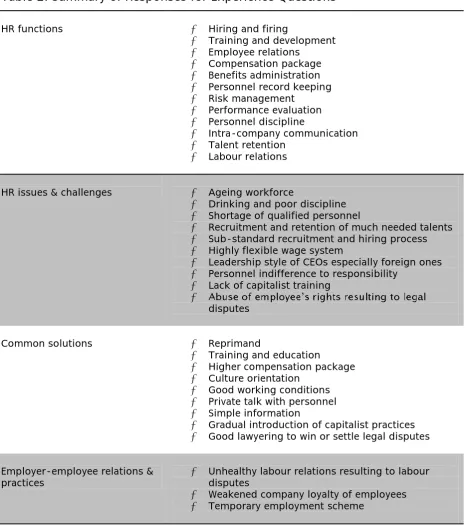
4.1.2 Responses to experience questions
37 For the first question, the responsibilities and functions entrusted on HR departments that respondents ensure to achieve includes the following: recruitment of needed employees; hiring and firing of personnel; labour relations; determining personnel wage and benefits; staffing positions; dividing workloads among personnel within the HR department; review of personnel records and performance; attending to personnel complaints; personnel discipline; training and development of personnel; employee relations; regulatory compliances of the company; personnel performance; employment contracts, conditions and disputes; organisation of employment records; and intra-company communication. Some clarifications were made
needs. According to them they can recommend and suggest if the CEO of the company asks their opinion. But common practice illustrates that HR departments are more of an implementing department as to the people need of the organisation.
For example, the determination of the qualities of recruits is determined by the CEO. But, in terms of personnel discipline, most of them answered that it was within their full discretion including the personnel compensation package. It turned out that CEO makes the rules regarding personnel qualification or the needed talents, corresponding responsibility, company discipline, and personnel performance. The implementation of which is left on the HR department. Thus, the supply and retention of needed talents, training and development of personnel, and personnel discipline are the full responsibility of the HR department. Aside from these are the legal compliances of the company.
38 directors educated abroad; highly flexible wage system they perceive this as one of the reasons for talent poaching and low talent retention in enterprises; absence of clear government regulation on HR (e.g., no law regarding standard compensation system, and non-legally binding employment contracts); leadership style of CEOs was also cited, specifically foreign CEOs among those specially cited were the incomprehension of the national and work culture of the Russian workforce, and the imposition of the organisational culture of the foreign mother company; personnel indifference to responsibility; and lack of training this they specifically refer to the work behaviour and attitude that work well with the capitalist enterprise; and court cases due to abusive employees.
For the third question, the common solutions that HR directors implement to personnel problems they cited were essentially characterised by: reprimand, training and education, higher compensation package, good working conditions, private talk with personnel, simple information regarding company changes, gradual introduction of capitalist practices (e.g., performance based promotion, team work, and feed-back system), and having good lawyers to win court cases. Asked about the solution regarding their CEOs, those who cited this said culture orientation, both ways on the part of the CEO and Russian managers, helped mitigate potential problems that may arise due to culture differences.
39 Table 2: Summary of Responses for Experience Questions
HR functions Hiring and firing
Training and development Employee relations
Compensation package Benefits administration Personnel record keeping Risk management
Performance evaluation Personnel discipline
Intra-company communication Talent retention
Labour relations
HR issues & challenges Ageing workforce
Drinking and poor discipline Shortage of qualified personnel
Recruitment and retention of much needed talents Sub-standard recruitment and hiring process Highly flexible wage system
Leadership style of CEOs especially foreign ones Personnel indifference to responsibility
Lack of capitalist training
disputes
Common solutions Reprimand
Training and education
Higher compensation package Culture orientation
Good working conditions Private talk with personnel Simple information
Gradual introduction of capitalist practices Good lawyering to win or settle legal disputes
Employer-employee relations & practices
Unhealthy labour relations resulting to labour disputes
Weakened company loyalty of employees Temporary employment scheme
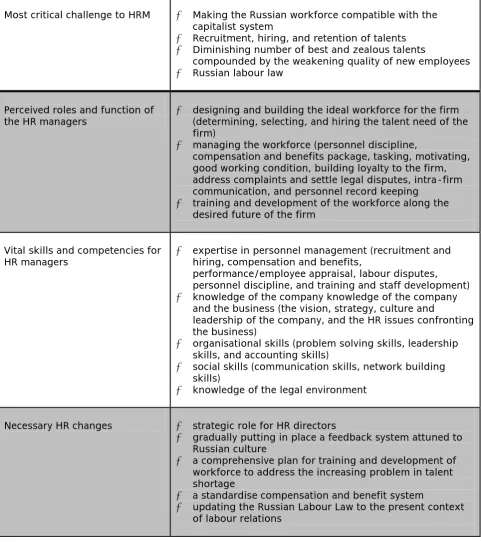
40 The second set of questions the knowledge questions that illustrate the HRM skills and competencies of HR professionals in Russia essentially , (ii) perceived function of the HR managers; (iii) perceived vital skills and competencies that Russian HR managers should acquire, and (iv) perceived necessary HR changes in business organisations operating in Russia whether local or foreign. For easy reading, answers to these questions are presented in Table 3.
-up into four areas of concern. One was how to make the Russian workforces compatible with the capitalist system this includes work attitudes, discipline, and behaviour of employees; feedback system; and performance appraisal system. Most of the respondents found the Russian workforce not so perfectly fitted to the way capitalist enterprises are managed and operated. According to them, the most challenging workforces are the older ones. They found the younger generation more adaptable and career-oriented but less zealous and more money-career-oriented. Another one cited was effective recruitment, hiring and retention of talents. Actually for the respondents, these were three big separate but closely related HR issues. Most of them saw recruitment and hiring to have a bearing on the retention of talents. The challenge can be stated in question as: How can most qualified talents be recruited to the organisation; what is the most effective system to ensure those hired are best talents; and what other measures can be taken to retain talents other than salary raise and promotion? Underlying these questions was their search for qualified and zealous talents. Related to these HR issues was the diminishing number of best and zealous talents compounded by the weakening quality of new employees. Lastly, they cited the employee-friendly labour code of Russia, which they saw misfit to the capitalist-oriented post-transition Russian enterprises.
41 HR needs of the firm; HR roles and functions are almost administrative and technical, yet HR issues and challenges being confronted are too strategic to the operation of the firm. Asked what to them is the ideal role and function of HR directors or managers they gave the following answers: designing and building the ideal workforce for the firm determining, selecting, and hiring the talent need of the firm; managing the workforce personnel discipline, compensation and benefits package, tasking, motivating, good working condition, building loyalty to the firm, address complaints and settle legal disputes, intra-firm communication, and personnel record keeping; and training and development of the workforce along the desired future of the firm.
For the third question, the skills and competencies they perceived vital to HR managers can be summed-up as follows: expertise in personnel management (recruitment and hiring, compensation and benefits, performance/employee appraisal, labour disputes, personnel discipline, and training and staff development), knowledge of the company and the business (the vision, strategy, culture and leadership of the company, and the HR issues confronting the business), organisational skills (problem solving skills, leadership skills, and accounting skills), social skills (communication skills, network building skills), and knowledge of the legal environment.
necessary for HR in Russia are the following: strategic role for HR directors, gradually putting in place a feedback system attuned to Russian culture, a comprehensive plan for training and development of workforce to address the increasing problem in talent shortage, a standardise compensation and benefit system, and updating the Russian Labour Law to the present context of labour relations. The respondents clarified that they see these changes necessary to improve the management of workforce in order to develop in them loyalty to the organisation and to maximise them. Although they admitted that these changes are not easy to take place in a micro and macro
42 changes but whose qualities and zeal are found to be weakening. Both groups pose challenge to HR.
Table 3: Summary of Responses for Knowledge Questions
Most critical challenge to HRM Making the Russian workforce compatible with the capitalist system
Recruitment, hiring, and retention of talents Diminishing number of best and zealous talents
compounded by the weakening quality of new employees Russian labour law
Perceived roles and function of the HR managers
designing and building the ideal workforce for the firm (determining, selecting, and hiring the talent need of the firm)
managing the workforce (personnel discipline,
compensation and benefits package, tasking, motivating, good working condition, building loyalty to the firm, address complaints and settle legal disputes, intra-firm communication, and personnel record keeping
training and development of the workforce along the desired future of the firm
Vital skills and competencies for HR managers
expertise in personnel management (recruitment and hiring, compensation and benefits,
performance/employee appraisal, labour disputes, personnel discipline, and training and staff development) knowledge of the company knowledge of the company
and the business (the vision, strategy, culture and
leadership of the company, and the HR issues confronting the business)
organisational skills (problem solving skills, leadership skills, and accounting skills)
social skills (communication skills, network building skills)
knowledge of the legal environment
Necessary HR changes strategic role for HR directors
gradually putting in place a feedback system attuned to Russian culture
a comprehensive plan for training and development of workforce to address the increasing problem in talent shortage
a standardise compensation and benefit system
updating the Russian Labour Law to the present context of labour relations
4.2 Data Analysis and Interpretation
43 Russia is characterised by a male-dominated, middle-aged, and locally educated HR directors. The dominance of male managers in the respondents is not unusual even for a society that had strongly advocated for gender equality. A study by Mandel (2004) shows that gender equality in production jobs in Soviet Russia is true only in terms of the accessibility of employment for women even in traditionally male-dominated industries like auto and farm-machine sector. However, gender discrimination was notable in the kind of work usually given to women and men. Women were commonly found in unskilled, low paying, and hazardous jobs; whereas in the management positions were overwhelmingly males. This was despite the appraisal of managers that women employees worked better than male employees who they said were drunkards and perennial latecomers. Nonetheless according to the Grant Thornton International Business Report (2012), Russia has the most women in senior management at 46%.
The dominance of middle-aged and locally educated respondents may have impacted on the way they perceived the questions. For example, the researcher observed that answers to the questions suggest a sharp, open-minded, practical, culture-sensitive, and strategic HR. The respondents left an impression on the researcher that they know and understand the situation, and they know what they need and what they want. This impression however was not shared by respondents coming from the energy, construction, and metallurgy & minerals. Incidentally, these were the respondents who belong to the ageing group. Perhaps, earlier studies (Elenkov 1997, Fey et al. 1999, 2000, Alexashin and Blenkinsopp 2005,and Denisova-Schmidt 2008, cited in Denisova-Schmidt 2011, p. 2) regarding the two different workforces in Russia apply here Those workforces with previous professional work experience in the Soviet Russia are those ageing respondents (49-50) who did not display high interest to changing the Russian HR management; while those workforces without previous professional work experience in the Soviet Russia are those younger respondents who displayed high interest to changing the Russian HR management.
44 HR function
d HR functions is that these functions are traditional HR functions. There is nothing wrong with this, especially so that these are in fact necessary to the operation of the company. Then it can be noted that these functions focused on the internal strength of the organization, which again is in fact the essential function of HR. It is being the internal strength of the organization that
ideal HR roles in building a
headache. In fact Shulzhenko2012, p.10)
c
processes,
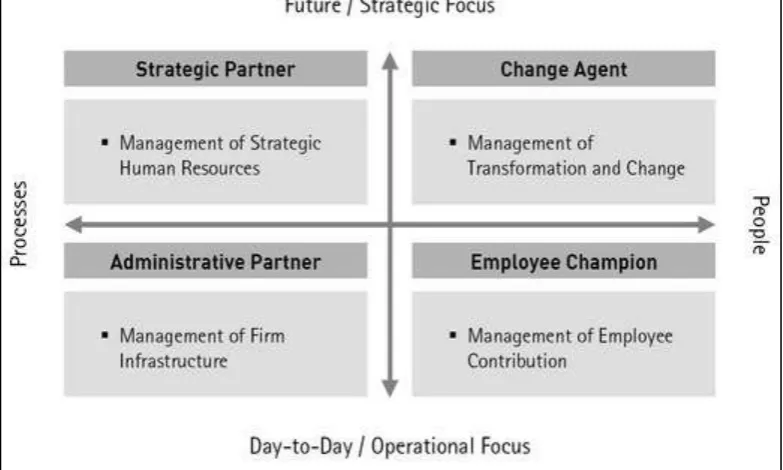
day-to-needs. These HR roles are manifested in four major HR functions as follows: (i) management of strategic human resources, which role he termed as
strategic partner the activity of which involves aligning HR and business
management of firm structure, which role he termed as administrative
expert the activity of which involves reengineering organisation processes
contribution, which role he termed as employee champion the activity of which involves listening and responding to employees or what he referred to
45 Figure 1: Ulrich Model HR Roles in Building a Competitive Organisation
(Source: Ulrich 1997, p.24)
HR issues and challenges
The HR issues and challenges noted by respondents can be categorised as follows: sufficient pool of talents (i.e., ageing workforce, shortage of qualified personnel),standard compensation package (i.e., highly flexible wage system), administrative systems (i.e., sub-standard recruitment and hiring process, recruitment and retention of much needed talents), leadership style (i.e., leadership style of CEOs), work attitude, behaviour and discipline (i.e., drinking and poor discipline, personnel indifference to
capitalist training). These issues and challenges were repeatedly noted in various earlier studies (Berger 1998,Thorniley 2007, Denisova-Schmidt 2011,Shulzhenko 2012) which only shows that these are indeed the HR issues causing headaches to HR in Russia. Similarly, these studies root out these issues and challenges to the economic transition of Russia from planned economy during the Soviet period to free market in the current Russia. Although, none of the respondents categorically attributed these changes to the transition, their answers clearly imply the same explanation.
46 and that this affect HR today. But aside from this, respondents also note government role why these problems persist. This observation was similarly noted in the 52-page report of the World Economic Forum (2013) outlining the biggest challenges that hundreds of business leaders in Russia foresee in the coming years. Two of the three key challenges stated express these
characterised by high levels of corruption at all levels of government and private institutions and offices. In business, this according to Butler and Purchase (2004) is profoundly expressed in the Russian term that has become well-entrenched in the Russian psyche. means accessing the inaccessible through exchange of favours. In fact, the loyalty of employees to line managers strongly impact on their wages (Bizyukov 2005, cited in Shulzhenko 2012, p.24). Another noted key challenge is low social cohesion as illustrated by brain drain (50% of Russian professionals seek to leave the
but alsoemphasises capital flight and domestic consumption reduction.
Common interventions
Observably, the common interventions that respondents cited are all tactical solutions, which imply that they only attend to daily problems traditionally
orientation is a strategic approach to the problem as this will impact on the adaption of workforces to the demands of the present free market system. This could be true if culture orientation is structural. But their practise only shows a person to person orientation. Meaning, either the foreign CEO teaches the HR director on the daily HR needs of the firm which the HR director in turn teach the HR staff or the HR director orients the firms
practices. Perhaps one strategic approach that came-up from respondents, but not in this question, is the clamour for attuning the Russian Labour Law to the present economic context. By doing so, the current problems regarding highly flexible wage system, talent retention, and personnel discipline can be strategically addressed.
47 Given the current changes that HR in Russian has been going through and subjected to without sufficient preparation, it is unsurprising to hear respondents saying that employer-employee relations are unhealthy. Though the respondents complain that the Russian labour law is employee biased and that employees tend to abuse this government bias, the root of the matter obviously lies on the opposing features of socialism and capitalism in labour management. In short, the increasing labour disputes that respondents confront only illustrates that the HR is gradually aligning to the framework of the free market and is gaining ground because if not, then there would be no increase in cases of labour disputes. Hence, HRs in Russia must brace their selves because as they systematically align their companies to its required HR design, labour issues will expectedly arise. In short, HR should plan ahead to mitigate this business disruptions.
4.2.3 Responses to knowledge questions
Most critical challenge to HRM
The most critical challenge to HR as perceived by the respondents essentially
environment. Understandably for the pool of talents, what concern the respondents most can be encapsulated as HR design (What kind of pool of talent will work best for their firms?), HR building (How can the appropriate
talents be safeguarded against poaching?). Given the high uncertainties confronting the future economic growth of Russia as the World Economic