Problem Structuring Methods for Collaboration:
A conceptual development, with an application to
a construction partnership in the UK
Luis Alberto Franco
Department of Operational Research
London School of Economics and Political Science
Thesis submitted to the University of London
for the Degree of Doctor of Philosophy
UMI Number: U205402
All rights reserved
INFORMATION TO ALL USERS
The quality of this reproduction is dependent upon the quality of the copy submitted.
In the unlikely event that the author did not send a complete manuscript and there are missing pages, these will be noted. Also, if material had to be removed,
a note will indicate the deletion.
Dissertation Publishing
UMI U205402
Published by ProQuest LLC 2014. Copyright in the Dissertation held by the Author. Microform Edition © ProQuest LLC.
All rights reserved. This work is protected against unauthorized copying under Title 17, United States Code.
ProQuest LLC
789 East Eisenhower Parkway P.O. Box 1346
Library
Jrntsri ubmty of Pontius
and economic Science
F
8> 3
Abstract
Problem structuring methods (PSMs) have been developed within operational
research (OR) to assist a set of actors to agree on a problem structure and make
commitments to consequential action. Their characteristic feature is the use of a
model to represent alternative versions of the problem of common interest,
combined with facilitation to help actors make constructive mutual adjustments.
Whilst most PSMs have traditionally been applied with actors confronting
problems within organizations, others have also been applied with actors
working between and across organisations to address a problem of common
interest. This research will explore the significance of PSMs in collaborative
contexts of this kind.
The aim of this research is to investigate the possible roles of PSMs in assisting
actors of an inter-organisational domain who engage in collaboration to address a
problematique of common interest in order to reach joint agreements with
respect to it. The hypothesis investigated in this research is that the analytical
assistance provided by PSMs can be expected to contribute to a collaboration
process principally through improving actors’ sense-making of their
problematique, and through providing structure to the product of this sense-
making activity. The interpretation of our hypothesis is that PSMs generate this
effect through improving the quality of dialogue between actors. This effect
should tend to impact positively on the ownership of the commitments resulting
from the dialogue, and on mutual accommodations in the power balance among
actors.
In order to articulate this hypothesis, it has been necessary to conduct some
conceptual clarification to achieve a clear meaning for the terms ‘shared
meaning’, ‘power’, and ‘dialogue’. Building upon this conceptual clarification, a
model of collaboration as a process has been developed, which identifies the
intended products of collaboration. This model provides the basis for identifying
the possible effects of PSMs, and for evaluating their effectiveness.
To explore our hypothesis and the adequacy of the conceptual model, a case
study drawn from an action research project in the UK construction industry was
carried out. This action research project was industry-academic collaboration
aimed at contributing to build a high value construction environment, and its
principal output was the development of a PSM-based methodology for
construction project reviews. The case study reported in this thesis involved the
application of this methodology in a multi-organizational construction
partnership in the hotel business. This involved engagement in and observation
of ongoing partnership activity of three construction project teams.
Reasonably clear and positive effects from the application of the methodology
were found in the dialogue between participants, consistent with the hypothesis.
Additional positive effects in terms of achieving inter-organisational learning
within the selected partnership were also identified. Overall the results of the
case study are encouraging; however, as they result from the application of a
particular PSM-based methodology, extrapolation to more general conclusions
about the potential of PSMs for multi-organisational collaboration should be
made with caution. Nevertheless, the results of this research suggest valuable
potential avenues for further research.
The case experience also was generally supportive of the conceptual model of
the collaboration process, in that the activities and processes observed could be
interpreted without difficulties within the model’s framework. The model offers
a means for further theoretical and empirical work aimed at confirming and
enriching its structure and validity.
Keywords: problem structuring methods, collaboration, inter-organisational
domains, dialogue, shared meaning, power, multi-organisational teams,
Table of Contents
ABSTRACT...2
1 INTRODUCTION... 16
2 CONCEPTUAL FRAMEWORK... 28
2.1 Meaning and shared meaning... 28
2.1.1 Meaning and shared meaning as cognitive phenomena...29
2.1.2 Meaning and shared meaning as relational phenomena...33
2.2 Power...38
2.2.1 Three dimensions o f power...39
2.2.2 Sources o f power...42
2.2.3 The power o f the system...45
2.3 Dialogue... 49
2.3.1 Types o f dialogue...50
2.3.2 Quality o f dialogue...53
3 CONCEPTUAL MODEL OF THE COLLABORATION PROCESS... 57
3.1 Overview of the conceptual model...58
3.2 Conceptual model of the analytical contribution to collaboration 61 3.2.1 Domain-level problem...63
3.2.2 Power base...63
3.2.3 Dialogue...64
3.2.4 Implementation...69
4 PROBLEM STRUCTURING METHODS FOR COLLABORATION... 72
4.1 The characteristics of Problem Structuring Methods... 72
4.1.1 PSM processes...80
4.1.2 PSM technology...82
4.1.3 PSM products...85
5 RESEARCH METHODOLOGY... 94
5.1 Adopted research design and its implications... 98
5.1.1 Characteristics o f an action research (AR) approach...98
5.1.2 Implications for the research o f adopting an AR approach...101
5.2 Adopted data collection and analysis strategy...103
6 THE CROSS-ORGANISATIONAL LEARNING APPROACH... 108
6.1 Collaboration in the UK construction industry...109
6.2 The B-HIVE research proj ect...I l l 6.3 The Cross-Organisational Learning Approach COLA)...113
7 THE B-HIVE CASE STUDY...121
7.1 The period of field work... 122
7.1.1 Whitbread PLC and its hotel division...122
7.1.2 SCA/COLA application...124
7.2 Analysis of research data...132
7.2.1 Analysis o f the post-workshop questionnaire responses...133
7.2.2 Analysis o f interview data...139
7.3 Evaluation of the research findings by the researcher...158
7.3.1 Evaluation o f the original conceptual model and hypothesis 159 7.3.2 Appropriateness o f the use o f PSMs in the study...165
7.3.3 Implications fo r wider use o f PSMs...170
8 CONCLUSIONS AND AGENDA FOR FURTHER RESEARCH... 173
8.1 Summaiy of research process... 173
8.2 Main research findings... 175
8.3 Directions for further research... 177
APPENDIX A: B-HIVE PROJECT PARTICIPANTS...181
APPENDIX B: DETAILS OF WORKSHOPS...183
APPENDIX C: MODIFIED VERSION OF SCA...185
APPENDIX F: LIST OF INTERVIEWEES... 213
APPENDIX G: INTERVIEW PROTOCOL... 214
List of Tables
Table 1-1: Three-phased collaboration model...21
Table 2-1: Example of a cognitive map as a grid...35
Table 2-2: Four dimensions of power...47
Table 2-3: Types of dialogue... 51
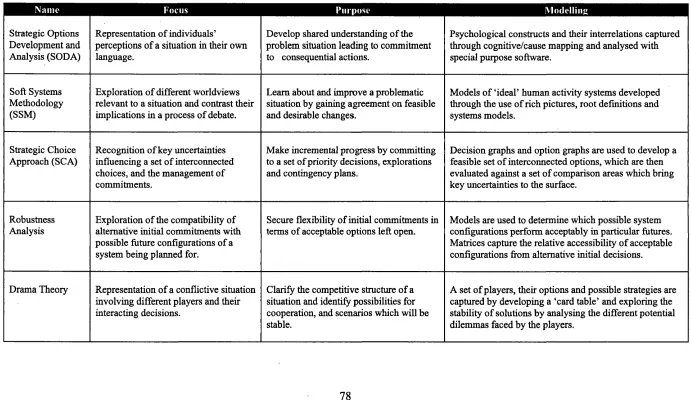
Table 4-1: Major Problem Structuring Methods...78
Table 4-2: PSM process, technology and products...79
Table 4-3: Potential principal effects expected from PSM during collaboration ..92
Table 5-1: Comparison between action research and other forms of intervention 100 Table 6-1: List of B-HIVE project members... 112
Table 7-1: Sample of decision areas, uncertainties areas and comparison areas (Meon Valley)... 129
Table 7-2: Extract from Meon Valley progress package... 131
Table 7-3: Overall perceived SCA/COLA effectiveness across 8 performance criteria by participant group... 135
Table 7-4: Overview of the interview material... 140
Table 7-5: Excerpts from coded data suggesting adjustments in partners’ expectations within the analytical category ‘adjusting’... 154
Table 7-6: Excerpts from coded data suggesting adjustments in partners’ relations within the analytical category ‘adjusting’... 155
Table 7-7: Matrix display showing excerpts of coded data regarding the analytical category ‘quality of dialogue’... 162
List of Figures
Figure 2-1: Example of a cognitive map as a network of nodes and links...36
Figure 2-2: Instrumental and symbolic aspects of power...41
Figure 3-1: Overview diagram of the conceptual model of a collaboration process ... 59
Figure 3-2: Conceptual model of the analytical contribution to collaboration...62
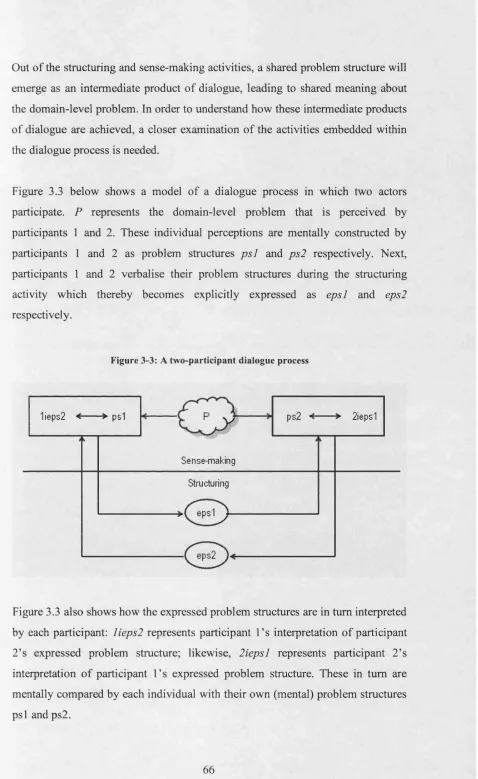
Figure 3-3: A two-participant dialogue process...66
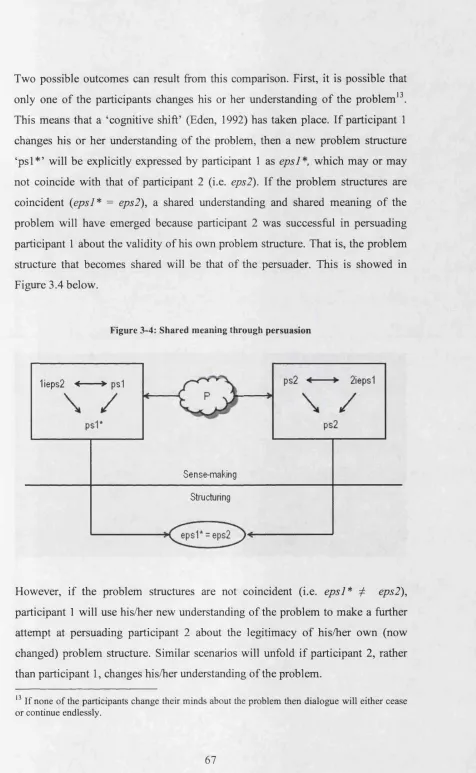
Figure 3-4: Shared meaning through persuasion... 67
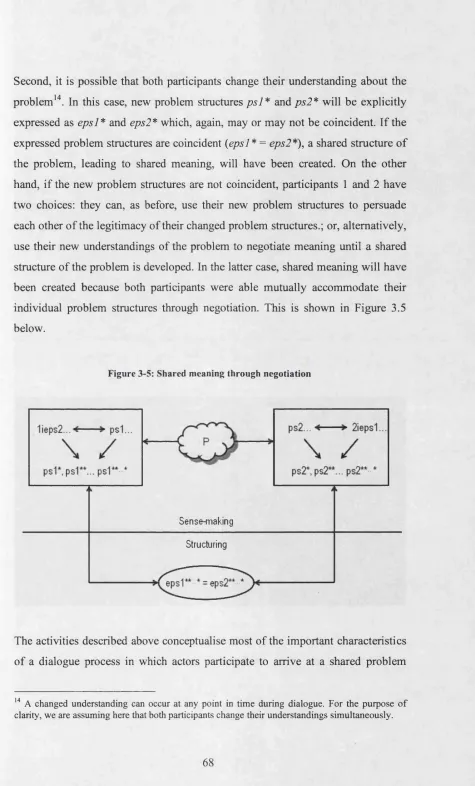
Figure 3-5: Shared meaning through negotiation... 68
Figure 6-1: The COLA review process... 116
Figure 7-1: Whitbread Hotel Company (Property Development) organisational chart... 123
Figure 7-2: Decision graph from the Meon Valley workshop... 130
Figure 7-3: Overall perceived SCA/COLA effectiveness across 8 performance criteria by WHC management and WHC hotel operators... 138
Figure 7-4: Overall perceived SCA/COLA effectiveness across 8 performance criteria by WHC partners and subcontractors (i.e. non-partners)...139
Figure 7-5: Illustration of open coding process from a segment of interview data. ... 141
Figure 7-6: Illustration of axial coding of the category ‘reviewing’... 142
Figure 7-7: Key analytical concepts generated from the data... 144
Figure 7-8: Emergent model of the partnering cycle...157
Figure 7-9: Reproduction of original conceptual model of the partnership process.
To Mami (Clelia) and Papi (Lucho)
Acknowledgments
I would like to express my gratitude to all the organisations that participated in
this research. Special thanks go to the individuals who were interviewed. Without
their willingness to cooperate this thesis would have never been completed. I
would also like to thank those organisations which supported my work financially
over the years: the Universidad del Pacifico, where I started my academic career
back in Peru; and subsequently the London School of Economics and Political
Science (LSE), the University of Strathclyde, Kingston University, and the
University of Warwick.
I am deeply grateful to my former colleagues in the B-HIVE team, for their
continuous support and trust in my work throughout my first research project
experience. Two people deserve special acknowledgement. I would like to thank
Mike Thomas, for his willingness and enthusiasm to learn and use problem
structuring methods during the research, and for making possible the fieldwork
within Whitbread. I am genuinely indebted to Mike Cushman, my fellow
colleague at the LSE, who provided me with vital encouragement throughout the
B-HIVE project, and had the patience to scrutinise my work and suggest ways of
improving it, even after B-HIVE. I look forward to working with him again in the
years to come.
Throughout the period of this research, I have profited immensely from working
with a number of scholars at different academic institutions. My deepest
appreciation goes to my former colleagues at the LSE and the University of
Strathclyde, who have unknowingly influenced my thinking and the argument
developed in this thesis.
Thanks to the administrative staff of the Department of Operational Research at
the LSE, Brenda Mowlam, Caroline Rudd and Jenny Robinson, all of whom
always offered me smiles and joyful chat, and came to my rescue when I needed
By far the largest debt in completing this thesis is owed to my supervisor,
Professor Jonathan Rosenhead, for his invaluable support, guidance and patience
throughout the years, particularly at times when there was little for me to
celebrate. His deep knowledge of the field, his shrewd insights, his sometimes
intolerable gift for developing counter arguments, and above all his ability to
disagree agreeably, have been inspirational and made the writing of this thesis an
stimulating experience.
To all the good friends I have made since I arrived in the UK back in 1996, for
their unconditional love and support throughout these years. Special thanks are
due to my mates Ion Georgiou, Carola Nijmeijer and Suzie Vaill for being a
sounding board during the bad times.
Finally, my deepest gratitude goes to my wife and soul mate, Kirsty, and my son
Santiago, both of whom have only known me while doing my PhD. They have
borne the burden of my physical and emotional absence, particularly during the
past two years, and now look forward to enjoying my undivided attention and a
proper family life. Their unconditional support and generosity, in loving me at a
distance when I needed to be left alone and cheering me on when I needed urgent
List of Abbreviations
AR Action Research
COLA Cross-Organisational Learning Approach
CVA Competing Values Approach
DA Decision Analysis
EPSRC Engineering and Physical Sciences Research Council
GDSSs Group Decision Support Systems
IORs Inter-organisational Relations
OMT Oval Mapping Technique
OR Operational Research
PSMs Problem Structuring Methods
SCA Strategic Choice Approach
SD System Dynamics
SODA Strategic Options Development and Analysis
SOSM System of Systems Methodologies
SSM Soft Systems Methodology
Glossary
Action-oriented dialogue - a type of dialogue in which participants collectively
seek to reach agreement on how to carry out an action which is of concern to
them. Action-oriented dialogue may (or may not) have well-organized rules of
conduct, and involve persuasion and negotiation as part of the process.
Actor - an individual, group or organisation seeking to influence the inter-
organisational domain which it is are part of.
Collaboration - a process by which actors of an inter-organisational domain work
together to gain a broader appreciation of a domain-level problem which affects
them, and to reach joint agreements with respect to it and the future direction of
the domain.
Dialogue - a process of communication among two or more individuals through a
series of back and forth messages or ‘speech acts’, in which these messages are
organised in a sequence towards fulfilling a goal.
Domain-level problem - an ill-structured problem area or ‘problematique’ which
needs to be resolved within an inter-organisational domain, and which gives it its
identity. Domain-level problems are characterised by high levels of complexity,
uncertainty, and conflict.
Instrumental power - the ability to secure preferred outcomes in the face of
conflict. Instrumental power may be consciously mobilised in the decision
making arena to produce favourable decisions or to keep issues out of the
decision-making arena
Inter-organisational domain - a social system which comprises a set of actors
with a common interest in a problem area which cannot be resolved unilaterally
Meaning - the product which results from a conscious individual directing
attention towards objects in his or her own world. Meaning is created through
personal experiences and social processes.
Negotiation dialogue - a type of dialogue oriented towards the resolution of a
conflict of interests between participants, in which each party makes offers of
concessions to the other until a satisfactory agreement which partly meets their
goals is reached.
Persuasion dialogue — a type of dialogue oriented towards the resolution of a
conflict of opinions between participants, in which each party tries to demonstrate
that a proposition or point of view is true or right, and based on evidence. A
persuaded party will change his or her initial positions and commit to that of the
persuader party.
Power - the ability to affect the behaviour of others in a conscious and deliberate
way.
Problem structuring methods - a family of participatory and interactive methods
developed within the discipline of operational research, whose purpose is to assist
groups of diverse composition gain a better understanding of a problematic
situation of common interest, and which is characterised by high levels of
complexity, uncertainty and conflict. This is achieved through the explorations of
different perceptions, and facilitating negotiation, with a view to generating
consensus on problem structure, and usually, on initial commitments to
consequential action
Shared meaning - the emergent product of regular social interaction, whereby
members of a group begin to favour one interpretation over another. In this way,
group members generate coincident expectations about patterns of reciprocal
exhibit agreement on both the interpretive schemas and the value systems they use
for meaning creation.
Social construction - the process by which individuals collectively construe and
reproduce their social world by acting on their interpretations and knowledge of it.
Symbolic power - the ability to legitimise ideas, procedures, actions and outcomes
without conflict. Symbolic power may be consciously mobilised through the
1
Introduction
The environmental contexts in which organisations operate are becoming
increasingly complex and turbulent. Complexity principally stems from the nature
of the problems organisations face: the issues that constitute these problems are
extensive and interconnected, and usually associated with high levels of
uncertainty. Turbulence, on the other hand, arises when the organisations that
share it become increasingly interdependent. This interdependency is also
associated with high levels of uncertainty, as organizations, acting independently
and in diverse directions, create unanticipated consequences for themselves and
others (Emery & Trist, 1972). The complexity and turbulence of the environment
thus makes it difficult for organizations to act unilaterally to solve the problems
they face.
Several forms of inter-organizational relations (IORs) have emerged in recent
decades as a response by organizations to the complexity and turbulence of their
environments. Typically, the particular form an IOR adopts will depend on
whether organisations wish to jointly develop a shared vision, resolve a conflict or
gain ‘collaborative advantage’ (Gray, 1989; Huxham, 1996). IORs can range from
strategic alliances and joint ventures between business organizations (e.g. Das,
Sen, & Sengupta, 1998; Dickson & Weaver, 1997; Doz & Hamel, 1998; e.g.
Harrigan, 1988; Saxton, 1997) to less institutionalised collaborations among a
wide variety of stakeholders concerned about issues of common interest (e.g.
Carpenter & Kennedy, 1988; Gray, 1989; Huxham, 1996; Westley & Vredenburg,
1991; Wood & Gray, 1991). Whatever the specific form of IOR adopted, its
general purpose is to enable organisations to manage their future collectively.
Different theoretical perspectives have been used to conceptualise inter-
organisational relations including transaction cost economics, exchange theory,
organizational learning and institutional theory (for recent reviews, see Barringer
& Harrison, 2000; Gray, 2000; Osbome & Hagedoom, 1997). In this thesis, we
domain is a social system which comprises a set of actors1 with a common interest
in a problem area which cannot be resolved unilaterally by any single actor (Gray,
1989; McCann, 1983; Milward, 1982; Trist, 1983).
An inter-organisational domain is not an objectively given entity but one that is
socially constructed (Berger & Luckmann, 1966) by the actors who constitute the
domain. Initially, the boundaries and identity of the domain are usually unclear,
shifting or in dispute (Gray & Hay, 1986). A key activity of this process of
socially constructing the domain is ‘joint appreciation’ (Trist, 1983; Vickers,
1965), which involves actors making judgements of fact and value about the
domain. These include judgements about what the domain is, and what it will or
might be on various hypotheses. Through joint appreciation, the problems and
actors that constitute the domain are clarified and stakeholders identified, and an
identity and mutually agreed upon boundaries for the domain are created. New
appreciations are made as new problems arise within the domain, which may lead
to new boundaries and a new set of stakeholders (Gray, 1989; Trist, 1983).
Once the identity and boundaries for the domain are created, stakeholders can be
expected to reach agreements to regulate their future activities. These may take
the form of policy recommendations to the stakeholders’ constituencies, or ad-hoc
arrangements that need not involve formalized agreements concerning
stakeholders’ future interactions for which enforced provisions are specified. It is
possible, however, for stakeholders to create formal, long-term structural
arrangements as mechanisms to support and sustain those activities which
contribute to their ‘joint appreciation’ (Gray, 1989; McCann, 1983; Trist, 1983).
These formal arrangements may include rules governing future interactions
among stakeholders and the design of stakeholders’ roles and responsibilities.
1 It is simplest to think of actors as individuals but of course they can be aggregates (e.g. groups, organizations). Any reference made to actors throughout this thesis is applicable to any of these categories, unless otherwise stated.
An inter-organisational domain thus can evolve from being an ‘under-organised
system’ where actors act independently, if at all, with respect to the problems that
constitute the domain (Brown, 1980), to what can be considered a temporary
‘negotiated order’ (Altheide, 1988; Gray, 1989; Heimer, 1985; Nathan & Mitroff,
1991; O'Toole & O'Toole, 1981; Westley & Vredenburg, 1991). Negotiated order
refers to an organisational context in actors continually negotiate their social and
working relationships in order to maintain order (Day & Day, 1977; Strauss,
1978; Strauss et al., 1963). Applied to the inter-organisational domain, a
negotiated order implies a set of actors collectively negotiating and renegotiating
agreements to govern their interactions with respect to the domain.
The development of a domain as a temporary negotiated order depends upon
actors collaborating to gain a broader appreciation of the problems they face and
to make progress which could have not been possible by any actor working alone
(Gray, 1989; Trist, 1983). Following Gray (1989), we define collaboration in this
thesis as:
a process by which actors o f an inter-organisational domain work together to
gain a broader appreciation o f the domain-level problem and reach joint
agreements with respect to it and the future direction o f the domain. A
domain-level problem is that problem area which needs to be resolved within the domain,
and which gives the domain its identity.
Domain-level problems usually defy a clear definition, which implies that it is not
possible to speak of ‘the problem’. Rather, it is more appropriate to speak of
domain actors confronted by a ‘problematic situation’ or ‘problematique’ (Quade,
1980) consisting of clusters of interconnected problems, and which no single actor
can solve unilaterally (Gray, 1989; McCann, 1983; Milward, 1982; Trist, 1983).
Gray (1989, p. 10) characterises such domain-level problems as follows:
■ the problems are ill-defined, or there is disagreement about how they
■ the problems are often characterised by complexity and uncertainty;
■ existing processes for addressing the problems have proved insufficient
and may even exacerbate them;
■ several stakeholders have a vested interest in the problems and are
interdependent;
■ these stakeholders are not necessarily identified a priori or organised in
any systematic way;
■ incremental or unilateral efforts to deal with the problems typically
produce less than satisfactory results;
■ differing perspectives on the problems often lead to adversarial
relationships and conflict among the stakeholders;
■ stakeholders may have different levels of expertise and different access to
information about their problematic situations; and,
■ there may be a disparity of power resources for dealing with the problems
among the stakeholders.
Problems with these characteristics have been termed ‘messes’ (Ackoff, 1974,
1981), ‘swampy’ (Schon, 1987), and ‘wicked’ (Rittel & Webber, 1973), and have
received particular attention by scholars within the operational research (OR) and
systems fields (to be discussed in Chapter 4).
If actors perceive that they can address the domain-level problem without
involving others, they will not participate in a process of collaboration. This
occurs when actors have either a range of alternatives to tackle the domain-level
problem unilaterally or recourse to ‘free-riding’ tactics to benefit without
contributing to the alleviation of the domain-level problem (Hardin, 1982; Olson,
1971).
Two simultaneous conditions seem to be essential for collaboration to be initiated.
First, actors must have a high stake in the outcome of the collaboration. The
stakes of actors are related to the fundamental interests of the firm such as
Second, it is also necessary that actors perceive a high degree of interdependency
with other actors of the domain for dealing with the domain-level problem (Gray,
1989; Logsdon, 1991; Oliver, 1990). Interdependency is associated with the
notions of reciprocity and asymmetry (Oliver, 1990). Reciprocity is based on the
social norm that one has an obligation to contribute in order to receive benefits.
Reciprocity occurs when actors recognise that mutually beneficial results can be
achieved through collaboration. By contrast, asymmetry is based on resource
interdependencies among actors. Actors initiate collaboration in an attempt to
control their interdependencies with other actors of the domain (Aldrich, 1976,
1979; Benson, 1975; Pfeffer& Salancik, 1978).
Once actors perceive the need to collaborate, the process of collaboration is
initiated. This process can be understood as constituted by three phases: problem
setting, direction setting and implementation (Gray, 1989; McCann, 1983). The
problem setting phase involves the exploration of the domain-level problem and
identification of those actors with a stake in it; the direction setting phase
comprises the development of agreements about valued, shared goals and actions.
These first two phases essentially require domain actors to engage in dialogue (to
be discussed in Chapter 2) whereby the domain-level problem is addressed.
Finally, in the implementation phase, steps are taken to ensure follow-through on
the agreements reached if formal collective mechanisms have been created. The
Table 1-1: Three-phased collaboration model
- adapted from McCann (1983) and Gray (1989)
Problem setting Structuring of domain-level problem
Stakeholder identification
Direction setting Articulation of shared values and goals
Articulation of alternatives for action Making choices about portfolio of options Reaching joint agreements about future direction
Implementation Implementation of joint agreements
Development and implementation of regulative frameworks
At the start of collaboration, actors usually begin with different, often fragmented,
conceptions of the domain-level problem (Nathan & Mitroff, 1991; Vaughan &
Siefert, 1992). In addition, they often have limited conceptions of how their
actions impinge on other parties and incomplete or mistaken perceptions about
what the other participants want or believe (Gray, 1989; Vansina & Taillieu,
1997). By collaborating, the divergence in the actors’ views, interests and
knowledge becomes a valuable asset, enabling actors to develop a rich, shared
picture of the domain-level problem before they reach agreement on a shared
problem definition and potential options for subsequent action (Gray, 1989). Thus
through collaboration, actors who previously shared no common meanings about
the domain can mutually create shared meaning (to be discussed in Chapter 2).
A significant aspect of the collaboration process by which an inter-organisational
domain is developed relates to how power (also to be discussed in Chapter 2) is
mobilised by actors to influence the domain (e.g. Agranoff & McGuire, 2001;
Biyson & Crosby, 1992; Child & Faulkner, 1998; Gray, 1985; Gray & Hay, 1986;
Himmelman, 1996; Mayo & Taylor, 2001). Gray (1989), for example,
distinguishes four types of power which can be mobilised to influence the
development of the domain: power to mobilize, power to organise, power to
The power to mobilise is expressed through the capacity of actors to mobilise
resources in order to effectively resist their exclusion from the domain. The power
to organise the domain stems from actors’ capacity to shape the boundaries of the
domain and create the forums in which domain-level problems are addressed. The
power to control the agenda and information is associated with the ability of
actors to control how issues and information are addressed within the domain.
Finally, actors with power to exercise influence or authorise action will ensure
that joint agreements will be successfully implemented.
Actors with more power can be expected to use it to construct the domain to their
advantage (e.g. Benson, 1975; Brown, 1980; Day & Day, 1977; Hardy, 1994a;
Hardy & Phillips, 1998; O'Toole & O'Toole, 1981). As Hardy and Phillips (1998)
argue, if actors have a stake in the domain, and the domain is socially constructed,
then “it is in the interests of each stakeholder to do everything possible to ensure
that the domain is constructed in a way that affords it the most advantage” (Hardy
& Phillips, 1998, pp. 218-219).
One way in which stakeholders can influence the construction of the domain is by
(re)defining the problems that constitute the domain. These problems are not
objectively present in the domain but are shared as a result of social interaction
among the domain actors. They are defined through conversational processes
which create meaning for them (Blumer, 1971; Dutton & Duncan, 1987; Eden,
1986; Eden et al., 1981; Ford & Ford, 1995; Hardy, Lawrence, & Grant, 2005).
These dialogical processes are essentially problem structuring activities which are
influenced by the interest and actions of actors with a stake in the domain.
The way in which a problem is structured and defined has important implications
for the subsequent direction of the domain. For it limits the potential nature and
outcome of inter-organisational interaction and plays an important role in
determining who participates in the development of the domain (Gray, 1989; Gray
& Hay, 1986; Gricar & Brown, 1981; Hardy & Phillips, 1998; Hardy, Phillips, &
may lead actors with a stake in the domain to form coalitions so that certain
participants can be included or excluded from the domain (Eden, 1996). Problem
structuring, therefore, is a significant mechanism through which stakeholders can
exercise power and influence the construction and development of the domain.
It has been argued that the participation of stakeholders in the construction of the
domain depends upon the perceived ‘legitimacy’ of stakeholders. Gray (1989), for
example, argues that an actor has legitimacy to participate when this actor is
perceived by the other domain actors to have not only the right but also the
capacity to participate in the domain. Legitimacy, however is not an objective
state, but one based on power (Frost, 1987) and created through the management
of meaning (to be discussed in Chapter 2) (Czamiawska, 1986; Pettigrew, 1979;
Smircich & Morgan, 1982). Consequently, actors of a domain require sufficient
power to demonstrate they have a ‘legitimate’ right to participate in its
development.
Therefore, power is a central aspect of the construction and development of an
inter-organisational domain. As collaboration is the process through which a
domain develops, power is also central to collaboration. Furthermore, as discussed
earlier, shared meaning is one of the products of successful collaboration, which is
created through dialogue. Given that dialogue is influenced by the interests and
intentions of domain actors, it is not unreasonable to postulate that for shared
meaning to emerge during collaboration, adjustments in the power relations
among actors of a domain will be needed. Otherwise there is the risk that the
domain will not develop through collaboration but through compliance,
contention or contestation3 (Hardy & Phillips, 1998). It follows that the
collaboration process ought to be assisted by mechanisms capable of facilitating
dialogue and mutual adjustments in the power balance between domain actors.
3 Compliance occurs when dominant actors use their power to regulate weaker actors which have
no choice but to cooperate. In contention involves weaker actors attempting to overturn existing
domain parameters in order to get access to the domain and, in so doing, challenging powerful
Some scholars (e.g. Bryant, 2003; Eden, 1996; Franco, Cushman, & Rosenhead,
2004; Friend, 1993; Friend & Hickling, 1997; e.g. Huxham, 1996; Taket & White,
2000) have suggested that problem structuring methods (PSMs) (to be discussed
in Chapter 4) can be useful mechanisms in helping actors of a domain who engage
in collaborative activities. PSMs are a family of participatory and interactive
methods developed within the discipline of operational research (OR), whose
purpose is to assist groups of diverse composition gain a better understanding of a
problematic situation of common interest, and which is characterised by high
levels of complexity, uncertainty and conflict. This is achieved through the
explorations of different perceptions, and facilitating dialogue and negotiation,
with a view to generating consensus on problem structure, and usually, on initial
commitments to consequential action (Rosenhead, 1996; Rosenhead & Mingers,
2001).
Indeed, it can be argued that the contextual characteristics of domain-level
problems described earlier broadly correspond to those for which PSMs were
specifically designed. The purpose and characteristics of PSMs appears to make
them potentially valuable in assisting collaborators to structure and define the
domain-level problem, to articulate the values affected by their choices with
respect to it, and to make mutual adjustments in order to reach joint agreements
about the future of the domain.
However, in spite of the reported success of PSMs applications with collaborative
groups, no theoretical arguments justifying the appropriateness of PSMs in this
context have been advanced so far. In particular, no theoretical models have been
presented concerning how dialogue about the domain-level problem is facilitated
by PSMs during collaboration. Furthermore, it is not clear whether PSMs are
capable of handling asymmetrical power relations among actors (e.g. Healey,
1997; Jackson, 1982, 2000; Mingers, 1992; Willmott, 1989). There is therefore a
case for investigating the potential of PSMs in assisting actors who engage in
collaboration to address a domain-level problem and reach agreements with
inter-organisational domain as a temporary negotiated order. This investigation may
also contribute to the assessment of the role that PSMs may have in handling
power dynamics among actors during collaboration.
Our broad hypothesis is that PSMs do have a role in assisting actors who engage
in collaboration to address a domain-level problem, and reach joint agreements
with respect to it. This broad hypothesis can be summarized as follows:
• the analytical assistance provided by PSMs will improve collaborators’
dialogue about the domain-level problem;
• this improved dialogue will allow actors to jointly create shared meaning, and
lead to an increased commitment towards enacting their reached agreements
regarding the domain-level problem; and,
• these effects should tend to impact positively on the development of a
temporary negotiated order for the domain.
In order to express the above hypothesis more precisely, a clarification of
concepts is first needed. In Chapter 2, several key concepts that emerge in the
literature of both inter-organizational collaboration and PSMs are discussed. The
concepts of shared meaning, power, and dialogue are defined in an operational
way.
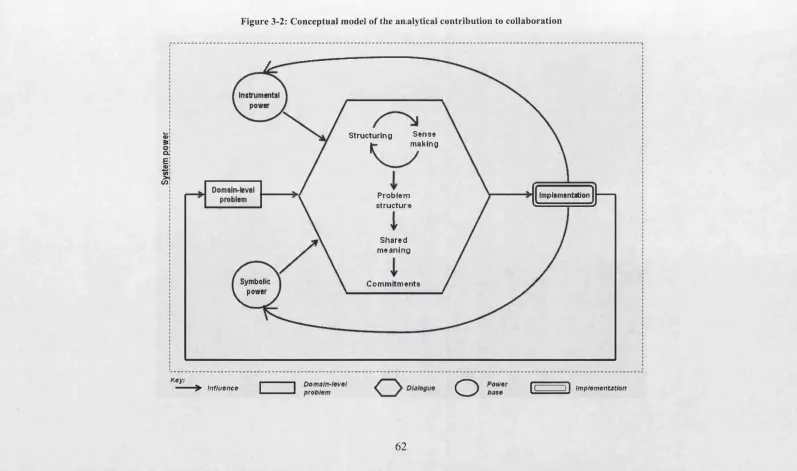
Based on this conceptual development, a model of the collaboration process is
built in Chapter 3. This model is intended to provide a plausible representation of
the factors associated with the emergence of shared meaning about a domain-level
problem among actors, and the development of joint agreements with respect to it.
The model builds principally on the work Gray (1989) on collaboration, Eden
(1982; 1986; 1988) on group problem solving; and Hardy (1985; 1994b; 1996) on
power. The elements of the model consist of domain-level problem, power base,
dialogue, and implementation. This model is intended to serve the function of
deriving possible roles for the form of analytical assistance provided through
In Chapter 4, two analyses are carried out. First the characteristics of PSMs are
discussed in preparation for the examination of the possible roles of PSMs in
assisting actors engaged in collaboration. This discussion seeks to examine
critically the claims which have been made for PSMs4. Second, based on the
preceding analysis, a potential role for the analytical assistance provided by PSMs
to a collaboration process is identified and argued for. Although there is no
generally accepted framework for the assessment of PSMs (Eden, 1995, 2000;
Eden & Ackerman, 1996; Finlay, 1998), for the purposes of this research this
assessment will be based on dimensions specific to the collaboration process such
as dialogue and power.
Chapter 5 discusses several potential research designs appropriate to empirically
investigate PSMs within multi-organisational collaborations and formulates a
particular research strategy, namely, action research (AR). This strategy is aimed
both at exploring the adequacy of the conceptual model developed in Chapter 3,
and also investigating in practice whether PSMs can indeed take up successfully
the role identified in Chapter 4.
In Chapter 6, an account of the development of a PSM-based approach that can
help in delivering the intended advantages of multi-organizational collaboration
within the context of construction partnerships is given. The approach developed,
named the Cross-Organisational Learning Approach (COLA), uses Strategic
Choice methods (Friend & Hickling, 1997), both to focus on the key issues, and
as the basis of the resulting review process. In Chapter 7, data generated from a
case study derived from a construction partnership in the UK leisure sector are
analysed using a grounded theory approach (Glaser & Strauss, 1967; Glaser,
1993; Strauss & Corbin, 1998).
The concluding Chapter 8 discusses lessons for PSMs and collaboration, and
2
Conceptual framework
As will be recalled from Chapter 1, the purpose of the research reported in this
thesis is to identify and evaluate the possible roles of PSMs in assisting actors
engaged in a process of collaboration by which actors of an inter-organisational
domain socially construct that domain. There are a number of key concepts which
emerge, explicitly or implicitly, in the literature of both inter-organisational
domains and PSMs, and which need to be clearly understood in order to formulate
our research strategy appropriately and unambiguously. These concepts are
‘shared meaning’, ‘power’, and ‘dialogue’, and will be developed in the following
sections.
The concepts to be elaborated below will subsequently be used to develop a model
of the process of collaboration. This model will help to clarify the possible roles
of PSMs (to be discussed in Chapter 4) in this process. Claims that have been
made about this family of methods include: that they facilitate the emergence of a
shared definition of the problematic situation of common interest, that they are
participative, and that they enable less unequal dialogue (Eden, Jones, & Sims,
1983; Rosenhead, 1996; Rosenhead & Mingers, 2001; White, 1996). It is hoped
that this research will help clarify whether PSMs are able to achieve shared
meaning in a dialogue in which collaborators have different power sources.
The concepts of shared meaning, power and dialogue are all interconnected and
interdependent and thus it is to an extent arbitrary which one is discussed first.
Our discussion begins with the concept of shared meaning. In elaborating the
concept of shared meaning, there will be need to clarify first the concept of
‘meaning’.
2.1 Meaning and shared meaning
Shared meaning is a significant aspect of the process of collaboration. As
common meanings about the domain can mutually create shared meaning.
Furthermore, the creation of shared meaning about a domain is considered a
necessary condition for the domain to develop as a temporary negotiated order
(e.g. Gray, 1989; Trist, 1983).
The importance given to the concepts of meaning and shared meaning in the
literature stems from the need to understand how groups make collective sense of
their experiences and how they come to take coordinated action. It is commonly
held that individuals act in an organised fashion as a result of sharing a common
set of meanings or interpretations of their joint experience (Louis, 1980; Pfeffer,
1981; Smircich, 1983; VanMaanen, 1979).
In what follows we will structure our discussion by reviewing the concepts of
meaning and shared meaning from two different perspectives: as a cognitive
phenomenon, drawing principally on the phenomenological work of Schutz
(1967); and as a relational phenomena (that is, as a system of interrelated
concepts).
2.1.1 Meaning and shared meaning as cognitive phenomena
A cornerstone of phenomenology is the notion that all meaning and knowledge is
rooted in the subjective view of the individual (Mead, 1964; Merleau-Ponty,
1962; Schutz, 1967). Meaning can only be understood from the point of view of
the individual who assigns idiosyncratic meanings to his or her experiences of the
world. The personal meaning an experience has for an individual arises from the
relationship between the meanings created through personal experience and those
created through social interaction between individuals (Huspek & Kendall, 1991).
According to phenomenologists, all meaning results from a conscious individual
directing attention towards objects in his or her own world (Deetz, 1973; Stewart,
1978). Thus meaning emerges as a relationship or dialogue between subject and
Working principally from the foundations laid by Weber (1964), Schutz (1967)
attempted to clarify the process of creating meaning through personal experience.
According to Schutz, human beings have three levels of experience, of which the
latter two are considered ‘meaningful’. The first level of experience is a pre-
phenomenological ‘lived experience’. It represents an undifferentiated stream of
continuous, transitional experiences each melting into another. This stream of
experience has no contours, no boundaries and no differentiations, and is therefore
meaningless.
At the second level, we step outside the stream of experience and direct conscious
attention back towards it. This act of reflection marks the undifferentiated stream
of experience into phases, thus dividing, classifying and differentiating it into
objects of attention to which the individual assigns meaning. Schutz (1967) argues
that the particular kind of attention we give at the moment of reflection gives the
new differentiated stream of experience a particular meaning. Thus personal
meaning is not purely subjective, as our conscious attention is always directed
towards some object, nor it is purely objective, as we provide our own
modifications to the stream of experience.
Finally, at the third level of experience, personal meanings can be synthesised into
an ‘interpretive scheme’ or ‘schema’. Schemas are devices that we use to
interpret future experiences. For example, several negative experiences with small
planes may be synthesised into a larger schema that will indicate the attitudes (or
meanings) taken towards different types and sizes of aircraft. In other words, the
schema synthesises earlier meanings and is used as an organising structure to
classify and give meaning to future experiences. This process of ordering
experiences under schemas by means of synthesis is what Schutz (1967) terms
interpretation: “Interpretation...is the referral of the unknown to the known, of
that which is apprehended in the glance of attention to the schemes of
Meanings are also created during social interactions through a process of
internalisation (Berger & Luckmann, 1966). Internalisation is the process by
which the manifestation of another individual’s subjectivity becomes meaningful
to us. For example, I see someone crying and I interpret it as expressing sadness.
However, the objective availability of an individual’s subjectivity does not
necessarily mean that our interpretation is adequate. In the same example, the
individual might have been crying because he or she was happy.
Related to, but analytically distinct from personal meaning, is shared meaning.
According to Gray et al (1985), shared meaning emerges when, during the course
of regular social interaction, members of a group begin to favour one
interpretation over another. In this way, group members generate coincident
expectations about patterns of reciprocal behaviour. Repeated confirmation (by
oneself and by others) that these reciprocal behaviours produce the anticipated
outcomes leads members to assign meaning to the behaviour. When several
members are guided by similar meanings about the anticipated consequences of
behaviour, it is said that a ‘constitutive rule’ governs behaviour (Harris & Cronen,
1979). These constitutive rules are analogous to Schutz’s (1967) concept of
interpretive schema in that groups of individuals may share constitutive rules to
organise their experiences and make them meaningful within larger schemes.
Shared meaning then, is facilitated to the degree that individuals employ similar
interpretative schemas or constitutive rules for ordering and interpreting their
experiences.
The emergence of shared meaning not only involves the use of similar interpretive
schemas or constitutive rules. It has been argued that meaning creation also
involves what Epstein (1979; 1983) terms ‘valuing’. That is, the connecting o f our
interpretive schemes with our value systems. These value systems are not
manifest in everyday communication but constitute tacit structures, and therefore,
are not necessarily part of conscious awareness (Franks, 1974; Habermas, 1971;
Polanyi, 1958). This notion of valuing is expressed slightly different by Vickers
p. 40). He defines value judgements as those judgements we make about the
significance to ourselves of some selectively perceived facts about reality. Thus
personal interests are a primary concern in the creation of meaning. If meaning
cannot be separated from the underlying interests of individuals, then shared
meaning must also involve ‘joint valuing’ (Gray, Bougon, & Donnellon, 1985).
In summary, for shared meaning to emerge individuals not only have to use
similar interpretive schemas, but must also hold similar views about how their
experience affects their personal welfare. Shared meaning then refers to the
degree to which individuals exhibit agreement on both the interpretive schemas
and the value systems they use for meaning creation.
It is important to note, however, that shared meaning is not created in a political
vacuum. Actors will compete to instil their own interpretive schemes and value
systems (Fine, 1991; Huspek & Kendall, 1991). These competitions take place in
a context where actors usually have differential access to the communication
devices necessary to disseminate and legitimise their interpretive schemes and
value systems (Deetz & Mumby, 1985). This means that it is the interpretive
schemes and value systems of the powerful which tend to become disseminated
and legitimised. Thus the emergence of shared meaning among actors is
essentially a political process in which power plays a crucial role. The important
concept of power will be elaborated later in Section 2.2.
So far we have discussed the creation of meaning and shared meaning from a
phenomenological perspective. As stated earlier, one of the concerns of this
research is whether the analytical assistance provided through PSMs can facilitate
the emergence of shared meaning during collaboration. In the PSM literature, the
emergence of shared meaning is usually referred to as the creation, by actors, of a
shared definition of a problematic situation of common interest (e.g. Eden, Jones,
& Sims, 1983). Inherently in this view is the notion that individuals describe the
Meaning and shared meaning are thus understood as relational phenomena. This
will be discussed next.
2.1.2 Meaning and shared meaning as relational phenomena
From a relational perspective, meaning is encoded in the form of concepts.
Concepts result from a categorisation process by which we group similar
experiences. It has been suggested that concepts are classes of objects that can be
defined by identifying one or more properties common to all members of that
class (Rosch, 1973; Rosch & Mervis, 1975; Rosch et al., 1976). For example,
males are distinguished from females and triangles from squares in this way.
Initially concepts arise through the direct assignment of an object or event to a
(superordinate) category through the use of the category’s label. Repeated use of
the concept label among members of a speech community confirms its coincident
denotative value and establishes the basis for communication and regularity in
social relations, because the meaning of these concepts is normally taken to
remain constant.
It should be noted that most concepts cannot be defined by properties alone.
Some members of a category may have no properties in common, but instead
derive similarity by sharing a gestalt5 (Bolinger, 1965; Miall, 1982). For concepts
of this type, context is central to their definition. That is, they are only understood
in relation to other concepts referred to in the same context. Concepts assume
clearer meaning the more the context is specified. Contextual clues are frequently
necessary to select the appropriate concept in the first place, and beyond that,
contextual clues elaborate the meaning an individual attaches to a concept. Hence,
the meaning of a concept resides not only in its properties but also in its pattern of
relations with other concepts present in a particular context. For example, the
concept of ‘love’ when related to the concept of ‘hate’ in a particular context will
have a different meaning when it is related to the concept of ‘indifference’ in a
different context.
As a result, the content and the meaning of a concept are particular to an
individual and to a situation. Since the meaning of a concept flows from its
embeddedness in a network of other concepts, obtaining shared meaning among
individuals would imply the use of similar networks of concepts. The degree of
similarity between these networks has been extensively explored in terms of
comparing individuals’ cognitive maps (Eden, Ackermann, & Cropper, 1992;
Eden, Jones, & Sims, 1983; Ford & Hegarty, 1984; Huff & Jenkins, 2002;
Markoczy & Goldberg, 1995; Nicolini, 1999; Weick & Bougon, 1986). A
cognitive map consists of the set of concepts and their interrelations which an
individual uses to understand a particular situation (Weick & Bougon, 1986). The
assembling of several individual cognitive maps results in a collective map. It is
this collective map that is usually associated with shared meaning (Bougon, 1992;
Eden, 1988; Eden, Jones, & Sims, 1983; Weick & Bougon, 1986).
Two main approaches to creating collective maps can be distinguished in the
literature: average (Bougon, Weick, & Binkhorst, 1977; Ford & Hegarty, 1984;
Weick & Bougon, 1986) and composite (Eden, 1988; Eden & Ackerman, 2001;
Eden, Jones, & Sims, 1983). The average approach to collective maps draws on
the work of Weick (1979) and Axelrod (1976), and involves the development of
cognitive maps for individuals each in the form of a grid (see Table 2.1)
containing the concepts that are deemed relevant with regards to the description of
Table 2-1: Example of a cognitive map as a grid
Concept A Concept B Concept C Concept D
Concept A +1
Concept B +1
Concept C +1
Concept D
Each cell entry has either a - 1 (indicating an inverse causality relationship
between the column and row concepts) or a +1 (indicating a direct relationship).
The collective map is then obtained by taking the average of the corresponding
cell scores for all individual cognitive maps. If, for example, the cognitive maps
of 10 individuals are elicited, the cell entries in the average map could range from
-10/10 to +10/10, depending on the number of individuals who thought a
relationship existed and the direction of the relationship. The average map,
therefore, is the arithmetic mean of the signed links reported by the individuals.
Causality relations mentioned by a significant number of individual can then be
treated as indicative of shared meaning.
The composite approach to collective cognitive maps was developed by Eden and
his associates (Eden, 1988; Eden & Ackerman, 2001; Eden, Jones, & Sims, 1983)
and is based on Kelly’s (1955) theory of personal constructs. In this approach
cognitive maps consist of concepts and their relationships represented by nodes
and links. The nodes representing concepts in the cognitive map are not mere
labels: the meaning an individual assigns to a concept depends on what he or she
contrasts it with. That is, the meaning of a concept depends on its opposite pole.
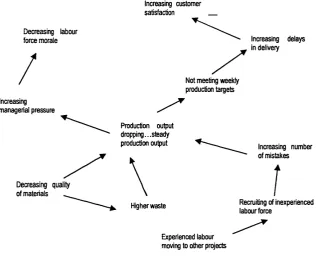
For example, the meaning of the concept ‘production output dropping’ will
depend whether it is contrasted with ‘production output increasing’ or with
inverse causal relationship (an arrow with a sign), or a direct causal
relationship. Properties or attributes of concepts can also be included in the maps
via connotative links to clarify meaning. An example of a cognitive map as a
[image:38.595.51.371.245.501.2]network of nodes and links is shown in Figure 2.2.
Figure 2-1: Example of a cognitive map as a network of nodes and links
Increasing customer satisfaction Decreasing labour
force morale
/
Increasing managerial pressure
Decreasing quality of materials
Increasing delays in delivery
Not meeting weekly production targets
Production output dropping...steady production output
Higher waste
Increasing number of mistakes
I
Recruiting of inexperienced labour force
Experienced labour moving to other projects
The collective map then is obtained by: (a) carefully merging all concept labels
presumed to denote similar meaning; (b) merging all concept labels that are the
same in the individual cognitive maps with vigilance for similarity of meaning;
and (c) linking all concept labels in the individual cognitive maps that denote
concepts which ought to have been linked (Eden & Ackerman, 2001; Eden, Jones,
& Sims, 1983). The composite approach to collective maps differs from the
average approach in that in the former case, collective maps are validated through
discussion and negotiation among participants.
In summary, the process of creating a collective map involves some form of
individual cognitive maps6, the resulting collective map is indicative of shared
meaning which, as stated earlier, is a is a prerequisite to produce organised action
(Bougon, Weick, & Binkhorst, 1977; Donnellon, Gray, & Bougon, 1986; Eden,
Jones, & Sims, 1983; Gray, Bougon, & Donnellon, 1985; Langfield-Smith, 1992;
Louis, 1980; Pfeffer, 1981; Smircich, 1983; Van Maanen, 1979; Weick, 1979;
Weick & Bougon, 1986).
Collective maps can then represent shared meaning but are also instrumental in
achieving shared meaning. Throughout this thesis, the achievement, by actors, of a
shared definition of a domain-level problem will be considered a pre-requisite of
the creation of shared meaning and the production of coordinated action. A shared
definition of a domain-level problem can be represented by a collective map.
However, it is important to notice that maps are not the only means through which
actors can arrive at a shared definition of a domain-level problem. Any explicit
shared representation which captures the concepts (and their relationships) used
by actors to describe a domain-level problem, can be used to develop a shared
definition and thus shared meaning. PSMs have as their characteristic the
development of a shared model representing the different perceptions of actors
with regards to a problematic situation. This model is then used to help actors
arrive at a shared definition of the problem situation. The discussion of PSM
models will be deferred until Chapter 4.
In this preceding discussion, the concepts of meaning and shared meaning have
been elaborated from both phenomenological and relational perspectives. The
latter can be seen as building upon the former by making explicit how individuals
create individual and shared meaning about their world. The importance of
elaborating the concepts of meaning and shared meaning within the context of this
research, it may be recalled, is that the creation of shared meaning is one of the
products of successful collaboration. A hypothesis of interest in this thesis is
whether analytical assistance, through PSMs, can facilitate the emergence of
shared meaning during collaboration.
Arriving at a shared definition of a domain-level problem is, as already mentioned
in Chapter 1, a critical aspect of the social construction of an inter-organisational
domain. Also, as discussed in Section 2.1, the creation of shared meaning is a
political process and actors’ power (or lack of power) will affect their ability to
participate effectively in this process. The following section will elaborate the
concept of power.
2.2 Power
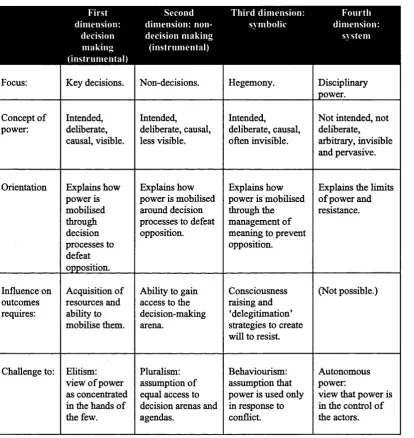
Power is a complex, multidimensional concept which has received a variety of
theoretical conceptualisations. Among the different approaches proposed for the
analysis of power are those of Pfeffer (1981), Hardy (1985), Boulding (1989),
Clegg (1989), Wrong (1995), Bourdeiu (1996) and Dowding (1996). In broad
terms, power can be conceived as the ability to affect the behaviour of others in a
conscious and deliberate way. This definition implies that coercion, manipulation,
authority, persuasion and influence are all expressions of power.
The discussion of power in this section is organised in four parts. In the first part,
the influential work of Lukes (1974), who provides a particularly useful
presentation of power in terms of three dimensions of increasing sophistication,
will be reviewed. In the second part, an important distinction will be made
between sources of power used in the face of conflict and those used to prevent
conflict from arising in the first place. This distinction will be based on the
framework developed by Hardy (1985), In the third part, a second distinction is
made between actors who benefit from their conscious mobilisation of power
through political strategies and those who benefit inadvertently from the power
the system’ will be elaborated drawing principally on the work of Foucault (1977;
1980; 1982; 1984).
2.2.1 Three dimensions o f power
Lukes (1974) linked the first dimension of power to the work of the pluralists (e.g.
Dahl, 1957; Polsby, 1963). The focus here is on the decision-making process. The
powerful are those who are able to influence this process in order to obtain the
decision outcomes they want.
Three main assumptions underlie the one-dimensional view of power. Firstly, it is
assumed that individuals are aware of their grievances and act upon them by
participating in the decision making process and using their influence to determine
key decisions. Secondly, the exercise of power is assumed to occur only in
decisions where conflict is clearly observable. Finally, it is assumed that conflict
is resolved during the decision making process. In summary, the first-dimensional
view of power focuses on the overt exercise of power in the decision-making
arena.
Awareness of the second dimension of power developed as researchers began to
question pluralist assumptions, in particular, the view that decision making arenas
were open to anyone with an interest in them and that, therefore, non-participation
reflected satisfaction and consensus (Bachrach & Baratz, 1962, 1963; 1970;
Lukes, 1974). Researchers started to consider the possibility that conflict can exist
without being necessarily articulated through official channels.
Subsequent work examined how full and equal participation might be constrained
by “the suppression of options and alternatives that reflect the needs of the non
participants. It is not necessarily true that people with the greatest needs
participate in politics most actively - whoever decides what the game is about also
decides who gets in the game” (Schattschneider, 1960, p. 105). Specifically,
making, and the agenda confined to safe issues. This process they called ‘non
decision making’, because it allows the more powerful actors to determine
outcomes from behind the scenes.
Luke’s (1974) noted that power can be mobilised not only to prevent issues from
entering the decision-making arena but also to prevent issues and conflict from
arising at all. This use of power in this form gives rise to Lukes’ (1974) third
dimension. Here, power can be used to shape people�