1
Title: The effect of time of night on wake-dream continuity
Authors:
Dr Josie E. Malinowski (corresponding author): Dr Josie E. Malinowski, Department of Psychology, University of Bedfordshire, Luton Campus, University Square, Luton LU1 3JU, [email protected].
Dr Caroline L. Horton: Leeds Metropolitan University, Faculty of Health and Social Sciences, Leeds, UK.
Running head: Time of night effects on continuity
Mailing address: Dr Josie Malinowski, Department of Psychology, University of Bedfordshire, Luton Campus, University Square, Luton LU1 3JU,
Keywords: The Continuity Hypothesis; wake-dream incorporations; memory
2 Abstract
Research has demonstrated a number of time of night and stage of sleep differences
in dream content, such as that dreams from later in the night are longer, more
emotional, and more bizarre. It was hypothesised that time of night may therefore
demonstrate differences in the continuity of waking life into dreams. Participants
(N=16) were systematically awoken four times a night for two nights and rated their
dreams for wake-dream continuity on a number of dimensions. It was found that time
of night affects wake-dream continuity overall, particularly showing an increase of
bizarreness over time; that there were more references to waking-life media in the
early than late night; that there were more references to waking-life activities and
objects in the late than early night; and that the ways in which different types of
wake-dream continuity correlate (such as continuity with present, past, and future
waking life) change from the early to the late night. No stage of sleep effects were
able to be demonstrated. The results support the hypothesis that time of night affects
wake-dream continuity.
3 1 Introduction
‘Continuity’ in dream research refers to the ways in which aspects of waking life
(such as experiences, thoughts, and emotions) are carried over into dreams, and
vice versa. A factor that may influence wake-dream incorporation is the time of night
from whence the dream came (Schredl, 2002), and, if found, these time of night
differences on wake-dream continuity may reflect altering memory consolidation
and/or integration processes across the night (Payne, 2010). The purpose of the
present study was to investigate time of night effects on continuity.
Stage of sleep differences in dream content have been demonstrated empirically in
many studies. Rapid-eye-movement (REM) sleep, the stage of sleep associated with
brain wave activity similar to wakefulness (high frequency, low amplitude) (Nir &
Tononi, 2010), which dominates the second half of the sleep cycle (McNamara et al.,
2010), has been shown to contain dreams that have more aggressive than friendly
interactions (McNamara et al., 2005), and are longer, more vivid, more bizarre, and
more emotional than NREM dreams (Hobson et al., 2000). Additionally, one paper
has found that they are associated with ‘recent residues’ (waking-life episodes within
a year of the dream), as opposed to ‘day residues’ (from the day immediately prior to
the dream) (Battaglia et al., 1987), and Blagrove et al. (2011) demonstrated that the
dream-lag effect, that is the trend for experiences from 5-7 days ago to be
incorporated into dreams (over and above events from 2-4 days ago) was evident in
REM but not NREM dreams. These latter findings might demonstrate time of night
4
rather than day- or remote-residues within late night dreams. More research is
needed to confirm these findings.
Although non-REM (NREM) sleep dreams are less common than REM sleep dreams
(Hobson et al., 2000), they have been shown to occur even in the absence of prior
REM sleep (Suzuki et al., 2004), illustrating that they exist independently of REM
sleep. NREM sleep comprises three stages of sleep all with different characteristics,
which include slower brain waves and sleep spindles (Maquet, 2010; Nir & Tononi,
2010). NREM sleep dreams have more friendly than aggressive interactions
(McNamara et al., 2005), and are shorter, more thought-like, and more related to
current concerns than REM dreams (Hobson et al., 2000). Sleep onset dreams
(Stage 1 NREM) are mostly associated with day residues as opposed to recent
residues (Battaglia et al., 1987).
Some REM/NREM dream content differences disappear when word length is
controlled, but it has been argued convincingly that to control to for word length is to
control for the very feature of the dream that is being measured, since word length is
likely to be an effect of dream features (such as bizarreness), not a cause of them
(Hobson et al., 2000), and is probably a marker of overall cortical activation
(Wamsley et al., 2007). Furthermore, some dream features remain significantly
different between REM and NREM sleep even when word length is controlled (Hobson et al., 2000), so searching for differences is valid whichever stance is taken
on word count.
However, the REM/NREM dichotomy is somewhat obscured by time of night effects,
because NREM dreaming becomes much like REM dreaming later in the night
5
REM dreams (Nir & Tononi, 2010). For example, hallucinatory thoughts are more
frequent in REM dreams across the night, but directed thought is only more frequent
in NREM dreams in the first five hours of the night (Fosse et al., 2004); and while
only REM dreams become more emotionally intense, bright, and clear later in the
night, both REM and NREM dreams become more bizarre, dreamlike, and longer
(Wamsley et al., 2007). Late-night REM dreams have also been found to contain
more remote waking-life episodes than early-night REM dreams in one study
(Verdone, 1965), although this was not replicated in a later study (see Domhoff,
2003), and so this finding requires further investigation. Nevertheless, sampling
dreams from systematic time periods across the night has been shown to be
comparable to sampling dreams from specific stages of sleep (Noreika, Valli
Lahtela, & Revonsuo, 2009).
Whilst there have been some investigations of the memory sources of dreams
sampled across the night, indicating differences in types of memories present in
different stages of sleep (Baylor & Cavallero, 2001), it remains unclear as to how this
can be conceived of in terms of continuity. Continuity between waking life and
dreams may exist that cannot be highlighted by identification of memory sources,
since continuity extends beyond the mere incorporation of episodic memories (Fosse
et al., 2003; Malinowski & Horton, 2014). Similarly, elements such as bizarreness
and/or discontinuity may change over the night, which may provide insights into
continuity. Our study presents the first attempt to map continuity as a construct onto
time of night, rather than identifying the memory sources of dream content. Based on
the evidence cited above, it was hypothesized that early-night dreams would contain
more day residues and late-night dreams more recent residues; that early-night
6
concerns and thoughts, than late-night dreams; and that late-night dreams would be
more emotional, bizarre, and discontinuous than early-night dreams.
1.2 Method
1.2.1 Participants
Participants were recruited via a participation credit scheme at Leeds Metropolitan
University, in which undergraduate psychology students participate for course
credits; and via opportunity sample. 16 participants (11 female, 5 male; 7 Leeds
Metropolitan University undergraduates, 9 acquaintances of the researchers) were
recruited, with an age range of 19 to 54 years of age (M = 27, SD = 9.00). 51 dreams
were collected (per participant: M = 3.19, SD = 2.01) over two nights. Participants were recruited on the basis of their having good general health, being over 18 years
of age, and not currently suffering nor historically having suffered from any sleep
disorders or health problems that may affect sleep (e.g. depression), or any health
problems that might worsen as a result of being awoken several times during the
course of two nights’ sleep (e.g. insomnia).
1.2.2 Design
Dreams were collected from participants awoken at certain intervals after they had
7
sleep (between 2.5 and 4.0 hours); in mid-late-night sleep (between 4.5 and 6.0
hours); and in late-night sleep (between 6.5 and 8.0). Participants also slept attached
to a home-based sleep-monitoring device called REMview, to track their stages of
sleep. REMview is identical in essence to the Nightcap, which has been
demonstrated to be able to detect REM and NREM (Stages 1, 2, or 3) (Aijilore et al.,
1995), using an eyelid sensor to measure eye movements and a head sensor to
measure body movements. However, due to equipment problems, stages of sleep
were not always recorded accurately, and so the focus of the results here is the time
of night differences. (For more details on this methodology, consult Malinowski,
2012). Upon awakening, participants were requested to verbalise their dream or
whatever was “going through their mind” (to elicit all mentation, not just participants’
idea of what a dream is, based on Foulkes, 1999), and these were audio-recorded.
Following the night’s awakenings, participants listened to their dreams and
completed a series of questions about them, as below.
1.2.3 Self-report questions
Participants completed one form per dream recorded, each morning of the study.
They reported all waking-life concerns, activities, emotions, people, objects, media,
and thoughts that appeared in the dream. Examples of each were given. They were
also asked to record when they had last experienced (“Experiences”) and when they
had last thought (“Cognitions”) about the waking-life element they had recorded.
These time referents were subsequently split into three categories: Day Residue,
8
al. (1987). Finally, participants answered 12 questions, some pertaining to
wake-dream continuity (such as “How related is the wake-dream to your present (within the last
month) waking life?”), and others to the general qualities of the dream (such as “How
emotionally intense was your dream?”), answerable on a scale of 0 to 9. After the
second night participants could also answer feedback questions (such as “Did you
understand everything that you were asked? If no, what didn’t you understand?”).
1.2.4 Procedure
Participants met with one of the researchers on their first study day, who illustrated
how to use the equipment by running through the standardised instructions.
Participants were instructed not to drink any alcohol or caffeine or consume anything
else that might interfere with sleep in the evening. In the evening, participants retired
to bed as per their usual routine and fitted the equipment themselves. During the
night, participants were awoken from the four time of night periods (see Section
1.2.2) and audio-recorded their dream. In the morning, participants removed the
equipment, listened to their recorded dreams, and filled in the forms corresponding
to each dream. Following the second night, particpants met up with the researcher
again to return the equipment and were debriefed.
The study abided by British Psychological Society ethical guidelines, and received
9 1.2.5 Analyses
Four sets of analyses were performed on the data to assess the effect of time of
night differences on:
1. The 12 dream variables (continuity with present, recent past, distant past, and
future waking life; general continuity; similarity to waking life; metaphorical
relation with waking life; emotional continuity; bizarreness; emotional and
stressfulness intensity; and importance).
2. The frequency of the different waking-life elements (worries/concerns,
activities, emotions, characters, objects, media, and thoughts)
3. The frequency of the three time referents (day / recent / remote residues)
4. The magnitude of correlations between the 12 dream variables.
Please see Appendix for the dream questions form participants filled in for each
dream, illustrating the wording of the 12 dream variables and the scoring method
used by participants.
1.3 Results
51 dreams were collected. The minimum word count was one word, the maximum
574 (M = 102.55, SD = 136.86). Dream forms were used in the analysis regardless of dream word length, provided the form was completed in its entirety. Of the 51
dreams, 49 dreams were suitable; two fell outside of the specified time categories.
10
are as follows: 7 Early (M = 97.50, SD = 81.51), 12 Early-Mid (M = 61.17, SD =
54.16), 16 Mid-Late (M = 69.31, SD = 109.57), and 14 Late (M = 164.23, SD = 162.91). There were no differences in word count between these four time point
categories, F(3,41) = 1.84, p>.05.
Four one-way MANOVAs were performed. In all four, time of night (four levels: Early,
Early-Mid, Mid-Late, and Late night sleep) was the independent variable. In the first
analysis, the participant self-ratings for the 12 dream variables were the dependent
variables. In the second analysis, frequency of occurrence of the seven waking-life
elements was the dependent variable. In the third analysis, the frequency of
occurrence of the three time referents for ‘experiences’ was the dependent variable.
In the fourth analysis, the frequency of occurrence of the three time referents for
‘cognitions’ was the dependent variable. For all three analyses, each dream was
treated as a case.
The dependent variables were all non-normally distributed according to the
Shapiro-Wilk test of normality. Three different transformations were attempted on all variables
(log, square root, and reciprocal), but none of the sets of transformed data displayed
normal distributions. However, Field (2009) has noted that all four test statistics
available in MANOVA are relatively robust to violations of multivariate normality and
thus it remained a suitable analysis. Box’s test of the assumption of the equality of
11
1.3.1 The effect of time of night on the 12 dream content variables
12
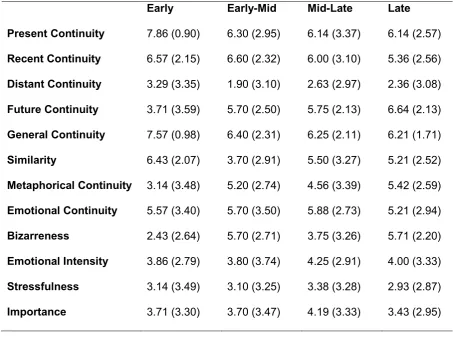
Table 1 – Means (SDs) of the 12 dream content variables
Early Early-Mid Mid-Late Late
Present Continuity 7.86 (0.90) 6.30 (2.95) 6.14 (3.37) 6.14 (2.57)
Recent Continuity 6.57 (2.15) 6.60 (2.32) 6.00 (3.10) 5.36 (2.56)
Distant Continuity 3.29 (3.35) 1.90 (3.10) 2.63 (2.97) 2.36 (3.08)
Future Continuity 3.71 (3.59) 5.70 (2.50) 5.75 (2.13) 6.64 (2.13)
General Continuity 7.57 (0.98) 6.40 (2.31) 6.25 (2.11) 6.21 (1.71)
Similarity 6.43 (2.07) 3.70 (2.91) 5.50 (3.27) 5.21 (2.52)
Metaphorical Continuity 3.14 (3.48) 5.20 (2.74) 4.56 (3.39) 5.42 (2.59) Emotional Continuity 5.57 (3.40) 5.70 (3.50) 5.88 (2.73) 5.21 (2.94)
Bizarreness 2.43 (2.64) 5.70 (2.71) 3.75 (3.26) 5.71 (2.20)
Emotional Intensity 3.86 (2.79) 3.80 (3.74) 4.25 (2.91) 4.00 (3.33)
Stressfulness 3.14 (3.49) 3.10 (3.25) 3.38 (3.28) 2.93 (2.87)
Importance 3.71 (3.30) 3.70 (3.47) 4.19 (3.33) 3.43 (2.95)
Using Roy’s largest root, there was a significant effect of time of night on the 12
dream content variables, Θ = .99, F(12, 34) = 2.82, p < .01, Ƞp2 = .51. Separate
univariate analyses on the dependent variables revealed that the only variable for
which there was a significant time of night effect was bizarreness F(3, 43) = 3.22, p <
.05. Games-Howell post-hoc (for unequal population variances) tests, however,
found no significant differences between the times of night; only the difference
between Early and Late sleep approached significance (p = .07, Ƞp2 = .19), with
13
1.3.2 The effect of time of night on waking-life elements
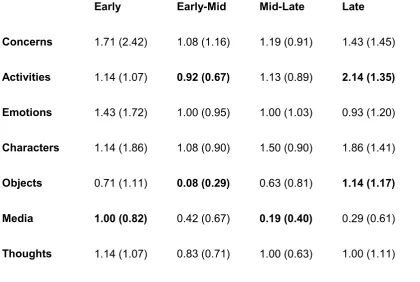
[image:13.595.70.491.241.523.2]Table 2 displays the means and standard deviations for the seven variables.
Table 2 – Means (SDs) of the frequency of the seven waking-life elements
Early Early-Mid Mid-Late Late
Concerns 1.71 (2.42) 1.08 (1.16) 1.19 (0.91) 1.43 (1.45)
Activities 1.14 (1.07) 0.92 (0.67) 1.13 (0.89) 2.14 (1.35)
Emotions 1.43 (1.72) 1.00 (0.95) 1.00 (1.03) 0.93 (1.20)
Characters 1.14 (1.86) 1.08 (0.90) 1.50 (0.90) 1.86 (1.41)
Objects 0.71 (1.11) 0.08 (0.29) 0.63 (0.81) 1.14 (1.17)
Media 1.00 (0.82) 0.42 (0.67) 0.19 (0.40) 0.29 (0.61)
Thoughts 1.14 (1.07) 0.83 (0.71) 1.00 (0.63) 1.00 (1.11)
Bold indicates a significant difference at the p<.05 level.
Using Roy’s largest root, there was a significant effect of time of night on the seven
waking-life element variables, Θ = .73, F(7, 41) = 4.30, p < .01, Ƞp2 = .42. Separate
univariate analyses on the dependent variables revealed that the three variables for
14
3.17, p < .05, Ƞp2 = .17. Games-Howell post-hoc tests showed that for Activities,
there was a significant difference between Early-Mid and Late night dreams (p < .05), with more activities in Late than Early-Mid dreams; for Objects, there was a
significant difference between Early-Mid and Late night dreams (p < .05), with more objects in Late then Early-Mid dreams; and for Media there was a significant
difference between Early and Mid-Late night dreams (p < .05), with more media
references in Early than Mid-Late night dreams.
1.3.3 The effect of time of night on time referents
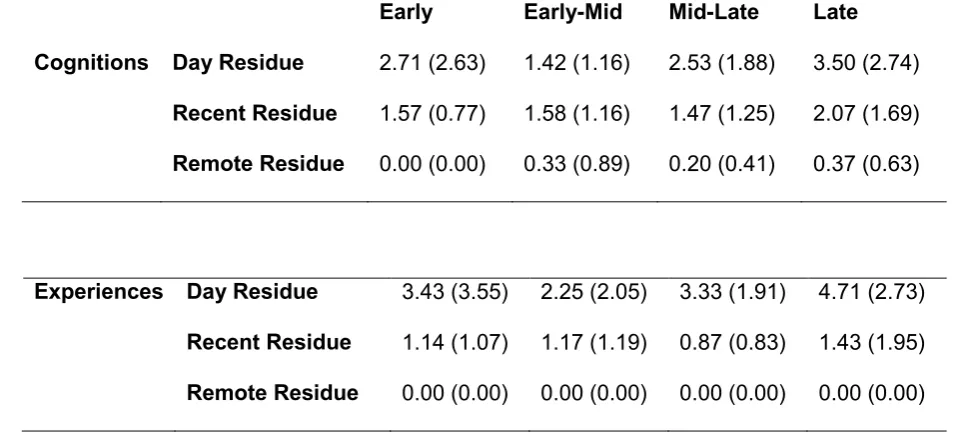
Table 3 displays the means and standard deviations for the three time referents for
[image:14.595.55.532.510.727.2]experiences and thoughts.
Table 3 – Means (SDs) of the frequency of the three time referents
Early Early-Mid Mid-Late Late
Cognitions Day Residue 2.71 (2.63) 1.42 (1.16) 2.53 (1.88) 3.50 (2.74)
Recent Residue 1.57 (0.77) 1.58 (1.16) 1.47 (1.25) 2.07 (1.69)
Remote Residue 0.00 (0.00) 0.33 (0.89) 0.20 (0.41) 0.37 (0.63)
Experiences Day Residue 3.43 (3.55) 2.25 (2.05) 3.33 (1.91) 4.71 (2.73)
Recent Residue 1.14 (1.07) 1.17 (1.19) 0.87 (0.83) 1.43 (1.95)
15
Using Roy’s largest root, there was a non-significant effect of time of night on the
three waking-life time referents for experiences, Θ = .17, F(3, 44) = 2.29, p > .05, Ƞp2
= .15, and for cognitions, Θ = .16, F(3, 44) = 2.31, p > .05, Ƞp2 = .14.
A post-hoc power analysis was conducted to investigate whether the sample size
provided enough power to detect an effect of time of night on waking-life time
referents. With 1-β = .8, Ƞp2 = .15, and p = .05, it was found that 24 participants
would have been needed to detect an effect. Thus, a moderate effect of time of night
on waking-life time referents may yet exist, but a larger sample size would be
required to detect it.
1.3.4 Correlations between continuity variables
Correlational analyses were performed to explore the general profile of early-night
and late-night dream characteristics. Due to the low number of cases for the four
time of night categories, the data were split into two time of night variables for the
correlational analyses. Early and Early-Mid night dreams were combined,
incorporating dreams from between 30 minutes and 4 hours after participants’
bedtime, and became ‘Early’ (N=19), and Mid-Late and Late night dreams were
combined, incorporating dreams from between 4.5 hours and 8 hours after
participants’ bedtime, and became ‘Late’ (N = 30).
Spearman’s parametric tests were used for both correlations due to the
16
display the correlation matrices. Significance values were determined with the
sequential Bonferroni method (Holm, 1979) to correct for the inflated risk of Type 1
17
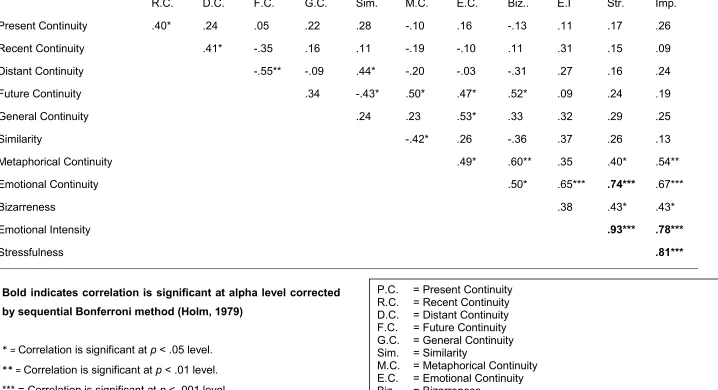
Table 4 – Correlation matrix: relationships between dream variables of early night dreams
R.C. D.C. F.C. G.C. Sim. M.C. E.C. Biz.. E.I Str. Imp.
Present Continuity .40* .24 .05 .22 .28 -.10 .16 -.13 .11 .17 .26
Recent Continuity .41* -.35 .16 .11 -.19 -.10 .11 .31 .15 .09
Distant Continuity -.55** -.09 .44* -.20 -.03 -.31 .27 .16 .24
Future Continuity .34 -.43* .50* .47* .52* .09 .24 .19
General Continuity .24 .23 .53* .33 .32 .29 .25
Similarity -.42* .26 -.36 .37 .26 .13
Metaphorical Continuity .49* .60** .35 .40* .54**
Emotional Continuity .50* .65*** .74*** .67***
Bizarreness .38 .43* .43*
Emotional Intensity .93*** .78***
Stressfulness .81***
P.C. = Present Continuity R.C. = Recent Continuity D.C. = Distant Continuity F.C. = Future Continuity G.C. = General Continuity Sim. = Similarity
M.C. = Metaphorical Continuity E.C. = Emotional Continuity Biz. = Bizarreness
E.I. = Emotional Intensity Str. = Stressfulness Imp. = Importance Bold indicates correlation is significant at alpha level corrected
by sequential Bonferroni method (Holm, 1979)
18
Table 5 – Correlation matrix: relationships between dream variables of late night dreams
R.C. D.C. F.C. G.C. Sim. M.C. E.C. Biz.. E.I Str. Imp. Present Continuity .66*** .21 .47** .74*** .74*** -.25 .60*** -.34* .25 .10 .26 Recent Continuity .21 .36* .62*** .52** -.13 .55** -.25 .15 .01 .19
Distant Continuity .07 .16 -.24 .18 .15 .11 .36 .42 .27
Future Continuity .51** .54** -.01 .47 -.00 .15 .04 .24
General Continuity .58*** -.04 .53** -.16 .33* .16 .21
Similarity -.55** .59*** -.52** .07 -.09 .11
Metaphorical Continuity -.08 .72*** .51** .58*** .47**
Emotional Continuity .05 .42* .34* .39*
Bizarreness .46** .57*** .41*
Emotional Intensity .86*** .91***
Stressfulness .75***
P.C. = Present Continuity R.C. = Recent Continuity D.C. = Distant Continuity F.C. = Future Continuity G.C. = General Continuity Sim. = Similarity
M.C. = Metaphorical Continuity E.C. = Emotional Continuity Biz. = Bizarreness
E.I. = Emotional Intensity Str = Stressfulness Imp. = Importance Bold indicates correlation is significant at alpha level corrected
by sequential Bonferroni method (Holm, 1979)
19
In early- but not late-night dreams, Emotional Continuity was related to
Stressfulness. Thus, when dreaming of one’s waking-life emotions, the dream was
more likely also to be stressful at the beginning but not the end of the night. In
late-night dreams there were many more much larger and significant correlations than
early-night dreams. For example, Present Continuity was positively correlated with
Recent, General, and Emotional Continuity, and Similarity, in the late but not early
night, as were Recent and General Continuity, Similarity and General Continuity, and
Similarity and Emotional Continuity. This implies that continuity was generally more
integrated in the later portion of the night than the earlier portion.
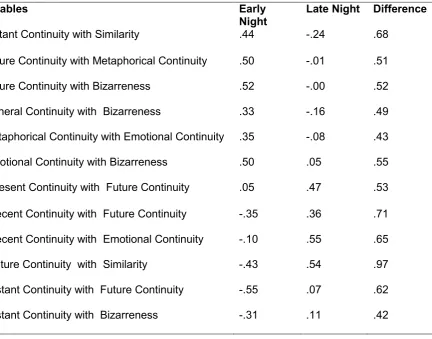
In addition, there were some differences evident in the size and/or direction of
correlations between the early and late night dreams. Differences in the size of
correlations that exceeded .4 were searched for and tabulated. Table 6 displays
variables that were correlated: (a) positively in the early night dreams but either
negatively or very weakly in the late night dreams, (b) positively in the late night
dreams but either negatively or very weakly in the early night dreams, and (c)
negatively in the early night dreams but very weakly in the late night dreams. Note
that these tables simply describe size and/or direction differences, and do not
20
Table 6 – Differences in correlations between early- and late-night dreams
Variables Early
Night Late Night Difference *Distant Continuity with Similarity .44 -.24 .68
*Future Continuity with Metaphorical Continuity .50 -.01 .51
*Future Continuity with Bizarreness .52 -.00 .52
*General Continuity with Bizarreness .33 -.16 .49
*Metaphorical Continuity with Emotional Continuity .35 -.08 .43
*Emotional Continuity with Bizarreness .50 .05 .55
**Present Continuity with Future Continuity .05 .47 .53
**Recent Continuity with Future Continuity -.35 .36 .71
**Recent Continuity with Emotional Continuity -.10 .55 .65
**Future Continuity with Similarity -.43 .54 .97
+Distant Continuity with Future Continuity -.55 .07 .62
+Distant Continuity with Bizarreness -.31 .11 .42
Key:
* variables positively correlated early in the night but negative or weak late in the night
** variables positively correlated late in the night but negative or weak early in the night
21 1.4 Discussion
1.4.1 The effect of time of night on continuity and other dream variables
Late-night dreams showed a trend towards being more bizarre than those in the
early night, in line with previous research (Fosse et al., 2004; Payne, 2010; Wamsley
et al., 2007). It was hypothesised that other features of dreams would increase
across the night, such as emotionality, and that some would be higher in the early
night, such as present continuity, but this was not upheld. It may be that there was
no effect for emotionality because emotionality only increases across the night in
REM sleep (Wamsley et al., 2007). The small samples in each grouping may also
account for the lack of more significant effects – some continuity variables changed
in the predicted direction but without reaching significance, such as a decrease in
present continuity – so further investigation with larger samples is required.
1.4.2 The effect of time of night on frequency of waking-life elements
Waking-life activities and objects appeared significantly more frequently in the late
than early-mid night dreams, and media in the early than mid-late night dreams. For
the former, a simple explanation of the higher incidence later on is that late night
dreams are known to be longer (Hobson et al., 2000), and there is likely to be more
of any element in longer than shorter dreams (Wamsley et al., 2007); but since there
were no differences in word length, this is unlikely to explain this result. The greater
occurrence of activities and objects in later dreams, but not of concerns or thoughts,
22
(Casagrande et al., 1996), and concerns and thoughts are thought-based rather than
imagistic or perceptual like activities and objects. Since it is known that late-night
dreams are typically longer (despite not being found in the present data) and thus
more of any element is likely for this reason, it is particularly interesting that there
were more references to media in early than mid-late sleep. This could be explained
by proximity: it may be that dreams of the early night are particularly influenced by
media that has been experienced the evening prior to sleep.
In a similar vein to the expectation that dream emotionality would increase across
the night, it was hypothesised that there would be more references to waking-life
emotions later in the night, based on the speculation that if dreams are more
emotional later in the night, they may relate to waking-life emotions. The explanation
for the null finding for waking-life emotions may be the same as the explanation for
the null finding for dream emotionality: the over-representation of late-night NREM
dreams, since emotionality is known to increase only in REM dreams across the
night. Alternatively, it may be that whilst late-night dreams are typically emotional,
this might not be a result of wake-dream continuity per se.
These differences in the composition of dreams across the night likely relate to the
memory sources of dreams, and as such can be interpreted in light of previous
research in this area: for example, that, episodic memory sources are relatively
prevalent in NREM dreams and semantic sources in REM dreams (Baylor &
Cavallero, 2001; see also Malinowski & Horton, 2014).
23
There were no time of night effects on the time referents of waking-life elements, in
contrast to previous research that has found that there are more recent memory
referents in early than late sleep (Battaglia et al., 1987; Verdone, 1965). Similarly,
Blagrove et al. (2011) demonstrated that the dream-lag effect was evident in REM
but not NREM dreams, potentially demonstrating time of night effects also. In the
present study, power analyses suggest that the small sample sizes may account for
the null finding; however, Hall (1966, cited in Domhoff, 2003) did not replicate
Verdone’s findings, and significant results were found for other analyses with small
samples in the present study, so this matter is still unresolved and is certainly worthy
of further investigation. However, the variability of findings may indicate that there
are potential confounds or third variables acting upon these time of night effects,
such as the age of the dreamer. For example, the reminiscence bump, the tendency
for older adults to recall a disproportionate number of memories from the late-teen
years, has been evidenced within dream recall (Grenier et al., 2005).
1.4.4 The difference in correlations between continuity variables in early and late
night dreams
Some correlations were inverted from the early- to late-night dreams, as follows.
(Note the following describes differences in magnitude of correlations, but is not
limited to significant correlations.) In the early night only, future continuity was
positively related to bizarreness and metaphoricalness and not related to other time
referents of continuity; it was also negatively related to distant continuity. Conversely,
in the late night only, future continuity was positively related to similarity and other
24
distant past continuity was positively related to similarity and negatively to future
continuity and bizarreness, but in the late night only it was negatively related to
similarity, and was not related to future continuity or bizarreness. A more
sophisticated statistical analysis with a larger sample needs to be undertaken to
illustrate which of these variables cluster or factor together, but these preliminary
findings may indicate that continuity manifests differentially dependent on time of
night. For example, future continuity may manifest in bizarre and/or metaphorical
ways in the early night, but in a way that is more similar to waking life in the late
night. In addition, dreaming of waking life seemed to be more likely to refer
independently to one type of continuity or another in the early than the late night: all
of the correlations between the continuity variables in the early night were either
relatively small and positive or small and negative, whereas in the late night in there
were much larger positive correlations between them.
Taken together, we could try to assimilate these depictions of continuity with the
literature concerning the memory sources of dreaming, the latter of which has
evidenced that NREM dreams are more likely to feature episodic elements of waking
life, with REM or late night dreams being more fragmentary (Baylor & Cavallero,
2001; Malinowski & Horton, 2014). However, there are two major differences
between the present findings and the memory sources field. Firstly, we investigated
time of night effects rather than comparing REM with NREM dreams. Secondly, we
present a method for investigating characteristics of continuity that goes far beyond
the reductionist method of exploring memory sources of dreams.
The pattern described above implies two potential alterations from early- to late-night
dreams: the way in which distant and future continuity are dreamt of switches place
25
time referents moves from independent to integrated dreaming. Due to the low
sample this suggestion is presented cautiously and with the caveat that it needs
testing with a larger sample.
The results presented illustrate novel evidence for time of night effects on continuity:
waking-life elements are represented with differing frequency from the early to the
late night; late-night dreams are more bizarre; and the correlations between
continuity variables (such as future) with each other and dream quality variables
(such as bizarreness) change across the night. It is likely that these differences
portray subjective mental representations that are reflective of physiological changes
across night, such as cortisol levels (Payne, 2010), which in turn may reflect
sleep-dependent processes such as memory consolidation and integration. For example, it
has been shown that associative memory is selectively activated during REM sleep
(Cai et al., 2009), which may be demonstrated in the present study by the more
integrative activation of memories in the late night, where REM dominates. Future
studies should continue to look for stage of sleep and time of night effects on
continuity, and consider the implications they may have for the dreams reflecting
26 References
Ajilore, O., Stickgold, R., Rittenhouse, C. D., and Hobson, J. A. Nightcap: laboratory
and home-based evaluation of a portable sleep monitor. Psychophysiology, 1995,
32: 32-41.
Battagila, D., Cavallero, C., and Cicogna, P. Temporal reference of the mnemonic
sources of dreams. Percept. Mot. Skills, 1987, 64: 979-983.
Baylor, G. W. and Cavallero, C. Memory sources associated with REM and NREM
dream reports throughout the night: a new look at the data. J. Sleep Res., 2001, 24:
165-170.
Blagrove M, Fouquet NC, Henley-Einion JA, Pace-Schott EF, Davies AC,
Neuschaffer JL, Turnbull OH. Assessing the dream-lag effect for REM and NREM
stage 2 dreams. PLoS One, 2011, 6(10), e26708.
Cai, D. J., Mednick, S. A., Harrison, E. M., Kanady, J. C., and Mednick, S. C. REM,
not incubation, improves creativity by priming associative networks. Proc. Natl. Acad. Sci. U. S. A., 2009, 106: 10130-10134.
Casagrande, M., Violani, C., Lucidi, F., Buttinelli, E., and Bertini, M.
Variations in sleep mentation as a function of time of night. Int. J. Neurosci., 1996,
85: 19-30.
Domhoff, G. W. The scientific study of dreams. APA Press, Washington DC, 2003.
Field, A. Discovering Statistics Using SPSS. Sage, London, 2009.
Fosse, M. J., Fosse, R., Hobson, J. A., and Stickgold, R. J. Dreaming and episodic
27
Fosse, R., Stickgold, R., and Hobson, J. A. Thinking and hallucinating: reciprocal
changes in sleep. Psychophysiology, 2004, 41: 298-305.
Foulkes, D. Children’s dreaming and the development of consciousness. Harvard
University Press, London, 1999.
Grenier, J., Cappeliez, P., St-Onge, M., et al. Temporal references in dreams and
autobiographical memory. Mem. Cognit., 2005, 33: 280-288.
Hobson, J., Pace-Schott, E., and Stickgold, R. Dreaming and the brain: towards a
cognitive neuroscience of conscious states. Behav. Brain Sci., 2000, 23:
793-1121.
Holm, S. A simple sequential rejective multiple test procedure. Scand. J. Stat.,
1979, 6: 65-70. .
Malinowski, J. E. How and why we dream of waking life: An empirical investigation
into the Continuity Hypothesis of dreaming. Unpublished thesis, 2012. Accessible
from ethos.bl.uk
Malinowski, J. and Horton, C. L. Memory sources of dreams: The incorporation of
autobiographical rather than episodic experiences. Journal of Sleep Research. 2014,
DOI: 10.1111/jsr.12134
Maquet, P. Understanding non rapid eye movement sleep through neuroimaging.
World J. Bio. Psychiatry, 2010, 11: 9–15.
McNamara, P., Johnson, P., McLaren, D., Harris, E., Beauharnais, C., and
Auerbach, S. REM and NREM sleep mentation. Int. Rev. Neurobiol., 2010, 92:
28
McNamara, P., McLaren, D., Smith, D., Brown, A., and Stickgold, R. A ‘‘Jekyll and
Hyde’’ within: aggressive versus friendly interactions in REM and non-REM dreams.
Psychol. Sci., 2005, 16: 130-136.
Nir, Y. and Tononi, G. Dreaming and the brain: from phenomenology to
neurophysiology. Trends Cogn. Sci., 2010, 14: 88-100.
Noreika V, Valli K, Lahtela H, Revonsuo A. Early-night serial awakenings as a new
paradigm for studies on NREM dreaming. Int J Psychophysiol, 2009, 74(1):14-8.
Payne, J. D. Memory consolidation, the diurnal rhythm of cortisol, and the nature of
dreams: a new hypothesis. In: A. Clow and P. McNamara (Eds) International review of neurobiology: dreams and dreaming. Elvesier, London, 2010: 103-134.
Schredl, M. Continuity between waking and dreaming: a proposal for a mathematical
model. Sleep Hypn., 2002, 5: 26-40.
Suzuki, H., Uchiyama, M., Tagaya, H., et al. Dreaming during non-rapid eye
movement sleep in the absence of prior rapideye movement sleep. Sleep, 2004, 27: 1486-1490.
Verdone, P. Temporal reference of manifest dream content. Percept. Mot. Skills,
1965, 20: 1253-1268.
Wamsley, E. J., Hirota, Y., Tucker, M. A., Smith, M, R., and Antrobus, J. S. Circadian
29 Appendix: Dream questions form
Think about all the ways in which your dream shares elements with waking life. Does the dream contain people you know, places you’ve been, things you’ve done, things you’re worried about? Think carefully through each part of the dream and identify how it relates to your waking life, then list as follows. [NB the time you last experienced something may be different to when you last thought about it – e.g. you saw a movie a couple of weeks ago, but talked about it with a friend the night before a dream about it.] Play the dream to yourself as many times as you need to and please try to complete the lists as fully as possible, so that every part of the dream that you recognised from your waking life is accounted for.
1. List any waking life worries or concerns the dream relates to, such as relationships, friendships, money, work or studies, life upheavals such as moving house, health, or any other worries or concerns. These can be things you are currently worried about, or have happened in the past. State when you last experienced this worry or concern and when you last thought about this worry or concern (e.g. last night, last week, a year ago, etc). If there are none, write N/A in the second box. An example is given for you in red ink in the first box.
Worry or concern Experienced Thought about
Revising for exams Three days ago Last night
2. List any waking life activities the dream relates to, such as socialising, hobbies, sports / exercise, work or studies, daily activities including travelling and eating, shopping, etc. These can be activities you have engaged in recently or longer ago. State when you last experienced this activity and when you last thought about this activity. If there are none, write N/A in the second box. An example is given for you in red ink in the first box.
Activity Experienced Thought about
Went shopping with my mum Last weekend Last weekend
30
and when you last thought about this emotion. If there are none, write N/A in the second box. An example is given for you in red ink in the first box.
Emotion Experienced Thought about
Angry at someone who cut me up driving A week ago Two days ago
4. List any waking life characters the dream relates to, including family members, friends, people from work, famous people e.g. film/TV stars, fictional people e.g. characters from film/TV, animals such as pets, etc. They can be people you have met or not, and it doesn’t matter when you last saw them. State when you last saw them, and when you last thought about them. If there are none, write N/A in the second box. An example is given for you in red ink in the first box.
Character Experienced Thought about
Janine (housemate / best friend) Last night Last night
5. List any waking life objects the dream relates to, such as clothing, books, furniture, and vehicles. State when you last came into contact with the object, and when you last thought about it. If there are none, write N/A in the second box. An example is given for you in red ink in the first box.
Object Experienced Thought about
Desk in my room at my parents’ house A month ago A month ago
31
Media Experienced Thought about
Saw ‘Sherlock Holmes’ at cinema Two weeks ago Yesterday
7. List any waking life thoughts the dream relates to, such as something you need to do, something you believe (e.g. religion or politics), or anything else you have been thinking about. State when you last thought about it. If there are none, write N/A, in the second box. An example is given for you in red ink in the first box.
Thoughts Experienced Thought about
Need to collect prescription from pharmacist Yesterday Yesterday
Now please think about how your dream relates to your waking life overall. Note that sometimes
you may have dreams that are literally related to your waking life – such as dreaming that you
turned up to the wrong exam, during your exam revision time. Other times you may find that dreams are related to your waking life, but in less literal ways: for example, you may dream of being lost if you are feeling lost; or you may dream about your studies, but in a strange way that is not at all like waking life. For the following questions, please try to think about how related to
your waking life the dream is regardless of whether the relation is literal or not.
1. How related is the dream to your present (within the last month) waking life on a scale of 0-9,
where 0 = no part of the dream is related to your present waking life, and 9 = every part of the dream is related to your present waking life? Answer:
2. How related is the dream to your recent past (a month or longer ago, but not childhood) waking
life on a scale of 0-9, where 0 = no part of the dream is related to your recent past waking life, and 9 = every part of the dream is related to your recent past waking life? Answer:
3. How related is the dream to your distant past (childhood) waking life on a scale of 0-9, where 0 =
32
4. How related is the dream to your future waking life (i.e., things you are anticipating for the future)
on a scale of 0-9, where 0 = no part of the dream is related to your future waking life, and 9 = every part of the dream is related to your future waking life? Answer:
5. How related is the dream to your waking life in general (present, past, or future) on a scale of 0-9,
where 0 = no part of the dream is related to waking life, and 9 = every part of the dream is related to waking life? Answer:
For the next two questions, please think more about whether the dream is literally related to your
waking life or not literally related to your waking life. If it is literally related, you could say the
dream is similar to your waking life. If it is not literally related, you could say the dream is
metaphorical for your waking life.
6. How similar is the dream to your waking life in general (present, past, or future) on a scale of 0-9,
where 0 = no part of the dream is similar to your waking life, and 9 = every part of the dream is similar to your present waking life? Answer:
7. How metaphorical is the dream to your waking life in general (present, past, or future), on a scale
of 0-9, where 0 = no part of the dream is metaphorical for waking life, and 9 = every part of the dream is metaphorical for waking life? Answer:
You may have found that emotions in your dream relate to emotions in your waking life: for example, if you’re feeling guilty about something, you might feel guilty in your dream; or if you feel anxious about something, you might feel anxious in your dream, and so on. If doesn’t matter if the dream is similar to waking life or a metaphor for waking life – please just think about the emotion.
8. How emotionally continuous is the dream to your waking life in general (present, past, or future),
on a scale of 0-9, where 0 = no part of the dream is emotionally continuous with waking life, and 9 = every part of the dream is emotionally continuous with waking life? Answer:
Finally, please answer the following questions:
9. How bizarre is the dream on a scale of 0-9, where 0 = there are no bizarre elements at all to the dream. 9 = dream is as bizarre as it can be? Answer:
10. How emotionally intense was your dream on a scale of 0-9, where 0 = not at all emotional, and 9 = as emotional as it is possible to be? Answer:
33
12. How stressful was your dream scale on a scale of 0-9, where 0 = not at all stressful, and 9 = as stressful as it is possible to be? Answer: