The dream-lag effect: Selective processing of personally significant
events during Rapid Eye Movement sleep, but not during Slow Wave
Sleep
E. van Rijn
a, J.-B. Eichenlaub
a,1, P.A. Lewis
b, M.P. Walker
c, M.G. Gaskell
d, J.E. Malinowski
e, M. Blagrove
a,⇑ aSwansea University Sleep Laboratory, Department of Psychology, Swansea University, UK b
Sleep and Memory Laboratory, Department of Psychology, University of Manchester, UK c
Sleep and Neuroimaging Laboratory, Department of Psychology, University of California, Berkeley, CA, USA dSleep, Language and Memory Laboratory, Department of Psychology, University of York, UK
eDepartment of Psychology, University of Bedfordshire, Luton, UK
a r t i c l e
i n f o
Article history:
Received 30 September 2014 Revised 23 December 2014 Accepted 28 January 2015 Available online 13 February 2015
Keywords:
Sleep REM sleep Slow Wave Sleep Memory consolidation Dream-lag
Dream
a b s t r a c t
Incorporation of details from waking life events into Rapid Eye Movement (REM) sleep dreams has been found to be highest on the night after, and then 5–7 nights after events (termed, respectively, the day-residue and dream-lag effects). In experiment 1, 44 participants kept a daily log for 10 days, reporting major daily activities (MDAs), personally significant events (PSEs), and major concerns (MCs). Dream reports were collected from REM and Slow Wave Sleep (SWS) in the laboratory, or from REM sleep at home. The dream-lag effect was found for the incorporation of PSEs into REM dreams collected at home, but not for MDAs or MCs. No dream-lag effect was found for SWS dreams, or for REM dreams collected in the lab after SWS awakenings earlier in the night. In experiment 2, the 44 participants recorded reports of their spontaneously recalled home dreams over the 10 nights following the instrumental awakenings night, which thus acted as a controlled stimulus with two salience levels, high (sleep lab) and low (home awakenings). The dream-lag effect was found for the incorporation into home dreams of references to the experience of being in the sleep laboratory, but only for participants who had reported concerns before-hand about being in the sleep laboratory. The delayed incorporation of events from daily life into dreams has been proposed to reflect REM sleep-dependent memory consolidation. However, an alternative emo-tion processing or emoemo-tional impact of events account, distinct from memory consolidaemo-tion, is supported by the finding that SWS dreams do not evidence the dream-lag effect.
Ó2015 The Authors. Published by Elsevier Inc. This is an open access article under the CC BY license (http://creativecommons.org/licenses/by/4.0/).
1. Introduction
Rapid-Eye Movement (REM) and non-REM sleep stages Slow Wave Sleep (SWS) and stage 2 sleep (N2), are believed to play a role in the consolidation of memories (e.g.,Diekelmann & Born, 2010; Gais & Born, 2004; Smith, 2001). Several researchers have proposed a sequential two-step model for memory consolidation during sleep (Gais & Born, 2004; Giuditta et al., 1995; Stickgold,
James, & Hobson, 2000). In the first step, events from the day are processed during SWS, with non-adaptive memories being weak-ened while adaptive memories and responses are strengthweak-ened. The second step takes place during REM sleep, in which adaptive memories are processed for better storage and integration with previous memories (Giuditta et al., 1995; Walker & Stickgold, 2010). A process of memory triage for consolidation has also been proposed (Stickgold & Walker, 2013), in which there is a differen-tial processing of memories based on factors such as salience and future relevance. This discriminatory selection serves multiple forms of memory, such as emotional memory, episodic memory and procedural memory, is facilitated by different sleep stages and by the reactivation of new memories during sleep, and is nec-essary for rapid and effective adaptation to changes in the environ-ment (Stickgold & Walker, 2013).
Dreaming has been proposed to reflect this reactivation and
consolidation of memories during sleep (Wamsley, Perry,
http://dx.doi.org/10.1016/j.nlm.2015.01.009
1074-7427/Ó2015 The Authors. Published by Elsevier Inc.
This is an open access article under the CC BY license (http://creativecommons.org/licenses/by/4.0/).
⇑Corresponding author at: Swansea University Sleep Laboratory, Department of Psychology, Swansea University, SA2 0LY, UK. Fax: +44 1792 295679.
E-mail addresses:[email protected](E. van Rijn),j.r.eichenlaub@swansea. ac.uk(J.-B. Eichenlaub),[email protected](P.A. Lewis),mpwalker@berkeley. edu(M.P. Walker),[email protected](M.G. Gaskell),josie.malinowski@beds. ac.uk(J.E. Malinowski),[email protected](M. Blagrove).
1
Present address: Department of Neurology, Massachusetts General Hospital, Harvard Medical School, MA, USA.
Contents lists available atScienceDirect
Neurobiology of Learning and Memory
Djonlagic, Babkes Reaven, & Stickgold, 2010; Wamsley & Stickgold,
2011). For example, Wamsley, Tucker, Payne, Benavides, and
Stickgold (2010)demonstrate that improved performance on a vir-tual navigation task is associated with task-related dreams during an intervening nap, but not with task-related daydreams during an intervening period of wake. Regarding longer timescales, findings of a 7-day U-shaped function of incorporation of waking life events
into dreams has led to speculation by Nielsen and Stenstrom
(2005)that this indexes a process of memory consolidation across several nights, during which recently acquired memories shift from the hippocampus to neocortical structures.
The 7-day U-shaped timescale comprises the appearance in dreams of memory details from one or two days before, known as immediate incorporations or the day-residue effect, and a delayed incorporation of daily events into dreams 5–7 days after the event took place, known as the dream-lag effect (Nielsen, Kuiken, Alain, Stenstrom, & Powell, 2004). Naturalistic designs used to study this have involved the completion of daily diaries and dream diaries over periods of one to two weeks, with the incorporation of waking life events into dream reports then being identified (Blagrove, Fouquet, et al., 2011; Blagrove, Henley-Einion, Barnett, Edwards, & Seage, 2011; Nielsen et al., 2004). In two of these studies (Blagrove, Henley-Einion, et al., 2011; Nielsen et al., 2004) account is taken of any putative recurring weekly events confound. Standardized stimulus designs have also been used, with a night sleeping in the sleep laboratory (Nielsen & Powell, 1989, second experiment) or the watching of a videotape of the ceremonial slaughter of a water buffalo (Powell, Nielsen, Cheung, & Cervenka, 1995) as the stimulus: In both these studies the dream-lag effect was found.
The dream-lag effect holds for REM sleep dreams but not N2 dreams (Blagrove, Fouquet, et al., 2011). In that study participants kept a daily diary for nine days and dream reports were then col-lected in the sleep laboratory from REM and N2 sleep, with inter-ruptions from both sleep stages occurring across the night. Participants rated the correspondence between each of their daily diary records and each dream report collected in the sleep labora-tory. Experiment 1 in the present paper similarly investigates the dream-lag effect for the incorporation of naturalistic events and occurrences into dreams where the sleep stage at awakening is
known. Experiment 1 extends the work of Blagrove, Fouquet,
et al. (2011) by having one condition where awakenings occur from REM sleep and from SWS. Of necessity data collection has to occur in the sleep laboratory and with SWS awakenings occur-ring early in the night, when SWS predominates, before the REM awakenings. The question of whether SWS dreams evidence the dream-lag effect arises because SWS is held to be involved in sys-tem consolidation for declarative memory (Diekelmann & Born, 2010), and in the integration of newly learned memories into exist-ing schemas, and the formation of new schemas (Lewis & Durrant, 2011). However, whether such processing is reflected in dream content, and with the timescale of delayed incorporation found for REM sleep dreams, is currently unknown.
Experiment 1 also extendsBlagrove, Fouquet, et al. (2011)by having another condition where participants are woken for dream reporting solely from REM sleep, at home using the Nightcap sleep monitoring device (Ajilore, Stickgold, Rittenhouse, & Hobson, 1995). Although the results of Blagrove, Fouquet, et al. (2011) regarding the dream-lag effect being specific to REM rather than N2 dreams were clear, and understandable in terms of REM specific emotional memory consolidation, dream reports were collected over two non-consecutive nights (separated by one night at home), as necessitated by the need to sample each of REM and N2 across the night. The advantage of the current study is that dream reports are collected solely from one night: with either SWS awakenings early and REM sleep awakenings later in the night, or solely REM
sleep awakenings across one night. This removes any confounds of having two nights of awakenings, such as dream content on the second dream collection night referring to the sleep experi-ment on the first night, which could increase apparent correspon-dences for the 2 and 3 day periods between a diary day and a dream report.
Experiment 1 also extends previous studies on the dream-lag by investigating which types of naturalistic occurrences are subject to delayed incorporation. In order that categories of waking life occurrence can be assessed separately, participants keep a struc-tured daily log, taken from Fosse, Fosse, Hobson, and Stickgold (2003), that differentiates three categories of waking life occur-rences: major daily activities (MDAs), personally significant events (PSEs), and major concerns (MCs). We hypothesize that PSEs are incorporated into dreams according to the 5–7 day dream-lag timescale. MDAs are not expected to demonstrate the dream-lag effect, as they are less salient than personally significant events, and because they might not be temporally exact or distinctive enough (Hartmann, 2000) to show the dream-lag. Major concerns also might not be temporally exact, and so likewise are not expect-ed to evidence the dream-lag.
All studies reviewed above on the dream-lag effect allowed for one overall correspondence score to summarize the comparison of a dream report with an event or a diary record of a day’s events. Importantly, in experiment 1, in order to allow for the identifica-tion of incorporaidentifica-tions of the three different types of waking life sources into dream reports, participants are allowed to score mul-tiple correspondences between each daily log record and each dream report. However,Henley-Einion and Blagrove (2014), using such a multiple correspondences method, found that there are individual differences in overall number of correspondences iden-tified between diary records and dream reports. This individual dif-ference in tendency to find connections between daily life records and dreams reports was found to result in a dilution or eradication of timecourse relationships for individuals who identify high num-bers of such incorporations across the study. The authors thus rec-ommend dividing participants in such studies into two groups, using a median split based on the total number of correspondences identified by each participant across the whole study. Following
this, Blagrove et al. (2014) used a multiple correspondences
method for comparisons of daily logs and dream reports, just as in the current study, with theFosse et al. (2003)daily log, but with spontaneous home dream recall. 38 participants kept a daily log and a dream diary for 14 days. Participants later compared all daily log records to all dream reports and identified any correspon-dences between items on the logs and the contents of each dream report. As above, participants were divided into above and below median total number of incorporations and the two groups were then analyzed separately. Comparing mean number of incorpora-tions per dream, a significant dream-lag effect was found for incor-porations of personally significant events, but only for the below-median total correspondences participants. A dream-lag effect was not found for MDAs and MCs. In experiment 1 here the same method of analysis is performed, with low and high incorporators analyzed separately, but with sleep stage of the dream being known. It is hypothesized that the REM sleep dream-lag effect will only be present in the low incorporator subsample, and only for PSEs.
be removed by the use of a single standardized stimulus, the incor-poration of which into dreams is then followed over subsequent periods of sleep. Experiment 2 in the present paper uses this stan-dardized stimulus design, and aims to test for the dream-lag effect using the experimental setting for the instrumental awakenings in the first experiment as the controlled event, and with the incorpo-ration of this event into dreams over the following 10 nights being assessed. The standardized stimulus studies reviewed above used highly salient stimuli, of a night in the sleep laboratory (Nielsen & Powell, 1989, second experiment) or a distressing videotape (Powell et al., 1995). Experiment 2 in the present paper extends that work by using two versions of a standardized stimulus, one of high and one of lower salience, these being whether the instru-mental awakenings occur in the sleep laboratory or at home, with salience consisting of the novelty and intrusiveness of the stimulus events. The high salience version is the sleep laboratory environ-ment, which is new and unfamiliar to participants, and involves being monitored by strangers and wearing highly intrusive EEG monitoring equipment, all of which might cause concern for par-ticipants. The less salient version is the home awakenings scenario, which takes place in a familiar environment, involves equipment (the Nightcap) which is self-applicable and relatively unobtrusive (Stickgold, Pace-Schott, & Hobson, 1994), and which occurs with-out the need for the presence of an experimenter.
This difference in salience of the two standardized stimuli is mirrored in studies of the content of dreams collected in the sleep laboratory, and the finding of the laboratory setting being incorpo-rated into such dreams (e.g.,Hauri, 1970; Roussy et al., 1996). Such incorporations can include dreaming about, for example, the sur-roundings, the EEG equipment or the experimenters. This influence of the laboratory environment on dreams has mainly been consid-ered as a methodological problem, but it can be used as a factor in itself, as a highly salient experimental stimulus (Schredl, 2008). In contrast, participants wearing the Nightcap rarely dream about the device itself, the setting or any other features of the experiment (Stickgold et al., 1994). As emotionally intense occurrences during the day are incorporated into dreams more frequently than are less emotional events (Cartwright, Agargun, Kirkby, & Friedman, 2006; Hoelscher, Klinger, & Barta, 1981; Malinowski & Horton, 2014; Nielsen, Deslauriers, & Baylor, 1991; Nikles, Brecht, Klinger, & Bursell, 1998; Schredl, 2006), we hypothesize that the dream-lag effect will be greater for those whose standardized stimulus is repeated awakenings in the sleep laboratory rather than at home. Furthermore, the inclusion of a major concerns category on the daily log for experiment 1 allows participants to be divided between those who have expressed concern about the impending night of instrumental awakenings, either in the sleep laboratory or at home, and those who have not expressed concern. In experi-ment 2, the analysis of dream report data for incorporations of the high and low salience stimuli thus includes the factor of whether or not the stimulus scenario was reported to be a major concern. The expectation is that the participants who had awakenings in the sleep lab and who had reported this to be a major concern will show the greatest evidence for the dream-lag effect in their subse-quent dreams.
The hypotheses above are tested using the participants’ scores for number of incorporations of waking life sources in dream reports. Most studies on the dream-lag have similarly used par-ticipants’ scores, but some have used independent judges’ scores. Where the experiments have been naturalistic, with diaries of daily life events being kept, independent judges’ scores have not identi-fied the dream-lag. For example, inNielsen and Powell (1992), two independent judges did not identify a significant dream-lag effect, and the inter-judge agreement and mean number of incorporations
they identified were low. In Nielsen and Powell’s (1989) first
experiment, two judges failed to identify a significant dream-lag
for naturalistic stimuli. Furthermore, in Blagrove, Henley-Einion et al. (2011), the dream-lag effect was only evidenced when par-ticipants assessed their own incorporations and not when indepen-dent judges assessed them. Problems with the use of indepenindepen-dent judges for scoring dream reports are detailed more extensively in Sikka, Valli, Virta, and Revonsuo (2014). However, when standard-ized events have been used as the stimulus, as was done inNielsen and Powell’s (1989)second experiment and inPowell et al. (1995), independent judges’ scores have identified the dream-lag effect. As a result of these findings we do not employ independent judges for the naturalistic stimuli experiment 1, but do so for the standard-ized stimuli experiment 2.
In summary, experiment 1 tests the hypothesis that the REM sleep dream-lag effect will be found for personally significant events, but only for participants with below median total number of incorporations across the study. Experiment 1 also aims to determine whether the dream-lag effect is present for SWS dreams. Experiment 2 tests the hypothesis that, using a standard-ized stimulus, the dream-lag effect will be greater for participants who had experienced a night of instrumental awakenings in the sleep laboratory rather than at home. The expectation is that the participants who had awakenings in the sleep lab and who report-ed beforehand that the sleep lab would be a major concern for them will show the greatest evidence for the dream-lag effect. In addition to these primary hypotheses regarding conditions when the dream-lag is expected to occur, a significant day-residue effect is also hypothesised to occur under these conditions, in accordance with previous findings of the U-shaped timescale of incorporations.
2. Methods
2.1. Design
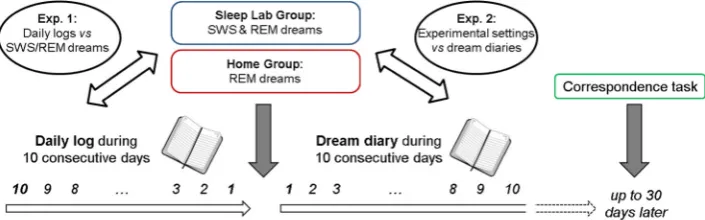
Participants were assigned to either the sleep laboratory awak-enings or home awakawak-enings condition. For experiment 1, par-ticipants kept a daily log for 10 days before having dream reports collected during one night in the sleep laboratory or at home. For experiment 2 participants kept a diary of dreams spontaneously recalled at home for the 10 nights after having instrumental awak-enings conducted in the sleep laboratory or at home. Participants subsequently identified correspondences between the content of dream reports from the instrumental awakenings and the 10 daily logs (experiment 1), and correspondences between spontaneous home dream reports and an account of the experience of the night
of instrumental awakenings (experiment 2). Fig. 1 shows the
design of the two experiments.
2.2. Participants
Forty-four participants (24 female, 20 male; aged 18–31, mean age = 21.41,SD =3.30) were recruited to take part in experiments 1 and 2. All participants were native English speakers and all but one were students at Swansea University. Participants were assigned to one of two groups: the sleep laboratory awakenings group (10
males, 10 females; mean age = 21.10, SD= 3.23) and the home
awakenings group (10 males, 14 females; mean age = 21.48, SD= 3.33).
Ethical approval for the study was obtained from the local Research Ethics Committee.
2.3. Experiment 1 – apparatus
In the sleep laboratory, sleep was monitored using polysomnog-raphy (PSG). For electroencephalogpolysomnog-raphy recording electrodes were placed according to the standard 10–20 system at C3, C4, F3 and F4, with one electrode placed between Cz and Pz for refer-ence. Electrodes were applied above the right outer canthus and below the left outer canthus for electrooculography and on the chin muscles for electromyography. Sleep stages were scored according to the AASM Manual for the Scoring of Sleep (Iber, Ancoli-Israel, Chesson, & Quan, 2007).
At home, sleep was monitored using the Nightcap, a home sleep monitoring device that can reliably distinguish between wake, NREM and REM sleep (e.g.,Ajilore et al., 1995; Stickgold et al., 1994). Participants wear a medical bandana that holds two sensors next to the forehead, one head movement detector and one eye movement detector. A small sensor is connected to the eye movement detector and is attached to one of the eyelids. The two Nightcap channels are for eye movements and head movements. Sleep stages are identified using an algorithm: Head
Movement = Wake; No Head Movement and No Eyelid
Movement = NREM sleep; No Head Movement and Eyelid Move-ment = REM sleep. The reliability of the Nightcap in identifying PSG-defined REM sleep, NREM sleep and wake has been demon-strated by Ajilore et al. (1995) and Cantero, Atienza, Stickgold, and Hobson (2002). The Nightcap was connected to a Macintosh laptop, which provided participants with on-screen instructions. The Mac laptop runs NightViewPM software (designed by the Center for Sleep and Cognition, Beth Israel Deaconess Medical Center, Harvard Medical School), which is programmed to conduct instrumental awakenings and digitally record the participant’s dream reports.
2.4. Experiment 1 – procedure and materials
2.4.1. Daily logs
All participants were instructed to keep a daily log for 10 con-secutive days before having dream reports collected in the sleep laboratory or at home. The daily log was taken fromFosse et al. (2003). In the evening participants recorded information on the log about their waking experiences of the day for the following three categories:
1. Major daily activities(MDAs): activities that took up most of the participants’ time during the day (for example, going to work or university, meals, shopping).
2. Personally significant events(PSEs): important daily events that may or may not have taken up much time (for example, emo-tional events).
3. Major concerns (MCs): concerns or thoughts that participants had on their mind during the day that may not have taken up much time, but were still considered important to them (for example, money problems, exam stress).
Participants were given definitions of the categories as above, and were instructed to report up to five items in each category per day.
2.5. Instrumental awakenings dream report collection
On the last day of keeping the daily log, participants had one night of instrumental awakenings, either in the sleep laboratory with PSG or at home with the Nightcap sleep monitoring device and laptop. In the sleep laboratory participants were woken 10 min into their first and second SWS periods. If they recalled a dream from either or both awakenings, they were woken 10 min into every following REM period, until morning. If they failed to recall a dream from the first two SWS awakenings, they were woken 10 min into their next SWS period. After three SWS awak-enings, only REM awakenings followed, regardless of participants’ dream recall from SWS. Participants were woken up by a buzzer. Immediately after awakening, the following recorded message was played from an audio digital recorder through an intercom: ‘‘What was going through your mind immediately before you were woken up?’’ To prompt the participants they were later asked with a recorded message: ‘‘Can you remember anything else?’’ After giv-ing their dream report through the intercom the participant was invited to go back to sleep until the next awakening.
[image:4.595.126.479.68.178.2]For the home awakenings group, on the afternoon prior to the awakenings night participants collected the Nightcap sleep moni-tor and laptop from the experimenter and received detailed instructions on how to use both. Dream reports were collected from instrumental awakenings following 10 min of every REM sleep period, awakenings being determined by the laptop software. Participants with the Nightcap were woken by a female voice say-ing ‘‘Wake up’’, increassay-ing in volume until they pressed the space-bar on the laptop to indicate that they were awake. The same voice then said ‘‘Awakening number [number]. Please report now’’. An oral report of any dream was recorded automatically onto the lap-top. Participants then went back to sleep until being woken again 10 min into their next REM period. In the morning, participants returned the device to the experimenter. The experimenters con-firmed from the Nightcap sleep records that each awakening was conducted in REM sleep.
2.6. Experiment 2 – procedure and materials
After the night of instrumental awakenings in the sleep labora-tory or at home all participants kept a home dream diary for 10 days. A digital voice recorder was given to participants to assist in the completing of the diary. The dream report diary comprised 10 pages on a Word file. Participants received the following instructions for reporting their dreams: ‘‘Each morning, immedi-ately after waking up, please type out a report on any dreams you had during the night or in the morning’’. Participants were asked to type out any dreams they had in as much detail as they could remember, including a description of the setting, characters, objects, and feelings. If they had more than one dream in a night, they were asked to describe each dream separately. When possible, participants gave an approximate time at which the dream(s) occurred. At the end of the 10 days participants returned their digi-tal dream diaries to the experimenter by email.
2.7. Experiments 1 and 2 – correspondence identification task
Approximately 3 weeks after returning the experiment 2 dream diary, participants were sent materials so that they could perform two correspondence tasks. Example sheets and instructions for how to perform both correspondence tasks were provided. In the first task (for experiment 1) the materials included transcripts of the dream reports collected following awakenings in the sleep laboratory or at home. Participants were instructed to compare each of their 10 daily logs with each of their dream report tran-scripts in order to identify similarities or correspondences between the log items and dream reports, such as of the characters, objects, actions, locations, or themes. For this task, participants were pre-sented with a randomized series of A3 sheets (42.029.7 cm), with a daily log on the left side and a dream report on the right side of each sheet. Depending on the number of dreams, each par-ticipant completed 30–40 sheets of daily logs with dream reports. For experiment 2 participants were asked to identify correspon-dences between their home dream reports and a description writ-ten by the experimenters of the experience of the night of having instrumental awakenings in the sleep laboratory, or at home with the Nightcap. Again, they were presented with a randomized series of A3 sheets, this time with the description of taking part in the awakenings experiment on the left side of each sheet and a dream report on the right side. Where more than one dream was reported for the same night by a participant these were presented on the same sheet. Below the description of taking part in the night of instrumental awakenings there was space for participants to add any other aspects of the experimental night that they wished. Cor-respondences could be identified between any elements in the description and in the dream report, such as, for example, charac-ters, objects, actions, locations, or themes. Depending on the num-ber of dreams, participants completed approximately 8 sheets, each with a dream report and a description of the instrumental awakenings night.
2.8. Data analysis – experiment 1
The length of each dream report in words was assessed follow-ingAntrobus’ (1983, p. 563)definition: ‘‘the count of all words in sentences or phrases in which the subject was describing some-thing that had occurred just before waking. It excluded ‘ahs’, ‘uhms’, repeated and corrected words, and all commentary on the experience, the report, or the current status of the subject.’’ Only dream reports of 10 words or more were included in the analyses.
For each of the three daily log categories separately, the total number of incorporations identified by the participant for each
sheet was summed. The mean number of incorporations per sheet for each of the three daily log categories was then computed for each day period (i.e., for each number of days between the daily log day and the night of instrumental awakenings). The 1 day peri-od refers to the daily log being completed on the day up to the night of instrumental awakenings, the 2 days period refers to the daily log being completed on the day before this, that is, 2 days before the night or morning of dream collection, and so on. This method of analysis gave a timescale of mean number of incorpora-tions per sheet (effectively, per dream) as a function of number of days between the daily log day and the occurrence of the dream. That is, the method shows how many incorporations occur in a dream from each of the preceding daily log days.
For presentation of the data, and for inferential statistics, the mean number of incorporations for each daily log category was cal-culated for four combined time periods, namely the mean of 1 and 2 days between daily log completion and occurrence of the dream, the mean of 3 and 4 days between log and dream, the mean of 5, 6 and 7 days, and the mean of 8 and 9 days. Analyses were conducted for these four periods, as this specific combination of three pairs of days plus the three-day dream-lag period was used inBlagrove, Fouquet, et al. (2011)and is in accord with the previous literature. For calculating these combined period measures, the total numbers of incorporations in each daily log category for each of the 1–2, 3–4 and 8–9 days combined periods are divided by 2, and total number of incorporations for the 5–7 days combined period is divided by 3, to obtain the measure of mean incorporations expressed on a per day basis. These four comparison periods, including the dream-lag period being defined as 5–7 days, are specified in advance so as to disallow ad hoc analyses and to reduce the possibility of type 1 errors. Day-residue and dream-lag effects were predicted for the incorporation of personally significant events, hence the number of PSE incorporations for the means of the combined periods 1– 2 days, and 5–7 days, were each hypothesized to be greater than for the mean of the combined period 3–4 days. These effects were hypothesized to occur for participants with below median total number of incorporations. A median split was used to divide the sleep laboratory and home awakenings groups into low and high incorporators. To calculate the median for the sleep laboratory group, the total number of correspondences identified by each par-ticipant for their REM sleep and SWS dreams combined was com-puted and divided by the number of dream reports for that participant. For the home awakenings group, the median was cal-culated by computing the total number of correspondences identi-fied by each participant for their REM dreams and dividing this total by the number of REM dream reports for that participant. A median split was then performed for the sleep laboratory group and for the home group separately.
Analyses were conducted on the sleep lab and home groups separately. To test the hypotheses, Friedman tests were conducted to compare rankings of the four time periods. If the Friedman test was significant, Wilcoxon signed-rank tests were conducted to compare the mean number of incorporations of the periods 1– 2 days with the mean of 3–4 days (day-residue effect) and the mean of 3–4 days with the mean of 5–7 days (dream-lag effect). A threshold ofp= .025 was used for significance of both tests as sleep lab and home groups are tested separately.
2.9. Data analysis – experiment 2
instrumental awakenings and the night of the spontaneous home dream report. These day period data were then averaged to obtain means for combined periods of 1–2 days between instrumental awakenings night and night of the dream report, 3–4 days, 5– 7 days, and 8–9 days between the night of instrumental awaken-ings and the dream report, these four combined periods being defined followingBlagrove, Fouquet, et al. (2011)and experiment 1 here. As for experiment 1, the total numbers of incorporations in each daily log category for each of the 1–2, 3–4 and 8–9 days combined periods are divided by 2, and total number of incorpora-tions for the 5–7 days combined period is divided by 3, to obtain the measure of mean incorporations expressed on a per day basis. It was hypothesized that there would be more incorporations of the standardized stimulus identified in dream reports for periods 1–2 days than for 3–4 days (day-residue effect) and more incorpo-rations for 5–7 days than for 3–4 days (dream-lag effect). To test these hypotheses, Friedman tests were conducted to compare rankings of the four time periods. If the Friedman test was sig-nificant, Wilcoxon signed-rank tests were then conducted, with a threshold ofp= .025 for significance of both tests. Analyses were conducted on the sleep lab and home groups separately. Par-ticipants were also divided into those reporting on the daily log for the last day of the diary keeping that the impending night of instrumental awakenings was a major concern for them.
As number of incorporations of the standardized stimulus was expected to be low a division into high and low incorporators was not appropriate. FromSchredl’s (2008) metaanalysis of the previous literature, direct references to the laboratory experience occur in 19.4% of dreams collected in the sleep lab, and direct plus indirect references occur in 38.4% of dreams, the modal reference per dream to the experimental situation is thus zero. The division of participants into high and low corresponders, necessitated in experiment 1 because of the far more numerous naturalistic incor-porations, is thus not used for the analysis of results in experiment 2, as low incorporators were expected to return scores pre-dominantly of zero for the spontaneous home dream reports.
2.10. Independent judging
As stated in the introduction, previous research does not sup-port the use of independent judges for identifying correspondences between records of waking life events and dream reports in naturalistic dream-lag studies. Furthermore, the task of assessing all permutations of all daily logs and all dream reports is a large one for each participant, but would make the task unfeasibly large if a judge had to perform this for all participants. Independent judging was thus not utilized for experiment 1. Previous research does support the use of independent judges for studies with an experimental standardized event as the stimulus. Furthermore, such studies have just one waking life report to which all of a par-ticipant’s dream reports are compared, and so the task is feasible for a judge to perform for all participants of a study. Independent judges (authors MB and JM) were thus utilized for experiment 2. Both of these judges have a substantial history of considering rela-tionships between waking life diary records and dream reports. The aim of independent judging was to confirm any statistically significant dream-lag identified for a condition: Independent judg-ing was thus not utilized for conditions where participants’ own scoring data did not identify the dream-lag. The judges were pre-sented with the same correspondence sheets as were the par-ticipants, neither judge had seen any of the dream reports of the participants prior to this. Any additional comments about the stan-dardized event added by participants were included at the bottom of the sheets. The order of the sheets was randomized for both judges and there was no information on any sheet or within any dream report that could have been used to ascertain the date order
of the dreams. Judges were asked to assess the total number of incorporations of the instrumental awakenings night present in each dream report.
For each dream report the following algorithm was used to cal-culate a score based on the number of correspondences identified by the two judges. If both judges identified the same correspon-dence between a dream report and the awakenings night descrip-tion, this was scored as 1; if only one of the judges identified a correspondence this was scored as 0.5: the sum of these scores was then calculated for each sheet, i.e., for each day period between night of instrumental awakenings and night of the spon-taneous home dream. If neither judge identified any correspon-dence between a particular dream report and the experiment description, the sheet was scored as 0. The mean number of corre-spondences between the dream reports and the description of the experiment were then calculated for the four combined time peri-ods, namely the means of the periods 1–2 days, 3–4 days, 5–7 days and 8–9 days between the night of instrumental awakenings and the night of the home dream. Wilcoxon signed-rank tests were used to compare the number of correspondences for the periods 1–2 days and 3–4 days (day residue effect) and 3–4 days and 5– 7 days (dream-lag effect) using the independent judge scores. These were computed where significant paired comparisons had been found using participant scores, and the significance threshold forpis set at .05 for such confirmation of significant comparisons.
3. Results
3.1. Experiment 1
3.1.1. Home awakenings group
Due to technical problems with the equipment, sleep data and dream reports were not collected from 7 participants in the home awakenings group; these participants are not included in the ana-lyses. Two other participants in the home group did not have dreams longer than the minimum of 10 words; data from these participants are not included in the analyses. Statistics from the REM awakenings are presented inTable 1.
To divide the home awakenings group into low and high incor-porators for the REM sleep analyses, the total number of corre-spondences for REM dreams divided by the number of REM dreams was calculated for each participant. The median number of correspondences per dream for the 15 home awakenings par-ticipants was 9.00. The median split resulted in 8 low (below medi-an) and 7 high (above medimedi-an) incorporators in the home group. The results from the home awakenings group for incorporations in REM sleep dreams of PSEs, MDAs, and MCs, for high and low incorporators separately, are shown inTable 2.
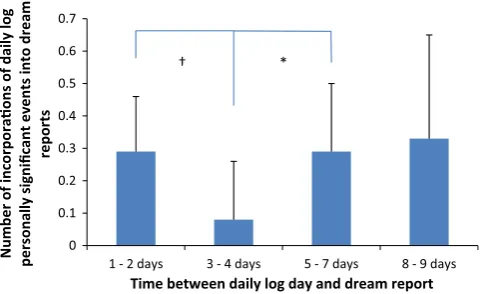
As hypothesized, for the low incorporators in the home group, there was a significant difference between the mean number of incorporations for PSEs across the four combined time periods (Friedman test, chi sq (3) = 10.13,p= .018).Fig. 2shows the com-parisons between means for the low incorporators home awaken-ings group: As hypothesized, the mean number of incorporations (on a per day basis) for the combined period 5–7 days was sig-nificantly higher than for the combined period 3–4 days (Wilcoxon test,z= 2.25,p= .024,r= .80), demonstrating a dream-lag effect. In addition, the mean number of incorporations for the period 1– 2 days was higher than for the period 3–4 days (Wilcoxon test, z= 2.21,p= .027,r= .78), demonstrating a day-residue effect.
p= .453) or high incorporators (Friedman test, chi sq (3) = 0.70, p= .872), nor for MCs of low (Friedman test, chi sq (3) = 0.72, p= .869) or high incorporators (Friedman test, chi sq (3) = 4.35, p= .226).
3.2. Sleep laboratory group
3.2.1. REM sleep dreams
In the sleep laboratory group, one participant failed to fall asleep and one participant did not complete the correspondence task; these participants are not included in the analyses. Two par-ticipants in the sleep laboratory group did not have REM dreams longer than the minimum of 10 words; data from these par-ticipants are also not included in the analyses. Statistics from the
REM awakenings are presented inTable 1. To divide the sleep laboratory group into low and high incorporators, the total number of correspondences for REM and SWS dreams divided by the total number of dreams was calculated for each participant. The median number of correspondences per dream for the 16 sleep laboratory participants was 11.63. The median split resulted in 7 low (below median) and 9 high (above median) incorporators in the sleep laboratory group. The results from the sleep laboratory group for incorporations in REM sleep dreams of PSEs, MDAs, and MCs, for high and low incorporators separately, are shown inTable 2.
No significant differences were found between the mean num-ber of incorporations across the four time periods for PSEs of low (Friedman test, chi sq (3) = 0.14,p= .968), or high incorporators (Friedman test, chi sq (3) = 3.40,p= .264). There were also no sig-nificant incorporation timecourse differences for MDAs of low (Friedman test, chi sq (3) = 1.63, p= .652) or high incorporators (Friedman test, chi sq (3) = 1.37,p= .712), nor MCs of low (Fried-man test, chi sq (3) = 6.06,p= .109) or high incorporators (Fried-man test, chi sq (3) = 5.19,p= .158).
3.2.2. SWS dreams
Two sleep lab participants failed to reach SWS, two participants were woken from SWS but did not recall a dream from that stage, one participant did not manage to fall asleep and one participant did not complete the correspondence task; these six participants are not included in the SWS analyses. Two further participants did not have SWS dreams longer than the minimum of 10 words; data from these participants are also not included in the analyses. Results are thus from the remaining 12 participants. Statistics from the SWS awakenings are presented inTable 1.
[image:7.595.35.553.94.174.2]To divide the sleep laboratory group into low and high incorpo-rators for the SWS analyses, the same median split was used as for the REM dream analyses. The median split resulted in 7 low incor-porators (below median) and 5 high incorincor-porators (above median).
Table 1
Experiment 1: Number of awakenings and dream reports, mean number of dream reports per participant, and mean (SD), minimum and maximum length of dream reports in words, for the home and sleep laboratory groups.
Home group (REM sleep) Sleep laboratory group (REM sleep) Sleep laboratory group (SWS)
Number of participants 15 16 12
Total number of awakenings 81 48 39
Total number of dream reports 55 41 15
Mean number of dream reports 3.67 (2.38) 2.56 (1.03) 1.25 (0.45) Mean report length (words) 71.55 (49.51) 109.37 (100.67) 30.92 (20.86)
Minimum length (words) 10 10 10
Maximum length (words) 428 452 104
0 0.1 0.2 0.3 0.4 0.5 0.6 0.7
1 - 2 days 3 - 4 days 5 - 7 days 8 - 9 days
Number of incorporaons of daily log
personally significant events into dream
reports
Time between daily log day and dream report *
†
Fig. 2.Mean number of incorporations of daily log personally significant events into REM sleep dream reports for low incorporators in the home awakenings group. Error bars represent standard deviations. p< .05 and⁄
[image:7.595.31.552.226.337.2]p< .025.
Table 2
Experiment 1: Mean number of incorporations of waking life sources into REM sleep dreams for all three daily log categories from low and high incorporators,a
as a function of time between daily log and dream report.b
Sleep laboratory and home awakenings groups presented separately.
Time between daily log and dream report Personally significant events Major daily activities Major concerns
Home group Low* High Low High Low High
1–2 days 0.29 (0.17) 0.39 (0.39) 0.43 (0.31) 0.71 (0.43) 0.19 (0.19) 0.32 (0.35) 3–4 days 0.08 (0.18) 0.40 (0.27) 0.42 (0.28) 1.03 (0.54) 0.23 (0.22) 0.31 (0.36) 5–7 days 0.29 (0.21) 0.37 (0.39) 0.45 (0.13) 1.05 (0.64) 0.30 (0.24) 0.35 (0.37) 8–9 days 0.33 (0.32) 0.39 (0.34) 0.56 (0.28) 1.09 (0.78) 0.29 (0.34) 0.46 (0.35)
Sleep laboratory group Low High Low High Low High
1–2 days 0.40 (0.33) 0.58 (0.43) 0.67 (0.44) 0.93 (0.70) 0.39 (0.24) 0.46 (0.61) 3–4 days 0.26 (0.19) 0.32 (0.34) 0.48 (0.37) 0.85 (0.74) 0.22 (0.27) 0.30 (0.37) 5–7 days 0.24 (0.20) 0.39 (0.35) 0.61 (0.40) 0.74 (0.37) 0.18 (0.17) 0.45 (0.28) 8–9 days 0.35 (0.38) 0.51 (0.44) 0.62 (0.30) 1.10 (0.62) 0.30 (0.26) 0.30 (0.57)
a
Low and high refer to subgroups defined as below or above the median for total number of incorporations identified per dream across the study.
b
Total number of incorporations in each daily log category for the 1–2, 3–4 and 8–9 days combined periods are divided by 2, and number of incorporations for the 5–7 days combined period is divided by 3, to obtain the measure of mean incorporations on a per day basis.
[image:7.595.39.281.411.558.2]The results from the sleep laboratory group for incorporations in SWS dreams of PSEs, MDAs, and MCs, for high and low incorpora-tors separately, are shown inTable 3.
No differences between the mean number of incorporations in SWS dreams were found across the four combined time periods for PSEs of low (Friedman test, chi sq (3) = 1.73,p= .629) or high incorporators (Friedman test, chi sq (3) = 4.39, p= .223). There were also no significant differences in incorporation timecourse for MDAs of low (Friedman test, chi sq (3) = 1.25,p= .741) or high incorporators (Friedman test, chi sq (3) = 6.12, p= .106), nor for MCs of low (Friedman test, chi sq (3) = 1.00,p= .801) or high incor-porators (Friedman test, chi sq (3) = 4.90, p= .180). Thus, no dream-lag effect was found for SWS dreams for the hypothesized PSE category of waking life memory source, nor for the MDA or MC categories.
3.3. Experiment 2
Three participants from the sleep laboratory group did not com-plete the second correspondence task; these participants are thus not included in the experiment 2 analyses. Results presented here are from the remaining participants (sleep laboratory awakenings group,n= 17; home awakenings group,n= 24). Statistics for the dreams reported at home from both groups for the 10 days after their night of instrumental awakenings are displayed inTable 4.
The sleep laboratory group was divided into two groups, those who reported, in their last daily log, the impending experimental night as being a major concern (n= 7), and those who did not report that this was a major concern (n= 10). The home instrumen-tal awakenings group was similarly divided into those who report-ed the impending experimental night as being a major concern (n= 6), and those who did not (n= 18). The mean number of incor-porations of the experimental stimulus into home dreams for the concerned and unconcerned participants, who had previously been awakened in the sleep laboratory or awakened at home, are pre-sented inTable 5. The mean number of incorporations across the four time periods differed significantly for the concerned sleep lab group (Friedman test, chi sq (3) = 15.28,p= .002), but not for the unconcerned sleep lab group (Friedman test, chi sq (3) = 3.48, p= .323), nor for the concerned or unconcerned home awakenings groups (Friedman tests, chi sq (3) = 4.50, p= .212 and chi sq (3) = 1.63,p= .653, respectively).
Fig. 3shows the mean number of incorporations of the instru-mental awakenings night in the home dream reports of the con-cerned participants who had slept in the sleep laboratory. The mean number of incorporations (on a per day basis) was sig-nificantly higher for the combined period 1–2 days between experimental night and home dream occurrence than for the com-bined period 3–4 days (Wilcoxon test, z= 2.39, p= .017,r= .90), demonstrating the day-residue effect. The mean number of incor-porations (on a per day basis) for the combined period 5–7 days was significantly higher than for the combined period 3–4 days (Wilcoxon test, z= 2.38, p= .018, r= .63), demonstrating the dream-lag effect.
3.3.1. Independent judging
The number of correspondences between the dream reports and the description of the instrumental awakenings night, as scored by the independent judges, were analyzed for the subgroup for which the dream-lag was evidenced (i.e., sleep lab participants who had recorded that they were concerned about the sleep laboratory study). Inter-rater reliability for the judges was assessed using intra-class correlation co-efficient (ICC), for scores of all the 57 sheets: ICC = .678,p< .01.Fig. 4shows the number of incorpora-tions of the instrumental awakenings night in the home dream reports of the concerned sleep laboratory group, as scored by the
independent judges. The mean number of incorporations per day for the period 5–7 days was significantly higher than the mean for the period 3–4 days (Wilcoxon test,z= 2.20,p= .028,r= .83), demonstrating the dream-lag effect. The difference between the mean number of incorporations per day for the periods 1–2 days
and 3–4 days was not significant (Wilcoxon test, z= 1.71,
p= .088,r= .65).
4. Discussion
There is a lengthy literature evidencing the dream-lag effect and suggesting that it is reflective of REM sleep-dependent emotional memory consolidation. The current work extends that literature by the use of designs that test for the dream-lag under optimal and sub-optimal conditions. In experiment 1, whereas the dream-lag effect was found for dreams from REM-only awakenings conducted at home, it was not found for REM awakenings conduct-ed in the sleep laboratory where these had been precconduct-edconduct-ed by two or three SWS awakenings. In experiment 2 the dream-lag effect was demonstrated for a highly salient event (being part of an experiment in the sleep lab) for participants who had expressed concern about that event, but not for unconcerned participants, and was also not demonstrated for a less salient event of a night of awakenings at home. Although sleep stage was not monitored in experiment 2, it is plausible to assume that the majority of dreams reported at home in the morning were REM sleep dreams, since REM sleep dominates the later parts of sleep.
Stickgold and Walker (2013)propose that for memories to be consolidated and integrated with existing knowledge, there is a process of memory triage that determines which memories should go through sleep-dependent processing and by which form of pro-cessing. Memory consolidation is thus a selective process, involv-ing discriminatory processinvolv-ing of specific memories. Our findinvolv-ings from both studies support this discriminatory selection and sal-ience tagging process: In experiment 2 the dream-lag effect was found for participants who had had the experience of being awak-ened in the sleep laboratory and who had been concerned about the impending experience. In experiment 1 a dream-lag effect was found for personally significant events, but not for major daily activities. The latter finding may be because major daily activities (for example, going to university, spending time at work, making or eating meals) are not sufficiently salient emotionally to be sub-ject to delayed incorporation into dreams, which accords with the relative lack of incorporation of major daily activities into dream
content in general, as shown by Hartmann (2000). This also
accords with findings that emotionally intense experiences are incorporated more frequently into dreams than are neutral experi-ences (e.g., Cartwright et al., 2006; Hoelscher et al., 1981; Malinowski & Horton, 2014; Nielsen et al., 1991; Nikles et al., 1998; Schredl, 2006). UnderStickgold and Walker’s (2013)model there may therefore have been more schemata adjustment and assimilation needed for PSEs than for MDAs, and more adjustment and assimilation needed following the laboratory experience for the concerned sleep laboratory participants, than for those who were unconcerned, and for those who had been subject to awaken-ings at home. However, it is acknowledged that there are no behav-ioral studies showing an association of the dream-lag effect with such adjustment and assimilation processes.
separated by one night sleeping at home. The design used in Blagrove, Fouquet, et al. (2011)was not ideal in that dream reports on the second night in the lab could refer to the laboratory experi-ence, either concurrently for that night, or for the lab experience from two nights earlier. However, this is unlikely to have caused the difference in dream-lag results between the studies, as any such correspondences with experiences 2–3 days earlier would either have augmented the day-residue effect (the combined 1– 2 days period), or counted against finding the dream-lag effect due to increasing the score for the 3–4 days comparison period. As the REM sleep dream-lag effect found in Blagrove, Fouquet, et al. (2011)was replicated by the REM sleep home dream collec-tion condicollec-tion in the current study, we consider that the main dif-ference between the sleep lab group ofBlagrove, Fouquet, et al. (2011)and the sleep lab group here is that SWS dreams were col-lected in the current study before REM dreams were colcol-lected. Pre-vious work has shown a sequential SWS to REM sleep memory consolidation process (Gais & Born, 2004; Giuditta et al., 1995; Stickgold et al., 2000). It may therefore be that waking participants up in SWS disturbed the memory consolidation processes taking place during SWS, resulting in subsequent consolidation not
occur-ring duoccur-ring REM sleep, and with the dream-lag effect then not being present. The REM sleep dream-lag may thus be dependent upon the integrity of SWS processes earlier in the night, but with the mechanism for this being unclear given the lack of a SWS dream-lag. One possible explanation follows fromStickgold and Walker’s (2013) suggestions that salience tagging occurs during or shortly after encoding, that salience tags are distinct from the memories they refer to, and that salience tags might decay faster than the item memories themselves. It may be that SWS is less sen-sitive to such salience tags, leading to the lack of a SWS dream-lag, and with SWS-dependent memory consolidation working on a more recent time scale than does REM sleep-dependent consolida-tion. A difference between the timescales of SWS and REM sleep
memory processing has also been proposed byLouie and Wilson
(2001). SWS may be less sensitive to salience tags than is REM sleep because, relative to SWS, REM sleep involves stronger
activa-Table 4
Experiment 2: Mean (SD) number of spontaneous home dream reports per participant over the 10 nights after the instrumental awakenings night, and mean (SD), minimum and maximum length of the dream reports in words, for groups that had had instrumental awakenings in the sleep laboratory or at home.
Sleep laboratory group
Home group
Number of participants 17 24 Mean number of home dream
reports
8.35 (1.69) 7.62 (1.24) Mean report length (words) 152.57 (87.85) 165.66
[image:9.595.35.554.97.160.2](93.08) Minimum report length (words) 10 12 Maximum report length (words) 1046 883
Table 5
Experiment 2: Mean (SD) number of incorporations of the instrumental awakenings night into subsequent home dreams, as a function of time since the instrumental awakenings night,a
of whether instrumental awakenings had occurred in the sleep laboratory or at home, and of whether concern had been expressed about the instrumental awakenings night.b
Time between instrumental awakenings night and dream report Sleep laboratory group Home group
Concern*n= 7 No concernn= 10 Concernn= 6 No concernn= 18 1–2 days 1.71 (0.76) 0.85 (0.75) 0.58 (0.58) 0.58 (0.77) 3–4 days 0.29 (0.39) 1.11 (0.74) 0.60 (0.89 1.00 (0.85) 5–7 days 1.12 (0.31) 0.82 (0.64) 0.42 (0.33) 0.62 (0.72) 8–9 days 0.5 (0.76) 0.90 (0.99) 1.20 (0.76) 0.78 (0.88)
a
Total number of incorporations for the 1–2, 3–4 and 8–9 days combined periods are divided by 2, and number of incorporations for the 5–7 days combined period is divided by 3, to obtain the measure of mean incorporations on a per day basis.
b
Concern and no concern subgroups are defined as whether the instrumental awakenings night had been recorded as a major concern on day 10 of the daily log.
*p= .002 (Friedman test, seeFig. 3for comparisons between the four time periods).
[image:9.595.306.547.219.353.2]* *
Fig. 3.Mean number of incorporations of the instrumental awakenings night into home dream reports for participants in the sleep laboratory group who recorded the impending experimental night as being a major concern. Incorporations are identified by participants. Error bars represent standard deviations.⁄
[image:9.595.34.286.257.344.2]p< .025.
Table 3
Experiment 1: Mean number of incorporations of waking life sources into SWS dreams for all three daily log categories from low and high incorporators,a
as a function of time between daily log and dream report.b
Sleep laboratory group only.
Time between daily log and dream report Personally significant events Major daily activities Major concerns
Low High Low High Low High
1–2 days 0.18 (0.24) 0.50 (0.35) 0.29 (0.39) 0.10 (0.22) 0.07 (0.19) 0.20 (0.47) 3–4 days 0.21 (0.27) 0.40 (0.65) 0.46 (0.71) 0.00 (0.00) 0.07 (0.19) 0.50 (0.50) 5–7 days 0.05 (0.13) 0.27 (0.43) 0.36 (0.39) 0.27 (0.28) 0.12 (0.25) 0.20 (0.30) 8–9 days 0.14 (0.24) 0.40 (0.65) 0.36 (0.38) 0.30 (0.45) 0.18 (0.37) 0.10 (0.22)
a
Low and high refer to subgroups defined as below or above the median for total number of incorporations identified per dream across the study.
b
[image:9.595.38.552.642.710.2]tion of the brain regions proposed byStickgold and Walker (2013) to carry the salience tags, such as the amygdala, brain-stem tegmental regions and striatum, and extended limbic cortical regions (Maquet et al., 1996).
However, the lack of a SWS (and N2) dream-lag effect runs counter to the view that the U-shaped timescale of dream incorpo-ration reflects a shift of memory representation from hippocampal to neocortical sites in the memory consolidation process. These results indicate that the dream-lag is a characteristic solely of REM sleep, that it is solely neocortical, and might involve memory reactivation and integration without hippocampal involvement. This endogenous reactivation proposal accords with the suggestion ofOudiette and Paller (2013)that reactivation in REM might have emotional memory or integrative learning functions. Although Lewis and Durrant (2011)propose that the replay of new mem-ories, and their integration into existing schemas, occurs in SWS, with Born and Wilhelm (2012) also proposing that declarative memory consolidation is primarily an SWS process, the current findings could suggest an involvement of REM sleep in this process, as part of the processing of emotional memories (Groch, Wilhelm, Diekelmann, & Born, 2013; Nishida, Pearsall, Buckner, & Walker,
2009). However, the findings of Cordi, Diekelmann, Born, and
Rasch (2014), on there being no effect of odor-induced memory reactivation during REM sleep on declarative memory stability, are evidence against the view that REM sleep, or REM dreams, might involve memory reactivation with a functional significance for memory consolidation. Furthermore, we acknowledge that there are no studies showing an association of the dream-lag effect with measures of behavior, or, importantly, with either semanti-cization or the integration of new with existing memories.
Stickgold and Walker (2013)use the term ‘‘memory evolution’’ to reflect both the qualitative changes that can occur during inte-grative processing and the extended time course over which they occur. Although other consolidation processes have been pro-posed that may take weeks (Wang & Morris, 2011), months (Takashima et al., 2006) or even years (Haist, Bowden Gore, & Mao, 2001), it can be speculated that the 5–7 day process exam-ined here might reflect REM sleep-dependent qualitative changes not occurring at shorter or longer timescales. However, in con-trast to delayed incorporation of experiences into dreams being interpreted as related to concurrent memory consolidation pro-cesses, the dream-lag effect might reflect the waking life personal
and emotional impact of events.De Koninck, Wong, and Hébert
(2012) studied the dream content and language proficiency of students on a French language course and concluded that incorporations of learning experiences into dreams might be a
reflection of the emotional experience of learning rather than a
characteristic of within-sleep consolidation processes. The
delayed incorporations seen in the dream-lag effect might similarly index the waking life personal and emotional impact of events (Malinowski & Horton, 2014; Schredl, 2006), as opposed to within-sleep memory consolidation processes.
A limitation of the study is that only self-reported frequent dream-recallers were recruited, so as to reduce the occurrence of missing observations, and this might limit the generalizability of the findings. As frequent dream recallers have greater activity in the default mode network (Eichenlaub, Nicolas, et al., 2014), and greater brain reactivity during both sleep and wake than do infre-quent dream recallers (Eichenlaub, Bertrand, Morlet, & Ruby, 2014; Ruby et al., 2013), it may be that high and low frequency dream recallers have differences in dream production processes. Daily life activities and events might also have a greater effect on the dream content of frequent dream recallers than for infrequent dream recallers, possibly mediated by a positive attitude toward or inter-est in dreams (Lambrecht, Schredl, Henley-Einion, & Blagrove, 2013). Testing for the incorporation of different categories of wak-ing life sources necessitated a design that allows for the identifica-tion of multiple correspondences between each daily log record and each dream report. The need to divide participants into high
and low correspondences subgroups, following Blagrove et al.
(2014) and Henley-Einion and Blagrove (2014), was confirmed, and should be utilized in future naturalistic studies using the mul-tiple correspondences method.
Whereas previous studies on the dream-lag effect have used designs where the dream-lag is predicted, and, in most instances, found, the current experiments involved multiple factors, for some of which there was no prediction of the dream-lag effect, or there was a sub-optimal condition for its presence. It is acknowledged that for many analyses in the present paper a dream-lag effect was thus not in evidence. However, given the large effect sizes for instances where the dream-lag effect was found, we interpret the instances in the current paper of no dream-lag effect as more likely indicating limiting conditions for the presence of the dream-lag, rather than as evidence that the effect is not robust.
4.1. Conclusion
The work reported here follows the suggestion byFosse et al. (2003)that ‘The study of the formal properties of dreaming, and of changes in these properties following experimental manipula-tion, can provide insights into the basic functioning of the brain during sleep.’ The results presented take a robustly evidenced phenomenon, the 5–7 day REM dream-lag effect, and show that its presence is dependent on the salience or personal importance of waking life events. The cortical and physiological characteris-tics of the REM dream-lag effect now need to be determined. Future research should address whether the dream-lag indexes memory reactivation, labilization and reconsolidation, which have been hypothesised to enable updating or mismatch identification during consolidation (Wang & Morris, 2011), and which may hence indicate a behavioral or brain function that results in the delayed incorporation of events into dreams. However, an emo-tion processing or impact of personal events account, separate from memory consolidation, needs to be considered given that slow wave sleep dreams, and N2 dreams, do not evidence the dream-lag effect.
Acknowledgments
Study funded by UK Economic and Social Research Council award ES/I037555/1 Dream content as a measure of memory con-solidation across multiple periods of sleep.
0 0.5 1 1.5 2 2.5
1 - 2days 3 - 4days 5 - 7days 8 - 9 days
Number of incorporaons of
experimental night sources into dream
reports
Time between experimental awakenings night and dream report
[image:10.595.51.289.70.225.2]*
Fig. 4.Mean number of incorporations of the instrumental awakenings night into home dream reports for participants in the sleep laboratory group who recorded the impending experimental night as being a major concern. Incorporations are identified by independent judges. Error bars represent standard deviations.⁄