Real Time Video Watermarking DWT Technique for Data
Authentication using Labview
Neelima Patel
1Mr. Pradeep Singh Yadav
21
Research Scholar
2Professor
1,2
Department of Electronics & Telecommunication Engineering
1,2
Shri Shankaracharya Institute of Technology & Management, Bhilai, India
Abstract— In this proposed work a new and fast technique has proposed for watermarking of real time video using discrete wavelet transformation (DWT) frequency domain. Lab View and IMAQ vision software package has been utilized to achieve the proposed method of real time video watermarking. The use of Lab View and IMAQ toolbox present a complete set of digital image processing and acquisition function that improve the efficiency of the project and reduce the programming effort of user obtaining better result in shorter time. In this method the real time video has been captured from the external device, in this work laptop from camera has used for input of video to be watermarked in audio video interleave (AVI) format has taken, which is then converted into number of frames. Each frame of the video is then embedded with watermarked using blind wavelet function. In this method the level of DWT can be easily controlled. Multi resolution analysis has been performed on watermarked video and peak signal to noise ratio (PSNR) and mean square error (MSE) values has taken out to get the performance accuracy and quality of watermarked video which actually depicts the efficiency and performance of watermarking technique and the results of these has compared to one of the existing technique.
Key words: RT, Digital Watermarking, DCT, DWT, DFT. Labview (2013), IMAQ NI-Vision & Advance Signal Processing Tools
I. INTRODUCTION
The basic introduction of watermarking has been explained, the piracy of digital media is a big challenge in this digital era, and to prevent that, watermarking technique has been evolved as an important technique to protect the original data. In this chapter the basic terminologies rated to watermarking has been explained however the watermarking technique has wide range of schemes, yet the basic procedures are same for the entire scheme which has already been explained in this chapter using block diagram.
A brief introduction of Labview and NI Vision toolbox using in proposed method. These tools are very powerful and fast to implement the proposed method of watermarking by reducing large programming time.
A brief introduction of watermarking algorithm is also explained along with the various properties of good watermarking techniques. Watermarking has wide range of importance and application in data protection.
Real Time Video Watermarking
RT video watermarking technology, nearly related to information security, information hiding and data authentication science, and it is a new edge research area of the current era in application of video and copyrights. In nowadays, the rapid construction of network of massages, Youtube video and e-business make this technology very
crucial and necessary for all forms of digital products protection, its applicability continuously boosted widespread. All these increasing demands for people enforces the author to design a better watermarking algorithm that must be combined with these controlled fashion and technologies so as to strive against all kinds of attacks and form integrated solutions for digital contents’ copyright protection. RT video watermarking schemes can be modeled as Control plus communication system involving an embedding NI vision and advance signalling tool at input and extracting tool at output. Fig.(1) shows the block diagram of RT video watermarking.
Fig. 1 Block Diagram of Video Watermarking
A. Categorization of Digital Watermarking 1) Visible Watermark
The information in the form of text or a logo helps to recognize the owner of the media is visible in the picture. For example TV channels YouTube channel example-DD National, a logo is shown on the upper left corner of the video. 2) Invisible Watermark
In this technique, the secret information which cannot be seen is inserted into a video frame but can be detected with proper means. But there is a possibility of theft of video contents; it is good to know the stolen data is of whom.
3) Robust Watermark
Degree of measure of invulnerability of video against different attacks can be check in this technique.
4) Fragile Watermark
Fragile watermarks are those which are delicate in nature and can be easily broken and tampered by any means. Data Manipulation destroyed the fragile watermarks. But on examining the watermark, modification joints can be detected.
5) Semi Fragile Watermark
It covers property of both the watermarking algorithm robust and fragile equally. But the minor stimulation on signal affects the watermark.
B. Features of Watermarking Procedures
watermarked and un-watermarked video frame by just seen it since they looks like same because it does not allows visual distortion but reduces the quality.
1) Effectiveness
This is the percentage of likelihood of detection of correct information in a Watermarked video.
2) Size of Payload
Every watermark has some mass. Information size and mass are of great consequence as larger systems needs a comparatively bigger payload to be embedded in a host video. Payload should be extracted with high confidence and minimum error.
3) Robustness
During transmission over communication channel, watermarked information is altered number of times and several piracy, image processing and video processing attacks strikes on it to remove watermark and create problem in proper detection. Dual watermarking i.e. watermarking within watermarking is used for getting maximum robustness while one watermarking is removed another is retained there to protect the video. Watermark can be embedded at number of positions in the video frame.
4) Security
Since security is the major concern, cryptographic secret key is used at embedding and extraction process. There are three kind of keys i.e. private, detection and public key are used in watermarking. Watermark is as so secret as only authorized organization can detect the watermark and hackers could not access the watermark.
5) Computational Complexity
Computational complexity means total duration spent on encoding and decoding. Computational complexity is very necessary for ensuring greater security and validation of watermark. But real time application on contrast requires both efficiency as well as speed
C. Techniques used for Watermarking
There are two major techniques for watermarking 1) Spatial Domain
In this domain, randomly selected the pixels of subsets of video frame and modification is done on that pixel. Uncooked data is directly loads into the frame pixels. Spatial domain technique also called spread-spectrum technique. It doesn’t need mathematical transform on original content for watermarking embedding and extraction. Before embedded in original content, watermark is encoded in sequence of noise. Correlation based receiver is used at extraction module. This technique is relatively computationally efficient and advantageous in real time applications. This technique is robust to JPEG compression and low-pass filtering. Some of its main algorithms are –Least Significant Bit, SSM Modulation Based Technique, Texture mapping coding Technique, Patchwork Algorithm.
2) Transform Domain
This technique is also called Frequency domain. In this technique, watermark embeds in the spectral coefficients of the video no. of frame. Human visual system (HVS) is better absorbed by the spectral coefficients. For example, the HVS is highly sensitive to low-frequency coefficients, and less sensitive to high- frequency coefficients i.e. low frequency coefficients are perceptually significant, which means
alterations to those components might cause distortion to the original video frame. In contrast, high- frequency coefficients are considered insignificant; so, video processing techniques, such as compression, tend to remove high frequency coefficients forcefully. That is why more watermarking schemes done on frequency domain. Imperceptibility and robustness are contradictory with each other. For compensation between these two, mostly all algorithms watermark embeds in the middle range frequency. Commonly used transform domain methods are Discrete Cosine Transform (DCT), Discrete Fourier Transform (DFT) and Discrete Wavelet Transform (DWT) using in labview tool to analysis to above technique’s
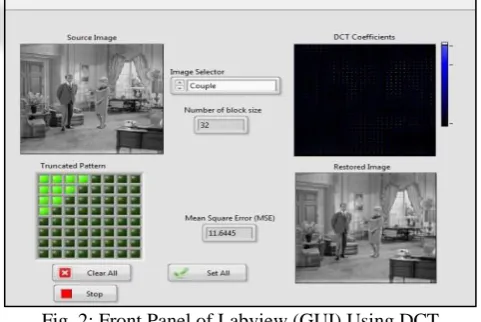
3) Discrete cosine transforms (DCT)
[image:2.595.308.549.437.598.2]Watermarking techniques based on classical mathematical transformation DCT method are more often used for watermarking compressed video frames. DCT method is compatible with existing international compression standards. For watermarking, procedures like first uncompressed the video then again compress are not required here. In this method, middle or low frequency coefficients are selected to superimpose watermark in the DCT transform domain. This scheme is relatively more robust against image processing and management operations like low pass filtering, brightness and contrast adjustment, blurring etc. compared to spatial domain watermarking schemes. However, they are computationally very expensive, weak against geometric attacks like cropping, rotation, scaling, destroy the invariance properties of the system and having implementation problem. Embedding should be done on the portion of video frame that is perceptually significant because insignificant portion is removed by compression schemes.
Fig. 2: Front Panel of Labview (GUI) Using DCT Technique
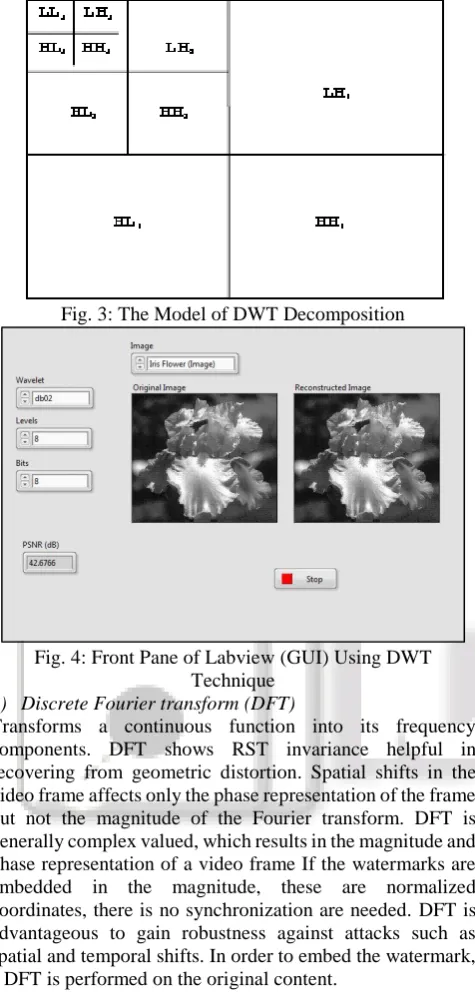
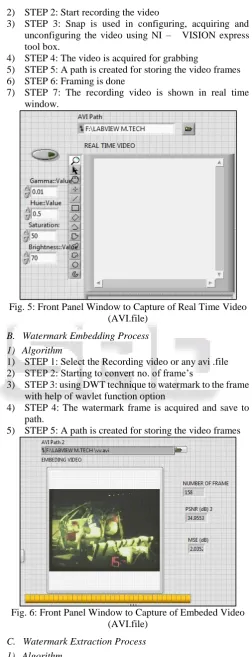
4) Discrete wavelet transforms (DWT)
Fig. 3: The Model of DWT Decomposition
Fig. 4: Front Pane of Labview (GUI) Using DWT Technique
5) Discrete Fourier transform (DFT)
Transforms a continuous function into its frequency components. DFT shows RST invariance helpful in recovering from geometric distortion. Spatial shifts in the video frame affects only the phase representation of the frame but not the magnitude of the Fourier transform. DFT is generally complex valued, which results in the magnitude and phase representation of a video frame If the watermarks are embedded in the magnitude, these are normalized coordinates, there is no synchronization are needed. DFT is advantageous to gain robustness against attacks such as spatial and temporal shifts. In order to embed the watermark, a DFT is performed on the original content.
II. LITERATURE REVIEW
Sadik. A.M .Al-Taweel et al. proposed a novel DWT-based video watermarking algorithm based on a three-level DWT using Haar filter which is robust against geometric distortions such as Downscaling, Cropping, and Rotation. It is also robust against Image processing attacks such as low pass filtering (LPF), Median filtering, and Weiner filtering. Furthermore, the algorithm is robust against Noise attacks such as Gaussian noise, Salt and Pepper attacks. The embedded data rate is high and the embedded watermark is robust and invisible. The watermark was successfully extracted from the video after various attacks. [1]
Min-Jeong Lee et al. proposed a real-time practical video watermarking technique on the compressed domain for HD video that is robust against video processing attacks. They focused on commonly used video processing such as
downscaling, resolution, frame rate changing, trans coding and developed for the broadcasting service. Video sequences consist of a series of consecutive still images or frames.[2]
Suppat Rungraungsilp et al. proposed a method for adding watermark that is hiding information into QR Code and compare for measure of performance in DFT and DWT domain. QR Code (Quick Response Code) embedded technique for invisible watermarking by using Discrete-Fourier-Transform (DFT) compare with Discrete-Wavelet-Transform (DWT).[3]
Shanjun Zhang et al. proposed a novel watermarking method based on discrete wavelet transform (DWT) to embed QR codes into still digital images. almost a technique embeds watermarks in the frequency domain, , such as DCT and DWT. One of the most difficult problems in digital video watermarking is watermark recovery from images with possible perturbations, including, degradation due to noise or compression, transformation by filtering, re-sampling, and other intentional or unintentional operations.[5]
Sanjana Sinha et al. proposed a hybrid digital video watermarking scheme based on Discrete Wavelet Transform (DWT) and Principal Component Analysis (PCA). Many digital watermarking schemes have been proposed for still images and videos. Most of them work on uncompressed videos, while others embed watermarks directly into compressed videos. Video watermarking introduces a number of issues not present in image watermarking. Video watermarking approaches can be classified into two main categories based on the method of hiding watermark bits in the host video. Author proposed an imperceptible and robust video watermarking algorithm based on Discrete Wavelet Transform (DWT) and Principal Component Analysis (PCA)[6]
S.Nafees Ahmed et al. proposed video data embedding scheme the embedded secret data is randomly segmented and reconstructed without knowing the original host video. Secret data is embedded in individual video frames using the frequency domains of DWT. In this paper, embeds different parts of a single watermark into different scenes of a video under the discrete wavelet domain[7]
Kesavan Gopal et al. proposed Watermarking of Digital Video Stream for Source Authentication Watermarking in real time will solve the source authentication issues. The parties involved in real time stream exchange, checks the authenticity of the data received, by extracting the watermark bits embedded in the stream. This watermark can be introduced into the video stream at source, channel or at the receiver side. In our work, we propose a simple video streaming authentication system using watermarking at the source principle rather than at video delivery or at channel[8]
Pik-Wah Chan et al. DWT-based Digital Video Watermarking Scheme with Error Correcting Code"digital video watermarking algorithm is proposed. We present a novel DWT-based blind digital video watermarking scheme with scrambled watermark and error correcting code. Our scheme embeds different parts of a single watermark into different scenes of a video under the wavelet domain. To increase robustness of the scheme, the watermark is refined by the error correcting code[10]
Lovika V et al. LabView Based Implementation of Image Denoising Algorithm using Wavelet Transform. Image denoising is the technique used to remove the noisy components from the image and also to preserve the information carrying components. Noise can be introduced in the image for various reasons as well as in different steps in image processing like image acquisition or image compression.[14]
S. Akshaya et.al. a proposed a method “ Real time
video watermarking using Labview” . LabVIEW software is used for watermarking purpose to reduce the complexity. The quality of the watermarked video is checked by comparing the histograms of original video and watermarked video. The quality of video after watermarking indicates that the method used for watermarking is good. The capacity of the algorithm used is very high. The basic techniques such as DWT are inbuilt in LABVIEW. Hence using the corresponding graphical icons the working is designed unlike the coding used in MATLAB [18]
III. PROPOSED METHODOLOGY
A colour mask is generally used (RGB Filter) for acquisition of colour images. This filter allows decomposing the light in three bands, Red, Green and Blue. The three matrixes are generated and each one of them stores the light intensity of each RGB channel. The next example show to acquire video from a webcam using the NI Vision Acquisition Express.
This block is located in Vision/Vision Express toolbox and it is the easiest way to configure all the characteristics in the camera. Inside this block there are four sections: the first one corresponds to the option of “select acquisition source” which shows all the cameras connected in the computer.
The next option is called “select acquisition type” which determines the mode to display the image and there are four modes: single acquisition with processing, continuous acquisition with inline processing, finite acquisition with inline processing, and finite acquisition with post processing. The third section corresponds to the “configure acquisition settings” which represents the size, brightness, contrast, gamma, saturation, etc. of the image and finally in the last option it is possible to select controls and indicators to control different parameters of the last section during the process. In the example presented in fig. it was selected the continuous acquisition with inline processing, this option will display the acquired image in continuous mode until the user presses the stop button.
A. Real Time Video Capturing 1) Algorithm
1) STEP 1: Select the camera
2) STEP 2: Start recording the video
3) STEP 3: Snap is used in configuring, acquiring and unconfiguring the video using NI – VISION express tool box.
4) STEP 4: The video is acquired for grabbing
5) STEP 5: A path is created for storing the video frames 6) STEP 6: Framing is done
7) STEP 7: The recording video is shown in real time window.
Fig. 5: Front Panel Window to Capture of Real Time Video (AVI.file)
B. Watermark Embedding Process 1) Algorithm
1) STEP 1: Select the Recording video or any avi .file 2) STEP 2: Starting to convert no. of frame’s
3) STEP 3: using DWT technique to watermark to the frame with help of wavlet function option
4) STEP 4: The watermark frame is acquired and save to path.
[image:4.595.300.553.61.720.2]5) STEP 5: A path is created for storing the video frames
Fig. 6: Front Panel Window to Capture of Embeded Video (AVI.file)
C. Watermark Extraction Process 1) Algorithm
3) STEP 3: select wavelet function to greay (U8) and watermarked frame number.
4) STEP 4: select wavelet exact band front panel NI vision development madule
[image:5.595.49.287.71.204.2]5) STEP 5: Exacting sub –band (LL,LH,HL and HH ) 6) STEP 6: shown in different s window in front panel
Fig. 7: Front Panel Window to Exact Sub Band & Level of Frames
D. Calculating PSNR & MSE Parameter 1) Algorithm
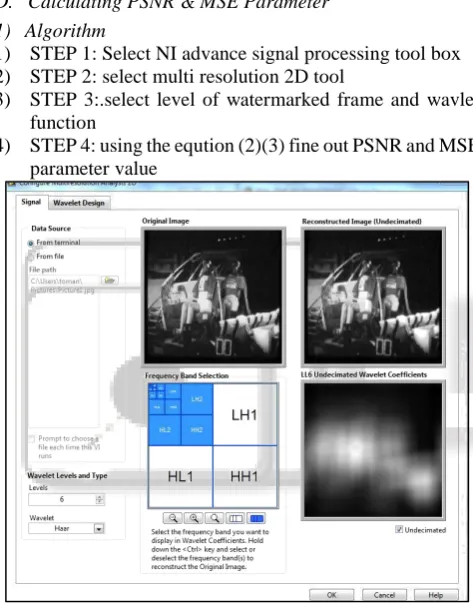
1) STEP 1: Select NI advance signal processing tool box 2) STEP 2: select multi resolution 2D tool
3) STEP 3:.select level of watermarked frame and wavlet function
4) STEP 4: using the eqution (2)(3) fine out PSNR and MSE parameter value
Fig. 8: Front Panel Window to Multi Resolution & Wavelet Level of Frames
IV. RESULT & DISCUSSION
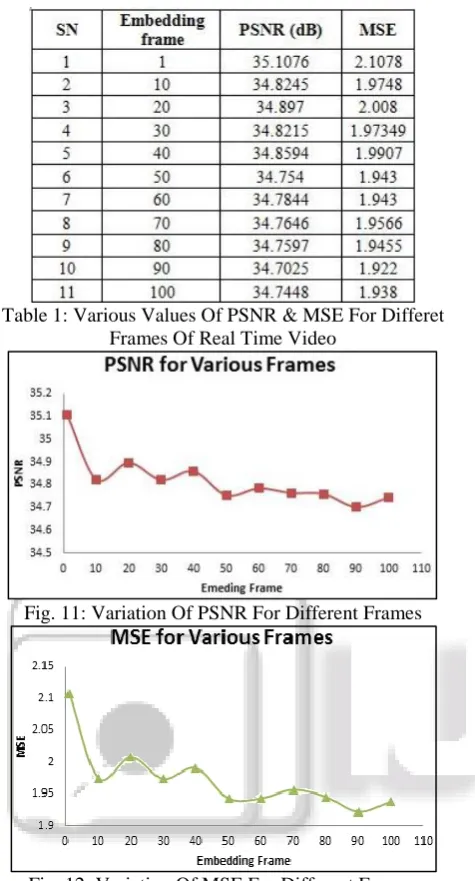
The proposed algorithm is applied to a sample video which has been taken from laptop from camera itself in AVI format. The proposed algorithm shows a good watermarking ability since the original sample frame and its corresponding watermarked frame looks quite identical. The performance of the proposed algorithm is used to hiding the defense data with high security. It is tested using real time video frames. The size of the frame is 360x268.This algorithm is evaluated when varying the size of the watermark by changing the different level and wavelet function in embedded watermark. Peak Signal to Noise Ratio (PSNR) is used as a general measure of the visual quality of the watermarking system. The PSNR value of gamma, hue and brightness saturation varied. The PSNR value depends on this value.
A. PSNR
The Peak-Signal-To-Noise Ratio (PSNR) is used to measure deviation of the watermarked and attacked frames from the original video frames and is defined as
PSNR = 10 log (2552
MSE) (1)
Where MSE (Mean Squared Error) between the original and distorted frames of size m×n is defined as:
MSE = 1
mn∑ ∑ [I(i, j)(i, j)] n
j m
i=1 (2) Where I and I′ indicates the pixel values at location (i,j) of the original sample frame and watermarked frame respectively. Higher the value of PSNR more the imperceptibility of watermarking. Its unit is in decibels (dB).
B. NC
The normalized coefficient (NC) gives a measure of the robustness of watermarking and its peak value is 1. Since in this work no attack has incorporated hence the value is always been 1.
NC =∑ ∑ W(i,j).Wi j ,(i,j) ∑ ∑ W(i,j)2
j
[image:5.595.48.285.238.540.2]i (3) Where W and W′ represent the original and extracted watermark respectively.
Fig. 9: Labview Front Panel (GUI) Of Praposed Method
Fig. 10: Real Time Video Recording And Embeding Watermark Video Front Panel(GUI)
The figure 9 and 10 shows Labview program front pannel and real time video recording and embedding watermark video front pannel respectively.
[image:5.595.303.548.303.570.2]Table 1: Various Values Of PSNR & MSE For Differet Frames Of Real Time Video
Fig. 11: Variation Of PSNR For Different Frames
Fig. 12: Variation Of MSE For Different Frames From figure 11 it is depicted that as the value of embedding strenght increses the value of PSNR decreses and similarly fig 12 shows the value of MSE for each frmes of the video.
V. CONCLUSION & FUTURE SCOPE
In the current work implementation of digital video watermarking technique based on Discrete Wavelet Transform (DWT) is proposed. DWT technique is a robust among all due to its multi resolution capability. Graphical programming are created using LabVIEW. In this proposed technique watermarked frames are almost identical to original video frame for low values of embedding strength. The proposed technique is less time consuming since it does not required tedious programming.
For the future work various attacks can be applied in this proposed model and their effect on watermarking can be studied also this model can be compared with other watermarking along with the same platform will be use for other kind of watermarking techniques like DCT, DFT etc.
REFERENCE
[1] Sadik. A.M .Al-Taweel, Putra Sumari, “Robust Video Watermarking Based On 3D-DWT Domain,” IEEE Communications, 2009.
[2] Min-Jeong Lee, Dong-Hyuck Im, Hae-Yeoun Lee, Kyung-Su Kim, Heung-Kyu Lee, “Real-time video watermarking system on the compressed domain for high-definition video contents: Practical issues”, Digital Signal Processing 22 (2012) 190–198.
[3] Suppat Rungraungsilp, Mahasak Ketcham, Tanee Wiputtikul, Kanchana Phonphak ,and Sartid Vongpradhip,” Data Hiding Method for QR Code Based on Watermark by comparing DFT with DWT Domain”, International Conference on Computer and Communication Technologies (ICCCT'2012) May 26-27, 2012 Phuket,Thailand.
[4] Shanjun Zhang, Kazuyoshi Yoshino,” DWT-Based Watermarking Using QR Code”, Science Journal of Kanagawa University 19 : 3-6 (2008).
[5] G. Langelaar, I. Setyawan, and R. Lagendijk, “Watermarking digital image and video data: A state-of-the-art overview,” IEEE Signal Process. Mag., vol. 17, no. 5, pp. 20–46, Sep. 2000.
[6] Sanjana Sinha, Prajnat Bardhan, Swarnali Pramanick, Ankul Jagatramka, Dipak K. Kole, Aruna Chakraborty, “Digital Video Watermarking using Discrete Wavelet Transform and Principal Component Analysis” International Journal of Wisdom Based Computing, Vol. 1 (2), August 2011.
[7] S.Nafees Ahmed, B.Sridhar, Dr.C.Arun, “Robust Video Watermarking based on Discrete Wavelet Transform” International Journal of Computer Network and Security (IJCNS) Vol 4. No 1. Jan-Mar 2012.
[8] Kesavan Gopal1, Dr. M. Madhavi Latha2 “ Watermarking of Digital Video Stream for Source Authentication” IJCSI International Journal of Computer Science Issues, Vol. 7, Issue 4, No 1, July 2010 ISSN (Online): 1694-0784 ISSN (Print): 1694-0814.
[9] Tamanna Tabassum, S.M. Mohidul Islam “A Digital Video Watermarking Technique Based onmIdentical Frame Extraction in 3-Level DWT”.
[10]Pik-Wah Chan and Michael R. Lyu1 “A DWT-based Digital Video Watermarking Schem with Error Correcting Code.”
[11]Mr Mohan A Chimanna 1 , Prof.S.R.Khot2, “Digital Video Watermarking Techniques for Secure Multimedia Creation and Delivery”, International Journal of Engineering Research and Applications (IJERA) ISSN: 2248-9622, Vol. 3, Issue 2, March -April 2013, pp.839-844.
[12]Ganesan Prabakaran,R. Bhavani, M. Ramesh, “A robust QR-Code video watermarking scheme based on SVD and DWT composite domain,” February 2013 DOI: 10.1109/ICPRIME.2013.6496482.
[13]Dr.G.R.Gnana King1, L.Nithya Devi2, E.Pavithra3, T.Sahana4,A.Subhashini5, “An efficient video watermarking scheme for conceling dta records using LabView” IJRTER-2016.
Image Denoising Algorithm using Wavelet Transform”, IJRASET, Volume 5 Issue II, February 2017, ISSN: 2321-9653.
[15]Kesavan Gopal1, Dr. M. Madhavi Latha2 “Watermarking of Digital Video Stream for Source Authentication” IJCSI International Journal of Computer Science Issues, Vol. 7, Issue 4, No 1, July 2010 ISSN (Online): 1694-0784 ISSN (Print): 1694-0814
[16]Yusuf Perwej , Firoj Parwej , Asif Perwej “Copyright Protection of Digital Images Using Robust Watermarking Based on Joint DLT and DWT” International Journal of Scientific & Engineering Research Volume 3, Issue 6, June-2012 1 ISSN 2229-5518.
[17]Loganathan Agilandeeswari1 and Kumaravel Muralibabu2 “ A Robust Video Watermarking Algorithm for Content Authentication using Discrete Wavelet Transform (DWT) and Singular Value Decomposition (SVD) International” Journal of Security and Its Applications Vol. 7, No. 4, July, 2013.
[18]S. Akshaya1, A. Fathima Rinosha2,
R.Gayattri3,A.Soumya Jeynithi4 ,Dr. R. Brindha “Real
time video water marking using labview” IJMTES | International Journal of Modern Trends in Engineering and Science ISSN: 2348-3121.
[19] GAURAV BHATNAGAR1 and BALASUBRMANIAN RAMAN “Wavelet packet transform-based robust video watermarking technique” Sa¯dhana¯ Vol. 37, Part 3, June 2012, pp. 371–388._c Indian Academy of Sciences. [20]Jamal HUSSEIN1 and Aree MOHAMMED2 Robust Video Watermarking using Multi-Band Wavelet Transform” IJCSI International Journal of Computer Science Issues, Vol. 6, No. 1, 2009 ISSN (Online): 1694-0784 ISSN (Print): 1694-0814.
[21]Anand Darji, Dr. A.N.Chandorkar, Dr. S.N.Merchant, Vipul Mistry* “VLSI Architecture of DWT based WatermarkEncoder for Secure Still Digital Camera Design” Third International Conference on Emerging Trends in Engineering and Technology.
[22]Chih-Wei Tang and Hsueh-Ming Hang, Fellow, IEEE “A Feature-Based Robust Digital Image Watermarking Scheme” IEEE TRANSACTIONS ON SIGNAL PROCESSING, VOL. 51, NO. 4, APRIL 2003.
[23]Tamanna Tabassum, S.M. Mohidul Islam, A Digital Video Watermarking Technique Based on Identical Frame Extraction in 3-Level DWT, 2012 15th International Conference on Computer and Information Technology (ICCIT).