Pollutant Formation in SI Engine
Aman Kumar
IIT Bhilai, India
Abstract— The main focus of this paper is to study andinvestigate the cyclic emissions and pollutant formation in a typical SI engine. The main ingredient of pollutants formation in a typical SI engine is Nitric Oxide (NO) and nitrogen oxide (NO2) collectively known as NOx. The other components are carbon monoxide (CO) and unburnt hydrocarbons (HC). The following paper is based on the experiments performed on an optical single cylinder SI research engine under different conditions. High - speed natural light photography is done to maintain records of in cylinder pressure, temperature and other parameters of the combustion chamber. The experiments included the investigation of the effect of various engine parameters such as ignition timing and mixture air-fuel equivalence ratio on knocking combustion and pollutant formation. The investigations are done to keep a check on the formation of pollutants from the gasoline engines which affects the environment adversely. As a result of the investigation, at stoichiometric conditions, by advancing spark timing from MBT to knock intensity equal to 6 bar, instantaneous NO and HC emissions are increased up to 60% as compared to the MBT operating conditions. A further increase of knock intensity at the limits of pre-ignition region was observed to significantly drop NO emissions. It was found that when knocking combustion occurs at lean conditions, NO emissions are increased.
Key words: SI Engine
I. INTRODUCTION
In the world of modern technology and innovation, the development process of engine has become a very challenging task due to the increasing demands with respect to performance, fuel efficiency and emissions. On the one hand, international laws are regulating exhaust gas emissions more and more strictly and the customers are demanding more fuel-efficient, affordable cars with a high level of comfort, drivability and luxury. One of the main aspect of developing an engine is to have knowledge on the different types of engine emissions and how to control them or to minimize the emission to a more safe level.
The emission from the engine are governs two major phenomenon- environmental problems and the other is the effect on the performance of the engine. As an engineer one must take care of the emission control from the engine, it must be as low as possible, only then the engine will work more smoothly and efficiently.
The spark-engine exhaust gases contains oxides of nitrogen (nitric oxide, NO, and small amount of nitrogen oxide, NO2 collectively known as NOx), carbon monoxide, (CO) and organic compound which are unburned hydrocarbon (HC). The relative amount depends upon engine design and operating conditions. But are of order: NOx (500-100) ppm, HC (300) ppm and CO present in an amount of 1 to 2 percent. Piston blow by gases, fuel evaporated and release to environment through vents in the fuel tank and carburetor after engine shutdown are also sources of unburned hydrocarbons. [2]
Diesel hydrocarbon emission are significant though level exhaust concerntrations are lower by a factor of 5 than typical SI engine levels. The hydrocarbons within the exhaust may condense to make white smoke throughout engine start up. Diesel engine are important source of particulate emission between about point to endpoint, 5% of the fuel is emitted as small particles which consists of soot with some additional absorbed hydrocarbon materials diesel engines are not a significant source of carbon monoxide.
When NOx react chemically with other atmospheric gaseous compounds such as “Volatile organic compounds” (VOCs) under the sunlight, it forms smog. Smog is dangerous to our environmental concerns as it reduces the visibility of surroundings and poses a health hazard to humans which includes irritation of eyes, respiratory and cardiovascular problems such as asthma and headaches and other skin related problems. [3]
Air-fuel ratio is one of the major parameter that affect the NOx formation. The SI engine is operated close to stoichiometric air-fuel ratio as it provides a smooth engine operation. Nitric oxide emissions are maximum at slightly (5-10%) Leaner than stoichiometric mixture due to combination of availability of excess oxygen and high combustion temperatures at this point. Carbon monoxide and HC emissions reduces with the increase in the air-fuel ratio as more oxygen is available for combustion. Further leaning of mixture results in poor quality of combustion and eventually in engine misfiring causing an erratic engine operation and sharp increase in HC emissions. It is desirable to operate the engine on lean mixtures such that they would provide low CO and HC, and moderate NOx emissions. But, presently most engines are operated very close to stoichiometric conditions for catalytic control of NOx emissions. [4]
II. EXPERIMENTAL SETUP
Optical Engine
A customized single cylinder research engine with a distinct optical arrangement was employed in this study.
The basic engine characteristics of the engine are presented as follows:-
Parameter (unit) Value
Number of Cylinders 1
Compression Ratio 8.4:1
Stroke (mm) 89
Bore (mm) 95
Displacement (cc) 631
Con-rod Length (mm) 165.16
Valve Lift (mm) 5
Inlet Valve Openings/Closing (BTDC) 375/145 Exhaust Valve opening/Closing (ATDC) 120/350
Table 1: Engine parameters. [5.1]
engine head was designed to withstand a combustion pressures up to 150 bar. The engine contains a flat piston crown, two inlet ports, and originally was designed with two exhaust ports. As the purpose of this study is focused on knocking combustion, one of the exhaust valves was deactivated in order to assist end-gas autoignition, by increasing residual gas fraction. A schematic presentation of the optical cylinder head is given below:
Fig. 1: Optical Engine Cylinder Head [5.2]
The recessed side mounted poppet valves guaranteed valve overlap without piston clash and to keep a compression ratio of 8.4.The research engine was also coupled with an eddycurrent dynamometer with a maximum power supply of 10 kW. The engine fuel supply was regulated by a Bosch EV6 PFI fuel injector operating at 3 bar rail pressure. The PFI injector had a two-hole pattern which forms a dual plume spray pattern that travels to the intake valves. The injection timing was fixed at 400 BTDC firing under all operating conditions. The fuel used in these experiments was PRF75, as a result of blending iso-octane and n-heptane (provided by a chemical supplier) on a volumetric basis in small batches immediately prior to each testing session. The ignition system consisted of an NGK ER9EH 8mm spark plug supplied by a Bosch P100T ignition coil.
III. EXPERIMENTAL CONFIGURATION AND MEASUREMENT
Experiments were conducted using the experimental setup schematically illustrated in the figure below:
Fig. 2: Illustration of experiment. [6]
The test protocol included the recording of high frequency and low frequency data and natural light photography data. The high frequency data were recorded in a National Instruments (NI) data acquisition card and included the incylinder pressure, encoder crank angle signal, exhaust temperature and exhaust NO and HC emissions recordings from the fast response analyzers. The low sampling frequency data contains ECU derived signals, including air-fuel equivalence ratio value (l sensor), ignition timing, throttle position, inlet air pressure and temperature and coolant temperature. Recording also included the high frequency photography data of the combustion evolution. An AVL GH14DK pressure transducer was installed on the side of the exhaust valves to measure cylinder pressure. It was built to fit this particular handmade engine cylinder head and its position were at the region where autoignition normally takes place. It has to be noted that when knock occurs, pressure distribution across the combustion chamber is not continous and the location of the transducer can also affect the recordings of the experiments.
The signal from the transducer was send to an AVL Flexifem charge amplifier. The error in the cylinder pressure measurement was less than ±1% full scale reading (FSO). The temperature of exhaust gas was installed downstream, to the exhaust gases to get an average value of NO emissions. The response time of corresponding NO emissions was in the order of 2 micro seconds. Simultaneously, Cambustion HFR400 analyzer was employed for HC measurement. The only used sampling head was installed downstream of the exhaust valves and its sampling time was close to 4 ms. Signals from both heads (3 in total) were directed to the NI data acquisition card.
Images of the visible light of the combustion heat were captured through an overhead window. The camera was capable of imaging at 6000 frames per second (fps) with a resolution of 512 x 384 pixels. All cycles presented in this paper were imaged at 6000fps with an exposure time of 167 ms. the internal memory of the camera allowed for a total of 10,000 frames to be recorded before the data were stored in a hard drive (laptop). By operating the engine at 1200 rpm, it was possible to record 16 consecutive cycles in a single test. Due to the large variation in intensity of the light emission from combustion between cycles, the gain was adjusted at each cycle to improve the clarity of the images.
The reason that in this study an optical engine has been employed is to qualitatively explain the cyclic resolved emission values under various knocking conditions by utilizing optical data. Realistic results from commercial engines may quantitatively change, as explained elsewhere
IV. ENGINE TEST PROTOCOL
[image:2.595.51.285.594.757.2]with an engine setup that lacks the water cooling in the head. The thermodynamic results were averaged over three sets of 100 cycles for each test condition. The sump oil temperature remained moderately low throughout testing (~40°C).
V. DATA PROCESSING
An example of processing the in-cylinder pressure of two consecutive cycles with KI index 0.76 bar (light knock cycle) and 15.1 bar (super knock cycle) respectively versus NO concentration is given with reference to (Figure3). During the valve-closed part of the current cycle, the analyzer measures the NO level of the remained in the exhaust manifold from the previous cycle. When exhaust valve opens (EVO) a portion of the (in-cylinder) gas violently exits the cylinder (blow-down) and clears the exhaust manifold from the previous cycle gas. However, a delay between EVO and analyzer response (point A in Fig 3) is observed, attributed to the distance between the valve outlet and the sampling probe, as well as to the instrument response time. After the exhaust valve closes (EVC), the analyzer signal exhibits a slight fluctuation (area B-C in Fig.3), indicating a variation of NO concentration in the cylinder gas. The NO concentration may vary from cycle to cycle due to the combustion process. During the closed part of the next cycle, the analyzer signal can be considered constant (part C-D in Fig.3) and corresponds to the NO level of the current cycle. This average value is taken as the NO emissions amplitude of the current cycle. Last but not least, Fig.3 also shows that the level of NO (C-D area) after a light knock cycle and after a super knock cycle (C0 point) can significantly vary. The deeper understanding of this observation is within the aim of this study. A similar procedure was followed to detect HC concentration at each combustion cycle, taking into account the variations in signal delay, due to the different positioning of the sampling probes for NO and HC species.
[image:3.595.310.539.251.463.2]More details on the exact process per pollutant can be found in open literature. [7.1]
Fig. 3: Schematic illustration of crank angle degree vs in cylinder pressure. [7.2]
Parameter (unit) Value
Engine Speed (RPM) 1200 ± 5
Relative AFR (l) 1± 0.01
Inlet Pressure (bar) 0.9 ± 0.02 Inlet Air Temperature (°C) 66 ± 2
Exhaust Bridge Temperature (°C) 130 ± 2
Head Temperature (°C) 88 ± 1
Table 2: Engine operating conditions
VI. RESULT
Effect of Spark Timing
[image:3.595.44.289.509.759.2]The phenomenon of knock is controllable by the spark advance as advancing or retarding the spark timing can increase or decrease the knock severity or intensity respectively. Although the knock varies from cycle to cycle and doesn’t occur at each combustion cycle, an average of combustion cycle is taken which represents ‘mean’ picture of knock intensity. Various spark timings lead to different heat release rate, which can be linked to end-gas pressure and temperature conditions that can cause autoignition.
Fig. 4: In cylinder pressure vs CAD [9.1]
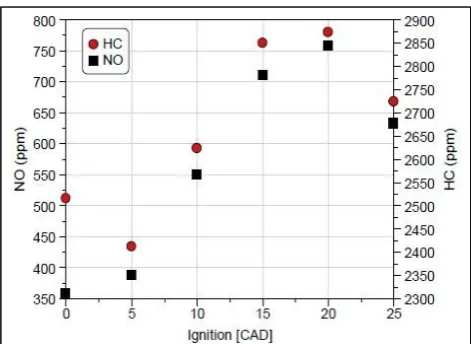
Cycle to cycle variability is recognized as the major reason of cyclic emission variation; however the impact of knocking combustion on pollutants formation has not been previous investigated. The averaged and variation range of the emission values for 300 combustion cycles as well as the relationship between NO and HC emissions against spark timing are increased against spark timing due to incomplete combustion as KI is increased. However, under heavy knock conditions mean HC are slightly decreased as pre-ignition appears and combustion characteristics change. Regarding NO, it was found that engine-out NO are enhanced versus spark timing which is continued until heavy knock conditions at spark timing 20° BTDC and then average formed NO is decreased. Previous studies on cyclic NO variability presented that MBT is related with the maximum mean NO value and the minimum COVNO value, while the effect of knocking combustion in this relationship is not usually considered. The current tested experimental case clearly presents that knock can further increase mean NO exhaust emissions by up to 36%, while considering NO variability, instantaneously this increment can reach up to 60%. A further analysis to better understand the deeper reason of this trend is needed and followed in this study. [9.2]
VII. EFFECT OF COMPRESSION RATIO
[image:4.595.307.537.267.457.2]NOx resulted from gasoline engine for wide range of equivalence ratios and for several compression ratios, NOx increased in the lean side with the increase of CR, for equivalence ratio less than (Ø =0.9), this was appeared by increased exhaust gas temperatures for these ratios, which increased from 525 to 585°C. These concentrations reduced in the rich side for equivalence ratios more than (Ø =1.1), because of the increase in maximum cycle temperature with CR increased
Fig. 5: NOx vs distinct CR. [8.2]
For equivalence ratios (Ø =0.9-1.1) where the engine produced the maximum brake power, NOx concentrations reduced with increased CR, because of interference of new parameter.
It was the optimum spark ignition timing, with CR increased the mixture temperature increased inside combustion chamber, improving the burning and increasing the flame propagation velocity, causing the optimum spark
timing to retard, to insure knock preventing. This operation reduces the NOx formation required time; this phenomenon will appear in Spark timing study clearly. NOx concentrations increased at CR=8.5:1 for these equivalence ratios range, because the CR effect prevailed OST effect and because of knock occurrence. The same conditions appear in fig. (2) for LPG used as an engine fuel, with some extend in the lean equivalence ratios, making the CR effect obvious in this side for equivalence ratios less than Ø =0.75. NG used as fuel in fig. (3), to show CR effect on NOx emitted by the engine, from the previous figures, the maximum value for NOx concentrations come within Ø=0.950.98 for NG, and for LPG between Ø=0.92 - 0.95, and for gasoline at Ø=0.9 - 0.93. The working at lean equivalence ratios less than Ø=0.8 gives accepted concentrations for USA and Europe emission limitations for 1996, with insured condition that burning failure will not happen. [8.1]
Fig. 6: NOx vs distinct CR. [8.3]
VIII. EFFECT OF AIR FUEL EQUIVALENCE RATIO
Combustion evolution and knock onset are affected by mixture composition and availability of oxygen, while the fluctuations of air-fuel equivalence ratio is an important source of CCV. Both of these factors affect pollutant formation.
[image:4.595.52.279.454.674.2]They found out that compression ratio can be increased with lean operation, implying that lean mixtures are more knock resistant. However, the operating conditions under which this trend is valid is not clearly stated. A possible reason could be the slower burn rate that leads to auto-ignition when piston expands and consequently end gas temperature and pressure are relatively low. The effect of air-fuel equivalence ratio on NO formation under knocking combustion is also explored. It was found that maximum NO emissions are enhanced under lean conditions due to the excess of oxygen and the peak temperature conditions that occur under slightly lean conditions. Compared to normal combustion lean operating (l~1.1) conditions, it was found that NO can be up to 3 times higher under auto-ignition conditions. [10.1]
Fig. 7: Direct Flame Visualization [10.2]
IX. EFFECT OF SPARK IGNITION
Spark ignition has effect on NOx concentrations for very lean equivalence ratios in exhaust gas was studied at HUCR and 1500 rpm engine speed, for four chosen lean equivalence ratios for each fuel, for gasoline Ø=0.83 was chosen, Ø =0.75 for LPG, Ø=0.75 for NG and Ø=0.7 for hydrogen. There was high reduction in NOx concentrations for all of the ratios, with retarding spark timing. NOx concentrations reduced around 42% when spark timing was retarded 10°BTDC for gasoline fuel. For LPG the concentrations reduced to 37% with retarding spark timing 10°BTDC from the optimum spark timing. For NG with the same condition NOx concentrations reduced 79%, for hydrogen reduced about 66% with spark timing retarded 10°BTDC.
[image:5.595.47.293.229.481.2]The spark timing effect appeared clearly for equivalence ratios near stoichiometric, gasoline NOx concentrations reduced to 42% when spark timing retarded 10°BTDC at equivalence ratio Ø=0.92, for LPG, NOx concentrations reduced about 42% at Ø=0.95 (near this ratio formed the maximum concentrations) for the same conditions, with NG as fuel, NOx concentrations reduced 70%, and for hydrogen the reduction was 50%.
Fig. 8: Spark Timing vs NOx [11.2]
The high reduction in Nox concentrations for metric weight unit because of its low burning rate, that create spark temporal arrangement impact on most temperature within the combustion chamber obvious, the spark temporal arrangement for NG is always advanced as compared to the other fuels. Ignition or spark timing retard lowers NOx emissions by moving the ignition event to later in the power stroke. Because the combustion chamber volume isn't at its minimum, the peak flame temperature will be reduced, thus reducing thermal NOx formation. Ignition timing retard is applicable to all engines. It is enforced in spark ignition engines by dynamical the temporal arrangement of the spark. Retarding spark timing effect on NOx concentration was very limited at rich equivalence ratios when spark timing retarded 10°BTDC gasoline NOx concentrations reduced only 12% at Ø=1.3, at the same equivalence quantitative relation except for LPG the concentrations reduced 15 August 1945 once spark temporal arrangement retarded 10°BTDC, when NG was used as a fuel at the same conditions, the NOx concentrations reduced 12.5%, but for hydrogen at Ø=1.3 the spark timing became critical condition, where advancing or retarding the spark timing made abnormal combustion conditions, and caused engine failure, because of this there's no curve representing gas behavior. The figures give emphasis that the spark timing effect is very limited at rich side because of oxygen lack. [11.1]
[image:5.595.315.541.539.695.2]Fig. 10: NO concerntration vs Ignition
X. CONCLUSION
This study tells about the pollutants formation under knocking combustion conditions using an optical single cylinder SI engine. An experimental setup has been utilized including fast response analyzers for detecting the NO and HC emissions, natural light photography and incylinder pressure recordings. The effect of various engine operating parameters where explored such as spark ignition timing and air fuel equivalence ratio, compression ratio. The effect of ignition timing on pollutants formation under various conditions has been investigated. The results showed that as spark timing is advanced and knock intensity is increased, both NO and HC emissions are enhanced. Up to knock intensity around 6 bar and under stoichiometric conditions, it was found that instantaneous NO emissions are raised up to 60% as compared to the MBT operating conditions. A further increase of knock intensity at the limits of pre-ignition region was found to significantly drop NO emissions. Simultaneously HC emissions were found to increase at the region of light and medium knock where the peak of HC emissions was observed, while at heavier knock region HC emissions drop.
The effect of air-fuel equivalence ratio on pollutants formation under knocking combustion has been also explored in this study. It was found that leaner mixtures present the onset of knock later compared to richer mixtures due to the slower deflagration rate. When knock occurs, the formed NO in lean mixtures are higher than in stoichiometric or rich mixtures due to the oxygen availability. Last but not least, it was found that under lean conditions NO emissions are enhanced as knock intensity is increased while under stoichiometric or slightly rich operating conditions it was found that NO are decreased for knock intensity higher than 6 bar. Spark temporal order is thought-about because the main think about controlling Roman deity concentration resulted from the engine, once it works with one in every of the studied organic compound fuels. Retarding the spark timing reduce NOx concentrations highly.
REFERENCES
[1] Study on pollutants formation under knocking combustion conditions using an optical single cylinder SI
research engine Apostolos Karvountzis-Kontakiotis, Hassan Vafamehr, Alasdair Cairns, Mark Peckham. [2] IC Fundamentals JB Heywood
[3] Study of NOx Emissions of S.I. Engine Fueled with Different Kinds of Hydrocarbon Fuels and Hydrogen Miqdam T. Chaichan, Qahtan A. Abass
[4] Thermodynamic analysis of combustion and pollutants formation in a wood-gas spark-ignited heavy-duty engine R.G. Papagiannakis T.C. Zannis
[5] [5.1], [5.2], [6] Study on pollutants formation under knocking combustion conditions using an optical single cylinder SI research engine Apostolos Karvountzis-Kontakiotis, Hassan Vafamehr, Alasdair Cairns, Mark Peckham
[6] [8.1] & [8.2] Study of NOx Emissions of S.I. Engine Fueled with Different Kinds of Hydrocarbon Fuels and Hydrogen Miqdam T. Chaichan, Qahtan A. Abass [7] [10.1] & [10.2] Comparitative study of experiment and
numerical NO profiles in SI combustion CHRISTOF SCHULZ, JU¨ RGEN WOLFRUM and VOLKER SICK [8] [9.1] & [9.2] Study on pollutants formation under
knocking combustion conditions using an optical single cylinder SI research engine Apostolos Karvountzis-Kontakiotis, Hassan Vafamehr, Alasdair Cairns, Mark Peckham
[9] [11.1], [11.2] & [11.3] ] Study of NOx Emissions of S.I. Engine Fueled with Different Kinds of Hydrocarbon Fuels and Hydrogen Miqdam T. Chaichan, Qahtan A. Abass
[10]Nitric oxide detection inside the cylinder of an SI engine by direct UV absorption spectroscopy H. Trad, P. Higelin, C. Mounaim-Rousselle_
![Fig. 2: Illustration of experiment. [6]](https://thumb-us.123doks.com/thumbv2/123dok_us/456677.1045331/2.595.49.287.161.373/fig-illustration-of-experiment.webp)
![Fig. 4: In cylinder pressure vs CAD [9.1] The latter can be observed there is a rapid increase](https://thumb-us.123doks.com/thumbv2/123dok_us/456677.1045331/3.595.44.289.509.759/fig-cylinder-pressure-vs-cad-observed-rapid-increase.webp)
![Fig. 5: NOx vs distinct CR. [8.2] For equivalence ratios (Ø =0.9-1.1) where the](https://thumb-us.123doks.com/thumbv2/123dok_us/456677.1045331/4.595.52.279.454.674/fig-nox-vs-distinct-cr-equivalence-ratios-o.webp)
![Fig. 9: Spark Timing vs NOx concerntration [11.3]](https://thumb-us.123doks.com/thumbv2/123dok_us/456677.1045331/5.595.47.293.229.481/fig-spark-timing-vs-nox-concerntration.webp)