Comparative Analysis of Tunnel Formwork System & Conventional
Formwork
Bhagirathi Singh
1Dr. Pankaj Singh
21
M.Tech. Scholar
2Head of Department
1,2Department of Civil Engineering
1,2S.R.K. University, Bhopal, India
Abstract— Winds of change are blowing across every industry in India but the construction industry is still reluctant to utilize the advanced techniques that can enhance the productivity and efficiency of the construction industry. In recent years construction industry is witnessing increased demand in multistorey construction and repetitive modular structures are becoming an integral part of it. These structures require detailed planning in order to save cost and time. As formwork accounts for about 25 40% of the total project cost and almost 60% of the time in concrete construction, we need to pay attention to the development in formwork techniques and replace conventional formwork with new formwork techniques like tunnel formwork. This paper aims at focusing on the benefits and limitations of tunnel formwork in contrast to conventional formwork thus changing the mindset of local construction industries that are still dependent on conventional formwork techniques.
Key words: Tunnel Formwork System, Conventional Formwork
I. INTRODUCTION
HE increase in population and the limitation of space has leaded the way to multistorey or highrise buildings. In order to make these structures sound, we need to focus on factors that impart strength to concrete and this is where formwork plays an integral role. Formwork is a temporary structure like a die or mould, used to contain poured concrete, to give concrete the desired shape and support it until it attains sufficient strength to carry its own weight. Formwork should be capable of carrying all imposed dead and live loads apart from its own weight. Pantheon, a former Roman temple and now a church in Rome, is the earliest example of use of mould for concreting. Formwork should be properly designed, fabricated, and erected to achieve high quality concrete finish. If this is not done properly the desired shape and strength of concrete is not achieved. Advanced Tunnel formwork is one of the new formwork techniques to hit Indian construction industry. It is found to be suitable for mass construction in Indian conditions. It delivers quality and speed at a rate which is higher than the speed achieved by most of the formwork systems. The labour in coordination with heavy machineries like tower crane speeds up the construction, assures quality control and durability. This reduces overall time and cost of the structure. This paper mainly focuses on advanced tunnel formwork systems, its components, working cycle, cost involved, its benefits and its limitations based on speed and economy.
II. OBJECTIVES The objective of this paper is to
1) Introduce advanced tunnel formwork systems to Indian construction industry and lay emphasis on the high
quality, speedy construction and if used effectively the economically which tunnel formwork yields.
2) Present comparative study of tunnel formwork and conventional formwork to eliminate the reasons which act as barrier for the local construction industries while opting for new formwork techniques like tunnel formwork.
III. LITERATURE REVIEW
Various types of formwork systems are used in India and based on type of material, purpose of use and method of erection the formwork systems are listed as follows.
1) Conventional formwork 2) Tunnel formwork 3) Climbing formwork 4) Mivan formwork 5) Slip formwork
The above mentioned formwork techniques are the trending techniques in construction industry of which conventional formwork is the traditional formwork. In this paper the focus will be on Tunnel Formwork and Conventional Formwork. A. Tunnel Formwork
Fig. 3.1 : Tunnel Formwork
B. Components and Supporting System in Tunnel Formwork The major components in Tunnel formwork are as follows: 1) Half Tunnel. Two half tunnels when bolted together
forms one unit which acts like tunnel.
2) Back Panel is attached to the two half tunnel forming one entire tunnel form.
3) Outside Wallform it is used as formwork arrangement for the end wall along with arrangements for lifting of platforms.
4) Lifting Beam is used in movement of tunnel panels. 5) Lifting Device applied for lifting of tunnel panels. 6) Roller for movement of tunnel form.
7) Kicker Form it prevents cement slurry leakage and also stabilises the form.
8) Slab Stopend is used to indicate the end for slab. 9) Slab Boxout is used as openings in slab for conduits. 10) Door Boxout is used as opening for door.
11) Window Boxout is used as opening for window. 12) Stripping Platform for easy removal of tunnel form after
concreting
13) Gable End Frame it is used as a platform for movement of labours.
14) Tie rod and cone set is driven before concreting is pour to take the lateral support of the concrete to be poured and keeping the form in place. 15. Crane and lifting equipments are used for movement of tunnel form from one floor to another.
C. Life Cycle of Tunnel Form
For optimizing the volume of formwork, equipment & workforce overall structure is divided into a number of more or less similar construction phases and sizes correspond to daily work to cast concrete. In order to save the time reinforcement mesh are used in place of normal steel bars. The wall and slab reinforcement is laid and kickers are placed for positioning formwork for wall. Two half tunnels are bolted on site to make one tunnel and lifted by crane to desired location. The ties are added. The concrete is poured and hot air blowers are placed for early settling of concrete. Thus concrete reaches striking strength overnight and the tunnel forms are removed the next day. The tunnel form are cleaned and oiled for reuse.
Fig. 2(a): Laying Reinforcement Mesh Fig. 2(b): Bolting Half Tunnels & Laying Slab Reinforcement D. Consideration of Cost Involvement in Tunnel Form For all structural systems, the construction cost is obviously expected to get higher as the number of floors. In case of tunnel formwork the past studies have shown that in the buildings of the same wall thickness, the unit cost per apartment decreases as number of floors increases. The components which influence cost are initial cost, cost of materials or assembly, reuse cost, machinery and operational cost and daily cost expenditure on labour. The initial cost is very high but tunnel formwork is economical in long run as the life cycle is reduced and reuse of form is possible. Reusability also reduces material, assembly and Errection cost.
Due to high quality finish the cost of finishing treatment is reduced. In order to maintain the durability of formwork, formwork oil (1 litre for 2045 m2 of formwork) is applied at regular interval and thus it is a minor cost. Machinery cost involves the operational cost and the cost of cranes. As skilled labours are involved and the work is repetitive the total time of construction is reduced so the amount spent on daily cost on labour and supervision cost is greatly reduced.
E. Advantages
The overall advantages of tunnel formwork are categorized into four categories as follows.
1) Design
1) Hitech allsteel system of tunnel form with 3 mm. steel surface provides durability and strength.
2) Collapsible strut provides clearance for form stripping, the composite wheel assemblies help in accurate form positioning and blockouts eliminate nailing.
3) Multiple rooms can be concreted and that provides flexibility in scheduling.
4) Proper concreting of ceiling to the wall results in lack of formation of beams.
5) Tunnel form can be adapted to special building features, like balconies. It gives freedom and variety in architectural designing.
6) The dimensional accuracy of the concrete structure allows the placement of partition walls and fixing of all other finishing material such as joinery right after casting.
[image:2.595.309.547.65.235.2]easy to adjust vertical and horizontal leveling. High kickers make it easier to adjust tunnel heights which eliminate levelling mistakes. Tunnel form can be adapted to higher floor level easily.
2) Quality
1) Installation of all utility conduits in the shell reduces the internal finishing work.
2) High quality and dimensional accuracy is achieved. 1/1000 deformation is allowed and can be achieved. Low depreciation and long life of building.
3) The obtained surface is smooth which minimizes much of finishing work and allows direct application of paint or wall paper after sanding off the fins at the joints connecting two forms and smoothing with paint filler. 4) Monolithic elements of the building prevent thermal
cracks which are observed in the heterogeneous materials because of temperature variation.
5) Low scope of change in the original design of the building results in application of standard dimensions of doors, windows, partition wall etc.
3) Time
1) In the high temperature zones and/or by thermal treatment, with the use of ordinary cement, the normal pace is one day per cycle. Achievable cycle of production is of 13 days.
2) A monolithic structure with simultaneous casting of walls/crosswalls and slab results in reduction in total construction time.
3) Installation of electrical conduits, water and gas pipes in the shell reduces the internal finishing work, internal finishing proceeds in accordance with the concrete shell construction resulting in reduced total building time. Reducing minor works and overlapping activities yields into high quality and speed of implementation.
4) Cost
1) Tunnel form can be reused and this reduces the overall cost of formwork for per m2 or per housing unit. 2) The amount of rework and finishing work is reduced thus
additional material, machinery and labour cost is saved. 3) High quality and early completion of project helps
minimize cost in long run.
4) Tunnel form system comes with highest jobsite safety due to full perimeter platform system. This reduces cost associated with risk.
F. Limitations in Implementation of Tunnel Form
1) High initial investment is high and it further increases for small sized projects.
2) Implementing all internal walls in the form of reinforced concrete is unnecessary which causes lack of changes in the plan and concrete increases dead load of the building. 3) Precast elements like stairs, parapets etc are used and this
requires separate workshop arrangement.
4) The activities involving erection, removal and carriage of formwork, scaffolds, and placing of precast components to the required place involves use of tower cranes and this increases cost. Topographic limitations can make movement of cranes difficult in some projects. 5) All activities need to be planned and executed according to the dependency to minimize time and cost. This
requires efficient construction management and high cash flow.
6) Large spans of slab cannot be executed due to increased gap between the tunnel form panels. Here combination of formwork system may be adopted. Very short span of slab incorporates difficulty in removal of tunnel form at the time of stripping and suspended ceiling is needed. Basement stories are avoided as it is difficult to remove formwork.
7) Axial system plays important role and load bearing walls must be designed continuously on the same axial system to resist horizontal forces.
8) The number of labour required is less and it is more efficient as compared to that in traditional formwork. Thus proper training is required to impart skills to handle tunnel formwork.
G. Role of Management
Coordination plays an important role in process of concreting with tunnel formwork. Cost and time constraints are always impacting design and quality considerations. In order to achieve conformity with design and maximum quality with reduction in cost and time, management comes into picture. 1) Responsibility of training the labours to ensure smooth
execution.
2) Building should be so planned that maximum tunnel from can be done with the help of one location of tower crane. Positioning of the crane, precast workshop, material storage, etc. are to be planned to reduce transportation time and idle time.
3) Detailed planning is required. All the activities are to be planned before the commencing of the project. This will reduce the lag time. The activities dependent on one another can be foreseen and executed in sequence this helps in providing space for ducts and facilities.
4) Alternatives should be decided beforehand incase barriers are faced in tunnel form especially in very short and very large spans of slab. This will help in speedy construction.
5) Tunnel form system comes with highest jobsite safety due to full perimeter platform system but risk management should not be ignored.
6) Involvement of all the sectors is needed. The designing team, execution team and architectural team need to be in sync so that tunnel formwork is executed on time.
IV. DATA COLLECTION
From the questionnaire, following hurdles were identified for hesitation of local construction industries to adopt tunnel formwork in place of conventional formwork in multistoried construction.
1) Less Awareness about new formwork techniques 2) Low skilled labour and the additional responsibility to
train them for modern formwork techniques 3) High initial cost
4) Burden of additional cost due to machineries like tower crane
5) Lack of experience in tunnel formwork 6) Reluctance to adopt new technology
Data collected from Rohan Abhilasha site is as below: 1) Plan of building
2) MS Project schedule
3) Quantity estimates of material (Steel, Concrete & formwork)
4) Formwork technical manuals & user guide
For comparison of tunnel formwork with conventional formwork, average values for conventional formwork from various construction sites are selected as part of the questionnaire.
V. DATA ANALYSIS
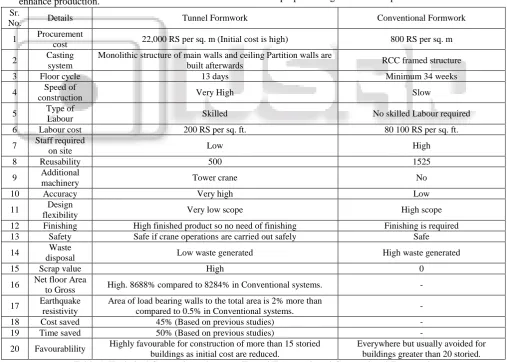
For data analysis detailed study of the tunnel formwork system is done and is compared with conventional formwork. Summary of findings is mentioned in following table.
Tunnel formwork is the solution to the repetitive modular multistoried construction and it eliminates the common hurdles that the local construction industries face. The details are explained as follows
1) Less Awareness about new formwork techniques: In order to maximize the quality with reduction in time and cost, constructors need to focus on innovations taking place around them. This simply needs initiatives to enhance production.
2) Low skilled labour and the additional responsibility to train them for modern formwork techniques: Internal training workshops can be conducted by the companies to improve the skills. Few labours are required as oppose to conventional formwork and thus it is cost effective in the long run.
3) High initial cost and Burden of additional cost due to machineries like tower crane: The initial cost is very high.
4) The duration required to finish the structure is half than that required with conventional formwork and thus early returns are possible. As per the previous studies the cost of tunnel formwork is lower than conventional formwork after building of 90 housing units.
5) Lack of experience in tunnel formwork and reluctance to adopt new technology: This is more of a mental blockage than practical problem. As tunnel formwork construction has already started in India, local construction industry can share the experience. Formwork contractors are usually hired and the procedure is explained through user guide manuals.
6) Difficulty in adoption of changes in original drawing: This is one of the limitations of tunnel formwork but proper management can help in this as discussed above. Sr.
No. Details Tunnel Formwork Conventional Formwork
1 Procurement
cost 22,000 RS per sq. m (Initial cost is high) 800 RS per sq. m
2 Casting
system
Monolithic structure of main walls and ceiling Partition walls are
built afterwards RCC framed structure
3 Floor cycle 13 days Minimum 34 weeks
4 Speed of
construction Very High Slow
5 Type of
Labour Skilled No skilled Labour required
6 Labour cost 200 RS per sq. ft. 80 100 RS per sq. ft.
7 Staff required
on site Low High
8 Reusability 500 1525
9 Additional
machinery Tower crane No
10 Accuracy Very high Low
11 Design
flexibility Very low scope High scope
12 Finishing High finished product so no need of finishing Finishing is required
13 Safety Safe if crane operations are carried out safely Safe
14 Waste
disposal Low waste generated High waste generated
15 Scrap value High 0
16 Net floor Area
to Gross High. 8688% compared to 8284% in Conventional systems. -
17 Earthquake resistivity
Area of load bearing walls to the total area is 2% more than
compared to 0.5% in Conventional systems. -
18 Cost saved 45% (Based on previous studies) -
19 Time saved 50% (Based on previous studies) -
20 Favourablility Highly favourable for construction of more than 15 storied buildings as initial cost are reduced.
[image:4.595.44.552.341.703.2]Everywhere but usually avoided for buildings greater than 20 storied. Table 1: Technical Comparisons between Tunnel Formwork and Conventional Formwork
VI. CONCLUSIONS
Formwork development has paralleled the growth of concrete construction from its earliest uses but still many construction companies, especially the locals, are hesitant in adopting
cost by 40% and time by 60% when compared to conventional formwork. Tunnel formwork has limitations like design limitations, requirement of skilled labour, crane availability, etc but these limitations don’t weigh much when compared to the long run benefits achieved by tunnel formwork. Alternatives can be used to reduce these limitations as mentioned in the paper and 100% utility can be achieved. Tunnel formwork may not be economical for construction of buildings less than 7 storied but as the number of floors increases the overall cost is reduced. Even in 5 storeys, total weight of the building can be designed 1.10 – 1.20 tons/m2 lighter than compared to 1.30 in conventional method. Depending upon whether economy or design is important, we can adopt tunnel formwork in different types of constructions. After studying and comparing both the systems it can be concluded that, though initial investment and per day operational cost in tunnel formwork is more than conventional formwork, the reusability and reduced slab cycle time makes tunnel formwork works economical. Rapid completion of project helps in returns from initial investment. Thus, in long run tunnel formwork is beneficial as compared to conventional formwork in repetitive modular multistoried construction.
REFERENCES
[1] Ms. Aakanksha Dilip Chaudhary Study of Tunnel Formwork System & Comparative Analysis with Conventional Formwork International Journal of Scientific & Engineering Research Volume 8, Issue 5, May2017 1281 ISSN 22295518 IJRET © 2017 http://www.ijret.org
[2] Erol Kalkan1* And S. Bahadir Yüksel2 Pros And Cons Of Multistory Rc TunnelForm (BoxType) Buildings The Structural Design Of Tall And Special Buildings Struct. Design Tall Spec. Build. (2007) Published online in Wiley Interscience (www.interscience.wiley.com). DOI: 10.1002/tal.368
[3] Randolf Miranda, Anand Kodre Advanced Tunnel Form Construction Technique, Case Study of “RohanAbhilasha, Wagholi” International Journal of Scientific Engineering and Science Volume 2, Issue 3, pp. 5457, 2018. ISSN (Online): 24567361 54 http://ijses.com/
[4] Hisham A. Abou Ibrahim,and Farook R. Hamzeh Role Of Formwork Systems In HighRise Construction 5th International/11th Construction Specialty Conference Vancouver, British Columbia June 8 to June 10, 2015 / 8 juin au 10 juin 2015
[5] Tejas D. Aradhye, Emeritus M. R. Apte Study Of Advanced Tunnel Formwork System In High Rise Building IJRET: International Journal of Research in Engineering and Technology eISSN: 23191163 | pISSN: 23217308 Volume: 05 Issue: 05 | May2016, Available @ http://ijret.esatjournals.org 529
[6] Mr. Amol S. Deshmukh, Mr. Manas A. Shalgar Study of Tunnel Formwork versus Aluminium Formwork. International Research Journal of Engineering and Technology (IRJET) eISSN: 2395 0056 Volume: 03 Issue: 12 | Dec 2016 www.irjet.net pISSN: 23950072 ©
2016, IRJET | Impact Factor value: 4.45 | ISO 9001:2008 Certified Journal | Page 477
[7] Mr. Manas A. Shalgar, Mr. Tejas D. Aradhye Introduction to advanced TUNNEL Formwork system: Case study of ‘Rohan Abhilasha’ International Research Journal of Engineering and Technology (IRJET) eISSN: 2395 0056 Volume: 04 Issue: 03 | Mar 2017 www.irjet.net pISSN: 23950072 © 2017, IRJET | Impact Factor value: 5.181 | ISO 9001:2008 Certified Journal | Page 294
[8] Angitha Sasidharan, Mohammed Aslam International Journal of Research in Advent Technology (EISSN: 23219637) Special Issue International Conference on Technological Advancements in Structures and Construction “TASC 15”, 1011 June 2015 108 Comparative Study of Tunnel Form and Framed Buildings by Dynamic Analysis
[9] K Anitha, P Deepan, V Shanmugavadivu, P Kathirvel Constructability assessment of conventional formwork and automated formworks in commercial building National Journal of Multidisciplinary Research and Development ISSN: 24559040 Impact Factor: RJIF 5.22 www.nationaljournals.com Volume 3; Issue 1; January 2018; Page No. 11771182
[10]Patil Sneha Mahesh, Bidavi Riddhi Rajendra, Frade Supriya Chandrakant ,Wable Vaishali Vishwanath Timber Formwork International Journal Of Interdisciplinary Innovative Research And Development (IJIIRD) ISSN: 2456236X Vol. 01 Issue 04, May2017 010414 www.ijiird.com 60
[11]K.Loganathan , K.E.Viswanathan A Study Report On Cost, Duration And Quality Analysis Of Different Formworks In HighRise Building International Journal of Scientific & Engineering Research, Volume 7, Issue 4, April2016 ISSN 22295518
[12]Kalbhor Shailesh S , Dr. A. C. Attar Comparative Analysis of Tunnel Formwork System and Aluminum Formwork System for High Rise Buildings International Journal of Engineering Research & Technology (IJERT) http://www.ijert.org ISSN: 22780181 www.ijert.org Vol. 6 Issue 05, May – 2017
[13]Mohd Syazwan Md. Rahim Nuzul Azam Haron Construction Cost Comparison Between Conventional and Formwork System for Condominium Project IJASCSE, Volume 2, Issue 5, 2013