Evaluating Accuracy of Structural Software Stadd Pro. & RCF
Naveen Kumar Kanojiya
1Dr. Pankaj Singh
21
M.Tech Scholar
2Head of Department
1,2Department of Civil Engineering
1,2S.R.K. University, Bhopal, India
Abstract— A significant revolution with computers’ usage in civil engineering business and construction process has been presented. Computers reduce all the extensive work specifically through the introduction of programs and software. Lately, software development has effectively contributed in various civil engineering disciplines, as it provides engineers with the ability to perform variety of complex calculations, modeling, drafting, designing practice and several analysis processes for civil engineering infrastructure. Many commercial companies that provide users with thousands of software are available today in the markets. However, the recent requirement is to select the suitable software that can perform multi engineering tasks efficiently and satisfy more specific users’ demands. Keywords: Stadd Pro. & RCF, RCC Frame Structures
I. INTRODUCTION
A building is a man-made structure with a roof and walls standing more or less permanently in one place. Buildings come in a variety of shapes, sizes and functions, and have been adapted throughout history for a wide number of factors, from building materials available, to weather conditions, to land prices, ground conditions, specific uses and aesthetic reasons. Daily new techniques are being developed for the construction of houses economically, quickly and fulfilling the requirements of the community. Engineers and architects do the design work, planning and layout, etc., of the buildings. The design of a simple building in the earlier times used to take at least a week. However, the design of complicated structures can now be done within a week’s time and with more accuracy using a host of software available in the market. A building frame consists of number of bays and storey. A multi-storey, multipanelled frame is a complicated statically intermediate structure. A design of R.C multi-storey frame work is taken up. The horizontal load consists of the earthquake and wind forces thus building is designed for dead load, live load and wind load as per IS 875-1987 and earthquake forces as per IS 1893(Part 1)- 2002.
The construction market has been blessed with two efficient Softwares namely STAAD Pro and R.C.F. SOFTWARE. Huge business firms and construction ventures have started using these Softwares for designing purposes. This paper focuses basically on the comparison between the results procured from the design of a multistoreyed structure calculated with the help of STAAD Pro and R.C.F. SOFTWARE Softwares. We have considered the height of each storey as 3m. The total height of the whole structure thereby becomes---. A conclusion is drawn at the end comparing the results drawn from their analysis and design. The results from the Softwares are then compared to the manual calculations.
A. RCC frame structures
An RCC framed structure is basically an assembly of slabs, beams, columns and foundation inter -connected to each other as a unit. The load transfer, in such a structure takes place from the slabs to the beams, from the beams to the columns and then to the lower columns and finally to the foundation which in turn transfers it to the soil. The floor area of a R.C.C framed structure building is 10 to 12 percent more than that of a load bearing walled building. Monolithic construction is possible with R.C.C framed structures and they can resist vibrations, earthquakes and shocks more effectively than load bearing walled buildings. Speed of construction for RCC framed structures is more rapid.
B. Different Methods Used For Design Working stress method
Limit state method Ultimate load method
C. Need and Advantages of Softwares
Being a totally practical and site based study, the use of the Softwares like STAAD Pro and R.C.F. SOFTWARE becomes questionable. But the civil engineering Softwares comprise of a wide range of tools to help the civil engineers in all construction works. In all the stages of work namely drafting & documenting, designing, visualizing & analyzing, these tools can be helpful. STAAD.Pro is Software which is used for data analysis and design. It is popular due to its flexible modelling environment and wide range of design codes. The design of petrochemical plants, tunnels and bridges can be easily done using it. It contains a wide range of features of civil engineering and is also easy to operate. STAAD Pro has made it easy for the civil engineers to pan the structures according to the demands of their clients.
R.C.F. SOFTWARE is used in the design of beams, slabs, columns, shear walls and bracings. The graphic input output and the numerical solutions are very easy. We also obtain precision and accuracy in Accuracy in dimensions by using Snaps (end, perpendicular, middle etc.).There are multiple viewing windows present in the Software.
D. Analysis and Design of a Structure
II. STAAD.PRO.SOFTWARE
STAAD stands for Structural Analysis and Design. STAAD.Pro is a general purpose structural analysis and design program with applications primarily in the building industry – commercial buildings, bridges and highways structures, and industrial structures etc. The program hence consists of the following facilities to enable this task Graphical model generation utilities as well as text editor based commands for creating the mathematical model. Beam and column members are represented using lines. Walls, slabs and panel type entities are represented using triangular and quadrilateral finite elements. Solid blocks are represented using brick elements. These utilities allow the user to create the geometry, assign properties, orient cross sections as desired, assign materials like steel, concrete, timber, aluminium, specify supports, apply loads explicitly as well as have the program generate loads, design parameters etc. Analysis engines for performing linear elastic and p-delta analysis, finite Element analysis, frequency extraction and dynamic response. Design engines for code checking and optimization of steel, aluminium and timber members. Reinforcement calculations for concrete beams, columns, slabs and shear walls. Design of shear and moment calculations for steel members. Result viewing, result verification and report generation tools for examining displacement diagrams, bending moment and shear force diagrams, beam, plate and solid tress contours, etc. Peripheral tools for activities like import and export of the data from and to other widely accepted formats, links with other popular Softwares for footing design, steel connection design, etc.
STAAD was the first structural Software which adopted Matrix Methods for analysis. The stiffness analysis implemented in STAAD is based on the matrix displacement method. In the matrix analysis of structures by the displacement method, the structure is first idealized into an assembly of discrete structural components (frame members or finite elements). Each component has an assumed form of displacement in a manner which satisfies the force equilibrium and displacement compatibility y at the joints.
A. Benefits of Using STAAD.Pro Software
1) Flexible modeling environment. STAAD.Pro v8i is based on latest programming technology that enables it to create an exact three dimensional replica of the required building or structure. The new STAAD.Pro software is equipped with advanced graphical environment and about 70 international design codes in 7 different languages. The flexible modeling environment of STAAD.Pro v8i software is due to the availability of a wide variety of advanced structural analysis and design features.
2) Availability of a wide range of design codes. STAAD.Pro v8i software has included both concrete and steel design together, thus making it a one-stop-point for building design. Due to the availability of a large variety of design codes, this software can easily determine the drift, deflection and depth of any construct. This software can also calculate the reinforcement for the concrete columns, beams and shear walls.
3) Interconnected and open architecture. Unlike other structural designing software, STAAD.Pro can be modified to suit the design needs. STAAD.Pro has been developed with an open architecture called OpenSTAAD. All the input and output functions are already included in the software itself. The software also has a pre-built collection of most used structures, such as trusses, buildings, mats, etc. that can be remodeled as per the requirement. New templates can also be added to the software. As it is an open architecture software, you can link your model to the Excel or Match CAD, so when the model changes, Excel also changes. One most exciting feature of this software is that it has embedded VBA that permits you to write your own designs and templates. 4) Contains All Features of Structural Engineering.
STAAD.Pro software contains all the necessary tools required to design a structure. It works in-sync with other programs such as STAAD.Pro Foundation, STAAD. Offshore, and RAM Concept for designing of foundations, offshore structures and steel connection, respectively. Also, If you are designing bridges or pipes, the software includes their respective features as well. 5) Extremely Flexible 2D/3D Modeling Environment We
revolutionized the concurrent use of spreadsheets, a 3D CAD graphical modeler, and a text-based input language editor. With over 40 step-by-step movie tutorials and hundreds of examples and verification problems, even a novice user can become productive in a matter of days. 6) Covers All Aspects of Structural Engineering
STAAD.Pro V8i is a solution for all types of structures and includes tools designed to aid specific structural engineering tasks. For example, for the bridge engineer, STAAD.beava incorporates a powerful influence surface generator to assist in locating vehicles for maximum effects.
7) Broad Spectra of Design Codes Are you tired of using one software to do your 2D/3D modeling, another one for your structural steel design, and yet another one to design your concrete beams, slabs, and foundations? Since the 1980s, STAAD.Pro V8i has encompassed concrete and steel design, making it a true one-stop-shop structural environment.
8) International Coding Since its introduction into the market in 1981, STAAD was thrown onto the international scene with its implementation of British codes. Currently, we support over 70 international codes and approximately 20 US codes. Forty-seven out of the top 50 ENR companies actively use STAAD.Pro V8i in their offices worldwide.
9) Interoperability and Open Architecture Unlike most structural software, STAAD.Pro V8i can be customized by you to exactly fit your design needs. STAAD.Pro V8i is developed on an open architecture called OpenSTAAD.
10) Quality Assurance STAAD.Pro V8i is the only structural analysis software that has gone through ISO 9001 certification and has passed the stringent software validation requirements of the nuclear industry (10CFR Part 50, 10CFR 21 and ASME NQA-1-2000).
multi-material structures. But did you know that the most powerful and widely used facets of STAAD.Pro V8i are its soil-structure interaction, push-over and dynamic analyses?
12) Reports and Documentation STAAD.Pro V8i has one of the most powerful, and customizable and high quality reports available so that you are able to provide your clients and engineers with exactly the information that is required, whether it is a two page summary of pictures exactly as seen onscreen or complete, fully detailed reports.
13) Technical Support by Structural Engineers We wants our users to find the easiest way to get their problems solved. STAAD.Pro V8i offers a dynamic website with new tips and tricks and a discussion board for STAAD users around the world.
B. Limitation:
1) Not for brick masonry work.
2) Does not show the amount of material used. 3) Not for costing and estimating.
4) Require proper skill for typical designs. 5) And few other.
III. RCF INTRODUCTION & LIMITATIONS
The software performs Analysis, Design, and Estimation & Costing of A RCC Floor at a given Uniform Level (2D). Multiple Level Floors (3D) cannot be analyzed.
1) The Software basically requires a User to enter floor data for Joints, Columns, Beams, Slabs, Point loads & Continuity. The rest of the things are taken care of by the software.
2) The results are displayed in the form of BM & SF, Beam & Slab Schedule, Quantities, Cost, Bar bending Schedule for Beams & Column Loads.
3) Graphics option are available for display and tabular Format is available for Editing and Deleting Data. 4) A User should Delete / Edit Input-Data through the
various Program Options only. If any editing is done outside the design environment than Data files may become corrupted. All Data should be Strictly "Entered" as explained in following steps.
5) Extensive Printing options are available under each display. Printing is straight forward with default set of values (Arial Font, 8 mm Thick, Bold, Portrait ). Only Beam Schedule will be Printed in Landscape Orientation. 6) The best way to go about the software is to Mark on the Floor Plan, Joint, Beam, Column and Slab Numbers. A Joint represents a Column location or an intersection between 2 Beams. The Beams are represented by its location in the form of Right Hand Side (RHS) & Left Hand Side (LHS) Joint numbers. The Slabs are represented by TOP LEFT & RIGHT BOTTOM joint numbers. All Joints will have X & Y Co-Ordinates; Top Left corner is taken as origin (0, 0). Joint / Beam / Column / Slab numbers should start with " 1 " and should not be repeated.
A. Building Data for Analysis And Design
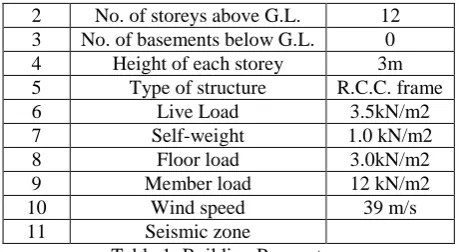
S.No. Description Information
1 Use of building Residential
2 No. of storeys above G.L. 12
3 No. of basements below G.L. 0
4 Height of each storey 3m
5 Type of structure R.C.C. frame
6 Live Load 3.5kN/m2
7 Self-weight 1.0 kN/m2
8 Floor load 3.0kN/m2
9 Member load 12 kN/m2
10 Wind speed 39 m/s
11 Seismic zone
Table 1: Building Parameters
[image:3.595.314.544.66.192.2]B. Structural Data for R.C.C Building 1) Building Plan for R.C.C Structure:
Fig. 2: Plan showing typical floor of R.C.C
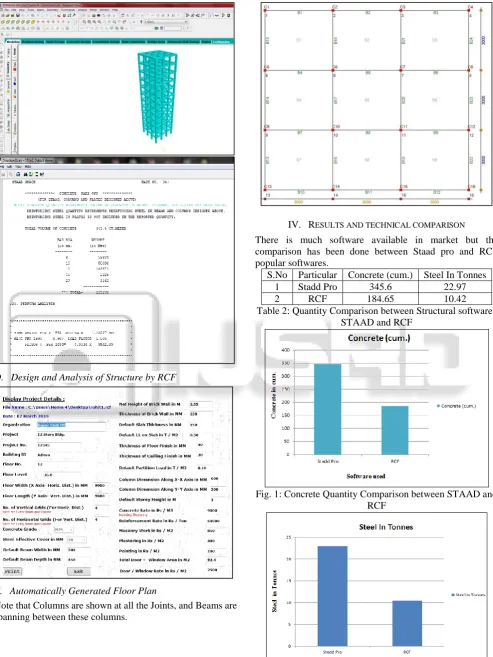
D. Design and Analysis of Structure by RCF
E. Automatically Generated Floor Plan
Note that Columns are shown at all the Joints, and Beams are spanning between these columns.
IV. RESULTS AND TECHNICAL COMPARISON
There is much software available in market but the comparison has been done between Staad pro and RCF popular softwares.
S.No Particular Concrete (cum.) Steel In Tonnes
1 Stadd Pro 345.6 22.97
[image:4.595.51.545.66.724.2]2 RCF 184.65 10.42
Table 2: Quantity Comparison between Structural softwares STAAD and RCF
[image:4.595.306.544.66.280.2]Fig. 1: Concrete Quantity Comparison between STAAD and RCF
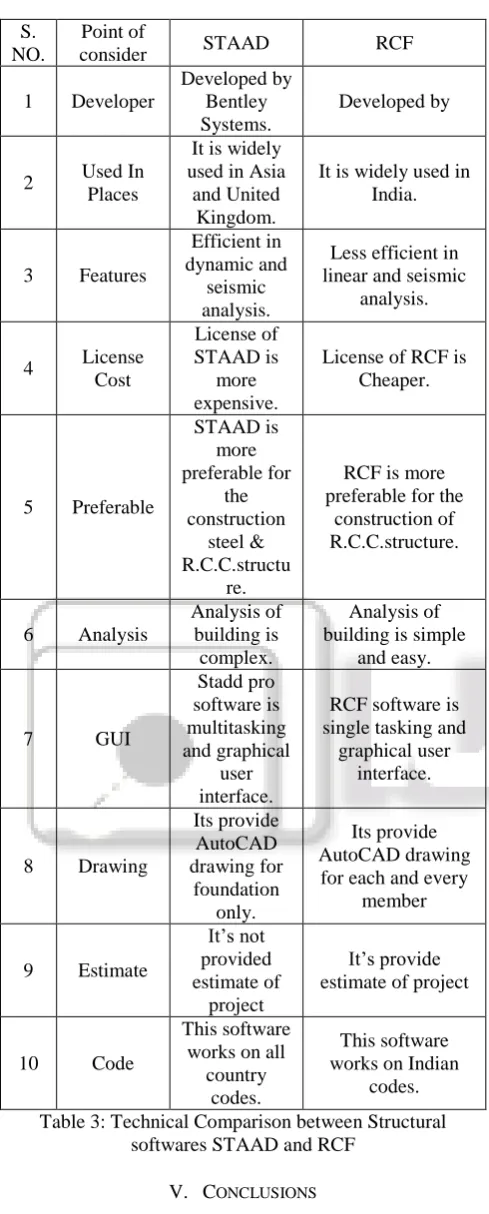
S. NO.
Point of
consider STAAD RCF
1 Developer
Developed by Bentley Systems.
Developed by
2 Used In
Places
It is widely used in Asia
and United Kingdom.
It is widely used in India.
3 Features
Efficient in dynamic and
seismic analysis.
Less efficient in linear and seismic
analysis.
4 License
Cost
License of STAAD is
more expensive.
License of RCF is Cheaper.
5 Preferable
STAAD is more preferable for the construction steel & R.C.C.structu re.
RCF is more preferable for the
construction of R.C.C.structure.
6 Analysis
Analysis of building is
complex.
Analysis of building is simple
and easy.
7 GUI
Stadd pro software is multitasking and graphical user interface.
RCF software is single tasking and
graphical user interface.
8 Drawing
Its provide AutoCAD drawing for foundation only. Its provide AutoCAD drawing for each and every
member
9 Estimate
It’s not provided estimate of
project
It’s provide estimate of project
10 Code
This software works on all
country codes.
This software works on Indian
[image:5.595.45.290.58.666.2]codes.
Table 3: Technical Comparison between Structural softwares STAAD and RCF
V. CONCLUSIONS
1) License of STAAD is more expensive as compare to RCF.
2) STAAD is more preferable for the construction steel & R.C.C.structure. but RCF used for only R.C.C.structure 3) Analysis of building is simple and easy by RCF software. 4) RCF provide AutoCAD drawing for each and every
member also provide estimate of project.
REFERENCES
[1] Renavikar Aniket V.1, Suryawanshi Yogesh2 Comparative Study on Analysis and Cost of R.C.C.and Steel-Composite Structure International Journal of Science and Research (IJSR)ISSN (Online): 2319-7064 Index Copernicus Value (2013): 6.14 | Impact Factor (2015): 6.391
[2] Mr. Nitish A. Mohite1, Mr. P.K.Joshi2, Dr. W. N. Deulkar3 Comparative Analysis of RCC and Steel-Concrete-Composite (B+G+ 11 Storey) Building International Journal of Scientific and Research Publications, Volume 5, Issue 10, October 2015 1 ISSN 2250-3153
[3] Shashikala. Koppad, Dr. S.V.Itti Comparative Study of RCC and Composite Multistoreyed Buildings International Journal of Engineering and Innovative Technology (IJEIT) Volume 3, Issue 5, November 2013 ISSN: 2277-3754 ISO 9001:2008 Certified
[4] A.Sattainathan Sharma*, R. Anjughap Priya, R. Thirugnanam and P. Rathna Priya Comparative Study on Multi-storey Structure of R.C.C and Composite Material Indian Journal of Science and Technology, Vol 9(2), DOI: 10.17485/ijst/2016/v9i2/86363, January 2016 ISSN (Print) : 0974-6846 ISSN (Online) : 0974-5645 [5] Umesh P. Patil1, Suryanarayana M2 Analysis Of G+15
Rcc And Composite Structure Having A Soft Storey At Ground Level By Response Spectrum And Equivalent Static Methods Using Etabs 2013 International Research Journal of Engineering and Technology (IRJET) e-ISSN: 2395 -0056 Volume: 02 Issue: 03 | June-2015 www.irjet.net p-ISSN: 2395-0072
[6] Mohd. Amir Khan Comparative Study of R.C.C & Structural Steel -Concrete Composite Frame for Linear and Non-Linear Analysis International Research Journal of Engineering and Technology (IRJET) e-ISSN: 2395-0056 Volume: 04 Issue: 07 | July -2017 www.irjet.net p-ISSN: 2395-0072
[7] A.S. Boke, 2k. R. Suryawanshi comparative study of r.c.c and steel-concrete composite (g+10) residential building journal of information, knowledge and research in civil engineering Issn: 0975 – 6744| nov 16 to oct 17 | volume 4, issue 2 presented at nc-rdd-ems-2017 on 18/03/2017
[8] S.R.Sutar1, P.M.Kulkarni2 Comparative inelastic analysis of RCC and steel-concrete composite frame IOSR Journal of Mechanical and Civil Engineering (IOSR-JMCE) e-ISSN: 2278-1684,p-ISSN: 2320-334X, Volume 13, Issue 4 Ver. IV (Jul. - Aug. 2016), PP 22-32 [9] Deepak M Jirage, Prof . V.G. Sayagavi, Prof. N.G. Gore Comparative Study of RCC and Composite Multi-storeyed Building International Journal of Scientific Engineering and Applied Science (IJSEAS) - Volume-1, Issue-6, September 2015 ISSN: 2395-3470
[11]Bhavin H. Zaveri 1, Jasmin A. Gadhiya 2, Hitesh K. Dhameliya 3 A Review on the Comparative Study of Steel, RCC and Composite Building International Journal of Innovative Research in Science, Engineering and Technology(A High Impact Factor, Monthly Peer Reviewed Journal) Vol. 5, Issue 1, Januray 2016 ISSN(Online): 2319-8753 ISSN (Print): 2347-6710 [12]K.Mukesh kumar1, H.Sudarsana Rao2 Seismic Analysis
of Composite Structures and its Comparision with RCC Structures IJESC Research Article Volume 6 Issue No. 10
[13]Jadhav Gorakhnath S1 Sutar Shrikant R 2 Bankar Shriprasad v3 “comparative analysis of rcc and steel-concrete composite multistoried building” journal of information, knowledge and research in civil engineering issn: 0975 – 6744| nov 16 to oct 17 | volume 4, issue 2 [14]Mohammed Imran1, Shaik Abdulla2, S.M.Hasmi3