Love and Other Stories
Hedley RobertsINTRODUCTION ... 3
AUTOBIOGRAPHICAL CONTEXT... 4
CREATIVE PRACTICE AND THEORY ... 7
PROFESSIONAL PRACTICE ... 62
CRITICAL REFLECTION ON PROFESSIONAL PRACTICE ... 66
CONCLUSION ... 72
BIBLIOGRAPHY... 75
LIST OF ILLUSTRATIONS ... 81
APPENDIX 2: FILMS FEATURING KISS SCENES ... 97
APPENDIX 3: ARTISTS AS REFERENCED... 99
Introduction
The doctoral programme has supported my transformation from a printmaker and digital media artist to a painter. It has enabled me to revaluate and re-embrace my practice as an artist, and has brought me to a point where I have focus in my practice in terms of concept, media, technique, methodology and professional practice.
My work uses paint and digital media to interrogate the complexity of romantic love and the emotional ‘between-ness’ of relationships. Paint is handled as an expressive, performative medium that aims to capture moments of the artist’s inner dialogue and emotional state. Digital media is used to create moving paintings that meld and conjoin figures to produce troubled, interrupted forms. Oversized watercolour portraits of flirtatious, angry, sad, confused, and unspecified individuals confront us as audience. Images of passionate kisses form psychodramatic landscapes of characters locked in moments of unbridled lust, caring embrace, or dramatic end. Each image is a moment that presages the possibility of tragedy and the loss of the innocent adolescent ideal of the endless embrace.
Autobiographical context
I made a decision to become an artist at 10 years old, after I looking at A Picture History of Art (1979) by Christopher Lloyd. His book introduced me to both art and the erotic by providing me, the prepubescent adolescent, with images of architecture, sculpture and the nude. There were no other books about art in my immediate environment, and the idea of being an artist was unthinkable in my family culture.
30 years later the residual experience of looking at this book continues to have influence both in terms of the material practice of visual research and collage methodology, my use of contextual reference, and my play with the psychological signifiers of implied autobiographical narrative frameworks.
A Picture History of Art functioned as library of images that, as a youth, I ‘surfed’ in a manner that is similar to my visual research methodologies using digital search engines on the worldwide web. The untutored reading of the book allowed me to initialise a joyful, non-hierarchical, un-interpreted experience of art history and provided a contextual framework for my practice and creative methodology. It also provided scenarios for autoerotic fascination and for the development of an internal psychosexual dialogue.
Throughout the 1990s and early 2000s, a postmodern attitude continued to inform my research context and practice methodology through digital imaging, collage, print, psychoanalysis, postmodern theory and cultural studies. Key to my studio research was Lacan’s work on the development of identity, separation anxiety and the construction of ‘libidinal dynamism’ (Lacan, J: 1936) and Winnicott’s theories on the ‘transitional object’ (Winnecott, D: 1953). Theoretically, the work functioned as a model of Lacanian psychoanalysis and as a discourse on the fractured nature of the postmodern identity and the futility inherent in libidinal desire.
started to use computers to make my first digital works, taking the computer into the life drawing room. Printed output was then used to produce screenprints and paintings. In the mid 1990s at the Royal College of Art I digitally appropriated Agostino Carracci erotic engravings as part of a discourse on the hidden currency of erotica in the history of printmaking, using digital technology enable me to discretely transform and reframe their narratives. For example, the characters in Susanna and the Elders [figure 1] were transformed by copying and reflecting Susanna’s face and hair onto one of the Elder characters, re-rendering the scene as a scenario of mirrored identity.
Figure 1: Hedley Roberts (1996), Susannah and the Elders
Screenprint on paper, 120 x 100 cm, UK Private Collection.
Between the late 1990s and early 2000s I worked extensively with digital print, video and performance. I invented character I called
Figure 2: Hedley Roberts (1998), Horsehead Brixton
Digital Print,130 x 70 cm, UK Private Collection
Horsehead [Figure 2] wore a latex sculpture of a horse’s head that had no airvents, and would restrict the wearer’s actions. The Goatfucker
character and scene was a post-modern play on the Pan and Nymph copulating images, ‘erotic’ artworks and engravings and ‘stag’ films. These dark works occupied a intense emotional space and were made as reflection on the masquerades of sexual identity in response to reading
Womanliness as a Masquerade (Riviere, J: 1929)
In 2006, after three years of working on digital network projects and not producing images, I began painting as an antidote to working exclusively with digital technology. In 2007 I joined the Professional Doctorate in Fine Art.
Creative Practice and Theory
Figure 3: Hedley Roberts (2008) A Country Alliance
Oil on Textile, 245x152cm, UK Collection of the Artist
A Country Alliance [Figure 4] represents the first significant work that I made whilst on the doctorate programme. Completed in early 2008, the work consists of a diptych of two 5ft x 4ft paintings. The work operates as a discourse on a relationship, and common with many of my works, arises out of a semi-autobiographical narrative via a complex of references.
I began A Country Alliance when I lived on a country estate in Hampshire. The land was owned by Lord Baring of Baring’s bank, and the house was one of several thatched cottages in a workers village. The farm workers cottages houses were being bought up by and influx of new residents who enjoyed pheasant beating and shooting, keeping their dogs and updating their houses in the country style.
the Glen’ (Landseer: 1851), reputedly Queen Victoria’s favourite painting, which is housed in the Houses of Parliament. Accompanying this is a second panel on William Morris’ Fruit printed textile (reprinted by Sanderson: 2009). The figure is Merle Oberon, appropriated from the 1945 film production of A Song to Remember (Vidor [Dir.]; 1945), where Oberon plays George Sand, the female writer notorious for her wearing of men’s clothes, her mannish ways and unorthodox love life. Merle Oberon was born to a 15-year-old Anglo-Sinhalese mother, and an unknown father (Delofski; 2002) Throughout her life, Merle Oberon’s parentage and ethnicity was hidden, firstly when her Grandmother brought her up as her daughter, and then when Oberon sought to hide the visible qualities of her mixed race through chemical means. Later, after a car accident left her facially scarred, she sought to employ careful lighting to affect her appearance. Indirectly, Oberon’s anxiety about her appearance made a significant contribution to the development of light and filming techniques for cosmetic ‘enhancement’ for media. (Higham & Moseley; 1983)
In its postmodern construction, Countryside Alliance [Figure 4] creates an allegory of masquerade in its use of reference to actors, narratives and characters that have slippery identities in both reality and fiction. Its use of the William Morris textile generates a reference to ‘country’ lifestyle living that is also a slippery and inconsistent status signifier.
At the time, I began to see Barthes fragments as a one sided dialogue with a beloved, and that this had similarities to love songs.
“Throughout any love life, figures occur to the lover without any order, for on the occasion they depend on an (internal or external) accident. Confronting each of these incidents (what “befalls’” him), the amorous subject draws on the reservoir (the thesaurus?) of figures, depending on the needs, the injunctions, or the pleasures of his image repertoire. Each figure explodes, vibrates in and out of itself like a sound severed in any tune – or is repeated to satiety, like the motif of a hovering music. No logic links the figures, determines their contiguity: the figures are non-syntagmatic, non-narrative; they are Erinyes; they stir, collide, subside, return, vanish with no more order than the flight of mosquitoes. Amorous dis-cursus is not dialectical; it turns like a perpetual calendar, an encyclopedia of affective culture.”
Roland Barthes – A lover’s Discourse; Fragments (Barthes; 1977, p9)
In this collection of writings, Barthes attempts to detail, very precisely, an anatomy of love and desire from the perspective of the lover of the beloved. Unrelenting in its analysis of the language of love, Barthes examines such topics as jealously, absence, embarrassment, ravishment, thoughts of suicide, fetishistic behaviour. He considers various love scenes and encounters, and relates the experience of the suffering of passion.
a “mutilated sentence” that functions indicatively. In the case of “Blue Coat and Yellow Vest” the sentence reads
“Any affect provoked or sustained by the clothing which the subject has worn during the amorous encounter, or wears with the intention of seducing the loved object.” (Barthes; 1977)
Barthes has annotated each paragraph with the name of a writer, philosopher, philosophy or friend that has been quoted or referred to. Other than this structuring, each figure is written individually with no particular observation of pattern, length or style. Occasionally they appear to break off, as if the thought was discontinued. In other fragments, the subject text is ruthless in its pursuit of a reading. For example, “I Love You” covers nine pages whilst “Aubade” is a single page. The figures are not in any particular order or classification, and neither is there a narrative to the collective fragments. It does not read as a story of love that can be identified as accompanying a specific relationship or amorous encounter, although on reading it is apparent that these are not observations but experiences.
Barthes text operates laterally and interconnectedly, without specific time or narrative. Each figure or fragment ‘soliloquy’ exists as a discursive ‘site’ for his thoughts and stimulates those of the reader. Barthes texts emerge from the texts of others, equally valuing the expressions of friends and eminent writers and thinkers. His ‘fragments’ are each, in themselves, discussions with his experiences and are informed by the totality of his knowledge and understanding through a wide variety of sources that include the Tao, Sade, Freud, Lacan, Mann, Werther, Sappho, haiku, The Marriage of Figaro, Leibnitz and many others. Barthes aim is for the reader to make the text ‘live’ through the experience of reading these private soliloquies and affirmations via their own subjectivity and personal experience, thereby rendering meaning themselves.
‘write’ or ‘produce’ meaning through the active act of reading, rather than passively consuming authored meaning. “Writerly text is ourselves writing, before the infinite play of the world is traversed, intersected, stopped, plasticized by some singular system (ideology, Genus, Criticism) which reduces the plurality of networks, the infinity of languages”.
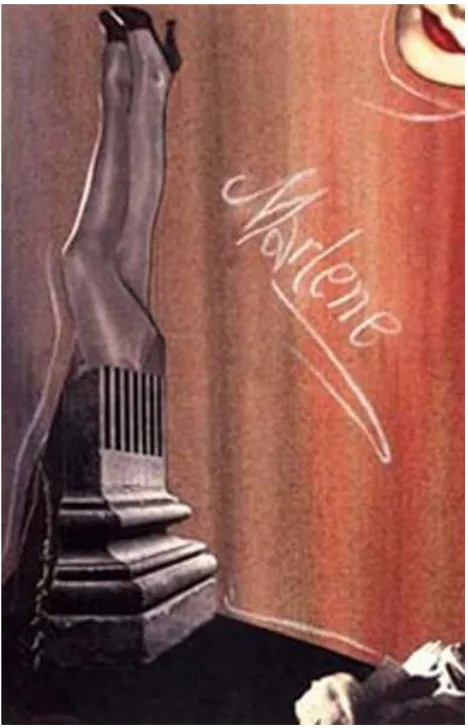
Barthes notion of the “scriptor” as a writer who draws upon all prexisting texts and combining them, intertextually, to create new works has particular significance in relation to my creative practice history and my approach to collage as a method for generating visual practices that explore psychological frames and narratives. The practice of collage is also common to many artists who have influenced my practice over the years.
Figure 4: Hoch Hannah (1930) Marlene, collage, 36.7x24.2cm, Athens; Dakis Joannou
desires and relationships as contextualized by contemporary psychoanalytic thinking dominated by Freud.
[image:13.595.101.497.195.447.2]In my own work, images collected from media, film advertising and personal photographs are used as source material to build complex compositions that obliquely intimate an autobiography.
Figure 5: Left: La Belle et La Bête, (1946) film still, Jean Cocteau (Dir)
Figure 6:Right: Hedley Roberts (2008) La Belle Bête, Digital Sketch. UK Collection of the Artist.
Figure 7: Roberts. H (2008) La Belle Bête (A Mad Shadow)
Oil on Panel, 100cm diameter. UK; Collection of the Artist
giving opportunities for the conceptual approach of applying the colour values of a historical painting over ones own work.
Despite the flexibility of the digital medium for planning and execution, the visual synthesis stages of creative process remain largely intuitive. I immerse myself in a landscape of images, texts, narratives, sound, music, and thoughts. These items are collected in a haphazard ‘magpie’ fashion, without attempt at an ordered ‘body’. Images are tried, tested, reimaged, sometimes once or twice, sometimes hundreds of times until they are unrecognisable from the original sources. Usually it is the introduction of an unexpected element into this landscape of images that figures and forms the opportunity for the first ideas. In this sense, the chaos of my digital files and semantic searches function like the floor of Francis Bacon’s studio where images are randomly juxtaposed to create opportunities for new combinations. (Peppiatt; 2012)
Figure 8: Hedley Roberts (2008) Visual Research
For example, the three images above were selected from a body of visual research into the pinafore dress that featured around 200 images. The image on the left arrived very early on in the process. I was particularly interested in the pose and the way that the crossed legs looked. However the work was not conceived until I found the image in the centre and on the right. These images are of the ‘Dolly’ sisters, stars of the vaudeville stages and early cinema, who were both the lover of the retail magnate Harry Gordon Selfridge (Chapman; 2006). These images were composited, with several others to make the work Suspended, Void
Figure 9: Hedley Roberts (2008) Suspended, Void
Acrylic on Canvas, 140 x 100cm. UK Collection of the Artist
palette, the learning of new software, the forgotten ‘inspirations’, the narrative stories that fill my head when I’m painting, or the music that I listen to. In the visual research process this unavailable energy is in the 1000s of images collected that inform the coalesces of ideas, in the digital processes it is within the photo montages and sketches that are obliterated by changes, alterations and deletions, and it is also in the process of abandonment, where the idea ceases to have momentum. In my watercolour on gesso works, this process has can be found in the technique of washing, ‘lifting’ and removal of pigment from the image to reveal the base support or staining. In my most recent oil paintings it can be found in the scrubbing out or obliteration of the previous layer of image, or in the drips that run away from the image, or in the painting that is abandoned unresolved. All these are essential to the system of creative production, but are dispelled during the process, and may not be evident in the finality of the outcome.
I conceive of my image making practice as a form of psychodynamic psychotherapy that allows me to work through psychodramatic scenarios and emotional landscapes as a method that enables to be to imagine and create scenes of a semi-autobiographical or biographical nature. This process forms structures that are drawn from my psychological landscape, but realised as fictions. Much of this work is contextualised by psychoanalytical theory, and in particular the ideas around twinning, conjoinment, mirroring, otherness, reflection are influenced by Lacan’s Mirror stage. In the ‘Mirror Stage’, the infant child is able to recognise a specular image of itself in the mirror, but as yet is not fully able to co-ordinate it’s movement and therefore perceives it’s self as a fragmented ‘other’, leading rivalry and tension between the subject and the other. When the misrecognition of the image as the self occurs this creates an ‘imaginary order’. The infant then turns towards the omnipresent maternal figure for assurance of it’s own precarious self mastery, thereby ‘calling upon’ the symbolic order.
collaboration, where two artists attempt to ‘fuse’ together different practices without working together, side by side on developing the same body of work. The themes of conjoinment, twinning and merging we present in both of our works, and these became key concepts.
Figure 10: Roberts, H & Mooney , S (2008) Conjoin:me
promotional image. Japan; Klein Dytham
the practice, Sian was largely responsible for the 3D forms, and I developed the 2D using printed textiles as a substrate for ‘trompe l’oeil’ paintings that negotiated the patterns and forms. Material sources for the collage continued to be films and photographs from 1940s Hollywood cinema, as a visual signifier of ‘romance’ that was utilized as a method for disarming the viewer gaze on the abhorrent quality of the conjoined forms.
Figure 11: Photo Mari, M (2008)
Roberts, H & Mooney , S (2008) Conjoin:me
In total we produced four large-scale works for an installed, site-specific show that used live models, animated backdrops and audio soundscapes.
Throughout the 2009-11 period, Roland Barthes A Lovers Discourse
Figure 12: Hedley Roberts (2010) The Everafter Series (reflections, red hair)
Watercolour on Paper, 152 x 124 cm. UK; Private Collection
In The Everafter Series [Figure 13-15], I began working with notions of masculinity and anxiety. This work revisited my undergraduate engagements with Judith Butler’s ideas around the ‘performative nature of gender identity’ and in particular the idea that “Gender is an identity tenuously constituted in time, instituted in an exterior space through a stylised repetition of acts.” (Butler; 1993) This, coupled with the intertextual method negotiated via Barthes provided a playful site for emotive performance and contemplative subjectivity.
John Huston’s 1967 film Reflections in a Golden Eye starring Marlon Brando and Liz Taylor. (Huston [Dir.]; 1967) This film tells the story of a relationship between a repressed homosexual military man and his wife. Each of these narratives considers the tension created by ‘expected’ performances of traditional roles.
Figure 13: Hedley Roberts (2010) The Everafter Series (reflections, golden eye)
Figure 14: Hedley Roberts (2010). The Everafter Series (reflections, come hither)
Watercolour on Paper, 152 x 124 cm. UK; Private Collection
The EverAfter Series of the 2009-10 period featured significant concentration on materials and methodologies. Through the making of these works I became increasingly interested in the qualities of the brush marks themselves, and in a search for more ‘painterly’ expressive marks. I began to use the qualities of the ground, the under-painting, the glazes and the impasto to inform the image, varying the pace and energy of application to examine how this transforms the visual ‘flow’ in the image.
Marlene Dumas, Paul P and Mamma Andersson In 2010-11, I further expanded this group of artists to include Gavin Nolan, Adrian Ghenie, Mercedes Helwin, Eric White, Ling Jian, Wilhelm Sasnal, Alexander Tinei, Simone Haack, Phillip Jones, Richard Wathen and Dan Coombes.
Figure 15: Left: Alexander Tinei, . (2011) White skin. Oil on canvas. 100 x 70 cm Figure 16: Right , Simone Haack. (2011) Heavenly Creatures, oil on canvas, 170 x 140 cm
Common to the practice of these artists is a visceral, corporeal use of the painting medium as a language within the image making. Each of these artists uses the viscosity of paint and the medium on the substrate to evidence the painterly quality of their works. Throughout, each of these artists engages a dialogue with painting as discourse, generating tensions between the illusory, mimetic potential of the medium and the physical material qualities to elucidate the tension between the inner world of the artist and the outer reality that the work exists within.
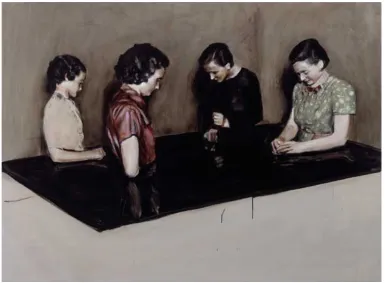
Figure 17: Michaël Borremans (2003) Four Fairies, oil on canvas, 110 x 150 cm David Zwirner Gallery
“I try to show figures—I don’t want to use the word “individuals”; they’re not individuals. I try to place them in a space that is familiar yet undefined. It’s very strange. I used to make images that were based on photographs from the 1930s or ’40s, but that was too recognizable. I heard that the work was nostalgic, and that was absolutely not the idea. So I try to avoid that, and now I usually work with models who pose for me. I have a room in my studio where I photograph them. It’s a room that’s anonymous, with a certain light—I call it my “Earth Light Room,” like in the spaceship in 2001: A Space Odyssey, where they have an “Earth Light Room,” whatever that might be. So it’s an artificial environment.” (Borremans; 2008)
that he creates. Ann Demeester, Director of De Appel, Amsterdam calls Borremans films ‘moving paintings’, referring to the scenes as “images that are content with remaining unrevealed, pleased with speaking in tongues without being fully understood.” (Demeester, Gioni, Michaud; 2008) Phillipe-Alain Michaud, Film Curator at the Musée national d'art moderne-Centre Georges-Pompidou speaks of Borremans films in relation to the act of painting and the material conjuring that occurs in the creation process, “If Borremans’ films are effectuated paintings, this picture [The Performance, 2002], may be the matrix of this transubstantiation, a painting of a painting: a representation of the white canvas of the screen, out of which rise impalpable effigies, like dead people emerging from their shrouds and transformed into pure appearance.” (Demeester, Gioni, Michaud; 2008, p15)
Figure 19: Michael Borremans. (2005) "Weight, video installation, Berlin Biennale 2006
Photo: Oliver Hartung (2006) for The New York Times
Borremans practice has enabled me to consider my own use of film in to make ‘moving pictures’, narrative structures in painting composition, and the notion of the ‘painting’ as a ‘space’ that is between the inner and outer dialogue that the artist has with the world.
Figure 20: Hedley Roberts (2011) AVA Galleries, London
my original reference A Picture History of Art (Lloyd; 1979). The artists listed have been discussed in tutorials and seminars in relation to my practice. This has been especially helpful in facilitating analysis of the material approach to making, and in particular to the phenomenological experience of ‘painting’. It has also assisted in identifying the functional operation of the material qualities within the frame of the illusionistic narrative ‘genre’ painting which characterizes the majority of painters listed, verses the non-illusionistic, ‘abstract’, ‘expressive’ methodologies identified in the work of the same artists, but most explicit in the work of artists like Cecily Brown or Adrian Ghenie, and to a lesser extent in passages of Michael Borremans works. Analysis of the practice of these artists and their own references and influences have impacted on my own working methodologies, for instance, Borremans references to Velazquez’s use of long handled brushes caused me to research both Velazquez’s methods, and led to me making my own long handled brushes. I also began to look at ways of creating time constraints for the production of each work. Whilst working on The EverAfter Series I was influenced by the practice of Luc Tuymans (Birnbaum & Tuymans; 1998) and Wilhelm Sasnal, (Wilmes; 2012) both of whom aim to make a painting in a single day. I began to give myself working period of two separate five hour blocks to complete each work. The immediacy of this timed approach led to a systhesis of both planning and chance that presented a the vitality that I was seeking.
almost classical vein: composition, figuration, use of light. On the other hand, I do not refrain from resorting to all kinds of idioms, such as the surrealist principle of association or the abstract experiments which foreground texture and surface. If the distribution of elements is precisely premeditated, paint is nonetheless applied freely, with unbridled gestures. The oil paint medium triggers a range of technical possibilities, which I am committed to explore in various combinations. For example, I mix various colors on a trowel and I apply it directly onto the canvas. Then I wipe it off with something else. Quite often I paint with a house-painter’s brush. I’m interested to see the outcome of such exercises.” (Magda; 2009).
Figure 21: Adrian Ghenie, (2008) Pie Fight Study, location unknown.
artist (and the viewer) being ‘in’ and ‘of’ the world. The physicality and psychology of this is familiar to Merleau-Ponty’s notion of ‘embodiment’. (Merleau-Ponty; 1964) This embodiment occurs in the interrelationship between artist, intention, the physical material, the psychology of the artist and ultimately the culture, psychology and experience of the viewer. “the painter can do no more than construct an image; he must wait for this image to come to life for other people. When it does, the work of art will have united these separate lives; it will no longer exist in one of them like a stubborn dream…it will dwell undivided in several minds’ (Merleau-Ponty; 1964, p70)
Figure 22: Hedley Roberts (2009) Self Portrait as a Dead Twin
Digital Video Loop, Dimensions Variable. UK; Collection of the Artist.
Figure 23: L’Eclisse, (1992) Film Still,Antonioni (Dir)
Prendeville explains that in Merleau-Ponty’s later works, “individuals are not defined as self-enclosed entities, but mediately or dividedly, as ‘seeing-seen’; there is a ‘fundamental narcissism in all vision’.” This thinking, this work, and this phrasing echo my other references to the Lacanian mirror-stage and the Oedipal complex.
Figure 24: Reneé Magritte (1928) The Lovers oil on canvas. 54.2 x 73 cm. Private collection
In Magritte’s subsequent painting of the unrequited lovers kiss, the shrouding of the faces of the lovers can be read metonymically, as a psychodrama of his own transitional subjectivity. Lacanian analysis might lead us to a post-oedipal psychoanalytical interpretation of this work, where Magritte identifies the desire for symbolic unification with the other in Romantic Love restrained by an external force.
Whilst Magritte’s representational style functions very differently to that of Borremans or Ghenie’s, in that it does not obviously engage with the material of the paint as a method for debating the ‘place of exchange’ that blends our Being between ‘inner’ and ‘outer’ experience, there is a similar thread of intentionality. Magritte’s painting offers the same opportunity to reflect on where the blending and ‘back-crossing’ (Prendeville; 1999) occurs between two consciousnesses or two bodies. Operating in a way that is similar to the scene in Antonio’s narcissistic mirror refection, it asks us to be in the experience in the space between, and to find ourselves disappointed, annihilated, unable and without satisfaction.
composition through psychology, particularly in the ‘centers as dividers’ chapter, where he discusses the ‘bipolar’ compositional device as a method for creating tension. Anheim’s method of analysis underpinned the compositional structures in the Everafter Series of paintings.
Figure 25: The Razor’s Edge, (1946) Film Still, Edmund Goulding (Dir)
Figure 26: Hedley Roberts (2009) The Razor’s Edge
Digital Video Loop, Dimensions Variable
In 2009, I reintroduced time-based media into my practice as a method for examining the moment of fusion, crossing, blending. This recourse evolved out of a desire to make ‘moving paintings” as a method for capturing a kind of internal transformation in process.
Digital Video Loop, Dimensions Variable
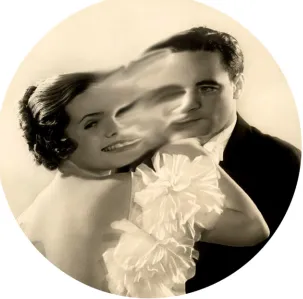
Irreconcilable Difference [Figure 27] makes oblique reference to Aristophanes Speech from Plato’s Symposium (Plato; 380BC). In this narrative, Aristophanes tells the story of how primeval beings were not separated into two sexes, but were one “being”. In the narrative Zeus lays retribution on the beings for an act of hubris towards the gods, and separates them into two parts, doomed to search for each other. Two separate figure forms (sisters) attempt to ‘conjoin’ through surreal ‘morphing’ with the aim of becoming a single unified figure, but ultimately fail, only to return to two figures and then to repeat the same pattern. The work is presented as a circular digital video projection in a ‘black box’ space. The image is projected as a continuous video loop that cycles through the transformation and then reverses.
Figure 28: Botticelli (1487) Madonna della Melagrana,
Tempera on Canvas, 43.5 cm diameter, Uffizi Gallery, Florence .
Figure 29: Hedley Roberts (2010) A Beautiful Wedding,
Digital Video Loop, Dimensions Variable. UK; Collection of the Artist.
In making the work in the circular motif, I was conscious of how the characters should be ‘looking out’ of the framed composition. My intention was to imply that they although they might initially seem to be looking out to the viewer through a window, or mirror into the viewers dimension, they are clearly in another dimension. In using this thematic device, I am reiterating the mirror theme through the use of the tondo framing device often used for either painting or mirror. (Olson; 1993) and continuing with the theme of previous double portrait works that made reference to Lacan’s work on the mirror stage of psychological development. (Lacan; 1977),
filled by the other, to be the other, which is why no determinate thing will do. It demands a love that paradoxically entails it’s own annihilation, for it demands a fullness of the other to stop up the lack that conditions it as a subject.” (Surup; 1992). In this Lacanian reading, their ‘idealized’ unification of the two figures into a single mature ‘mother’ figure can be read as an unsatisfactory attempt to resolve the trauma of existence.
My initial attention in the making of this work, was primarily the psychodrama of the composition. However, in the process of transformation through morphing, the forms have to go through stages of figuration where the structure and form dissolves and dissipates before it becomes the new figure. This process creates a tension between the definition of the structured form (the identifiable figure) disintegrative process that increasingly becomes chaotic and more abstract in it’s journey before new structures start to emerge in the transformation to a new form. A technological process in animation called ‘tweening’ generates this process. Put simply, in traditional animation, ‘tweening’ or ‘inbetweening’ is the digital generation of intermediate frames between key frames that generate the impression of movement. In Irreconcilable Difference and other animated works I have used this process in combination with other digital tools that enable the pixel data to be manipulated. The terminology for this process uses metaphor of “liquefied paint”. Mimetically speaking, the viscous membrane (pixels) of the image can be dragged, expanded, compressed, pulled, pinched, and twisted as well as copied, repeated, manipulated and transformed. This process is used to transform the images at key frames in the timeline of the work, the ‘inbetweening’ process is then used to auto-generate the intermediate frames. This generative process is used in a methodology that might be analogous to the smearing, wiping back and dilution of a painted image using turpentine or other solvent, or to the drawing process where an image is made, and rubbed out and made again with the residue of the history of the corrections.
From an initial state of conjoin-ment, the two figures in
begin in a state of ‘trauma’ and seek ‘unification’ into a singular whole, and yet always having to return to repeat the futile exercise. In this sense the work is a discourse on the perpetual state of paradoxical ‘desiring’ that Lacan’s mirror stage refers to. The figures seek to complete the cycle in their search for ultimate loving by absorption into the maternal figure, but realize that annihilation is the outcome of that scenario, and so they therefore recoil.
In Irreconcilable Difference, the originating image is a digital collage that has been composited from the component parts of a family portrait photograph given to me when I made a call for ‘friend’s family photographs’ that expressed a ‘loving relationship’ that I would then ‘read’ and interpret. The ‘beginning’ image was composited from a photographic portrait of two sisters. In the still composition that begins the work, the two faces are conjoined in a manner that suggests what might be read as a portrait of the psychological condition of their relationship. However, this work is does not function as a biographical illustration of their relationship, as this is not known to me. Therefore, the transformation that I have performed on this image is, in fact an interpretive representation of my reading of their relationship from the image and my own psychological and cultural experiences, and therefore can more properly be understood as an semi-autobiographical work because it conveys as much about the artist as it does the sitter.
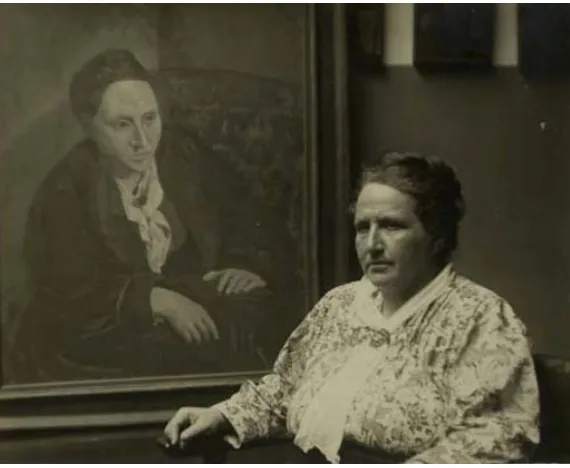
for the gaze in the field of the Other.” (Lubar; 1997) This understanding of the relationship between ‘sitter’ and the gaze is important within the context of my own ‘portraits’. The narrative of the young Picasso’s tense relationship with his powerful subject and the resultant ‘portrait’ is a model for understanding the process by which my own figurative compositions depart from mimesis, even though they are often sourced from photographs.
Figure 30: Man Ray (1922) [Gertrude Stein with Picasso’s portrait of Getrude Stein]
Figure 31: Hedley Roberts (2010) Applegraft
[image:41.595.114.484.488.715.2]AppleGraft [Figure 31] is a 7-minute film loop work that has been created using technological and methodological processes similar to
Irreconcilable Difference, and the work continues to interrogate the similar themes using similar formal and referential devices. Again, the work features two siblings being consumed into one single figure across time inside a tondo composition. However, in this work, there is a central ‘apple’ that is consumed into the belly of the final figure. The symbolic significance of this image makes reference to the biblical narrative of the ‘Fall’ of human kind from god’s grace. In the work, the two siblings appear as child/women chimeras. They are clothed in pinafore dresses that intentionally reference a previous generational ‘Sunday best’ outfit that might have been worn but my parent’s generation. In using this period of historical reference to the typical ‘best’ dress of late 1940s or early 1950s, I am referring to the period that my mother may have grown up in. The figures themselves, are ‘digital paintings’. Although they have been sourced, in part, from Harpers Bazaar images of that period (Harpers; 1945-7), they have been composited, mutated and transformed beyond any recognizable source image. Autobiographically speaking, both of these characters psychologically refer to a fantasy ‘imago’ of the mother, that only exists in my psychic memory. In this ‘memory’, this maternal character is a woman child. In the work, this character is represented as two figures and can be interpreted through Lacanian analysis as a representation of the ‘subject’ and the ‘other’ in conflict in the mirror phase where “The child sees itself in the mirror, but the image is reversed. Identity is a mere outer skin that constantly distorts one’s relations with others. When the fragmented body gives way to the armour of the subject – and to it’s identity, already alienating by definition – the ‘ego’ is formed. (Sarup; 1992, p.65).
identity. The whole composition itself is a discourse on the psychological conditions within an enterprise of socio-economic love. The mutations that the figures undergo during the transformation towards in the aspiration for stylized ‘beautiful’ romantic form are hideously ugly. They occur very slowly, subtly and continuously across the image. In watching them, it is impossible to track them all at once, and yet collectively they gravitate towards a smooth flowing romantic figuration. In this figuration I am making subtle reference to the society portraits of Thomas Gainsborough or John Singer-Sergeant to refer to the social mobility ambitions of my own parent-figure. In the final instance the single figure has annihilated the multifaceted personalities of the complex youths and absorbed the symbolic apple that represents the fall from naive grace, and is once again, unresolved in the final instance of the cycle because a compositional red line continues to separate the two haves of the figure leaving it to remain fractured and in danger of unravelling at any given moment.
Shortly after the EverAfter Series and the circular formatted time based works, I began to work more extensively in watercolour on paper and on gessoed panel. The 2009 EverAfter Series represented a turning point with a change of medium to watercolour on paper. Understanding the material and physical properties of the watercolour is imperative to success in using the medium. I began by examining the properties of different manufacturers products and the history and recipes for making watercolour via writings and research by the Art Historian, Nicola Moorby, a specialist on watercolour and, in particular, Turner. In her role as Tate Britain Curator of the ‘Watercolour’ exhibition, Moorby writes that the “water component of watercolour means that it is much trickier to use without some knowledge and anticipation of it’s physical characteristics…It is difficult to correct or hide mistakes, and virtually impossible to replicate effects in the same manner.” (Smith [ed]; 2011, p23)
materials to soak in. In trials, I found that the highly polished surface could initially resist watercolour pigment when suspended with high water content. The painting material could then be made fluid on the surface, allowing for a temporary period of working of the puddles of liquid. These properties are very different to those of paper, which will absorb almost instantly, even when heavily sized. When worked flat on the floor, these qualities enabled me to use the viscous drag of the material to move or ‘pool’ watercolour material of high or low pigment content on the polished surface. The material would suspend for a few moments and then absorb into the substrate. Subsequent layers would operate as glazes, but could also be manipulated more boldly to work the gesso chalk / glue into the material of the watercolour, rendering it more opaque into a material that has properties similar to gouache.
Figure 32: Hedley Roberts (2010) Arguments; Pulling You Away From Me (detail) Watercolour on Gesso Panel, 80 x 80 cm. UK Private Collection
psychological dimension that operated in a similar way to the time based works. “Supernova 1006; I remember you” [Figure 33] was the first of these works, executed on the largest commercially available single sheet paper, arches 60 x 48 inches. The scale itself worked to enable the image to emerge, as I was working in a very physical way with the work. It was made on the floor, and I was using large brushes, mops and homemade tools to obliterate the image after I’d painted the figurative sections.
Figure 33: Hedley Roberts (2010) Supernova 1006; I Remember You (detail) Watercolour on Gesso Panel, 110 x 90 cm. UK; Collection of the Artist
Figure 34: Hedley Roberts (2010) Sirius; The Teary Eyed Breaking Heart
Watercolour on Gesso Panel, 80 x 80 cm. UK; Private Collection
Figure 35: Hedley Roberts (2010) Arguments; Pulling You Away From Me Watercolour on Gesso Panel, 80 x 80 cm. UK; Private Collection
Arguments; Pulling You Away From Me [Figure 35] also uses the morphing technique to blend the two figures that might be twins, siblings or a narcissistic mirrored relection. In this work the faces have been painted and the wiped out, their defining features obliterated to create a sense of blended lost identity.
Figure 36: Hedley Roberts (2011) Alpha Centauri; So Close You Burn
Watercolour on Gesso Panel, 50 x 50 cm. UK Private Collection
Figure 37: Hedley Roberts (2011) Sometimes I think You’ll Never Leave
Digital Video Loop, Dimensions Variable. UK Collection of the Artist
have made the small watercolour paintings directly observed from the screen of digitally manipulated images. In these kiss paintings I used watercolour in a very traditional way, observing the conventions of controlled watercolour studies. The language of this method refers to many of the tropes and tautologies used in ‘appreciating’ watercolour painting as referred to by Alison Smith in “Watercolour”, the 2011 catalogue accompanying the Tate Britain show of the same name. (Smith; 2011). In her introductory text, Smith refers to “the way we tend to view watercolour through Romantic naturalism, which forms the conventional history of the subject in Britain, as represented by the abstract and expressive art of painters such as Francis Towne, Thomas Girtin, John Sell Cotman and Turner…” “…as a fundamentally Modernist understanding in asserting that the essence of the medium lends it a specific identity.” In
Sometimes I think you’ll never leave I am countering what Smith refers to as the romantic, Modernist “truth to materials” by my own use of watercolour as a media reference in a work that is a digital simulacrum of the fluidity of watercolour. Sometimes I think you’ll never leave is an animated, time based piece that uses the ‘liquefied paint’ process metonymical methodology of “Irreconcilable Difference” to simulate the viscous qualities of the flow, flooding and saturation of watercolour pigment transparency and transference, glaze and liquidity. In functioning as an indexical sign for the time process that is lost within the physical painting process, the work metonymically speaks of the in-authenticity of the digital medium, and also of the inevitable failure of the kiss to solicit both oneness whilst still maintaining separate identity.
oral eroticism. This involved the work of Freud and his contemporaries on the development of sexuality, and kissing as the relatively late development phase in sexuality. This research led me to Adam Phillips’ book, “On Kissing, Tickling, and Being Bored”. (Phillips; 1993) In the chapter “Plotting for Kisses”, Phillips tells a story of a eight year old girl telling him in a session “how much she loves being in the countryside on holiday. I ask what she likes doing there and she replies, with a kind of blithe indifference, ‘Oh, sometimes I just go out looking … for cows, birds, kisses, things like that.’ ‘Kisses?’ I ask. ‘You know, lovers … I hate it when people kiss, their mouths get muddled up.’” This ‘muddling’ enables Phillips to identify that the kiss has a ‘mutuality that blurs the distinction between giving and receiving” in reference to the possibility of the kissing act as a non-gender specific, offering possibilities of penetrative interaction and exchange that is not bound by the obvious physiological properties of opposite sex couplings.
Figure 38: Hedley Roberts (2011) AVA Gallery Installation
personality of the child when faced with the withdrawal of the maternal bosom. (Ferenczi; 1933) Phillips goes on to note that children retain an intense curiosity about kissing, and write that the “commonest infantile sexual theories that babies are conceived by kissing is anatomically inaccurate but suggestive and metonymically correct”. He goes on to identify that, from a psychoanalytical point of view, “the kiss is a revealing sequence containing a personal history. The way a person kisses and like to be kissed shows in condensed form something about a persons character.” The ‘muddling up’ of the kiss, as observed by the eight year old child in Phillips’ narrative precisely captures the Freudian theory of the kiss as a ‘normal perversion’ of the sexual act. “Even a kiss an be described as a perverse act, since it consists in the bringing together of two oral erotogenic zones instead of the genitals. Yet no one rejects it as perverse; on the contrary it is permitted in theatrical performances as a softened hint at the sexual act.” Phillips goes on in his analysis of Freud’s work on kissing to hypothesize that for Freud, kissing confirmed “his sense of the narcissistic intent, the grudge at the root of sexuality: a grudge that is to say, contingent upon the cumulative trauma that is human development. Desire, he wants us to know, is always in excess of the objects capacity to satisfy it.”
Picture Association of America film rating system. The production code had two sections, the first outlined a set of "general principles" which concerned morality. The second featured a set of "particular applications", which included an exacting list of items that could not be depicted. In section of the ‘Hays’ code on sex (2.2.b) , it states that “Excessive and lustful kissing, lustful embraces, suggestive postures and gestures, are not to be shown.” Williams refers specifically to the practice of ‘interruptum’ to comply with the code. In response directors used symbolism to comply, but still maintain the erotic narrative. Strategies and devices employed including cutting the tryst partway through, but implying continuation ‘offscene’. Common signifiers in the following scenes would include typical tropes of; entwined clothes on the floor, two abandoned half champagne glasses on a table, a half finished cigarette smoking in the ashtray.
The pervasiveness of this tendency to imagine the spectacle of ones own kissing experience within the verisimilitude of the Hollywood kiss can be seen in the social media culture of self-publishing, for example;
http://fuckyeahkissing.tumblr.com/. (fuckyeahkissing; 2009) The owners of this tumblr blog only post submissions sent by readers of the blog. This blog is typical of the current generation of bloggers who actively submit images of themselves to amateur community blogsites requests. Many of these sites feature ‘self shooters’ who pose provocatively in the mirror for their mobile phone camera, or the self shooting technique of extending the arm to gain a focal length sufficient enough to frame oneself kissing a partner within the gaze of the camera. Oliver Mannion analyses Facebook via Lacan, providing a useful interpretation of this social media phenomenon of ‘self shooting’. “For Zizek, cinema is the art of appearance that shows us how reality constitutes itself. Facebook is the art of the ego, which shows us how we construe our identities and relate to others.” (Mannion; 2011)
‘romantic love’. Through this analysis, Brown considers Sartre’s existentialist criticism of ‘romantic love’ as an act of ‘bad faith’ and ultimately inauthentic. (Satre; 1958) She links Sartre to a view shared, in part by Lacan in his critical analysis of the human condition as one of alienation and misrecognitions, and ‘need minus demand’ (Lacan; 1977)
In examining the kiss image and iconography, I also considered the formal compositional values of the framed shot at the kiss moment in cinema. Through visual analysis of film stills, I noted that these scenes would often use a formal heart shaped compositional motif to frame the kiss scene. The ‘heart’ is composed through both the gaze of the lens and through the juxtaposition of the faces and limbs in the kiss itself. The ‘in profile’ framing of the two heads that form the upper hemispheres of the heart shape more usually forms the ‘heart’ of this kiss, and the hands of one or both of the kiss participants reaching up to the others face will usually form the lower ‘V’ shape of the composition. The symbolism of this ‘heart shaped’ compositional device seems to be obvious in the majority of images, and yet I have not found a theoretical discourse that analyses the persistence of the formal aspects of composition within this visual language.
Figure 39: Hedley Roberts (2011) The Scent of the moment Never Lingers Long Enough to Forget Watercolour on Paper, 60 x 48 inches. Germany: Private Collection
action and my own psychodynamic flow was firmly embodied within the active transmission and reception of the painting process and my inner dialogue and personal storytelling had synergies with the image portrayed.
Figure 40: Hedley Roberts (2011) The Last Kiss You Never Gave
Watercolour on Paper, 60 x 48 inches. UK; Collection of the Artist
damar varnish, different oils and various solvents, and settled on a combination of liquin, damar varnish, linseed oil, zest-it solvent and turpentine. (Mayer; 1991, Zest-it; 2012)
Figure 41: Hedley Roberts (2012) I’m Just Not Here Anymore
Oil on Gesso Panel, 48 x 48 inches, UK; Collection of the Artist.
Figure 42: Hedley Roberts (2012) The End, Reflected in a Golden Eye
Oil on Gesso Panel, 48 x 48 inches. UK; Collection of the Artist
figure on the right, however, is looking out, disconnected from the scene of the kiss. In viewing this figure we are aware of some unknown internal dialogue taking place within this character. The work makes oblique references to Picasso’s 1969 kiss paintings [Figure 51] and his 1937 painting Weeping Woman [Figure 52] In Weeping Woman, the younger Picasso is the artist observing the woman weeping, in the Kiss paintings Picasso is in the scene as the artist engaged in a slightly detached kiss with a much younger model. The End, Reflected in a Golden Eye refers to Huston’s film, but also to Picasso’s paintings. The weeping of the dripping painted material in The End, Reflected in a Golden are the tears, and the eye looking out from the merged form is that of the subject considering his own mortality in the moment.
Figure 43: Hedley Roberts (2012) The Dream of De Beauvior Square
The Dream of De Beauvior Square [Figure 43] also portrays an emotional scene of two characters in embrace, possibly in bed. Rendered in both dark and light, heavy and thin, the figures are deliberately different and in opposition. The compostion of the two figures uses a device that enables them to share the same shoulder form, enabling the figures to be compacted into a tighter frame and closer connection. The large dark section to the bottom right of the image frames the faces, pushing them up into the top third, which allows the characters to face in different directions without forcing them apart. The aim of this work was to create a scene in which the two charcaters were separate, in their own internal worlds, but inside these personal spaces there might be the possiblity that would connect functioning as a yin and yang within the composition, both necessary to complete the other.
Figure 44: Hedley Roberts (2012) The Blue Collar
The Blue Collar [Figure 44], in contrast to I’m Just Not Here Anymore, is an attempt to explore the emotional intensity of a desire imagined in the darkness. The paint is brushed into the image in a gestural manner that reveals the figures out of the darkness. The blue collar functions as a compositional anchor that locates the solid form of the male figure into the form of the square canvas, enabling the female figure to be a suspended from in space fixed only by the kiss of the male. This work informed by several private autobiographical narrative threads can be captured in Barthes figure “Sobria Ebrietas: vouloir-saisir: the “will-to-possess”. “Realizing that the difficulties of the amorous relationship originate in his ceaseless desire to appropriate the loved being in one way or another, the subject decides to abandon henceforth all "will-to-possess" in his regard.” (Barthes; 1977, p232) In this, the figure of the beloved, potentially weightless, only connected by the fixidity of the kiss and the application of the painted material that attempts to weigh down without suppression.
The work undertaken at Artoll, Germany in March 2012 represents the most recent work at the time of writing. Works like The End, Reflected in a Golden Eye, I’m Just Not Here Anymore, The Blue Collar
and The Dream of De Beauvior Square are ‘gateway’ works that indicate the potential future route for my practice into a darker, more challenging space where the painfulness of emotional relationships can be considered.
Professional Practice
Joint Exhibitions
2008, Conjoin:me, Super Deluxe Gallery, Tokyo, Japan
Collaborative project with Sian-Kate Mooney. Installation of Art-Fashion Sculptures, digital projections and soundscapes.
2012, East is East, Annexe Gallery, Kuala Lumpur (curator)
Showcase of UEL staff and students art and design work. Work exhibited: digital textile print on silk. Exhibition Project conceived, managed and curated by Hedley Roberts
2012, East is East, CDS Gallery, NAFA, Singapore (curator)
Showcase of UEL staff and students art and design work. Work exhibited: digital textile print on silk. Exhibition Project conceived, managed and curated by Hedley Roberts
2012, Directional Forces 2012, Artoll, Germany (curator)
Residency of UEL Doctorate in Fine Art students and international artists. Residency and Exhibition Project conceived, managed and curated by Hedley Roberts
2008, UEL Digital Art and Moving Image Showcase, Trinity Buoy Wharf, London, UK
Selected Exhibitions
2010, Loop Extra, Edinburgh Festival, Scotland
Film Festival. Work exhibited: Sometimes I think You’ll Never Leave. Film Loop
2010, Loop, Barcelona, Spain
Film Festival. Work exhibited: Sometimes I think You’ll Never Leave. Film Loop
2010, If You’ve Got Nothing to Say, Don’t Say it Here, Centre D’Art Contemporain, Madagascar
Film Festival. Work exhibited: 2 paintings. 2010, Wunderkammer, Artoll, Germany
Invited Residency of international artists. 9 paintings produced during residency. 6 exhibited.
2010, Unreliable Narrator, Vyner Street Gallery, London, UK Group Show, Hedley Roberts, Martin Barrett, Garry Doherty, Pete Nevin. Work Exhibited: Various Paintings, Video Loop
2010, Family, Susak Biennual, Croatia
2010, Thinking Hand, APT Gallery, London, UK
Group Show, UEL Fine Art Doctorate Artists. Work Exhibited: La Belle Bete
2009, Mythical Lyrical, Sueli Turner Gallery, London UK
Group Show, Invited Artists. Curated by Pete Cobb. Work Exhibited:
A Country Alliance
Professional Doctorate in Fine Art exhibitions
2012, Work In Progress, AVA Gallery, London, UK 2011, Showcase, AVA Gallery, London, UK
2011, Work In Progress, AVA Gallery, London, UK 2010, Showcase, AVA Gallery, London, UK
2010, Work In Progress, AVA Gallery, London, UK 2009, Showcase, AVA Gallery, London, UK
2009, Work In Progress, AVA Gallery, London, UK 2008, Showcase, AVA Gallery, London, UK
2008, Work In Progress, AVA Gallery, London, UK
Residencies
2011, Directional Forces 2012, Artoll, Artist in Residence, Germany (Curator and residency organizer)
2010, Summerlabor, Artoll, Artist in Residence, Germany 2010, Susak Biennial, Croatia
Teaching
2011, Visiting Professor Samporna Foundation, Indonesia
2009-12, Visiting Professor, Legenda Education Group, Kuala Lumpur, Malaysia
2006-8, Visiting Professor, Limkokwing Creative Technologies University, Kuala Lumpur, Malaysia
2009-12, External Examiner for MA Contemporary Arts Practice, Coventry University
2008-12, Subject Director for Digital Arts and Visual Communication, University of East London, UK
2006-8 Programme Leader for International Contemporary Art and Design Practice Overseas Programme
2006-2008 Programme Leader for BA Digital Arts, University of East London, UK
Conference Papers and Presentations
2012, Directional Forces 2012, UEL Practice as Research Symposium Series, University of East London, UK
2012, This is not a book: Social media and learning in art and design, ARLIS, London, UK
2011, Dr Who: Sharing Learning Experiences Across Space and Time, UEL Collaborative Partners Conference, Kuala Lumpur, Malaysia
2011, UELTalent: Showcasing creative excellence and
providing entrepreneurship opportunities for art and design graduates, UEL Research and Knowledge Exchange Conference, University of East London, UK
2011, Social Learning in the Digital Age of Art and Design Higher Education, National Society of Art and Design Education Conference 2011, London, UK
2010, Netbooks for All: digital technologies for the
enhancement of learning environments, Learning and Teaching
Conference, UEL
2010, Web2.0 Learning Technologies in The School of
Architecture and the Visual Arts. UELConnect Conference
2008, Studio without walls: expanding the learning
environment with social media, Learning and Teaching
Conference, UEL
2008, Webtools ARLIS, Chelsea School of Art, London
2006, Blended and E-Learning, an evaluation of UELPlus (Blackboard Vista) for teaching and Learning within and Art and Design Environment, Architecture and the Visual Arts”, paper, University of East London, UK
Critical Reflection On Professional Practice
Throughout the doctoral programme I have engaged in a variety of professional practice activities ranging from exhibiting my own work in group shows, curating exhibitions, organising projects and presenting my creative work in the context of my pedagogic practice as an academic. In the section below I have documented a selection of these projects.
[image:66.595.154.449.478.700.2]Conjoin:Me
Figure 45: Roberts, H & Mooney M (2008) Conjoin:me Installation SuperDeluxe Gallery, Tokyo, Japan.
The Conjoin:me collaboration with Sian-Kate Mooney was presented at SuperDeluxe Gallery, Tokyo, Japan in 2008. The project was funded through UEL Research and Knowledge Exchange funding and was sponsored by Klein-Dytham Architects and Fabpad Printing Bureau. The projects was undertaken as a collaboration between the two artists, with further collaborations with sound artist Dominic Montague and Animator Maurice Stubbs. The aim was to produce a body of work that reflected the conjoined practices of the two artists, but could be easily transported and installed. In principle, the project was divided into two main responsibilities, the 3 dimensional sculptural form (Sian-Kate Mooney) and the 2 dimensional images, textiles and media (Hedley Roberts). I was project manager and responsible for securing the funding, managing marketing, communications and operational arrangements.
Figure 46: Mari, M (2008) [Photo]: Roberts, H & Mooney M (2008) Conjoin:me Installation SuperDeluxe Gallery, Tokyo, Japan.
My creative involvement in the project has been covered elsewhere in this document. However, to provide context for the exhibition, it is important that I detail aspects of the work in relation to the professional practice of production.
make this a practical within the confines of the project, it was decided that the furniture form should be an IKEA Klippan (IKEA; 2012) sofa. This sofa is the most ubiquitous sofa form in the world today, and can be purchased in every major city. Our arrangement was that we would, on arrival, purchase the sofas that would function as part of the sculpture. The installation required that live models wear the sculptures, and with local support we hired professional dancers to wear the sculptures for the evening event. The event was well attended by the Tokyo art and design scene and we were invited to do an additional lecture as part of the Pecha Kucha series at SuperDeluxe.
Figure 47; left: Mari, M [photo] Conjoin:me SuperDeluxe Opening Event Figure 48: right: Roberts, H & Mooney, S; Conjoin:me flyer & Business Card Design
Directional Forces 2012
In 2010 I was invited to take part in Wunderkammer, an international artists residency at Artoll in Germany. Whilst on this residency in 2011 I was asked if I would curate my own residency at the venue in the following year. In March 2012, I took fifteen artists to Artoll to take part in an intensive two week artists residency programme.
(Directional forces, 1974–77) is an installation of 100 chalked blackboards featuring the wide range of subjects that Beuys covered in his lecture presentations. The work was begun during Art and Society at the Institute of Contemporary Arts, London (Nov. 1974). It was subsequently shown at the René Block Gallery, New York (April 1975) and the Venice Biennale (July 1976) before Beuys installed it in Berlin in its final form.
Beuys developed the role of the artist as pedagogue throughout the 1970s, including discussion and teaching in his expanded definition of art, delivering lectures in galleries and art colleges using complex annotated chalk drawings on blackboards. Beuys thinking was highly influenced by the work of the educationalist thinker, Rudolf Steiner. (Holland; 2008) Beuys theories of ‘Social Sculpture’ and the ‘Social organism as work of art’ emerge from Steiner’s theories of the ‘Social Three-folding” of ‘economy, politics and culture’. Beuys believed that art and creativity had the power to transform, and key to this was the belief that ongoing, active debate is necessary to stimulate this. (Holland; 2008)
The aim of the “Directional Forces 2012” was for the artists to interrogate the pedagogy of their practice within a social situation within a series of interconnected studios, leading towards a new body of work by each artist. None of the studio spaces have separating doors, and artists are free to observe and comment on the practices of each other, without privacy. The artists live, eat and work together, sharing knowledge, ideas and creative experiences through social interaction and engagement. This is an unfamiliar situation for the majority of artists, who typically work in isolated studio spaces in cities.
The works contributed to an exhibition on the 17/3/12 at Artoll and are in the process of being extended into a catalogue publication featuring images and text by the artists and associated writers. The project is documented in an online blog http://directionalforces2012.tumblr.com, which aims to capture the ‘social organism’ that transformed the practices of these artists during this period of intense working activity.