What is narrative?
Corinne Squire
In this paper, I want to look at two aspects of narrative that relate to common definitions of it,
in order to take apart those definitions and reconfigure them in another way.
I shall start with a very broad definition of a narrative as a chain of signs with particular
rather than general social, cultural and/or historical meanings. This definition means that
narratives can involve sign sets that move temporally, causally, or in some other
socio-culturally recognizable way, and that because they operate with particularity rather than
generality, they are not reducible to theories. Within this definition, narrative can operate
across media, including within still images. It derives simply from the succession of signs,
independent of the symbol system, medium, or ‘semiotic matrix’ (Brockmeier, forthcoming)
in which that succession occurs. However, in a narrative, the movement from sign to sign has
a recognizable social, cultural and historical significance. A number series is a progression of
signs, but its primary meaning is mathematical and does not lie in social, cultural or historical
realms. A corollary of this definition is that stories do not have universal currency; they draw
on and work within particular social, cultural and historical symbolic resources. The ‘reading’
of stories may therefore shift or break down between distinct social, cultural and historical
worlds. Within such a definition, visual materials can certainly constitute narratives.
In many accounts of narrative, stories’ temporal progression is privileged; I am not, however,
prioritising it in the above definition. Lives unfold in time, so does the hearing or reading of
stories, and stories’ ability to parallel the lifecourse on this dimension is often taken as
determining their value. But just because they happen in time, this doesn’t mean that time is
their major organising principle. After all, they happen in space too, and narrative researchers
much more rarely spend time exploring the parallels between the spatial dimensions of bodies
and lives, and the spatial extension of voices, writing, image. Moreover, the nonlinearity of
apparently temporally arranged narratives is also acknowledged as highly significant within
literary and cultural theory, as with the post-nineteenth century novel, or ways in which
comic artists often disrupt the left-to-right, top-to-bottom temporal coding of images, or more
complexly, the gaps within Jo Spence’s (1999) sequences of photographs of her cancer
to examine the flexible timings of the unconscious. Temporality thus signally fails to explain
the narrative power even of moving images - unless we recast all that falls outside it as other
forms of temporality, a move that merely reinstates it as an organising principle.
Still images are perhaps the most interesting cases to examine for narrative outside
temporality – if, that is, we except those versions of them that are clearly temporally marked
as for instance a moment in a larger verbal story, or a life; or those images that are
surrounded by explicating text that ‘tells their story.’ As Rosalind Krauss (1993) has pointed
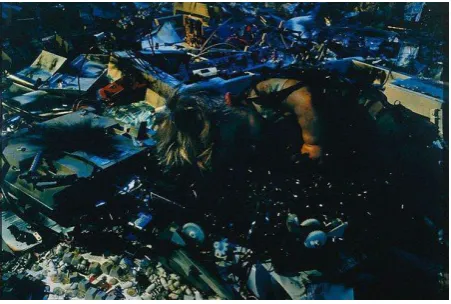
out, there can be movement within still images. Writing about Cindy Sherman’s ‘disaster’
photographs, which re-enact, with mimetic failure and excess, earlier ‘history’ paintings,
Krauss describes an ‘erosion of form from within’ in these still images as they move towards ‘formlessness,’ set in downward motion by the gravitational ‘forces of the horizontal.’ This
generates another kind of narrative succession, towards, as Barthes (2009) would say more
generally, death, within the photographs.
Sherman’s later photographs of ambiguous materials, abject and decomposing, trace similar
progressions more explicitly, and without the historicising connotations of the ‘disaster’
series which could be taken as implicit temporalisation. In these later photographs,
progressions of decay occur across the image, but they are not temporally marked and need
Similarly, the recent BBC radio series, made with the British Museum, a ‘History of the world in 100 objects’ (MacGregor, 2011) allowed those objects to display narratives
crystallised within them. Of course, there are stories written about the objects, and they can
be fitted into broader historical narratives too. However, the visible marks that the objects
bear upon them show their narratives to some degree, independently of the other stories
around them. This West African drum, for instance, demonstrates its origin in the wood it is
made of. Its skin, reflecting the next stage in its journey and a complex, indeterminate history
within slavery, is North American. The object’s location in the British Museum indexes the
US-based collecting of rich English merchants, who were also often implicated in slavery.
Some of this history is written strikingly into the object; much is not, but these historical
disjunctions also at times figure within the object, for instance in the disconnect between
[image:3.595.153.379.71.223.2]wood and skin.
Laura Mulvey (2006) has suggested that contemporary visual technologies point up some
different, ‘delayed’ ways to look at moving images. Pausing moving images, repeating them,
zooming in, taking images apart and recombining them – these processes emphasise how
meanings can be deferred and reconfigured. They suggest a more reflective, ‘pensive’ way of
relating narratively to images. Contemporary processes of image reading thus show how we
can read narratives in altered, fragmented and open ways. Mulvey addresses primarily
moving images, but still images and objects provide a similar deferred narrative possibility,
repeatedly stirred up by the differences within the image or object that a ‘pensive’ reading
foregrounds – by subtle details within it, for instance.
This account of narrative moves away from what is perhaps the socio-historically specific
dominance of ‘pure’ temporality in narrative studies, sustained in social-scientific ideas about
narrative longer than in some other fields (Mitchell, 1987; Fried, 2012). The lack of
foregrounded temporality in still visual images and objects especially, allows us to look at
other possibilities – spatiality, conceptual progressions, interpersonal co-constructions – as
primary narrative organisers.
Anthony Appiah talks about the open possibilities of future readings of the Akan drum. It is
often said that objects and images are more likely than verbal materials to generate shifting or
broken narrative readings through their ‘openness’ – that is, through the much larger set of
signifiers to which each signified potentially connects. This truism perhaps derives its force
from the comforting but misleading familiarity of certain kinds of language, rather than visual
or object, interpretation, within contemporary western cultures – and also from long histories
within those cultures of argument about the relative functions and status of words and images
(Derrida, 1987; Mitchell, 1987). When we start to read in detail, at different levels, for what
and bounded readings than visual or object narratives. Multiplicity, fracture and contradiction
characterize narratives across media. Narratives are all put together from signs whose own
disarticulations are compounded by the chains of signs that constitute stories.
I am going to look now at the place of exceptions in narratives, especially in relation to the
HIV epidemic, my main research field, whose exceptionality is itself often the subject of
debate. In relation to this epidemic, I think we can see exceptional stories working in at least
two different and valuable ways.
The importance of particularity in stories, which in its most acute form manifests as
exceptions, is widely recognised by narrative researchers – the particularity of stories is
indeed what distinguishes narrative from theory, for instance, for Bruner (1990). I think this
distinction is useful - narrative is usually differentiated from theory, precisely to the extent
that it explicates through specificity. But the distinction is not fully tenable. My own work
and that of many others is always concerned with multiple instances of narratives studied
across multiple participants – not as many as would be addressed in a quantitative study of
course, but a number similar to that characterising many qualitative studies. In such work,
researchers are aiming not for generalisability, which relies on defined conventions of
sampling and significance –although these of course differ markedly between social, natural
and physical sciences. Rather, this kind of work relies on what is often called transferability
(Lincoln and Guba, 1985) – that is, the possibility for audiences and very often, researchers
themselves to relate findings from one context to those in another context, to make
connections that may offer ways of understanding other findings in other contexts and that
may even suggest what findings may emerge in them. This is not generalisability or
predictivity but rather, pragmatic versions of them which recast them as transferability and
informed speculation.
In such circumstances, narratives, analysed across multiple instances, can produce heuristics,
if not theories, of phenomena. Theories in any case occur at multiple levels, and many of
them are pretty close to being heuristics, especially in the social sciences. The possibility that
such heuristics offer of going beyond description and singularity in researching narratives is
important. But the role of specificity and exceptions doesn’t seem strong in such an account.
However, it is narratives’ rootedness in the particular that allows them to bring into research,
It’s this rooted particularity that allows narrative research to become more or differently
transferable, to build better heuristics.
There is also a large amount of narrative research that is much more clearly grounded in
particularity: research on specific stories, biographies, and cases. Elliot Mishler’s (1999)
work has been exemplary in arguing for the importance of variability in narrative research,
showing that such research is not just doing what the majority of qualitative research does
anyway, but is contributing something really distinctive in its exhaustive pursuit of what
comes next in the story, the other story, the untold or unheard story. I think this is
interestingly different from what anthropological particularity offers, though this is a
distinction needing more unpacking than can be achieved here.
Such variability and particularity function in two apparently different ways. Sometimes they
are emblematic. Part of this emblematising process, involves including exceptionality. The
exceptional nature of some stories helps support arguments, because it suggests the
generality across highly idiosyncratic circumstances of those arguments. So in such cases,
stories are found or constructed and used to illustrate or encapsulate a more general truth, as
when researchers tend to use story extracts in describing narrative patterns across a large
dataset. It’s clear, though, that in such cases, the individual story does not really matter for
the argument, even if it is what readers remember; and also, that a story can be used to bolster
some quite questionable arguments, because the reliance on stories tends to divert readers,
both logically and because of the sheer column inches the stories take up. Narrative
researchers are not immune to these failings.
The other way in which narrative particularity functions is explicitly as exception – that is, to
point up radically distinct phenomena rather than to illustrate general ones. This kind of
particularity involves unassimilable stories which point outside the usual theoretical frame.
Such stories can be problematic for narrative researchers. Sometimes indeed researchers
might be advised to throw such stories out of their dataset, such is their atypicality. Their
theoretical reach is apparently limited – they can support only a preliminary, single-instance
account - but their significance for the testing and development of theory -or heuristics - is
great. By making things messy, they challenge existing explanations and expand the scope of
future ones.
Looking more broadly at narrative material, I think it’s helpful to think about such narrative
apparently more emblematic, transferable material. Narrative exceptions get their strength
from the conventions they step outside; narrative conventions get their strength from their
exceptions. (This, perhaps, is how the notion of exceptionality differs most clearly from that
of deviant case analysis - Lincoln and Guba, 1985). Nussbaum (1998) has argued something
similar in the case of tragedy. Circumstances of suffering may be baroque and distant,
unalloyedly exceptional, she says, but that only underlines the commonality of suffering
itself, and of the agentic albeit doomed attempts within tragedy to overcome it. At Occupy
London’s Tent City University, at a stories workshop, I told a story about an HIV positive
woman in South Africa specifically for us to see whether the radical otherness of the material
made any narrative sense in that context. It was indeed the strong unfamiliarity of the details
of the story that reinforced the common narrative line the listeners extracted: that terrible
events can be accepted, transcended and even used to shape a progressive life path. Again
this dialectical working of narrative convention with exception is hardly a new or original
insight. Mishler (1999), presenting material from craftartists’ individually unique life stories,
points out that across this disparateness the common occurrence of turning points in life
narratives for instance is apparent to readers in very different circumstances.
Conversely, moments of exceptionality can often be recognised in even the most
conventional narratives. They are the signifiers that drop out of the story without having a
clear meaning, the unreadable elements that either stick in the head or immediately get
forgotten, like the puncta that Barthes (2009) describes in photographs. This is where reading
for exceptionality, what Schor (2006) calls reading in detail, becomes important for all
narrative work, whether it’s based on small or large stories, cases or large databases.
Recalcitrance to meaning is indeed the appeal I would say of the particularity of stories – the
unincorporable elements of them. Many critics of the narrative turn – Craib (2004), Frosh
(2002), Cowen (2009) - suggest that we are seduced by the closure and predictability of
stories, while lives are messy, inchoate and nonsensical. But a growing body of research and
indeed all our work at CNR I’d say emphasises the incoherence, the intrinsic multiplicity and
contradictions of stories (Hyvarinen et al, 2010) . In this we are drawing on wellestablished
literary-theoretical ideas about the discontinuities within language, including narrative
language (Butler, 2005). In my case, particularly in relation to HIV narratives I’ve found the
work of the analyst and literary theorist Julia Kristeva (1984) useful in trying to read stories
(Of course there are pleasures of repetition and closure in narratives, but it’s interesting that
exact repetition, exact closure, is not what we usually demand of stories. Even for children,
the much-desired repetition of a story is happening always in another context that (as Derrida
in Cornell, 2005, puts it) opens up another meaning. Even in oral traditions often caricatured
as faithful reproducers of narratives, innovation is prized alongside familiarity. As we might
expect then, the recuperative power of stories, well captured in McAdams’s (2006)’s book on
redemption narratives, is always underpinned and shadowed by stories’ more disruptive
effects. Cowen says we avoid the ‘complex story maps’ that are really required to do justice
to phenomena; I think that such complexity is itself attractive, even if it is implicit and covert
within many apparently conventional and coherent stories. Perhaps the other interesting thing
about what Cowen calls his suspicion of narrative is that it’s a suspicion of pleasure, surfaces,
triviality, ‘meaningless’ details, perhaps femininity itself.
I want to turn now to exceptionality in some stories from my most recent research about HIV.
Of course, exceptionality in the HIV case applies to lived phenomena and not only stories.
But there has been longstanding argument in the HIV industry about just how exceptional
HIV is – is it just another condition of low health resources, gender inequity,
underdevelopment and postolonialism? Is there something exceptional about its scale,
stigmatisation and effects? Or is this ‘exceptionalist’ claim simply one made to extort money
from northern governments and international NGOs while the epidemic flattens out into yet
another ongoing health problem? Is HIV now just differentially treatable according to
resources, like many other conditions, with strong but not unique resource implications and
no likely new theoretical interest for social researchers? (De Waal, 2006).
In my most recent interview round investigating HIV support in the UK, I interviewed 46
people living with HIV – 15 of whom I’ve interviewed before – and found a strong tension
between the narrative naturalization of HIV- its management through medicalisation
normalisation and marketisation – and the narrative disruption of such processes by stories of
being left behind by treatment, social services, public representations of the epidemic, by
stories of everyday lives lived excluded from or on the margins of families, work,
relationships, citizenship, and by stories of resisting medicalisation, refusing to be normal,
rejecting markets or setting up their own (Squire, 2010). These disruptions do indeed
demonstrate HIV exceptionalism, though I think there are better ways to describe it . For it’s
really about not a general HIV exceptionalism of the kind that used to be argued for, but
this condition; its particular medical unpredictability and treatment difficulty; its particular
and continuing, sexualised, gendered, homophobic stigmatisation in many contexts; and the
particular new physiological and psychosocial phenomena around this relatively young
condition that are always coming into existence and the specific unspoken abdication of HIV
treatment in low-income countries (Nguyen, 2010) and its limitations in many other contexts.
While one can see such narrative patterns across different epidemic contexts, developing over
the last decade and a half of treatment access in the west, the narrative tension has I think
increased in the contemporary austerity context, so that many of the stories in the interviews
appeared to be stories about living in a recession rather than living with HIV, accompanied
by concomitant moments of narrative alternatives where interviewees found ways of framing
their neoliberal lives differently.
I want to present a couple of stories whose narrative exceptionality is also a way of
conveying these particularities of the HIV epidemic. First, this is a story Robert (all names
are pseudonyms) told – not for the first time- by about how he met his boyfriend.
Robert: Yes, I mean, it’s quite funny, because he's someone that I'd seen around for years, who I fancied, and then we got into contact online and then, there's an application on the iPhone, called Grindr, and I messaged him on Grindr, and we were chatting on that and then I thought, ‘right, I'll disclose’, so I disclosed that I was positive, and he said, oh, ‘so am I’, and I went, ‘ oh cool’ and he said, ‘those aren't the words I'd use, but I know what you mean.’
This is a story, which Robert himself tells as atypical, of romance and disclosure by
messaging – Robert later says he thinks that medium gives people a space to respond that
face-to-face disclosure does not - , and of a transgressive valuing of HIV as ‘cool’. Robert’s
now-boyfriend thought the last text message a little un-pc; Robert like a number of other
interviewers talked a few times about his flippant and ‘darkly’ humorous address to HIV,
something not all HIV positive people, let alone all people, shared. A lot of audiences, of all
HIV positive statuses, can understand a story that ends with the relief of two people not
having to deal with serodiscordance in their relationship – calling that ‘cool’ for many
contravenes an appropriate seriousness. However, this story of ‘cool’ does work to exemplify
something really specific about the epidemic in this time, in those circumstances: that HIV
positive people who are being treated can and will consider and sometimes have unprotected
sex with each other, as Robert describes later – and perhaps with people who are HIV
negative -because their low viral loads make infection risks very small. This, within a
be a disturbing thought – should people living with HIV have the same pleasures as everyone
else? And if people living with HIV can be so healthy that unprotected sex is not risky, how
can they understood as reassuringly, punitively different from others?
The ‘coolness’ Robert mentions is also related by him later to him and his boyfriend’s ability
to care for one another, and here again the exceptionality of this story points to something
quite particular about the contemporary UK epidemic: that it’s invisibilised, medicalised and
stigmatised to such an extent that much non-medical care is indeed given by HIV positive
people to other HIV positive people. Perhaps something else that’s transgressive about this
story, is that readers glimpse in it something of the seriously uncool social relations HIV
positive people often have with those of other statuses, the personal toll exacted by exclusion
and othering.
I want now to show you a really different story, again highly specific and in this way opening
up the contemporary contexts of the epidemic as well as escaping them in its idiosyncracy –
but working more as radical exception, less as exemplification. Here is Dorothy, an HIV
positive woman in her forties from Southern Africa, living in the UK, telling us about her
difficulties with her daughter, and how her son died:
Dorothy: She (daughter) still in {country 1} yes um, I tried to bring her but it didn’t work out and then I thought, I thought she was in primary school there going to secondary school so I had not looked for a place for her because I thought it was going to be possible but it didn’t, I had to go back to my sister again and beg her to take her so she took her, and then at one time she beat her up, with um you know the rawhide, you know they put a stick at the other end , she beat her, my daughter never told me, she beat her and she put salt and put chillies, my daughter never told me, I didn’t know about it until she went to visit at her father’s sister, that’s when they saw the scars and asked her and then she told them that my sister had beaten her and she had stolen some money from her , she didn’t want me to send her money but I said when I was going to school my parents used to give me a 50 cents at least you know...I feel I haven’t been there for my children you know and my son died in his sleep and I
understand he was fasting, I don’t know what for and er, I dunno they told me at one time he wanted to commit suicide, and I regret having I told him to look after his sister you know, and I regret having told him that, because I don’t know why he wanted to commit suicide you know, seeing the people in Africa who are HIV.
This is one narrative sequence in a complex interview story that piles difficulty on loss on
guilt on struggle. It is not more difficult in content than other stories in the interview.
There are groups of stories about migration, detention, leaving children, living on vouchers,
and getting diagnosed late, to all of which Dorothy’s interview contributes. These stories of
hers act as a kind of window onto the range of issues HIV positive migrants face, issues so
wideranging and intense that HIV itself often disappears from the picture. Such particularities
tell us that HIV is often not at the centre of people’s stories; they lay out the current
complexity of those other factors as well as of HIV itself. In addition, many of these stories
perform a depression that cannot be generalised or narrated away, that just gets repeated
again and again, that is inevitably quite disturbing to listen to and much more to tell -but that
is highly comprehensible. However, some of Dorothy’s stories – like those above - are also
exceptional in ways that do not convey understanding. These stories of her sister and children
contain many elements that are entirely idiosyncratic. She has an ambivalent and very
specific relationship with her sister, particularly but not only around HIV; she has a daughter
who has tried to protect her from sending remittances by stealing money; her son, who had a
serious non-HIV-related illness, contemplated suicide because, she fears, her injunction to
take care of his sister led him to know his mother had HIV, and to fear that– like other HIV
positive people he had known – she would die; perhaps his fasting was expiatory.
Such exceptional stories are not illustrative. They open up aspects of the epidemic such as
relationships within HIV affected families, and across generations, that call for explanation,
without telling us much about them. Nevertheless, such variability is important to know about
even if, in the present, recognising it is all we can do; otherwise we would indeed be settling
for the stories we know, the familiar ones, the comfortable ones that do not jibe with
messiness of lives.
It is at this point of radical exceptionality , that the question of what narrative is, comes close
to another question: what is narrative for? As Butler (2005) suggests, this is, in the case of
personal narratives, foundationally a moral question. Self-narratives position us ethically in
response to the social call to be moral subjects. But the moral narrative order is a contested
and sometimes incomprehensible terrain. Narrative’s radical exceptions lead us to think about
the particularity of stories as ethical, not just representational, features.
References
Brockmeier, J. (forthcoming).
Bruner, J. (1990) Culture and Human Development: A New Look. Human Development, 33,
344-355.
Butler, J. (2005) Giving an account of oneself. New York: Fordham University Press.
Cornell, D. (2005) Derrida: the gift of the future. differences 16, 3: 68-75.
Cowen, T. (2009) Be suspicious of stories.
http://www.ted.com/talks/tyler_cowen_be_suspicious_of_stories.html Accessed 08.03.2012
Craib, I. (2004) Narratives as bad faith. In M.Andrews, S.Sclater, C.Squire and A.Treacher
(eds) Uses of narrative. New Brunswick, NJ: Transaction
De Waal, A. (2006) AIDS and power. London: Zed Books
Derrida, J. (1987) Truth in painting. Chicago, IL: Chicago University Press.
Fried, M. (2012) Forward, in G. Lessing Laocoan, Baltimore, MD: Johns Hopkins University
Press.
Frosh, S. (2002) After words. London: Palgrave
Hyvärinen, M., Hydén, L.C., Saarenheimo, M., Tamboukou, M. (eds) (2010) Beyond Narrative Coherence, Amsterdam: John Benjamins Publishing.
Krauss, R. (1993) Cindy Sherman’s gravity: a critical fable. Artforum International 32, 1:
163-6.
Kristeva, J. Powers of horror. New York: Columbia University Press.
Lincoln, A and Guba, E (1985). Naturalistic Inquiry. Newbury Park, CA: Sage Publications.
McAdams, D. (2006) The redemptive self. New York: OUP USA.
Mishler, E. (1999) Craftartists. Cambridge, MA: Harvard University Press.
Mitchell, W. (1987) Iconology. Chicago, IL: Chicago University Press
Mulvey, L. (2006) Death 24 X a second. London: Reaktion Books
Nguyen, V-K. (2010) The republic of therapy. Chapel Hill, NC: Duke University Press
Nussbaum, M. (1998) Victims and agents: what Greek tragedy can teach us about sympathy
and responsibility. Boston Review, December 20.
Schor, N. (2006) Reading in detail. New York: Routledge.
Spence, J. (1995) Cultural sniping. London: Routledge.
Squire, C. (2010) Being naturalized, being left behind: The HIV citizen in the era of