P rin cip al -A gen t P roblem s w ith T yp e-D ep en d en t O u tside
O ptions
by
Silvia Sonderegger
Submitted to the Department of Economics
in partial fulfillment of the requirements for the degree of
Doctor of Philosophy
at the
THE LONDON SCHOOL OF ECONOMICS AND POLITICAL SCIENCE
November 2003
© The London School of Economics and Political Science 2003
Signature of A uthor...
Department of Economics
January 13, 2004
Certified by
UMI Number: U2309B0
All rights reserved
INFORMATION TO ALL USERS
The quality of this reproduction is dependent upon the quality of the copy submitted. In the unlikely event that the author did not send a complete manuscript and there are missing pages, these will be noted. Also, if material had to be removed,
a note will indicate the deletion.
Dissertation Publishing
UMI U230930
Published by ProQuest LLC 2014. Copyright in the Dissertation held by the Author. Microform Edition © ProQuest LLC.
All rights reserved. This work is protected against unauthorized copying under Title 17, United States Code.
ProQuest LLC
Library
b rtM ft u e w ry CM
Abstract
The literature on adverse selection has until recently concentrated on the case where the agent’s outside option is type-independent, implying th at all types of agent receive the same payoff should no trade occur with the prin cipal. Unfortunately, this assumption is not innocuous. If it is relaxed, the properties of the optimal contract can change dramatically. This thesis characterizes the impact of type-dependent outside options in three differ ent settings. First, we explore the notion th at a worker’s prospects in the labour market may be influenced by his employment history. Under these circumstances, employers may incentivise their employees by randomizing over the probability with which current employees are retained. We identify a set of sufficient conditions for this to be the case in a two-period employ ment relationship, where the employee’s ability is private information and both parties are risk-neutral. Although randomization is seldom observed in the real world, our results suggest th at employers may optimally introduce some ambiguity over the conditions that need to be fulfilled in order to be retained.
Second, we study competition in price-quality menus within the context of an horizontally differentiated duopoly, where each firm also operates in a local, monopolistic market. It is assumed that the consumer’s (unobserv able) valuation for quality is determined by the nature of his preferences over horizontal (or brand) product characteristics. We find that, if competition between the two firms is sufficiently fierce: (1) the equilibrium quality sched ule exhibits bunching and (2) the equilibrium contract features overprovision of quality for sufficiently low types. Thus, with respect to the monopoly set ting, competition may introduce new types of distortions, namely upward distortions.
C on ten ts
1 Introd u ction 6
2 R and om ization w ith T ype-depend en t O utside O ptions 12
2.1 Introduction... 12
2.1.1 Related lite ra tu re ... 14
2.2 The m o d el... 16
2.3 First b e s t ... 19
2.4 Second b e s t ... 21
2.4.1 Type-independent outside options ... 22
2.4.2 Optimal mechanism when tv(6) = 1 for all ty p e s ... 24
2.4.3 Allowing for ra n d o m iz atio n ... 31
2.5 Concluding remarks ... 38
2.6 A p p e n d ix ...39
3 N onlinear Pricing and M ultim arket D u op olists 55 3.1 Introduction... 55
3.1.1 Related lite ra tu re... 58
3.2 The m o d el... 59
3.3 Im plications... 65
3.4 Concluding r e m a r k s ... 76
3.5 A p p e n d ix ... 76
4 Incentive Problem s in th e Introduction o f N ew T echnologies w hen th e
4.1 Introduction... 87
4.1.1 Related lite ra tu re ... 91
4.2 The m o d el... 92
4.3 Im plications... 99
4.3.1 No commitment to tra n s p a re n c y ... 99
4.3.2 The principal’s d e c is io n ... 104
4.3.3 Optimality of commitment ...107
4.4 Concluding remarks ... 116
4.5 A p p e n d ix ... 117
L ist o f F igures
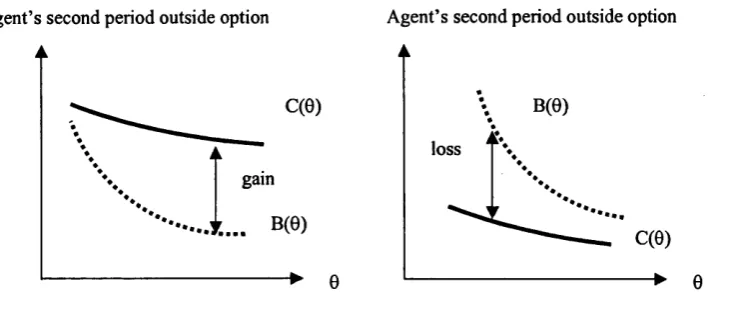
2-1 Agent’s second period outside option when 0 > 0 ( 9 ) > B'(9)... 37
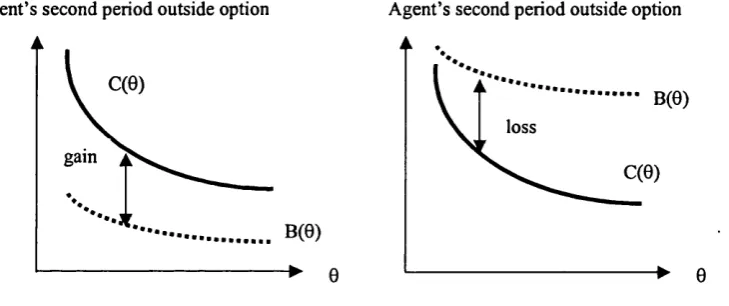
2-2 Agent’s second period outside option when C'{0) > B ' (6) > 0... 38
2-3 Agent’s second period outside option when 0 ( 9 ) < B'(9) < 0... 38
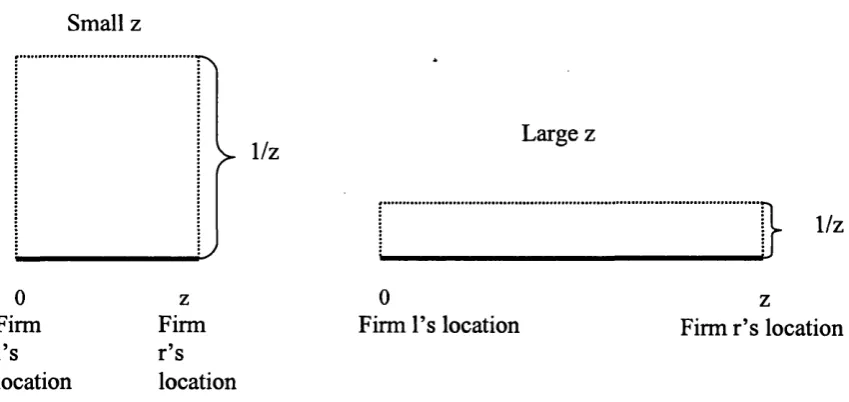
3-1 Distribution of preferences over horizontal product characteristics. . . . 61
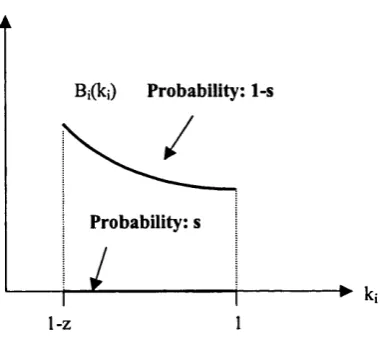
3-2 Consumer’s marginal valuation of quality, within each market... 62
3-3 A possible reservation utility schedule... 68
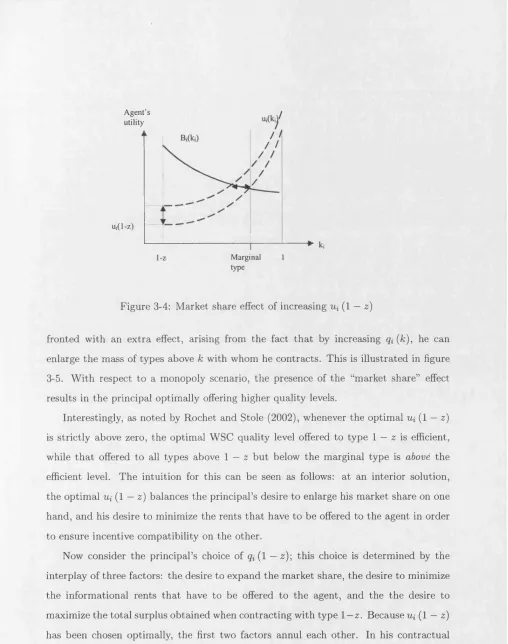
3-4 Market share effect of increasing U{ (1 — z) ... 70
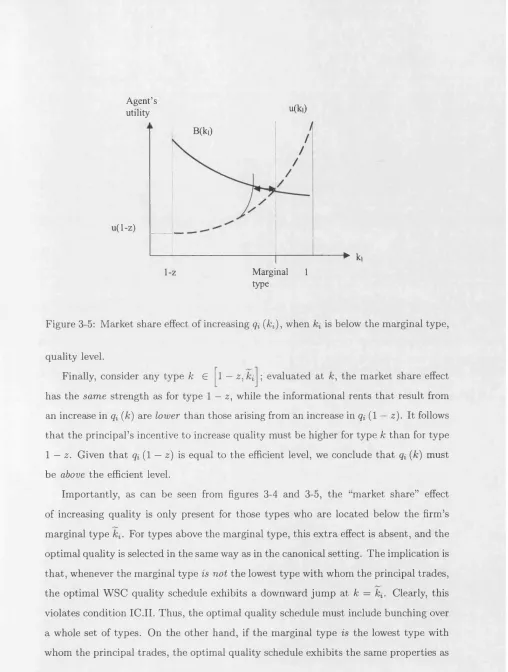
3-5 Market share effect of increasing qi (ki), when k{ is below the marginal tvpe... 71
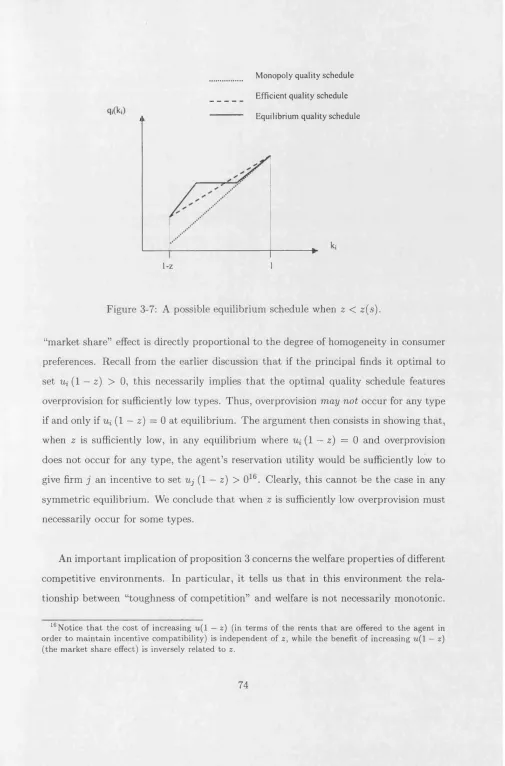
3-6 2 73 7+i 3-7 A possible equilibrium schedule when z < z (s)... 74
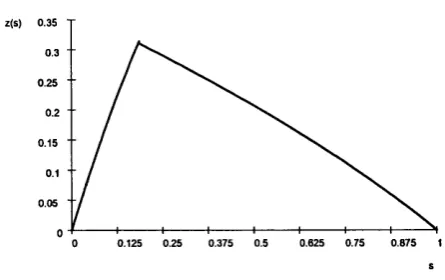
3-8 Level of 2 below which overprovision undoubtedly occurs... 75
3-9 3^ - j (2s + 2 V 2 V - s 2 + 3 - 6 ) ... 85
4-1 Timing in the hold-up problem... 102
4-2 Timing in the present setting... 102
4-3 Informational rents needed to induce transparency, assuming th a t both r and p are ^ 1... 110
C h ap ter 1
In tro d u ctio n
The theory of general equilibrium is universally regarded as the one of the major achieve ments of economics. According to this theory, the economy is composed of a continuum of agents who interact through the price system. Agents consider themselves too small to influence the equilibrium prices, and therefore behave as price-takers. The power of the theory of general equilibrium resides in the fact th at it generalizes Adam Sm ith’s “invisible hand” to a wide variety of settings1; so long as the appropriate market can be set up, market forces are sufficient to ensure efficiency. This also applies to situations where uncertainty is present, provided that information is symmetric among economic agents.
In the presence of asymmetric information, however, the theory of general equilib rium loses power. This was first highlighted by Akerlof (1970), Spence (1973), and Rotschild and Stiglitz (1976). These authors showed th at when information is asym metrically distributed among agents, a competitive equilibrium may fail to exist, or may exist but not be Pareto efficient. Following this discovery, several economists decided to turn away from general equilibrium models, and instead concentrate on the problem of exchange under asymmetric information in the simplest possible setting, i.e. between a small number of traders. Soon it became clear th at in order to gain a better insight into this type of interaction, new tools had to be adopted: an agent who possesses private
information is bound to behave strategically. The methodology of game theory was adopted to model such strategic interactions. Contract theory was born.
Contract theory utilizes game theoretical concepts to model the strategic interactions among a small group of economic agents, within a partial equilibrium context. The paradigm most commonly employed for this purpose is the principal-agent model. In this model, there are two economic agents: the informed party, or agent, whose information is relevant for the common welfare, and the uninformed party, called the principal. Bargaining over the terms of trade takes a very simple form: the principal possesses all the bargaining power. He proposes a “take it or leave it” contract2 specifying the terms of trade to the agent, who may accept or reject the offer, but may not propose another contract.
This thesis concentrates on the class of principal-agent models th at study situations where the agent’s private information concerns his characteristics, or type (adverse selection models). The literature on adverse selection has until recently concentrated on the case where all types of agent receive the same payoff should no trade occur with the principal; in other words, the agent’s outside option is type-independent. This simplifying assumption has allowed theorists to make remarkably robust predictions: with respect to the full-information, efficient outcome, the optimal contract prescribes no distortions for the “best” type agent, and downward distortions for all other types (as in Mussa and Rosen, 1978). Moreover, if the agent’s type distribution satisfies a common monotone hazard property, the optimal menu of contracts involves full separation of types.
Unfortunately, the assumption of type-independent outside options is often not re alistic; whenever trading with the principal implies some foregone opportunity for the agent (arising for instance by the possibility of trading with other principals), it is nat ural to expect th a t the opportunity cost incurred when trading with the principal should vary with the agent’s type. Even more importantly, the assumption of type-independent outside options is not innocuous. If this assumption is relaxed, the properties of the
equilibrium contract can change dramatically. This was first highlighted by Lewis and Sappington (1989), within the context of the regulation of a public firm. They showed th a t if the firm’s (unobservable) marginal cost is inversely correlated with its fixed cost, the firm faces countervailing incentives : on one hand, it would like to quote a high marginal cost, in order to set a high price; on the other hand, it would like to quote high fixed costs (and a low marginal cost), in order to receive a higher refund. The presence of these countervailing incentives implies th a t bunching and overprovision3 feature in the optimal incentive contract.
A full characterization of the adverse selection problem in the presence of type- dependent outside options can be found in Maggi and Rodriguez-Clare (1995) and Jullien (2000). These authors show that, at equilibrium, pooling or separation, upward, downward or no distortions may all emerge, depending on the shape of the agent’s outside option. The general lesson to be learned is th at whenever trading with the principal implies some foregone opportunity for the agent: (1) this is likely to m atter and (2) no general predictions can be made concerning the properties of the equilibrium contract. This suggests th a t the investigation into the impact of type-dependent outside options in agency settings should be conducted at a more specific level. By reducing the level of generality, we may be able to draw more detailed conclusions.
This thesis characterizes the impact of the presence of type-dependent outside op tions in three separate settings. The second chapter explores the notion th a t a worker’s prospects in the labor market may be influenced by his employment history. Dismissal from a previous job, for example, may send a negative signal concerning the worker’s ability, thereby narrowing his prospects. Alternatively, the fact th at a worker has accu mulated previous work experience may make him more valuable in the eyes of potential employers. In a two-period model, this implies th at the agent’s (type-dependent) out side option before he contracts with the principal differs from his outside option after
one period of employment. We find th at if the difference between the agent’s ex-ante
and ex-post outside option (i.e. the opportunity cost of dismissal) varies according to the agent’s type, the optimal contract may involve randomization over the probability with which the worker is retained after the first period of employment. This is because randomization over the probability of retention equips the employer with the means to discriminate more efficiently among different types of employees. For instance, if more able types fear dismissal more than less able ones, the principal may utilize random ization as a mean to decrease the agent’s incentives to under-report his ability. Thus, randomization allows the principal to exploit the countervailing incentives generated by the opportunity cost of dismissal. We identify the sufficient conditions for random ization to be optimal, and characterize the optimal contract when these conditions are fulfilled.
In practice, of course, contracts including randomization are extremely difficult to enforce or verify by courts of law. This does not, however, rule out the possibility of stochastic contracts being implemented. The principal may for instance be motivated by reputational concerns4, which could be sufficient to guarantee th at at equilibrium he will indeed randomize over retention, with the right probability. Importantly, though, the practical problems of including randomization in any legal contract imply th a t the contract between the principal and the agent will contain some ambiguity (or incom pleteness) over the conditions th at need to be fulfilled in order to guarantee retention. Thus, employment contracts may contain some vagueness (or incompleteness) even in environments where all aspects are verifiable. Indeed, as recognized by Macauley (1963) and Bernheim and Whinston (1998), this apparently unjustified incompleteness is often observed in reality.
The third chapter studies competition in price-quality menus within the context of an horizontally differentiated duopoly, where each firm also operates within a local, monopolistic market. It is assumed th at the consumer’s (unobservable) valuation for quality is determined by the nature of his preferences over horizontal (or brand) product characteristics. T hat is, a consumer who prefers one brand over the other will derive
more utility from an increase in quality if this occurs within the context of his favorite brand, as opposed to the other brand. Equivalently, a consumer with a strong preference for quality when purchasing a certain brand would have a low valuation for quality when purchasing the rival brand. This implies th at the outside option of a consumer located in the competitive market is a decreasing function of his preferences over quality.
From the point of view of each firm, the presence of two markets results in the con sumer’s outside option being either equal to zero (when he is located in the monopolistic market), or taking a positive value (when he is located in the competitive market), with a certain probability. In addition to the standard “efficiency versus informational rents” considerations, the principal’s contractual choice is therefore influenced by an extra ef fect, arising from the fact th at by increasing the utility th at the agent obtains from trading with him, the principal can enlarge the mass of types with whom he contracts. W ith respect to the standard monopoly scenario, this “market share” effect results in the principal offering higher quality levels to low types. If competition between the two firms is sufficiently fierce, the presence of this extra effect implies that: (1) the equi librium quality schedule exhibits bunching and (2) the equilibrium contract prescribes overprovision of quality to low types. Thus, with respect to the monopoly setting, more competitive environments may feature new types of distortions (namely: upward dis tortions). This suggests that the relationship between “toughness of competition” and welfare may not necessarily be monotonic.
rather than absolute, productivity. This implies that, conditional on working with for the principal, different types of agent obtain the same utility from any given production- payment contract. The only difference among different types of agents concerns their expected utility from alternative employment (their outside option). We find th at if (1) the agent’s outside option is lower when the technology in which the agent specializes is not the most efficient and (2) the principal cannot commit to employ the agent if he decides to adopt another technology, no renegotiation-proof contract exists th a t induces the agent to reveal his information. The implication is th a t the principal chooses to adopt the least efficient technology with a positive probability. Thus, when it comes to the adoption of radical new technologies, larger firms, where ownership and expertise tend to be separated, are disadvantaged in comparison to smaller, entrepreneurial firms.
C h ap ter 2
R an d om ization w ith
T yp e-d ep en d en t O u tsid e O p tions
2.1
In troduction
and his outside option after one period of employment varies across different levels of ability. We call this difference the opportunity cost of dismissal. The degree to which this opportunity cost varies across types determines the payoffs employees of different ability can expect to earn from contracts involving different probabilities of dismissal, which accordingly modifies their incentive to misrepresent their true type. Indeed, one of the conditions that we identify as sufficient for randomization to be optimal is the requirement th at dismissal counteract the incentives which dominate under the offer of an efficient contract. If the dominant incentive is for the employee to understate his ability, then this requirement means that less able types fear dismissal less (respectively, benefit from experience more) than more able types. The opposite holds if the domi nant incentive is for the employee to overstate his ability. In both cases, the possibility of dismissal softens the worker’s incentive compatibility constraint, thus decreasing the informational rents in need of being allocated to induce a given level of production. Thus, randomization over the probability of dismissal proves to be a useful tool, equip ping the employer with the means to discriminate between different types of employees. Significantly, as mentioned above, this condition alone does not however guarantee the optimality of randomization. For the optimality of randomization to be guaranteed, it is also necessary to ensure th at the worker’s participation constraint cannot always be met by means of a deterministic contract. We find that this can only be the case when the worker is offered no informational rents. Our principal findings can therefore be summarized as follows: in order for randomization to be optimal, it is sufficient that
• the opportunity cost of dismissal counteract the incentives which dominate under the offer of an efficient contract and
• randomization maximizes the employer’s expected profit when the employee is kept onto his reservation utility.
who engage in surplus-creating production at equilibrium, and by increasing production whenever trade occurs.
In practice, of course, contracts including randomization are extremely difficult to enforce or verify by courts of law. This does not, however, rule out the possibility of stochastic contracts being implemented. The principal may for instance be motivated by reputational concerns1, which could be sufficient to guarantee th a t at equilibrium he will indeed randomize over retention, with the right probability. Importantly, though, the practical problems of including randomization in any legal contract imply th a t the written contract between the principal and the agent will contain some ambiguity over the conditions th a t need to be fulfilled in order to guarantee retention. Thus, employ ment contracts may contain some vagueness (or incompleteness) even in environments where all aspects are verifiable. Indeed, as recognized by Macauley (1963) and Bern- heim and Whinston (1998), this apparently unjustified incompleteness is often observed in reality.
2 .1 .1 R e la te d lite r a tu r e
In the presence of adverse selection, the literature identifies the optimality of random ization with reference to situations where either
• different types have different attitudes towards risk or • the agent’s type-space is multidimensional.
The first category is examined by Arnott and Stiglitz (1988), Brito, Hamilton, Slut sky and Stiglitz (1995) and Stiglitz (1982), who formalize the notion th at, when the agent’s attitude towards risk is correlated with his type, randomization can be opti mally utilized to loosen the agent’s incentive compatibility constraint. This is also the case in the present setting, but the rationale for our results is very different: in the present paper, all parties are assumed to be risk-neutral, and randomization proves use ful because the impact of dismissal upon the agent’s future employment prospects varies in accordance with his ability. Moreover, randomization here occurs over the probability with which trade takes place in the second period, rather than over the terms of trade.
The second category is studied by Baron and Myerson (1982), Che and Gale (2000) and Rochet (1984). These papers show th at stochastic mechanisms, where the decision to produce or not to produce is used as a screening device, may prove useful when the agent’s type is bi- rather than uni-dimensional. Again, the setting considered by those papers differs from the present one, where the agent’s type is assumed to be uni- rather than bi-dimensional.
Importantly, the papers cited above concentrate on static settings, and thus find it difficult to generate an intuitive interpretation of randomization. In contrast, the present paper considers a dynamic setting, where randomization can intuitively translate into the introduction of some contractual ambiguity concerning the conditions under which retention occurs.
The present paper therefore adds to the literature on stochastic mechanisms, in that it provides a novel rationale for their optimality, and establishes a link between this literature and th at which studies adverse selection in the presence of type-dependent participation constraints. Jullien (2000) and Maggi and Rodriguez-Clare (1995) provide a general theory of type-dependent reservation utility with a continuum of types, and show that the properties of the optimal mechanism may differ considerably with respect to the so-called standard setting, where the agent’s reservation utility is assumed to be type-independent. Our paper extends this intuition by showing how the presence of type- (and history-) dependent outside options may result in randomization over trade in the second period being optimal. It is worth noting th at our intuition builds on Acemoglu and Pischke (1998), who introduce and empirically test the notion that dismissal may negatively influence a worker’ s future employment prospects.
2.2
T h e m od el
We consider a two-period setting in which an employer (the principal) contracts with an employee (the agent) over the production of a certain amount of output in each period. Production is assumed to be observable and verifiable. The agent’s marginal cost of production, or type, is denoted by 0, and is unobservable by the principal. We assume th at 0 is drawn from a distribution /(0 ) with associated density F(0), over a finite support <3? = [0,0], where is increasing in 0 and is decreasing in 0. At the beginning of the second period, the principal decides whether to retain the agent or not. We assume th a t the principal can credibly commit to condition his decision to retain the worker upon the outcome of a publicly observable randomizing device. We also assume th a t if the agent accepts the contract, he is contractually bound to work for the principal whenever the outcome of randomization prescribes so.
A contract between the agent and the principal can therefore be denoted as {7r, qi,q2,u>i,W2},
where q\ is the amount of output that the agent must produce in period one, 7r is the probability with which the agent is retained after the first period, q<i is the amount of output th at the agent must produce in period two if he is retained and W{,i = 1,2 is the monetary payment th a t the agent receives for producing output <&. We denote as
q the highest possible amount of output th a t can be produced in any period. Thus,
qi E [0,g] for i = 1,2. Notice th at we rule out the possibility of randomization at the beginning of period one being optimal. The rationale for this originates from the notion that if the agent is not employed by the principal in the first instance, his employment history would not be affected should the outcome of randomization prescribe no trade with the principal. Because we are assuming risk neutrality by both parties, a contract including randomization under these circumstances is therefore indistinguishable from a deterministic contract where payment and output production are replaced by their certainty equivalents.
is contingent upon this report.
The timing of actions is as follows:
0. The principal offers the worker a menu of contracts |tt(0 ), qi(9), q2(6), wi(0), W2(9)
which are conditional upon the agent’s declared type 9. If the agent declines the con tract, he receives his ex-ante outside option and the principal receives nothing.
1. First period: if the agent has accepted the contract in period 0, he produces output q\{9) and receives wage w\{9).
2. At the end of the first period, the agent is retained with a probability 7r(9), or dismissed with probability (1 — 7r(0)).
3. Second period: if the agent is retained, he produces output <72 M against a
payment W2{9). If the agent is not retained, he receives his ex-post outside option.9
We assume th a t the agent’s type and his expected payoff from alternative employ ment are perfectly correlated. If an agent of type 9 does not accept the principal’s contract at time zero, he expects to earn B{9) in each period from alternative em ployment. For simplicity, we set the discount factor to 1. The present value of the agent’s reservation utility when his type is 9 is therefore given by 2J9(0), while the second-period ex-ante outside option is B{9). If the agent is not retained after the first period, his expected payoff from alternative employment in the second period is given
by C(9), which may be different from B{9)\ C{9) therefore indicates the agent’s ex-post
(as opposed to ex-ante) outside option in period 2. We allow C(9) to be both higher or lower than B{9)\ if work experience strengthens the agent’s prospects in the labour market more than dismissal (and updating concerning his ability) weakens them, we should expect C(9) > B(9). Otherwise, we should expect C{9) < B{9). Because both
B{9) and C{9) refer to the agent’s expected utility from alternative employment, as a function of his marginal cost of production when working for the principal, we expect
B'(9) and C'(9) to have the same sign. A situation where this sign is negative reflects a
a negative correlation exists between the agent’s ability when working with the princi pal and his ability when working elsewhere. This may reflect the relationship-specific nature of the skills necessary for the job.
We impose the following assumption:
A1 C"(G) = B"{9) = 0 V0
As will become clear later, this assumption allows us to considerably simplify the analysis.
If an agent of type 9 accepts a contract {7T, q\, q2, wi, ^2}, his net expected utility
u(9) is given by
(wi - 9 q i ) + 7T (v)2 ~ 9q2) + (1 ?r) C(0) - 2 B{9)
payoff prob.of payoff in prob.of E(payoff) in reservation
in being second being second utility
first period retained period if dismissed period if
retained dismissed
If the agent accepts a contract {7T, <7 1, <72, wi, ^2}, the principal’s expected profit Up
is equal to2
(vqi - wi) + 7r (u<72 — w 2) (2.2)
payoff in prob. that payoff in second period if first period agent is retained agent is retained
where v > 9. Notice th at we are assuming that if the agent is not retained, the principal’s payoff in the second period is zero3. Also, both parties are risk neutral with respect to monetary transfers and output production. In order to simplify the analysis, we impose the following assumptions:
A 2 .a) q(v — 9) > max {C(9), B{9)} V0
2For clarity of exposition and tractability, we assume that both the agent’s utility and the principal’s payoff are linear in q. Our results should however still hold if this assumption was relaxed.
A 2.b) C{9) < 2B{0)V9
A 2.c) q{v - 9 ) + C{9) > 2£(0)V0
In words, assumption 2.a) says th at if the agent produces the highest possible amount of output in any given period, it is always efficient for him to interact with the principal. Assumption 2.b) ensures th at if the agent does not produce anything in either period, it is not efficient for him to accept the principal’s contract. Finally, assumption 2.c) guarantees if the agent produces q in the first period and is not retained in period two, it is efficient for him to accept the principal’s contract.
In what follows, we first solve for the first best (efficient) menu of contracts. This allows us to identify the nature of the inefficiencies arising from the unobservability of the agent’s type. We then derive the optimal mechanism if the agent’s outside option is type-independent. Third, we allow for type-dependence of the agent’s outside option, and first consider the case in which the principal is obliged to retain all agents with probability one (efficient retention rule). Finally, we allow for randomization. The reason why we introduce two intermediate steps before presenting our contribution is that these intermediate steps allow us to better highlight the role played by the presence of type-dependent outside options, and to better understand the rationale behind the optimality of randomization in their presence. All the proofs can be found in the appendix.
2.3
F irst b est
If the agent’s type 9 is perfectly observable, the principal selects the contract he offers to each type 9 by maximizing
vqi{9) - wi{9) -I- 7r(0) (vq2(9) - w2(9)) (2.3)
subject to
q iW G [0,g] ,* = 1,2 (2.4)
and the agent’s participation constraint
u{9) > 0 V0 (PC)
w\(9) can also be written as
u{9) + eq i{9) - 7t (9) ( w2(9) - 9q2{9)) - (1 - 7t{9))C{9) + 2B{9) (2.6)
substituting for w\{9) in (3.25) profit we get
0qi{9) + ir(9)q2(e)) ( v - $ ) + ( l - tt(0))C(0) - 2B(6) - u(6) (2.7)
Because there are no informational asymmetries, the principal sets the agent onto his participation constraint, so that: u(9) = 0. The principal’s expected payoff is therefore given by
(9l (9) +7r(9)q2(6)) ( v - 9 ) + ( 1 - tt(9))C(6) - 2B(9) (2.8)
The FOC with respect to 7r(9) is:
(v - 9)q2(9) - C(9) (2.9)
In this setting, this is always positive. The FOC with respect to q2(9) is
7r ( 9 ) ( v - 9 ) (2.10)
while the FOC with respect to <71 (0) is
v - 9 (2.11)
Again, both expressions are always positive. The optimal contract therefore prescribes:
R e s u lt 1: The efficient contract specifies that the principal should hire the agent for both periods with probability one, and that the agent should produce q in each period.
In the first best contract, the agent is required to produce q and is retained after the first period with probability one. Randomization is never optimal because it introduces ex-post inefficiency without bringing any advantage. Because there are no informational asymmetries, the agent does not receive any informational rents. The payment he receives is just sufficient to cover his cost of production and keep him indifferent between contracting with the principal and accepting his ex-ante outside option.
2.4
Second b est
From the revelation principle, we know that if the agent’s type is not observable, the principal’s search for an optimal mechanism may be restricted to the set of contracts which induce truthtelling (incentive compatibility).
P ro p o s itio n 1 The following conditions are necessary and sufficient for incentive com patibility4;
IC .I u'(6) = —qi(0) — n(0)q2(0) + C'(6)(l — 7r(0)) — 2B'{9) at any point of differentia bility
IC .II q\{9) + 7r(0) (q2(0) + C'{9)) is non-increasing in 6.
Conditions IC.I and IC.II are the first and the second order conditions for local incentive compatibility. In the appendix, we derive these conditions and show that together they ensure global incentive compatibility.
In what follows, we indicate the mechanism derived by imposing only condition IC.I as the WSC mechanism (where WSC stands for “without second-order condition”). Whenever the WSC mechanism satisfies IC.II, solving the relaxed problem allows us to identify the optimal mechanism.
2 .4 .1 T y p e -in d e p e n d e n t o u tsid e o p tio n s
As a benchmark, we characterize the second best mechanism when B{9) = C (9) =
0
for all types. In th at case, the principal’s expected profit when the agent’s type is 9is given by
vqi(9) - wi (9) + n(9)(vq2(9) - w 2{9)) (2.12)
w\{9) can also be written as
u{9) + 9q i {9) - 7t(9)(w2(9) - 9q2(9)) (2.13)
substituting for w\ (9) in (3.15) we get
[qi(9) + ir(9)q2( 9 ) } - u ( 9 ) (2.14)
Notice th at participation by the agent can always be ensured by offering the “null” contract: qi(9) = q2{9) = ir(9) = u(9) =
0.
For the principal, this contract yields the same payoff as no contract. There is therefore no loss of generality in assuming that the principal contracts with all types.The first order condition for incentive compatibility requires
u'(9) = - q i {9) - 7r{9)q2(9) <
0
(IC.I.l)To induce truthtelling, informational rents have to be offered to all types but the least efficient with whom the principal decides to interact. The principal is faced with a trade off between the payoff which he can obtain when contracting with a given type and the informational rents which have to be offered to lower types. By having the agent’s participation constraint bind when his type is 9, the principal can ensure participation by all types. From the incentive compatibility constraint, we can therefore write
9
t*(0) = [ (? iM + * (% 2 (0 )) de - 2 (B (6) - B(W)) (2.15)
The principal’s problem can be written as
0
max 7 r ( 0 ) € [ O , l ] , 9 1 ( 0 ) , 9 2 ( 0 ) € [ O
0
0
/ [(«i(0) + t t ( % 2(0)) (v - 0) -
2B(0)
-~ j
(Qi(s)-\-Tr(s)q2{s))ds]f(9)d9 (PP-1)s
Notice th a t the principal only cares about expected total production. We denote q\ (9) +
7r(9)q2(9) as Q(9) and rewrite the principal’s problem as
max
Q(d)e[o,2q]
0
0
/
0\
f(9)d9 (P P.l')
J I Q(0)(u - 6) + 2
(B(0) - B ( 0 ) ) - j
Q(s)dAfter integration by parts, this becomes
max
Q(0)
V
J
[( W H i, - 0) + 2 (B{0) - B(0)) f (0) - F(0)Q(0)\ d0 (PP.l")The first-order condition with respect to Q(9) is
( » - « ) -
7
^
(2^ )
Because uf(9) = —Q(9), by marginally decreasing Q(9) the principal is able to decrease the informational rents that have to be offered to types below 9, but also decreases the efficiency of trade with type 9. The optimal WSC contract sets Q(9) = 0 if the first effect is stronger than the second and Q(9) = 2q otherwise. This is the case whenever
v~e*m
( 2 ' 1 7 )Define 9\ by v = 9\ + Given our assumptions on the distribution of types,
pre-scribes5:
f for 9 > 9\ : Q(9) = 0 and u(9) = 0
(for 9 < 9\ : Q{9) = 2q and u(9) = 2q{9\ — 9)
It can be easily verified that this mechanism satisfies incentive compatibility6. Notice that for types > 9i, the optimal contract prescribes no trade between the agent and the principal. Finally, notice that Q{9) = 2q corresponds to qi{9) = q2{9) = <7, ir(0) = 1; randomization is therefore never optimal.
R esult 2: I f the agent’s participation constraint is type-independent, the optimal
mechanism specifies that the agent engages in productive trade with the principal only
when his type less or equal to 9\ . When this is the case, the agent is retained in the second period with probability one, and is asked to produce q in each period. Randomization is
therefore never optimal
If the agent’s outside options are type-independent, the introduction of informational asymmetries implies th a t the optimal contract must provide informational rents to all types but the highest with whom the principal decides to interact. This introduces a trade-off between efficiency and informational rents and induces the principal to forego interacting with the agent whenever his type is too high. Informational asymmetries therefore result in an inefficiently low amount of productive trade between the agent and the principal. Importantly, randomization is never optimal.
2 .4 .2 O p tim a l m e c h a n ism w h e n ir(9) = 1 for a ll ty p e s
We now reintroduce the type-dependent participation constraint, and, again for bench marking purposes, characterize the optimal mechanism when the principal is constrained to retain all types with whom he engages in surplus-creating trade with probability one (efficient retention rule). If tt(9) is constrained to be equal to one for all types, the
5For clarity of exposition, we prefer to define the optim al contract in terms of n (0 ),q i(9 ), i = 1,2 and u{9). N otice however that for given 7r(0) and qi{9), u(6) implicitely defines Wi(6), the compensation which the agent receives if employed.
6In this case, IC.II is satisfied if Q(9) is non-increasing in 9 .The optim al WSC contract is such that
Q '{9) = 0 whenever the Q (.) schedule is differentiable. There is a discontinuity at 91, where Q (.) jumps
from 2q for 9 —> 9± to 0 for 9 —►9 f . Because the discontinuity involves a downward jump, it does not violate incentive compatibility.
principal’s expected profit when the agent’s type is 9 is given by
vq\(9) - w\{9) + vq2(9) - w2(9) (2.18)
w\ (9) can also be written as
u{9) + 9qi{9) - w 2(9) + 9q2(9) + 2B{9) (2.19)
substituting for w\(9) in (3.17) we get
(qi(0) + q2(9)){v - 9 ) - u(9) - 2B(9) (2.20)
In contrast with the previous case, participation by the agent can no longer be ensured by offering the “null” contract. To induce him to participate, the principal has to match the agent’s (strictly positive ) reservation utility. The implication is that it may be optimal for the principal to exclude some types from participating in the mechanism. Following Jullien (2000), we avoid the participation issue by endowing the principal with new trade possibilities which (i) can mimic exclusion while maintaining interaction and (ii) do not allow the principal to extract a positive surplus from the agent. We therefore assume th at there exist a second trade technology, which ensures th at the agent can be kept onto his reservation utility without any cost (or benefit) for the principal. This assumption allows us to restrict attention to the situation where the principal contracts with all types. In what follows, we refer to this second technology as the “no-surplus” technology, and refer to the main technology as the “surplus-creating” technology.
Ignoring the second order condition for incentive compatibility, the principal’s prob lem can therefore be written as
9
..
f
t(9i W + 92(0))(« - 6) - u(0)] f(9)<t>(9)d9 (PP.2)<K0)e(o,i),gi(0),g2(0)e[o,g]
j
subject to
u'{6) = - ( g 1( 0 ) + ® ( 0 ) ) - 2 £ '( 0 ) (IC.I.2)
u(0) > 0 (PC)
where <p{9) = 0 if the “no-surplus” technology is employed, and is equal to 1 otherwise. Denote qi(0) + qrA@) by Q($). The first order condition for incentive compatibility can be rewritten as
u'(9) = -Q (9 ) - 2B'{9) (IC.I.2')
When the efficient contract is offered (i.e. Q(9) — 2q), this becomes
u'(9) = - 2 ( B '( 9 ) + q) (IC.I*)
The direction in which informational rents increase when the principal offers the efficient contract vary according to the sign of B'(9)+q. Thus, the nature of the trade off between efficiency and informational rents changes, depending on whether B'{9) + q is positive or negative. We consider each case in turn.
B'(9) + q > 0
When this is the case, we know that if the principal offers the efficient output allocation (i.e. Q{9) = 2q), informational rents are decreasing in 9; th a t is, more able types earn a higher net utility from trading with the principal than less able types.
Because informational rents are moving in the same direction as in the case with type-independent reservation utility, the trade-off between informational rents and effi ciency is the same; this implies that, for 9 > 9\, the principal finds it optimal to reduce production, in order to save on informational rents th a t have to be offered to more able types. In the absence of type-dependent reservation utilities this results in setting
1. B'(e) > 0 :
In th at case, v! (9) = 0 could only be achieved within the context of the surplus- creating technology by asking the agent to produce a negative quantity, something that is not feasible. In fact, u'(9) is < 0 for all Q(9) G [0,2q\. The agent’s participation constraint binds only for the highest type who creates a positive surplus. Denote this type as Oh’, from incentive compatibility, we know th a t7
u(9) = J Q{9)d9 + 2{B(9H) - B(9)) (2.21)
e
Because B(9) is increasing in type, by decreasing Oh the principal can decrease the
rents that have to be offered to lower types. This implies th at the optimal contract might specify <f){0) = 1 only for 9 < Oh < #i8- Thus, the presence of type-dependent
reservation utilities does not increase (and might even decrease) the contract’s efficiency. This is a consequence of the fact th at the agent’s reservation utility moves in the opposite direction as informational rents, thus reinforcing the incentives present in the standard setting.
2. B'(9) < 0 :
When the agent’s reservation utility decreases in 0, the principal can implement
u{0) = u'(0) = 0 for all 0 G [0i,0] by setting u(9) = 0 and asking the agent to produce Q(0) = —2B'{9) whenever his type belongs this set. In that case, the agent produces a positive amount without affecting the rents th at have to be offered to lower 0’s. To ensure th at the principal’s problem is non-trivial and tractable, we restrict attention to
7Because u \ 9 ) is < 0 for all Q { 9 ) € [0,2g], and because incentive com patibility requires u(6) to be continuous, if the surplus-creating technology is utilized for trade with types in \9H , 9 H — e] for any
e > 0, then it must also be utilized for all types below 0H — e.
8 Because we are considering the case where B{9) + q > 0, the exclusion of high types from
surplus-creating trade does not violate incentive compatibility. To see that, consider a type 9 > 9h, who kept onto his reservation utility in the optimal meachanism. For this type, incentive com patibility requires
situations where
-B '{0){v - 9 ) - B(9) > 0 V0 (2.22)
T hat is, we assume that the principal can always gain a positive profit by asking the agent to produce Q(9) = —2B'(9) while keeping him onto his reservation utility, offering
u(9) = 0. Because it allows the principal to earn a positive profit without affecting the informational rents th at have to be offered to satisfy incentive compatibility, this option is always preferable to no (surplus-creating) trade. Given that, it is easy to see th a t the optimal WSC contract must prescribe (f)(9) = 1 V0 and:
for 9 > 9y. Q(9) = -2 B '(9 ) and u(9) = 0;
for 9 < 9i: Q(9) = 2q and u(9) = 2 [q(0i - 9) + B (0i) - B(9)\
It can be easily verified th at under assumption 1 this mechanism is incentive compatible9. The optimal mechanism therefore prescribes surplus-creating trade with all types, and is therefore more efficient than th at derived in the absence of type-dependent reserva tion utilities. This is the case because the agent’s reservation utility increases in the same direction as informational rents. The trade-off between informational rents and efficiency is therefore softened by the necessity to provide the agent with a level of gross utility which increases in his ability, in order to ensure his participation.
B'(9) + q < 0
When this is the case, u'(9) = 0 could only be achieved within the context of the surplus-creating technology by asking the agent to produce Q(9) > 2q , something that is not feasible. In fact, u'(9) is > 0 for all Q(9) E [0,2q\. That is, informational rents are decreasing in the agent’s ability: because his reservation utility is strongly increasing in his ability, the agent’s dominant incentive is th at of understating his type. The principal can ensure participation by all types types by having the agent’s participation constraint bind for the lowest 9 who produces a positive surplus. Denote this type as
9In this case, IC.II is satisfied if Q (0) + C' (9) is non-increasing in 9. Because we are assuming that
C ” (9) = 0, this is trivially the case for 9 < 9\. For 6 > 9i, IC.II is satisfied provided that —2B ' (9) is non-increasing in 0.This is always the case given assum ptionl. Finally, we consider the discontinuity in
Q (9) which occurs at 9 = 9\. Because this discontinuity involves a downward jump, it does not violate incentive compatibility.
Ol- From the incentive compatibility constraint10, we can write
e
u(0) =
I
Q(6)d9 - 2 (B{9) - B(9L) (2.23)By increasing Ol, the principal can reduce the rents th at have to be offered to higher types. Thus, the optimal contract may exclude sufficiently low types from surplus- creating trade (i.e., may prescribe Ol > £)• For a given 9l, the principal’s problem can
be written as
o f e \
Q m ax 2_]
J
Q(0)(v - 0) + 2 (B(0) - B(0)) +j
Q(s)ds€ ^
*lV
£f{0)d0 (PP.2.2)
After integration by parts, this becomes
0
J {(Q(9)(v - 9) - 2 (B(6) - B(9))) f{6) + (1 - F(8))Q(6)\ d9 (PP.2.2')
01
The first order condition with respect to Q(0) is
( v - 0 ) m + ( l - F ( 0 ) ) (2.24)
which is always strictly positive. It follows th at the optimal11 contract12 prescribes:
f for 0 > 0L: 0(0) = 1, Q{0) = 2q and u{0) = 2 [q(0 - Ol) + B{0L) - B(0)\ 1
(for 0 < Ol: 0(0) = 0 J
(OM.2.2) Because informational rents are increasing in 0, the principal can reduce them by
10Because u' (d) is > 0 for all Q(9) G [0 ,2q], and because incentive com patibility requires u{0) to
be continuous, if the surplus-creating technology is utilized for trade with types in [ 9l, 9l + e ] for any
e > 0, then it must also be utilized for all types below Ol + £•
11 The principal’s profit when trading with the agent is 2 (q(v — 6l ) — B{0l)) > 0.
12 This contract would not violate incentive compatibility; consider a type 0 < 0 L who is kept onto his
reservation utility. For this type, incentive compatibility requires B( 0) — B { 0 L) > q(0L — 0). Because
producing a higher level of output. W ithin the present setting, this results in the optimal contract being efficient for all 0 > Ol. This is however a consequence of the linearity in quantity production of the two parties’ utility functions, and would not occur in the presence of concavities. As shown by Maggi and Rodriguez-Clare (1995) and Jullien (2000), in th a t case the optimal contract would prescribe overproduction for all but the least able type.
The results obtained in this subsection are summarized below:
R e s u lt 3: When the principal is constrained to retain all types with whom he trades with probability one, the presence of type-dependent reservation utilities alters the fea
tures of the optimal contract in the following way:
(i) when the agent’s reservation utility decreases in his ability (i.e. B'(0) > 0), the optimal contract is equally or less efficient than that described in result 2. That
is, the optimal contract prescribes (surplus-creating) trade between the principal
and the agent only when the agent’s type is less or equal to 0h, for some Oh < 0 \.
When trade occurs, the agent produces the efficient quantity.
(ii) when the agent’s reservation utility is increasing in his ability (i.e. B'(0) < 0), the presence of type dependent reservation utilities may improve the efficiency of the
optimal contract. I f B'(0)-\-q > 0, this is always the case. The optimal mechanism differs from that described in result 2 in that all types engage in surplus-creating
trade with the principal. Full efficiency is however not reached, as types in [0, 0i]
produce an inefficiently low quantity of output. These types are offered no informa
tional rents. On the other hand, if B f(0) + q < 0, the presence of type-dependent reservation utilities may result in low types being excluded from (surplus-creating)
trade. Whenever surplus is created, however, quantity production is efficient.
When the agent’s reservation utility decreases in his ability (i.e. B'{0) > 0), the in centives arising from the presence of a type-dependent reservation utility reinforce those present in the standard setting (i.e. under the assumption th at the agent’s reservation utility is type-independent). This may result in additional inefficiency.
B'{9) < 0), the incentives arising from the presence of a type-dependent reservation utility run counter those present in the standard setting. If B'(6) + g > 0, implying that the incentives provided by the presence of a type-dependent reservation utility are not too strong, the principal can keep the agent onto his reservation utility for a whole set of types. This enables him to enlarge the range of types with whom he contracts, without influencing the informational rents that have to be offered to induce truthtelling.
2 .4 .3 A llo w in g for r a n d o m iza tio n
In the previous section, we have derived the optimal mechanism when the principal is constrained to retain all types with whom he trades with probability one (efficient reten tion rule). We have found that in some instances, the optimal mechanism may include more exclusion (and less efficiency) than in the case where the agent’s outside options are type-independent. In those instances, relaxing the requirement th at 7r (0) = 1 for all types may improve the efficiency of the optimal contract by allowing the principal to trade with the agent while at the same time keeping him onto his reservation util ity. Randomization may be necessary in order for this to be the case. Alternatively, randomization may not required to keep the agent onto his reservation utility, but may allow the principal to earn a higher expected payoff while doing so. Notice th a t the optimality of relaxing the requirement th at tt (0) = 1 for all types is not sufficient to ensure the optimality of randomization. In order for randomization to be optimal, we need to ensure th at it is preferred to setting 7T (0) = 0. We now explore these intuitions more formally.
The principal’s expected profit when the agent’s type is 0 is given by
vQiW ~ v>i(0) + 7r(0)(vg2(0) - ^2(0)) (2.25)
w\ (0) can also be w ritten as
Substituting for w\{9) in (2.25) we get
(qi(0) + tt(0)©(0)) (v - 6) + (1 - tv(9))C(9) - 2B(0) - u(9) (2.27)
Ignoring the second-order condition for incentive compatibility, we can write the prin cipal’s problem as
9
m ^ ^ rn , / Ito W + W ) (« " « + (1 “ " W K W - - *(*)] / 0(0)G(O,1), «(0),«(*)€[(),*] J
ir(0)€[O,l] 9
(PP) subject to
u'(0) = C(0) -
2B'(0) - q,(0)
- *(«)(C'(9) + 9,(0))
(IC.I)and
u{0) > 0 (PC)
Notice th at 7r(0) enters the problem in a linear fashion. Thus, randomization may be
optimal if and only if either
• randomization is necessary in order to satisfy the second order condition for incen tive compatibility or
• setting 7t(0) = 0 or 7r(0) = 1 would violate the agent’s participation constraint. As shown in the appendix, the latter case may arise only if u (6) = 0, and setting
7r(0) = 0 or 7r(0) — 1 would violate the agent’s participation constraint when his type
is arbitrarily close (above or below, depending on the direction in which incentive com patibility binds) to 6. In th at case, randomization is utilized to keep the agent onto his reservation utility, thus ensuring th at v! (6) = 0. This brings us to the following proposition:
P ro p o sitio n 2 In the optimal mechanism, the principal m ay find it optimal to ran
domize over the probability with which type 6 is retained after the first period if and only
if
( i ) randomization is necessary in order to satisfy the second order condition f o r in
(ii) u(9) = 0, and setting ir(9) = 0 or setting ir(9) = 1 would violate the agent’s
participation constraint when his type is arbitrarily close to 6. When this is the
case, randomization is utilized to ensure that u' (9) = 0 .
In what follows, we concentrate on the optimal WSC mechanism, and derive the necessary conditions for it to prescribe randomization. We then characterize the optimal WSC mechanism whenever these conditions are met, and show th at it satisfies the second-order condition for incentive compatibility and is therefore globally optimal. In other words, we do not provide an exhaustive description of all the circumstances under which randomization may be optimal, but instead identify a set of sufficient conditions for this to be the case.
O ptim al W SC m echanism
When the agent is kept onto his reservation utility, the optimal WSC contract for any type 9 is found by substituting for q\ = 0 ( 9 ) —2B,(9)— n (C'(9) + q2) into the principal’s expected payoff, and by maximizing the resulting expression with respect to 7r and q2,
subject to the following constraints
C1 (
i)
q*> 0
(ii) q2 < qC2
( l l ) 7T < 1
c - (i ) C ' ( 8 ) - 2 B ' ( 6 ) - i r ( O ( 8 ) + q2) > 0 (ii) 0 ( 8 ) - 2B'(9) - 1 ( 0 ( 8 ) + <7 2) < q
The principal’s expected payoff when u(9) = 0 is given by
qi(v - 9) + 7rq2(v - 9) + ( 1 - 7r)C(9) - 2B(9) (2.28)
Substituting for q\ = C'(9) — 2B'(9) — 1r (C'(9) + q2) and rearranging we get
The first-order condition with respect to 7r is
- C ' { 9 ) { v - 9 ) - C { 9 ) (2.30)
Whenever the expression (2.30) is positive, the principal’s expected profit from con tracting with 9 when u(9) = u'(9) = 0 is increasing in 7r, and vice-versa. The sign of (2.30) therefore determines whether the principal will optimally select the highest, or the lowest value of 7r (9) which satisfies constraints C l, C2 and C3. If this value is non degenerate, the optimal WSC mechanism prescribes randomization whenever the agent is kept onto his reservation utility. The following proposition identifies the conditions under which this is the case.
P ro p o s itio n 3 The necessary conditions for the optimal WSC contract offered to a given type 9 to include randomization are:
(i) I f B'(6) + q > 0, i.e. the incentive compatibility constraint binds upwards:
a.
C, {9){v — 9) 4- C{9) > 0: the principaTs expected profit from contracting with 9 when u(9) == u' (9) = 0 is decreasing in 7r;b. C'(9) — 2B'(9)—q > 0: the agent’s informational rents when qi{9) = q, nr(9) =
0 increase in the opposite direction to those offered when qi(9) = qi{9) = q ,
?r(0) = 1.
(ii) I f B ' (9) + q < 0, i.e. the incentive compatibility constraint binds downwards:
a.
C'(9)(v — 9) + C(9) < 0: the principal’s expected profit from contracting with 9 when u(9) = u '(9) = 0 is increasing in 7r;b. C '(9)— 2B ’{9)— q < 0: the agent’s informational rents when q\{9) = q, n(9) =
0 increase in the opposite direction to those offered when qi{9) = q2{9) = q ,
7r(9) = 1.
When these conditions hold, the optimal WSC mechanism includes randomizations
to any type 9 specifies:
C ' ( 9 ) - 2 B ' ( 9 ) - q <n (9) = QiW = g, A 0) = O (0) + q
When this contract is offered, the 'principal’s profit when contracting with type 0 is given
by q(v — 9)(1 + 7r(0)) + C (9)(1 - 7r) — 2B(9) —> > 0 from assumption 2.c.
C orollary 1 Randomization m ay only be optimal when 0 ( 9 ) ^ B , (9). A necessary
condition f o r this to be the case is that C(9) ^ B {9).
The intuition for proposition 3 goes as follows. First, consider the case where B'(9) + q > 0; the requirement that O ( 0 ) ( v — 9) + C(9) > 0 ensures that, conditional on
u' (9) = 0, the principal: a) does not find it optimal to select ir (0) = 1 (case where
B'(0) < 0) or b) can earn nonnegative profits (case where B '(0) > 0). The condition
th at C '{9 )—2 B , {9) —q > 0 ensures th at u' {9) = 0 is not consistent with setting 7r (0) = 0 13
Now consider the case where B '(0) + q < 0. Recall th at in this case, u' (9) = 0 is not feasible when 7r(0) = 1. The condition th at C'(9) —2B'(9) — q < 0 ensures that
u' (9) = 0 can be implemented when 7r (9) is sufficiently small. The requirement that
O ( 0 ) ( v — 9) A- C(9) < 0 ensures that, conditional on u' (9) = 0, the principal does not
find it optimal to select 7r (9) = 0.
Finally, notice th at with respect to the case where 7r (9) = 1 for all types, random ization may improve efficiency in two ways: by enlarging the range of types with whom the principal engages in surplus-producing trade at equilibrium, and by increasing pro duction, whenever trade occurs.
The following proposition characterizes the optimal WSC mechanism whenever the necessary conditions identified by proposition 3 are met. In the appendix, we show th at this mechanism satisfies the second order condition for incentive compatibility, and is therefore globally optimal.
13Recall that incentive compatibility requires u'{9) = C'{9) — 2B'{9) — q\ (9) — 7r(9)(C'(9) + qi (9)).
P ro p o s itio n 4 When the necessary conditions identified in proposition 3 hold, the op timal mechanism prescribes surplus-creating trade with all types, and has the following
characteristics:
(i) if B '(9) + q > 0 : there exist a 9R £ [9, #i[ such that
r for 9 < 9r : qi(9) = q2 (9) = q,7r (9) = 1, u (9) = 2 [q(9R - 9) + B (i9R) - B (9)] j
\fo r 9 > 9r: q, (9) = q2 (6) = q, w (0) = u(6) = 0 J
(ii) if B'(9) + q < 0 : there exist a 9R such th at
f for 9 > 9r : qi (9) = q2 (9) = q, it (9) = l , u ( 9 ) = 2 \q (9 - 9R) + B (9R) - B (0)] | l f o r 0 < % qi (0) = q2 (9) = q, tt (6) = , u{6) = Q )
When the dominant incentive is for him to understate (respectively, overstate) his ability, the agent is offered a stochastic contract whenever his ability is sufficiently low (high). The rationale for this result stems from the fact th a t randomization is optimal only when the agent is kept onto his reservation utility. Because keeping the agent onto his reservation utility involves an efficiency loss, this will only occur when the informational rents th at would otherwise have to be offered to preserve incentive compatibility are sufficiently high.
D iscu ssio n
Proposition 4 tells us th at the conditions which are necessary for the optimal WSC contract to include randomization are also sufficient for randomization to feature in the globally optimal contract. We now discuss the economic implications of some of these conditions.
Agent’s second period outside option Agent’s second period outside option
B(0)
loss
C(9) C(0)
gain
B(0)
Figure 2-1: Agent’s second period outside option when 0 > C'(9) > B'(9).
for more able types. Thus, more able types fear dismissal more than less able ones. When C(9) > B(9), on the other hand, C'(9) > B'(9) implies th at the opportunity gain realized after dismissal is higher for less able types. T hat is, less able types benefit from on-the-job experience more than more able ones, and are willing to sacrifice more in order to obtain this experience. Both situations are depicted in figure 2-1 for the case where both £ (.) and C(.) are negatively sloped. Figure 2-2 depicts the case where they are positively sloped. The common feature is that randomization allows the principal to increase the production allocated to less able types (higher 0’s), without affecting the rents allocated to lower types.
[image:39.595.85.450.114.271.2]Agent’s second period outside option Agent’s second period outside option
B(0)
loss
C(0) C(0)
gam
B(0)
Figure 2-2: Agent’s second period outside option when 0 ( 9 ) > B'(6) > 0.
Randomization allows the principal to increase the production allocated to more able types (lower 0’s), without affecting the rents allocated to higher types.
Agent’s second period outside option Agent’s second period outside option
C(0)
gain
B(0)
B(0)
loss
C(0)
Figure 2-3: Agent’s second period outside option when 0 ( 9 ) < B'(9) < 0.
2.5
C on clu din g remarks
[image:40.595.80.456.89.253.2] [image:40.595.84.449.373.526.2]un-derstood literally, randomization is seldom observed; however, our results show th at employers may introduce an element of ambiguity on the conditions in need of being met to prevent dismissal. Hence, employment contracts may be purposely vague (or incomplete), even in environments where all aspects of activity are verifiable (and con tracting costs are negligible). Indeed, as Bernheim and Whinston (1998) and Macauley (1963) have observed, contracts often fail even to specify verifiable obligations of the parties involved. This paper may b